Agricultural businesses face two distinct solar opportunities. The first is straightforward: solar panels on farm buildings - barns, dairy units, polytunnels, grain stores - to reduce electricity bills in the same way any commercial building can. The second is more complex and more interesting: agrivoltaics, where solar and farming share the same land simultaneously.
Both approaches are growing rapidly across Europe. Italy's Agrisolare programme allocated €1.5 billion for farm solar. Germany's KfW loan programs fund agricultural solar at below-market rates. France has specific legislation for agrivoltaics. The UK's Smart Export Guarantee provides export payments for any farm-scale solar generation. And agrivoltaic systems are now commercially operating across the Netherlands, Germany, France, and Italy - with a rapidly expanding evidence base on which crops thrive and which don't.
This chapter covers both paths: farm building rooftop solar, and agrivoltaic systems on agricultural land.
What you'll learn in this chapter
- What agrivoltaics is and how it differs from standard ground-mount solar
- The four main agrivoltaic system types and which crops suit each
- Research evidence on how solar panels affect crop yields
- Farm building rooftop solar - sizing, structural requirements, and examples
- Country-by-country planning rules for agricultural PV across Europe
- Agricultural solar incentive programs: Italy Agrisolare, France, Germany, UK
- Agricultural solar ROI with real case examples
- Key design parameters for agrivoltaic systems
What Is Agrivoltaics?
Agrivoltaics (also written agri-PV, or agrivoltaic farming) is the simultaneous use of land for solar energy generation and agricultural production. Solar panels are installed at elevated height - typically 3–5 metres above ground level - or in a vertical bifacial configuration, so that farming continues on the same land underneath or between the arrays.
The concept addresses the fundamental tension between solar development and agricultural land protection. In most European countries, regulators and farmers have resisted converting productive agricultural land to ground-mount solar - with good reason. Agrivoltaics offers a third path: keep the land productive for food production while adding a solar energy layer above it.
Market Scale
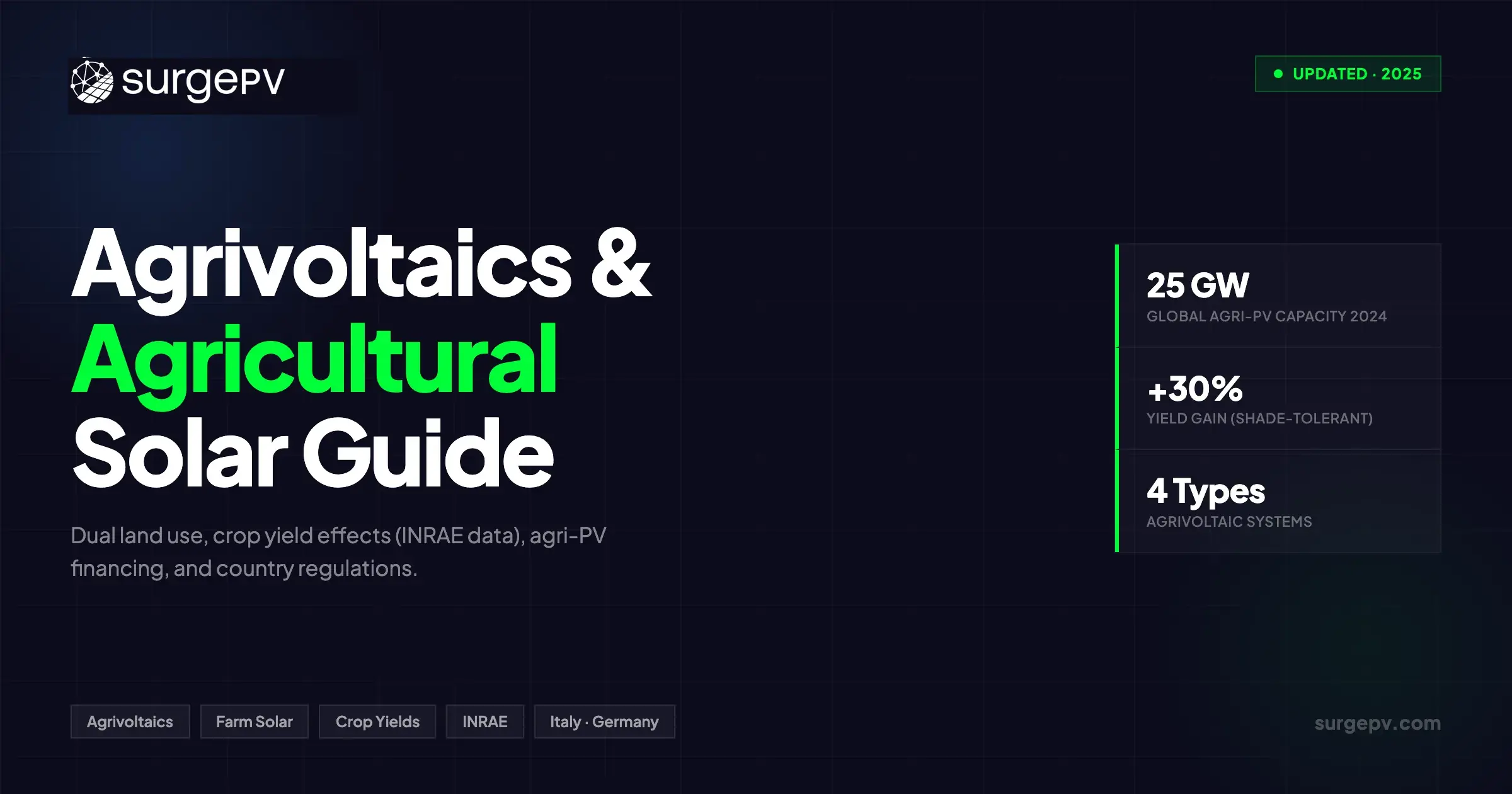
Global agrivoltaic capacity grew from approximately 5 GW in 2020 to over 25 GW by the end of 2024. The growth is concentrated in Asia (Japan, South Korea, China) but Europe is accelerating rapidly. Germany has over 300 MW of agrivoltaic installations; France has passed specific legislation; the Netherlands has commercial berry and vegetable operations running at significant scale; and Italy's funded Agrisolare programme is driving uptake on farm buildings across the country.
The Land Use Argument
Agrivoltaics resolves the land use conflict that makes standard ground-mount solar politically and planning-wise difficult in most EU agricultural regions. A farmer who installs a standard ground-mount system on 5 hectares has effectively taken that land out of food production for 25 years. A farmer who installs an elevated agrivoltaic system on 5 hectares maintains full agricultural use while generating substantial electricity - changing the planning and community reception of the project entirely.
Types of Agrivoltaic Systems
Four main agrivoltaic system types are in commercial operation. Each suits different crops, topographies, and farming operations.
| System Type | Best Crops | Crop Yield Impact | Extra Cost vs Standard Ground-Mount |
|---|---|---|---|
| Elevated fixed | Vegetables, herbs, soft fruit (strawberries, raspberries) | 0% to +30% (shade benefit for sensitive crops) | +25–50% |
| Tracking agrivoltaics | Arable crops, vegetables, lavender | +5% to +20% | +40–70% |
| Vertical bifacial | Grass, viticulture, arable (wheat, barley) | -5% to +15% | +20–40% |
| Strip agrivoltaics | Arable, sunflowers, soy | -10% to +5% | +10–20% |
Elevated Fixed Systems
The most widely deployed agrivoltaic configuration in Europe. Panels are mounted on elevated structures at 3–5 metres height, allowing standard farming equipment to operate underneath. Panel inter-row spacing is wider than standard ground-mount to allow light transmission to the crops below. The elevated structure significantly increases steel and foundation costs - hence the 25–50% premium over standard ground-mount - but enables the most versatile range of crops.
Vertical Bifacial (East-West) Systems
Panels mounted vertically in an east-west orientation, generating electricity from both faces - east-facing panels generate in the morning; west-facing in the afternoon. Crops grow in the rows between the vertical panels, receiving full midday sun. This configuration is gaining traction in viticulture (vineyards) and for arable crops where the midday sun period is the highest-value generation window. Initial installations in German wine regions have shown positive results for vine water retention.
Tracking Agrivoltaics
Single-axis trackers adjust panel angle throughout the day to optimise generation while simultaneously adjusting shading levels for the crops underneath. Advanced systems integrate crop management and solar optimisation algorithms - shading the crop during peak heat stress periods (11am–3pm in summer) while tilting for maximum generation in cooler morning and evening hours. Higher complexity and cost, but the highest potential for both solar generation and crop yield optimisation.
How Solar Panels Affect Crop Yields
The research evidence on agrivoltaic crop yield impacts is now substantial. The overall conclusion: for shade-tolerant and heat-sensitive crops, well-designed agrivoltaic systems improve yields. For shade-intolerant crops, there is yield reduction proportional to the degree of shading.
Crops That Benefit
French national research institute INRAE published a multi-year study showing 20% yield increases for lettuce under elevated agrivoltaic panels, due to reduced heat stress and lower evapotranspiration. Similar results have been documented for:
- Lettuce and leafy greens: +15–30% yield in summer; better quality (less bolting) under partial shade
- Strawberries: Reduced sunscald damage; longer harvest window; +10–20% yield in hot climates
- Raspberries and blackberries: Reduced heat stress; improved berry quality; well-suited to elevated systems
- Herbs (basil, chives, parsley): Bolt later under partial shade; higher quality product for premium market
- Potatoes: Reduced water requirements; moderate yield maintained with 20–30% light transmission reduction
Crops That Tolerate Agrivoltaics
- Wheat and barley: Moderate yield reduction (5–15%) with appropriate spacing; compatible with vertical bifacial systems where inter-row spacing preserves full midday sun
- Lavender: Drought-tolerant; benefits from reduced water demand under partial shade; French installations in Provence show no meaningful yield reduction
- Grass for silage/hay: Generally tolerant of partial shading; heavily deployed in agrivoltaic pasture systems in France and Germany
Crops Poorly Suited
Corn (maize), sunflowers, and rapeseed require high direct solar radiation throughout the growing season. Any meaningful shading reduces their yields significantly. These crops are better suited to standard ground-mount solar on separate land or farm building rooftop solar.
The Water Retention Effect
One consistent finding across agrivoltaic research is reduced evapotranspiration beneath the panels. The Fraunhofer Institute's measurements at the first commercial agrivoltaic installation in Germany (Heggelbach, Baden-Württemberg) found that irrigation requirements under the panels were 15–30% lower than in adjacent non-covered areas. In water-stressed agricultural regions - southern Spain, Portugal, parts of southern Italy - this can be as financially significant as the electricity generation itself.
Farm Building Rooftop Solar
For most farms, the simplest solar entry point is rooftop solar on existing agricultural buildings. Barns, grain stores, polytunnels, dairy units, and machinery sheds typically have large, unobstructed roof areas - often with less structural complexity than industrial buildings because they're lighter-duty structures. Farm rooftop solar follows the same principles as commercial rooftop solar, with some farm-specific considerations.
Building Types and Solar Suitability
- Dutch barns (open-sided steel frame): Very common on UK and European farms. Steel portal frame with profile steel roof - excellent for solar mounting, no penetration required with correct clamps. Check purlin spacing and structural capacity.
- Brick/concrete farm buildings: Older farm buildings may require structural assessment before solar. Concrete roof slabs can bear the load but waterproofing penetrations require specialist treatment.
- Polytunnels: Solar panels integrated into polytunnel frames are an emerging technology but not yet mainstream. Standard polytunnel structures cannot support conventional solar panels; purpose-built solar polytunnel systems are available at premium cost.
- Dairy units: High electricity load (refrigeration, milking equipment) running 24/7 - excellent self-consumption candidate. Check roof orientation and any asbestos cement legacy roofing.
Sizing for Farm Energy Profiles
Farm electricity consumption profiles vary significantly by enterprise type:
- Dairy farms: 24/7 operation with refrigeration, milking parlour, and water heating. Self-consumption ratios of 70–85% are achievable. Annual consumption: 50,000–200,000 kWh depending on herd size.
- Poultry farms: Continuous ventilation, heating, and lighting. Very high self-consumption potential. Annual consumption: 100,000–500,000 kWh for large broiler units.
- Arable farms: Highly seasonal - peak electricity use during grain drying in autumn. Solar generation peaks in summer. Self-consumption mismatch is the key challenge; battery storage or export tariff needed to capture summer generation.
- Mixed farms: Balance of continuous and seasonal loads; design around the continuous base load for highest self-consumption.
Example: 200 kW Livestock Barn in Bavaria
A 200 kW rooftop system on a combined beef and dairy operation. The farm runs refrigeration and milking equipment 24/7 with additional heating and ventilation loads. System generation: 200,000 kWh/year. Self-consumption: 78%. Annual savings: €35,000 at €0.225/kWh. Export income: €1,900/year. System cost: €195,000. Payback: 5.4 years. For precise sizing and financial modelling, see Chapter 2: System Sizing.
Planning and Land Classification Issues
Planning for agricultural solar - particularly ground-mount and agrivoltaic systems - is the most variable and jurisdiction-dependent aspect of the entire sector. Understanding the national framework before starting design work is essential.
Country-by-Country Planning Framework
| Country | Ground-Mount on Agricultural Land | Agrivoltaics | Farm Building Rooftop |
|---|---|---|---|
| Germany | Permitted on marginal land; restricted on premium farmland | Increasingly permitted; no dedicated national regulation but Bundesland rules apply | Generally permitted; simpler for existing buildings in agricultural zones |
| France | Restricted; strong protection of agricultural land | Specifically regulated (Decree 2024-318): must prove maintained agricultural productivity | Permitted; specific feed-in tariff for farm solar under 100 kW |
| Italy | Complex; varies by region; Agrisolare targets buildings, not land | "Agrisolare" programme funds building solar; separate regulations for land-based agrivoltaics | Streamlined via Agrisolare programme; significant government support |
| Spain | Varies by autonomous community; can be highly restrictive | No unified national framework; some autonomous communities permitting | Permitted; net metering under Real Decreto 244/2019 |
| UK | Restricted on Grade 1 and 2 land; Grade 3 permitted with conditions | No specific agrivoltaic regulation; assessed under general planning policy | Often permitted development for existing buildings; check local conditions |
France's Agrivoltaic Decree (2024-318)
France was the first major European country to create specific legislation for agrivoltaics. Decree 2024-318, which came into force in April 2024, defines agrivoltaics in law and sets conditions under which agrivoltaic projects can receive planning approval and access specific feed-in tariff support. Key requirements: agricultural production must remain the primary use of the land; maximum panel cover is defined per application; and the applicant must demonstrate that the solar installation does not degrade agricultural productivity beyond defined thresholds. Projects that meet the criteria can access the specific agrivoltaic feed-in tariff, currently competitive for systems under 100 kW.
UK Agricultural Land Classification
The UK's Agricultural Land Classification (ALC) grades land from Grade 1 (best quality, capable of growing the widest range of crops) to Grade 5 (very poor quality). National planning policy strongly discourages solar development on Grade 1 and Grade 2 land. Grade 3 land (the largest category in England) is permitted for solar subject to planning conditions. Most commercially viable farm solar in England and Wales is therefore on Grade 3 or lower land, or on farm buildings (where land classification is irrelevant).
Design Commercial Solar Projects in SurgePV
System sizing, shading analysis, financial modeling, and professional proposals - built for commercial EPCs.
Book a Free DemoNo commitment required · 20 minutes · Live commercial project walkthrough
Agricultural Solar Incentives
Agricultural solar benefits from general commercial solar incentives (feed-in tariffs, net metering, export guarantees) plus in some countries from agriculture-specific programs that provide grants or preferential financing specifically for farm energy projects.
Agricultural solar incentive availability by country (2024)
Italy's Agrisolare programme is the most generous agricultural solar incentive in Europe. All countries offer some export payment mechanism.
Italy: Agrisolare Programme
The Italian government's Agrisolare programme allocated €1.5 billion under the National Recovery and Resilience Plan (PNRR) for solar installations specifically on agricultural buildings. The programme provides grants covering 40–80% of installation costs for farms installing solar on barns, greenhouses, and other agricultural buildings. Priority is given to livestock farms, which receive the highest grant rates. Applications are managed through AGEA (Agenzia per le Erogazioni in Agricoltura). The 2022–2025 allocation period has seen very high demand, with several rounds oversubscribed.
Germany: KfW Agricultural Energy Programs
KfW's 270 Renewable Energies Standard program is accessible to agricultural businesses for farm solar installations. Loans up to €50 million at below-market rates, with repayment terms of up to 20 years. The Einspeisevergütung (feed-in tariff) for excess generation up to 400 kW applies to farm solar in the same way as any commercial installation - approximately €0.079/kWh for the 40–400 kW tier in 2024.
France: Agrivoltaic Feed-in Tariff
France has a specific feed-in tariff for agrivoltaic projects below 100 kW, introduced alongside the 2024 agrivoltaics decree. Projects meeting the dual-use criteria (agricultural productivity maintained per Decree 2024-318) access a guaranteed rate for electricity fed into the grid. The tariff rate is competitive for small farm agrivoltaic installations, providing revenue certainty over a 20-year contract period.
UK: Smart Export Guarantee
UK farms can access the Smart Export Guarantee (SEG) for all electricity exported to the grid, at rates set by licensed SEG suppliers (currently 3–20p/kWh depending on supplier and tariff). No agricultural-specific subsidy exists for new installations. Farm solar in the UK relies on self-consumption savings and SEG export income, supported by standard commercial financing. For farms in Scotland, the Energy Saving Trust Scotland provides specific advisory support and limited grant funding for farm energy projects.
EU Common Agricultural Policy (CAP)
The EU CAP 2023–2027 framework allows member states to include agrivoltaics and farm energy diversification within their Rural Development Programme spending. In practice, access to CAP support for agrivoltaics varies by member state and depends on how each national CAP plan has been structured. Italy (via Agrisolare/PNRR), France, and the Netherlands have been most active in channelling agricultural funding toward solar.
Agricultural Solar ROI
Agricultural solar ROI varies by system type. Farm building rooftop solar delivers economics similar to commercial rooftop solar - payback of 6–9 years with relatively low complexity. Agrivoltaic systems carry higher installation costs but generate dual revenue streams: electricity and maintained agricultural productivity (plus reduced irrigation costs in some configurations).
Farm Rooftop Solar: Typical Payback Range
For EU farms with existing agricultural buildings in good structural condition, rooftop solar paybacks of 6–9 years are typical. The key variable is self-consumption: a dairy farm with 24/7 refrigeration load achieves a 6–7 year payback; an arable farm with seasonal use may see 9–12 years without battery storage or significant export tariff income.
Agrivoltaic ROI: Dutch Strawberry Grower Case Study
A 150 kW elevated agrivoltaic system on a soft fruit growing operation in the Netherlands. The system covers 1.2 hectares of strawberry crop at 3.5 metres elevation with 35% light transmission to the crop.
- System investment: €210,000
- Annual solar generation: 128,000 kWh
- Self-consumed electricity: 74,000 kWh/year (58% self-consumption)
- Annual electricity savings: €18,000 at €0.243/kWh
- Reduced irrigation cost: €4,000/year (28% reduction in water use)
- Export income (SDE++ supported): €2,500/year
- Total annual financial benefit: €24,500
- Simple payback: 8.6 years
- 25-year NPV: €291,000
Note: this case excludes the value of maintained crop productivity. If standard ground-mount solar had been used instead, the 1.2 ha would have been taken out of strawberry production - forgoing crop revenue of approximately €40,000–€60,000/year. The agrivoltaic system effectively generates electricity while preserving a revenue stream that dwarfs the solar savings.
Revenue Stacking in Agricultural Solar
The full financial picture for agricultural solar includes multiple revenue streams:
- Electricity bill savings (self-consumed generation)
- Export tariff / SEG / feed-in tariff income
- Reduced irrigation costs (agrivoltaics)
- Maintained crop revenue (agrivoltaics vs. land-take)
- Grant income (Italy Agrisolare, French CAP grants)
- Carbon credit income (increasingly accessible for EU farm operators)
Designing an Agrivoltaic System
Agrivoltaic design is more complex than standard commercial rooftop or ground-mount solar. The design must optimise for both electricity generation and agricultural productivity - these objectives are partially in tension, and the right balance depends on the specific crop and farming operation.
Key Design Parameters
- Panel height: Standard agricultural equipment (tractors, harvesters) typically requires 3.5–4.5 metres clearance. Height also affects light distribution - higher panels create less pronounced shade bands and more even light distribution at crop level.
- Inter-row spacing: Wider spacing reduces light interception but allows better light distribution. Most commercial agrivoltaic installations target 30–50% light transmission to the crop, achieved through a combination of panel tilt, height, and inter-row spacing.
- Tilt angle: Lower tilt (10–15°) reduces shading and is appropriate for shade-tolerant crops. Higher tilt (30–35°) maximises solar generation but creates more pronounced shade bands - better for crops with lower shading sensitivity.
- Tracking vs fixed: Tracking systems can optimise the tilt in real time - shading the crop during peak heat (beneficial for heat-sensitive crops) while maximising generation during cooler periods. Fixed systems are simpler and cheaper but less flexible.
Light Transmission Targets by Crop
| Crop | Minimum Light Transmission | Optimal System |
|---|---|---|
| Lettuce / spinach | 30% | Elevated fixed, high tilt |
| Strawberries | 40% | Elevated fixed or tracking |
| Wheat / barley | 60% | Vertical bifacial or wide-spaced elevated |
| Grass (pasture) | 50% | Elevated fixed, moderate spacing |
| Lavender | 50% | Elevated fixed or tracking |
| Viticulture (vines) | 55% | Vertical bifacial - east-west rows |
Structural and Foundation Requirements
Elevated agrivoltaic systems require substantially stronger foundations than standard ground-mount solar. The increased height creates significantly higher wind moment loads at the foundation. Screw pile or concrete pad foundations must be engineered for the specific wind zone and soil conditions. Agricultural soil - particularly in cultivated fields - may have reduced bearing capacity due to cultivation and organic content, requiring deeper or wider foundations than a standard ground-mount structural calculation would specify.
Soil and Drainage Considerations
Agricultural soil health is a key concern in agrivoltaic installation. Heavy plant and vehicles during installation can compact the soil. Best practice: install access roads on geotextile and stone to minimise soil compaction; specify screw pile foundations that minimise soil disturbance; and schedule installation for dry ground conditions to avoid damaging soil structure. The long-term soil health under and around agrivoltaic installations is an area of active research - evidence so far suggests minimal long-term impact with good installation practice.
For system layout and shadow analysis on agrivoltaic projects, professional solar design software that handles elevated panel arrays and models light transmission to ground level is essential. SurgePV's design tools handle both standard commercial solar and the more complex geometry of elevated agrivoltaic systems.
Frequently Asked Questions
What is agrivoltaics and how does it work?
Agrivoltaics (also called agri-PV) is the simultaneous use of land for both solar power generation and agriculture. Solar panels are installed at a height of 3–5 metres above ground level - or as vertical bifacial panels - allowing farming to continue underneath or between the arrays. Well-designed agrivoltaic systems can maintain or improve crop yields for shade-tolerant species while generating significant solar electricity. Global agrivoltaic capacity grew from 5 GW in 2020 to over 25 GW by 2024, with Europe accelerating rapidly.
Does solar harm crop yields?
It depends on the crop. Shade-tolerant crops - lettuce, spinach, strawberries, herbs, and some root vegetables - can see yield increases of 10–30% under well-designed agrivoltaic panels, because partial shading reduces heat stress and water loss. Shade-intolerant crops such as corn, sunflowers, and most cereals are less suitable. INRAE's research in France documented 20% lettuce yield increases under elevated agrivoltaic panels. The key is matching system design to the specific crop's light requirements.
Is agricultural land eligible for solar panels in Europe?
Agricultural land eligibility varies significantly by country. In Germany, premium agricultural land is protected but solar is permitted on marginal land, and agrivoltaics on better land where dual use is demonstrated. France regulates agrivoltaics via Decree 2024-318, requiring proof of maintained agricultural use. Italy's Agrisolare programme actively funds solar on farm buildings. The UK restricts solar on Grade 1 and Grade 2 land; Grade 3 and below is permitted with planning conditions. All countries permit solar on agricultural buildings without the agricultural land classification concern.
How much does an agrivoltaic system cost?
Agrivoltaic systems cost 25–50% more per kWp than standard ground-mount, due to the elevated mounting structure. A typical elevated agrivoltaic installation in Europe costs €1,200–€1,800/kWp, compared to €900–€1,150/kWp for standard ground-mount. The additional cost must be weighed against dual-use benefits: maintained agricultural productivity, potentially easier planning approval, and access to agricultural incentive programs such as Italy's Agrisolare grant or France's agrivoltaic feed-in tariff.
Can I get funding for solar panels on my farm?
Yes, in several European countries. Italy's Agrisolare programme allocated €1.5 billion for solar on agricultural buildings, with grants covering 40–80% of costs. France offers a specific feed-in tariff for agrivoltaic projects under 100 kW. Germany provides KfW 270 loans at below-market rates for farm energy projects. The UK's Smart Export Guarantee pays for exported electricity. The EU CAP 2023–2027 allows member states to include agrivoltaics as eligible for rural development investment grants - access varies by country.
About the Contributors

CEO & Co-Founder · SurgePV
Keyur Rakholiya is identified by SurgePV as its CEO and a company co-founder. His SurgePV author page lists only role information that can be tied to the public profile below; credentials, project totals, testing claims, media appearances, and speaking engagements are not asserted without retained evidence.
