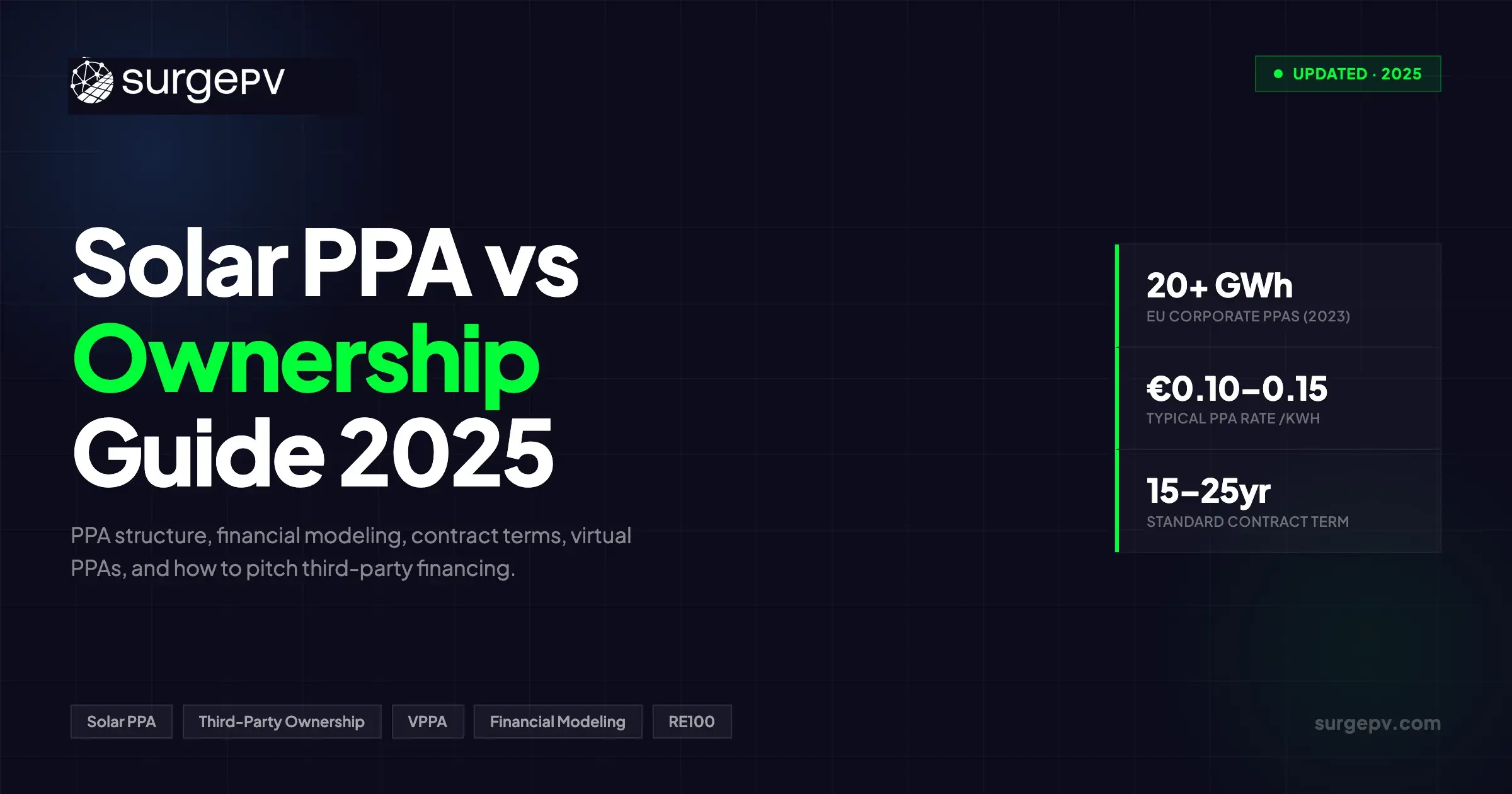
The decision between a Power Purchase Agreement and outright ownership is the most consequential financing choice in commercial solar. Both deliver solar electricity. The PPA requires no capital and minimal risk from the customer's side. Ownership captures the full economic value of the system - but demands capital, balance sheet capacity, and a long-term view. Get the choice wrong in either direction, and the business either misses substantial value or takes on contractual obligations it isn't suited to carry.
This chapter covers the PPA structure in full: how rates are set, how contracts are built, how to model the financials against ownership and lease alternatives, who should use them, and how to pitch them as a solar installer or developer. It also covers virtual PPAs, the European corporate PPA market, and the risk factors every commercial buyer should understand before signing.
What you'll learn in this chapter
- How a solar PPA works - structure, cash flows, and contract life
- PPA vs ownership vs lease - side-by-side comparison across 10 dimensions
- Who should use a PPA - ideal customer profiles and disqualifiers
- PPA financial mechanics - how to model 20-year savings with a real example
- How PPA rates are set and what IRR targets developers use
- ITC and tax credit transfer under the US Inflation Reduction Act
- Key contract terms - what to negotiate and what to watch out for
- Onsite vs virtual PPAs (VPPAs) - how each works and the risks of each
- Risk matrix and mitigation strategies
- How to pitch a PPA to a commercial client
- European corporate PPA market data and active markets
What Is a Solar PPA?
A Power Purchase Agreement (PPA) is a long-term electricity supply contract between a solar system developer and an end customer. The developer - not the customer - finances, installs, owns, and operates the solar system on or near the customer's premises. The customer agrees to purchase some or all of the electricity generated by that system at a pre-agreed rate per kilowatt-hour for the duration of the contract, typically 15–25 years.
The PPA rate is set at a discount to the customer's prevailing grid electricity tariff - usually 10–30% below. The rate may be fixed for the entire contract term, or it may escalate annually by 1–3% (the "escalator"), or it may be indexed to an inflation measure such as CPI or the wholesale electricity price index. The customer pays only for electricity actually generated: if the system underperforms due to weather or equipment failure, the payment falls accordingly.
The Basic Cash Flow Structure
The customer has two electricity sources: the solar PPA system (behind the meter) and the grid (for shortfalls when solar generation is insufficient). The PPA payments go to the developer. Grid payments go to the utility. In a well-designed behind-the-meter PPA, the solar system covers 30–70% of the customer's total load, and the blended average cost per kWh across both sources is materially below what the customer paid before.
The developer, for its part, has invested capital in the system and recovers that capital through the PPA payments over the contract life. The margin above cost recovery - funded partly by the below-retail PPA rate and partly by tax incentives the developer captures - is the developer's return. On a typical commercial PPA, developer IRRs run 6–12% depending on system size, location, and tax equity structure.
Typical PPA Contract Parameters
| Parameter | Typical Range | Notes |
|---|---|---|
| Contract term | 15–25 years | 20 years most common for commercial rooftop |
| PPA rate discount to grid | 10–30% | Larger systems / better irradiance = larger discount |
| Annual escalator | 0–3% | Flat rate is increasingly common in post-2022 contracts |
| Minimum system size | 100–250 kW | Most providers prefer 250 kW+ |
| Buyout option | Year 5–10 earliest | At fair market value or scheduled fixed price |
| Performance guarantee | P90 output guarantee | Developer liable if output falls below guaranteed level |
| End-of-term options | Purchase / renew / remove | Removal at developer's cost in most contracts |
PPA vs Ownership vs Lease: Full Comparison
The three main commercial solar structures differ across 10 dimensions that matter to a commercial buyer. Understanding all ten is necessary before recommending or selecting a structure.
| Dimension | PPA | Outright Ownership | Solar Lease |
|---|---|---|---|
| Upfront CapEx | None | Full system cost | None or nominal deposit |
| Who owns the system | Developer / third party | Customer | Leasing company / third party |
| O&M responsibility | Developer | Customer | Typically the leasing company |
| Tax credit ownership (ITC/IRA) | Developer | Customer | Leasing company |
| Depreciation benefit | Developer | Customer | Leasing company |
| Balance sheet treatment | IFRS 16 right-of-use asset + liability | Asset + depreciation | IFRS 16 operating lease |
| Output risk | Developer (customer pays per kWh generated) | Customer | Customer (fixed monthly payment) |
| Buyout option | Yes - typically after year 5–10 | N/A - already owned | Yes - at end of lease or mid-term |
| Flexibility to modify | Low - contract restrictions | Full flexibility | Low - lease agreement restrictions |
| 25-year total cost | Highest | Lowest | Medium-high |
The core tension is between upfront capital and long-term value. Ownership delivers the best 25-year financial outcome but requires capital and puts O&M responsibility on the customer. A PPA delivers immediate savings with zero capital, but surrenders tax benefits, constrains future flexibility, and costs more in total over the contract life.
Key Difference: PPA vs Lease
The most misunderstood distinction: under a PPA, the customer pays per kWh actually generated. Under a lease, the customer pays a fixed monthly amount regardless of generation. For commercial buyers, the PPA is almost always preferable - a system that generates less due to unexpected shading or equipment degradation reduces the customer's payment proportionally rather than leaving the customer paying for output that never arrived.
Who Should Use a PPA
PPAs are not the right structure for every commercial solar customer. The ideal PPA customer has a specific combination of characteristics. Mismatching the structure to the wrong customer type causes problems down the line - either the customer exits the contract expensively, or a developer ends up with a counterparty who can't sustain payments for 20 years.
Ideal PPA Customer Profiles
- Large corporates with ESG targets (RE100 members): Companies committed to 100% renewable electricity under the RE100 initiative use PPAs as a primary procurement tool. The PPA provides a documented renewable electricity source and - if structured with Guarantees of Origin (GOOs) or RECs - satisfies Scope 2 emissions reporting requirements under GHG Protocol market-based accounting.
- Municipalities and public sector bodies: Local councils, hospitals, schools, and other public bodies often cannot make capital investments outside approved budget cycles. PPAs allow them to decarbonise without CapEx approval. Many EU member states have developed standardised public-sector PPA frameworks specifically for this market.
- Universities and research institutions: Large campus electricity consumers with stable, predictable load profiles and long institutional planning horizons. The 20-year PPA term aligns well with a university's planning horizon. Many UK and European universities have signed PPAs for 250 kW to 5 MW rooftop systems.
- Hospitality and large retail: Hotels, supermarkets, and large retail chains with consistent daytime electricity demand (HVAC, refrigeration, lighting) make excellent PPA customers. Their load profiles align well with solar generation, maximising self-consumption of PPA electricity.
- Manufacturing with stable load: Factories running 2–3 shifts with consistent daytime electricity consumption have predictable self-consumption rates that make PPA financial modelling reliable. The key qualifier is load stability - volatile production schedules create curtailment and off-take issues.
Who Should NOT Use a PPA
- Tenants without long-term leases: A PPA runs 20 years. A tenant with 5 years remaining on a building lease faces severe mismatch. If the tenant vacates, the PPA liability either transfers to the new tenant (if they agree) or triggers expensive early termination. Never sign a PPA term that extends beyond the remaining building lease without an explicit novation or termination framework.
- Businesses with volatile or seasonal load: A seasonal business that only operates 6 months per year will have high solar curtailment during off-peak months, reducing actual savings while PPA obligations remain. The financial model must reflect realistic annualised self-consumption, not peak-month projections.
- Businesses likely to relocate: If there is a credible chance of relocation within the PPA term - due to growth, lease expiry, or strategic plans - the PPA creates a liability that will need to be resolved. The cost of early termination can easily exceed the savings generated to date.
- High-tax-rate businesses that can claim full depreciation: A business paying 25%+ effective corporation tax, with the ability to claim full expensing or accelerated depreciation on a solar system, will almost always achieve a better financial outcome through ownership. The depreciation benefit alone can be worth 15–25% of the system cost in year one.
PPA Financial Mechanics
The central question in any PPA evaluation is whether the PPA rate - and its escalator - results in net savings versus the grid over the contract life, and how those savings compare to what the customer would have earned through ownership. The answer depends on four inputs: the PPA rate, the escalator, the grid rate forecast, and the system's annual generation.
Worked Example: 500 kWp Factory in Germany
A German manufacturing facility with a 500 kWp rooftop system. Current grid tariff: €0.24/kWh. PPA rate offered: €0.14/kWh (initial discount of 42%). Annual escalator: 1.5%. Annual generation: 475,000 kWh. Self-consumption rate: 85% (403,750 kWh consumed behind meter). Grid rate assumption: flat at €0.24/kWh for simplicity (in practice, model the grid tariff increasing at 2–3%/yr for a more conservative comparison).
| Year | PPA Rate (€/kWh) | Annual PPA Cost (€) | Grid Equivalent Cost (€) | Annual Saving (€) | Cumulative Saving (€) |
|---|---|---|---|---|---|
| 1 | 0.140 | 56,525 | 96,900 | 40,375 | 40,375 |
| 5 | 0.151 | 61,019 | 96,900 | 35,881 | 191,000 |
| 10 | 0.162 | 65,607 | 96,900 | 31,293 | 363,000 |
| 15 | 0.175 | 70,575 | 96,900 | 26,325 | 507,000 |
| 20 | 0.188 | 75,777 | 96,900 | 21,123 | 621,000 |
| 20-yr Total | - | 1,289,000 | 1,938,000 | - | €621,000 |
Over 20 years, the factory saves approximately €621,000 versus paying the grid, with no upfront investment. However, if the factory had purchased the system outright for approximately €450,000 (€900/kWp installed), total electricity cost over 20 years would be €450,000 (system cost) - saving €1,488,000 against the grid, a difference of €867,000 in the owner's favour.
Key Takeaway
PPAs deliver real, material savings versus grid electricity. But they deliver roughly one-third to one-half of the financial benefit that outright ownership achieves. The relevant question is not "is the PPA good?" but "does the customer have - or can they access - the capital to own instead?"
The Grid Rate Escalation Effect
The comparison above used a flat grid rate, which is conservative from the PPA's perspective. If grid electricity prices rise at 2–3% per year - which has been the long-run historical trend across most European markets - the PPA's savings advantage grows over time relative to the static model. A grid rate that rises from €0.24 to €0.38 by year 20 makes the PPA increasingly attractive versus continued grid purchasing. This is the primary argument PPA developers make when grid rate escalation assumptions are in dispute.
How PPA Rates Are Set
Understanding how developers price PPAs is essential for evaluating whether a proposed rate is competitive. The PPA rate is not arbitrary - it is set by working backwards from the developer's required return on investment.
The Developer's LCOE + Margin Model
The starting point is the Levelised Cost of Energy (LCOE) for the specific project: the total lifecycle cost of the system (capital, financing, O&M, insurance) divided by the total kWh generated over the system's life. For a well-designed commercial rooftop system in Central Europe, LCOE currently runs €0.06–€0.10/kWh depending on system size, financing cost, and location. In Southern Europe (Spain, Italy, Portugal), LCOE can be as low as €0.04–0.07/kWh due to higher irradiance.
The developer adds a margin above LCOE to hit their target IRR. Target developer IRRs for commercial PPAs typically run:
- 6–8% IRR: Utility-affiliated developers with low cost of capital and tax equity access. Can offer the most competitive PPA rates.
- 8–10% IRR: Specialist PPA providers and mid-sized independent power producers. Typical range for most commercial PPA offers.
- 10–12% IRR: Smaller developers or projects with higher complexity. Rates will be less competitive.
Tax Equity Considerations
In the US, the developer's ability to monetise the 30% ITC and MACRS depreciation materially reduces the PPA rate they need to charge. A developer who can access tax equity - an investor who takes a share of the project ownership in exchange for using the tax credits - effectively receives 30% of the project cost back at inception, dramatically reducing the capital they need to recover through PPA payments. This is why US commercial PPA rates have historically been more competitive than European equivalents: US tax incentives are more front-loaded.
Grid Rate Forecasting
Developers also build in a grid rate forecast when setting the escalator. A developer who projects grid rates rising at 3%/yr will price the escalator lower, knowing the customer's savings grow over time and the customer is unlikely to exit. A flat-rate PPA (0% escalator) is generally more favourable to the customer on a long-term NPV basis than a 3% escalator, even if the initial rate is the same - because the customer's savings erode less quickly relative to a rising grid rate.
ITC and Tax Credit Transfer Under the IRA
The US Inflation Reduction Act (2022) made significant changes to solar tax credit mechanics that directly affect the PPA market.
The 30% Investment Tax Credit
The federal ITC provides a credit equal to 30% of the cost of a qualifying solar system against the developer's federal tax liability. For a $2M commercial system, this is a $600,000 tax credit. Under the original ITC structure, the developer needed sufficient tax appetite - taxable income - to use the credit. If not, they needed a tax equity investor: a bank or corporation with large tax appetite that would invest in the project in exchange for the tax benefits.
IRA Transferability Provision
The IRA introduced transferability: a developer can now sell the ITC to a third-party buyer for cash, without that buyer needing any ownership stake in the project. This fundamentally simplified the market. A developer who cannot use the ITC directly can sell it for approximately $0.92–$0.96 per dollar of credit value (a small discount for the buyer to earn a return). The cash from the sale goes into the project, reducing the developer's effective capital cost and allowing more competitive PPA rates.
EU Equivalents
The EU does not have a direct ITC equivalent. EU support for commercial solar operates through:
- Germany: KfW subsidised loans reduce financing cost. Accelerated depreciation (50% in year one from 2023) benefits owning businesses, not PPA developers. No direct tax credit.
- Netherlands: The SDE++ subsidy (operating support) can in some structures be assigned to the PPA developer, improving the economics of the offer to the customer.
- Spain: IDAE grants and soft loans available for commercial renewable projects. Most Spanish commercial PPAs are priced without subsidy dependence given Spain's low LCOE.
- UK: No equivalent to the US ITC. UK commercial solar PPAs rely on lower-cost debt, smart export guarantee revenue, and grid tariff arbitrage rather than tax credit monetisation.
Key PPA Contract Terms
Before signing a commercial PPA, the customer's legal and financial advisers need to review 10 specific contract provisions. Each has material financial implications.
| Contract Term | What to Look For | Negotiation Priority |
|---|---|---|
| PPA rate | Initial rate as % of grid tariff. Get at least 2–3 competing quotes. | High |
| Annual escalator | Fixed %, CPI-linked, or flat. Flat-rate is most customer-favourable. | High |
| Contract term | Must not exceed remaining building lease term. 15 years preferred over 25 if rates are equivalent. | High |
| Performance guarantee | P90 annual output guarantee. What remedies exist if developer misses? Cash credit? System repair SLA? | High |
| Offtake obligation | Is the customer required to take all electricity generated? Or can excess be spilled without payment? | Medium |
| Curtailment provisions | What happens if grid constraints require curtailment? Customer should not pay for curtailed output. | Medium |
| Roof rights / easement | Developer holds a legal right to occupy the roof. What are the terms for the customer to access their own roof for maintenance? | Medium |
| Early termination clause | Termination fee structure. Is it NPV of remaining payments, or a declining schedule? Negotiate a capped, declining schedule. | High |
| Buyout option | Pre-agreed fixed price schedule is far preferable to "fair market value" - which requires costly independent appraisal and often favours the developer. | High |
| Property sale / novation | If the property is sold, does the PPA automatically transfer to the new owner? Can the developer block the transfer? Get this in writing. | Medium |
Pro Tip: Always Negotiate the Buyout Schedule
Most PPA templates include a buyout option at "fair market value" - a phrase that creates future disputes. Negotiate a specific buyout price schedule at signing: for example, €X in year 7, €Y in year 10, €Z in year 15. After 20 years of operation, a solar system may have limited residual value, and both parties benefit from certainty rather than a contested appraisal process.
Onsite vs Offsite PPAs: Physical vs Virtual
Not all PPAs involve a system installed on the customer's premises. Large corporates, in particular, use virtual or synthetic PPAs to achieve renewable energy procurement goals at scale, across geographies where they cannot install physical systems.
Physical (Behind-the-Meter) PPA
The solar system is installed on or adjacent to the customer's premises. Electricity is consumed directly behind the meter, avoiding grid transmission charges on the consumed portion. This is the most economically efficient PPA structure because the customer avoids transmission and distribution costs on every kWh consumed. The main constraints are the physical limits of the available roof or ground area and the requirement for the developer and customer to be co-located.
Virtual / Synthetic PPA (VPPA)
A Virtual PPA is a financial contract rather than a physical electricity supply arrangement. The renewable generator (typically a large solar or wind farm) sells its electricity into the wholesale market. The corporate buyer signs a VPPA contract that:
- Sets a "strike price" per kWh - the contracted price the corporate agrees to pay.
- Settles the difference between the strike price and the actual market price (the "merchant price").
- Transfers Renewable Energy Certificates (RECs in the US, Guarantees of Origin in the EU) to the corporate buyer, allowing them to claim renewable electricity on a market-based Scope 2 accounting basis.
If the market price exceeds the strike price, the developer pays the corporate the difference. If the market price falls below the strike price, the corporate pays the developer the difference. This structure hedges the developer against price risk and gives the corporate a fixed effective renewable electricity cost - but only on a financial basis. The corporate still buys its physical electricity from the grid.
VPPA Risks: Basis Risk and Settlement Risk
VPPAs carry two risks that physical PPAs do not:
- Basis risk: The settlement price in the VPPA is based on the wholesale market price at the generator's location. The corporate buyer's actual electricity cost is based on the retail tariff at its facilities, which may be in a completely different market or country. If the two prices diverge - as they frequently do - the VPPA hedge does not perform as expected. A corporate in the UK buying electricity at retail prices is not effectively hedged by a VPPA on a solar farm in Texas.
- Settlement risk: In a prolonged period of low wholesale electricity prices, the corporate must make settlement payments to the developer even as its own electricity costs fall. The net effect may be that the corporate pays more for electricity than if it had no VPPA at all. This scenario played out for several large European VPPAs in 2020 when wholesale prices collapsed.
VPPAs are most suitable for very large corporates with sophisticated energy management teams who understand the financial instrument risk - not for typical SME or mid-market commercial buyers. For most commercial solar installers, the physical behind-the-meter PPA is the relevant product.
Risk Matrix: PPA Risks and Mitigations
Every PPA involves risks on both sides of the contract. The customer's adviser should work through the following risk matrix before recommending a PPA.
| Risk | Who Bears It | Severity | Mitigation |
|---|---|---|---|
| Counterparty risk - developer default or exit | Customer | High | Check developer's financial standing; require performance bonds; ensure step-in rights for a replacement O&M provider in the contract |
| Output risk - system underperforms | Developer (in a PPA) | Medium | Performance guarantee with P90 baseline; clear remedies (credit, repair SLA) in contract |
| Grid curtailment risk - DNO restricts export | Developer | Low–Medium | Confirm grid connection terms before contract; ensure curtailment events do not trigger payment obligation |
| Interest rate risk - developer's financing cost rises | Developer (pre-committed rate) | Low (for customer) | PPA rate is locked at contract signing; customer is protected from developer refinancing risk |
| Regulatory risk - net metering or feed-in tariff rules change | Both | Medium | Include regulatory change provisions: if rules change materially, either party can trigger renegotiation or termination |
| Property sale / business exit | Customer | High | Negotiate novation rights and termination schedule upfront; never sign a PPA without knowing the exit cost |
| Grid rate falling significantly | Customer | Medium | If grid rates fall, PPA savings shrink or disappear - unlikely long-term but possible short-term. Consider shorter terms (15 years) to reduce exposure. |
How to Pitch a Solar PPA to Commercial Clients
For solar installers and developers, the PPA is the hardest commercial product to sell - not because the economics are weak, but because it requires the customer to sign a 15–25 year commitment with a company they may have met three months ago. The pitch must address this directly rather than glossing over it.
Target Customers First
Qualify before pitching. The three questions that determine PPA suitability are: (1) How long is your remaining building lease or ownership tenure? (2) Do you have capital available that could instead purchase the system outright? (3) Is your electricity load relatively stable and predictable year-round? If a prospective customer has a 5-year lease, €500K in the bank, and a seasonal operation, a PPA is wrong for them regardless of how attractive the rate looks.
Who to Talk To
The decision maker on a commercial PPA is typically the CFO, Finance Director, or Head of Procurement - not the sustainability manager or facilities team. The sustainability manager may champion the project, but the CFO will scrutinise the contract terms. Prepare for financial, legal, and credit questions from the outset. Showing up with a deck that only covers environmental benefits will stall at the first commercial review.
ROI Framing That Works
Frame the PPA as an electricity tariff decision, not a finance decision. The customer is not "signing a 20-year agreement" - they are "locking in an electricity rate of €0.14/kWh when the grid charges €0.24/kWh, with the rate rising no more than 1.5% per year." Show the 20-year savings table. Show what their grid tariff would need to fall to for the PPA to become uneconomic. (The answer is usually "less than half of current rates, sustained for 20 years" - which gives the customer confidence that the downside scenario is remote.)
Handling Objections
| Objection | Response |
|---|---|
| "We don't like long commitments." | Acknowledge it directly. Then show the buyout option schedule - they can exit in year 7 for €X. The commitment is bounded. And they have signed longer commitments for their building lease, fleet contracts, and ERP system. |
| "What if you go out of business?" | Show the performance bond and step-in right provisions. The system keeps running regardless - it is a physical asset on their roof, not a subscription to a software service. Even if the developer enters administration, a replacement O&M provider can be appointed. |
| "We might move in the next 10 years." | This is a legitimate concern. Address it: either shorten the term to 10–12 years, or show the novation clause that allows them to transfer the contract to their property buyer or future tenant. |
| "Can we just buy it instead?" | Yes - and show them the ownership comparison. If they have the capital and tax position to benefit from ownership, recommend it. Offering the right product for the customer builds long-term relationships. A forced PPA with the wrong customer will fail. |
| "Our board won't approve the balance sheet impact." | Walk through the IFRS 16 treatment with their auditor's guidance. Clarify whether their board is objecting to the right-of-use asset or the liability. Ownership also impacts the balance sheet - the difference is presentation, not economic reality. |
Due Diligence Package
A professional PPA proposal includes the following before asking for a decision: (1) site-specific generation model with monthly and annual output, (2) 20-year savings projection with grid rate sensitivity analysis, (3) PPA contract summary (not the full 60-page agreement - a 2-page commercial term sheet), (4) developer financial information and track record, and (5) references from existing PPA customers. SurgePV's solar proposal software generates professional, branded proposals that include generation models and financial projections - covering exactly the material a commercial client needs to make this decision.
Model PPA vs Ownership in Minutes
SurgePV's financial tool calculates 20-year savings for PPA, cash purchase, and loan scenarios side-by-side. Show commercial clients the full picture in a professional proposal.
Book a Free DemoNo commitment required · 20 minutes · Live project walkthrough
European Corporate PPA Market
The European corporate PPA market has grown from a niche product into a mainstream renewable procurement mechanism. BNEF data shows that more than 20 GWh of corporate renewable PPAs were signed across Europe in 2023, up from under 5 GWh in 2019. The growth is driven by corporate net-zero commitments, volatile post-2022 electricity prices, and the regulatory tailwinds of the EU Green Deal and REPowerEU initiative.
Most Active Markets
| Country | Market Maturity | Key Characteristics |
|---|---|---|
| Spain | Most mature | Lowest LCOE in Europe (high irradiance), large pipeline of corporate solar PPAs, highly competitive PPA rates (€0.04–0.07/kWh on large utility-scale). Many international corporates using Spain to offset Scope 2 emissions via VPPAs. |
| UK | Mature | Strong corporate PPA market for wind and solar. Multiple specialist brokers (Fieldglass, Limejump). Corporate PPAs for behind-the-meter commercial rooftop well established; virtual PPAs for larger corporates also active. |
| Germany | Growing | Grid connection queues have historically slowed PPA growth; regulatory simplifications in 2023 are accelerating the market. Strong demand from RE100-committed industrial companies (chemicals, automotive, manufacturing). |
| Netherlands | Growing | High corporate energy costs post-2022 crisis drove strong PPA interest. SDE++ subsidy framework creates stable revenue, improving PPA bankability. Several large Dutch multinationals (Shell, ASML, Philips) have signed corporate PPAs. |
| Nordics | Most mature for wind PPAs | Long history of corporate wind PPAs; solar PPAs growing in Sweden and Denmark. Low electricity prices historically but corporate RE procurement driven by ESG commitments. |
| Italy | Emerging | Regulatory environment improving; Agrisolar and rooftop commercial PPA market growing. Grid connection backlogs remain a constraint. Strong irradiance makes LCOE competitive. |
RE100 as a Market Driver
RE100 is a global corporate renewable energy initiative with over 400 member companies committed to 100% renewable electricity. RE100 members include major European manufacturers, retailers, and financial institutions. PPA procurement - particularly VPPAs and large-scale physical PPAs - is the primary mechanism through which RE100 members achieve their targets. For solar installers targeting large commercial customers, knowing which prospects are RE100 members (or aspiring to be) is a strong indicator of PPA readiness.
PPA vs Green Electricity Tariff
A question commercial buyers frequently ask: "Why sign a 20-year PPA when we can just switch to a green electricity tariff from our supplier?" It is a fair question, and the answer matters for how PPAs are sold.
| Solar PPA (Physical) | Green Electricity Tariff | |
|---|---|---|
| Price certainty | High - locked rate for 15–25 years | Low - tariff rate changes annually or at contract renewal (typically 1–2 years) |
| Price vs grid | Below grid (10–30% discount) | At or above grid (green premium typically 5–10% above standard tariff) |
| Additionality | High - new generation built specifically for this contract | Variable - green tariffs may use existing renewable generation credits, not new capacity |
| Scope 2 accounting | Market-based (with GOOs/RECs) | Market-based (with GOOs/RECs) |
| SBTi / RE100 acceptability | Yes, with additionality evidence | Depends - some green tariffs accepted, others not |
| Commitment required | 15–25 years | 1–3 years typically |
| Suitable for | Long-term building tenancy, stable load, ESG credibility requirements | Short lease, need for flexibility, smaller businesses without PPA minimum size |
The critical difference is price certainty and additionality. A green tariff customer is still exposed to wholesale electricity market volatility when the tariff renews. A PPA customer has locked in their rate for 15–25 years, providing genuine long-term budget certainty. For businesses with Science-Based Targets (SBTi) that require demonstrable additionality in renewable procurement, a physical PPA on newly installed solar is a stronger claim than buying RECs on existing generation.
Frequently Asked Questions
What is a solar PPA and how does it work?
A solar Power Purchase Agreement (PPA) is a contract in which a third-party developer installs, owns, and operates a solar system on the customer's premises. The customer purchases the electricity generated at a fixed or escalating rate per kWh - typically 10–30% below the prevailing grid tariff - for a contracted term of 15–25 years. The developer recovers its capital through the electricity payments and earns a return over the contract life. The customer benefits from day-one savings with zero upfront investment. At end of term, the customer can purchase the system, extend the contract, or have it removed.
What is the difference between a solar PPA and a solar lease?
Under a solar PPA, the customer pays per kWh of electricity actually generated by the system. Under a solar lease, the customer pays a fixed monthly or annual fee to use the system regardless of how much electricity it produces. A PPA transfers output risk to the developer - if the system underperforms, the customer pays less. A lease transfers output risk to the customer - the monthly payment is fixed whether the system generates 100% or 60% of projected output. For commercial customers, PPAs are generally preferred because payment tracks actual benefit received.
Who owns the solar tax credits under a PPA?
Under a PPA, the developer - not the customer - owns the solar system and therefore claims all tax benefits, including the US federal Investment Tax Credit (30% ITC) and MACRS accelerated depreciation. The developer's ability to monetise these tax benefits is a key reason PPAs can offer below-market electricity rates. Under the Inflation Reduction Act (2022), ITC credits are also transferable - developers can sell the tax credit to a third-party investor rather than requiring a traditional tax equity partner. In the EU, tax incentive treatment varies by country and project structure.
What is a virtual PPA (VPPA) and how does it differ from a physical PPA?
A physical PPA involves a solar system installed on the customer's premises, with electricity delivered directly behind the meter. A virtual PPA (VPPA) is a financial contract where the renewable generator and the corporate buyer are at different locations. The generator sells electricity to the grid at wholesale prices; the corporate buyer receives Renewable Energy Certificates and a financial settlement based on the difference between the contracted strike price and the actual wholesale price. VPPAs allow corporates to claim renewable energy procurement without a physical installation, but introduce basis risk - when the settlement price diverges from the buyer's actual electricity cost - and settlement risk in periods of low wholesale prices.
What happens at the end of a solar PPA contract?
At end of term, the customer typically has three options: (1) purchase the system at fair market value, which after 20–25 years is often very low given panel age; (2) renew the PPA at a new rate; or (3) request removal at no cost to the customer (the developer's obligation under most contracts). Customers should negotiate a pre-agreed buyout price schedule at signing - for example, a schedule of fixed purchase prices at years 10, 15, and 20 - rather than relying on a future fair market value assessment, which creates unnecessary disputes and cost.
What's Next
You've completed Chapter 7 of the Commercial Solar Guide. Next, explore industrial-scale solar or continue to the remaining chapters.
Continue the Guide
- Chapter 8: Industrial & Factory Solar - large-scale rooftop and ground-mount for industry
- Chapter 9: Agricultural Solar & Agrivoltaics - dual land use and agri-PV structures
- Chapter 10: Monitoring & SCADA - performance monitoring and fault detection
- Chapter 11: Tax Incentives & Subsidies - country-by-country incentive breakdown
Related Hub Guides
If you're ready to go deeper on specific topics, these other SurgePV hub guides cover adjacent areas in detail:
- Solar Business Hub - running a solar installation or development business
- Solar Technology Hub - panels, inverters, batteries, and system components
- Solar Careers Hub - jobs and career paths in the solar industry
To apply what you've learned: use SurgePV's generation and financial tool to model a real commercial solar project, then generate a client proposal with the solar proposal software. The combination of accurate site-specific generation data and professional financial modelling is what converts commercial prospects into signed contracts.
About the Contributors

CEO & Co-Founder · SurgePV
Keyur Rakholiya is identified by SurgePV as its CEO and a company co-founder. His SurgePV author page lists only role information that can be tied to the public profile below; credentials, project totals, testing claims, media appearances, and speaking engagements are not asserted without retained evidence.
