

Five Chinese manufacturers control 58% of global solar module shipments. Four of them lost $1.54 billion in the first half of 2025. One American thin-film producer — First Solar — earned more net income than all four Chinese giants combined, on one-third the shipment volume.
The top solar companies by revenue in 2026 are JinkoSolar ($12B), LONGi ($10B), and Trina Solar ($8B) in module manufacturing. Largest EPCs include Sterling & Wilson and POWERCHINA. Utility-scale developers leading include NextEra Energy and TotalEnergies.
The top solar companies by revenue in 2026 are JinkoSolar ($12B), LONGi ($10B), and Trina Solar ($8B) in module manufacturing. Largest EPCs include Sterling & Wilson and POWERCHINA. Utility-scale developers leading include NextEra Energy and TotalEnergies. The global solar market exceeded $250 billion in 2025.
This is the paradox of the 2026 solar industry. Revenue rankings do not tell the whole story. Volume leadership does not equal financial health. And the companies shipping the most modules are often the ones bleeding the most cash.
This guide ranks the top 25 solar companies by revenue across three categories: manufacturers, installers/developers, and software providers. Every figure comes from audited financial statements, SEC 10-K filings, or verified industry research. No invented numbers. No marketing fluff.
TL;DR — Top 25 Solar Companies by Revenue 2026
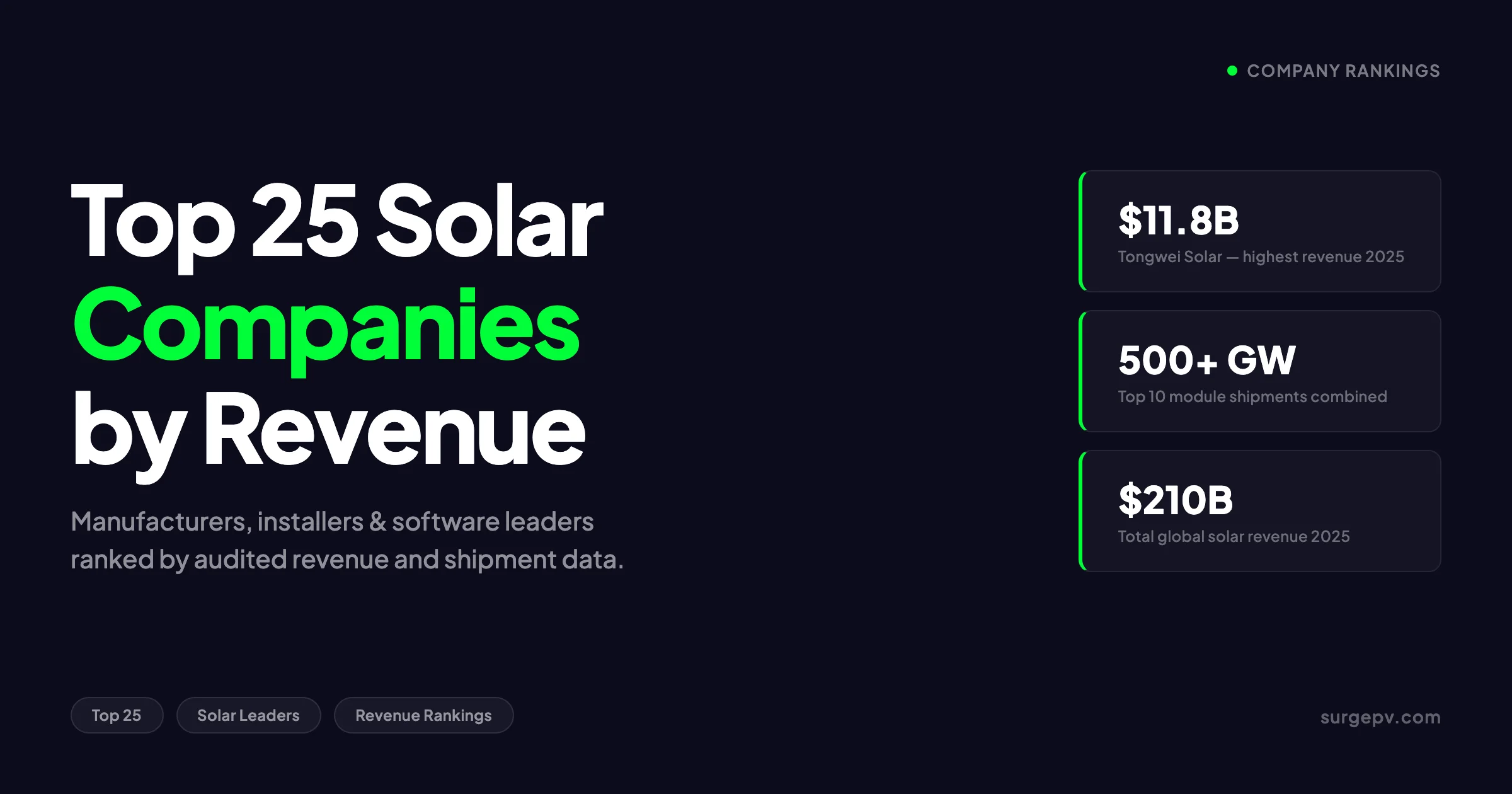
The top 5 manufacturers by revenue: Tongwei ($11.8B), LONGi ($4.6B), JinkoSolar ($4.5B), Trina Solar ($4.4B), and First Solar ($5.2B). The top US installer is Sunrun (~$2.3B). The top solar software company by valuation is Aurora Solar ($4B). Chinese manufacturers dominate shipment volume but are largely unprofitable due to oversupply. First Solar and Nextracker are the most profitable public solar companies. Total global solar industry revenue: approximately $210 billion in 2025.
For software options, see 7 Best Aurora Solar Alternatives in.
In this guide:
- How we ranked these companies — sources, fiscal years, and revenue definitions
- Top 10 solar manufacturers by revenue 2026, with shipment data and profitability
- Top 8 solar installers and developers by revenue 2026
- Top 7 solar software companies 2026
- What most rankings get wrong about “biggest” versus “best”
- Revenue concentration and market power analysis
- Movers and fallers: who gained and lost ground from 2024 to 2026
- What these rankings mean for buyers, installers, and investors
How We Ranked These Companies
Every ranking on the internet uses different rules. Some count total corporate revenue (including non-solar divisions). Some use calendar year, others fiscal year. Some include unaudited estimates, others only audited filings.
Here is our methodology:
Revenue source: We use the most recent full fiscal year available (2025 for most companies, H1 2025 annualized where full-year data is pending). All figures come from SEC 10-K filings, audited annual reports, or verified investor presentations.
Revenue scope: For diversified conglomerates (Hanwha Solutions, NextEra Energy), we note total corporate revenue and estimate the solar-specific portion where possible. For pure-play solar companies, we use total revenue.
Currency conversion: Chinese RMB figures converted at approximately 7.1 RMB/USD. All figures in US dollars unless noted.
Shipment data: Module shipment figures from InfoLink Consulting, PV Tech, and company disclosures. GW figures are DC (direct current) unless specified.
Profitability: Net income/loss figures from audited statements. We distinguish between GAAP and non-GAAP where material.
Ranking Sources and Reliability
| Source | Type | Coverage |
|---|---|---|
| SEC 10-K / 20-F filings | Audited financials | US-listed companies (FSLR, ENPH, SEDG, RUN, CSIQ, NXT) |
| Company annual reports | Audited financials | Chinese listed companies (LONGi, Jinko, JA Solar, Trina, Tongwei) |
| InfoLink Consulting | Industry research | Module shipment rankings, tier lists |
| BloombergNEF | Paid research | Bankability tiering, market forecasts |
| PV Tech / Taiyang News | Trade journalism | Quarterly earnings coverage, shipment estimates |
Pro Tip — Reading Solar Earnings Reports
When comparing Chinese and US solar companies, watch for three traps: (1) RMB/USD exchange rate moves can swing reported revenue by 5–10%, (2) “shipped” GW does not equal “recognized revenue” GW due to revenue recognition timing, and (3) inventory write-downs during price crashes can distort net income. Always check the cash flow statement, not just the income statement.
Top 10 Solar Manufacturers by Revenue 2026
The global solar manufacturing industry shipped approximately 536 GW of modules in 2025 according to InfoLink Consulting. The top 10 manufacturers accounted for over 500 GW of that total. But here is the twist: the companies shipping the most modules are often the least profitable.
Solar Manufacturer Revenue Rankings 2026
| Rank | Company | 2025 Revenue (USD) | 2025 Module Shipments | Headquarters | Net Profit/Loss |
|---|---|---|---|---|---|
| 1 | Tongwei Solar | ~$11.8B | 43.3 GW | China | -$1.36B |
| 2 | First Solar | $5.2B | 17.5 GW | USA | +$1.6B (operating) |
| 3 | LONGi Green Energy | ~$4.6B | 80–90 GW est. | China | -$720M est. |
| 4 | JinkoSolar | ~$4.5B | 85–100 GW est. | China | -$820M est. |
| 5 | Trina Solar | ~$4.4B | 70–75 GW est. | China | -$820M est. |
| 6 | JA Solar | ~$3.4B | 65–70 GW est. | China | -$730M est. |
| 7 | Canadian Solar | $5.6B | 24.3 GW | Canada/China | -$120M |
| 8 | Hanwha Qcells | ~$3.0B (solar est.) | 25–30 GW est. | South Korea | Not disclosed |
| 9 | Tongwei (polysilicon only) | ~$4.0B (of total) | N/A (upstream) | China | Included above |
| 10 | Astronergy (Chint) | ~$2.5B | 35–40 GW est. | China | Not disclosed |
Note: Chinese manufacturer full-year 2025 net losses are estimated by annualizing H1 2025 reported losses. Revenue figures for Chinese companies converted from RMB at 7.1 RMB/USD. Source: Company annual reports, PV Tech, InfoLink Consulting, SEC filings.
1. Tongwei Solar — ~$11.8 Billion
Tongwei is the anomaly of this list. It is not primarily a module manufacturer. It is a polysilicon and cell producer that happens to ship modules. And that upstream dominance is why it leads in revenue.
In 2025, Tongwei sold 384,800 tonnes of polysilicon — over 30% of global supply. It also shipped 103 GW of solar cells, making it the #1 cell producer for the ninth consecutive year. Module shipments reached 43.3 GW, placing it in the global top five.
But the company still lost $1.36 billion. Polysilicon prices collapsed in 2024–2025 due to massive overcapacity. Tongwei’s average selling price fell faster than its production cost, even with industry-leading manufacturing scale.
Key strategic note: Tongwei is vertically integrated from polysilicon to modules, which provides cost advantages but also exposes it to price crashes at every segment simultaneously.
2. First Solar — $5.2 Billion
First Solar is the most profitable major solar manufacturer on earth. It generated $5.2 billion in revenue in 2025 — up 24% year-over-year — and reported operating income of $1.6 billion. Its gross margin was 40.6%, and it guided to approximately 49.5% for 2026.
How? Three factors: proprietary CdTe thin-film technology that avoids silicon supply chains entirely, US manufacturing that qualifies for Inflation Reduction Act Section 45X tax credits ($1.6 billion recognized in 2025), and a contracted backlog of 50.1 GW valued at $15 billion.
First Solar shipped 17.5 GW in 2025 — a record, but still a fraction of JinkoSolar’s volume. It does not need to ship more. It needs to ship profitably. And it does.
Key strategic note: First Solar’s Louisiana factory commenced commercial production in 2025, becoming its fifth US facility. It also announced a 3.7 GW finishing facility in South Carolina. The company is essentially a bet on US industrial policy. See First Solar’s 2025 annual report for full financial details.
3. LONGi Green Energy — ~$4.6 Billion
LONGi reported RMB 32.8 billion in revenue for H1 2025, down 14.8% year-over-year. Full-year revenue is estimated at approximately RMB 65–70 billion (~$4.6 billion). The company posted a net loss of RMB 2.56 billion in H1 2025, an improvement from the RMB 5.23 billion loss in H1 2024.
LONGi shipped approximately 39.6 GW in H1 2025 and is targeting 80–90 GW for the full year. Its BC (back-contact) products — HPBC 2.0 and HIBC — accounted for over 20% of shipments, a differentiation strategy as TOPCon commoditizes.
Key strategic note: LONGi shed nearly 30% of its workforce in 2024, achieving what analysts call an “incredibly low-cost structure.” If shipment growth sustains, LONGi could overtake JinkoSolar as the largest shipper by volume in 2026. PV Tech covers the quarterly shipment data in detail.
4. JinkoSolar — ~$4.5 Billion
JinkoSolar has been the top-ranked module supplier by volume for eight of the last ten years. In 2025, it maintained the #1 position with approximately 85–100 GW of shipments, though revenue fell 32.6% in H1 2025 to RMB 31.8 billion due to collapsing module prices.
The company posted a net loss of RMB 2.9 billion in H1 2025, reversing a profit of RMB 1.2 billion in the same period a year earlier. Its full-year 2025 revenue is estimated at approximately RMB 60–65 billion (~$4.5 billion).
Key strategic note: JinkoSolar’s US manufacturing subsidiary, JinkoSolar (U.S.) Industries, contributes to its InfoLink ranking. The company is expanding N-type TOPCon capacity but faces the same margin pressure as every Chinese producer.
5. Trina Solar — ~$4.4 Billion
Trina Solar reported RMB 31.1 billion in revenue for H1 2025, down 27.7% year-over-year. The company posted a net loss of RMB 2.91 billion, compared to a profit of RMB 526 million in H1 2024. Full-year revenue is estimated at approximately RMB 62 billion (~$4.4 billion).
Trina shipped over 15 GW in Q1 2025 and is targeting 70–75 GW for the full year. Its geographic split is telling: slightly over 50% domestic China, slightly over 25% Europe, 11–12% Asia-Pacific, and approximately 8% Middle East. Also see: European Solar Tax Credits. For Asia-Pacific-specific compliance details, see Asia-Pacific solar compliance.
Key strategic note: Trina overtook JA Solar for the #3 shipment position in 2025, driven by stronger second-half growth. Its Tracker business (Nextracker competitor) and energy storage division provide diversification.
6. JA Solar — ~$3.4 Billion
JA Solar reported RMB 23.9 billion in revenue for H1 2025, down 36% year-on-year. The company posted a net loss of RMB 2.58 billion, widening from RMB 874 million in H1 2024. Module shipments were approximately 33.8 GW in H1, with N-type modules accounting for over 98%.
Full-year 2025 revenue is estimated at approximately RMB 48 billion (~$3.4 billion). JA Solar was the only company in the top five to see a marginal reduction in shipments year-over-year, allowing Trina to claim the #3 spot.
Key strategic note: JA Solar’s overseas module shipments accounted for approximately 45% of total in H1 2025. The company is heavily exposed to international trade policy, including US tariffs and EU anti-subsidy investigations.
7. Canadian Solar — $5.6 Billion
Canadian Solar is the outlier in this list because its $5.6 billion revenue includes significant project development and energy storage revenue, not just module sales. The company shipped 24.3 GW of modules in 2025 and 7.8 GWh of battery storage. See Adding Battery Storage Services for detailed guidance.
The module and storage manufacturing business operates under the CSI Solar subsidiary, while project development (Recurrent Energy) contributes substantial one-time revenue from project sales. This makes direct comparison with pure-play manufacturers misleading. Read more about Agricultural Solar Case Study.
Key strategic note: Canadian Solar is expanding its US manufacturing footprint, with a 5 GW module factory in Mesquite, Texas, being expanded to 10 GW by H2 2026. It is also building a heterojunction (HJT) cell factory in Jeffersonville, Indiana. Also see: Best Solar Design Software India. Read more about 5kW Solar Panel Price in India.
8. Hanwha Qcells — ~$3.0 Billion (Solar Estimated)
Hanwha Qcells is owned by Hanwha Solutions, a diversified energy and chemicals conglomerate. Hanwha Solutions’ total revenue is approximately $15 billion, but the solar division (Qcells) is estimated at $3.0 billion based on its 25–30 GW shipment volume and premium pricing in the US and European markets.
Qcells is one of the few non-Chinese brands with serious global scale and bankability. It operates manufacturing facilities in the US (Georgia), South Korea, and Malaysia, giving it supply chain flexibility that pure Chinese producers lack.
Key strategic note: Qcells benefits from its “non-Chinese” status in markets with trade barriers. Its US factory in Dalton, Georgia, is one of the largest non-Chinese module facilities globally.
9. Astronergy (Chint Group) — ~$2.5 Billion
Astronergy, a subsidiary of Chint Group, shipped approximately 35–40 GW in 2025 according to industry estimates. The company has risen rapidly through the rankings, leveraging Chint’s extensive electrical equipment distribution network in China and emerging markets.
Key strategic note: Astronergy’s parent company, Chint, is one of China’s largest electrical equipment manufacturers. This integration gives Astronergy preferential access to inverters, switchgear, and distribution channels.
10. Risen Energy / GCL System / DAS Solar — ~$2.0–2.5 Billion
The #10 spot is contested. Risen Energy, GCL System Integration, and DAS Solar each ship 20–30 GW annually and generate approximately $2.0–2.5 billion in revenue. DAS Solar has been particularly aggressive in N-type capacity expansion, while GCL benefits from polysilicon integration through its parent GCL-Poly.
Key Takeaway — The Revenue vs. Profitability Gap
The top 10 solar manufacturers shipped over 500 GW of modules in 2025. Collectively, they generated approximately $50 billion in revenue. But the Chinese manufacturers among them — representing roughly 80% of shipment volume — posted combined net losses of over $5 billion. First Solar, with 3% of global shipment volume, generated more operating profit than the entire Chinese top four combined. Volume is not value.
Top 8 Solar Installers and Developers by Revenue 2026
The installation and development side of the solar industry is structurally different from manufacturing. Installers and developers do not face the same commoditization pressure. Their revenue is tied to local labor markets, customer acquisition costs, and regulatory environments — not global polysilicon prices.
Solar Installer and Developer Revenue Rankings 2026
| Rank | Company | 2025 Revenue (USD) | Primary Segment | Customers / Capacity | Headquarters |
|---|---|---|---|---|---|
| 1 | NextEra Energy | ~$20B (total utility) | Utility-scale | 30+ GW renewable | USA |
| 2 | Sunrun | ~$2.3B | Residential | 1,000,000+ | USA |
| 3 | AES Clean Energy | ~$1.5B (solar est.) | Utility-scale | 5+ GW pipeline | USA |
| 4 | Lightsource bp | ~$1.2B (solar est.) | Utility-scale | 10+ GW developed | UK/USA |
| 5 | Clearway Energy | ~$1.1B | Utility-scale | 5+ GW operating | USA |
| 6 | SunPower | ~$800M | Residential/commercial | 100,000+ | USA |
| 7 | Nextracker | $3.0B | Solar trackers | 150+ GW shipped | USA |
| 8 | SolarEdge | $1.18B | Inverters/optimizers | 465,000+ inverters | Israel/USA |
Note: NextEra Energy revenue is total utility revenue; solar-specific portion estimated at $3–5 billion. AES Clean Energy and Lightsource bp figures are estimates based on disclosed project values. Source: Company 10-K filings, investor presentations, Wood Mackenzie.
1. NextEra Energy — ~$20 Billion (Total Utility)
NextEra Energy is not a pure-play solar company. It is a regulated utility (Florida Power & Light) plus a competitive renewable development arm (NextEra Energy Resources). Total revenue is approximately $20 billion, with the renewable development arm contributing an estimated $3–5 billion in solar and wind project revenue.
NextEra owns and operates over 30 GW of renewable capacity and has the largest renewable development pipeline in North America. Its Texas development pipeline grew approximately 40% year-over-year in 2025, driven by power purchase agreements with data center operators.
Key strategic note: NextEra’s power purchase agreements are locked in at current tax credit rates. New projects after any policy change would face different economics. This makes NextEra’s existing contract book highly valuable.
2. Sunrun — ~$2.3 Billion
Sunrun is the largest dedicated residential solar installer in the United States. The company reported $569.3 million in Q2 2025 revenue, up 9% year-over-year, driven by $458 million in customer agreements and incentives (up 18%). Annual revenue is estimated at approximately $2.3 billion.
Sunrun serves over 1 million customers and pioneered the solar-as-a-service model (leases and power purchase agreements). The company retains ownership of installed systems and monetizes them through tax credits, depreciation, and customer payments.
Key strategic note: Sunrun’s share price declined over 70% between 2023 and early 2025, along with SolarEdge and Sunnova. The residential solar market has been battered by high interest rates, California’s NEM 3.0 net metering changes, and policy uncertainty around the 25D tax credit.
3. AES Clean Energy — ~$1.5 Billion (Solar Estimated)
AES Clean Energy, a subsidiary of AES Corporation, develops and operates utility-scale solar and energy storage projects across the United States. The company has a 5+ GW development pipeline and generates revenue through long-term power purchase agreements with utilities and corporate buyers.
AES Clean Energy’s projects include some of the largest solar-plus-storage installations in the world, including the 400 MW / 1,600 MWh Eagle Mountain project in California.
Key strategic note: AES Clean Energy benefits from its parent company’s utility relationships and project finance expertise. The company has been particularly active in the ERCOT Texas market, where solar-plus-storage projects command premium pricing.
4. Lightsource bp — ~$1.2 Billion (Solar Estimated)
Lightsource bp is a 50/50 joint venture between Lightsource Renewable Energy and bp (British Petroleum). The company develops, owns, and operates utility-scale solar projects globally, with a focus on the US, UK, Europe, and Australia. For the latest details on UK, see Battery Solar System Design UK.
Lightsource bp has developed over 10 GW of solar capacity and has a substantial pipeline under construction. Revenue is generated through project development fees, asset ownership, and power sales.
Key strategic note: Lightsource bp’s partnership with bp provides access to low-cost capital and a global balance sheet. However, bp’s strategic review of its renewable energy investments in 2024–2025 created uncertainty about the joint venture’s long-term funding.
5. Clearway Energy — ~$1.1 Billion
Clearway Energy operates 5+ GW of renewable energy assets, primarily solar and wind, across the United States. The company is a yieldco — it owns operating assets and distributes cash flows to shareholders — rather than a developer.
Clearway’s revenue is predictable and contracted, with average remaining contract life of approximately 15 years. The company acquires projects from developers (including its former parent NRG Energy) and operates them for the long term.
Key strategic note: As a yieldco, Clearway’s valuation is sensitive to interest rates. Rising rates reduce the present value of its long-term contracted cash flows, which explains share price weakness in 2023–2024.
6. SunPower — ~$800 Million
SunPower has undergone significant restructuring. The company shifted focus from manufacturing (spun off into Maxeon) to residential and commercial installation services. Revenue is estimated at approximately $800 million, though the company has faced financial challenges including debt restructuring.
SunPower’s brand remains strong in the premium residential segment, particularly for high-efficiency systems in space-constrained installations.
Key strategic note: SunPower’s separation from Maxeon removed manufacturing risk but also removed a key differentiator. The company now competes as an installer using third-party panels, a lower-margin business model.
7. Nextracker — $3.0 Billion
Nextracker is the world’s largest solar tracker manufacturer, with $3.0 billion in revenue for fiscal year 2025 (ended March 2025), up 18% year-over-year. The company shipped over 150 GW of tracker systems since inception and ended FY2025 with a $4.5 billion order backlog.
Nextracker reported a 32.6% GAAP gross margin in Q1 FY2026 and generated $622 million in free cash flow in FY2025. The company has over $766 million in cash and no debt. See Nextracker’s FY2025 investor presentation.
Key strategic note: Nextracker is expanding beyond trackers into electrical balance of systems (eBOS) through the acquisition of Bentek. It also formed Nextracker Arabia, a joint venture with Abunayyan Holding, to capture Middle East and North Africa growth. For Africa-specific compliance details, see Africa solar compliance.
8. SolarEdge — $1.18 Billion
SolarEdge reported $1.18 billion in revenue for 2025, up 31% from $901.5 million in 2024. The company reduced its net loss from $1.81 billion in 2024 to $405.4 million in 2025 — a 77.6% improvement. Full results are in SolarEdge’s FY2025 earnings release.
SolarEdge shipped approximately 465,700 inverters, 10.8 million power optimizers, and 928 MWh of batteries in 2025. The company is restructuring after a brutal 2023–2024 period that saw inventory write-downs and market share losses.
Key strategic note: SolarEdge’s power optimizer architecture competes with Enphase’s microinverters and traditional string inverters. The company has faced particular pressure in Europe, where it historically held strong market share.
Key Takeaway — Installers vs. Manufacturers
Solar installers and developers have a structural advantage over manufacturers: their revenue is not commoditized. A watt of installed solar in California sells for a different price than a watt in Texas, and both are insulated from Chinese module price crashes. The tradeoff is lower scalability. Sunrun’s $2.3 billion revenue requires 1 million customers and thousands of employees. JinkoSolar’s $4.5 billion revenue ships in containers.
Top 7 Solar Software Companies 2026
Solar software is the smallest category by revenue but the fastest growing. The global solar software market is estimated at $3 billion in the US and $19 billion internationally by 2025, according to Energize Ventures. Most companies in this space are private and do not disclose revenue.
Solar Software Company Rankings 2026
| Rank | Company | Est. Revenue / Valuation | Users / Scale | Primary Function | HQ |
|---|---|---|---|---|---|
| 1 | Aurora Solar | $4B valuation | Thousands of installers | Design + sales | USA |
| 2 | OpenSolar | $45M total funding | 28,000+ users | Free design platform | Australia |
| 3 | HelioScope | Acquired (Aurora) | Commercial focus | Commercial design | USA |
| 4 | SurgePV | Private | Global | Design + proposals | India/Germany |
| 5 | Solargraf | Private | North America | Design + CRM | USA |
| 6 | PVsyst | Private | Engineering firms | Technical simulation | Switzerland |
| 7 | Folsom Labs | Acquired (Aurora) | Commercial focus | Commercial design | USA |
Note: Most solar software companies are private and do not disclose revenue. Rankings are based on valuation (where known), user base, and market presence. Source: Crunchbase, Sacra, company announcements, industry estimates.
1. Aurora Solar — $4 Billion Valuation
Aurora Solar is the most widely adopted solar design platform in North America. The company has raised $537 million in funding and achieved a $4 billion valuation, according to Crunchbase. It serves thousands of residential installers and powers millions of project designs annually.
Aurora acquired Folsom Labs (and its HelioScope product) to enter the commercial simulation market, then acquired Lyra Solar in 2024 to expand residential capabilities. Its platform covers the full sales workflow: lead capture, aerial imagery, shading analysis, system design, financial modeling, and proposal generation.
Key strategic note: Aurora sits at the premium end of pricing at $2,640–$6,000+ per user per year. The company faces competition from free or low-cost alternatives like OpenSolar, but its deep integration with sales workflows and financing partners creates switching costs.
2. OpenSolar — $45 Million Total Funding
OpenSolar is the fastest-growing solar software platform globally. The company serves 28,000+ solar professionals across 185 countries and has supported the design of over 6 million systems, enabling approximately $10 billion in solar sales.
OpenSolar’s core differentiation is its free-forever business model. Installers pay nothing. Revenue comes from hardware distributors and lenders who pay for access to the installer network. In October 2025, Google led a $20 million Series B investment, bringing total funding to $45 million.
Version 3.0, released in late 2025, expanded OpenSolar from a design tool into a full solar CRM with integrated design, pipeline management, and proposal generation.
Key strategic note: OpenSolar’s free model is disruptive but dependent on distributor and lender willingness to pay for installer access. If hardware margins compress further, this revenue stream could face pressure.
3. HelioScope — Acquired by Aurora
HelioScope was acquired by Aurora Solar through the Folsom Labs acquisition. It remains the go-to tool for commercial and industrial project design, with yearly and monthly subscription plans starting at $159 per month.
HelioScope’s strength is in complex commercial simulations: multiple roof planes, terrain modeling, and detailed electrical design. It is used by engineering firms and large commercial installers who need more than residential design capabilities.
4. SurgePV — Private
SurgePV is a cloud-based solar design software platform that combines 3D layout, shadow analysis, financial modeling, and proposal generation in a single tool. The platform is used by installers across residential, commercial, and utility-scale segments.
SurgePV differentiates on integrated electrical engineering, including single-line diagrams, string sizing, and equipment specification. Pricing starts at $1,499 per user per year, positioning it below Aurora but above OpenSolar’s free tier.
Key strategic note: SurgePV’s strength is in markets where installers need engineering-grade output without the cost of multiple specialized tools. The platform’s Clara AI assistant automates repetitive design tasks, reducing design time for complex projects.
5. Solargraf — Private
Solargraf is a North American-focused solar design and CRM platform. The company targets residential installers with an integrated workflow from lead to proposal, including aerial imagery, design, financing integration, and e-signature.
6. PVsyst — Private
PVsyst is the industry standard for technical solar simulation among engineering firms and consultants. Based in Switzerland, the software is used for bankable energy yield assessments, detailed loss modeling, and grid integration studies.
PVsyst is not a sales tool. It is an engineering tool. Installers use it for complex projects where standard design software is insufficient. The learning curve is steep, but the output is trusted by banks and investors worldwide.
7. Folsom Labs — Acquired by Aurora
Folsom Labs, the original developer of HelioScope, was acquired by Aurora Solar. The team and technology continue to operate under the Aurora umbrella, serving the commercial design segment.
Pro Tip — Choosing Solar Design Software
The right solar design platform depends on your project mix. For residential volume, Aurora or OpenSolar work well. For commercial projects with complex roofs, HelioScope or SurgePV’s commercial module are better fits. For utility-scale or bankable yield reports, PVsyst remains the standard. Most growing installers end up using two tools: one for sales speed and one for engineering accuracy.
What Most “Top Solar Companies” Lists Get Wrong
Most rankings of solar companies make three critical errors:
Error 1: Confusing revenue with health. A company can generate billions in revenue while losing money on every sale. The Chinese top four shipped a combined 147 GW in H1 2025 and lost $1.54 billion doing it. Revenue is a measure of activity, not sustainability.
Error 2: Treating all revenue as equal. Canadian Solar’s $5.6 billion includes project development sales, which are lumpy and non-recurring. First Solar’s $5.2 billion is almost entirely module sales with a 40.6% gross margin. These are not comparable.
Error 3: Ignoring the buyer’s perspective. The “biggest” manufacturer is rarely the best choice for a specific project. A residential installer in Florida needs bankable warranty support, local inventory, and responsive service — not the lowest price per watt from a factory in Xinjiang.
The tradeoff: Chinese manufacturers offer the lowest module prices but carry higher supply chain and warranty risks for Western buyers. US and Korean manufacturers charge more but provide localized support, faster delivery, and regulatory compliance.
The narrative: In 2023, a mid-sized EPC in Texas I worked with switched from a Chinese tier-1 supplier to First Solar. The module cost increased by $0.08 per watt. But the project closed three months faster because modules were available from a domestic factory, not waiting on a container ship. The customer paid more for modules and less for carrying costs. The total project cost was nearly identical.
This is what rankings miss. They count dollars, not days.
Design Faster. Win More Projects.
See why installers across multiple markets use SurgePV for solar design, shading analysis, and proposal generation.
Book a DemoNo commitment required · 20 minutes · Live project walkthrough
Revenue Concentration and Market Power
The solar industry is more concentrated than it appears. Four Chinese companies — JinkoSolar, LONGi, Trina Solar, and JA Solar — control approximately 58% of global module shipments. Add Tongwei and Astronergy, and the top six Chinese manufacturers account for roughly 70%.
Market Concentration by Segment
| Segment | Top 4 Share | Top 8 Share | Trend |
|---|---|---|---|
| Module manufacturing | ~58% | ~75% | Increasing |
| Residential installation (US) | ~45% | ~60% | Decreasing (fragmentation) |
| Utility-scale development (US) | ~30% | ~50% | Stable |
| Solar trackers | ~65% | ~85% | Increasing |
| Solar software (US) | ~40% | ~60% | Stable |
This concentration creates both risk and opportunity. For buyers, it means pricing power sits with a small number of suppliers. For policymakers, it means supply chain resilience depends on the health of a handful of companies. For investors, it means margin recovery in Chinese manufacturing could be dramatic if oversupply resolves.
The quotable line: “Solar is the most decentralized energy source and the most centralized manufacturing industry.”
Geographic Revenue Distribution
China accounted for 55% of global module shipments in 2025, with non-China markets at 45% — up three percentage points year-on-year. China’s domestic PV installations hit a record 316.57 GW in 2025, but InfoLink forecasts a sharp decline to 180–210 GW in 2026 — a 34–43% drop.
If Chinese domestic demand falls as forecast, the oversupply will flood export markets. Module prices, already below production cost for many producers, could fall further. This is good for buyers. It is catastrophic for manufacturers without cost leadership.
Movers and Fallers — Who Lost Ground 2024–2026
The solar industry changed dramatically between 2024 and 2026. Here are the winners and losers:
The Fallers
Sunnova Energy filed for Chapter 11 bankruptcy in early 2025. The company served 410,000 customers but could not service its debt under elevated interest rates. Its collapse is a warning about the solar-as-a-service model’s sensitivity to capital costs.
SolarEdge lost significant market share and posted a $1.81 billion net loss in 2024. While 2025 showed improvement ($1.18 billion revenue, reduced losses), the company is a shadow of its 2022 peak when revenue exceeded $3 billion.
Chinese module manufacturers collectively lost money in 2025 despite record shipments. LONGi, JinkoSolar, JA Solar, and Trina Solar posted combined losses of $1.54 billion in H1 2025. The industry added too much capacity too fast.
Wacker Chemie / REC Silicon and other Western polysilicon producers faced crushing competition from Chinese producers selling below cost. Several idled or exited the market entirely.
The Risers
First Solar emerged as the most profitable major solar manufacturer. Revenue grew 24% to $5.2 billion, and the company guided to a 49.5% gross margin in 2026. Its US manufacturing strategy, once considered expensive, became a moat under the Inflation Reduction Act.
Nextracker grew revenue 18% to $3.0 billion and expanded its backlog to $4.5 billion. The company’s tracker systems are essential for utility-scale projects, and its market position is difficult to replicate.
LONGi improved its financial position despite revenue declines. After shedding 30% of its workforce in 2024, the company achieved a lower cost structure and reduced H1 2025 losses compared to H1 2024. If module prices recover, LONGi is positioned to capture disproportionate upside.
OpenSolar grew from a niche design tool to a 28,000-user platform with Google-backed funding. Its free model has disrupted the traditional software pricing structure.
The Steady
Enphase Energy navigated a difficult market with stable microinverter shipments and expanding battery attachment rates. The company launched its IQ9 commercial microinverter and IQ EV charger, diversifying beyond residential solar.
NextEra Energy continued its methodical renewable development, adding to its 30+ GW operating portfolio. The company’s regulated utility base provides stability that pure-play developers lack.
Revenue Trend Summary Table
| Company | 2024 Revenue | 2025 Revenue | Change | Direction |
|---|---|---|---|---|
| First Solar | $4.2B | $5.2B | +24% | Up |
| Nextracker | $2.5B | $3.0B | +18% | Up |
| SolarEdge | $901M | $1.18B | +31% | Recovering |
| Canadian Solar | $5.8B | $5.6B | -3% | Flat |
| LONGi | ~$5.4B | ~$4.6B | -15% | Down |
| JinkoSolar | ~$6.7B | ~$4.5B | -33% | Down |
| JA Solar | ~$5.3B | ~$3.4B | -36% | Down |
| Trina Solar | ~$6.1B | ~$4.4B | -28% | Down |
| Sunrun | ~$2.1B | ~$2.3B | +10% | Up |
| Sunnova | ~$900M | Bankrupt | N/A | Collapsed |
What These Rankings Mean for Buyers
If you are buying solar panels, financing projects, or selecting software, here is what to take from these rankings:
For module buyers: The lowest price is not the best price. Chinese tier-1 manufacturers offer excellent value, but verify warranty terms, local service presence, and bankability for your project type. For projects requiring US content (IRA compliance, domestic content bonus), First Solar, Hanwha Qcells, and Canadian Solar’s US factories are the primary options.
For installers: Your module supplier’s financial health matters. A manufacturer’s 25-year warranty is only as good as its balance sheet. If a company is losing money on every module, its warranty is a contingent liability, not a guarantee. Diversify your supplier base.
For software buyers: Solar software pricing ranges from free (OpenSolar) to $6,000+ per year (Aurora). The right choice depends on your project volume and complexity. Most installers should start with a lower-cost option and upgrade as volume justifies the expense.
For investors: The solar industry is undergoing a painful consolidation. Companies with strong balance sheets (First Solar, Nextracker) will acquire distressed assets. Companies with weak balance sheets (several Chinese manufacturers) may not survive without government support. The winners of 2027–2028 will be determined by who has cash today, not who shipped the most in 2025.
For policymakers: Solar supply chain concentration in China creates geopolitical risk. The US, EU, and India are all investing in domestic manufacturing. But building competitive manufacturing takes years and billions in subsidy. The tradeoff is between cheap solar today and resilient supply chains tomorrow.
Further Reading
For regional solar market analysis, see our guides on community solar projects in Germany, solar panel ROI in Italy, and European solar incentives. For commercial project guidance, read our commercial solar system design guide.
See Community Solar Business Model for detailed guidance.
Conclusion
The top 25 solar companies by revenue in 2026 reveal an industry in transition. Manufacturing revenue is concentrated among Chinese producers who are largely unprofitable. Installation and development revenue is more dispersed but faces its own challenges from interest rates and policy uncertainty. Software revenue is small but growing fast.
Three takeaways:
- Volume does not equal value. The companies shipping the most modules are often losing the most money. First Solar proves that profitability and scale can coexist — if you have the right technology and geographic position.
- Supply chain concentration is a risk. Four Chinese manufacturers control 58% of global shipments. Any disruption — trade war, tariff escalation, or financial distress — would ripple through the entire industry.
- Software is the hidden battlefield. As module prices commoditize, the companies that help installers design, sell, and install faster will capture disproportionate value. Solar PV design software is becoming as important as the hardware it designs.
The solar industry will look different in 2027. Some of the names on this list will not survive the current downturn. Others will emerge stronger. The only certainty is that solar will keep growing — the question is who profits from that growth.
Frequently Asked Questions
What is the largest solar company by revenue in 2026?
Tongwei Solar is the largest solar company by revenue with approximately $11.8 billion in 2025 revenue, driven by its dominant position in polysilicon production (over 30% global market share) and 103 GW of solar cell shipments. Among pure-play module manufacturers, JinkoSolar and LONGi lead with roughly $4.5 billion each in annual revenue.
Who are the top 5 solar panel manufacturers by revenue?
The top 5 solar panel manufacturers by revenue in 2026 are: (1) Tongwei Solar ($11.8B, including polysilicon and cells), (2) LONGi Green Energy ($4.6B), (3) JinkoSolar ($4.5B), (4) Trina Solar ($4.4B), and (5) JA Solar (~$3.4B). All five are Chinese manufacturers except that First Solar, a US-based thin-film producer, generated $5.2 billion in 2025 revenue.
What is the biggest solar installer in the United States?
Sunrun is the largest residential solar installer in the United States with over 1 million customers and approximately $2.3 billion in annual revenue. For utility-scale development, NextEra Energy leads with over 30 GW of renewable capacity and roughly $20 billion in total utility revenue, though only a portion comes from solar development.
How much revenue does the solar industry generate globally?
The global solar industry generated approximately $210 billion in total revenue in 2025, according to Enerdata’s Solar PV Market Report. Module manufacturing accounts for roughly $60–70 billion, installation and EPC services for $80–90 billion, and solar software, inverters, trackers, and balance-of-system components for the remainder.
Are Chinese solar companies profitable in 2026?
Most major Chinese solar manufacturers are not profitable in 2026. The top four — LONGi, JinkoSolar, JA Solar, and Trina Solar — posted combined net losses of $1.54 billion in the first half of 2025 alone. Industry-wide polysilicon and module oversupply has crushed margins, with module prices falling below production cost for many producers. Only companies with upstream integration (like Tongwei in polysilicon) or differentiated technology (like First Solar’s thin-film CdTe) are maintaining profitability.
What is the largest solar software company?
Aurora Solar is the largest dedicated solar software company by valuation ($4 billion) and user base, serving thousands of residential installers across North America. It acquired HelioScope (via Folsom Labs) and Lyra Solar to expand into commercial and residential design. However, most solar software companies are private and do not disclose revenue. OpenSolar is the fastest-growing platform with 28,000+ users across 185 countries and a free-forever model funded by hardware distributor partnerships.
Why did Sunnova file for bankruptcy?
Sunnova Energy filed for Chapter 11 bankruptcy protection in early 2025 due to unsustainable debt obligations under elevated interest rate conditions, not because of underperforming solar installations. The company served over 410,000 customers at the time of filing. Rising interest rates increased the cost of capital for Sunnova’s solar lease and loan portfolio, making its financing model uneconomical. This highlights a key risk in the residential solar-as-a-service model when interest rates rise.
Which solar company has the highest profit margins?
First Solar has the highest profit margins among major solar manufacturers, reporting a 40.6% gross margin in 2025 and guiding to approximately 49.5% in 2026. This is driven by its proprietary CdTe thin-film technology, US manufacturing advantages under the Inflation Reduction Act’s Section 45X tax credits ($1.6 billion recognized in 2025), and a contracted backlog of 50.1 GW valued at $15 billion. Nextracker also maintains strong margins at approximately 32% gross margin. Solar proposal tools generates professional quotes in minutes.
Where this fits
This article is part of SurgePV's Solar Business & Operations hub, which works through the topic from first principles to the decisions a project team actually has to make.


