

Quick Answer
Solar energy in Austria benefits from the EAG (Erneuerbaren-Ausbau-Gesetz) framework offering feed-in tariffs and investment grants. Residential systems receive €200–€500/kWh battery grants. Installation costs are €1,300–€1,700/kWp. Austria targets 100% renewable electricity by 2030.
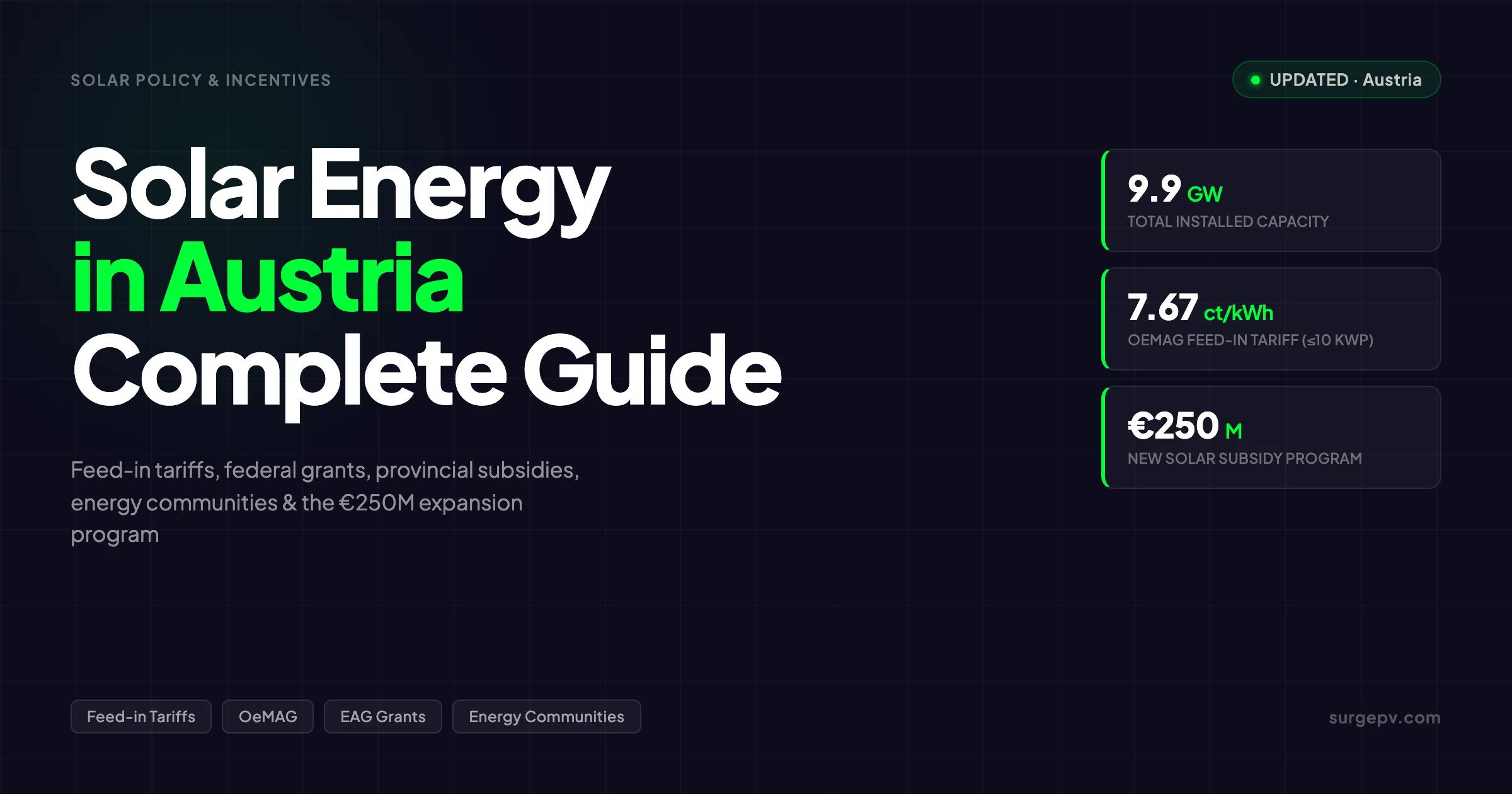
Austria covered 95% of its national electricity demand from renewable sources in 2024 — the highest share in its modern grid history. Solar is now the fastest-scaling piece of that mix. The country ended 2025 with 9.9 GW of cumulative PV capacity, up from under 2 GW just five years earlier, and the government has committed €250 million to push that total significantly higher by 2030. Whether you are an installer expanding into the Austrian market, a homeowner weighing a rooftop system, or a developer evaluating project economics, this guide covers every layer of Austria’s solar support system: feed-in tariffs, federal grants, provincial subsidies, tax rules, energy community frameworks, and the policy changes shaping the 2026 market.
Solar energy in Austria benefits from the EAG (Erneuerbaren-Ausbau-Gesetz) framework offering feed-in tariffs and investment grants. Residential systems receive €200–€500/kWh battery grants. Installation costs are €1,300–€1,700/kWp. Austria targets 100% renewable electricity by 2030.
TL;DR — Austria Solar Support 2026
Austria’s layered solar support includes: OeMAG feed-in tariffs of 5.74–7.67 ct/kWh guaranteed for 13 years; federal EAG investment grants up to €7,000 for PV + storage; income tax exemption on solar revenue up to 35 kWp; provincial top-ups of €500–€3,000+ depending on location; and a new €250 million subsidy program opening in Q2 2026 targeting 5 GW of new capacity by 2030.
Austria Solar Market at a Glance
Austria’s PV market went through three distinct phases in four years. From 2021 to 2023, installations accelerated rapidly — peaking at a record 2,474 MW in 2023 alone. In 2024, the market added another 2,084 MW. Then in 2025, installations fell sharply to 1,634 MW, a 22% decline, driven primarily by the government’s early abolition of the VAT exemption for small rooftop systems.
| Year | New Capacity (MW) | Cumulative Capacity (GW) |
|---|---|---|
| 2022 | ~1,400 | ~3.5 |
| 2023 | 2,474 (record) | ~5.9 |
| 2024 | 2,084 | ~8.0 |
| 2025 | 1,634 | 9.9 |
| 2026 (forecast) | ~1,600–1,900 | ~11.5–11.8 |
The 2030 target under the Renewable Energy Expansion Act (EAG) calls for 11 TWh of annual PV generation — roughly double current output. PV Austria estimates the country needs 2 GW of new capacity every year through 2030 to reach that target. At 2025’s installation rate, Austria is running 20–25% short.
Austria’s solar intensity compares well to its Alpine neighbours. The country averages 1,100–1,500 kWh/m²/year in global horizontal irradiance (GHI), with southern regions like Styria, Carinthia, and Burgenland approaching 1,400–1,500 kWh/m²/year — comparable to southern Germany and northern Italy. Also see: solar panel ROI in Italy. Also see: Germany solar subsidies.
Pro Tip
Before sizing any Austrian rooftop installation, run a site-specific irradiance analysis. Yield variations between a north-facing Vienna apartment roof and a south-facing Carinthian house can exceed 30%. SurgePV’s solar shadow analysis software generates location-specific irradiance data to validate system sizing before any permit is submitted.
For a direct comparison, see Arka 360 vs SurgePV.
The Regulatory Framework Behind Austria’s Solar Growth
Three laws govern solar PV in Austria. Understanding their interaction is necessary for anyone advising clients or managing installations.
Renewable Energy Expansion Act (EAG) — 2021 The EAG (Erneuerbaren-Ausbau-Gesetz) is Austria’s primary renewable energy law. It replaced the older Green Electricity Act (Ökostromgesetz) and redefined Austria’s 2030 electricity targets: net 100% renewable electricity, with 11 TWh from photovoltaics, 10 TWh from wind, 5 TWh from new hydropower, and 1 TWh from biomass. The EAG established the two-channel support system — feed-in market premiums and investment grants — now administered by OeMAG.
Austrian Electricity Act (ElWOG) and the new ElWG (2025) The Electricity Industry and Organization Act (ElWOG) regulates grid access, distribution fees, and consumer rights. In late 2025, Austria passed the new Electricity Industry and Organization Act (ElWG), which added new energy sharing frameworks: the “self-supply facility” model and “peer-to-peer” electricity trading. These expand the tools available to energy communities and prosumers beyond the original EAG framework.
E-Control E-Control (Energie-Control Austria) is the independent energy regulator. It oversees distribution grid access, sets network tariff rules, enforces fair competition, and supervises OeMAG’s market activities.
OeMAG OeMAG (Ökostromabwicklungsstelle Austria) is the Green Electricity Settlement and Clearing House. All EAG support applications — both feed-in market premium contracts and investment grant requests — are submitted exclusively through the OeMAG online portal. Applications must be filed within time-limited call windows published by OeMAG.
Austria’s constitutional structure adds complexity: building permits, zoning, and certain energy regulations fall under individual Bundesland (province) jurisdiction. There is no single national permit. A 200 kWp rooftop in Vienna follows different approval rules than the same system in Styria. This federal-provincial split means permit timelines and requirements vary significantly by location. For Germany-specific information, see Multi-Family Residential Solar Case Study. Read more about Residential Solar ROI Case Study Germany.
OeMAG Feed-in Tariffs: What Austria Pays for Solar Electricity
Austria’s feed-in tariff system operates as a market premium under the EAG. The OeMAG pays a fixed rate per kilowatt-hour for electricity fed into the grid, guaranteed from the date of commissioning for 13 years.
Current Feed-in Tariff Rates (2026)
| System Size | Feed-in Rate | Guarantee Period |
|---|---|---|
| Up to 10 kWp | 7.67 ct/kWh | 13 years |
| 10 kWp – 20 kWp | 6.08 ct/kWh | 13 years |
| 20 kWp – 100 kWp | 5.74 ct/kWh | 13 years |
From August 1, 2026, revised tariff rates will apply to newly commissioned systems, ranging between 5.45 ct/kWh and 12.22 ct/kWh depending on system size and type. Systems commissioned before that date lock in the current 2026 rates.
Market Premium vs. Feed-in Tariff
Larger systems (generally above 100 kWp) access support through a competitive market premium mechanism rather than fixed feed-in rates. In the market premium model, the developer sells electricity on the spot market and receives an OeMAG top-up to cover the difference between the market price and the reference production cost. Premium levels depend on the tender round and project type. This competitive mechanism is designed for commercial and industrial projects where scale makes auction participation practical.
How to Apply
Applications for OeMAG feed-in contracts must be submitted online through the OeMAG portal during published call windows. The process involves:
- Register the system with the grid operator (DSO) and obtain a metering point identification (Zählpunktnummer)
- Submit the feed-in contract application during an OeMAG call window — applications outside call periods are not accepted
- Commission the system within the deadline specified in the contract award
- Connect the smart meter (required for all OeMAG-registered installations)
The feed-in rate is fixed at the time of contract award, not at commissioning. This means early application in a call window locks in the current rate even if commissioning occurs months later.
Feed-in vs. Self-Consumption Economics
At 7.67 ct/kWh feed-in rate versus Austrian residential electricity prices of €0.25–€0.35/kWh, self-consumption is roughly 3–4 times more valuable per kWh than grid export. Battery storage to increase self-consumption rates from 30% to 70%+ significantly improves project returns compared to maximising grid exports. The math consistently favours self-consumption-first design.
See Adding Battery Storage Services for detailed guidance.
Comparison with Germany and Italy
Austria’s OeMAG feed-in tariff for small residential systems (7.67 ct/kWh) sits between Germany’s EEG rate for similar-size systems (around 8.11 ct/kWh) and Italy’s net metering compensation (approximately 8–13 ct/kWh equivalent). Austria’s 13-year guarantee period is shorter than Germany’s 20-year EEG contract but comparable in total present-value terms given Austria’s higher base rates. For a detailed European comparison, see the European solar incentives guide. For the latest details on France, see Agricultural Solar Case Study. For Europe-specific compliance details, see Europe solar compliance.
EAG Investment Subsidies: Federal Grants for Solar PV
Beyond feed-in tariffs, Austria offers direct capital grants through the EAG Investment Subsidy (Investitionszuschuss) program. These grants are applied for before construction and paid after commissioning — the opposite of the OeMAG market premium, which is a revenue stream over time.
Current Federal Grant Rates
| System Type | Grant Rate | Maximum Grant |
|---|---|---|
| PV system only | €250 per kWp | €5,000 per system |
| PV system + battery storage | €350 per kWp | €7,000 combined |
| Battery storage retrofit | €200 per kWh | €2,500 per installation |
A standard 10 kWp residential system qualifies for €2,500 in federal grants without storage, or up to €3,500 with a battery. These grants apply to private individuals installing residential systems. Commercial and industrial installations access separate call-based programs with different rate structures — up to 1,000 kWp is eligible under the EAG framework.
Innovative PV Surcharge
The EAG Investment Subsidy Regulation 2025 introduced a 30% surcharge on base subsidy rates for innovative photovoltaic installations. Qualifying categories include:
- Building-integrated photovoltaics (BIPV)
- Agrivoltaics (dual-use solar on agricultural land)
- Floating PV installations
- Vertical bifacial systems
This surcharge makes Austria one of the few European markets to directly incentivise alternative installation formats through grant uplift rather than just feed-in tariff differentiation.
Made-in-Europe Bonus
The 2025 regulation also introduced a Made-in-Europe bonus for systems built primarily with European-manufactured components. This aligns with EU industrial policy under the Net Zero Industry Act, which targets 40% of clean technology manufacturing in Europe by 2030.
How to Apply for Investment Grants
Investment grant applications are submitted through the OeMAG portal during limited call windows. The key rule: the application must be submitted and approved before construction begins. Late applications — submitted after installation starts — are ineligible. Call windows are announced several weeks in advance on the OeMAG and Federal Ministry websites.
In 2025, the government quadrupled one funding round from €12 million to €48.8 million after receiving 9,327 applications — a demonstration of demand that consistently outstrips available budget. The practical advice for installers: advise clients to apply at the opening of each call window, not during the final days.
Pro Tip for Installers
When presenting project economics to Austrian clients, model the subsidy scenario as the baseline — not the optimistic case. Federal grants plus provincial top-ups routinely cut net project cost by 25–35% for a standard residential system. Use solar proposal software that can layer multiple subsidy stacks into a single client-facing summary to avoid confusion between federal, provincial, and tax benefit calculations.
Provincial Subsidies: What Each Bundesland Offers
Federal grants are available nationwide, but Austria’s nine provinces (Bundesländer) each run independent subsidy programs. These programs change annually, are often quota-limited, and have different eligibility criteria. The table below reflects the situation as of early 2026.
| Province | 2026 PV Grant | Battery Storage Grant | Notes |
|---|---|---|---|
| Vienna | New €7M program | Included | Focus on innovative land use |
| Lower Austria | Program active | Varies | Contact state authority for current rates |
| Upper Austria | Program active | Included | Annual quota applies |
| Styria | Active — storage focus | Via Eco Fund from Oct 2025 | Innovative storage integration emphasis |
| Tyrol | €125/kWp (reduced from €250) | €100/kWh up to 10 kWh (max €1,000) | Rate cut from Jan 2026 |
| Vorarlberg | Program active | Varies | Check Vorarlberg energy agency |
| Carinthia | Program active | Varies | Annual quota applies |
| Burgenland | Program active | Varies | Sunniest province — high adoption |
| Salzburg | No grant from 2026 | No grant | Program ended Dec 31, 2025 |
Salzburg Exception
Salzburg ended its provincial PV subsidy program on December 31, 2025. Homeowners in Salzburg can still access federal EAG grants and OeMAG feed-in tariffs, but there is no provincial top-up as of 2026. Check the Salzburg energy agency website for any new program announcements.
Stacking Federal and Provincial Subsidies
Austrian law permits combining federal EAG grants with provincial subsidies for the same installation — there is no deduction rule between the two levels. A Vienna household installing a 5 kWp system with battery storage could receive:
- Federal grant: €1,750 (5 kWp × €350/kWp)
- Vienna provincial grant: up to €2,000+ depending on program details
- Combined pre-tax subsidy: potentially €3,000–€4,000 on an €8,500 system
On top of this, the 20-year income tax exemption applies to all revenue from the system. The economics are strongest for households in provinces with active programs.
Tax Benefits: Solar Income Tax Exemption
Austria’s tax treatment of solar income is more straightforward than in most European countries. Under current rules:
- Income tax exemption: Revenue from solar electricity generation is fully exempt from income tax for systems up to 35 kWp with annual turnover below €12,500.
- No VAT liability: Systems below this threshold also fall outside the VAT registration requirement — operators do not need to collect or remit VAT on electricity sales.
- No separate declaration: Income from qualifying small PV systems does not need to be declared in the annual tax return.
This means the overwhelming majority of Austrian residential and small commercial installations — essentially anything under 35 kWp — operate in a zero-tax environment. The simplicity is notable: there is no annual filing burden, no partial-year calculation, and no risk of inadvertently crossing into a taxable bracket mid-year.
VAT on System Purchase: The 2025 Change
The picture changed on April 1, 2025. Austria had applied a 0% VAT rate on photovoltaic system hardware since January 2023 as part of an EU-permitted tax measure. The new government abolished this exemption earlier than planned — the original sunset date was December 31, 2025. The rate reverted to 20% VAT on all PV system purchases.
This change had a measurable market impact. PV Austria attributed a significant portion of the 22% installation decline in 2025 to uncertainty caused by the early VAT change and the policy instability it signalled. For installers, this adds approximately €1,200–€1,700 in pre-subsidy cost to a standard 6 kWp system compared to the 0% VAT period.
For VAT-registered commercial operators, this is largely neutral — input VAT on a business system is fully reclaimed. For private households, however, the VAT cost is real and not offset by the income tax exemption (which applies to output revenue, not purchase costs).
Accelerated Depreciation for Businesses
Commercial operators who are VAT-registered can claim the full input VAT on PV system purchase and claim standard depreciation on the asset (typically over 15–20 years under Austrian accounting rules). For businesses with taxable solar income above the €12,500 threshold, standard business tax deductions apply. Austrian solar installers advising commercial clients should consult a local Steuerberater (tax advisor) to optimise the interaction between investment grants, depreciation timing, and the income tax exemption threshold.
Energy Communities: Austria’s Collective Solar Model
Austria is a European leader in renewable energy communities. As of September 2025, the country had over 5,500 registered energy communities with more than 200,000 metering points — figures that no other EU member state matches in per-capita terms.
Two Types of Energy Community
Renewable Energy Communities (EEG — Erneuerbare Energiegemeinschaften) Members share electricity generation and consumption within a single distribution grid region. A solar array on one building’s roof can supply neighbours, a community hall, or small businesses within the same grid area. The grid itself handles the physical delivery; the community model governs the financial and contractual relationships. EEG members pay reduced grid tariffs on shared electricity — typically around 60% lower than standard grid fees — making internal trading significantly cheaper than grid export and re-import.
Citizens Energy Communities (BEG — Bürgerenergiegemeinschaften) A broader model permitting electricity sharing across wider geographic areas, potentially spanning multiple distribution grid zones or transmission grid connections. BEGs face higher transaction costs since they use the full grid, but they enable larger-scale community models that cross municipal boundaries.
New Forms Under the ElWG (2025)
The Electricity Industry and Organization Act passed in late 2025 introduced two additional frameworks:
- Self-supply facility (Eigenversorgungsanlage): A formal structure for multi-party buildings — apartment blocks, commercial estates — to share a single rooftop PV installation among multiple metered consumers on the same property.
- Peer-to-peer (P2P) electricity trading: Allows bilateral electricity trading between prosumers without routing through a formal community structure. This is an early-stage model still pending full implementation guidance.
Technical Requirements
Participation in any energy community requires a smart meter (Smartmeter) that transmits generation and consumption data to the grid operator in 15-minute intervals. Austria’s smart meter rollout covers most of the country. Installers setting up community solar projects should verify smart meter availability with the local DSO before finalising the project design. See Community Solar Business Model for detailed guidance.
For a deeper look at how energy communities are reshaping solar economics across Europe, see the guide to community solar projects in Germany.
Designing Solar Projects for the Austrian Market?
SurgePV handles everything from site-specific shadow analysis to compliant proposals with subsidy stacks — in the format Austrian clients expect.
Book a DemoNo commitment required · 20 minutes · Live project walkthrough
Solar Installation Costs and Payback in Austria
Austrian installation costs sit in the middle of the European range. As of 2026:
| System Size | Typical Installed Cost (Gross) | After Federal Grant | After Provincial Grant |
|---|---|---|---|
| 3 kWp (residential) | €4,500–€5,500 | €3,750–€4,750 | €3,000–€4,000 |
| 5 kWp (residential) | €7,000–€9,000 | €5,750–€7,750 | €4,500–€6,000 |
| 10 kWp (residential/small commercial) | €12,000–€16,000 | €9,500–€13,500 | €8,000–€11,000 |
| 50 kWp (commercial) | €45,000–€60,000 | €42,500–€57,500 | Varies by program |
| 100 kWp (commercial) | €80,000–€110,000 | €77,500–€107,500 | Varies by program |
Installed costs include panels, inverter, mounting, AC/DC cabling, metering, grid connection fee, and labour. Battery storage adds €600–€900 per kWh of usable capacity. Also see: Us Residential Solar Market Trends 2026. For United States-specific compliance details, see United States arizona/phoenix.
Worked Example: 5 kWp Vienna Residential System
| Item | Value |
|---|---|
| Gross system cost | €8,500 |
| Federal grant (PV + storage) | −€1,750 |
| Vienna provincial grant | −€1,500 (estimated) |
| Net cost after grants | ~€5,250 |
| Annual self-consumption savings (€0.28/kWh) | €650 |
| Annual OeMAG feed-in revenue (7.67 ct/kWh) | €285 |
| Total annual benefit | €935 |
| Simple payback period | ~5.6 years |
Source: Example based on energy.werner.solutions cost model, Vienna average electricity prices, and OeMAG 2026 rates.
Over a 25-year system life with electricity prices rising at 2% annually, a system with a 5.6-year payback generates a net lifetime return of approximately €15,000–€18,000 after deducting all costs and grants repayment obligations (there are none in Austria — grants are non-repayable).
Regional Yield Variation
System yield varies significantly across Austria’s geography:
| Region | Typical Annual Yield (kWh/kWp) | Payback Advantage vs. Vienna |
|---|---|---|
| Burgenland (east) | 1,100–1,200 | +15–20% faster |
| Styria (south) | 1,050–1,150 | +10–15% faster |
| Carinthia (south) | 1,100–1,250 | +15–20% faster |
| Vienna (central) | 950–1,050 | Baseline |
| Tyrol (Alpine) | 900–1,000 | Comparable to Vienna |
| Salzburg (Alpine) | 900–1,000 | Comparable to Vienna |
Southern-facing, low-shade rooftops in Burgenland or Carinthia consistently achieve 1,100+ kWh/kWp annually. Alpine locations at altitude can also perform well due to reflection from snow and reduced atmospheric absorption, but shading from terrain and neighbouring buildings requires careful site analysis.
Use solar design software to model location-specific yield estimates before submitting any project proposal to an Austrian client. Generic yield assumptions — often overstated in spreadsheet models — are the most common source of underperforming Austrian installations.
The €250 Million 2026–2030 Solar Program
In early 2026, the Austrian government announced a major new subsidy commitment: €250 million targeted at adding 5 GW of new PV capacity by 2030. This program operates through the OeMAG framework and is the single largest solar subsidy commitment in Austrian history.
Key Program Details
- Total budget: €250 million
- Capacity target: 5 GW of new PV by 2030
- Application window: Q2 2026 (first calls expected to open mid-2026)
- First disbursements: Summer 2026
- Eligible systems: Residential, commercial, and industrial PV; agrivoltaic systems likely eligible with a premium
The €250 million program is separate from the existing annual EAG grant rounds. It represents a multi-year commitment, which is a departure from Austria’s previous year-by-year funding approach. For the industry, multi-year budget certainty is more valuable than a single large call window — it allows installers to plan capacity and clients to plan projects without the start-stop pattern of previous years.
What This Means for Installers
Five GW in four years requires roughly 1.25 GW per year from this program alone. At average residential system sizes of 8–10 kWp, that translates to approximately 125,000–150,000 systems per year — nearly double the number installed in 2025.
For installation companies, the program creates a planning horizon. Firms that build installer pipelines, training capacity, and design workflows now — before the call windows open — will be best positioned to capture the available market. Austria’s solar installer base contracted during the 2025 slowdown; the new program will drive rehiring and upskilling.
Key Takeaway
The €250M program is an opportunity, not a guarantee. Budget rounds are oversubscribed quickly in Austria — the 2025 round saw 9,327 applications for a €48.8M budget. The practical strategy: have clients apply on the day a call window opens, with all required documentation prepared in advance. Late applications in heavily oversubscribed rounds are routinely waitlisted or rejected.
Solar Permitting and Grid Connection in Austria
Austria has no single national permit for solar installations. Permitting falls under provincial (Bundesland) jurisdiction, and requirements vary between provinces and even between municipalities within the same province. The general framework:
Systems Under 10 kWp (Residential Rooftop)
Most provinces treat small residential rooftop installations as notification-only or require a simplified building permit. In Vienna, systems on existing residential buildings under a certain size threshold need only a notification to the district authority (Bezirksamt), not a full permit. In rural provinces, the threshold may differ. Grid connection for systems under 10 kWp is requested directly from the local DSO (distribution system operator) using a standardised form — the DSO has a legal obligation to connect qualifying systems.
Systems 10–100 kWp
A building permit (Baugenehmigung) is typically required. The DSO conducts a grid impact study before confirming the connection point and any required protection relays. Allow 2–4 months for permit and connection approval combined.
Systems 100 kWp–1 MWp
Full building permit required in most provinces. DSO grid study is mandatory. Some provinces require an environmental impact screening (Vorprüfung). Typical timeline: 4–8 months.
Systems Above 1 MWp (Ground-Mount or Large Commercial)
Large ground-mount systems require a formal Environmental Impact Assessment (UVP — Umweltverträglichkeitsprüfung) in most provinces above certain capacity thresholds. Development plan amendments (Flächenwidmung) are required if the land is not already zoned for energy use. Total permit timelines for utility-scale projects can run 18–36 months. The Austrian government introduced acceleration measures in 2024–2025, including amendments to building codes and zoning laws, to reduce these timelines — but implementation varies by province.
Grid Connection Rights
Under the ElWOG and its successor ElWG, Austrian grid operators must provide non-discriminatory access to the distribution grid for renewable energy systems. Connection refusal is only permitted where genuine grid capacity constraints exist and cannot be resolved within a reasonable timeframe. Grid expansion delays remain a real bottleneck for larger projects in certain regions, particularly in western provinces where grid infrastructure lags solar deployment rates.
For commercial projects above 50 kWp, early DSO engagement — before finalising system design — reduces total permitting time by 2–4 months. Submit a preliminary connection inquiry (Anfrage zur Netzanbindung) at the design stage to identify any required grid reinforcement work.
2025 Market Review and 2026 Outlook
The 2025 Austrian solar market delivered a sobering lesson in how policy volatility affects a growth market. Three factors drove the 22% installation decline:
VAT change: The early abolition of the 0% VAT exemption on April 1, 2025 — four months ahead of the planned December 2025 expiry — was a market shock. Projects planned on the basis of 0% VAT had to be repriced at 20%. Some residential clients cancelled orders; others delayed into 2026.
Funding gaps: Austria ran through 2025 with a notable absence of active federal grant programs during parts of the year. The last major program closed in November 2025; the next was not expected until Q2 2026. In markets conditioned on subsidy stacking, funding gaps suppress demand even when the underlying economics remain sound.
Industry capacity contraction: Installation companies reduced headcount during the slow period. Reduced installer capacity creates a further constraint on market recovery even when demand returns.
PV Austria Managing Director Vera Immitzer noted that installation companies need policy consistency to plan their workforce: “Installation companies want to work consistently.” The current stop-start funding model makes that difficult.
2026 Expectations
PV Austria projects 2026 installations will remain below 2,000 MW, roughly flat with 2025. The key upside risk is the new €250 million program: if applications open early and funds deploy quickly, H2 2026 could see a demand surge. The key downside risk is continued policy uncertainty — any further changes to the VAT regime or grant eligibility rules would repeat the 2025 pattern.
For installers, the 2026 market likely looks like a two-half year: subdued H1 as clients wait for the new program, followed by a busier H2 as grants flow. Building pipeline now — with clients ready to apply as soon as call windows open — is the effective strategy.
Austria needs to average 2 GW per year through 2030 to meet its renewable targets. At current trajectory, that requires a material policy and installation industry response. The €250 million program is the government’s opening move in that direction.
Compare the Austrian trajectory with the solar incentives and market trends in Germany and Italy for a broader European picture.
How Solar Design Software Improves Austrian Project Economics
Austria’s solar subsidy system rewards precision. Grant applications require documented system specifications: component lists, layout drawings, yield estimates, and grid connection data. OeMAG investment grant applications that contain errors or missing documentation are rejected — resubmission requires waiting for the next call window.
Solar design suite that generates accurate yield models, professional layout drawings, and export-ready grant documentation reduces the administrative burden on both the installer and the client. For Austrian installers handling the federal-provincial subsidy stack, software that can model both layers simultaneously — federal EAG grant plus provincial program — produces proposals that clients find easy to evaluate and sign.
Shadow analysis matters particularly in Austria’s Alpine topography. Terrain shading, tree shading, and building-to-building shading are significant yield factors in urban and mountain settings. A system sized on flat-terrain assumptions for a Tyrol or Salzburg installation can underperform by 15–25%. The solar shadow analysis software integrated into SurgePV’s design workflow runs horizon-based shading calculations that capture Alpine-specific yield losses that flat-earth simulation tools miss.
For commercial projects targeting the EAG market premium through competitive tendering, accurate financial modeling is a submission requirement. The solar financial analysis tool in SurgePV allows installers to produce bankable yield and revenue projections that satisfy both client due diligence and OeMAG tender documentation standards.
Austria’s solar market is competitive. Projects won on the basis of accurate, professional proposals — not on the basis of the lowest upfront quote. Design and proposal quality differentiates high-performing installation firms from those competing purely on price.
Austria’s Role in the Broader European Solar Push
Austria sits within the EU’s overarching solar policy framework. The EU Solar Strategy originally targeted 600 GW of cumulative solar capacity by 2030; the Net Zero Industry Act revised that to 750 GW. RED III (the Renewable Energy Directive revision) raised the binding EU-wide renewable energy share target to 42.5% by 2030.
For Austria, these EU-level mandates provide a structural floor under national policy. Austria cannot simply walk away from its solar targets without breaching EU obligations — and the European Commission has begun infringement proceedings against member states that miss interim renewable milestones. Austria’s EAG itself was designed to align with EU State Aid rules on renewable support mechanisms.
The IEA’s analysis of Austria’s EAG notes it as a model for other Central European countries integrating market premium mechanisms with investment grant programs. Austria’s energy community framework, in particular, has been referenced in EU energy community best-practice guidance.
For installers operating across multiple EU markets, the EU solar rooftop mandate under the revised Energy Performance of Buildings Directive (EPBD) creates a pan-European installation requirement that will drive demand across all member states, including Austria, through 2027–2030. For an overview of how European solar tax credits compare across countries, that guide provides a structured comparison.
Conclusion
Austria’s solar support system is one of the more complete in Central Europe: guaranteed feed-in rates, capital grants, provincial top-ups, an income tax exemption, and an energy community framework all operating simultaneously. The 2025 slowdown was real, but it was policy-driven rather than fundamental — Austria’s solar resource, grid capacity, and installer base are all capable of supporting 2 GW per year of installations.
Three actions for installers and developers in the Austrian market:
- Apply at call open: Austrian grant programs are systematically oversubscribed. The difference between a grant and a waitlist position is often days. Build application-ready documentation into your pre-sale workflow.
- Prioritise self-consumption design: With feed-in rates at 5–7 ct/kWh and electricity retail prices at 25–35 ct/kWh, every kWh self-consumed is worth 3–5 times more than one exported. Battery storage combined with smart load management maximises the economics of every system.
- Model Alpine shading precisely: Generic flat-terrain yield estimates consistently overperform in Austrian installations. Commission accurate shadow analysis on every project — the error cost of a mis-sized system in a Tyrol village is not recoverable through grants.
Frequently Asked Questions
What are the solar feed-in tariffs in Austria in 2026?
Austria’s OeMAG feed-in tariffs for 2026 are 7.67 ct/kWh for systems up to 10 kWp, 6.08 ct/kWh for 10–20 kWp, and 5.74 ct/kWh for 20–100 kWp. Rates are guaranteed for 13 years from commissioning. From August 1, 2026, new rates will apply to newly commissioned systems, ranging between 5.45 ct/kWh and 12.22 ct/kWh depending on size and system type.
What government grants are available for solar in Austria in 2026?
Federal grants under the EAG offer €250 per kWp for PV-only systems (max €5,000) and €350 per kWp for PV with battery storage (max €7,000 combined). Battery retrofits receive €200 per kWh (max €2,500). Provincial governments add €500–€3,000+ depending on the Bundesland. A new €250 million multi-year program targeting 5 GW of new capacity by 2030 opens applications in Q2 2026.
Is solar income tax-free in Austria?
Yes. Revenue from solar generation is fully income tax exempt for systems up to 35 kWp with annual turnover below €12,500. This covers the vast majority of Austrian residential and small commercial installations. The exemption applies to both self-consumed and grid-fed electricity revenue and requires no annual tax filing for qualifying systems.
What is the OeMAG in Austria?
OeMAG (Ökostromabwicklungsstelle Austria) is the Austrian Green Electricity Settlement and Clearing House. It administers all EAG support: both feed-in market premium contracts and investment grant applications. All applications are submitted exclusively through the OeMAG online portal during limited call windows. OeMAG operates under the supervision of E-Control, Austria’s independent energy regulator.
What are Austria’s 2030 solar energy targets?
The EAG targets 11 TWh of annual PV generation by 2030, as part of reaching net 100% renewable electricity. This requires equipping approximately 1 million rooftops with solar systems. PV Austria estimates 2 GW of new capacity annually through 2030 is necessary to hit the target. As of end-2025, cumulative installed capacity stood at 9.9 GW, with annual generation well below the 11 TWh goal.
How do energy communities work in Austria?
Austrian energy communities allow households, businesses, and municipalities to share solar generation within a defined geographic area. Members use smart meters to track 15-minute generation and consumption intervals. There are two main types: Renewable Energy Communities (EEG) for sharing within a distribution grid region, and Citizens Energy Communities (BEG) for broader geographic sharing. Austria had over 5,500 communities with 200,000+ registered metering points as of September 2025. The new ElWG (2025) added self-supply facility and peer-to-peer models.
Which Austrian province has the best solar subsidies in 2026?
This varies by year and program status. In 2026, Tyrol offers grants at reduced rates, Styria supports innovative storage, and Vienna launched a new €7 million program. Lower Austria and Upper Austria maintain active programs. Salzburg ended its provincial program at the end of 2025 — residents there rely on federal grants only. Federal EAG grants apply nationwide and can be stacked with provincial programs wherever both are active.
Is solar worth it in Austria in 2026?
Yes, for most locations. A typical 5 kWp system in Vienna costs around €8,500 gross, falling to approximately €5,250 after federal and provincial grants. Annual benefits from self-consumption savings and feed-in revenue average €935, implying a payback period of around 5–6 years. Southern regions — Burgenland, Carinthia, Styria — achieve faster payback due to higher irradiance. Over a 25-year system life, a well-sited Austrian installation typically returns 3–4 times its net-of-grant cost.
Where this fits
This article is part of SurgePV's Solar Incentives & Policy hub, which works through the topic from first principles to the decisions a project team actually has to make.

