

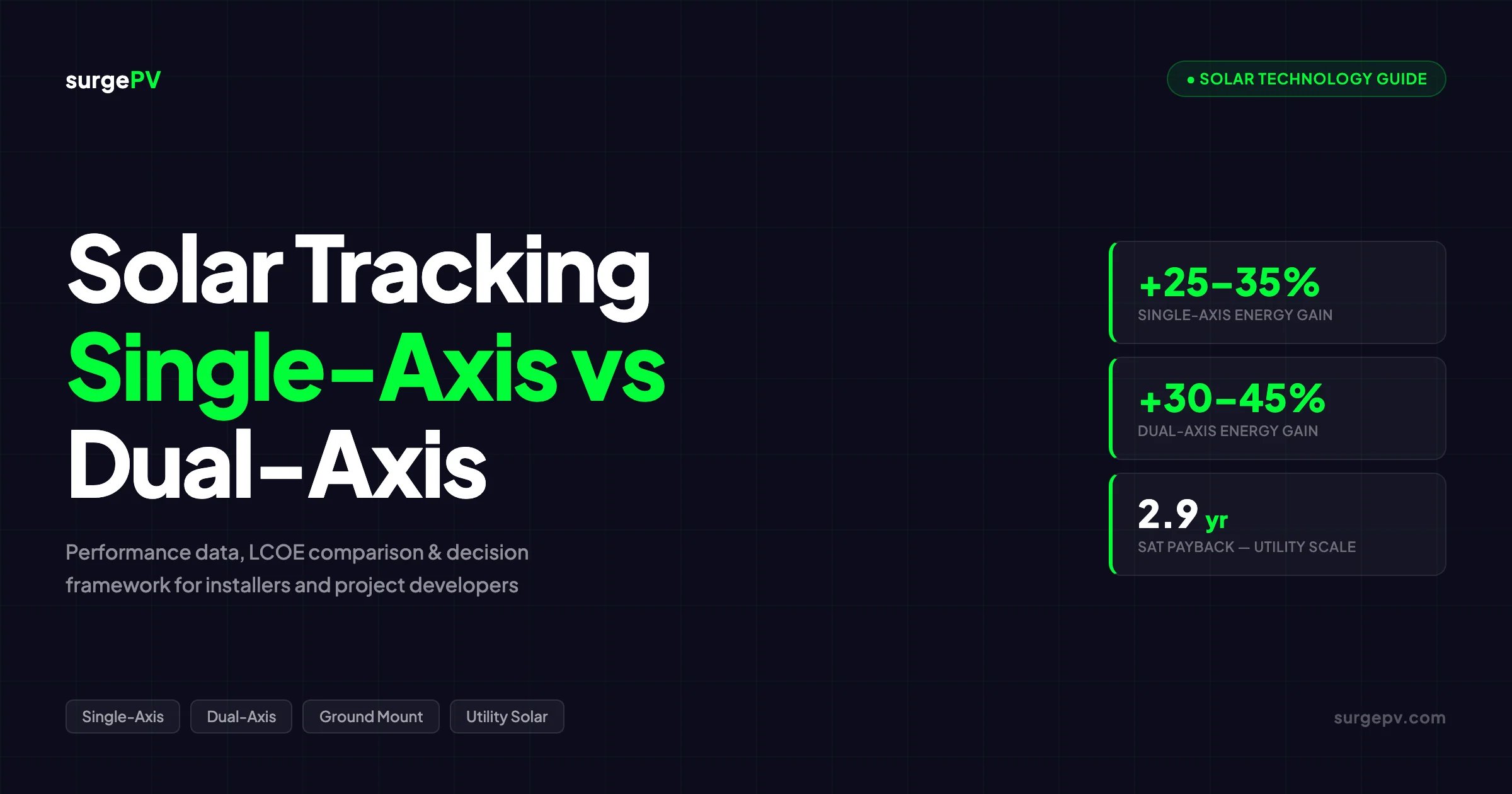
Quick Answer
Single-axis solar trackers increase energy yield by 15–25% versus fixed-tilt at a 10–15% cost premium. Dual-axis trackers boost yield by 30–40% but cost 25–35% more and have higher maintenance. Single-axis is the standard for utility-scale projects; dual-axis is limited to concentrated solar and niche applications.
Utility-scale solar has settled on single-axis trackers as the default configuration. Over 35% of new utility-scale solar capacity now uses single-axis tracking, and that share keeps growing. The economics are straightforward: a 25% energy yield increase for a 15–20% cost premium produces a positive LCOE impact at scale. What is less straightforward is when to upgrade from single-axis to dual-axis, whether trackers make sense for smaller commercial systems, and how to model the performance difference before breaking ground.
Single-axis solar trackers increase energy yield by 15–25% versus fixed-tilt at a 10–15% cost premium. Dual-axis trackers boost yield by 30–40% but cost 25–35% more and have higher maintenance. Single-axis is the standard for utility-scale projects; dual-axis is limited to concentrated solar and niche applications.
Single-axis solar trackers increase energy yield by 15–25% versus fixed-tilt at a 10–15% cost premium. Dual-axis trackers boost yield by 30–40% but cost 25–35% more and have higher maintenance. Single-axis is the standard for utility-scale projects; dual-axis is limited to concentrated solar and niche applications.
This guide compares single-axis and dual-axis solar tracking systems across five dimensions: energy yield, cost, ROI, maintenance, and project fit. Every figure is sourced. Every recommendation connects to real project conditions.
TL;DR — Solar Tracking Systems
Single-axis trackers deliver 20–35% more energy than fixed tilt at 15–20% higher cost — the standard choice for utility-scale ground-mount solar. Dual-axis trackers produce 30–45% more than fixed tilt but cost 2–3x more and require more maintenance, making them viable only in specific scenarios: space-constrained sites, high-latitude locations, or commercial applications with premium electricity rates. For most projects, single-axis wins on LCOE. Dual-axis wins only when land is the primary constraint.
What Solar Trackers Actually Do
A fixed-tilt solar panel captures maximum irradiance only when sunlight strikes it at a perpendicular angle. The rest of the day, the cosine effect reduces power output — a panel at 60° off-perpendicular captures just 50% of available irradiance. Fixed-tilt systems optimize the tilt angle for the annual average, not any given hour.
Solar trackers solve this by rotating the panel array to follow the sun, reducing the off-angle loss throughout the day. The extent of improvement depends on how many axes of rotation the tracker uses.
The three configurations — fixed tilt, single-axis, and dual-axis — form a spectrum of precision, cost, and complexity. Understanding fixed tilt as the baseline makes the comparative data more meaningful.
Fixed tilt: Panel angle set once at installation, typically at latitude minus 10–15° for year-round optimization. No moving parts. Lowest cost. Ground coverage ratio (GCR) of 0.30–0.40.
Single-axis (SAT): Rotates panels on an east-west axis, tracking the sun’s daily arc from sunrise to sunset. Does not adjust for seasonal elevation changes. GCR of 0.35–0.45.
Dual-axis (DAT): Rotates on both the east-west axis (daily tracking) and the north-south axis (seasonal elevation tracking). Captures the sun at near-perpendicular angle at virtually all times. GCR of 0.15–0.25 — requires significantly more land per panel than either alternative.
Pro Tip
Before specifying a tracker type, model the site’s irradiance profile using cloud solar design software and surface the tracker-vs-fixed yield delta in solar proposal software for the project owner. Locations with high diffuse irradiance (overcast climates) see smaller tracker gains than locations with high direct normal irradiance. A 500 kW site in the UK may see only 15% gain from tracking; the same system in Saudi Arabia may see 35%.
Single-Axis Solar Trackers: Performance, Cost & Best Use Cases
How Single-Axis Trackers Work
Single-axis trackers consist of torque tubes that hold the panel rows, driven by a central actuator motor. The torque tube rotates on a north-south longitudinal axis, tilting panels east in the morning and west in the afternoon. Most modern systems use GPS-linked controllers and a master-slave architecture — one controller drives multiple rows in sync.
Three SAT variants exist based on panel orientation and rotation geometry:
| SAT Type | Panel Orientation | Best Use Case |
|---|---|---|
| Horizontal Single-Axis (HSAT) | Horizontal, aligned N-S | Utility scale, low-to-mid latitude sites |
| Vertical Single-Axis (VSAT) | Vertical, tilted | High-latitude sites, moderate terrain |
| Tilted Single-Axis (TSAT) | Fixed tilt + rotation | Latitudes above 45°N/S |
HSAT is the dominant commercial form. It is what the vast majority of utility-scale ground-mount projects use globally. For Global-specific compliance details, see Global net-metering-by-country.
Energy Yield: Single-Axis vs Fixed Tilt
The yield improvement from single-axis tracking varies with latitude and local climate. Higher DNI share — more direct normal irradiance relative to total — means larger tracking gains. The data below is drawn from NREL PVWatts simulations and SolarPower Europe yield benchmarks: Also see: European Solar Incentives.
| Location | Latitude | SAT Gain vs Fixed Tilt | Annual Yield (SAT) |
|---|---|---|---|
| Dubai, UAE | 25°N | 20–22% | ~2,000 kWh/kWp |
| Madrid, Spain | 40°N | 24–28% | ~1,650 kWh/kWp |
| Chicago, USA | 42°N | 23–27% | ~1,450 kWh/kWp |
| Berlin, Germany | 52°N | 18–22% | ~1,050 kWh/kWp |
| Melbourne, Australia | 38°S | 23–26% | ~1,600 kWh/kWp |
Gains are highest at mid-latitudes (30–45°) where the sun’s daily arc provides significant east-west tracking opportunity and clear skies keep direct irradiance dominant. Above 55°, diffuse irradiance makes up a larger share of total irradiance, shrinking the tracking advantage — panels cannot track what arrives uniformly from the entire sky dome.
Key Takeaway
A 5 MWp single-axis tracked project in Madrid generates approximately 8.25 GWh/year vs 6.5 GWh/year for the equivalent fixed-tilt system — a 1.75 GWh annual difference that translates directly to revenue at wholesale electricity prices of €60–80/MWh.
Single-Axis Tracker Costs
The cost premium for single-axis tracking over fixed tilt depends on system scale, terrain complexity, and manufacturer. The figures below represent commercial utility-scale projects in Europe:
| Cost Component | Fixed Tilt | Single-Axis Tracker |
|---|---|---|
| Mounting structure | €0.08–0.12/Wp | €0.12–0.18/Wp |
| Motor and controls | — | €0.03–0.06/Wp |
| Installation labor | €0.04–0.07/Wp | €0.06–0.10/Wp |
| Total structure cost | €0.12–0.19/Wp | €0.21–0.34/Wp |
At 5 MWp scale, the incremental cost of single-axis tracking over fixed tilt is typically €75,000–€150,000, depending on region and terrain. That incremental investment delivers 1.5–2x the energy gain per euro spent compared to simply adding more panels on a fixed structure.
Backtracking: The Key SAT Optimization
Without backtracking, rows shade each other during the first and last hour of each day, cutting energy output significantly. Modern tracker controllers implement backtracking algorithms that calculate the exact angle at which adjacent-row shading begins for each tracker position, then move panels to the shade-free angle during those periods.
Backtracking recovers 2–4% of annual energy output that would otherwise be lost to inter-row shading. It is now standard in all commercial SAT systems and should be confirmed with any tracker manufacturer before purchase. Ask specifically for the backtracking logic used at your site’s latitude and GCR — generic algorithms tuned for flat terrain underperform on sloped sites.
Single-Axis Tracker Pros and Cons
| Advantage | Disadvantage |
|---|---|
| 20–35% yield increase over fixed tilt | Requires relatively flat terrain (max 5–6° cross-slope) |
| Lower cost than dual-axis | Needs more land than fixed tilt |
| Standard at utility scale — proven reliability | Moving parts increase maintenance requirements |
| Compatible with bifacial panels | Motor and sensor failures require field service |
| Enables backtracking for inter-row shade management | Wind loads increase structural requirements |
| Positive LCOE impact at scale | Not cost-effective for systems under 200–500 kW |
Dual-Axis Solar Trackers: Performance, Cost & Best Use Cases
How Dual-Axis Trackers Work
Dual-axis trackers add a second rotational degree of freedom. In addition to east-west daily tracking, they rotate panels on the horizontal axis to follow the sun’s elevation as it changes throughout the day and across seasons.
Two main designs exist:
Tip-tilt tracker: Panels mounted on a single horizontal platform that tilts in both axes. Common in smaller commercial systems and research installations.
Pedestal (azimuth-elevation) tracker: Each panel or small array mounted on an individual pedestal with independent azimuth (rotation) and elevation (tilt) drives. The most precise design, used in concentrated solar power and high-precision installations.
Dual-axis systems require individual or small-group mounting (typically 4–16 panels per tracker unit), which means higher structural cost and more motors per megawatt compared to the row-based design of single-axis systems.
Energy Yield: Dual-Axis vs Fixed Tilt and SAT
The MDPI Energies review of solar tracking systems and the ASES performance comparison study both confirm the latitude dependence of dual-axis gains: For France-specific information, see Agricultural Solar Case Study.
| Location | Latitude | DAT Gain vs Fixed Tilt | DAT Gain vs SAT |
|---|---|---|---|
| Dubai, UAE | 25°N | 22–28% | 2–6% |
| Madrid, Spain | 40°N | 30–38% | 6–12% |
| Chicago, USA | 42°N | 32–40% | 9–14% |
| Berlin, Germany | 52°N | 35–45% | 17–23% |
| Melbourne, Australia | 38°S | 30–36% | 7–11% |
The marginal gain of dual-axis over single-axis is strongly latitude-dependent. Near the equator (Dubai, 25°N), seasonal sun-path variation is minimal and the second axis adds only 2–6% over single-axis. At Berlin (52°N), the seasonal elevation swing is large — the sun at winter solstice sits just 15° above the horizon vs 61° at summer solstice — and dual-axis captures this variation, adding 17–23% over single-axis.
This latitude dependency explains why dual-axis trackers find their strongest economic case at high latitudes and in space-constrained applications where maximizing energy per square meter of land is the design objective.
Dual-Axis Tracker Costs
Dual-axis trackers are significantly more expensive than single-axis systems:
| Cost Component | Single-Axis | Dual-Axis |
|---|---|---|
| Mounting and structure | €0.12–0.18/Wp | €0.20–0.30/Wp |
| Motors and controls | €0.03–0.06/Wp | €0.08–0.15/Wp |
| Civil works (foundations) | €0.02–0.04/Wp | €0.05–0.10/Wp |
| Installation labor | €0.06–0.10/Wp | €0.12–0.20/Wp |
| Total structure cost | €0.23–0.38/Wp | €0.45–0.75/Wp |
The 2–3x cost premium over single-axis is the primary reason dual-axis adoption at utility scale remains near 2% of new capacity globally. For a 5 MWp project, dual-axis structure costs €500,000–€1,000,000 more than a comparable single-axis system. The additional energy generated (6–20% over SAT) rarely closes this gap at current wholesale electricity prices.
Dual-Axis Tracker Pros and Cons
| Advantage | Disadvantage |
|---|---|
| Maximum possible energy yield per installed watt | 2–3x higher cost than single-axis |
| Best performance at high latitudes (above 45°N/S) | Higher maintenance frequency and complexity |
| Maximizes output per square meter of land | Requires skilled technicians for servicing |
| Enables near-perpendicular irradiance capture year-round | Individual pedestal mounts limit inter-row bifacial rear-side gain |
| Viable for space-constrained commercial installations | Wind load sensitivity — larger cross-section exposure |
| Can double as agrivoltaic shading structure | Not cost-competitive at utility scale in most markets |
Head-to-Head Performance Comparison
| Parameter | Fixed Tilt | Single-Axis | Dual-Axis |
|---|---|---|---|
| Annual yield vs fixed | Baseline | +20–35% | +30–45% |
| Marginal gain over SAT | — | Baseline | +10–20% |
| Cost (structure + install) | €0.12–0.19/Wp | €0.21–0.34/Wp | €0.45–0.75/Wp |
| Land requirement (relative) | 1.0x | 1.2–1.4x | 1.8–2.5x |
| Moving parts per MW | None | Low (1 axis, row-based) | High (2 axes, individual mounts) |
| Maintenance interval | Annual (cleaning only) | 12–18 months | 6–12 months |
| Optimal latitude range | All | 25–55°N/S | 35–65°N/S |
| Utility-scale market share | ~50% | ~48% | ~2% |
| Bifacial panel compatibility | Good | Excellent | Good |
| Backtracking capability | No | Yes | Yes (azimuth axis) |
Market share data: Wood Mackenzie Solar Tracker Report 2025
Key Takeaway
Single-axis tracking has effectively become the default for utility-scale ground-mount solar — it captures most of the yield gain available from tracking at a fraction of the dual-axis cost. Dual-axis occupies a small but growing niche in high-latitude commercial installations and agrivoltaic deployments where land is the binding constraint.
ROI and Financial Analysis
The LCOE Framework
The right way to compare tracker configurations is through levelized cost of energy (LCOE) — the total lifetime cost per kilowatt-hour generated. Trackers increase both cost (upfront capital, O&M) and output (more kWh), so the net effect on LCOE depends on which change is proportionally larger.
For a representative 5 MWp utility-scale project in southern Spain:
| Configuration | CapEx | Annual Generation | 25-yr Generation | LCOE |
|---|---|---|---|---|
| Fixed tilt | €4.5M | 7.25 GWh | 163 GWh | €0.028/kWh |
| Single-axis | €4.8M | 9.10 GWh | 205 GWh | €0.023/kWh |
| Dual-axis | €5.6M | 10.1 GWh | 227 GWh | €0.025/kWh |
Single-axis achieves the lowest LCOE despite higher upfront cost because the yield gain (25%) outpaces the cost premium (6–7%). Dual-axis delivers even more energy but at a cost premium (24% over single-axis) that exceeds the additional yield gain (11% over single-axis), resulting in a slightly higher LCOE than SAT.
At standard utility-scale project conditions, single-axis wins on LCOE. Dual-axis only wins when land cost is very high (forcing maximum energy density) or when site dimensions make dual-axis the only way to install enough capacity.
Payback Period on Incremental Tracker Cost
A practical metric for commercial installers is the simple payback period on the incremental tracker investment over fixed tilt:
| Configuration | Incremental Cost over Fixed Tilt | Additional Annual Revenue | Payback Period |
|---|---|---|---|
| Single-axis (5 MWp, Madrid) | €300,000 | €105,000/yr (@€60/MWh) | 2.9 years |
| Dual-axis (5 MWp, Madrid) | €1,100,000 | €174,000/yr (@€60/MWh) | 6.3 years |
| Single-axis (500 kW, Madrid) | €35,000 | €10,500/yr | 3.3 years |
| Dual-axis (500 kW, Madrid) | €130,000 | €17,400/yr | 7.5 years |
For commercial projects at higher electricity prices (retail self-consumption rate, €0.15–0.25/kWh), dual-axis payback compresses significantly:
| Configuration | Incremental Cost | Additional Annual Revenue | Payback |
|---|---|---|---|
| Single-axis (500 kW, retail €0.18/kWh) | €35,000 | €31,500/yr | 1.1 years |
| Dual-axis (500 kW, retail €0.18/kWh) | €130,000 | €52,200/yr | 2.5 years |
At commercial retail electricity rates, both tracker types show strong payback, and dual-axis becomes much more viable — especially in space-constrained commercial carport or canopy applications. Use the generation and financial tool to model these scenarios with site-specific inputs before committing to a tracker specification. For more on this topic, see Commercial Solar Carport Design Guide.
Pro Tip
For commercial self-consumption systems, tracker ROI depends on the avoided retail electricity cost, not the feed-in tariff or wholesale price. A 500 kW commercial system avoiding €0.22/kWh in retail purchases has 3x the tracker ROI of the same system selling at €0.07/kWh wholesale. Run the right scenario in your financial model.
Model Tracker Performance Before You Commit
SurgePV’s generation and financial tools let you compare fixed tilt vs single-axis vs dual-axis output for any location, with detailed LCOE and payback analysis side by side.
Book a DemoNo commitment required · 20 minutes · Live project walkthrough
For a direct comparison, see Arka 360 vs SurgePV.
When Fixed Tilt Still Wins
Despite the yield advantages of tracking, fixed tilt remains the right choice in specific scenarios:
Rooftop systems: Rooftop mounting does not allow tracker rotation. Fixed tilt optimized for roof pitch and azimuth is the only option.
Terrain constraints: Single-axis trackers require terrain with less than 5–6° cross-slope. Steeper terrain, undulating ground, or confined irregular plots make tracker installation mechanically complex and expensive.
Small systems under 200 kW: Below this threshold, the economics of single-axis tracking rarely work at typical electricity prices. The per-unit overhead of tracker hardware (controllers, wiring, commissioning) does not scale down proportionally.
High-diffuse-irradiance climates: In climates where 60%+ of annual irradiance is diffuse (northern UK, Scandinavia, Pacific Northwest), tracking gains drop significantly. Diffuse irradiance arrives from the entire sky dome and cannot be captured through angle optimization. See our guide on Battery Solar System Design UK for more.
Low electricity price markets: Where electricity prices fall below €0.05/kWh (some Middle Eastern wholesale markets), the incremental revenue from tracker yield gain takes very long to recover the incremental capital cost.
How to Choose: Decision Framework
Work through these questions in order:
1. Is this rooftop or ground mount?
- Rooftop → Fixed tilt. End of decision.
- Ground mount → Continue.
2. What is the system size?
- Under 200 kW → Fixed tilt is likely optimal unless electricity price is very high.
- 200–500 kW commercial → Single-axis if terrain is flat and electricity price is above €0.10/kWh.
- 500 kW+ utility scale → Single-axis is the default. Run LCOE to confirm.
3. What is the site latitude?
- Below 30°N/S → Single-axis delivers 20–22% gain. Dual-axis adds minimal marginal value (2–6%).
- 30–50°N/S → Single-axis strong. Dual-axis viable only with a land constraint.
- Above 50°N/S → Single-axis still preferred at scale. Dual-axis justified where land is premium.
4. Is land the binding constraint?
- No land constraint → Single-axis at utility scale.
- Tight land constraint → Dual-axis maximizes output per square meter.
5. What is the electricity price?
- Below €0.08/kWh → Run LCOE carefully; fixed tilt may win.
- €0.10–0.18/kWh → Single-axis standard; dual-axis viable for commercial self-consumption.
- Above €0.18/kWh (retail self-consumption) → Both tracker types show strong ROI.
6. What is the terrain slope?
- Cross-slope above 6° → Fixed tilt or a terrain-following tracker variant (specialized SAT).
- Flat or gently sloping → Standard HSAT works.
Key Takeaway
For the majority of ground-mount solar projects between 500 kW and 100 MW at latitudes between 25° and 50°, single-axis tracking is the answer. The deviations — fixed tilt for small systems and difficult terrain, dual-axis for high-latitude land-constrained commercial sites — are important exceptions but not the rule.
Tracker Technology: What Has Changed Since 2020
Modern solar trackers are a different product from systems installed before 2020. Several engineering advances have improved both performance and reliability:
Smart Backtracking and Terrain Following
Early backtracking algorithms assumed flat terrain and identical row heights. Modern systems use GPS-linked elevation mapping to calculate site-specific backtracking schedules that account for actual terrain variation. Terrain-following trackers (Nextracker NX Horizon, Array Technologies DuraTrack) operate on cross-slopes up to 10–15° without yield loss, compared to the 5–6° limit of first-generation SATs.
Diffuse Light Optimization
A growing number of tracker controllers use real-time pyranometer data or sky irradiance sensors to switch between tracking mode and a flat (0°) position when diffuse irradiance exceeds direct irradiance. Flat positioning maximizes sky-view factor and captures more diffuse light during overcast periods. This recovers 1–3% annual energy in moderate-climate installations.
Wind Stow Algorithms
Modern trackers monitor wind speed via on-site anemometers and automatically rotate panels to a flat or feathered position when wind exceeds safe operating limits. This reduces structural stress and prevents mechanical failure during storm events. Earlier systems used fixed wind-speed thresholds; current systems use predictive algorithms that balance energy yield against structural load.
Bifacial-Optimized Tracking Angles
Standard backtracking algorithms minimize inter-row shading. Bifacial-optimized algorithms go further, calculating the tracking angle that maximizes combined frontside and rear-side irradiance, accounting for ground albedo. At ground albedo above 0.25 (light gravel, white geomembrane), bifacial-optimized tracking adds 1–3% annual yield over standard backtracking. For more on this topic, see Bifacial Solar Panel Design Guide.
Remote Monitoring and Predictive Maintenance
Commercial tracker systems now integrate with SCADA and remote monitoring platforms. Motor current draw, rotation speed, and position sensor data are streamed continuously to cloud dashboards that flag anomalies before they become failures. Mean time between failures (MTBF) for modern SAT motors exceeds 15 years in controlled testing.
Trackers and Bifacial Solar Panels
Single-axis trackers and bifacial solar panels are a natural combination. Bifacial panels generate additional energy from reflected irradiance on the rear cell surface, but this requires the rear surface to have a clear view of the ground below. Fixed-tilt systems at GCR 0.40 can shade the ground beneath panels, limiting rear-side irradiance. Single-axis tracking at GCR 0.35–0.40 keeps panel elevation higher during peak irradiance hours, improving both rear-side sky view and ground irradiance capture throughout the day.
Typical combined yield gains for bifacial panels on single-axis trackers vs monofacial on fixed tilt, based on NREL’s bifacial photovoltaic research:
| Ground Albedo | Bifacial SAT Gain vs Mono Fixed | Bifacial Gain Component | SAT Gain Component |
|---|---|---|---|
| 0.15 (dark soil, low) | 28–30% | 3–5% | 24–26% |
| 0.25 (light gravel) | 32–36% | 7–10% | 25–27% |
| 0.40 (white geomembrane) | 40–48% | 15–20% | 25–28% |
The albedo of the ground surface under and around the tracker rows is the biggest variable in bifacial system design. Installing light-colored gravel or a white geomembrane between rows is one of the highest-ROI optimization steps for bifacial SAT systems. The bifacial gain scales significantly with ground reflectivity.
Modeling Tracker Performance with Solar Software
Before choosing a tracker type, the right process is to model all three configurations — fixed tilt, SAT, and DAT — for the specific project site and compare LCOE, IRR, and payback. Using solar software for this analysis moves the conversation from heuristics to site-specific financial data.
Good solar design platforms enable this through three capabilities:
Irradiance simulation: Site-specific GHI, DNI, and DHI data drives accurate yield modeling for each tracker configuration. The ratio of DNI to total irradiance determines how much tracking gain is possible at the site. Read the solar irradiance guide for a full breakdown of the irradiance components that drive this calculation.
Shading analysis: Tracker rows create dynamic shading patterns that change throughout the day and year. The shadow analysis tool calculates inter-row shading losses for tracker configurations at different GCR values, letting you find the optimal balance between land use and shading loss.
Financial modeling: After yield simulation, project NPV, IRR, and payback period for each configuration at site-specific electricity prices and financing terms. The generation and financial tool provides these comparisons side by side, which is what bankable project development requires.
Pro Tip
Model the project at two GCR values for single-axis tracking: the land-constrained GCR (whatever the site allows) and the cost-optimal GCR (typically 0.35–0.40). If the land-constrained GCR exceeds 0.50, inter-row shading begins to significantly erode the tracking gain — at which point fixed tilt often performs better per invested euro.
Agrivoltaics and Solar Trackers
Dual-axis trackers are finding a growing application in agrivoltaic design — solar installations combined with agricultural land use. The ability to precisely control panel angle opens up a function that fixed and single-axis systems cannot match: dynamic light management for crops growing beneath the panels.
In agrivoltaic dual-axis systems, panel angle is set not just to maximize solar energy capture, but to regulate the amount of sunlight reaching the crops below. Shade-tolerant crops (lettuce, herbs, small berries) benefit from 30–50% shading during peak summer hours while remaining fully exposed during morning and late afternoon. Dual-axis trackers can deliver this variable shading profile automatically based on time of day and season.
Single-axis trackers contribute to agrivoltaics through a different mechanism. East-west oriented panel rows on HSAT systems with moderate GCR naturally distribute shade and light access across crop rows throughout the day, which some research projects have shown to improve water retention and reduce heat stress. The agrivoltaic benefit is indirect but meaningful for water-limited climates.
Regional Tracker Adoption: Where Single-Axis Dominates
Understanding where each tracker type is deployed commercially gives useful context for new project decisions. The global tracker market crossed $8 billion in 2024 and is projected to grow at 12% CAGR through 2030, driven almost entirely by single-axis systems at utility scale.
United States
The US is the world’s largest single-axis tracker market. Over 80% of utility-scale ground-mount projects now specify single-axis tracking, driven by the LCOE advantage in high-DNI markets like the Southwest (Texas, California, Nevada). The US tracker market is dominated by Nextracker and Array Technologies, which together hold roughly 60% of domestic market share. Dual-axis trackers represent less than 1% of US utility-scale deployments.
Europe
Europe presents more geographic variation. Southern European markets (Spain, Italy, Portugal, Greece) have high DNI and strong single-axis economics, with tracker penetration at utility scale exceeding 70%. Northern Europe (Germany, Netherlands, Scandinavia) still has significant fixed-tilt deployment because diffuse irradiance shares are high and tracker economics are marginal for projects below 5 MWp. The Netherlands and Germany have growing dual-axis commercial deployments in agrivoltaic projects. Also see: solar panel ROI in Italy. Read more about Commercial Rooftop Solar Case Study Italy.
Spain deserves special mention. With over 35 GW of new solar capacity planned through 2030 under the PNIEC national energy plan, virtually all large-scale new capacity will use single-axis tracking. The tracker payback in southern Spain at current electricity prices is under 3 years, making it the clear standard. See the European solar subsidies tracker for current incentive structures in key markets.
Middle East and Africa
High-DNI markets in MENA theoretically offer the largest absolute yield gains from tracking. However, tracker economics compete against very low land costs and high dust/sandstorm exposure, which increases maintenance costs and can degrade tracker control systems. Saudi Arabia and UAE projects have adopted single-axis tracking at scale for utility projects; smaller commercial systems often remain on fixed tilt to minimize mechanical complexity in harsh environments.
Asia-Pacific
India is emerging as a major tracker market, with single-axis tracking becoming standard for ground-mount projects above 50 MW. The solar software market in India is growing in parallel to support tracker-based project design. Australia, with high DNI and favorable terrain in inland regions, has strong tracker penetration at utility scale in New South Wales and Queensland. Also see: 5Kw Solar Panel Price In India. For Australia-specific compliance details, see Australia comparisons/lgc-vs-stc.
Key Takeaway
Single-axis tracking is the global standard for utility-scale ground-mount solar in high-DNI markets. The remaining fixed-tilt deployment is concentrated in rooftop solar, small commercial, high-diffuse-irradiance climates (northern Europe), and developing markets where maintenance infrastructure limits tracker adoption.
Common Tracker Installation Mistakes
Underestimating Terrain Preparation Cost
SAT requires tight tolerance on pile depth and alignment to ensure torque tubes rotate freely without binding. Rocky terrain, expansive clay, or irregular bedrock can push pile installation costs significantly above budget. A geotechnical survey before tracker specification avoids costly surprises during construction.
Wrong GCR for the Latitude
GCR of 0.40 works well at 35°N. At 50°N, the same GCR creates severe inter-row shading during winter months when sun elevation is low. Higher-latitude sites need lower GCR (more land per watt) to maintain tracking effectiveness. Use the solar panel spacing calculation guide to verify row spacing before finalizing layout.
Selecting Tracker Before Inverter Topology
SAT rows generate different string voltages throughout the day as panels tilt in and out of optimal angle. Central inverters with limited MPPT range can lose yield during early morning and late afternoon. String inverters with per-string MPPT handle tracker voltage variation better. Confirm inverter MPPT range with the tracker manufacturer before committing to equipment selection.
Skipping Commissioning Verification
Tracker commissioning requires verification that backtracking angles are correctly configured for the specific site latitude and row spacing. Incorrect backtracking data reduces annual yield by 3–6%. Commission each tracker row with a GPS-calibrated sun position verification at sunrise and sunset on commissioning day. Do not accept commissioning sign-off without this step documented.
Ignoring Long-Term O&M Cost in Financial Models
Many tracker ROI models include only the upfront cost differential and ignore annual O&M. Tracker maintenance adds €0.005–0.010/Wp/year over fixed tilt. For a 5 MWp system over 25 years, that is €625,000–€1,250,000 in additional O&M — a number large enough to change the LCOE outcome in close comparisons. See the solar NPV, IRR, and payback guide for a framework to model this correctly.
Maintenance Requirements
Both tracker types require more maintenance than fixed-tilt systems. Planning for this cost is part of a realistic project model.
| Maintenance Task | Single-Axis | Dual-Axis | Typical Frequency |
|---|---|---|---|
| Motor lubrication | Yes | Yes | Annual |
| Sensor calibration | Yes | Yes | Annual |
| Controller firmware update | Yes | Yes | As released |
| Drive belt/gear inspection | No (modern direct-drive) | Yes | 6–12 months |
| Wind anemometer calibration | Yes | Yes | Annual |
| Full system audit | Every 3 years | Every 2 years | — |
Annual tracker O&M typically adds €0.005–0.010/Wp/year to total O&M costs. Over a 25-year project life, this adds €0.125–0.250/Wp — a real cost that belongs in every LCOE calculation.
The availability difference matters too. Modern SAT systems report availability above 98% — meaning less than 180 hours of downtime per year. Dual-axis systems, with more moving parts per unit, typically achieve 95–97% availability. That 1–3% availability gap costs energy yield that partially offsets the theoretical performance advantage.
Tracker Manufacturer Reference
The global tracker market is concentrated around a handful of manufacturers. Their products differ primarily on terrain tolerance, backtracking algorithm sophistication, and monitoring integration:
| Manufacturer | Key Product | Terrain Tolerance | Notable Feature |
|---|---|---|---|
| Nextracker | NX Horizon | Up to 15° cross-slope | Decentralized control, terrain-following |
| Array Technologies | DuraTrack HZ v3 | Up to 10° cross-slope | Proven MTBF, widely bankable |
| Soltec | SF7 | Up to 12° | Bifacial-optimized algorithm |
| PV Hardware | Libra | Standard (6°) | European market focus |
| STi Norland | Genius Tracker | Up to 10° | Horizontal HSAT, cost-focused |
| Deger | MLD Max | Dual-axis | Astrotracking sensor system |
| Mechatron | SunTracer | Dual-axis | High-precision pedestal design |
Bankability — whether a lender’s technical advisor will accept the tracker — is as important as performance specs for financed projects. Nextracker and Array Technologies have the most extensive bankability track record globally.
Conclusion
Three takeaways for specifying solar tracking systems:
- Single-axis is the standard at utility scale because it delivers 20–35% more energy at a LCOE that beats both fixed tilt and dual-axis for most project profiles. If you are designing a ground-mount system above 500 kW on reasonably flat terrain, single-axis is the starting assumption, not an option to evaluate.
- Dual-axis makes sense in three specific cases: high-latitude sites (50°N+) where seasonal elevation variation is large, space-constrained commercial installations where energy density matters more than cost per watt, and agrivoltaic applications where precise angle control serves a dual function.
- Model before you specify. Tracker ROI is site-specific — irradiance profile, electricity price, land cost, and terrain all shift the calculation. Running the numbers in solar design software before committing is not optional for serious project developers; it is the difference between a bankable project and a suboptimal one.
Frequently Asked Questions
What is the difference between single-axis and dual-axis solar trackers?
Single-axis trackers rotate on one plane, following the sun east to west throughout the day. Dual-axis trackers add a second rotational axis, adjusting for both the sun’s daily path and seasonal elevation changes. Single-axis typically delivers 20–35% more energy than fixed tilt; dual-axis can add 30–45%.
How much more energy does a dual-axis tracker produce than a single-axis?
Dual-axis trackers produce approximately 10–20% more energy than single-axis systems in most climates. At high latitudes above 50°N/S, the seasonal elevation gain is larger and the advantage can reach 25%. Near the equator, the marginal benefit drops to 5–8% since seasonal sun-path variation is minimal.
Are solar trackers worth the extra cost?
Single-axis trackers are typically worth the investment at utility scale (500 kW+) where the LCOE reduction of 5–8% more than compensates for the 15–20% cost premium over fixed tilt. Dual-axis systems are harder to justify at scale due to higher cost and maintenance, but can be viable for space-constrained commercial sites or high-electricity-price markets.
What is the payback period for a solar tracker?
Single-axis tracker payback on the incremental cost over fixed tilt typically falls between 5 and 8 years for utility-scale projects. Dual-axis tracker payback ranges from 7 to 12 years, though manufacturers report 2–4 year paybacks in niche high-electricity-price applications.
Which type of solar tracker is best for residential use?
Neither tracker type is cost-effective for residential rooftop solar. Ground-mount residential systems can use single-axis trackers for larger arrays (10+ kW), but the payback extension rarely justifies the added cost for typical homeowners. The exception is land-rich rural properties with high electricity rates.
Do solar trackers require more maintenance than fixed systems?
Yes. Both tracker types have motors, gears, and sensors that require periodic inspection and lubrication. Single-axis trackers typically need maintenance every 12–18 months; dual-axis every 6–12 months. Motor and sensor failures are the most common issues. Commercial warranties typically cover 5–10 years of parts.
Can solar trackers work with bifacial panels?
Yes, and the combination is particularly effective. Single-axis trackers with bifacial panels on a light-colored ground surface (albedo 0.3+) can yield 10–15% more than single-axis with monofacial panels. The tracking motion keeps the rear side of bifacial panels exposed to reflected irradiance throughout the day.
What is backtracking in solar trackers?
Backtracking is an algorithm that temporarily reverses or reduces tracker rotation angle in the early morning and late afternoon to prevent inter-row shading. Without backtracking, rows behind taller adjacent rows lose energy from partial shading. Modern tracker controllers use GPS-derived sun position to calculate the exact backtracking schedule for each row.
Where this fits
This article is part of SurgePV's Solar Technology hub, which works through the topic from first principles to the decisions a project team actually has to make.
