

Answer
A homeowner in Phoenix, Arizona installed a 7.2 kW solar system in early 2024. Three years later, her actual savings track slightly ahead of projection — her utility raised rates twice, and her system produced 2% more than the PVWatts estimate. Determines solar irradiance (PVWatts, SolarGIS). 1,000–2,200 kWh/kW/yr Monthly electricity usage.
A homeowner in Phoenix, Arizona installed a 7.2 kW solar system in early 2024. Her average electricity bill was $210 per month. The installer projected $42,000 in 25-year savings. She paid $18,500 after the federal tax credit. Three years later, her actual savings track slightly ahead of projection — her utility raised rates twice, and her system produced 2% more than the PVWatts estimate. Her break-even point will arrive in year 7. After that, every kilowatt-hour is free.
A homeowner in Phoenix, Arizona installed a 7.2 kW solar system in early 2024. Three years later, her actual savings track slightly ahead of projection — her utility raised rates twice, and her system produced 2% more than the PVWatts estimate. Determines solar irradiance (PVWatts, SolarGIS).
This is the story solar sales pitches tell. But the full picture is more useful. A solar savings calculator is only as good as its assumptions. This guide shows you what those assumptions are, which ones matter most, and how to build a savings estimate you can trust. Accurate estimates start with reliable solar software suite that models production, consumption, and tariffs together.
TL;DR — Solar Savings Calculator for Homeowners
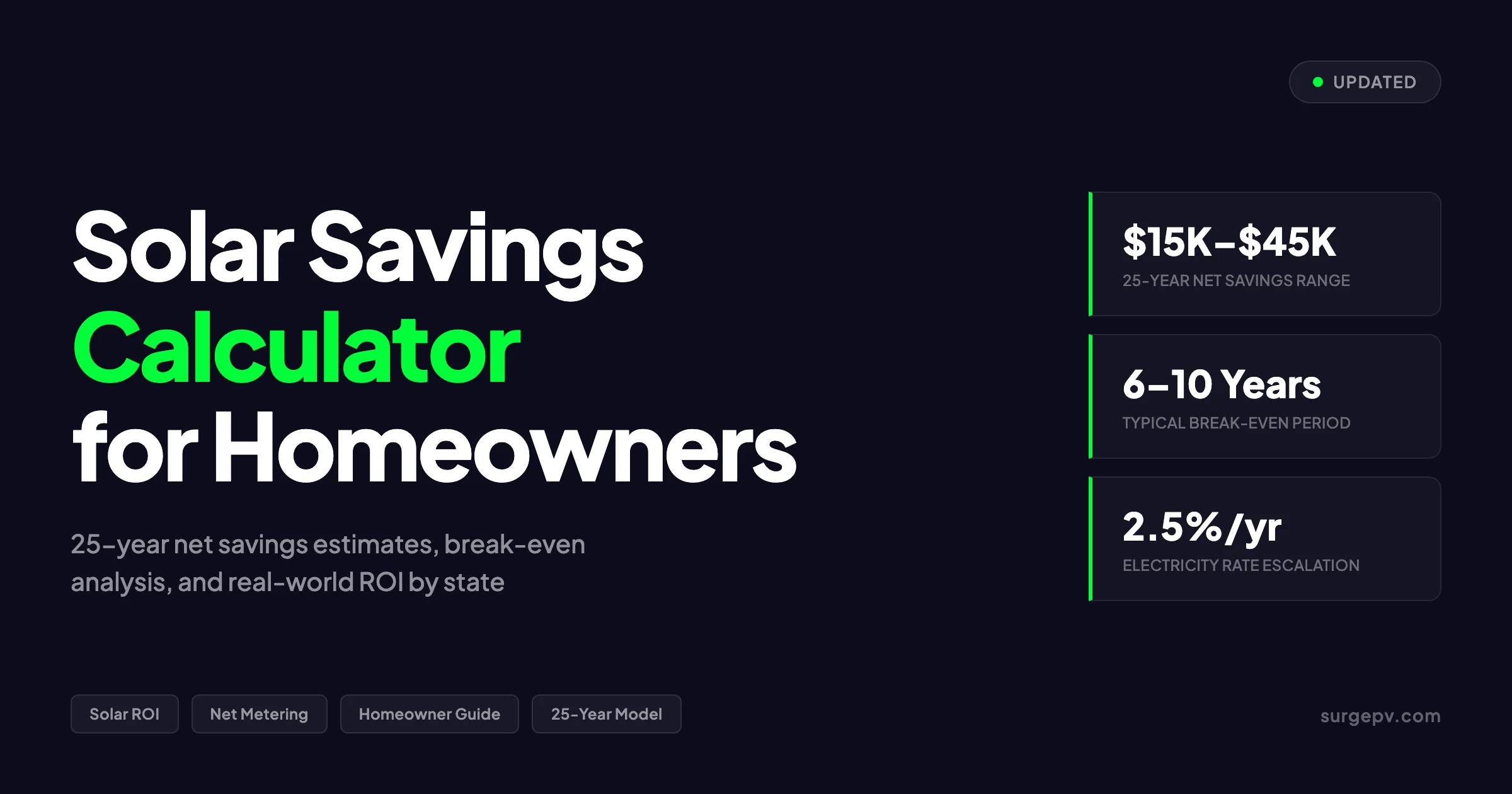
A typical US homeowner saves $15,000–$45,000 over 25 years with a properly sized solar system. The range depends on your state, electricity rate, net metering policy, and whether you finance or pay cash. Use NREL PVWatts for production estimates and verify every assumption a salesperson gives you.
In this guide:
- What a solar savings calculator does and what inputs it needs
- System cost inputs: size, location, and installation pricing
- Electricity rate and escalation assumptions
- Production estimates and self-consumption rates
- Net metering vs. feed-in tariff impact on savings
- 25-year cumulative savings model with year-by-year table
- Incentive impact on net savings (ITC expired, state incentives)
- Battery storage and its impact on savings
- Regional savings comparison (US states, EU countries)
- Common mistakes in savings estimation
- What most homeowners get wrong about savings
- Break-even point analysis
What a Solar Savings Calculator Does
A solar savings calculator estimates the financial return of installing photovoltaic panels on a specific property. It combines location-based solar production data, local electricity rates, system costs, and policy variables into a net savings figure over the system lifetime.
The best calculators do not just spit out a number. They show their work. You should be able to see:
- Estimated annual production in kWh
- Self-consumption vs. export split
- Value of self-consumed energy at retail rates
- Value of exported energy under your net metering policy
- Upfront cost net of incentives
- Financing cost if applicable
- Maintenance and inverter replacement reserves
- Electricity rate escalation applied year by year
The Six Inputs Every Calculator Needs
| Input | Why It Matters | Typical Range |
|---|---|---|
| Location / address | Determines solar irradiance (PVWatts, SolarGIS) | 1,000–2,200 kWh/kW/yr |
| Monthly electricity usage | Sizes the system and sets self-consumption baseline | 500–1,500 kWh/mo |
| Roof characteristics | Shading, orientation, tilt affect production | −15% to +5% vs. optimal |
| Current electricity rate | Sets the value of every self-consumed kWh | $0.10–$0.42/kWh |
| Available incentives | Reduces upfront cost directly | $0–$10,000+ |
| Financing method | Determines interest cost and cash flow timing | Cash, loan, lease, PPA |
My opinion: Most online calculators overstate savings by 15–30%. They assume aggressive electricity rate escalation, ignore inverter replacement, and use optimistic production figures. Always run NREL PVWatts as a sanity check. It is conservative, transparent, and free.
System Cost Inputs: Size, Location, and Installation Pricing
System cost is the foundation of every savings calculation. Get this wrong and everything else is fiction.
US Residential Solar Cost Per Watt (2026)
| System Size | Cost Per Watt | Total Installed Cost | Notes |
|---|---|---|---|
| 3 kW | $3.50–$4.50 | $10,500–$13,500 | Small homes, high $/W due to fixed labor |
| 5 kW | $3.00–$3.80 | $15,000–$19,000 | Common starter size |
| 6 kW | $2.80–$3.60 | $16,800–$21,600 | National average system size |
| 8 kW | $2.60–$3.40 | $20,800–$27,200 | Family homes with EV |
| 10 kW | $2.40–$3.20 | $24,000–$32,000 | Large homes, pool, multiple EVs |
| 12+ kW | $2.20–$3.00 | $26,400–$36,000+ | Very large homes or partial commercial |
Source: NREL Solar Benchmark Q1 2026, EnergySage Marketplace Data. All-in costs include panels, inverter, mounting, labor, permits, and interconnection. Does not include battery storage. Read Adding Battery Storage Services for a complete walkthrough.
What Drives Cost Variation
Geography: California and Massachusetts average $3.00–$3.80/W. Texas and Florida run $2.40–$3.20/W. Hawaii tops $4.00/W due to shipping and labor costs.
Roof complexity: A simple south-facing asphalt shingle roof is cheapest. Tile roofs add $0.20–$0.50/W. Flat roofs with ballast mounting add $0.30–$0.60/W. Steep pitches or multi-level roofs add labor hours.
Equipment tier: Tier 1 panels (Jinko, LONGi, Trina) with string inverters cost less. Premium panels (SunPower, REC) with microinverters or power optimizers add 15–25%.
Installer margin: National installers (Sunrun, Tesla) often price 10–20% above local independents. The tradeoff is warranty backing and service network.
Pro Tip — Getting Accurate Quotes
Request at least 3 quotes from different installer types: one national brand, one strong local independent, and one regional specialist. Price spreads of $5,000–$8,000 for the same system spec are common. The lowest quote is not always best — check NABCEP certification, years in business, and whether they handle permitting and interconnection.
Electricity Rate and Escalation Assumptions
Your current electricity rate sets the baseline. The escalation assumption determines whether your savings grow modestly or dramatically over 25 years.
US Average Residential Electricity Rates by Region (2026)
| Region | Average Rate ($/kWh) | Representative States |
|---|---|---|
| New England | $0.22–$0.32 | MA, CT, RI, NH, VT, ME |
| Middle Atlantic | $0.16–$0.24 | NY, NJ, PA |
| East North Central | $0.14–$0.18 | OH, MI, IN, IL, WI |
| West North Central | $0.12–$0.16 | MN, IA, MO, ND, SD, NE, KS |
| South Atlantic | $0.13–$0.18 | FL, GA, SC, NC, VA, WV, DE, MD, DC |
| East South Central | $0.11–$0.15 | KY, TN, AL, MS |
| West South Central | $0.11–$0.16 | TX, OK, AR, LA |
| Mountain | $0.12–$0.18 | AZ, CO, UT, NV, NM, ID, MT, WY |
| Pacific Contiguous | $0.16–$0.32 | CA, OR, WA |
| Pacific Noncontiguous | $0.28–$0.42 | HI, AK |
Source: EIA Electric Power Monthly, March 2026. Rates are blended averages including fixed charges where applicable.
Rate Escalation: The Hidden Multiplier
Most calculators apply an annual electricity rate escalation of 2–3%. This is reasonable based on historical data. The EIA reports US residential rates rose at a 2.3% compound annual rate from 2010 to 2024.
But escalation is not uniform. California saw rates rise 4.2% annually. Texas rates were flat for a decade due to cheap natural gas, then spiked in 2021–2023.
Impact of escalation assumption on 25-year savings (6 kW system, $0.18/kWh starting rate):
| Escalation Rate | 25-Year Cumulative Savings | Difference from 0% |
|---|---|---|
| 0% (flat rates) | $18,400 | Baseline |
| 1.5% | $24,200 | +$5,800 |
| 2.5% | $29,800 | +$11,400 |
| 4.0% | $38,600 | +$20,200 |
Assumptions: 6 kW system, $18,000 installed cost, no incentives, 8,400 kWh/year production, 40% self-consumption, full net metering, 0.6% panel degradation.
My opinion: Salespeople often use 4–5% escalation to make solar look irresistible. That is not honest. Use 2–2.5% for conservative planning. If rates rise faster, you win. If they do not, you still break even.
Production Estimates and Self-Consumption Rates
A solar savings calculator must estimate how much energy your system will produce and how much of that you will use in real time.
Solar Production by US Region
| Region | Annual Production per kW | 6 kW System Annual Yield |
|---|---|---|
| Southwest (AZ, NV, So. CA) | 1,500–1,750 kWh/kW | 9,000–10,500 kWh |
| Southeast (FL, GA, SC) | 1,350–1,550 kWh/kW | 8,100–9,300 kWh |
| Texas / Oklahoma | 1,400–1,650 kWh/kW | 8,400–9,900 kWh |
| Midwest (IL, OH, IN) | 1,200–1,400 kWh/kW | 7,200–8,400 kWh |
| Northeast (NY, MA, PA) | 1,100–1,350 kWh/kW | 6,600–8,100 kWh |
| Pacific Northwest (WA, OR) | 1,000–1,200 kWh/kW | 6,000–7,200 kWh |
| Hawaii | 1,450–1,700 kWh/kW | 8,700–10,200 kWh |
Source: NREL PVWatts, default settings (south-facing, 20° tilt, 0.8 performance ratio). Actual yields vary by specific location, roof orientation, and shading.
Self-Consumption: The Critical Variable
Self-consumption is the percentage of solar production used in your home in real time. The rest is exported to the grid. Under full net metering, this distinction does not matter financially — you get full retail credit for exports. Under net billing or reduced export rates, it matters enormously.
| Household Profile | Typical Self-Consumption | Why |
|---|---|---|
| Retired couple, home all day | 55–70% | High daytime load |
| Family with kids, someone home | 45–60% | Midday usage from appliances |
| Dual-income, no one home daytime | 25–40% | Low daytime load, high evening |
| Family + EV charged at home | 50–65% | EV charging during solar hours |
| Family + EV + battery | 70–85% | Battery stores midday surplus |
The math: A kWh self-consumed at $0.18/kWh saves $0.18. A kWh exported under net billing at $0.06/kWh saves $0.06. The difference is 3x. This is why self-consumption rate is often more important than total production.
For installers modeling self-consumption accurately, solar design tools with load profile integration is essential. SurgePV’s platform matches production profiles against typical household load curves by region and home size. For a direct comparison, see Arka 360 vs SurgePV.
Net Metering vs. Feed-in Tariff Impact on Savings
Net metering policy is the single largest policy variable in residential solar economics. A system that saves $40,000 under full net metering might save only $20,000 under net billing.
Net Metering Policies by State (2026)
| State | Policy Type | Export Credit Rate | Impact on Savings |
|---|---|---|---|
| California | NEM 3.0 (net billing) | Avoided cost (~$0.05–$0.08/kWh) | Severely reduced vs. NEM 2.0 |
| Arizona | Net billing (APS) | ~$0.10/kWh | Moderately reduced |
| Nevada | Net metering (restored) | Full retail | Favorable |
| Texas | No statewide policy; utility-specific | Varies widely | Check your utility |
| Florida | Full net metering | Full retail | Favorable |
| New York | VDER (value stack) | ~$0.12–$0.18/kWh | Moderately reduced |
| Massachusetts | SMART + net metering | Full retail + incentive | Very favorable |
| Hawaii | No net metering; self-supply only | N/A | Battery required |
| Illinois | Net metering | Full retail | Favorable |
| Colorado | Net metering | Full retail | Favorable |
Source: DSIRE, SEIA state policy summaries, utility tariff filings 2026. Policies change frequently — verify with your utility before deciding.
California NEM 3.0: A Case Study in Policy Change
California’s transition from NEM 2.0 to NEM 3.0 in April 2023 is the most significant net metering change in US solar history.
| Metric | NEM 2.0 (pre-April 2023) | NEM 3.0 (current) |
|---|---|---|
| Export credit | Full retail (~$0.30/kWh) | Avoided cost (~$0.05–$0.08/kWh) |
| 25-year savings (6 kW, CA) | $45,000–$60,000 | $20,000–$30,000 |
| Battery economics | Marginal | Strongly favorable |
| Payback period | 5–7 years | 8–12 years |
The NEM 3.0 export rates are based on an “avoided cost calculator” that values exported energy by time of day. Midday exports (when solar is abundant) receive the lowest rates. Evening exports receive higher rates. This structure makes batteries economically rational — store midday solar and discharge during peak evening hours.
Counterintuitive finding: California solar is still worth it under NEM 3.0. The payback is longer, but the 25-year savings remain positive. The mistake is comparing NEM 3.0 to NEM 2.0. The correct comparison is NEM 3.0 solar to no solar at all. For the latest details on France, see Agricultural Solar Case Study. See our guide on Floating Solar Farms France for more.
25-Year Cumulative Savings Model
Here is a complete year-by-year savings model for a typical US residential solar installation. This is the output a rigorous solar savings calculator should produce.
Base Case: 6 kW System, Midwest, Cash Purchase
Assumptions:
- Location: Columbus, Ohio (1,300 kWh/kW/year)
- System size: 6 kW
- Installed cost: $19,200 ($3.20/W)
- Federal ITC: $0 (expired Dec 2025)
- State incentive: $0
- Electricity rate: $0.15/kWh, escalating 2.5%/year
- Self-consumption: 40%
- Net metering: Full retail credit
- Panel degradation: 0.6%/year
- Inverter replacement: $3,000 at year 13
- Annual maintenance: $150/year
Year-by-Year Savings Table
| Year | Production (kWh) | Self-Consumed (kWh) | Exported (kWh) | Electricity Rate | Bill Savings | Export Credit | Gross Benefit | Maintenance | Net Annual Savings | Cumulative Savings |
|---|---|---|---|---|---|---|---|---|---|---|
| 1 | 7,800 | 3,120 | 4,680 | $0.150 | $468 | $702 | $1,170 | $150 | $1,020 | −$18,180 |
| 2 | 7,753 | 3,101 | 4,652 | $0.154 | $477 | $716 | $1,193 | $150 | $1,043 | −$17,137 |
| 3 | 7,707 | 3,083 | 4,624 | $0.158 | $487 | $731 | $1,218 | $150 | $1,068 | −$16,069 |
| 4 | 7,660 | 3,064 | 4,596 | $0.162 | $496 | $745 | $1,241 | $150 | $1,091 | −$14,978 |
| 5 | 7,614 | 3,046 | 4,568 | $0.166 | $506 | $758 | $1,264 | $150 | $1,114 | −$13,864 |
| 6 | 7,569 | 3,028 | 4,541 | $0.170 | $515 | $772 | $1,287 | $150 | $1,137 | −$12,727 |
| 7 | 7,523 | 3,009 | 4,514 | $0.174 | $524 | $786 | $1,310 | $150 | $1,160 | −$11,567 |
| 8 | 7,478 | 2,991 | 4,487 | $0.179 | $535 | $803 | $1,338 | $150 | $1,188 | −$10,379 |
| 9 | 7,433 | 2,973 | 4,460 | $0.183 | $544 | $816 | $1,360 | $150 | $1,210 | −$9,169 |
| 10 | 7,389 | 2,956 | 4,433 | $0.188 | $555 | $833 | $1,388 | $150 | $1,238 | −$7,931 |
| 11 | 7,344 | 2,938 | 4,406 | $0.193 | $567 | $851 | $1,418 | $150 | $1,268 | −$6,663 |
| 12 | 7,300 | 2,920 | 4,380 | $0.198 | $578 | $867 | $1,445 | $150 | $1,295 | −$5,368 |
| 13 | 7,256 | 2,902 | 4,354 | $0.203 | $589 | $884 | $1,473 | $3,150 | −$1,677 | −$7,045 |
| 14 | 7,213 | 2,885 | 4,328 | $0.208 | $600 | $900 | $1,500 | $150 | $1,350 | −$5,695 |
| 15 | 7,169 | 2,868 | 4,301 | $0.213 | $611 | $917 | $1,528 | $150 | $1,378 | −$4,317 |
| 16 | 7,126 | 2,850 | 4,276 | $0.218 | $622 | $933 | $1,555 | $150 | $1,405 | −$2,912 |
| 17 | 7,083 | 2,833 | 4,250 | $0.224 | $635 | $952 | $1,587 | $150 | $1,437 | −$1,475 |
| 18 | 7,041 | 2,816 | 4,225 | $0.229 | $645 | $968 | $1,613 | $150 | $1,463 | −$12 |
| 19 | 6,998 | 2,799 | 4,199 | $0.235 | $658 | $987 | $1,645 | $150 | $1,495 | $1,483 |
| 20 | 6,956 | 2,782 | 4,174 | $0.241 | $670 | $1,006 | $1,676 | $150 | $1,526 | $3,009 |
| 21 | 6,914 | 2,766 | 4,148 | $0.247 | $683 | $1,025 | $1,708 | $150 | $1,558 | $4,567 |
| 22 | 6,873 | 2,749 | 4,124 | $0.253 | $696 | $1,044 | $1,740 | $150 | $1,590 | $6,157 |
| 23 | 6,831 | 2,732 | 4,099 | $0.259 | $708 | $1,062 | $1,770 | $150 | $1,620 | $7,777 |
| 24 | 6,790 | 2,716 | 4,074 | $0.266 | $722 | $1,084 | $1,806 | $150 | $1,656 | $9,433 |
| 25 | 6,750 | 2,700 | 4,050 | $0.273 | $737 | $1,106 | $1,843 | $150 | $1,693 | $11,126 |
Key results for this base case:
- Break-even point: Year 18.5
- 25-year cumulative net savings: $11,126
- Simple payback (undiscounted): 18.5 years
- IRR (25-year): 4.2%
This base case is conservative — no federal tax credit, Midwest production, moderate electricity rate. It still breaks even and delivers positive returns.
Optimistic Case: Same System, Arizona, With ITC (Legacy)
| Parameter | Value |
|---|---|
| Location | Phoenix, Arizona |
| Production (Year 1) | 10,200 kWh |
| Electricity rate | $0.14/kWh, 2.5% escalation |
| Installed cost | $17,400 ($2.90/W) |
| Federal ITC (30%) | −$5,220 |
| Net upfront cost | $12,180 |
| Self-consumption | 45% |
| Break-even | Year 7.2 |
| 25-year cumulative savings | $38,400 |
| IRR | 14.8% |
The difference between the Midwest base case and the Arizona optimistic case is $27,000 in 25-year savings. Location, incentives, and electricity rates matter more than system size.
Incentive Impact on Net Savings
Incentives directly reduce upfront cost. Every dollar of incentive improves payback and IRR.
Federal Incentive Status (2026)
The 30% federal Investment Tax Credit (ITC) expired for residential solar on December 31, 2025. Systems placed in service before that date can still claim the credit. For 2026 and beyond, no federal residential ITC exists unless Congress extends it.
| System Size | Gross Cost | ITC (if eligible) | Net Cost |
|---|---|---|---|
| 5 kW | $16,000 | $4,800 | $11,200 |
| 6 kW | $19,200 | $5,760 | $13,440 |
| 8 kW | $24,000 | $7,200 | $16,800 |
| 10 kW | $29,000 | $8,700 | $20,300 |
Active State and Utility Incentives (2026)
| State / Program | Incentive Type | Typical Value | Status |
|---|---|---|---|
| Massachusetts SMART | Performance-based | $0.02–$0.04/kWh for 10 years | Active |
| New York NY-Sun | Rebate | $0.20–$0.35/W | Active, declining |
| Illinois Shines | Rebate | $0.50–$0.80/W (SREC equivalent) | Active |
| New Jersey SREC-II | SREC market | $70–$110/SREC | Active, market-priced |
| Connecticut Green Bank | Low-interest loan | 0–2.99% APR | Active |
| Hawaii Tax Credit | State tax credit | 35% of cost | Active |
| Texas — no statewide | Utility rebates | Varies (CPS, Oncor) | Check locally |
| Florida — no statewide | Property tax exemption | 100% exempt | Permanent |
| Arizona — no statewide | Sales tax exemption | 100% exempt | Permanent |
Source: DSIRE database, state energy office websites, Q1 2026. Programs change frequently. Verify current status before making financial decisions.
The Financing Multiplier
How you pay for solar changes the savings math significantly:
| Financing Type | Upfront Cost | Monthly Payment | 25-Year Total Cost | 25-Year Net Savings |
|---|---|---|---|---|
| Cash purchase | Full | $0 | $19,200 | $11,100–$38,400 |
| 20-year loan at 6% | $0 | $137/mo | $32,880 | $8,000–$25,000 |
| 20-year loan at 4% | $0 | $116/mo | $27,840 | $12,000–$30,000 |
| Solar lease | $0 | $85–$120/mo | $25,500–$36,000 | $5,000–$15,000 |
| PPA | $0 | $0.12–$0.16/kWh | Varies by production | $3,000–$12,000 |
Based on 6 kW system, Midwest to Southwest range. Loan savings assume loan covers full system cost net of any incentives.
My opinion: Cash purchase delivers the highest lifetime savings but requires capital. A low-interest loan (under 5%) is the best compromise for most homeowners — you keep the tax benefits (if available), own the system, and spread the cost. Leases and PPAs are simple but cap your savings. Avoid them if you can qualify for a loan.
Battery Storage and Its Impact on Savings
Battery storage changes the economics in specific markets. It is not universally beneficial.
When Batteries Increase Savings
- Time-of-use rates: Store solar at midday (low rates) and discharge during peak evening (high rates)
- Net billing markets: Store low-value exported energy instead of selling it cheap
- Backup power value: Avoid food spoilage, medical equipment downtime, work interruption
- Demand charge reduction: Relevant for some commercial and large residential customers
When Batteries Do Not Pay Back
- Full net metering + flat rates: You already get full retail credit for exports. A battery adds cost without adding value.
- Low electricity rates: At $0.11/kWh, the value of stored energy is too low to justify battery cost.
- Short system life: If you plan to move in 5–7 years, you may not recover battery cost before selling.
Battery Economics by Market (2026)
| Battery Size | Installed Cost | Annual Savings Boost | Simple Payback | 25-Year NPV Impact |
|---|---|---|---|---|
| 10 kWh (Tesla Powerwall 3) | $8,000–$12,000 | $400–$800 | 10–25 years | −$2,000 to +$4,000 |
| 13.5 kWh (Enphase 5P) | $10,000–$14,000 | $500–$1,000 | 10–22 years | −$1,000 to +$5,000 |
| 5 kWh (entry LFP) | $4,000–$6,000 | $200–$400 | 10–25 years | −$1,500 to +$1,000 |
Savings boost assumes California NEM 3.0 or similar time-of-use market. In full net metering markets, savings boost is near zero.
The tradeoff: Batteries add $8,000–$14,000 to system cost. In California under NEM 3.0, they can improve 25-year savings by $5,000–$15,000. In Florida with full net metering, they add cost without financial return. The decision should be based on your specific utility rate structure, not generic advice.
Further Reading
For a detailed comparison of AC-coupled vs. DC-coupled battery systems and their impact on solar design, see our guide on AC vs. DC coupled solar storage.
Read AC Coupled vs DC Coupled Battery Solar for a complete walkthrough.
Regional Savings Comparison
Solar savings vary dramatically by region. Here is a comprehensive comparison.
US State Solar Savings Comparison (6 kW System, Cash Purchase)
| State | Production (kWh/yr) | Electricity Rate | 25-Year Savings | Break-Even | Key Policy |
|---|---|---|---|---|---|
| Hawaii | 9,600 | $0.38 | $58,000 | 4.5 yr | 35% state tax credit |
| California | 9,300 | $0.28 | $28,000 | 7.5 yr | NEM 3.0 (net billing) |
| Massachusetts | 7,500 | $0.30 | $32,000 | 6.5 yr | SMART + net metering |
| Arizona | 10,200 | $0.14 | $24,000 | 7.0 yr | Net billing (APS) |
| New York | 7,200 | $0.22 | $22,000 | 8.0 yr | VDER value stack |
| Texas | 9,000 | $0.13 | $18,000 | 9.0 yr | Utility-specific |
| Florida | 8,400 | $0.14 | $20,000 | 8.0 yr | Full net metering |
| Illinois | 7,500 | $0.15 | $19,000 | 8.5 yr | Net metering + Shines |
| Ohio | 7,800 | $0.15 | $18,000 | 9.0 yr | Net metering |
| Washington | 6,600 | $0.11 | $10,000 | 13.0 yr | Net metering |
| Oregon | 6,900 | $0.12 | $12,000 | 11.5 yr | Net metering |
Assumptions: 6 kW system, $3.00/W average installed cost, no federal ITC (post-2025), 40% self-consumption, 2.5% rate escalation, 0.6% degradation, $3,000 inverter replacement at year 13, $150/year maintenance. Savings are net of all costs.
European Comparison
| Country | Installed Cost (€/kWp) | Electricity Rate | 25-Year Savings (6 kWp) | Break-Even |
|---|---|---|---|---|
| Germany | €1,200–€1,600 | €0.35–€0.42 | €18,000–€28,000 | 7–10 yr |
| Italy | €1,100–€1,500 | €0.28–€0.35 | €15,000–€30,000 | 5–8 yr |
| Spain | €900–€1,300 | €0.18–€0.25 | €12,000–€20,000 | 6–9 yr |
| France | €1,400–€1,900 | €0.22–€0.28 | €10,000–€18,000 | 8–12 yr |
| UK | £1,200–£1,800 | £0.30–£0.36 | £12,000–£22,000 | 7–11 yr |
| Netherlands | €1,100–€1,500 | €0.32–€0.40 | €18,000–€28,000 | 6–9 yr |
European savings include active national incentives (Italy 50% tax deduction, Netherlands net metering transition, etc.) as of 2026. Also see: European Solar Incentives. For Italy-specific information, see Commercial Rooftop Solar Case Study Italy. For Europe-specific compliance details, see Europe solar compliance.
Common Mistakes in Savings Estimation
Homeowners and even some installers make consistent errors when estimating solar savings. Here are the most costly ones.
Mistake 1: Ignoring Inverter Replacement
String inverters last 10–15 years. Microinverters and power optimizers last 20–25 years. A string inverter replacement costs $2,000–$4,000 including labor. Calculators that ignore this overstate savings by $2,000–$4,000.
Mistake 2: Assuming 100% Offset
Your solar system offsets your electricity usage. It does not eliminate your utility bill. Most utilities charge a fixed monthly connection fee ($10–$25) that solar cannot remove. Some also charge minimum usage fees or demand charges. Your post-solar bill is rarely zero. For United States-specific compliance details, see United States arizona/phoenix.
Mistake 3: Overstating Rate Escalation
A 4% annual escalation assumption turns $0.15/kWh into $0.40/kWh over 25 years. Historical US average is 2.3%. Some states have seen flat or declining rates. Aggressive escalation assumptions inflate savings projections by 30–50%.
Mistake 4: Using Nameplate Capacity for Production
A 6 kW system does not produce 6 kW × 24 hours × 365 days. Real-world production is 15–22% of nameplate capacity on an annual basis due to night, clouds, temperature losses, and system inefficiencies. A 6 kW system in Ohio produces ~7,800 kWh/year, not 52,560 kWh.
Mistake 5: Ignoring Financing Cost
A $20,000 system financed at 6% over 20 years costs $32,880 in total payments. The interest cost is $12,880. Cash savings and financed savings are not the same. Always model your actual financing terms.
Mistake 6: Forgetting Panel Degradation
Solar panels lose 0.5–0.8% of output per year. Over 25 years, a system producing 8,000 kWh in year 1 produces ~6,800 kWh in year 25. Calculators that use flat production overstate year-25 savings by 15%.
Pro Tip — Sanity Check Any Quote
Take any solar savings estimate and divide the 25-year savings by 25. Does the annual savings number match your expected bill reduction? If a salesperson projects $50,000 in savings on a $20,000 system, that is $2,000/year. Does a $200/month bill drop to near zero? If not, question the assumptions.
What Most Homeowners Get Wrong About Savings
The solar industry has done a poor job of educating homeowners on three realities.
Reality 1: Solar Is a Long-Term Asset, Not a Quick Win
The break-even period is 6–12 years for most systems. That is a long time. If you plan to move within 5 years, solar may not pay back before you sell. Yes, studies show solar increases home value by 3–4% (Berkeley Lab, 2019). But the premium varies by market, and not every buyer values solar equally.
My opinion: Do not install solar primarily as a home improvement investment. Install it because you plan to stay and you want to control your energy costs. The home value boost is a bonus, not the main event.
Reality 2: Your Utility Can Change the Rules
Net metering policies change. California proved this in 2023. Nevada proved it in 2015–2017. Your 25-year savings projection assumes current policy holds. It may not. This is an unquantifiable risk that no calculator captures.
The hedge: size your system for high self-consumption. The less you depend on export compensation, the less policy risk you carry.
Reality 3: Maintenance Is Real
Panels need cleaning in dusty or pollen-heavy climates. Inverters fail. Monitoring systems need attention. Squirrels chew wiring. These are not hypothetical problems. Budget $100–$300/year for maintenance and expect at least one significant repair in 25 years.
A failure example: A homeowner in rural Texas installed a 10 kW system with no monitoring. A squirrel chewed through DC wiring in year 3. The system was offline for 8 months before he noticed his bill had risen. The repair cost $800. The lost production cost $900. One year of neglect erased 10% of his projected 25-year savings.
Break-Even Point Analysis
Break-even is the point where cumulative savings equal cumulative costs. Before this point, you are underwater. After this point, every kWh is profit.
Factors That Shorten Break-Even
| Factor | Impact | How to Achieve It |
|---|---|---|
| High electricity rate | +$500–$1,500/year savings | Live in CA, MA, HI, or CT |
| High solar irradiance | +500–2,000 kWh/year | Live in AZ, NV, NM, or FL |
| High self-consumption | +$200–$600/year | Add battery, shift loads to daytime |
| Low installed cost | −$2,000–$5,000 upfront | Get multiple quotes, avoid premium brands |
| Strong incentives | −$3,000–$8,000 net cost | Check DSIRE, state programs, utility rebates |
| Low financing cost | −$3,000–$6,000 interest | Use home equity loan, green bank loan |
Break-Even by Scenario
| Scenario | Upfront Cost | Annual Net Savings | Break-Even |
|---|---|---|---|
| Conservative (OH, no incentives, cash) | $19,200 | $1,020 | 18.5 yr |
| Moderate (TX, small utility rebate, 5% loan) | $17,000 | $1,400 | 12.5 yr |
| Good (FL, cash, full net metering) | $18,000 | $1,800 | 10.0 yr |
| Strong (AZ, cash, good irradiance) | $17,400 | $2,100 | 8.3 yr |
| Excellent (MA, SMART + net metering, cash) | $18,000 | $2,400 | 7.5 yr |
| Optimal (HI, 35% state credit, cash) | $14,800 | $3,200 | 4.6 yr |
How to Use a Solar Savings Calculator Correctly
Here is the process I recommend for any homeowner considering solar.
Step 1: Run NREL PVWatts
Go to pvwatts.nrel.gov. Enter your address. Use default settings for the first run. Note the annual production estimate. This is your unbiased baseline.
Step 2: Get Your Actual Usage and Rate
Pull 12 months of electricity bills. Calculate your average monthly usage in kWh and your effective rate ($/kWh including all fees). Do not use the headline rate — use total bill divided by total kWh.
Step 3: Size Your System
A common rule: system size (kW) = annual usage (kWh) ÷ (production per kW in your area). In Ohio: 10,000 kWh/year ÷ 1,300 kWh/kW = 7.7 kW system. Size for 80–100% offset depending on net metering rules.
Step 4: Get 3 Quotes
Use EnergySage, SolarReviews, or local referrals. Compare $/W, equipment, warranty, and installer reputation. The lowest price is not always best.
Step 5: Build Your Own Model
Use the year-by-year table format in this guide. Plug in your actual numbers. Apply conservative assumptions: 2% rate escalation, 0.6% degradation, $3,000 inverter replacement, $150/year maintenance.
Step 6: Compare to Salesperson Projections
If the salesperson’s 25-year savings are more than 25% above your conservative model, ask them to justify every assumption. If they cannot, their projection is optimistic.
Model Accurate Solar Savings for Every Client
SurgePV’s generation and financial tool builds bankable 25-year savings models with regional irradiance, utility rate structures, and net metering policies pre-loaded. Stop guessing. Start modeling with real data.
Book a DemoNo commitment required · 20 minutes · Live project walkthrough
Conclusion
A solar savings calculator is a tool, not a prophecy. The quality of its output depends entirely on the quality of its inputs.
- Use conservative assumptions. 2% rate escalation, 0.6% degradation, real maintenance costs.
- Verify net metering policy. Full net metering and net billing produce radically different results.
- Get multiple quotes. Price spreads of $5,000+ are common for identical systems.
- Plan for the long term. Solar pays off over 15–25 years, not 2–3 years.
The homeowner in Phoenix who tracks ahead of projection is not lucky. She sized her system correctly, used conservative estimates, and her utility raised rates. The math works when the assumptions are honest.
Tools & Further Reading
Continue exploring related SurgePV resources:
Frequently Asked Questions
How much can I save with solar panels over 25 years?
A typical US homeowner with a 6–8 kW solar system saves $15,000–$45,000 over 25 years after accounting for installation cost, incentives, and electricity rate escalation. The exact number depends on your state (sunny states like Arizona and California yield higher savings), your current electricity rate (higher rates = bigger savings), and your net metering policy. Systems in high-rate states with strong net metering often reach $35,000–$50,000 in cumulative savings.
What inputs does a solar savings calculator need?
A reliable solar savings calculator requires six inputs: (1) your location (zip code or address) to estimate solar irradiance and production, (2) your average monthly electricity bill or usage in kWh, (3) your roof characteristics (size, orientation, shading), (4) current electricity rate and utility name, (5) available incentives (federal, state, local, utility), and (6) financing method (cash, loan, lease, or PPA). The most accurate calculators also factor in electricity rate escalation (2–3% per year), panel degradation (0.5–0.8% annually), and inverter replacement around year 12–15.
Is the 30% federal solar tax credit still available in 2026?
No. The 30% federal Investment Tax Credit (ITC) for residential solar expired on December 31, 2025, and was not extended by Congress. Homeowners who placed systems in service before that date can still claim the credit. For systems installed in 2026 and beyond, the residential ITC is no longer available. Some states and utilities still offer rebates, tax credits, or performance-based incentives. Check the Database of State Incentives for Renewables (DSIRE) for current programs in your area.
How does net metering affect solar savings?
Net metering is the single most important policy for residential solar savings. Under full net metering, every kilowatt-hour your system exports to the grid earns a credit equal to the full retail rate you pay for grid electricity. This effectively values your exported solar at $0.14–$0.35/kWh depending on your state. Under net billing or reduced export rates (common in California under NEM 3.0, Arizona, and Nevada), exported energy is valued at a lower avoided-cost rate — often $0.05–$0.08/kWh. The difference between full net metering and net billing can reduce 25-year savings by $10,000–$20,000 for a typical residential system.
Does battery storage increase solar savings?
Battery storage increases total solar savings in markets with time-of-use rates, demand charges, or weak net metering policies. In California under NEM 3.0, a battery stores midday solar production and discharges it during peak evening hours when grid rates are highest — increasing the value of each stored kWh from $0.08 to $0.35+. In states with full net metering and flat rates, batteries typically do not pay back their incremental cost within the system lifetime. The break-even for residential batteries is 10–15 years in most US markets as of 2026.
What is a good break-even period for residential solar?
A good break-even period for residential solar in the US is 6–10 years. Systems in sunny states with high electricity rates (California, Hawaii, Massachusetts) often break even in 5–7 years. Systems in lower-irradiance or lower-rate markets (Washington, Oregon, parts of the Midwest) may take 10–14 years. Any system that breaks even in under 12 years is generally considered a sound investment given the 25–30 year system lifespan. After break-even, every kWh produced is effectively free energy.
Why do solar savings estimates vary so much between calculators?
Solar savings estimates vary because calculators use different assumptions for five key variables: (1) electricity rate escalation (some use 0%, others use 3%+ annually), (2) panel degradation (0.5% vs 0.8% per year makes a 7.5% difference over 25 years), (3) financing cost (cash vs loan changes net savings dramatically), (4) net metering policy (full retail credit vs avoided-cost export rates), and (5) incentive stack (some calculators include expired programs). Always check the assumptions panel and compare multiple calculators. The NREL PVWatts calculator is the most transparent and widely trusted.
What is the most common mistake homeowners make when estimating solar savings?
The most common mistake is assuming 100% of solar production replaces grid purchases at the full retail rate. In reality, most households self-consume only 30–50% of their solar production in real time. The rest is exported to the grid. Under full net metering, this still yields full retail credit. Under net billing or reduced export rates, the value of exported energy drops sharply. Homeowners also frequently ignore inverter replacement cost ($2,000–$4,000 around year 12–15), panel cleaning and maintenance ($100–$300/year), and the fact that some utility fees are fixed charges that solar cannot eliminate.
How do electricity rate escalations affect long-term solar savings?
Electricity rate escalation is one of the most powerful drivers of solar savings. At 2.5% annual escalation, a $0.15/kWh rate becomes $0.27/kWh by year 25. A solar system locked in at today’s cost effectively generates electricity at a fixed rate for 25 years. Every percentage point of escalation adds roughly $2,000–$4,000 to 25-year cumulative savings for a typical 6 kW system. However, some utilities have held rates flat or even decreased them due to cheap natural gas — so assuming 4–5% escalation, as some solar salespeople do, inflates projections unrealistically.
Should I use a solar savings calculator or hire a professional?
Use a calculator for initial screening and a professional for final decision-making. Free online calculators (NREL PVWatts, EnergySage) give accurate production estimates and rough savings ranges. They are excellent for answering “is solar worth exploring for my home?” A professional solar installer or energy advisor adds value by assessing roof condition, shading from trees and neighboring buildings, local permit requirements, utility interconnection rules, and financing options. For a $15,000–$30,000 investment, the $0 cost of getting 2–3 professional quotes is a small price for accuracy.
Where this fits
This article is part of SurgePV's Solar Business & Operations hub, which works through the topic from first principles to the decisions a project team actually has to make.
