

The data center industry is now the fastest-growing source of electricity demand in advanced economies. Global data center electricity consumption is projected to reach 565 terawatt-hours in 2026, up 26 percent from 447 TWh in 2025, according to Gartner. AI-optimized servers alone will account for 31 percent of that consumption. Total data center power demand is expected to rise to 132 gigawatts in 2026 and 290 GW by 2030.
That growth has turned power from a facilities input into a strategic constraint. In markets like Northern Virginia, Dublin and Singapore, new builds are being delayed by grid interconnection queues. The wait now stretches four to seven years. Solar is one of the few resources that can be deployed inside that window. The financial case has become unusually strong for facilities that consume electricity around the clock.
This guide is written for data center operators, energy procurement managers and EPCs preparing commercial solar tenders. It explains how to calculate solar ROI for a data center. It also covers why the numbers differ from generic commercial solar, and which financing structure captures the most value in 2026.
Quick Answer
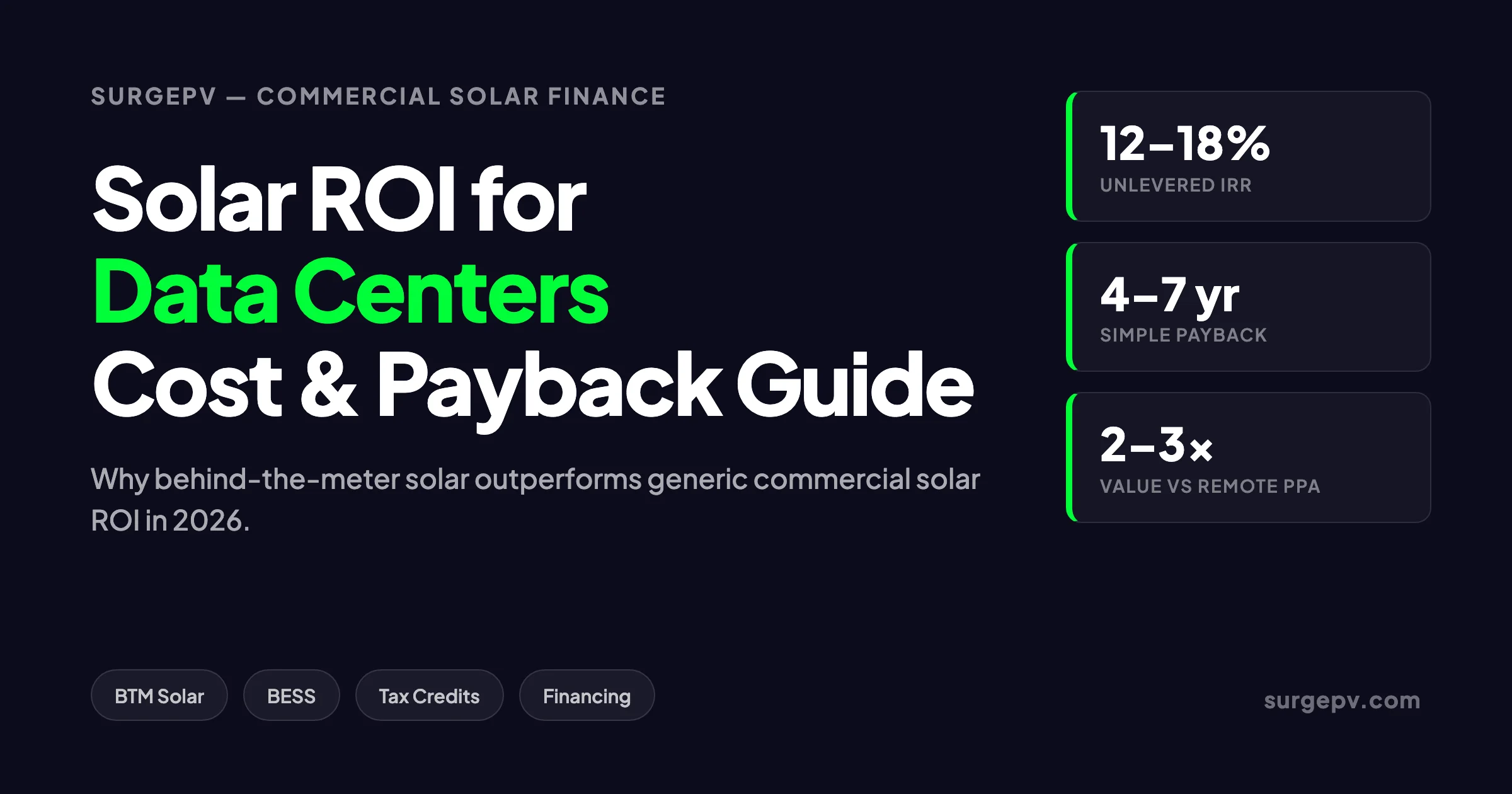
Behind-the-meter solar at a data center typically pays back in 4 to 7 years and generates a 12 to 18 percent unlevered IRR. The ROI is higher than generic commercial solar. Data centers consume power 24/7, face steep demand charges, and avoid transmission and distribution fees on every onsite kilowatt-hour.
What this guide covers:
- Why data center solar ROI differs from ordinary commercial solar
- The full cost stack for a data center solar plus storage project
- A worked ROI calculation for a 1 MW IT load facility
- Ownership, PPA and lease trade-offs
- How demand charges change the math
- The impact of battery storage on returns
- Federal tax credits and depreciation in 2026
- When data center solar ROI does not clear hurdle rates
- Common modeling mistakes that kill ROI
Why Data Center Solar ROI Is Different
Most commercial buildings use electricity during business hours and shut down at night. Their solar self-consumption rate is often 30 to 50 percent, with the remainder exported to the grid at a wholesale or net-metering rate. Data centers invert that profile. They run continuously, which means nearly every kilowatt-hour produced by an onsite array is consumed immediately at the retail rate.
This high self-consumption rate is the first reason data center solar ROI is stronger. The second is the bill structure. Industrial electricity tariffs for data centers include three large components:
- Energy charges: the per-kWh rate for electricity consumed
- Demand charges: a monthly fee based on the highest 15-minute average kW
- Transmission and distribution charges: fees for moving power across the grid
ModulEdge estimates that transmission, distribution and demand charges can exceed 50 percent of an industrial electricity bill. Behind-the-meter solar avoids all three on the energy it produces. A remote PPA or virtual PPA only avoids the energy charge. That is why BTM solar typically delivers 2 to 3 times more financial value per kWh than a utility-scale PPA.
The third difference is scale. A 1 MW IT load data center at a Power Usage Effectiveness of 1.4 draws 1.4 MW continuously, or roughly 12.3 GWh per year. A 30 percent solar offset requires 4 to 5 MWp of PV. The project is large enough to capture installer economies of scale, use ground-mount trackers, and justify a dedicated battery plant. Smaller commercial roofs rarely achieve those efficiencies.
Global utility-scale solar LCOE has fallen to roughly $0.043 per kWh, according to IRENA. Data centers that install behind-the-meter solar capture that low generation cost while avoiding retail delivery charges, which widens the spread further. The fourth difference is tenure. Data centers are built for 25 to 40 years, which matches the 30-year productive life of modern solar modules. The asset and the load live on similar timelines, so long-term financing, PPA contracts and warranty extensions all make sense.
For a deeper look at the engineering side, read our guide to data center solar and storage sizing.
The Cost Stack for Data Center Solar in 2026
A credible ROI model starts with an accurate cost stack. The numbers below reflect US market pricing as of mid-2026 for a commercial-scale, ground-mount or carport project.
| Component | Unit Cost | Notes |
|---|---|---|
| Solar PV modules and racking | $0.40–$0.55 per Wdc | Bifacial modules on single-axis trackers at the higher end |
| Inverters and MV transformers | $0.12–$0.18 per Wdc | Central or string inverters with medium-voltage step-up |
| Installation and BOS | $0.18–$0.25 per Wdc | Civil, electrical, commissioning |
| Engineering and permitting | $0.08–$0.12 per Wdc | PE-stamped drawings, interconnection studies |
| Total solar CapEx | $0.85–$1.10 per Wdc | Before ITC and MACRS |
| BESS | $250–$320 per kWh | 4-hour LFP system, installed |
| EPC margin and contingency | 8–12 percent of hard costs | Risk allocation and contractor overhead |
For a 5 MWp solar array paired with 10 MWh of storage, the pre-incentive capital cost ranges from $7.5 million to $10.5 million. The solar portion is roughly $4.5 million to $5.5 million. The battery portion is $2.5 million to $3.2 million. Soft costs, EPC margin and contingency account for the remainder. The Lawrence Berkeley National Laboratory Utility-Scale Solar report tracks these cost benchmarks annually for the US market.
Operating costs are lower but persistent:
- O&M: $10 to $15 per kW per year for solar; $8 to $12 per kW-year for BESS
- Insurance: 0.4 to 0.6 percent of asset value per year
- Property tax: 0.8 to 1.5 percent of CapEx in most jurisdictions
- Inverter replacement: budget 15 to 20 percent of original inverter cost in year 12 to 15
- BESS replacement: plan 50 to 65 percent of original battery cost in year 12 to 15
These figures are for direct ownership. Under a PPA, many of them sit with the investor, but the host pays a long-term energy rate that embeds the same costs plus investor return.
How to Calculate Solar ROI for a Data Center
The cleanest way to value a data center solar project is a discounted cash-flow model. Inputs include capital cost, annual production, energy savings, demand-charge savings, tax credits, depreciation, O&M, financing and a discount rate. Outputs include simple payback, net present value and internal rate of return.
Here is a worked example for a 1 MW IT load facility in Arizona.
Facility assumptions
- IT load: 1 MW continuous
- PUE: 1.4
- Total facility load: 1.4 MW
- Annual energy: 12,264 MWh
- Utility rate: $0.10 per kWh
- Demand charge: $20 per kW per month
- Solar offset target: 50 percent
Solar and storage sizing
- Required solar energy: 6,132 MWh per year
- Arizona capacity factor: 24 percent
- Performance ratio: 0.85
- Required DC capacity: 6,132 / (8,760 × 0.24 × 0.85) = 3.43 MWp
- Battery: 2 MW / 4 MWh for time-shift and peak shave
Capital cost
- 3.43 MWp solar at $0.95 per Wdc: $3.26 million
- 4 MWh BESS at $290 per kWh: $1.16 million
- Soft costs and contingency at 12 percent: $0.53 million
- Total CapEx: $4.95 million
Annual savings
- Energy savings: 6,132 MWh × $0.10 = $613,200
- Demand charge reduction: 1.0 MW × $20/kW/month × 12 = $240,000
- T&D and capacity charge avoided on solar kWh: $0.03 per kWh × 6,132 MWh = $183,960
- Total gross savings: $1,037,160
Incentives
- Federal ITC at 30 percent: $1.49 million tax credit
- MACRS depreciation: $4.95 million × 80 percent depreciable basis × 21 percent tax rate × time-value benefit ≈ $0.70 million NPV
- Net CapEx after incentives: $2.76 million
Returns
- Simple payback post-ITC: $2.76M / $1.04M = 2.7 years
- 25-year unlevered IRR: approximately 22 percent
- 25-year NPV at 8 percent discount: approximately $6.8 million
This is an optimistic but realistic case for a sunny US market with strong demand charges. In lower-irradiance markets, or where demand charges are below $10 per kW per month, the payback stretches toward 5 to 7 years. The IRR falls to 12 to 15 percent.
The generation and financial tool in SurgePV models this exact cash flow including 8760-hour production, BESS dispatch and tariff structures.
Ownership, PPA or Lease: Which Financing Model Wins
Data center operators can acquire solar through three main structures. The right choice depends on balance sheet capacity, tax appetite and whether the project is core to the business.
| Factor | Direct Ownership | Behind-the-Meter PPA | Solar Lease |
|---|---|---|---|
| Upfront capital | High | Low or zero | Low or zero |
| Captures ITC and MACRS | Yes | No — passes to investor | No — passes to lessor |
| Long-term savings | Highest | Moderate | Lowest |
| Balance sheet treatment | Asset and liability | Contractual offtake | Lease liability |
| O&M responsibility | Owner or EPC | Investor | Lessor |
| Best for | Profitable operators with tax appetite | Capital-constrained or non-core projects | Simplest procurement, least upside |
Direct ownership is the value-maximizing path when the operator can use the 30 percent ITC and depreciation. The payback in the Arizona example above compresses from roughly 7 years pre-incentive to under 3 years post-incentive. Ownership also retains residual asset value after year 25.
A behind-the-meter PPA is attractive when capital is constrained or when the data center operator does not have enough taxable income to absorb the ITC. The host pays a fixed per-kWh rate, usually 10 to 30 percent below the blended utility rate, for 15 to 25 years. The investor captures tax benefits and depreciation, so the host gives up some upside in exchange for zero capital at risk.
A solar lease is operationally similar to a PPA but typically pays a fixed monthly amount regardless of production. It is the simplest structure but usually the most expensive over the contract life. It works best for operators that want a single line item and no performance risk.
For most data center operators with a multi-year facility horizon, direct ownership wins on IRR. The exception is a short lease term or a balance sheet that cannot carry the asset. In those cases, a PPA still delivers meaningful savings with no capital outlay.
See our glossary entry on solar PPAs for a fuller explanation of contract structures.
The Demand Charge Advantage
Demand charges are the least understood and most valuable part of data center solar economics. A data center’s monthly peak often occurs during a hot afternoon when cooling and IT load align. Solar production also peaks at midday. The overlap means solar directly reduces the peak kW that sets the demand charge.
A battery adds precision. It can discharge during the exact 15-minute interval when the facility hits its monthly peak, shaving 1 MW or more off the billed demand. At $20 per kW per month, shaving 1 MW saves $240,000 per year. At $30 per kW per month, the same battery saves $360,000 per year.
This is why a battery can pay for itself on demand-charge savings alone, before it ever stores a solar kilowatt-hour. A 4 MWh battery that shaves 1 MW of peak for two hours per day pays back in roughly 4 to 6 years. That assumes a high-demand-charge market.
The mistake many models make is to ignore demand charges entirely or to assume solar production perfectly tracks the peak. It does not. Clouds, maintenance and load variation mean a battery is usually needed to capture the full demand-charge value. For more detail, see our guide to demand charges.
Battery Storage and Its Impact on ROI
Battery storage is no longer a premium add-on for data center solar. Pack prices for stationary lithium iron phosphate systems fell to roughly $70 per kWh at the cell level in 2025, according to BloombergNEF. Fully installed systems now sit at $250 to $320 per kWh. JLL’s 2026 Global Data Center Outlook expects the global average BESS price to fall below $90 per kWh at the cell level. That makes storage a standard infrastructure component.
A battery improves solar ROI in four ways:
- Time-shift: store midday solar surplus and discharge during evening peak rates
- Peak shave: cut the highest 15-minute kW each month
- Self-consumption: increase the percentage of solar consumed onsite instead of exported at low value
- Ride-through: bridge the seconds between grid loss and generator start
In the Arizona example, adding a 4 MWh battery increased the annual savings by roughly $240,000 in demand-charge reduction and $80,000 in time-of-use arbitrage. The battery added $1.16 million to CapEx but improved project NPV by roughly $1.8 million. The solar-plus-storage IRR was approximately 4 percentage points higher than solar alone.
The right battery size depends on tariff structure as much as on solar capacity. A facility with high demand charges and a wide time-of-use spread justifies a larger battery. A facility with flat rates and low demand charges may not need storage at all.
Federal Tax Credits and Depreciation in 2026
The US federal incentives for commercial solar remain attractive in 2026, though some deadlines are approaching.
Investment Tax Credit. Solar and standalone energy storage placed in service in 2026 qualify for a 30 percent tax credit. The IRS publishes the rules in its Business Energy Investment Tax Credit guidance. Projects that meet domestic content requirements or are located in energy communities can add 10 percentage points each, for a maximum credit of 50 percent.
MACRS depreciation. Commercial solar qualifies for five-year MACRS. In 2026, 60 percent bonus depreciation applies to the depreciable basis. The combination of ITC and MACRS can recover 50 to 60 percent of project cost in the first two years for a profitable taxpayer.
Safe harbor. The full 30 percent ITC for projects beginning construction before certain deadlines remains available. Projects should begin construction in 2026 to preserve the current rate. After 2026, the base credit is scheduled to step down for projects that do not meet domestic content or labor requirements.
These incentives transform marginal projects into strong ones. In the Arizona example, the post-incentive payback was 2.7 years versus roughly 7 years without incentives. For a CFO, the tax stack is often the deciding factor between proceeding and deferring.
When Data Center Solar ROI Falls Short
Solar ROI is not universally strong. There are cases where the business case does not clear internal hurdle rates, and recognizing them early saves wasted engineering effort.
Low electricity rates and weak demand charges. Markets with industrial rates below $0.07 per kWh and demand charges below $10 per kW per month do not produce enough savings. The avoided-cost spread is too narrow. In those regions, a remote PPA may still make sense for sustainability compliance, but BTM solar is unlikely to deliver a compelling IRR.
Poor solar resource without carbon pricing. Northern Europe sees 1,000 to 1,200 equivalent peak sun hours per year. A data center there needs nearly twice the array capacity of a Southwest US site for the same energy. Without a carbon price or renewable mandate, the economics struggle.
Short facility tenure. A solar project returns most of its value after year 7. If the data center lease expires in year 5, or if the operator plans to migrate workloads to a larger campus, the asset can become stranded. Ownership only works when the load and the asset stay together.
Land or rooftop constraints. A 5 MW IT load facility targeting 50 percent solar offset needs 15 to 20 acres of adjacent land. Many urban or colocation sites simply do not have it. Rooftop solar on a typical data center provides 100 to 500 kW, useful but insufficient for majority solar fractions.
Restrictive grid export rules. Some utilities limit or prohibit exporting surplus solar to the grid. That forces either strict self-consumption sizing or costly curtailment. An interconnection study that reveals zero export rights can change a project’s economics from attractive to marginal.
High interconnection upgrade costs. Behind-the-meter solar avoids transmission queues, but it does not always avoid distribution upgrades. A project that requires a new substation or feeder rebuild can see interconnection costs add $0.20 to $0.50 per Wdc. That can erase the first five years of savings.
The honest takeaway is that data center solar is a high-ROI option in the right markets, not a universal solution. The first filter is always the same: high retail rates, strong solar resource, available land, and a long-term facility commitment.
Common ROI Mistakes Data Center Buyers Make
Even experienced operators make the same modeling errors. Each one can shift the IRR by several percentage points.
Using a flat avoided $/kWh. This is the most common mistake. Solar value in a data center comes from energy savings, demand-charge reduction and avoided T&D fees. A model that values production at only the energy rate understates value by 20 to 40 percent.
Overstating self-consumption. Without an 8760-hour simulation, it is easy to assume 100 percent of solar production is used onsite. In reality, weekends, maintenance windows and cloud events create surplus that may be exported at low value or curtailed.
Ignoring curtailment. Local distribution feeders sometimes cannot absorb surplus solar during low-load weekends. A project that models no curtailment can miss $100,000 or more in first-year revenue.
Using the wrong discount rate. A 4 to 7 year payback project is not low risk. Data center solar carries production, tariff, equipment and interconnection risks. Use a discount rate that reflects project risk, not the company’s weighted average cost of capital.
Forgetting BESS replacement. LFP batteries degrade and typically need a major replacement around year 12 to 15. Models that show a 25-year IRR without this capital event are optimistic.
Misapplying the ITC. Storage must meet specific rules to qualify for the standalone ITC. Co-located storage paired with solar usually qualifies, but the documentation matters. Engage a tax advisor early.
The solar design software used for the initial study should model all of these variables together. Single-purpose calculators that ignore demand charges or storage dispatch will produce misleading ROI figures.
Conclusion
Solar ROI for data centers in 2026 is unusually strong because the load profile, bill structure and asset life of a data center align well with what solar and storage do best. Behind-the-meter projects in sunny, high-tariff markets can pay back in under four years and generate IRRs above 20 percent after federal incentives. Even conservative markets deliver 4 to 7 year paybacks and double-digit IRRs.
The key is to model the full value stack: energy savings, demand-charge reduction, avoided T&D fees, tax credits and depreciation. A model that captures only the energy rate will understate returns and may cause a valuable project to be rejected.
If you are evaluating solar for a data center, the next steps are:
- Pull 12 months of 15-minute interval load data and identify your true peak kW and energy charges
- Run a solar plus storage feasibility study at 30, 50 and 70 percent solar offset targets
- Compare ownership, PPA and lease structures against your tax appetite and balance sheet
Model Your Data Center Solar ROI
SurgePV combines 8760-hour production, BESS dispatch and full financial modeling in one platform — built for commercial and industrial solar design.
Book a DemoNo commitment required · 20 minutes · Live project walkthrough
Frequently Asked Questions
What is a typical solar ROI for a data center in 2026?
Behind-the-meter data center solar in the US typically delivers a 12 to 18 percent unlevered IRR. Simple payback is 4 to 7 years after the 30 percent federal Investment Tax Credit. The range depends on local electricity rates, demand charges, solar resource, and whether battery storage is added. Sites with industrial rates above $0.10 per kWh and demand charges above $15 per kW per month usually land at the better end of the range.
Why is solar ROI higher for data centers than for ordinary commercial buildings?
Data centers run near-constant baseload, so almost every solar kilowatt-hour is consumed onsite at the full retail rate. They also pay large demand charges based on the highest 15-minute peak each month. Behind-the-meter solar plus battery storage shaves those peaks and avoids transmission, distribution and capacity charges that can make up more than half of an industrial bill. The result is 2 to 3 times more value per kWh than a remote utility-scale PPA.
How much does a data center solar system cost?
As of mid-2026, ground-mount solar for data centers costs roughly $0.85 to $1.10 per watt-direct-current before incentives. Battery energy storage systems run $250 to $320 per kilowatt-hour installed. Soft costs including engineering, permitting and interconnection add 10 to 15 percent. A 5 MWp array with 10 MWh of storage therefore lands between $7.5 million and $10.5 million before the Investment Tax Credit and depreciation benefits.
Is it better to buy, lease or sign a PPA for data center solar?
Direct ownership captures the full economic value including tax credits, depreciation and residual asset value, and it delivers the highest long-term ROI. A behind-the-meter PPA preserves capital and fixes a long-term energy rate but passes tax benefits to the investor. A solar lease is simplest but usually the most expensive over 20 years. Choose ownership if you have the tax appetite and balance sheet; choose a PPA if capital is constrained or the project is outside your core business.
Can battery storage improve data center solar ROI?
Yes. A battery can pay for itself in 4 to 6 years through demand-charge reduction and time-of-use arbitrage alone, before any solar interaction. In data centers, the BESS also shifts midday solar surplus into evening peak periods, increases self-consumption, and provides ride-through during generator start-up. The combination of solar plus storage almost always produces a higher blended IRR than solar alone.
What federal incentives apply to data center solar in 2026?
The federal Investment Tax Credit provides a 30 percent tax credit for commercial solar and standalone storage placed in service in 2026. Projects that meet domestic content requirements or are located in energy communities can add 10 percentage points each, lifting the credit to 40 or 50 percent. Accelerated MACRS depreciation allows 60 percent bonus depreciation in 2026. The remainder is depreciated over five years. The tax shield is worth roughly 20 to 25 percent of project cost for a profitable offtaker.
How do demand charges affect data center solar economics?
Industrial demand charges are billed on the highest 15-minute average kW each month and commonly range from $15 to $35 per kW per month. A single 1 MW peak costs $180,000 to $420,000 per year. Solar reduces daytime peaks, and a battery can discharge during the highest peaks, directly cutting this line item. Ignoring demand charges in a solar ROI model understates value by 20 to 40 percent.
What is the biggest mistake when modeling data center solar ROI?
The most common mistake is valuing solar production at a flat avoided $/kWh. Data center solar value comes from three streams: energy charge reduction, demand charge reduction, and avoided transmission and distribution fees. A model that uses only the energy rate misses the two larger components and will produce an artificially long payback and low IRR. The second biggest mistake is overstating self-consumption without an 8760-hour load and production simulation.
Where this fits
This article is part of SurgePV's Solar Business & Operations hub, which works through the topic from first principles to the decisions a project team actually has to make.
