

Solar ROI for cold storage is unusually strong because refrigerated warehouses are among the most energy-intensive commercial buildings in the world. They consume an average of 24.9 kilowatt-hours of electricity per square foot each year. That is roughly four times the 6.1 kilowatt-hours used by non-refrigerated warehouses, according to the U.S. Energy Information Administration’s Commercial Buildings Energy Consumption Survey. Refrigeration alone accounts for 70 to 80 percent of that load. The result is a 24/7 baseload. It aligns almost perfectly with daytime solar generation and creates some of the strongest behind-the-meter economics in commercial solar.
The cold storage market is also growing fast. The U.S. market was valued at more than $42 billion in 2024 and is expanding at roughly 14 percent per year, according to industry analysis. New facilities face rising utility rates, longer interconnection queues, and pressure from retail customers to cut Scope 2 emissions. Solar is one of the few capital projects that addresses all three problems at once. It lowers operating costs, reduces exposure to rate hikes, and produces verifiable carbon reductions.
This guide is written for cold storage operators, facility managers, energy procurement teams and EPCs preparing commercial solar tenders. It explains how to calculate solar ROI for a refrigerated warehouse. It covers why the numbers differ from generic commercial solar, how demand charges change the math, and which financing structure captures the most value in 2026.
Quick Answer
A well-designed behind-the-meter solar system at a refrigerated warehouse typically pays back in 3 to 6 years. It also generates a 12 to 18 percent unlevered IRR. The economics are stronger than generic commercial solar. Cold storage runs 24/7, consumes 4–5 times more electricity per square foot than dry warehouses, and pays large demand charges.
What this guide covers:
- Why cold storage solar ROI differs from ordinary commercial solar
- How refrigerated warehouses use energy and why load profile matters
- The full cost stack for a cold storage solar plus storage project
- A worked ROI calculation for a 200,000 square foot facility
- Ownership, PPA and lease trade-offs
- How demand charges and battery storage change returns
- Federal tax credits and depreciation in 2026
- When cold storage solar ROI does not clear hurdle rates
- Common modeling mistakes that kill ROI
Why Cold Storage Solar ROI Is Different
Most commercial buildings use electricity during business hours and shut down at night. Their solar self-consumption rate is often 30 to 50 percent, with the remainder exported to the grid at a wholesale or net-metering rate. Cold storage inverts that profile. Compressors, condensers and evaporators run continuously, which means nearly every kilowatt-hour produced by an onsite array is consumed immediately at the retail rate.
This high self-consumption rate is the first reason cold storage solar ROI is stronger. The second is the bill structure. Industrial electricity tariffs for refrigerated warehouses include three large components:
- Energy charges: the per-kWh rate for electricity consumed
- Demand charges: a monthly fee based on the highest 15-minute average kW
- Transmission and distribution charges: fees for moving power across the grid
Envigilance reports that demand charges alone can make up 30 to 50 percent of a cold storage utility bill. Behind-the-meter solar avoids energy and delivery charges on the kilowatt-hours it produces. A battery can shave the peaks that drive demand charges. A remote PPA or virtual PPA only avoids the energy charge. That is why onsite solar typically delivers 2 to 3 times more financial value per kWh than a utility-scale PPA for this load type.
The third difference is scale. A 200,000 square foot refrigerated warehouse can easily support a 1 to 2 MW rooftop system. The project is large enough to capture installer economies of scale, use commercial-grade inverters, and justify a dedicated battery plant. Smaller commercial roofs rarely achieve those efficiencies. Global utility-scale solar LCOE has fallen to roughly $0.043 per kWh, according to IRENA. Cold storage facilities that install behind-the-meter solar capture that low generation cost while avoiding retail delivery charges, which widens the spread further.
The fourth difference is operational resilience. A power outage at a cold storage facility can spoil millions of dollars of inventory. Solar paired with storage can keep refrigeration running during grid outages. That resilience value is hard to model precisely, but it is often the deciding factor for operators in markets with unreliable grids.
How Cold Storage Facilities Use Energy
A refrigerated warehouse is not a dry warehouse with extra air conditioning. It is a thermal machine that fights entropy continuously. Understanding how it uses energy is the foundation of a credible ROI model.
Chilled vs. Frozen Storage
Energy intensity varies sharply with temperature. Typical consumption ranges are:
| Storage Type | Temperature | Energy Use |
|---|---|---|
| Chilled | 34–38°F (1–3°C) | 80–130 kWh/m²/year |
| Frozen | -10 to -20°F (-23 to -29°C) | 180–250 kWh/m²/year |
| Blast freezing | variable | 400–600+ kWh/tonne |
| Dry warehouse | ambient | 30–50 kWh/m²/year |
A mixed-temperature facility will have a blended profile. The coldest rooms set the peak demand because compressors work hardest to maintain deep-freeze temperatures, especially in summer. A design that sizes the solar array only for the average facility load will miss the value of shaving those peaks.
The Demand-Charge Problem
Cold storage loads are spiky. Compressors cycle on and off. Defrost cycles restart multiple units at once. Dock doors open and let in warm, humid air. A single 15-minute interval can set the billed demand for the whole month. In some territories, an 80 percent ratchet clause locks that peak into the next 11 months.
Commercial demand charges commonly range from $10 to $35 per kW per month. For a 500 kW peak, that is $60,000 to $210,000 per year before a single kilowatt-hour is billed. Solar reduces daytime peaks. A battery can discharge during the highest peaks. Together they directly cut this line item. Our deeper guide explains the design logic in solar demand charge reduction and peak shaving.
Load Factor and Solar Fit
Cold storage facilities have high load factors. They draw power continuously, which means solar generation coincides with consumption for most of the day. Self-consumption rates of 80 to 95 percent are common. High self-consumption maximizes the value of every solar kilowatt-hour because onsite use avoids the full retail rate plus delivery charges. Export at avoided-cost or wholesale rates is far less valuable.
The Cost Stack for Cold Storage Solar in 2026
A credible ROI model starts with an accurate cost stack. The numbers below reflect US market pricing as of mid-2026 for a commercial-scale rooftop or carport project at a refrigerated warehouse.
| Component | Unit Cost | Notes |
|---|---|---|
| Solar PV modules and racking | $0.45–$0.65 per Wdc | Bifacial modules on commercial rooftops at the higher end |
| Inverters and switchgear | $0.15–$0.22 per Wdc | String or central inverters with monitoring |
| Installation and BOS | $0.20–$0.30 per Wdc | Structural, electrical, commissioning |
| Engineering and permitting | $0.10–$0.15 per Wdc | PE-stamped drawings, interconnection studies |
| Total rooftop solar CapEx | $1.20–$1.80 per Wdc | Before ITC and MACRS |
| Solar carport premium | $0.40–$0.70 per Wdc | Adds shade, avoids roof work |
| BESS | $250–$320 per kWh | 4-hour LFP system, installed |
| EPC margin and contingency | 8–12 percent of hard costs | Risk allocation and contractor overhead |
For a 1.5 MWp rooftop solar array paired with 1 MWh of storage, the pre-incentive capital cost ranges from $2.3 million to $3.2 million. The solar portion is roughly $1.8 million to $2.7 million. The battery portion is $250,000 to $320,000. Soft costs, EPC margin and contingency account for the remainder. The Lawrence Berkeley National Laboratory Utility-Scale Solar report tracks these cost benchmarks annually for the US market.
Operating costs are lower but persistent:
- O&M: $10 to $15 per kW per year for solar; $8 to $12 per kW-year for BESS
- Insurance: 0.4 to 0.6 percent of asset value per year
- Property tax: 0.8 to 1.5 percent of CapEx in most jurisdictions
- Inverter replacement: budget 15 to 20 percent of original inverter cost in year 12 to 15
- BESS replacement: plan 50 to 65 percent of original battery cost in year 12 to 15
These figures are for direct ownership. Under a PPA, many of them sit with the investor, but the host pays a long-term energy rate that embeds the same costs plus investor return.
How to Calculate Solar ROI for a Cold Storage Facility
The cleanest way to value a cold storage solar project is a discounted cash-flow model. Inputs include capital cost, annual production, energy savings, demand-charge savings, tax credits, depreciation, O&M, financing and a discount rate. Outputs include simple payback, net present value and internal rate of return.
Here is a worked example for a hypothetical 200,000 square foot refrigerated warehouse in California. The numbers are illustrative; every site needs its own load and production model.
Facility assumptions
- Floor area: 200,000 sq ft
- Energy intensity: 25 kWh/sq ft/year
- Annual consumption: 5,000 MWh
- Average blended rate: $0.14 per kWh
- Demand charge: $18 per kW per month
- Peak demand: 1,200 kW
- Annual demand charge: $259,200
Solar assumptions
- System size: 1,500 kW DC
- Specific yield: 1,600 kWh/kW/year
- Annual production: 2,400 MWh
- Self-consumption rate: 90 percent
- Exported production: 240 MWh at $0.04 per kWh
Cost assumptions
- Solar CapEx: $1.50 per Wdc = $2,250,000
- BESS: 500 kWh at $280 per kWh = $140,000
- Total hard cost: $2,390,000
- Soft costs and contingency at 12 percent: $286,800
- Total project cost before incentives: $2,676,800
Year-1 savings
- Onsite solar consumption: 2,160 MWh × $0.14 = $302,400
- Export revenue: 240 MWh × $0.04 = $9,600
- Demand charge reduction: 300 kW × $18 × 12 = $64,800
- Total year-1 savings: $376,800
Incentives
- Federal ITC at 30 percent: $803,040
- MACRS 60 percent bonus depreciation plus 5-year schedule
- Tax shield value at 25 percent effective rate: approximately $450,000
Returns
- Net cost after ITC: $1,873,760
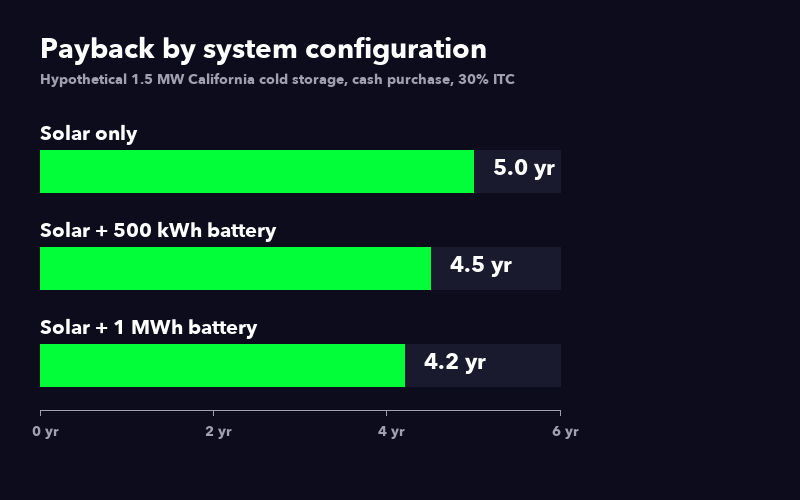
- Simple payback: 5.0 years
- Unlevered IRR over 25 years: approximately 14 percent
- 25-year NPV at 8 percent discount: approximately $1.9 million
Adding the battery increases upfront cost by $140,000 but can increase demand-charge savings by another $40,000 to $60,000 per year. In this example, the solar-plus-storage configuration pushes unlevered IRR above 16 percent and payback below 4.5 years.
A tool like SurgePV’s generation and financial tool models this exact stack. It imports interval data, applies local tariffs, and runs 25-year cash flows in one workflow.
Ownership, PPA, Lease and Financing Trade-offs
The financing structure changes the headline ROI more than most design choices. Cold storage operators should model each option against their balance sheet and lease situation.
| Structure | Upfront Cost | Who Owns Asset | Tax Benefits | Best For |
|---|---|---|---|---|
| Cash purchase | Full | Host | Host captures ITC, MACRS, depreciation | Owner-occupiers with tax appetite |
| Debt financing | 20–40 percent | Host | Host captures tax benefits; debt adds interest | Owners who want to preserve capital |
| PPA | $0 | Investor | Investor captures ITC and depreciation | Leased buildings or capital-constrained owners |
| Operating lease | Minimal | Lessor | Lessor captures tax benefits | Short-term occupancy or simple accounting |
Direct ownership captures the full economic value. It delivers the highest long-term IRR and leaves the operator with a depreciating asset at the end of year one. The main requirement is tax appetite. A company that does not pay federal income tax cannot use the ITC directly unless it structures a partnership flip or sale-leaseback.
A behind-the-meter PPA preserves capital and fixes a long-term energy rate. It is often the right choice for 3PL operators in leased buildings or for owners who want O&M off their books. The trade-off is lower lifetime savings because the investor keeps the tax benefits and charges a risk premium.
A solar lease is the simplest structure but usually the most expensive over 20 years. It works best for operators who want a single line item and no asset management responsibility. For most cold storage owners with a 10-plus year hold period, cash purchase or debt financing wins.
Battery Storage, Peak Shaving and Resilience
Cold storage operators often ask whether battery storage is worth the extra cost. The answer depends almost entirely on the demand-charge rate. In markets with demand charges above $15 per kW per month, batteries usually pay for themselves in 4 to 6 years through peak shaving alone.
A battery can discharge during the highest 15-minute peaks. It can also store midday solar surplus and shift it into evening peak-rate periods. For cold storage, there is a third benefit: backup power. A 500 kWh battery paired with 1.5 MW of solar can keep critical refrigeration loads running for several hours during an outage. That can prevent spoilage losses that dwarf the battery cost.
Real-world data supports the case. Promise Energy documents a Central Valley cold storage project. The site used a 1.5 MW rooftop solar system, an 800 kWh battery, an LED retrofit and an energy management platform. The project produced $247,000 in annual savings. The project paid back in 2.4 years and delivered a 42 percent first-year ROI. Catalyze reports that solar-plus-storage systems save cold storage operators an average of $20,000 to $50,000 annually in energy costs, citing Wood Mackenzie research.
The exception is markets with low demand charges and strong net metering. In those regions, a battery may extend payback rather than shorten it. The right way to decide is to model the facility’s actual 8760-hour load profile with and without storage.
Federal Incentives and Depreciation in 2026
The US federal incentive stack for commercial solar remains strong in 2026. The key programs are:
- Investment Tax Credit (ITC): 30 percent of project cost for commercial solar and standalone storage placed in service in 2026. The Department of Energy federal solar tax credits for businesses page tracks current guidance.
- Domestic content bonus: 10 percentage points added to the ITC if the project uses domestic steel, iron and manufactured products.
- Energy community bonus: 10 percentage points added if the project is in a census tract tied to fossil-fuel employment or brownfield sites.
- MACRS depreciation: 60 percent bonus depreciation in 2026, with the remainder depreciated over five years.
For a profitable corporate offtaker, the tax shield from MACRS is worth roughly 20 to 25 percent of project cost on top of the ITC. A $2.5 million project can therefore see effective net cost below $1.3 million after incentives. That is why ownership beats a PPA in most tax-paying structures.
State and utility incentives vary. California’s Self-Generation Incentive Program, New York’s NY-Sun, and Massachusetts SMART program can add rebates or performance payments for storage and solar. DSIRE is the standard database for checking state-level options.
When Cold Storage Solar ROI Does Not Clear Hurdle Rates
Solar is not a universal winner. Several conditions can push payback beyond acceptable thresholds:
- Low electricity rates: Markets with commercial rates below $0.08 per kWh and demand charges below $8 per kW per month rarely justify behind-the-meter solar on savings alone.
- Weak solar resource: Facilities in the Pacific Northwest or heavily shaded sites may see production 30 to 40 percent below sunny markets.
- Short lease terms: A tenant with fewer than 10 years remaining cannot amortize a capital system. A PPA may still work if assignable.
- Restrictive interconnection or export limits: Some utilities cap commercial solar size, impose standby charges, or pay low export rates. These rules can kill project economics.
- Roof condition: A roof that needs replacement within 5 years adds $2 to $5 per square foot. Carports avoid the roof but cost more.
The honest approach is to set a hurdle rate and run a sensitivity table. If the base case is marginal, do not force the project. Wait for lower costs, better incentives, or a tariff change.
Common Mistakes That Kill Cold Storage Solar ROI
Even strong sites can produce disappointing returns if the model is wrong. Watch for these errors:
- Valuing solar at a flat avoided energy rate. Cold storage value includes energy, demand and delivery savings. Use only the energy rate and the project looks half as attractive as it really is.
- Ignoring ratchet clauses. One bad 15-minute peak can lock a high demand charge for 11 months. Model the worst-case peak, not the average.
- Overstating self-consumption. Summer solar surplus may exceed refrigeration load if the facility is partially empty. Use an 8760-hour simulation.
- Undersizing the interconnection. A 1.5 MW array on a 1 MW service transformer will face export limits or costly upgrades.
- Forgetting thermal load growth. Adding blast freezing, electric forklifts or EV charging can change the load profile and the optimal system size.
- Using residential design rules. Cold storage needs commercial-grade equipment, three-phase inverters, and structural engineering for roof loads.
The best projects start with 12 to 24 months of interval data, a structural assessment, and a production model that matches the facility’s actual load shape. SurgePV’s solar design software and shadow analysis tools help avoid these mistakes by importing real load data and simulating production hour by hour.
Frequently Asked Questions
What is a typical solar ROI for cold storage in 2026?
Behind-the-meter solar at a refrigerated warehouse typically delivers a 12 to 18 percent unlevered IRR. Simple payback is 3 to 6 years after the 30 percent federal Investment Tax Credit. The range depends on local electricity rates, demand charges, solar resource, facility size, and whether battery storage is included. Sites with demand charges above $15 per kW per month and commercial rates above $0.10 per kWh usually land at the better end of the range.
Why is solar ROI higher for cold storage than for ordinary commercial buildings?
Refrigerated warehouses consume electricity around the clock and use 4 to 5 times more energy per square foot than dry warehouses. Refrigeration accounts for 70 to 80 percent of their electrical load. Because the load runs continuously, almost every solar kilowatt-hour is consumed onsite at the full retail rate. Solar also reduces demand charges, which can make up 30 to 50 percent of the bill. The result is a high self-consumption rate and strong value per kilowatt-hour.
How much does a cold storage solar system cost?
As of mid-2026, commercial rooftop solar for cold storage costs roughly $1.20 to $1.80 per watt-direct-current before incentives. Solar carports add $0.40 to $0.70 per watt. Battery energy storage systems run $250 to $320 per kilowatt-hour installed for a 4-hour lithium iron phosphate system. Soft costs including engineering, permitting and interconnection add 10 to 15 percent. A 1.5 MW rooftop array therefore lands between $1.8 million and $2.7 million before incentives.
Is it better to buy, lease or sign a PPA for cold storage solar?
Direct ownership captures the full economic value including tax credits, depreciation and residual asset value, and it delivers the highest long-term IRR. A behind-the-meter PPA preserves capital and fixes a long-term energy rate but passes tax benefits to the investor. A solar lease is simplest but usually the most expensive over 20 years. Choose ownership if you have the tax appetite and balance sheet. Choose a PPA if capital is constrained, the building is leased, or the project is outside your core business.
Can battery storage improve cold storage solar ROI?
Yes. A battery can pay for itself in 4 to 6 years through demand-charge reduction and time-of-use arbitrage alone. In cold storage, it also shifts midday solar surplus into evening peaks and provides backup power for refrigeration during outages. The combination of solar plus storage almost always produces a higher blended IRR than solar alone when demand charges exceed $15 per kW per month.
What federal incentives apply to cold storage solar in 2026?
The federal Investment Tax Credit provides a 30 percent tax credit for commercial solar and standalone storage placed in service in 2026. Projects that meet domestic content requirements or are located in energy communities can add 10 percentage points each, lifting the credit to 40 or 50 percent. Accelerated MACRS depreciation allows 60 percent bonus depreciation in 2026, with the remainder depreciated over five years. The tax shield is worth roughly 20 to 25 percent of project cost for a profitable offtaker.
How do demand charges affect cold storage solar economics?
Commercial demand charges are billed on the highest 15-minute average kW each month and commonly range from $10 to $35 per kW per month. A single 500 kW peak costs $60,000 to $210,000 per year. Solar reduces daytime peaks, and a battery can discharge during the highest peaks. Ignoring demand charges in a solar ROI model understates value by 20 to 40 percent.
What is the biggest mistake when modeling cold storage solar ROI?
The most common mistake is valuing solar production at a flat avoided dollar-per-kWh rate. Cold storage solar value comes from three streams: energy charge reduction, demand charge reduction, and avoided transmission and distribution fees. A model that uses only the energy rate misses the larger components and will produce an artificially long payback and low IRR. The second biggest mistake is ignoring the summer overproduction problem or ratchet clauses.
Does cold storage solar work in leased buildings?
It can, but the lease term must be longer than the payback period. Most cold storage operators need at least 10 years of remaining lease term to justify a capital purchase. A PPA or lease can be structured to transfer with the lease or end when the lease ends. Landlord consent, roof warranty protection, and interconnection rights must be documented before any design work begins.
How long does a cold storage solar project take from feasibility to commissioning?
A typical commercial cold storage solar project takes 9 to 18 months. Feasibility and energy audit take 1 to 2 months. Financing and procurement close in 2 to 4 months. Design and permitting run 3 to 6 months. Utility interconnection approval takes 2 to 6 months. Construction, scheduled around cold-chain operations, lasts 2 to 4 months.
Next Steps
Cold storage solar is a finance project dressed up as an engineering project. The returns are real, but only if the model captures the full value stack.
- Start with 12 to 24 months of interval data and a structural roof assessment.
- Model energy, demand and delivery savings separately. Do not rely on a flat avoided rate.
- Run ownership, PPA and lease scenarios side by side before choosing a financing structure.
If you are evaluating cold storage solar, book a SurgePV demo. See how SurgePV builds an hour-by-hour ROI model from your actual utility bills. You can also review solar software pricing or explore our commercial solar solutions for refrigerated warehouses.
Where this fits
This article is part of SurgePV's Solar Business & Operations hub, which works through the topic from first principles to the decisions a project team actually has to make.
