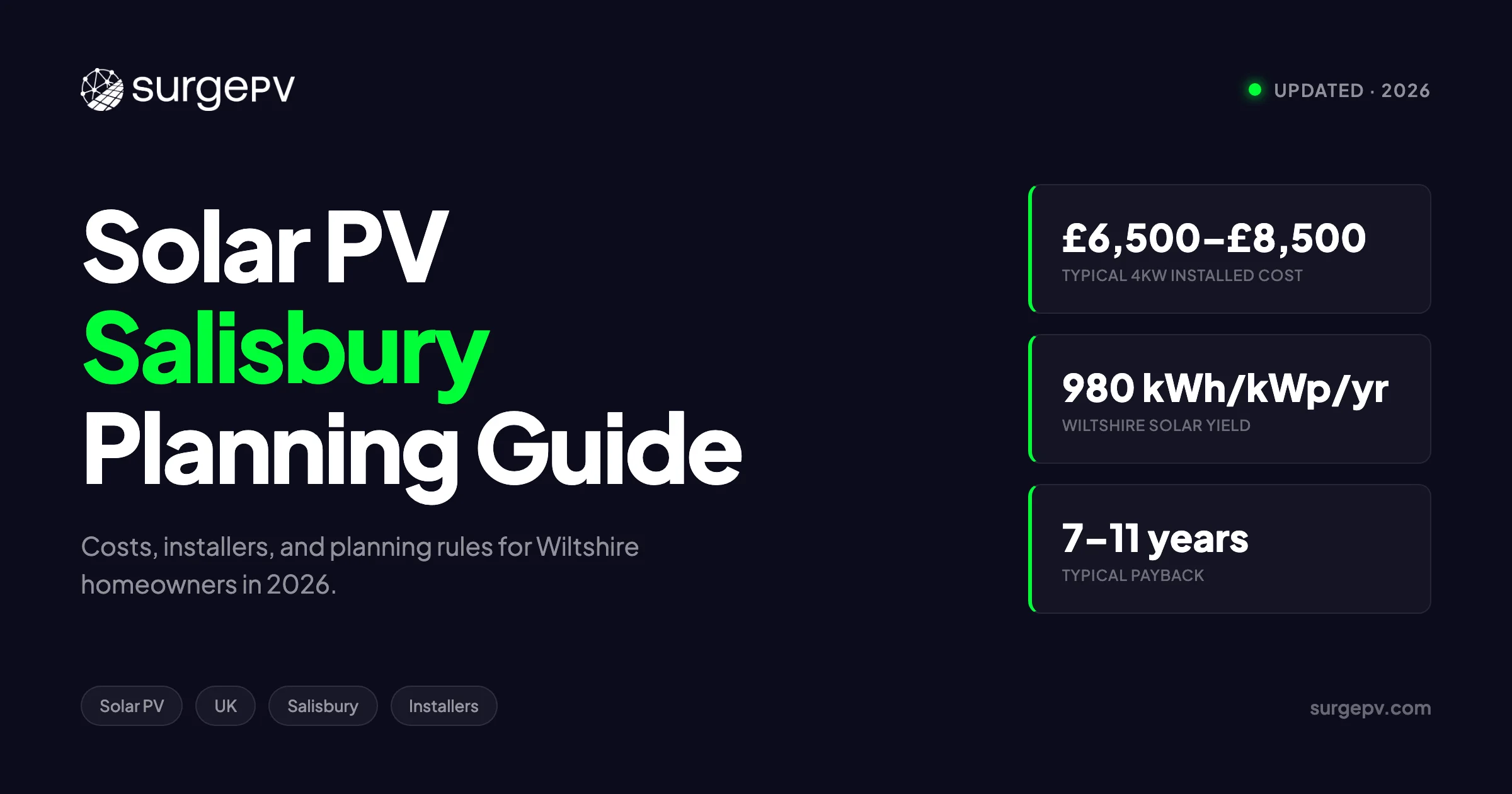
Salisbury sits in one of the UK’s better solar zones. Wiltshire ranks #9 of 102 counties for solar potential, with roughly 980 kWh of generation per installed kWp each year and about 1,620 annual sunshine hours. That puts a well-sited 4kW system on a Salisbury roof ahead of the UK average by 7–10%.
But solar PV in Salisbury is not just a climate play. The city has a dense cluster of historic and listed buildings, conservation areas, and a World Heritage Site buffer around Stonehenge. A standard permitted-development installation in a modern suburb can become a planning case in the city centre or a nearby village conservation area. Buyers need local data, not generic UK advice.
This guide covers 2026 costs for solar PV in Salisbury, how to size a system, what the Smart Export Guarantee pays, which installers are active in the area, and how heritage rules affect design. It is written for homeowners, landlords, and small businesses who want clear numbers before they request quotes.
In this guide you will learn:
- Why Salisbury’s solar yield beats most UK counties
- Real 2026 costs for 3kW, 4kW, and 6kW systems, with and without battery storage
- How the Smart Export Guarantee and self-consumption affect payback
- Planning rules for conservation areas and listed buildings in Wiltshire
- How to choose an MCS-certified installer in Salisbury
- What commercial, farm, and heritage projects can learn from Salisbury Cathedral’s 37kW array
Quick Answer
A typical 4kW solar PV system in Salisbury costs £6,500–£8,500 installed, generates about 3,800–3,920 kWh per year, and pays back in 7–11 years. Most installs do not need planning permission, but listed buildings and some conservation-area properties do.
Why Solar PV Works in Salisbury
Salisbury benefits from Wiltshire’s inland, south-westerly position. The county sits on chalk downland with low rainfall by UK standards — about 700 mm per year — and relatively high sunshine hours. SolarInfo.uk lists Wiltshire at roughly 980 kWh per kWp per year, which is about 7% above the UK average of around 920 kWh/kWp.
For context, a 4kWp system on an unshaded south-facing roof in Salisbury should produce roughly 3,800–3,920 kWh annually. The average UK household uses about 3,449 kWh per year, according to the latest government NEED data. In the Salisbury area, average household electricity consumption is higher, at about 4,058 kWh per year, because of a mix of larger detached homes, rural properties, and older housing stock. A 4kW system can therefore cover a large share of a typical home’s annual demand, though seasonal mismatch still matters.
Generation is not evenly spread. May, June, and July typically deliver 13–14% of annual output each. December and January together may contribute under 5%. That seasonal curve is why battery storage and time-of-use tariffs have become important: a system that overproduces in summer needs either export income or a battery to capture value.
Roof orientation changes the numbers quickly. A south-facing roof is ideal. East- or west-facing roofs lose 15–20% compared with south. North-facing roofs are usually not viable unless the pitch is shallow and shading is minimal. In Salisbury’s older centre, where rooflines are complex and chimneys are common, a site survey becomes essential before any quote is meaningful.
Pro Tip
Use a shading assessment before you sign a contract. Salisbury’s historic streets have narrow gaps, tall chimneys, and mature trees that can cut summer evening generation by 20–30% on otherwise good roofs.
Solar PV Costs in Salisbury: 2026 Prices
UK solar prices have stabilised after the supply-chain spikes of 2022–2023. In 2026, a typical 4kW solar-only system in Salisbury costs £6,500–£8,500 including installation, scaffolding, inverter, and 0% VAT. The 0% VAT rate for residential solar and battery storage applies until 31 March 2027, after which it is scheduled to revert to 5% unless extended.
The table below shows typical installed costs by system size. These are market ranges based on 2026 installer quotes and assume a standard pitched roof with no major scaffolding or electrical complications.
| System Size | Solar-Only Cost | With 5–10 kWh Battery | Typical Annual Output (South-Facing) |
|---|---|---|---|
| 3 kW | £5,000–£6,500 | £9,000–£11,500 | 2,850–2,940 kWh |
| 4 kW | £6,500–£8,500 | £10,000–£14,000 | 3,800–3,920 kWh |
| 5 kW | £7,500–£9,500 | £11,500–£15,500 | 4,750–4,900 kWh |
| 6 kW | £8,500–£11,000 | £13,000–£17,500 | 5,700–5,880 kWh |
Battery storage adds £3,000–£6,500 depending on capacity and brand. A 5 kWh battery is enough for most households to shift evening demand; a 10 kWh battery suits homes with electric heating or an EV. Hybrid inverters, which combine solar and battery inversion in one unit, are increasingly common and can reduce hardware costs, though they may limit future battery brand choice.
Several factors push Salisbury quotes toward the top or bottom of these ranges:
- Roof complexity. Hipped roofs, multiple valleys, dormers, or fragile slate increase labour and scaffolding costs.
- Heritage constraints. Listed buildings and conservation-area properties may need bespoke mounting, in-roof panels, or planning drawings.
- Electrical upgrades. Older homes may need a new consumer unit or earthing upgrade to meet current regulations.
- DNO approval. Systems above 3.68 kW single-phase usually need Distribution Network Operator approval under G98 or G99. Most installers handle this, but it adds time.
- Panel and inverter choice. Premium all-black panels, microinverters, or power optimisers add cost but can improve aesthetics and shade tolerance.
Because 0% VAT is scheduled to end on 31 March 2027, installers in Salisbury are reporting fuller diaries. If you want to lock in the current rate, start the quoting process in the summer or autumn of 2026 rather than waiting until spring 2027.
How Much Can You Save? Payback and SEG
Savings come from two sources: using your own solar instead of buying grid electricity, and exporting surplus for the Smart Export Guarantee (SEG). In 2026, the average UK electricity price is around 24.67p/kWh from April to June 2026, rising to 26.11p/kWh from July to September 2026 under the Ofgem price cap.
Self-consumption is the larger saving. Every kWh you use from your panels saves roughly 25p, because you do not buy it from the grid. Exported kWh earns only 3–17.5p depending on your SEG tariff. That gap means the financial case for solar is strongest for households that use electricity during the day, or that add a battery to shift daytime solar to evening use.
A typical 4kW solar-only system in Salisbury generates about 3,850 kWh per year. If the household self-consumes 50% and exports 50%, the annual benefit is roughly:
- Self-consumed: 1,925 kWh × 25p = £481
- Exported at 15p/kWh: 1,925 kWh × 15p = £289
- Total annual benefit: ~£770
Against a £7,000 system cost, that gives a simple payback of about 9 years. Add a battery that raises self-consumption to 75%, and the annual benefit might rise to £850–£950, but the upfront cost is higher, so payback often stretches to 10–14 years.
The table below shows how SEG tariffs compare in 2026. Rates change frequently, so treat these as snapshots.
| Supplier | Tariff | Typical Export Rate | Notes |
|---|---|---|---|
| E.ON Next | Next Export Premium v3 | ~17.5p/kWh | Often installer/customer conditions |
| British Gas | Export & Earn Plus | ~15.1p/kWh | British Gas import customers only |
| EDF | Export Exclusive 12m | ~18p/kWh | EDF/selected installer customers |
| Good Energy | Solar Savings | ~15p/kWh | Open to non-customers on some tariffs |
| Octopus | Outgoing Octopus | ~12p/kWh | Octopus import customers |
| Octopus | Intelligent Octopus Flux | Peak ~32p/kWh, off-peak ~24p/kWh | Requires compatible battery and smart meter |
| Fuse Energy | Single Rate Variable | ~13p/kWh | No import switch required |
The highest rates usually require you to be that supplier’s import customer or to have bought the system through their installer network. If you prefer flexibility, Fuse Energy’s open tariff or Octopus Outgoing are simpler options, though the rate is lower.
One common misconception is that a bigger system always pays back faster. It does not. Oversizing panels beyond what you can use or export economically can leave you selling surplus at 3–5p/kWh while financing extra hardware. A good installer will model your actual usage pattern, not just your roof area.
For installers who want to model these scenarios accurately, solar design suite like SurgePV can run hourly self-consumption and SEG projections using Salisbury’s irradiance data and current tariff rates.
Planning Permission and Heritage Rules in Salisbury
Most domestic rooftop solar panels in Wiltshire are permitted development. That means no planning application is needed if the installation meets standard conditions under the Town and Country Planning (General Permitted Development) (England) Order 2015:
- Panels must not project more than 200mm beyond the roof surface.
- Panels must not exceed the highest part of the roof, excluding chimneys.
- The equipment must be removed when no longer needed for microgeneration.
- Ground-mounted systems must be no more than 4m high and at least 5m from any boundary.
Flat roofs also fall under permitted development as of 2023, provided the panels do not protrude more than 1m above the flat roof surface and are set back from the edge.
The complication in Salisbury is heritage. Wiltshire has over 130 conservation areas, including parts of Salisbury city centre, Wilton, Amesbury, and many villages. Within these areas, panels on roof slopes visible from a highway usually need planning permission. Some areas also have Article 4 Directions, which remove permitted development rights entirely. That means even rear-roof panels may need consent.
Listed buildings have no permitted development rights for solar panels. You need listed building consent for any external alteration, and you may also need planning permission. Applications are more likely to succeed if the design is discreet:
- All-black panels with black frames and backsheets
- In-roof or integrated systems that sit flush with the roof covering
- Placement on non-visible elevations
- Reversible fixings that do not damage historic fabric
- Minimal visible cabling
Properties in the Stonehenge and Avebury World Heritage Site buffer zone, or in Areas of Outstanding Natural Beauty such as the Cranborne Chase AONB, may face additional scrutiny. Pre-application advice from Wiltshire Council is cheap insurance: it flags issues before you pay for a full design.
Even when planning permission is not needed, Building Regulations still apply. Roof loadings must be checked, electrical work must meet Part P, and fixings must withstand wind loads. Your installer should provide a structural assessment and an electrical installation certificate.
Choosing a Solar PV Installer in Salisbury
MCS certification is the minimum threshold. Only MCS-certified installations qualify for the Smart Export Guarantee, and the MCS certificate is the document your energy supplier will ask for. You can verify an installer’s current status on the official MCS Installer Finder at mcscertified.com rather than trusting a logo on a website.
Beyond MCS, look for:
- RECC membership or HIES accreditation for consumer protection
- Which? Trusted Trader or Checkatrade presence with recent reviews
- Experience with your property type — heritage, flat roof, agricultural, or commercial
- A written quote that includes panel and inverter makes, estimated generation, scaffolding, DNO paperwork, and warranty terms
- Proof of insurance and a clear complaints process
The following MCS-certified installers are active in or around Salisbury. Ratings and review counts are from public sources and may change; verify before you choose.
| Installer | Location | Rating | Notes |
|---|---|---|---|
| SGS Heating & Electrical | Salisbury | 4.6/5 (298 reviews) | Established 1988; MCS and EPVS registered |
| Glow Green | UK-wide, covers Salisbury | 4.0/5 (202 reviews) | 14 years in business; full energy-services range |
| Bespoke PV | Hampshire/Wiltshire | Not listed | Heritage and rural specialists; MCS, IAA, TrustMark |
| Lumos Energy | Broughton Gifford, Wiltshire | 5/5 (50+ reviews) | Family-run, 1,500+ installations |
| Starks Solar | Salisbury, Wilton, Amesbury | Not listed | Local family-run; heritage/conservation specialists |
| GHE Solar | Berkshire/Hampshire/Wiltshire | 4.7/5 (80 reviews) | 40,000+ panels installed |
| Infinity Energy Services | Salisbury area | Not listed | Solar PV, battery, EV charging |
| Energy-Tec | Salisbury | 5.0/5 (2 reviews) | Selected installer for Nadder Community Energy |
Get at least three quotes. The cheapest quote is rarely the best. Compare the predicted generation figures, equipment warranties, and whether the quote includes DNO application and commissioning paperwork. A low headline price can hide extras such as scaffolding, monitoring, or post-installation support.
For installers producing proposals, solar proposal tools can help present these numbers clearly to Salisbury customers, including heritage-specific notes and SEG projections.
Commercial, Farm, and Heritage Solar in Salisbury
Solar PV in Salisbury is not limited to residential rooftops. The surrounding Wiltshire countryside has farms, estates, commercial units, and historic buildings with large roof areas and high daytime electricity use.
The most visible local example is Salisbury Cathedral. In 2020, Joju Solar installed 93 solar panels on the South Cloister roof, creating a 37kW system. It generates about 33,708 kWh per year and cuts carbon emissions by roughly 11,764 kg annually. The project was funded by a community share offer with ethical investors, many of them local. It shows that even Grade I listed buildings can host solar PV when the design is sensitive and the mounting is reversible.
For farms and commercial buildings, the economics are different. A barn or warehouse with a large, uncomplicated roof can host a 50–250kW system. Because businesses use much of their electricity during the day, self-consumption rates are often 60–80%, and payback can fall to 4–6 years after capital allowances. Agricultural properties also benefit from 0% VAT on certain renewable installations and can often use battery storage to manage grain drying, cold storage, or EV charging loads.
Heritage properties require a different mindset. The goal is not maximum generation; it is useful generation with minimal visual impact. That usually means:
- Smaller arrays on secondary roofs
- In-roof panels that replace rather than sit on tiles
- Hidden cable routes through lofts or behind guttering
- Coordination with conservation officers before any application
Rural properties around Salisbury also face practical constraints: narrow lanes limit scaffolding lorry access, older roofs may need reinforcement, and off-grid or weak-grid locations may need battery backup or voltage management. A site visit is non-negotiable.
Common Mistakes Salisbury Buyers Make
Even in a strong solar location, buyers can trip over details that are specific to Salisbury and Wiltshire.
Ignoring heritage status until after the quote. If your property is listed or in a conservation area, the installer’s standard on-roof kit may not be approvable. Check the Wiltshire Council planning map and Historic England listed building register before you request quotes.
Fixating on panel count instead of generation. Ten cheap panels on a shaded east-facing roof can produce less than eight premium panels on an unshaded south-facing roof. Ask for a predicted annual generation figure in kWh, not just a system size in kW.
Choosing the cheapest SEG tariff by default. A tariff at 3p/kWh can cost you £150–£250 per year compared with a 15p/kWh tariff. The difference often outweighs any panel-brand upgrade over the system lifetime.
Oversizing without a battery or export plan. A large system that exports most of its summer output at low SEG rates is a poor investment. Size the system to match your usage, your roof, and your budget — not your roof area.
Skipping the DNO question. Systems above 3.68 kW on a single-phase supply usually need G99 approval. Good installers handle this, but it can add 4–8 weeks to the project. Ask upfront.
Forgetting future loads. If you plan to buy an EV or switch to a heat pump in the next five years, say so. A system sized only for today’s usage may need expansion later, which is more expensive than sizing once.
Design Solar PV Projects for Salisbury with SurgePV
Model hourly generation, shading, self-consumption, and SEG income using UK-specific irradiance and tariff data. Produce MCS-ready documentation and client proposals in minutes.
Book a DemoNo commitment required · 20 minutes · Live project walkthrough
Conclusion
Solar PV in Salisbury makes financial and environmental sense for many properties. Wiltshire’s solar resource is well above the UK average, 0% VAT is available until 31 March 2027, and a 4kW system typically pays back in 7–11 years. The main local wrinkle is heritage: listed buildings and conservation areas need careful design and may require planning permission.
If you are considering solar PV in Salisbury, take three steps next:
- Check your property status on the Wiltshire Council planning map and Historic England register before you request quotes.
- Get three quotes from MCS-certified installers and compare predicted generation, warranties, and SEG tariff advice — not just headline price.
- Model your usage and future loads so the system is sized for your actual needs, including any planned EV or heat pump.
Frequently Asked Questions
How much does a 4kW solar PV system cost in Salisbury?
A typical 4kW solar PV system in Salisbury costs £6,500–£8,500 installed, including 0% VAT until 31 March 2027. Adding a 5–10 kWh battery raises the total to £10,000–£14,000.
Do I need planning permission for solar panels in Salisbury?
Most rooftop solar panels in Salisbury are permitted development if they project no more than 200mm from the roof and sit below the ridge. Listed buildings need listed building consent, and conservation areas may need permission for front or highway-visible panels.
How much electricity does a 4kW solar system generate in Salisbury?
A south-facing 4kW system in Salisbury generates roughly 3,800–3,920 kWh per year, based on Wiltshire’s solar yield of about 980 kWh per kWp. East- or west-facing roofs produce 15–20% less.
What is the payback period for solar panels in Salisbury?
A solar-only 4kW system in Salisbury typically pays back in 7–11 years. Adding a battery can extend payback to 10–14 years, depending on self-consumption, electricity prices, and SEG export rates.
Which solar installers serve Salisbury?
MCS-certified installers serving Salisbury include SGS Heating & Electrical, Glow Green, Bespoke PV, Lumos Energy, Starks Solar, GHE Solar, Infinity Energy Services, and Energy-Tec. Always verify current MCS status on mcscertified.com.
What is the Smart Export Guarantee rate in 2026?
SEG rates in 2026 range from about 3p/kWh to 17.5p/kWh. Top fixed rates include E.ON Next Export Premium at ~17.5p/kWh and British Gas Export & Earn Plus at ~15.1p/kWh, often restricted to existing customers.
Can I install solar panels on a listed building in Salisbury?
Listed buildings do not have permitted development rights for solar panels. You need listed building consent and possibly planning permission. All-black or in-roof panels on non-visible elevations improve approval chances.
Is Salisbury a good place for solar panels?
Yes. Wiltshire ranks #9 of 102 UK counties for solar potential, with about 980 kWh/kWp/year and 1,620 annual sunshine hours. Salisbury’s mix of detached homes, rural properties, and commercial roofs suits many solar applications.
For a deeper look at how location affects returns, see our guide to solar payback periods by country. If you want to compare Salisbury’s solar resource with other UK and European locations, our solar irradiance data for European cities explains the methodology. Installers can also use our SEG tariff comparison tool to keep export-rate advice current.
Where this fits
This article is part of SurgePV's Solar Installation hub, which works through the topic from first principles to the decisions a project team actually has to make.