

Quick Answer
Yet most solar design guides treat grounding as an afterthought, tacked onto the end of a wiring chapter. Confusing them is one of the most common design errors and a direct path to inspection failure. Grounding electrode (ground rod, structure) Minimum size. 14 AWG Cu. 8 AWG Cu (or per table) Splice allowed?.
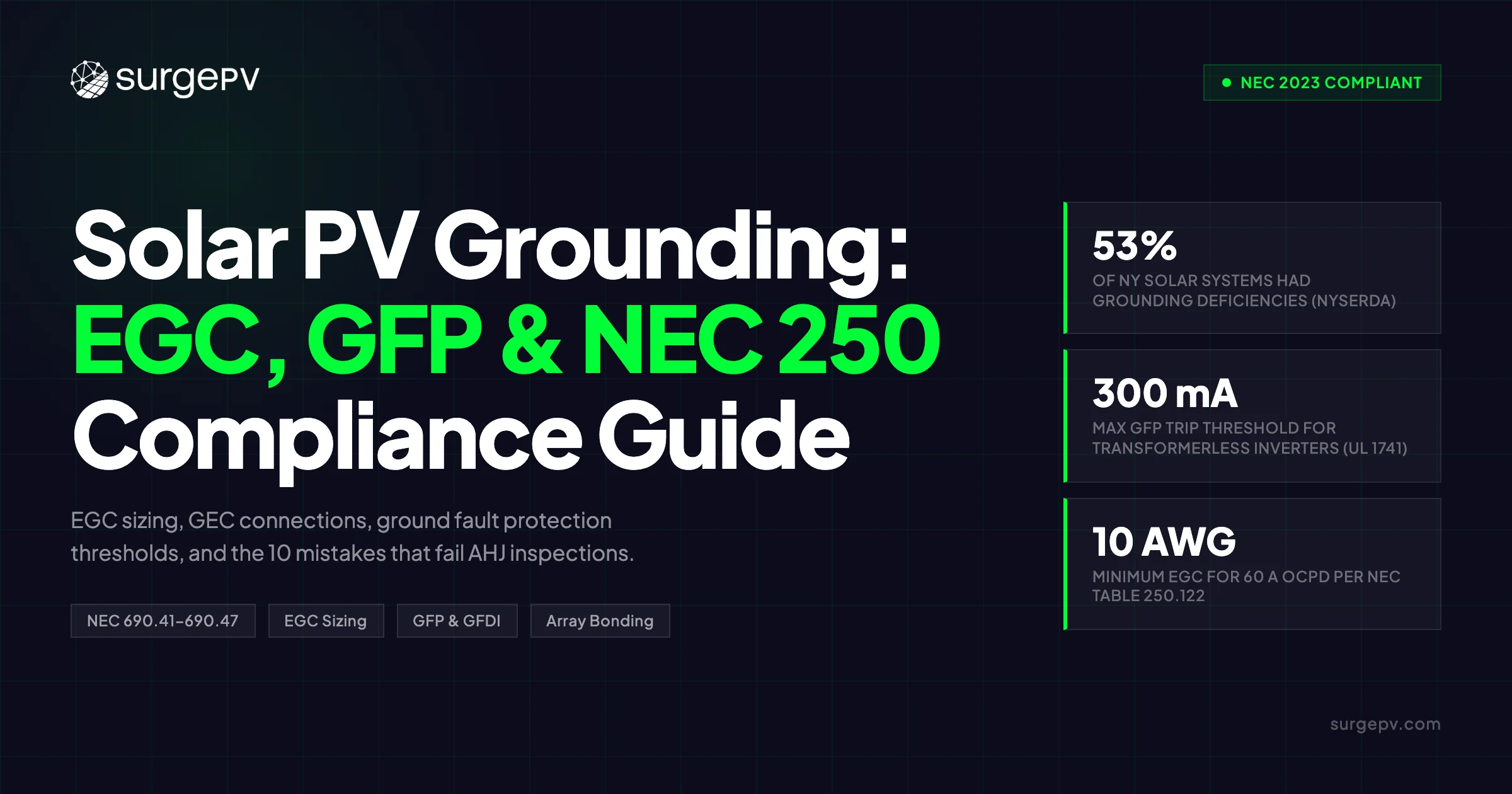
Grounding is the most frequently failed category in solar PV inspections. A NYSERDA NY-Sun inspection review of New York installations found grounding deficiencies in 53% of systems inspected (NYSERDA, Solar PV Permitting and Inspecting, NY-Sun Program) — the single largest cause of permit re-inspection, PTO delay, and liability exposure. Yet most solar design guides treat grounding as an afterthought, tacked onto the end of a wiring chapter.
Yet most solar design guides treat grounding as an afterthought, tacked onto the end of a wiring chapter. Confusing them is one of the most common design errors and a direct path to inspection failure. Grounding electrode (ground rod, structure) Minimum size.
This guide covers every layer of a compliant solar PV grounding system design: equipment grounding conductors (EGC) and their NEC 250.122 sizing rules, grounding electrode conductors (GEC) and the 690.47 connection options, ground fault protection detection logic for both transformer-isolated and transformerless inverters, array frame bonding with UL 2703-listed hardware, and the 10 specific mistakes that trigger AHJ failures. If you use solar design platform to generate single-line diagrams and electrical documentation, understanding these rules tells you exactly what your software should be checking automatically.
TL;DR — Solar PV Grounding System Design
EGC = fault-current path from equipment back to source; sized per Table 250.122. GEC = earth reference connection; sized per Table 250.166 (DC) or 250.66 (AC). GFP in transformerless inverters uses isolation resistance monitoring with a 300 mA / 0.3 s trip threshold, not a physical fuse. The most common inspection failure: an ungrounded array frame caused by assuming a bolted rail connection provides continuity through anodized aluminum.
In this guide:
- The two-part grounding system in solar PV — what EGC and GEC each do
- NEC 690.41 configurations — which one applies to your project
- EGC sizing by OCPD rating (Table 250.122) with residential examples
- GEC design under NEC 690.47 — connections, materials, and sizing
- Ground fault protection — how GFDI fuses and isolation monitoring detect faults
- Array frame bonding — WEEBs, UL 2703, and the anodized aluminum problem
- 10 common grounding mistakes and how they map to inspection failures
Two Types of Grounding in Solar PV Systems
Solar PV grounding is not one system. It is two, with different purposes, different sizing methods, and different NEC sections. Confusing them is one of the most common design errors and a direct path to inspection failure.
Equipment Grounding (EGC path) bonds all exposed non-current-carrying metal parts — module frames, racking sections, enclosures, conduit — to an equipment grounding conductor that runs back to the source. Its purpose is safety: during a ground fault, the EGC carries fault current back to trip the OCPD and clear the fault. It does not connect to earth directly. See Solar Racking Design Guide for detailed guidance.
System/Earth Grounding (GES path) establishes the voltage reference to earth through a grounding electrode conductor (GEC) connected to a physical electrode (ground rod, building steel, concrete-encased rebar). Its purpose is system stability and lightning protection. It carries surge energy, not fault current.
| Component | EGC (Equipment Grounding Conductor) | GEC (Grounding Electrode Conductor) |
|---|---|---|
| NEC sizing section | Table 250.122 (by OCPD rating) | Table 250.166 (DC) / 250.66 (AC) |
| Purpose | Fault-current return path | Earth voltage reference |
| Material | Copper or aluminum | Copper ONLY (no aluminum for GEC) |
| Connection point | Equipment frames, enclosures, raceway | Grounding electrode (ground rod, structure) |
| Minimum size | 14 AWG Cu | 8 AWG Cu (or per table) |
| Splice allowed? | Yes, listed methods | Only irreversible compression or exothermic weld |
| Can substitute for the other? | No | No |
EGC vs GEC — the most confused pair in NEC 690
The GEC cannot serve as the EGC, and the EGC cannot serve as the GEC. They are different conductors, sized by different tables, serving different functions. Inspectors in New York City specifically call out “GEC-used-as-EGC” as a codified violation per NYC DOB interpretation guidelines.
NEC 690.41 System Grounding — Which Configuration Applies?
NEC 690.41(A) defines five system grounding configurations for PV arrays. The one that applies to your project determines whether a DC conductor is grounded, whether a GFDI fuse is needed, and how the inverter must be listed.
| Config | Description | Typical Use | Key Requirement |
|---|---|---|---|
| 690.41(A)(1) | Functionally grounded 2-wire — one conductor grounded via GFDI fuse | Pre-2017 transformer-isolated residential | GFDI fuse + GFP device per 690.5 |
| 690.41(A)(2) | Bipolar array with grounded center tap | Bipolar string systems | Center-tap bonded to GEC |
| 690.41(A)(3) | Array not isolated from grounded inverter output (functionally grounded via inverter) | >90% of modern US residential | Inverter must be listed for this configuration |
| 690.41(A)(4) | Ungrounded (truly floating) | Rare; transformer-isolated + continuous insulation monitoring | Isolation monitoring required; UL 1741 listed |
| 690.41(A)(5) | Solidly grounded — hard-wired bond without fuse | Stand-alone, DC pumping, off-grid | Single ground point; no GFDI fuse |
The 2023 NEC updated NEC 690.42 (retitled “Point of PV System DC Circuit Grounding Connection”) to clarify that when GFP is provided, the bond is made internally by the GFP device and must not be duplicated externally. The 2023 edition also added a note recommending the ground connection be located close to the PV source to limit lightning surge exposure.
Pro Tip
For most modern residential projects, configuration (A)(3) applies. Verify this by checking that your inverter listing documentation specifically states it is listed for “functionally grounded PV arrays” per NEC 690.41(A)(3). If the listing says “ungrounded array only,” the design rules change significantly — particularly for conductor color coding and OCPD pole requirements.
Sizing the Equipment Grounding Conductor (EGC) Under NEC 250.122
The Basic Rule
NEC 690.45 directs you to size the EGC per Table 250.122, using the rating of the overcurrent protective device (OCPD) protecting the circuit. When no OCPD is installed in the circuit — common for DC homerun circuits between the array and combiner — treat the OCPD as though it were rated at 125% of Isc per NEC 690.8(A).
The absolute minimum EGC is 14 AWG copper. This floor applies even when Table 250.122 would otherwise allow a smaller conductor for very low OCPD ratings.
Common Residential EGC Sizes
| OCPD Rating | EGC (AWG Cu) | Typical Circuit |
|---|---|---|
| 15 A | 14 AWG | Single-module branch string (micro or DC optimizer) |
| 20 A | 12 AWG | String circuit with module-level protection |
| 30 A | 10 AWG | 2-string combiner output |
| 60 A | 10 AWG | Residential homerun, combiner output |
| 100 A | 8 AWG | Commercial combiner output or large residential |
| 200 A | 6 AWG | Large commercial homerun |
Always reference the current edition of Table 250.122 directly. Values depend on conductor material and temperature rating, and some OCPD ranges map to the same AWG entry.
What NEC 690.45 and 690.46 Add
Physical protection: An EGC smaller than 6 AWG must be protected from physical damage per NEC 250.120(C). Run it in conduit or a listed cable assembly wherever it is exposed.
Routing with circuit conductors: The EGC must run with the circuit conductors in the same raceway (NEC 250.134(B)). A separate raceway is a code violation and creates an inductive ground loop that can cause nuisance AFCI/GFCI tripping.
No voltage-drop upsizing: When you upsize ungrounded conductors for voltage drop, the EGC does not need to increase proportionally. This is a common misconception that inflates copper costs on larger residential and commercial jobs.
EGC Routing Rule
The EGC must travel in the same conduit as the current-carrying DC conductors. A separate raceway creates a physical ground loop that increases impedance on the fault path and can interfere with AFCI/GFCI operation. Route them together from array to inverter with no exceptions.
Solar Grounding Electrode System — GEC Design
What the GEC Does
The GEC connects the electrical system to a physical grounding electrode in the earth. It establishes a voltage reference, provides a path for lightning-induced surges, and limits potential differences during utility disturbances. It is sized to handle surge energy, not continuous fault current.
Material requirement: The GEC must be copper. NEC Article 250 prohibits aluminum for grounding electrode conductors because aluminum corrodes at buried connections and the joint resistance rises over time.
Splices: The GEC may not be spliced at intermediate points. If a splice is unavoidable, use an irreversible compression connector or exothermic weld (Cadweld or equivalent). Wire-nutted splices inside a junction box fail inspection and violate NEC 250.64(C).
GEC Sizing
| System | Sizing Reference | Based On |
|---|---|---|
| AC-side GEC | NEC Table 250.66 | Largest ungrounded service-entrance conductor |
| DC array GEC | NEC Table 250.166 | Largest conductor supplying the DC system |
For a residential system fed by a 200 A service (2/0 AWG Al), Table 250.66 requires a minimum GEC of 2 AWG Cu on the AC side. A 10 AWG array homerun maps to 8 AWG Cu minimum on the DC side per Table 250.166.
GEC Connection Options (NEC 690.47)
NEC 690.47 gives three paths for integrating DC and AC grounding electrode systems:
Option (C)(1) — Bonding jumper between electrodes: Bond the DC array grounding electrode to the AC system grounding electrode with a bonding jumper sized per 250.166. Both electrodes stay in place.
Option (C)(2) — DC GEC run to AC electrode: Run the DC GEC directly to the AC grounding electrode. If the AC electrode is not accessible, terminate at the AC GEC with a listed connector.
Option (C)(3) — Combined AC EGC and DC GEC: The most common approach for modern residential. The AC equipment grounding conductor — sized to the larger of Table 250.122 or Table 250.166 — serves as the DC GEC as well. This eliminates a separate DC electrode conductor and is acceptable for grounded PV systems under 2023 NEC.
Ground-Mount Array Electrode
When the array is more than 6 feet (1.8 m) from the building’s grounding electrode system, NEC 690.47(D) requires a supplementary electrode at the array:
- Standard ground rod: 5/8-inch diameter, 8-foot length, copper-clad steel
- Array steel structure: If driven piles or poles meet NEC 250.52(A) — specifically 8 feet of metal in contact with earth — the structure itself qualifies as the electrode
Array Structure as Electrode
Ground-mount racking systems with galvanized steel piles driven at least 8 feet into earth qualify as grounding electrodes under NEC 250.52(A)(5). This eliminates the need for a separate ground rod at the array. Verify with your AHJ — some jurisdictions require the supplementary rod regardless.
Ground Fault Protection (GFP) — How It Works
Where GFP Is Required
NEC 690.41(B) requires ground fault protection for PV circuits with voltage above 30 V or current above 8 A. This covers virtually every grid-tied system. The narrow exception applies to off-building circuits that are solidly grounded and have no more than 2 PV source circuits in parallel.
Transformer-Isolated Inverters — GFDI Fuse
Older and some commercial string inverters use galvanic transformer isolation between the DC array and AC grid. In these systems:
- One DC conductor is grounded (bonded to the GEC) via a GFDI (Ground Fault Detection and Interruption) fuse.
- During a ground fault, current bypasses the normal GFDI fuse path, the fuse opens, and the inverter shuts down.
- Typical fuse ratings: 1 A for systems ≤15 kW; up to 5 A for systems above 250 kW.
- The fuse is the GFP device — it must be rated, accessible, and replaceable.
The limitation of GFDI fuses is sensitivity. A 1 A fuse cannot detect a 0.9 A ground fault — the fault burns continuously until it escalates. This was the root cause of several PV array fires in the 2010s on large commercial systems.
Transformerless Inverters — Isolation Monitoring
Modern transformerless (TL) inverters use active isolation resistance monitoring instead of a GFDI fuse. The detection logic works as follows:
- The inverter continuously monitors insulation resistance between both DC conductors and the equipment ground.
- Before connecting to the grid each morning, the inverter runs a self-test — checking isolation resistance while the array is energized but the inverter output is open.
- During operation, the monitor detects both slow degradation (resistance drift) and sudden faults.
UL 1741 CRD thresholds (current standard for grid-tied inverters ≤30 kW):
| Parameter | Threshold |
|---|---|
| Maximum permissible fault current | 300 mA |
| Maximum trip time at threshold | 0.3 seconds |
| Sudden-change detection | 30 mA / 0.04 seconds |
TL inverters are approximately 3× more sensitive to ground faults than transformer-isolated inverters on residential circuits. For commercial-scale installations with thin-film modules — which have higher array-to-ground parasitic capacitance — the isolation monitoring topology matters. Topologies with constant common-mode voltage (NPC/half-bridge) generate less leakage current than full-bridge designs.
Pro Tip
Look for “Type B RCD compatible” in the inverter technical specification. This designation confirms the inverter’s internal isolation monitoring can detect both AC and DC fault current components — required by most European grid codes and increasingly requested by US utilities for commercial interconnection.
For Europe-specific compliance details, see Europe solar compliance.
Both DC Conductors Must Be Switched
Because no DC conductor is grounded in a TL system, both poles carry potential. This has three design consequences:
- The DC disconnect must interrupt both DC conductors simultaneously (2-pole).
- The OCPD must protect both ungrounded conductors.
- Wire color coding changes: white and gray are reserved for grounded conductors. In TL systems, both DC conductors are ungrounded — use red/black or other non-white/gray colors.
Array Frame Grounding — Racking and Bonding
The Anodized Aluminum Problem
PV module frames are extruded anodized aluminum. Anodization creates a thin, electrically insulating aluminum oxide layer on all surfaces. This means:
- Bolting a module to a rail does not create an electrical bond.
- A standard hex-head bolt through an anodized hole provides no measurable continuity.
- Continuity through a bolted connection will fail a basic resistance test.
This is the source of the most common array grounding failure: an installer mounts 20 modules, runs a green EGC to the rail, and passes every visual check — but the frames are electrically floating because the oxide layer was never penetrated.
Listed Bonding Hardware
WEEB clips (Washer Electrical Equipment Bond): Stainless steel washers with raised teeth that bite through anodized coatings when torqued to specification. WEEBs are listed to UL 467. When installed per the listing, they provide a verified ground path from module frame to rail.
- Torque per manufacturer spec: IronRidge/Burndy WEEBs require 13.5 N·m (10 ft-lb); Wiley WEEB-PMC requires 20.5 N·m (15 ft-lb). Check the listing for each product.
- WEEBs are single-use. Retorquing after repositioning damages the bite teeth and voids the listing.
UL 2703-listed clamps and mounting systems: Many modern rail clamps (IronRidge UFO, Unirac SolarMount, Schletter) integrate bonding teeth directly into the clamp geometry. If the product bears a UL 2703 listing, the clamp simultaneously mounts and grounds the module — no separate WEEB needed.
What does NOT work:
- Standard star washers — not listed to UL 2703 or UL 467 for module bonding
- Self-tapping screws into anodized surfaces — no continuity guarantee
- Module-frame-to-clamp contact without listed bonding means
Star Washers Fail Inspection
Star washers are commonly used by installers who believe they scratch through anodization. They are not listed to UL 2703 or UL 467 for PV module bonding. Using star washers instead of WEEBs or UL 2703-listed clamps will fail the AHJ inspection continuity check. This is consistently cited in Massachusetts DOER and NYSERDA audit reports.
EGC Routing from Array
The EGC must leave the array in the same conduit or cable assembly as the DC current-carrying conductors. At the array, the EGC connects to a bare copper bus on the racking system — typically 6–10 AWG bare copper — collected at the combiner box or directly at the inverter input.
For ground-mount systems, the bare copper EGC run from combiner to inverter must be protected from physical damage if exposed (conduit or direct-burial listed cable). This is a frequent oversight on commercial ground-mount projects where the combiner-to-inverter run crosses open terrain.
Common Grounding Mistakes and Inspection Failures
NYSERDA’s NY-Sun inspection review found grounding deficiencies in 53% of systems inspected (NYSERDA, Solar PV Permitting and Inspecting, NY-Sun Program). Massachusetts DOER reported that 18% of critical violations were at the array and 16% were at the inverter — the two locations where grounding is most likely to be incorrectly implemented.
Here are the 10 specific mistakes that drive those statistics:
| # | Mistake | NEC Violation | Consequence |
|---|---|---|---|
| 1 | Floating array frame — bolt assumed to ground through anodization | 690.43(A), 250.134 | Frame energizes during fault; shock and fire hazard |
| 2 | EGC missing from homerun conduit | 250.134(B), 690.45 | No fault-return path; OCPD may not trip |
| 3 | GEC used as EGC (or vice versa) | 250.122, 250.166 | Undersized fault path; earth reference path overloaded |
| 4 | Copper lug direct on aluminum rail without transition | 250.64(A), 110.14 | Galvanic corrosion; connection fails within 2–5 years |
| 5 | Multiple neutral-ground bonds at subpanels | 250.6, 250.24(A)(5) | Objectionable current on EGC; GFCI/AFCI nuisance trip |
| 6 | Wrong GFDI fuse size in transformer-isolated inverter | 690.5 | Under-rated fuse nuisance trips; over-rated fuse misses faults |
| 7 | Grounding DC conductor in TL inverter | 690.35(C) | DC injection into grid; inverter damage; persistent fault current |
| 8 | Star washers instead of UL 2703-listed WEEBs | 690.43(D) | Floating module frames; fails continuity test |
| 9 | Inaccessible GEC splice (wire nut inside wall) | 250.64(C) | Splice must be accessible and irreversible |
| 10 | No ground-fault indication or monitoring plan | 690.5(C) | Faulted system runs undetected; fire risk accumulates |
Grounding errors are invisible during installation. They surface at inspection or, worse, during a fault event. PV design software that validates these checks during the design phase prevents the re-inspection cycle before it starts.
Design Compliant Grounding Systems Before You Submit for Permit
SurgePV checks EGC sizing, GEC routing, GFP compatibility, and UL 2703 bonding requirements automatically — flagging violations before your single-line diagram reaches the AHJ.
Book a DemoNo commitment required · 20 minutes · Live project walkthrough
For a direct comparison, see Arka 360 vs SurgePV.
Grounding for Transformerless Inverters — Special Rules
Over 90% of US residential inverters installed today are transformerless (non-isolated) per industry design literature. They are 2–4% more efficient than transformer-isolated units and significantly lighter — but the grounding rules differ substantially from the GFDI-fuse era.
Side-by-Side: Isolated vs Transformerless
| Parameter | Transformer-Isolated | Transformerless (Non-Isolated) |
|---|---|---|
| DC conductor grounding | One conductor grounded via GFDI fuse | No DC conductor grounded — array floats |
| GEC terminal on inverter | Required (UL 1741) | Not present — no internal DC bond |
| GFP method | GFDI fuse (690.5) | Isolation resistance monitoring (690.35) |
| GFP trip threshold | ~1 A fuse | 300 mA max / 0.3 s |
| DC disconnect | 1-pole on ungrounded conductor OK | Both poles must switch — 2-pole required |
| OCPD requirement | 1-pole on ungrounded conductor | Both conductors must have OCPD |
| DC wire color coding | White/gray for grounded conductor | No white/gray on DC — both are ungrounded |
| Equipment grounding (EGC) | Required | Required — not optional in TL systems |
In TL systems, the DC array conductors are not connected to ground (system grounding), but all metal enclosures, module frames, and racking must still be EGC-bonded (equipment grounding). These are separate requirements and both are mandatory.
SLD Implications
A single-line diagram for a TL system looks different from an isolated system diagram:
- No GEC terminal shown between the inverter DC input and the grounding electrode.
- Both DC conductors are shown interrupted by a 2-pole disconnect.
- The EGC runs from the array racking to the inverter enclosure, then to the panel EGC bar — but never from the inverter DC input to the electrode.
Solar software that understands inverter topology generates the correct SLD automatically. Manually drawing an SLD without topology awareness commonly results in incorrect GEC placement — a mistake that inspectors catch immediately on commercially submitted drawings.
For projects where shading analysis informs string layout and inverter selection, shadow analysis tools can help you confirm whether a given inverter topology suits partial-shade conditions before grounding design begins. Read Inverter Selection Solar Design Guide for a complete walkthrough.
Frequently Asked Questions
What size ground wire do I need for solar panels?
The EGC is sized per NEC Table 250.122 based on the OCPD rating protecting the circuit. For a 20 A OCPD, use 12 AWG copper minimum. For a 60 A OCPD (typical residential homerun), use 10 AWG copper. The absolute minimum is 14 AWG. If there is no OCPD in the circuit, calculate as if the OCPD equals 125% of Isc per NEC 690.8.
What is the difference between EGC and GEC in solar PV systems?
The EGC creates the fault-current path from equipment enclosures and module frames back to the source — sized per Table 250.122. The GEC creates the earth reference connection between the system and the grounding electrode — sized per Table 250.66 (AC) or 250.166 (DC array). They serve different functions and cannot substitute for each other.
Do solar panels need a separate ground rod?
Only if the array is more than 6 feet from the building’s grounding electrode system. NEC 690.47(D) requires a supplementary grounding electrode at the array when it is more than 1.8 m from the nearest building electrode. For roof-mounted systems, the building electrode satisfies the requirement. For ground-mount arrays farther than 6 ft from the premises, install a 5/8-inch by 8-foot copper-clad ground rod, or use the array steel structure if it meets NEC 250.52.
Can you ground the DC conductors on a transformerless inverter?
No. Transformerless inverters lack galvanic isolation. If you ground a DC conductor, a circulating current loop forms through the grid neutral, causing DC injection into the grid, inverter damage, and continuous fault current. Equipment grounding (EGC bonding of frames and enclosures) is still required — that is separate from system grounding and remains mandatory in all TL installations.
Conclusion
A complete solar PV grounding system design requires two separate, correctly sized conductor paths — the EGC for fault return and the GEC for earth reference — combined with a ground fault protection strategy that matches the inverter topology. Getting either wrong produces a system that looks correct on the surface but fails at inspection or creates a latent fire hazard.
Three actions before you submit any solar permit:
- Verify EGC sizing against Table 250.122 for every circuit — string homerun, combiner output, and AC disconnect feed.
- Confirm inverter topology (isolated vs transformerless) and apply the correct GFP and wire color rules. A transformer-isolated SLD submitted for a TL inverter will be rejected.
- Check every module frame for listed bonding — WEEBs or UL 2703-listed clamps only. Star washers do not pass.
The solar proposal software and electrical design tools in SurgePV handle EGC sizing, GEC routing, GFP compatibility checks, and bonding hardware specifications within the same workflow that generates your permit package. The solar yield and financial analysis models system output alongside electrical design, so the full project picture is consistent before it goes to the AHJ.
Grounding does not have to be the most confusing part of NEC 690. With the right design process, it becomes a checklist — one that SurgePV completes automatically.
Where this fits
This article is part of SurgePV's Solar Design hub, which works through the topic from first principles to the decisions a project team actually has to make.
