

Wichita homeowners pay some of the fastest-rising electricity rates in the region. Evergy Kansas South customers saw rates climb from about 13.0 cents per kWh in 2021 to roughly 14.2 cents per kWh in 2024, an increase of about 9.2% in just three years, according to Palmetto’s Kansas market data. At the same time, Wichita receives more than 230 sunny days per year and averages 5.4 peak sun hours per day. That combination makes solar a real option for many Sedgwick County homes, but the math changed in 2026.
This guide covers what a solar panels system in Wichita KS actually costs, how the new Kansas net metering rules affect sizing, which incentives still apply, and how to choose an installer. It is written for residential solar homeowners in Sedgwick County, but installers and EPCs can use the same data to set customer expectations. If you are an installer, the right solar software makes it easier to model these scenarios accurately.
In this guide, you will learn:
- Current installed costs and payback periods for Wichita homes
- How the 2026 Kansas net metering 50% export-capacity limit changes system sizing
- Which incentives remain after the federal residential tax credit expired
- How the installation process works in Sedgwick County
- What to look for when comparing Wichita solar installers
- Financing options and weather considerations specific to south-central Kansas
Quick Answer
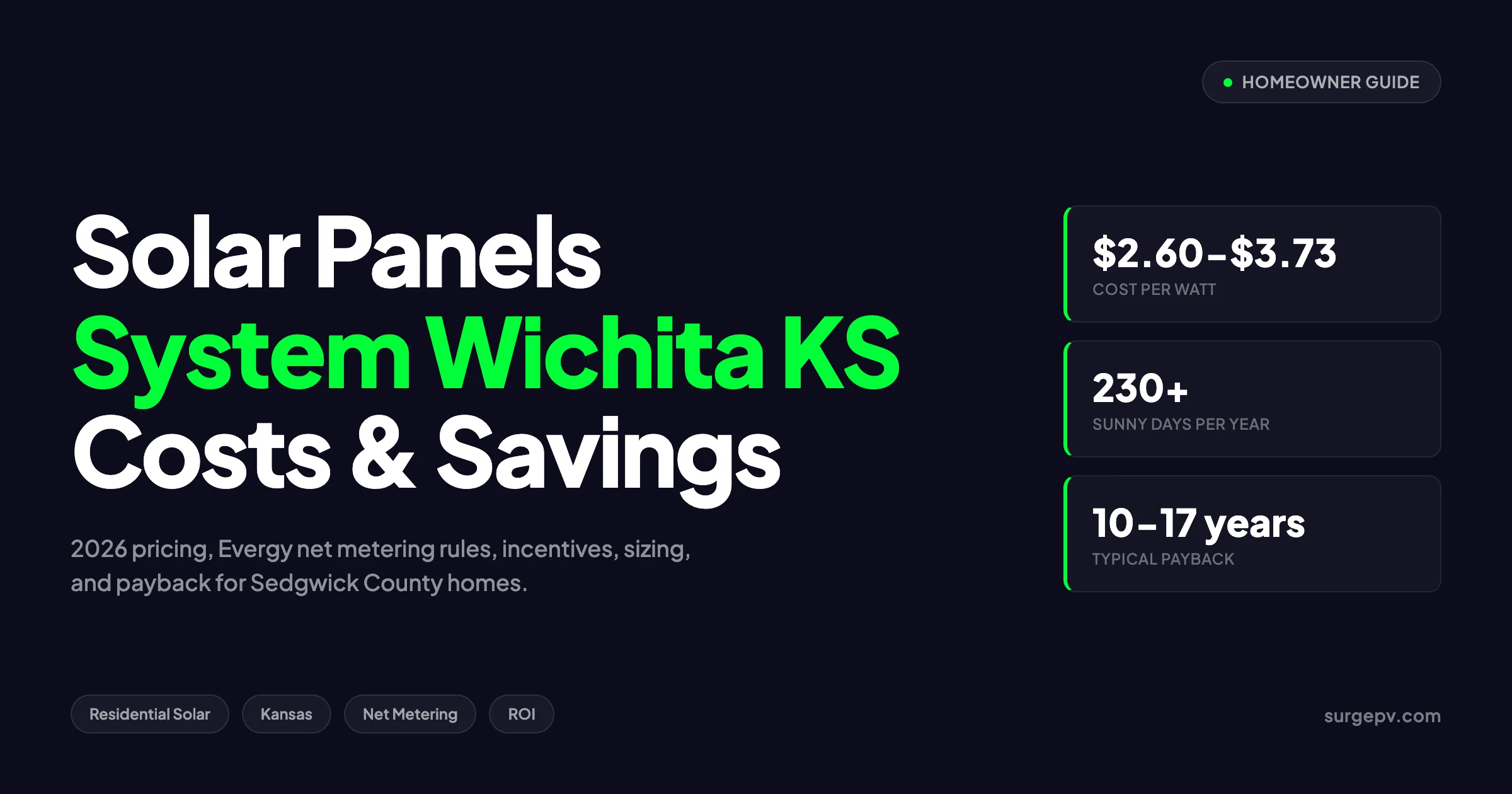
A residential solar panels system in Wichita KS typically costs $2.60-$3.73 per watt, with most homes needing a 7-11 kW system. Payback ranges from 10 to 17 years, depending on system size, financing, and how much of your generation you use on-site rather than export to Evergy.
Why Wichita Solar Economics Changed in 2026
Wichita has the sun. It has rising utility rates. What changed in 2026 is the incentive structure.
For years, solar sales pitches in Kansas leaned heavily on the 30% federal residential tax credit. That credit made a $25,000 system cost $17,500 after the first year. It shortened payback periods and made larger systems look attractive. The credit expired for cash and loan purchases on December 31, 2025, under the Big Beautiful Bill.
At the same time, Kansas tightened net metering. New participants are now limited to 50% of export capacity. Excess generation still earns a credit, but at roughly 2.4 cents per kWh, far below the retail rate of 13-15 cents per kWh.
The result is a market that rewards precision. The homeowners who do best in 2026 are the ones who size systems for actual consumption, maximize self-use, and get multiple quotes. The ones who lose are the ones who buy the biggest possible system and assume the grid will buy back their excess at full price.
How Much Does a Solar Panel System Cost in Wichita?
Solar pricing in Wichita sits close to the national middle. The exact cost depends on system size, panel brand, inverter type, roof complexity, and installer margin.
EnergySage reports an average of $2.68 per watt for Wichita as of June 2026, with an 11.26 kW system priced at about $30,150 before incentives, according to EnergySage’s Wichita market data. Palmetto lists a higher $3.02 per watt for a 7.7 kW system, at roughly $23,280 cash. EcoWatch data from 2025 showed about $3.00 per watt and a 7.4 kW system near $24,676 before incentives.
The table below combines these sources into realistic Wichita ranges by system size.
| System Size | Cost per Watt | System Cost (Before Incentives) | Typical Home Type |
|---|---|---|---|
| 5 kW | $2.60-$3.20 | $13,000-$16,000 | Small home, low usage |
| 7 kW | $2.60-$3.20 | $18,200-$22,400 | Average Wichita home |
| 9 kW | $2.60-$3.20 | $23,400-$28,800 | Larger home or pool |
| 11 kW | $2.60-$3.20 | $28,600-$35,200 | Large home, high AC load |
| 13 kW | $2.60-$3.20 | $33,800-$41,600 | Very large home or EV charging |
A typical Wichita household uses 900-1,200 kWh per month, so a 7-9 kW system covers most or all of that usage. Larger homes with electric vehicles, pools, or all-electric HVAC may need 11 kW or more. If you want to model payback for a specific system size, SurgePV’s generation and financial tool can run the numbers using Wichita irradiance and current utility rates.
Pro Tip
Get at least three quotes. We have seen per-watt prices vary by $0.50 or more between Wichita installers for the same roof and system size. The lowest quote is not always the best if it uses lower-tier equipment or a thin labor warranty.
Are Solar Panels Worth It in Wichita?
The value of solar in Wichita depends on three things: your current electric bill, how long you plan to stay in the home, and whether you can use most of your solar power during the day.
Under net metering in Kansas, excess electricity sent to the grid is credited at the utility’s system average cost, roughly 2.4 cents per kWh, not the full retail rate of about 13-15 cents per kWh. That means every kWh you consume directly saves you the retail rate, while every exported kWh saves only the wholesale credit. Self-consumption is where the real value lives.
Here is a realistic payback comparison for two Wichita homes, both with a $150 average monthly electric bill and an electricity rate of 14 cents per kWh.
| Scenario | System Size | Gross Cost | Annual Savings | Payback | 25-Year Savings |
|---|---|---|---|---|---|
| Smaller system, high self-use | 7 kW | $20,000 | $1,400 | ~14 years | ~$18,000-$25,000 |
| Larger system, more export | 11 kW | $30,000 | $1,600 | ~19 years | ~$12,000-$20,000 |
The larger system produces more total energy, but because a bigger share is exported at the low wholesale credit, its payback stretches longer. This is the key tradeoff most Wichita homeowners miss.
Key Takeaway
In Wichita, a right-sized system usually beats a maximum-sized system. Overbuilding can add cost without adding proportional savings because exported power is valued at roughly 2.4 cents per kWh.
What Size Solar System Do You Need in Wichita?
Sizing starts with your last 12 months of electric bills. Look for total annual kWh, not just the monthly dollar amount, because rates change.
A rough rule of thumb for Wichita:
- 1 kW of solar produces about 1,400-1,500 kWh per year
- A 7 kW system produces roughly 9,800-10,500 kWh per year
- A 10 kW system produces roughly 14,000-15,000 kWh per year
To size correctly, divide your annual kWh by 1,450. If you use 12,000 kWh per year, a 8.3 kW system would theoretically offset 100%. Then adjust for roof direction, shading, and the 2026 export-capacity limit.
Roof Direction and Shading
South-facing roofs produce the most in Wichita. East- and west-facing roofs still work but may produce 10-15% less. North-facing roofs are usually poor candidates unless the pitch is shallow. Shade from mature oak trees, common in older Wichita neighborhoods like College Hill and Riverside, can cut production sharply.
The 2026 Kansas Export-Capacity Limit
Starting January 1, 2026, new net metering participants in Kansas are limited to 50% of export capacity. In practical terms, this reinforces the case for sizing a system to match your actual on-site consumption rather than maximizing production.
If your annual usage is 12,000 kWh, a system that produces 12,000 kWh may now export a meaningful share. A system sized closer to 9,000-10,000 kWh of annual production could deliver a better payback because more of the generation is used directly.
For installers, this means load analysis matters more than ever. Tools like solar design software help model hourly production against your usage patterns, not just annual totals. For homeowners, the takeaway is simple: a system matched to your actual load will usually pay back faster than a system sized to fill your roof.
Kansas Solar Incentives and Net Metering in 2026
Incentives for Wichita solar changed significantly heading into 2026. Here is what is still on the table and what disappeared.
Federal Residential Solar Tax Credit
The 30% federal residential clean energy tax credit, often called the ITC, expired for cash and loan purchases after December 31, 2025. Homeowners who buy a system with cash or a loan in 2026 no longer qualify for the credit. Some lease and power-purchase agreement providers may still capture a commercial credit and pass part of the savings through, but that depends on the provider. The Database of State Incentives for Renewables & Efficiency (DSIRE) tracks current federal and state incentive status.
Kansas Renewable Energy Property Tax Exemption
Kansas still exempts the added value of a solar system from property taxes for 10 years under K.S.A. 79-201 Eleventh. If a $25,000 solar array raises your home’s assessed value by $15,000, you do not pay property tax on that added value for a decade. At Kansas’s average property tax rate near 1.33%, that saves roughly $150-$200 per year. Details are available from the DSIRE Kansas property tax exemption page.
Net Metering Under K.S.A. 66-1263
Evergy Kansas Central, which serves Wichita, must offer net metering under the Kansas Net Metering and Easy Connection Act. The Kansas Statutes authorize the program, and the Evergy website publishes the current application and tariff details. Key rules include:
- Systems up to 150 kW AC export capacity may participate
- Excess generation is credited at the system average cost, about 2.4 cents per kWh
- Credits carry forward monthly but expire on March 31 each year
- The net-metered capacity cap rises from 6% to 7% in July 2026 and 8% in July 2027
Evergy Home Battery Storage Pilot Program
Evergy runs a battery pilot program that provides qualifying customers with a free 16 kWh battery, roughly an $18,000 value, in exchange for a $10 monthly program fee. The program runs through 2026. A battery lets you store daytime solar production for evening use, which increases self-consumption and can improve payback under wholesale export credits.
No State Solar Rebate
Kansas does not offer a state solar tax credit or rebate. Some local utilities or rural electric cooperatives may have small programs, but Wichita homeowners should not count on them.
| Incentive | Status in 2026 | Value |
|---|---|---|
| Federal residential ITC | Expired for cash/loan purchases | 0% |
| Kansas property tax exemption | Active | 10 years on added value |
| Evergy net metering | Active | Wholesale credit for exports |
| Evergy battery pilot | Active through 2026 | Free 16 kWh battery + $10/month |
| State solar rebate | Not available | $0 |
How Solar Installation Works in Wichita
The installation process in Sedgwick County follows a standard sequence, but local permitting and utility interconnection add Wichita-specific steps.
-
Site assessment and quote. The installer visits your home, measures the roof, checks electrical service capacity, and reviews shading. Expect this to take 1-2 hours.
-
System design and proposal. The design specifies panel layout, inverter type, estimated production, and financing. Review the production estimate carefully. It should match your usage and roof conditions.
-
Contract and financing. Once you sign, the installer orders equipment. Lead times vary from 2-8 weeks depending on panel and inverter availability.
-
Permitting. The installer submits plans to Sedgwick County or the City of Wichita for building and electrical permits. Permit timelines range from a few days to several weeks.
-
Installation. Most residential systems install in 1-3 days. The crew mounts rails, attaches panels, installs the inverter, and runs conduit to your main electrical panel.
-
Inspection. A city or county inspector verifies code compliance, including NEC 690 requirements for PV systems.
-
Utility interconnection. Evergy installs a bi-directional meter and grants permission to operate. This step can take 2-6 weeks.
-
Activation and monitoring. Once permission to operate is granted, the system turns on. Most systems include app-based monitoring.
A Palmetto customer in Wichita reported 112 days from initial sales call to installation, which is typical for the region, according to Palmetto’s Wichita installation overview.
Common Mistakes Wichita Homeowners Make
The most expensive mistake is buying a system that is too large for your usage. Because exports earn only wholesale credits, every extra kilowatt of capacity beyond your daytime load pays back slowly.
Another common error is signing a solar loan without asking for the cash price. Dealer fees of 15-25% are often baked into the loan, so the total cost can be thousands higher than the quoted “system price.”
Homeowners also sometimes skip the insurance check. Standard policies often cover solar, but limits and deductibles vary. A single Wichita hailstorm can damage panels, inverters, or roof penetrations. Confirm coverage before installation.
Finally, do not assume net metering will last forever. Kansas has already tightened the rules once. If you are on the fence, understand that future changes could reduce export compensation further.
Choosing a Solar Installer in Wichita
Not every installer who advertises in Wichita has deep local experience. Here is what to check.
Years in business. Look for at least five years of operating history. Solar companies with thin balance sheets sometimes exit the market, leaving warranty claims unpaid.
Licenses and insurance. Kansas requires electrical contractors to hold a license. Verify the installer is licensed in Kansas and carries general liability and workers compensation insurance.
Labor warranty. A 10-year labor warranty is the industry minimum. Some Wichita installers offer 20-25 years.
Equipment. Ask for panel and inverter datasheets. Tier 1 panels with 25-year warranties and inverters from established brands are worth the small premium.
Local references. Request addresses of nearby installations. Drive by if possible. Local installers like Barkley Solar and Cromwell Solar have decades of Wichita-specific experience, including wind-load and hail considerations. You can verify Kansas contractor licenses through the State of Kansas licensing portal.
Financing transparency. If the quote includes a loan, ask for the cash price, loan term, interest rate, and dealer fee. Some solar loans carry dealer fees above 20%, which inflate the total cost.
| Criteria | Minimum Standard | Better |
|---|---|---|
| Years in business | 5+ | 10+ |
| Labor warranty | 10 years | 20-25 years |
| Panel warranty | 25 years | 25 years, Tier 1 brand |
| Inverter warranty | 10-12 years | 20-25 years |
| Local references | 3+ | Recent Wichita installs |
Wichita Weather and Solar Performance
Wichita’s climate is actually good for solar. The city averages 230 sunny days per year, well above the national average of 205. Summer days are long and clear, which drives strong production.
Hail Risk
Wichita sits in Tornado Alley and sees hail most years. Choose panels with a high impact rating. Most modern panels are tested to withstand 1-inch hail at 51 mph, but severe Wichita hail can exceed that. Homeowners insurance usually covers storm damage, but confirm solar is included in your policy.
Wind Risk
Kansas wind loads are no joke. A good installer will use proper roof attachments, flashing, and rail systems rated for local wind speeds. This is one reason local experience matters.
Snow and Cold
Snow usually slides off tilted panels within a day or two. Cold, sunny winter days can actually produce more per watt than hot summer days because panels operate more efficiently at lower temperatures.
Production by Season
A typical Wichita system produces about 40% of its annual output from May through August, according to Palmetto’s Wichita production data. Winter months produce the least, but net metering credits from summer can offset winter bills if they are used before the March 31 expiration.
Financing Options for Wichita Homeowners
Most Wichita homeowners choose one of four financing paths. The right choice depends on your tax situation, credit score, and how long you plan to own the home.
Cash purchase. You own the system outright and receive the full benefit of energy savings. With the federal ITC gone for residential cash purchases, payback is longer than in prior years, but total lifetime savings are highest. Cash also simplifies selling the home because there is no lender or lease transfer to negotiate.
Solar loan. A $0-down or low-down-payment loan lets you own the system while spreading payments over 10-25 years. Watch for dealer fees that raise the effective cost. Compare the loan payment to your current electric bill. A loan only makes sense if the monthly payment is close to or below what you currently pay Evergy.
Solar lease. You pay a fixed monthly amount, usually $90-$150, and the leasing company owns the system. No upfront cost, but you do not build equity. Leasing companies may still benefit from commercial tax credits. Leases can complicate home sales if the buyer does not want to assume the contract.
Power purchase agreement (PPA). You pay only for the electricity the system produces, typically at a rate lower than Evergy’s retail rate. Like a lease, you do not own the system. PPAs work best for homeowners who want lower bills without maintenance responsibility.
If you are unsure which option saves the most over time, use a solar financial modeling tool to compare cash, loan, and lease scenarios side by side.
| Financing Type | Upfront Cost | Own System? | Best For |
|---|---|---|---|
| Cash | High | Yes | Long-term homeowners with savings |
| Loan | Low | Yes | Homeowners who want ownership without large upfront cost |
| Lease | None | No | Homeowners who want predictable payments |
| PPA | None | No | Homeowners who want to avoid maintenance risk |
Model Your Wichita Solar Project in SurgePV
Run hourly production, shading, and payback calculations for any Wichita roof with SurgePV’s solar design software.
Book a DemoNo commitment required · 20 minutes · Live project walkthrough
Frequently Asked Questions
How much does a solar panel system cost in Wichita, KS?
A residential solar panel system in Wichita costs between $2.60 and $3.73 per watt, depending on equipment and installer. A typical 7 kW system runs about $18,200-$26,100 before incentives, while an 11 kW system is roughly $28,000-$30,000.
Are solar panels worth it in Wichita, Kansas?
Solar can be worth it in Wichita if you plan to stay in the home long enough to cover the payback period, which typically ranges from 10 to 17 years. Wichita gets 5.4 peak sun hours per day and over 230 sunny days per year, so production is solid.
What size solar system do I need for my Wichita home?
Most Wichita homes need a 7 to 11 kW system to offset annual usage. The right size depends on your monthly kWh use, roof space, shading, and whether you want to cover 100% of your bill. Under 2026 Kansas net metering rules, new systems are limited to 50% of export capacity.
Does Kansas have net metering for solar?
Yes, investor-owned utilities like Evergy must offer net metering under K.S.A. 66-1263. However, excess generation is credited at the wholesale system average cost, roughly 2.4 cents per kWh, and unused credits expire each March 31.
What solar incentives are available in Wichita in 2026?
The 10-year Kansas Renewable Energy Property Tax Exemption on added home value is still available. The federal residential ITC expired for cash and loan purchases after December 31, 2025. Evergy’s Home Battery Storage Pilot Program offers a free 16 kWh battery for qualifying customers through 2026.
How long do solar panels last?
Most solar panels carry 25-year product and performance warranties and remain productive for 30 years or more. Efficiency declines slowly, typically about 0.5% to 0.8% per year.
Do solar panels increase home value in Kansas?
Owned solar systems can increase home value. A Zillow study found homes with solar sold for about 4.1% more on average. In Kansas, the added value is also exempt from property taxes for 10 years.
Can I get free solar panels in Kansas?
Truly free solar panels are not available. Some companies advertise $0-down solar loans or leases, but those still involve monthly payments. The Evergy battery pilot program provides a free battery to qualifying participants, not free panels.
What are the best solar companies in Wichita?
Well-known Wichita-area installers include Barkley Solar, Cromwell Solar, Crown Roofing & Solar, and KC Solar. Look for at least 5 years in business, proper licensing, a 10-year labor warranty, and transparent equipment and financing options.
How does Wichita weather affect solar panels?
Wichita’s 230+ sunny days and 5.4 peak sun hours support strong production. Hail and high winds are the main risks, so choose panels with good impact ratings and an installer familiar with local wind-load requirements.
Bottom Line
A solar panels system in Wichita KS makes sense for homeowners who:
- Plan to stay in the home for at least 12-15 years
- Have a south-facing roof with minimal shading
- Can use a meaningful share of their solar power during the day, or add a battery
- Understand that the 2026 net metering rules reward self-consumption, not overproduction
Start by collecting 12 months of electric bills, then get three quotes from installers with local Wichita experience. Size the system for your actual usage, not your roof’s maximum capacity. And if you are an installer or EPC, use solar design software to show homeowners exactly how production, shading, and payback play out on their specific roof.
For homeowners ready to compare options, start with SurgePV’s solar software platform. It helps installers design, simulate, and propose systems with accurate Wichita production and financial data.
Where this fits
This article is part of SurgePV's Solar Business & Operations hub, which works through the topic from first principles to the decisions a project team actually has to make.

