

Quick Answer
The US alone has over 5 million residential solar systems operating today. Solar O&M employment in the US nearly doubled between 2019 and 2024, reaching 21,833 dedicated workers according to the U.S. Technical O&M — on-site labor, inspections, cleaning, repairs, and inverter servicing — accounts for approximately 52% of the market.
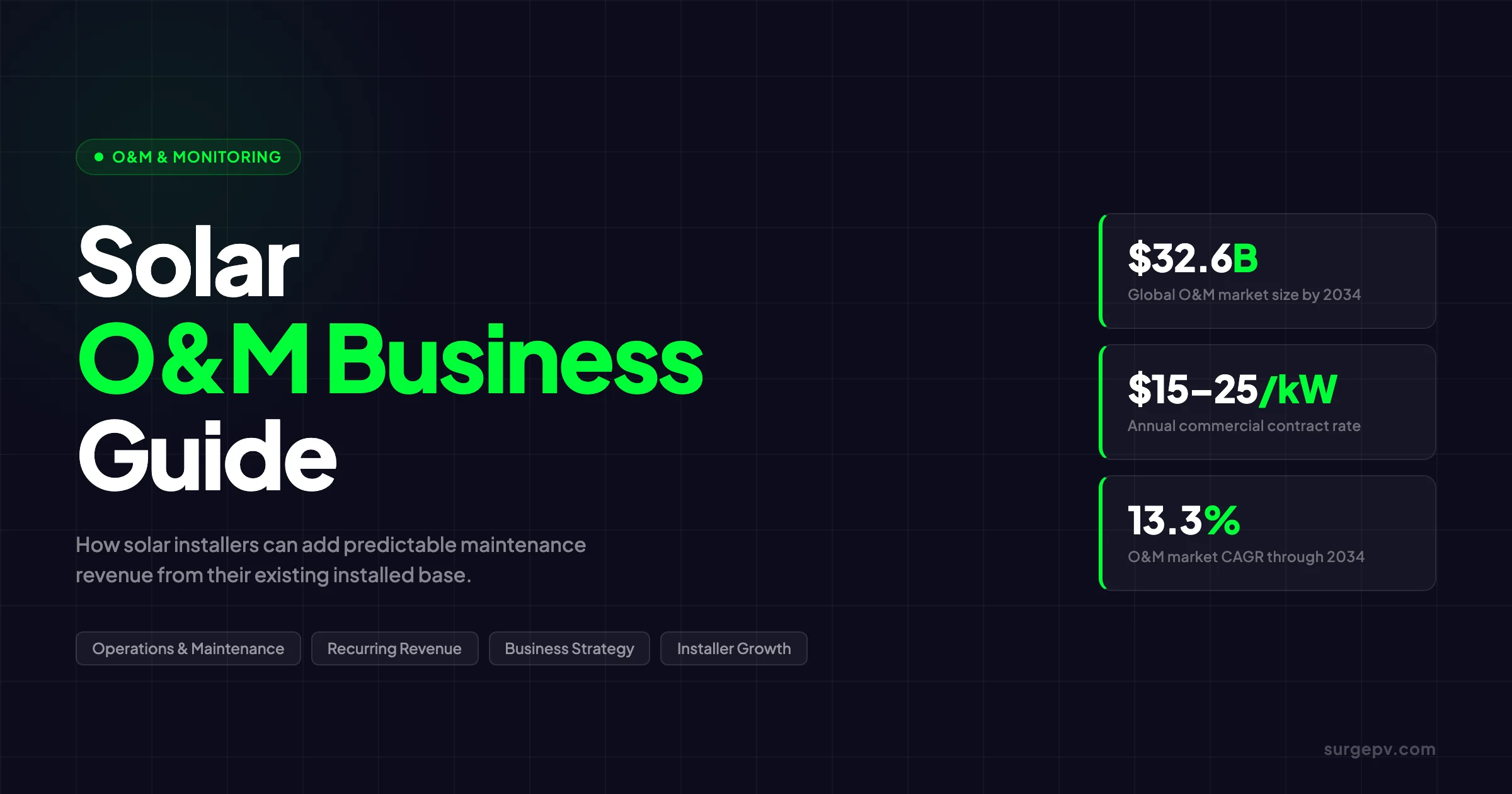
Every solar installer eventually hits the same ceiling: revenue is only as high as the number of new installations. The solar O&M opportunity breaks that ceiling. The global solar operations and maintenance market reached $14.5 billion in 2024 and is on track to hit $32.6 billion by 2034 — growing at a CAGR of 13.3% — and most of that work will be done by the same companies that installed the panels in the first place. This guide covers exactly how to build a solar O&M service line: what to offer, how to price it, how to sell it, and what the financials actually look like once it runs. For Global-specific compliance details, see Global net-metering-by-country.
The US alone has over 5 million residential solar systems operating today. Solar O&M employment in the US nearly doubled between 2019 and 2024, reaching 21,833 dedicated workers according to the U.S. Technical O&M — on-site labor, inspections, cleaning, repairs, and inverter servicing — accounts for approximately 52% of the market.
TL;DR — Solar O&M Business
O&M contracts create recurring revenue from systems you already installed. Residential contracts run $99–$300/year; commercial contracts run $15–$25 per kW per year. A base of 100 residential customers generates roughly $20,000 in annual recurring revenue at 35–50% gross margin. Start with monitoring-only, then layer in inspection, cleaning, and corrective tiers.
What this guide covers:
- Why the O&M market opportunity is at its strongest right now
- What services to offer and how to build a 3-tier pricing model
- How to write and pitch O&M contracts to new and existing customers
- What staffing and operational setup looks like at different scales
- Financial projections: ARR, margins, and what recurring revenue does to your business valuation
Why Solar O&M Is the Installer’s Best Revenue Move Right Now
Three market forces are converging in 2026 to make O&M the clearest growth path for solar installers.
The installed base is aging. The US alone has over 5 million residential solar systems operating today. Systems installed between 2016 and 2020 are now 6–10 years old — far enough into their lifecycle to need regular service, and old enough that some of the companies that originally installed them have gone out of business. That stranded customer base represents a real, addressable O&M market waiting for a provider.
New-install demand is compressing. The 30% federal residential ITC expired December 31, 2025. Install volumes will stabilize at lower levels through 2026, and many installers who relied on tax-credit-driven demand are looking for replacement revenue. O&M is the most direct answer.
O&M jobs are growing faster than install jobs. Solar O&M employment in the US nearly doubled between 2019 and 2024, reaching 21,833 dedicated workers according to the U.S. Department of Energy. This is a professionalizing service category with real labor supply building behind it.
For installers, this creates an opening that a new entrant cannot easily replicate. You already have the customer relationship, the system documentation, and the technical knowledge. Your cost of acquiring an O&M customer from your own install base is close to zero.
Pro Tip
The cheapest O&M customer to acquire is the one you just finished installing. Include your O&M contract offer in every project handover package — before the customer leaves the site, not after.
The Solar O&M Market: Size, Segments, and What It Means for Installers
The solar O&M market has two primary segments. Understanding them shapes which services you build first.
Technical O&M — on-site labor, inspections, cleaning, repairs, and inverter servicing — accounts for approximately 52% of the market. This is where installers operate naturally. Your technicians already know the equipment, already understand the site, and already have the tools.
Asset management — remote monitoring, performance reporting, financial tracking, and warranty administration — accounts for around 31% of the market. This segment requires less physical labor but more software infrastructure. For smaller installers, it is typically bundled into a monitoring subscription rather than sold as a separate deliverable.
The remaining share covers specialized services: thermal imaging, drone inspection, and vegetation control. These are upsell opportunities for premium commercial contracts, not starting points.
Precedence Research projects the global solar O&M market will reach $32.63 billion by 2034. Over 60% of new solar farms already adopt integrated O&M contracts at commissioning. The commercial and utility sectors normalized this years ago — the residential sector is catching up. For Global-specific compliance details, see Global solar-permitting-speed-by-country.
The key takeaway for your business: technical O&M is where installers have the clearest competitive advantage, and it is growing fast enough to support a material portion of a mid-size installer’s total revenue.
What a Solar O&M Service Actually Includes
O&M is not just panel cleaning. A properly structured service plan covers four distinct categories of work.
Preventive Maintenance
Scheduled activities that keep the system performing at its design output. This includes:
- Annual or biannual on-site visual inspections
- Panel cleaning (frequency depends on location: 2–4 times per year in dusty or high-pollen climates, once per year in clean environments)
- Roof penetration and mounting hardware checks
- Inverter firmware updates and thermal checks
- DC/AC wiring and connection inspections
- Vegetation clearance around ground-mounted arrays
- Combiner box and junction box inspections
Monitoring and Performance Reporting
Remote production monitoring is the foundation of any O&M service. This means setting up a monitoring account at commissioning, confirming the data feed is active, and generating regular performance reports for the customer. Reports should flag:
- Generation vs. forecast variance
- String or inverter underperformance
- Clipping events
- Fault codes and alarm history
Monitoring creates the visibility that justifies every other O&M service. Without it, you are reacting to customer complaints instead of catching issues early. Every O&M program should start by confirming that every system under contract has active monitoring.
Corrective Maintenance
Reactive work triggered by faults, alarms, or performance drop. This covers:
- Inverter replacements and repairs
- Module replacements for defective or physically damaged panels
- Wiring and connection faults
- Monitoring communication failures
- Meter and production data discrepancies
According to NREL’s O&M cost modeling report, undetected system faults reduce energy output by 10% to 25% annually. For a 10 kW residential system generating $1,800 per year in electricity value, that is $180–$450 in silent annual losses the customer is absorbing without knowing it. The O&M pitch is built on this number.
Warranty Administration
Many module and inverter warranties require proof of maintenance to remain valid. A solar O&M provider who tracks inspection records, keeps service logs, and manages warranty claims on behalf of the customer is delivering significant administrative value — particularly for commercial customers with 25-year PPA or lease agreements in place. Warranty administration is high-perceived-value, low-cost work, and it belongs in every contract above the Basic tier.
Key Takeaway
Monitoring + preventive + corrective + warranty administration is the complete O&M scope. Residential plans can start with monitoring only. Commercial customers almost always need all four categories from day one.
How to Structure Your O&M Service Tiers
A tiered pricing structure lets customers self-select their level of service, reduces sales friction, and creates natural upsell paths. Three tiers work well for most installers.
| Tier | Services Included | Residential Price | Commercial Price |
|---|---|---|---|
| Basic (Monitoring) | Remote monitoring, monthly report, email alerts | $99–$150/year | $8–$10/kW/year |
| Standard (Inspection + Cleaning) | Basic + annual inspection, 1 cleaning visit, inverter check | $200–$300/year | $15–$18/kW/year |
| Premium (Full Service) | Standard + priority dispatch, 2 cleanings, warranty admin, corrective labor included | $400–$600/year | $22–$28/kW/year |
Residential pricing notes:
- Basic tier is the entry point. Offer it free or at cost for the first year on new installs to establish the monitoring relationship, then convert to paid in year two.
- Most residential customers will upgrade to Standard once they understand what monitoring-only misses.
- Premium tier is designed for customers with battery storage, complex roof configurations, or warranty-sensitive financing agreements. For more on this topic, see Adding Battery Storage Services.
Commercial pricing notes:
- Commercial pricing is universally quoted per kW. It is easier to justify, easier to compare across sites, and scales naturally with system size.
- For a 200 kW commercial rooftop at $18/kW/year, you are generating $3,600 per customer annually — from a system your crew installed once.
- NREL and Sandia National Laboratories peg the industry benchmark for comprehensive commercial O&M at $15–$25 per kW per year. Your pricing should land within this band to remain competitive.
Pro Tip
Always quote O&M alongside the installation proposal — not after commissioning. Customers who sign up at project close have significantly lower churn than those approached six months after installation when the relationship has cooled.
Pricing Your O&M Contracts: Cost of Delivery and Margins
The margin in O&M comes from route optimization and labor efficiency, not from maximizing the price ceiling. Here is how the cost structure breaks down.
Residential Cost of Delivery
A technician driving an efficient route can complete 6–8 residential inspection and cleaning visits per day. Factor in the following per job:
| Cost Item | Estimate |
|---|---|
| Technician labor (8-hr day, 7 jobs) | $40–$52 per job |
| Vehicle and fuel (allocated per job) | $12–$18 per job |
| Materials (cleaning supplies, connectors) | $20–$40 per visit |
| Admin and scheduling overhead | $15–$20 per job |
| Total cost per inspection + cleaning visit | $87–$130 |
A Standard plan at $250/year per customer includes one inspection and one cleaning visit. At $110 average cost of delivery, your gross profit on that visit is approximately $140. Add the monitoring platform cost ($60–$96/year depending on your platform) and the net margin on the full Standard contract is 35–50%.
For 100 residential Standard-tier customers:
| Metric | Value |
|---|---|
| Annual recurring revenue | $25,000 |
| Monitoring platform costs | $7,200–$9,600 |
| On-site visit delivery costs | $11,000–$13,000 |
| Gross profit | $2,400–$6,800 |
| Gross margin | 10–27% at 1 visit/year |
The margin expands significantly when you batch visits geographically — a technician covering 8 customers in the same neighborhood costs the same as covering 8 customers spread across 50 miles. Route density is where the O&M economics improve.
At 2 customers per hour in a dense route, 100 customers take 50 technician hours per year — about 6.5 eight-hour days. That is a realistic side operation for an existing install crew, not a full-time hire.
Commercial Cost of Delivery
Commercial visits take longer (typically 4–6 hours per site depending on system size) but the contract value per visit is much higher.
For a 100 kW commercial system at $18/kW/year ($1,800/year):
| Cost Item | Estimate |
|---|---|
| 2 technician days (inspection + 1 cleaning) | $560–$720 |
| Materials | $80–$120 |
| Admin and performance reporting | $100–$150 |
| Monitoring platform (annual) | $120–$180 |
| Total cost of delivery | $860–$1,170 |
| Revenue | $1,800 |
| Gross margin | 35–52% |
Ten commercial customers at 100 kW each produces $18,000 in ARR with $8,600–$11,700 in delivery costs. That is $6,300–$9,400 in gross profit achievable with one technician spending two days per week on O&M.
Key Takeaway
O&M gross margins run 35–52% once route density is established. Margin improves significantly as you add customers in the same geographic cluster — travel time drops without changing contract value.
Setting Up Your First O&M Contracts
A written contract protects both parties and defines expectations before the first service visit. At minimum, an O&M service agreement should cover:
Scope of services — List every included activity in plain language. Separate “included in contract price” (preventive) from “billable at discounted hourly rate” (corrective). Ambiguity here is the source of most customer disputes.
Response times — Define response windows for fault alerts. A Premium contract might guarantee a 24-hour phone response and a 72-hour on-site response. A Basic plan might specify business-hours email support only.
Performance warranty language — Be careful with production guarantees. Unless you are accounting for weather, grid curtailment, and module degradation in the contract terms, do not commit to specific output numbers. Commit to service delivery, not energy production.
Contract term and renewal — One-year auto-renewing contracts are standard for residential. Commercial contracts often run 3–5 years with annual CPI escalators built in.
Exclusions — Be explicit about what is not covered. Acts of God, vandalism, structural failures, and manufacturer defects not covered under a product warranty are all standard exclusions. If warranty claims management is an included service, define what “management” means — it means filing the claim, not funding the repair.
Payment terms — Annual prepayment simplifies accounting and improves cash flow. Offer a 5–10% discount for annual prepay versus monthly billing. Most customers will take the discount.
Pro Tip
Have a solar attorney review your contract template once before you start using it. The upfront cost ($300–$600) prevents disputes that cost 10x that amount and your customer relationship. Reuse the template for every customer after that.
For commercial customers, expect a more detailed negotiation. The Solar Best Practices contractual framework provides industry-standard terms as a starting reference.
Manage Your Installed Fleet With SurgePV
SurgePV gives installers a centralized platform to track system performance, flag underperformance, and document service history across your entire O&M customer base.
Book a DemoNo commitment required · 20 minutes · Live project walkthrough
For a direct comparison, see Arka 360 vs SurgePV.
Building Your O&M Operations: Staff, Tools, and Workflow
The operational setup for O&M is lighter than most installers expect. Here is how to structure it at three stages of growth.
Stage 1: 0–50 Customers (Part-Time Overlay)
At this scale, O&M is handled by existing install crew during slower periods. No dedicated hire needed.
What you need:
- A monitoring platform account (examples: Enphase Enlighten, SolarEdge monitoring portal, or a third-party aggregator)
- A simple scheduling spreadsheet or CRM-based service calendar
- A one-page service report template sent to customers after each visit
- A signed contract template (DocuSign or paper)
Staffing: 1 technician, 1–2 days per month. Roughly 4–6 hours per customer per year at this scale.
Target: Convert 30–50% of new installs to Basic or Standard O&M plans.
Stage 2: 50–200 Customers (Dedicated Role)
At 50+ customers, you need a part-time dedicated O&M coordinator if not a full technician.
What you need:
- A field service management tool for scheduling and route optimization
- A customer-facing performance dashboard (auto-generated monthly)
- A CRM with service history tracking — our best solar CRM for installers guide covers the main options
- An O&M-specific section on your website so customers can find and purchase plans
Staffing: 1 full-time O&M technician handles up to 150 residential customers or 15–20 commercial customers. They spend roughly 3 days per week on service visits and 2 days on monitoring review, report generation, and corrective dispatch.
Target: 40–60% O&M attachment rate on all new installs; outreach campaign to existing install base.
Stage 3: 200+ Customers (O&M as a Business Unit)
At this scale, O&M should operate as a distinct service line with its own P&L.
What you need:
- Dedicated O&M manager
- 2–3 technicians (or a regional subcontractor network for geographic coverage)
- Automated monthly reporting via monitoring platform API
- Fleet management tools for tracking all systems in one dashboard
- Separate invoicing and billing system for recurring contracts
Target: $200,000–$500,000 ARR depending on residential vs. commercial mix. At this scale, O&M typically accounts for 15–25% of total company revenue.
Key Takeaway
You do not need a dedicated hire until you cross 50 customers. Start by converting your own install base — the customers are already there and the acquisition cost is zero.
How to Sell O&M to Your Existing Customers
The pitch is direct: your system has been running for X years and has never been professionally serviced. Here is what that costs you.
For a customer with a 10 kW system generating $1,800 per year in electricity value, a 15% output drop from undetected soiling, string faults, or inverter degradation is a $270 annual loss. A $200 Standard O&M plan pays for itself in under a year if it catches and corrects even one performance issue. That math is easy to explain in a phone call or email.
Five sales channels to activate:
1. At project handover. The most effective moment. Hand the customer their commissioning documentation and the O&M plan offer simultaneously. Customers who sign at handover have the highest retention rate and lowest churn.
2. Annual monitoring report email. Send every customer a year-end performance summary. Include one line: “Your system produced X kWh this year. Book your annual inspection to protect that output next year.” Include a link to purchase a plan.
3. Fault alert follow-up calls. When monitoring flags an issue, call the customer before dispatching a technician. Use the conversation to pitch the service plan: “We caught this early because we monitor your system. Would you like us to cover future service calls under a maintenance agreement?”
4. 5-year service reminder campaign. Systems that are 5 years old are entering their first meaningful service cycle. A direct email to your 5-year install list with a “5-year performance check” offer has strong response rates.
5. Referral from existing O&M customers. Customers on service plans become advocates when the service is visible. Ask them to refer neighbors or business contacts who have solar but no service coverage. A simple referral discount accelerates this.
What Not to Do
Do not pitch O&M as a fee for monitoring. Customers resist paying for something passive they cannot see. Pitch it as protection: “I will tell you when something goes wrong before it becomes expensive.”
Do not send a generic quote. Personalize every O&M pitch with the customer’s actual system size and a calculation of what a 10–15% performance fault costs them annually. Specific numbers close better than vague benefit statements.
Using Solar Software to Scale O&M
The difference between an O&M service that grows and one that stalls is usually software. Manual tracking across 50+ customers creates errors, missed visits, and slow fault response. The right tools automate the routine work and free your team for the technical work.
Monitoring platform — Every system under O&M needs production monitoring with active alerting. Set custom alert thresholds that notify you before the customer notices. The goal is to be calling the customer about a problem, not receiving a call about it.
PV design software with portfolio visibility — When you use solar software that stores your design documentation centrally, you have instant access to string configurations, inverter specs, and expected output for every system in your portfolio. This cuts diagnostic time on corrective calls significantly. The technician arrives knowing exactly what they are looking at.
Generation and financial modeling — The generation and financial tool in SurgePV lets you track expected vs. actual yield across multiple sites, making it straightforward to spot systemic underperformance patterns — a string orientation issue common across a batch of installs, for example, or an inverter firmware version causing recurring clipping.
CRM and scheduling — Use your CRM to schedule recurring service visits automatically. Set a task that fires 90 days before each contract renewal. Tag customers by tier so the technician’s route is organized by service level. This also means no customer ever falls through without a renewal touch.
Solar proposal software makes it easy to create formal O&M contract presentations for commercial customers who need professional documentation before signing. Build an O&M proposal template once and reuse it across all commercial prospects.
Automated reporting — Monthly performance reports sent automatically reduce the time your team spends on customer communication while increasing the customer’s perceived value of the service. A well-designed report shows generation, savings, avoided emissions, and any alerts — in one page, sent on schedule, with no manual work.
The goal is a workflow where your technician arrives at a site with full system documentation, the customer receives an automated monthly report, and you are alerted to faults before the customer knows they exist.
Financial Modeling: What O&M Revenue Actually Looks Like
Here are three realistic scenarios for an installer launching an O&M program from their existing install base.
Scenario 1: Residential-Only, 100 Customers
| Metric | Value |
|---|---|
| Customers (Standard tier) | 100 |
| Average contract value | $220/year |
| Annual recurring revenue | $22,000 |
| Monitoring platform costs | $7,200 |
| On-site visit costs | $6,500–$8,000 |
| Gross profit | $6,800–$8,300 |
| Gross margin | 31–38% |
| Technician days required | 13–17/year |
At 200 customers, ARR doubles to $44,000. Delivery costs increase only partially because route density improves — you are covering more jobs per technician day as the base grows.
Scenario 2: Commercial-Focused, 20 Customers
Assume an average system size of 150 kW per customer at $18/kW/year.
| Metric | Value |
|---|---|
| Customers | 20 |
| Average system size | 150 kW |
| Contract value per customer | $2,700/year |
| Annual recurring revenue | $54,000 |
| Cost of delivery | $26,000–$32,000 |
| Gross profit | $22,000–$28,000 |
| Gross margin | 41–52% |
| Technician days required | 55–70/year |
20 commercial customers at this size requires roughly one technician working on O&M two days per week — achievable as a role split within your existing team.
Scenario 3: Mixed Portfolio, 150 Customers
| Segment | Count | Avg. Contract | ARR |
|---|---|---|---|
| Residential Basic | 40 | $120/year | $4,800 |
| Residential Standard | 70 | $230/year | $16,100 |
| Commercial (50–200 kW avg) | 40 | $2,400/year | $96,000 |
| Total | 150 | — | $116,900 |
At 40–45% blended gross margin, $116,900 ARR generates $46,760–$52,605 in gross profit — enough to cover the salary of a full-time O&M technician with $20,000–$25,000 remaining as contribution toward overhead.
What Recurring Revenue Does to Business Valuation
This is the argument that should motivate any owner thinking about selling or raising capital. Installation revenue is valued at 0.3–0.5x revenue in M&A. Recurring service revenue — contracts with multi-year terms and high renewal rates — is valued at 2–4x revenue.
A $100,000 O&M ARR book is worth $200,000–$400,000 in a business sale. The same $100,000 in one-time installation revenue contributes $30,000–$50,000 to valuation. The multiple difference is the real financial argument for building an O&M service line alongside your install business.
See our full breakdown of solar installer profit margins for context on how O&M fits into your overall business P&L.
Common Mistakes Installers Make When Launching O&M
Most O&M programs fail not because the market is absent — it is clearly there — but because of avoidable operational mistakes in the first 90 days.
Underpricing the contract. Many installers set O&M prices based on what they think the customer will accept, not what the service actually costs to deliver. If you price a residential plan at $99/year and it requires 3 hours of technician time plus a monitoring subscription, you are losing money. Price on cost-plus-margin, not on gut feel.
No written contract. Verbal O&M agreements generate disputes. “I thought the panel replacement was included” is a conversation you do not want to have. Every O&M customer needs a signed scope-of-services agreement before work starts. See our guide on solar warranty claims for installers for the related complexity this prevents.
Skipping monitoring setup at installation. An O&M program without monitoring is purely reactive. If monitoring was not configured at commissioning, you are doing corrective-only work — the lowest-margin, highest-friction version of O&M. Fixing this on every new install going forward is the single most important process change you can make.
Including corrective labor in the flat contract price. Until you have a clear handle on corrective call frequency across your customer base, do not bundle corrective labor into your fixed price. Charge corrective work at a discounted hourly rate for contract customers and at full rate for non-customers. This protects your margin while giving contract customers a meaningful benefit.
Ignoring warranty administration. Customers who have had inverters or modules fail under warranty but never knew they could claim it are the easiest upsell to Premium O&M. Warranty administration is high-perceived-value, low-cost work. It belongs in your Standard tier, not held back for Premium.
No commissioning handoff process. If the install team does not document monitoring credentials, string configurations, and login details at commissioning, the O&M team wastes hours per site reconstructing that information. Build a commissioning checklist that captures everything O&M needs before the install crew leaves the site. This applies to every install you do from now on.
Key Takeaway
The most common failure is launching O&M without a written contract, active monitoring, and pricing built on actual cost. Fix those three things before signing your first O&M customer.
Insurance and Liability Considerations for O&M Providers
Most installers have general liability insurance for install work. O&M requires a separate review of your coverage because the nature of the exposure is different.
What changes when you add O&M:
- You are now on-site repeatedly at the same customer’s property. Each visit creates a new liability exposure window.
- You are monitoring a system and receiving fault alerts. If you receive an alert, fail to act on it, and the customer suffers a loss (panel fire, inverter failure causing damage), your monitoring record may be cited in a claim.
- Corrective maintenance involving electrical work at an operating PV system carries higher risk than new-build installation.
What to review with your insurance broker:
| Coverage Type | Why It Matters for O&M |
|---|---|
| General liability | Must extend to recurring service visits, not just one-time install |
| Professional liability (E&O) | Covers failure to detect or report a fault during monitoring |
| Workers’ compensation | Confirm coverage for maintenance tasks, which may differ from installation tasks in your policy language |
| Inland marine / equipment floater | Covers diagnostic and cleaning equipment your technicians carry |
Most installers can add O&M coverage as an endorsement to their existing policy at modest additional premium. Get the endorsement in writing before you start your first service contract.
Limiting your liability in the contract — Your O&M service agreement should include a liability cap (typically equal to the annual contract value) and language clarifying that you are not responsible for consequential damages from system underperformance not caused by your service failure. A solar attorney reviewing your contract once handles this correctly.
Predictive Maintenance: The Next Step After Reactive O&M
As your O&M program matures past reactive service calls, the competitive edge shifts toward being predictive. Predictive maintenance uses performance data trends — not just fault alerts — to identify system issues before they cause significant output loss or customer complaints.
These techniques are available to mid-size installers without enterprise software:
String-level performance analysis — Flag any string producing more than 5% below its designed output over a rolling 30-day period. In most cases, this is soiling, shading from new obstructions, or a loose connection. Catching it at 5% underperformance is a cleaning visit. Missing it until it becomes 20% underperformance is an inverter replacement. Shadow analysis software identifies shading issues before installation.
Inverter clipping pattern analysis — Repeated clipping events on a correctly designed system indicate module degradation or heavy soiling. This is visible in inverter data 6–12 months before a customer notices a change in their electricity bill. See Solar Inverter Clipping for detailed guidance.
Performance ratio trending — Calculate PR monthly and track it over time. A PR that was 82% in year one and is now 74% in year four is not just normal degradation — it signals a serviceability issue requiring investigation.
Thermal inspection every 3–5 years — Thermal cameras identify hotspots, delamination, and bypass diode failures that visual inspection misses entirely. This is a high-value upsell on premium commercial contracts and differentiates you from competitors who only offer visual-only maintenance.
None of these require expensive platforms. They require a monitoring system that exports data, a simple analysis template, and a technician who knows what to look for.
Pro Tip
Build a quarterly performance review into every commercial O&M contract. A one-page performance summary emailed to the building owner or facilities manager keeps the contract top of mind and makes renewal straightforward when the time comes.
Building an O&M Business From Third-Party Installs
You do not have to limit O&M to systems you installed. A significant portion of the addressable market — systems where the original installer has closed, merged, or simply does not offer service — is available to any qualified operator willing to do the prospecting.
How to enter third-party O&M:
- Identify geographic clusters where your technicians already operate regularly
- Target residential or commercial customers in those areas with “orphaned” systems — no active monitoring account, no service provider on file
- Offer a free initial inspection and performance audit to establish the relationship
- Propose a Standard or Premium contract based on audit findings
The free audit converts well because it delivers immediate value. Most customers learn something they did not know about their system’s current state: a soiling issue, an offline string, an inverter firmware that has not been updated in three years. You solve the problem, they sign the contract.
For solar companies expanding into solar project management beyond just installation, third-party O&M is also a way to build revenue in geographic markets where you cannot yet justify a full install team.
Pro Tip
Target commercial property managers with multiple solar assets. A manager with 3–5 rooftop systems across their portfolio will pay a premium for consolidated O&M billing and a single-point reporting dashboard. Competing installers who only do single-site contracts cannot offer this.
Scaling O&M Across Europe and International Markets
The O&M business model translates directly to European and other international markets, often with stronger financial incentives for customers to maintain performance. Feed-in tariffs in many countries pay on actual metered generation — meaning underperformance has an immediate cash cost the customer can calculate from their utility bill. Also see: European Solar Tax Credits.
In Germany, for instance, systems under EEG feed-in agreements are contractually required to maintain performance standards over the lifetime of the incentive period. O&M contracts that document service history protect the installer and the customer in the event of a performance dispute with the grid operator. Also see: Germany solar subsidies. See our guide on Community Solar Projects Germany for more.
The same applies in Italy under the GSE’s monitoring requirements for systems above a certain size, and in France where performance documentation is increasingly required for commercial off-take agreements. Our guides on solar energy policies in Europe and European solar incentives cover the regulatory context in detail. Also see: solar panel ROI in Italy. Also see: France solar feed-in tariffs.
For installers operating in multiple countries, standardizing your O&M contract template and service scope — while adapting pricing to local labor costs — is the most efficient way to scale the service line internationally.
Conclusion
Solar O&M is the most direct path from installation-only revenue to recurring revenue. The market is there — $32.6 billion globally by 2034. The customers are there — millions of residential and commercial systems entering their first real service cycle. The margin is there — 35–52% gross on a well-run service operation.
Three steps to get started:
- This week: Build a two-page O&M contract template with Basic and Standard tiers, pricing based on your actual delivery costs, and a clear scope-of-services list.
- This month: Identify the 20 most recently installed customers in your database and send them a follow-up email offering a first-year Standard plan at 20% off. Track conversion rate.
- This quarter: Set up active monitoring on every install in your base that does not have it configured. This is the foundation — without monitoring, everything else is reactive.
The installers who build an O&M service line now are the ones with the most resilient revenue in 2027 and beyond.
Frequently Asked Questions
What is solar O&M?
Solar O&M (operations and maintenance) covers all services that keep a PV system performing at its rated output after installation — including monitoring, panel cleaning, inverter checks, and corrective repairs. Installers who offer O&M create a recurring service relationship with their customers long after the original installation is complete.
How much does a solar O&M contract cost?
Residential O&M contracts typically run $99–$300 per year for monitoring and annual inspections. Commercial contracts are priced at $15–$25 per kW per year — so a 100 kW rooftop system generates $1,500–$2,500 annually per customer. Utility-scale contracts start around $8 per kW per year for large portfolios.
How do installers price solar maintenance contracts?
Most installers use a tiered model: a basic tier covering monitoring and annual inspection, a standard tier adding cleaning and inverter service, and a premium tier including priority response and panel replacements. Pricing is set per kW installed or as a flat annual fee, with a typical gross margin of 35–50% on labor once routes are optimized.
What services does a solar O&M plan include?
A full O&M plan includes production monitoring, annual or biannual on-site inspections, panel cleaning, inverter firmware updates and health checks, warranty claim management, vegetation trimming, and corrective repair dispatch. Premium plans add thermal imaging, performance guarantee clauses, and 24/7 fault alerts.
How do I start offering O&M services as a solar installer?
Start by converting your most recent installs to a monitoring-only plan at no or low cost, then add paid inspection and cleaning tiers. Build a service schedule template, train one technician on O&M protocols, and create a written contract template. Most installers can launch a functional O&M program within 30 days.
Is solar O&M profitable for small installers?
Yes — O&M typically runs 35–50% gross margin once technician routes are optimized. A solo technician can service 6–8 residential systems per day. With 100 residential customers paying $200 per year each, that is $20,000 in annual recurring revenue requiring roughly 12–15 technician days per year to service.
Where this fits
This article is part of SurgePV's Solar Business & Operations hub, which works through the topic from first principles to the decisions a project team actually has to make.

