Quick Answer
Solar mounting structures include roof-mount (penetrating, ballasted, shared rail — $0.15–$0.30/W), ground-mount (fixed-tilt, tracking — $0.20–$0.50/W), and pole-mount (for single panels or small arrays). Material options: aluminum (lightweight, corrosion-resistant) and galvanized steel (stronger, cheaper).
The mounting structure holds your panels in place for 25–30 years. It determines tilt angle, wind resistance, installation speed, and long-term maintenance costs. Choose wrong and you are locked into suboptimal performance for decades.
Solar mounting structures include roof-mount (penetrating, ballasted, shared rail — $0.15–$0.30/W), ground-mount (fixed-tilt, tracking — $0.20–$0.50/W), and pole-mount (for single panels or small arrays). Material options: aluminum (lightweight, corrosion-resistant) and galvanized steel (stronger, cheaper).
Solar mounting structures include roof-mount (penetrating, ballasted, shared rail — $0.15–$0.30/W), ground-mount (fixed-tilt, tracking — $0.20–$0.50/W), and pole-mount (for single panels or small arrays). Material options: aluminum (lightweight, corrosion-resistant) and galvanized steel (stronger, cheaper).
This guide covers every major mounting type with real cost data, installation time comparisons, and the design considerations that matter for each. For the latest details on France, see Agricultural Solar Case Study. Read more about Floating Solar Farms France.
TL;DR — Mounting Structure Selection
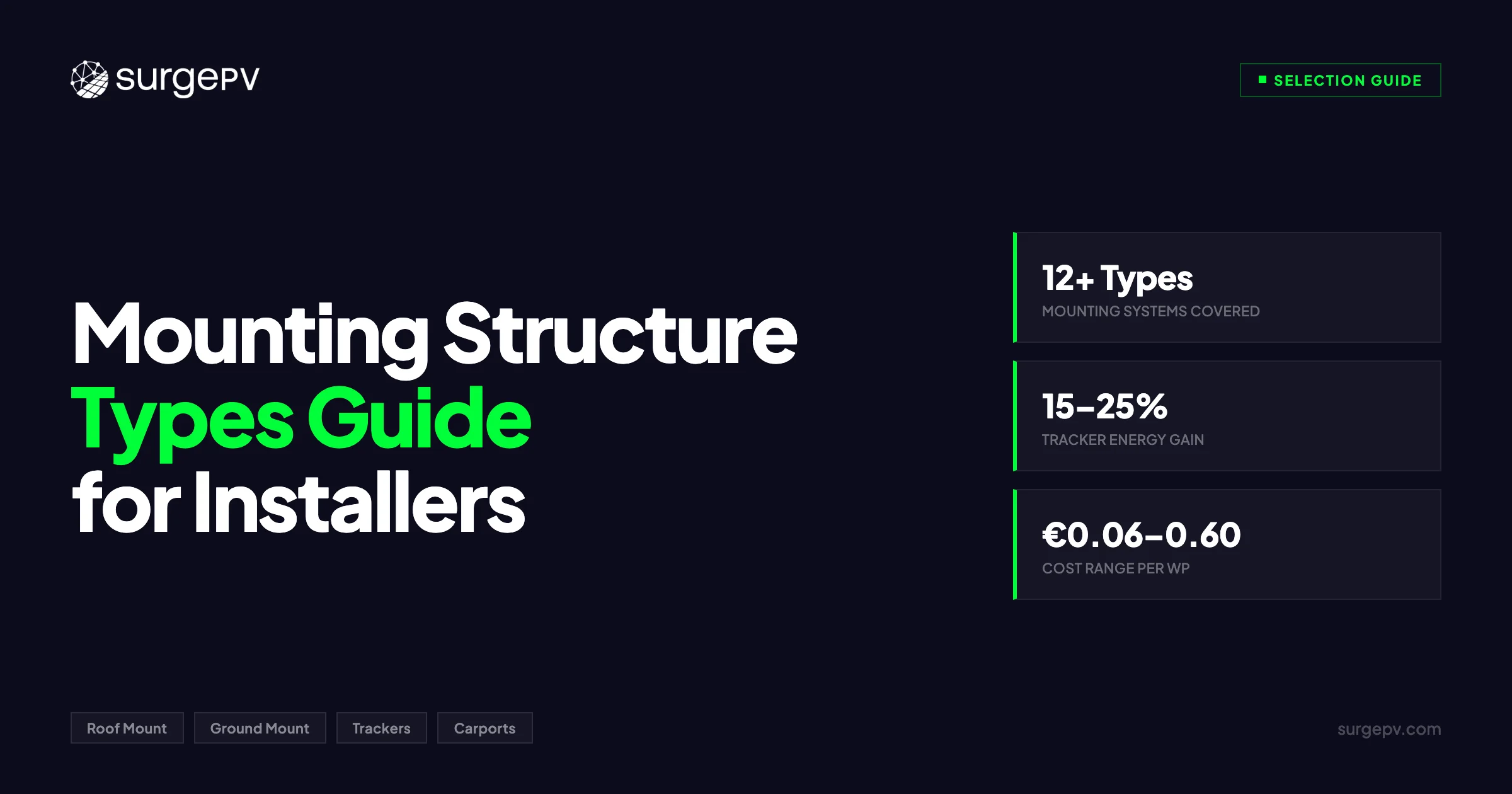
Pitched roof rail systems remain the default for residential. Flat roof ballasted systems avoid penetrations and structural concerns. Ground-mount driven pile is the standard for utility-scale. Single-axis trackers add 15–25% yield for large ground-mount projects. Carports serve dual-purpose but cost 30–50% more per watt. Match the structure to the site, not the other way around.
See Commercial Solar Carport Design Guide for detailed guidance.
Roof-Mounted Systems
Roof mount is the most common installation type for residential and commercial solar. It uses the existing building structure, requires no additional land, and is typically the lowest-cost option per installed watt.
Pitched Roof Rail Systems
The industry workhorse. Two or more aluminum rails are attached to the roof rafters through the roofing material using lag bolts and waterproof flashings. Panels clip onto the rails with mid-clamps and end-clamps.
Cost: €0.08–€0.15 per Wp for the racking hardware Install time: 3–5 hours for a typical 10-panel residential system Lifespan: 25–30 years (aluminum rails with stainless steel hardware)
Works on asphalt shingle, tile, slate, and most pitched roof materials. Requires roof penetrations, which must be properly sealed to prevent leaks.
Rackless / Rail-Less Systems
Panels attach directly to the roof structure through individual mounting points, without continuous rails. Each panel gets 2–4 attachment brackets bolted to the rafters.
Cost: €0.06–€0.12 per Wp Install time: 2–4 hours (20–30% faster than rail systems) Best for: Standard residential installations where speed matters
The main advantage is installation speed. Fewer components, less cutting, faster layout. The trade-off: less flexibility for panel spacing and orientation adjustments.
Flat Roof Ballasted Systems
Panels sit in pre-angled trays weighted down by concrete blocks, a configuration known as ballasted racking. No roof penetrations required. The weight of the ballast (typically 10–20 kg/m²) holds everything in place.
Cost: €0.10–€0.18 per Wp (plus ballast material) Install time: 4–8 hours for a 30 kWp commercial system Best for: Commercial flat roofs where penetrations are not allowed or practical
The structural load is the main constraint. A ballasted system adds 15–25 kg/m² to the roof load. The structural engineer must confirm the roof can handle this weight, especially in snow-load zones.
Flat Roof Tilt-Up Systems
Similar to ballasted systems but with adjustable tilt frames that angle panels at 10–30 degrees from horizontal. This increases energy yield by 5–15% compared to flat-mounted panels.
Cost: €0.12–€0.22 per Wp Install time: 5–10 hours for a 30 kWp commercial system Best for: Commercial flat roofs where optimizing yield is worth the extra cost
Tilt-up systems require inter-row spacing to avoid self-shading. This reduces the total number of panels that fit on a given roof area. The trade-off between tilt angle and panel density is a core design decision — solar design tools helps find the optimal balance.
Metal Roof Clamp Systems
Standing seam metal roofs allow clamp-on mounting with zero penetrations. S-5 clamps grip the standing seam ribs, and rails or direct-attach brackets connect to the clamps.
Cost: €0.08–€0.14 per Wp Install time: 2–4 hours (fastest roof mount option) Best for: Commercial and agricultural buildings with standing seam roofs
For corrugated metal roofs, through-fastener brackets with rubber gaskets are used instead of clamps. These require penetrations but are straightforward to waterproof.
Roof Mount Comparison Table
| System | Cost (€/Wp) | Install Time | Penetrations | Best Application |
|---|---|---|---|---|
| Pitched roof rail | €0.08–€0.15 | 3–5 hrs | Yes (lag bolts) | Residential pitched roofs |
| Rackless / rail-less | €0.06–€0.12 | 2–4 hrs | Yes (fewer) | Fast residential installs |
| Flat ballasted | €0.10–€0.18 | 4–8 hrs | No | Commercial flat roofs |
| Flat tilt-up | €0.12–€0.22 | 5–10 hrs | No | Commercial yield optimization |
| Metal roof clamp | €0.08–€0.14 | 2–4 hrs | No (standing seam) | Metal-roofed commercial/ag |
Pro Tip
Always confirm roof structural capacity before specifying a mounting system. For ballasted flat roof systems, request a structural assessment if the building is older than 20 years or if local snow loads exceed 1.0 kN/m². The cost of a structural review (€500–€1,500) is far less than the cost of a roof failure.
Ground-Mounted Systems
Ground mount is the standard for utility-scale solar farms and a strong option for commercial and agricultural projects where roof space is limited or unsuitable. It offers complete control over tilt, azimuth, and row spacing.
Fixed-Tilt Driven Pile
Steel piles (W-beams or pipe) are driven 1.5–2.5 meters into the ground using a pile driver. Purlins and rails connect the piles, and panels mount on top.
Cost: €0.12–€0.20 per Wp (structure only, excluding foundation) Install time: 100–200 piles per day with a pile-driving crew Best for: Utility-scale projects on flat or gently sloping terrain with suitable soil
This is the fastest and most cost-effective ground-mount method. Works in most soil types except solid rock or very loose sand. A geotechnical survey determines pile depth and spacing.
Fixed-Tilt Ballasted Ground Mount
Concrete blocks or pre-cast footings replace driven piles. Panels mount on frames anchored to the ballast.
Cost: €0.15–€0.25 per Wp Best for: Sites where driven piles are not feasible (rocky ground, contaminated soil, landfills, areas with buried utilities)
Ballasted ground mount costs more and takes longer to install, but avoids any ground penetration — the go-to choice for brownfield and landfill solar projects.
Ground Screws
Helical screw foundations are twisted into the ground with specialized equipment. They hold like driven piles but are removable and reusable. Also see: Us Residential Solar Market Trends 2026.
Cost: €0.14–€0.22 per Wp Install time: 50–100 screws per day Best for: Sites requiring minimal ground disturbance, temporary installations, or projects requiring decommissioning plans
Ground screws are popular in Northern Europe, where environmental regulations restrict ground disturbance. They install cleanly with minimal soil disruption. Also see: European Solar Incentives. For Europe-specific compliance details, see Europe solar compliance.
Seasonal Adjustable Tilt
Frames with manual tilt adjustment allow operators to change panel angle 2–4 times per year to track seasonal sun height changes.
Typical gain: 5–8% more annual yield vs fixed optimal tilt Cost: €0.18–€0.28 per Wp Best for: Small to medium ground-mount systems where marginal yield gain justifies manual labor
For larger systems, the labor cost of seasonal adjustment outweighs the yield benefit. Single-axis trackers are more cost-effective above approximately 500 kWp.
Tracking Systems
Trackers rotate panels to follow the sun across the sky. They cost more and add mechanical complexity, but the energy gain is significant for the right projects.
Single-Axis Trackers
Panels rotate on a north-south axis, tracking the sun from east to west throughout the day. The tilt adjusts automatically using motors and controllers.
Energy gain: 15–25% more than fixed-tilt, depending on location and DNI levels Cost: €0.06–€0.10 per Wp additional vs fixed-tilt racking Maintenance: Annual motor and bearing inspection, controller calibration Best for: Utility-scale ground-mount projects above 1 MWp in high-DNI locations See Design Commercial Solar System 1MW for detailed guidance.
Single-axis tracking is now standard for utility-scale solar in Southern Europe, the Middle East, and Australia. At current costs, it pays for itself within 3–5 years through the additional energy generated. For Australia-specific information, see Solar Energy in Australia. For Australia-specific compliance details, see Australia comparisons/lgc-vs-stc.
The main manufacturers include Nextracker, Array Technologies, and Soltec. Market share is heavily concentrated among these three.
Dual-Axis Trackers
Panels rotate on both a horizontal and a vertical axis, maintaining optimal perpendicular alignment to the sun at all times.
Energy gain: 30–40% more than fixed-tilt Cost: €0.15–€0.30 per Wp additional vs fixed-tilt Best for: Research installations, high-value concentrated PV, or niche applications where maximum output per panel matters more than cost per watt
Dual-axis trackers are rarely used in commercial projects. The additional 10–15% gain over single-axis does not justify the 2–3x higher cost and maintenance.
Tracker Comparison
| Feature | Fixed-Tilt | Single-Axis | Dual-Axis |
|---|---|---|---|
| Annual yield gain (vs fixed) | Baseline | +15–25% | +30–40% |
| Additional cost per Wp | — | €0.06–€0.10 | €0.15–€0.30 |
| Maintenance | Minimal | Low (annual) | Moderate (semi-annual) |
| Moving parts | None | Motor + bearings | 2 motors + gears |
| Typical project size | Any | Above 500 kWp | Research / niche |
| LCOE impact | Baseline | -8–15% | -5–10% (offset by cost) |
When Trackers Make Financial Sense
Single-axis trackers are cost-justified when three conditions are met: (1) DNI exceeds 1,800 kWh/m²/year, (2) land cost is low relative to system cost, and (3) the project is large enough to spread tracker controller costs across many rows (typically above 500 kWp). In Northern Europe with diffuse-dominant irradiance, trackers rarely pencil out.
Design Any Mounting Configuration in SurgePV
SurgePV models roof mount, ground mount, and carport layouts with automatic tilt optimization, row spacing, and shade analysis for any site.
Book a DemoNo commitment required · 20 minutes · Live project walkthrough
For a direct comparison, see Arka 360 vs SurgePV.
Specialty Mounting Systems
Solar Carports and Canopies
Steel or aluminum structures built over parking areas, with solar panels as the canopy surface. Dual purpose: power generation and vehicle shade/rain protection.
Cost: €0.30–€0.60 per Wp (structure only, 2–3x more than standard ground mount) Typical configurations: Single-cantilever (one row of columns), T-frame (central column), or multi-row Best for: Commercial properties with large parking areas, EV charging stations, schools, hospitals
Carports cost significantly more per watt than rooftop or ground mount, but they use otherwise unproductive space. For properties with constrained roof area, carports can double the total installed capacity.
BIPV — Building-Integrated Photovoltaics
Solar cells integrated into building materials: roof tiles, facade panels, windows, or skylights. The PV element replaces conventional material rather than being added on top.
Cost: €0.50–€1.50 per Wp (2–5x more than standard rooftop PV) Efficiency: 10–18% (lower than standard panels due to aesthetic constraints) Best for: New construction with architectural requirements, heritage buildings where standard panels are not permitted
BIPV makes economic sense only when the replaced building material has significant cost (such as natural stone facades) or when regulations prohibit standard panel mounting.
Floating Solar (Floatovoltaics)
Panels mounted on floating platforms anchored to the bottom or shore of a water body. Reservoirs, lakes, and water treatment ponds are the primary sites.
Cost: €0.15–€0.30 per Wp (floating platform only) Energy gain: 5–10% more than ground-mount due to water cooling effect Best for: Water utilities, reservoirs, irrigation ponds, and sites with limited land
Floating solar also reduces water evaporation by 50–70% on covered areas, a significant co-benefit in arid regions. The main challenges are anchoring in variable water levels and protecting electrical connections from moisture.
Pole-Mounted Systems
Panels mount on a single steel pole, typically 3–5 meters high. Used for small off-grid systems, remote monitoring stations, and agricultural applications.
Cost: €0.20–€0.40 per Wp Typical size: 1–4 panels (0.3–1.6 kWp) Best for: Off-grid signage, CCTV, weather stations, gate openers, water pumps
Structural Engineering Considerations
Every mounting system must withstand the environmental loads at its location. Under-designing risks collapse. Over-designing wastes money.
Wind Loads
Wind is the primary structural concern for solar mounting. Design standards include:
- Eurocode EN 1991-1-4 (Europe) — specifies wind pressure based on terrain category and height
- ASCE 7 (United States) — wind speed maps and exposure categories
- IEC 61215 / IEC 61730 — module-level mechanical load ratings
Typical design wind speeds range from 90 km/h in sheltered inland areas to 200+ km/h in coastal zones. Tilt angle significantly affects uplift: panels at 30 degrees experience roughly 40% more uplift than panels at 10 degrees.
Snow Loads
In Northern Europe and mountainous regions, snow accumulation can add 0.5–2.5 kN/m² to the structural load. This applies to both roof-mount and ground-mount systems.
Design considerations:
- Panels tilted above 30 degrees shed snow naturally
- Flat or low-tilt panels accumulate snow and require higher structural ratings
- Snow guard placement prevents sliding panels from dumping snow on walkways
Roof Structural Capacity
The existing roof structure must support the added dead load of panels, racking, and ballast (if applicable).
| System Type | Added Dead Load |
|---|---|
| Pitched rail (flush mount) | 10–15 kg/m² |
| Flat ballasted | 20–35 kg/m² |
| Flat tilt-up with ballast | 25–40 kg/m² |
Most modern commercial roofs are designed for 1.0–2.0 kN/m² live load. A ballasted solar system consuming 0.25–0.40 kN/m² leaves adequate margin in most cases. Older roofs and lightweight steel buildings need individual assessment.
Pro Tip
Always request the building’s original structural drawings before designing a roof-mount system. The drawings show the roof’s load capacity, rafter/purlin spacing, and connection details. Without them, a structural engineer must perform an on-site assessment, adding €1,000–€3,000 and 2–4 weeks to the project timeline.
How Mounting Type Affects System Design
Mounting structure directly shapes every downstream design decision.
Tilt and Azimuth Constraints
Pitched roofs fix the tilt and azimuth. A south-facing 35-degree pitch is ideal. A north-facing 10-degree flat section is not.
Flat roofs and ground-mount offer design freedom. The optimal tilt and azimuth depend on latitude, self-consumption goals, and inter-row spacing constraints. See our solar angles guide for optimization data.
Inter-Row Spacing
Any system with tilted rows requires spacing to prevent self-shading. The steeper the tilt and the higher the latitude, the more spacing is needed.
- Fixed-tilt ground mount at 25° tilt, 50°N: approximately 2.5–3.0m row pitch for standard 2m panels
- Flat roof tilt-up at 15° tilt, 50°N: approximately 1.8–2.2m row pitch
Our inter-row spacing guide covers the formulas and pre-calculated reference tables for common configurations.
Energy Yield Simulation
Different mounting types produce different energy yields from the same panels. Solar design tools accounts for mounting type in the simulation by modeling:
- Tilt and azimuth angles (fixed or tracking)
- Ground reflectance (albedo) for bifacial calculations
- Row-to-row shading across 8,760 hours
- Temperature effects based on mounting ventilation (flush mount runs hotter than tilt-up)
The solar yield and financial analysis then converts the yield simulation into customer-facing financial projections.
Design Workflow
For any mounting type, the design workflow follows the same sequence:
- Import site imagery and define the mounting area — see our solar panel layout design guide
- Select mounting type and panel orientation
- Place panels with appropriate setbacks and spacing
- Run shadow analysis to identify shaded panels
- Assign strings and inverters
- Generate BOM and proposal
PV design software handles this workflow for roof mount, ground mount, and carport configurations. The mounting type changes spacing rules and structural parameters; the workflow stays the same.
For a full walkthrough of how mounting type fits into the end-to-end design process, see the residential solar system design guide. For installation-specific guidance, see our solar panel installation guide.
Further Reading
Explore our complete Solar Installation Guide for 10 chapters on site surveys, permitting, and commissioning.
Frequently Asked Questions
What are the different types of solar panel mounting systems?
The main types are roof-mounted (pitched rail, rackless, flat ballasted, flat tilt-up, metal roof clamp), ground-mounted (driven pile, ballasted, ground screw), tracking (single-axis, dual-axis), and specialty (carport, BIPV, floating, pole-mounted). Each type suits different site conditions, budgets, and energy yield targets.
Which solar mounting system is best for residential installations?
For pitched roofs, rail-based mounting systems are the industry standard, offering the best balance of cost, reliability, and flexibility. Rackless systems are gaining popularity for faster installation and fewer roof penetrations. For flat roofs, ballasted tilt-up systems provide optimal angle without structural modifications.
Are solar trackers worth the investment?
Single-axis trackers increase energy yield by 15–25% compared to fixed-tilt systems, making them cost-effective for utility-scale projects in high-DNI locations where land is affordable. For residential and most commercial rooftop installations, the added cost and mechanical complexity of trackers is not justified.
How do you choose between roof mount and ground mount solar?
Choose roof mount when the roof has adequate structural capacity, orientation, and unshaded area. Choose ground mount when the roof is unsuitable, when larger system sizes are needed, or when optimal tilt and azimuth are a priority. Ground mount costs more per watt due to foundation and land requirements but offers greater design flexibility. Solar proposal software generates professional quotes in minutes.
Where this fits
This article is part of SurgePV's Solar Design hub, which works through the topic from first principles to the decisions a project team actually has to make.