

Quick Answer
Solar monitoring systems range from basic inverter monitoring (free, limited data) to advanced SCADA systems ($0.02–$0.05/W). Key platforms include SolarLog, Meteocontrol, and AlsoEnergy. Advanced monitoring detects faults within hours rather than months, improving asset returns by 2–5%.
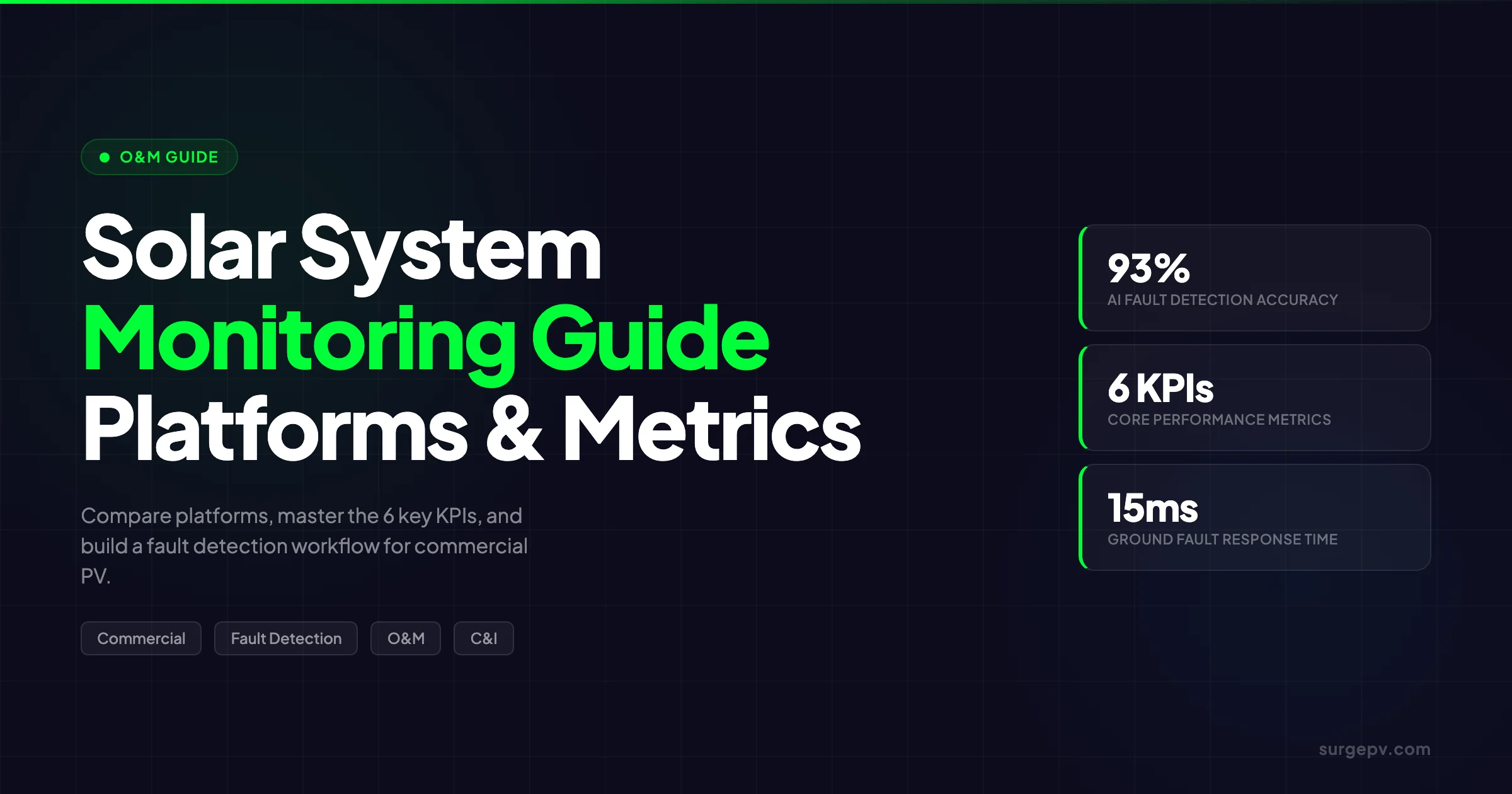
A commercial solar system running without active monitoring is guessing at its own performance. You will not know about a failed string until an invoice shows lower-than-expected generation — by which point revenue loss is already baked in. A unified monitoring platform can cut fault response time from days to hours by aggregating data into a single portfolio view, and research on AI-based systems shows neural networks now classify seven fault types at 93% accuracy.
Solar monitoring systems range from basic inverter monitoring (free, limited data) to advanced SCADA systems ($0.02–$0.05/W). Key platforms include SolarLog, Meteocontrol, and AlsoEnergy. Advanced monitoring detects faults within hours rather than months, improving asset returns by 2–5%.
This guide covers how solar monitoring systems work, the six metrics that define system health, how leading platforms compare for commercial use, and what fault detection looks like in practice — from millisecond hardware-level arc detection to AI-driven anomaly classification.
TL;DR — Solar Monitoring for Commercial Systems
Track six KPIs: Performance Ratio, Specific Yield, Availability Factor, Weather-Corrected Performance, Degradation Rate, and Soiling Index. For multi-brand commercial fleets, choose a hardware-agnostic platform. Module-level monitoring adds fault isolation precision at higher hardware cost. AI anomaly detection now achieves 93% fault classification accuracy across seven fault types. Budget $500–$2,000 per year for monitoring software at the 100 kWp–1 MWp scale.
For more on this topic, see Design Commercial Solar System 1MW.
What Solar Monitoring Systems Actually Track
Solar monitoring is not just production logging. A full monitoring stack captures five data layers simultaneously:
| Layer | Data Points | Purpose |
|---|---|---|
| AC output | kWh produced, kW real-time, export/import, power factor | Revenue verification, grid compliance |
| DC strings | String voltage, current, IV curve shape | String fault detection |
| Module level | Per-panel voltage, current, temperature | Granular fault isolation |
| Environment | Irradiance (W/m²), ambient temp, wind speed, soiling | PR normalization, loss attribution |
| Inverter health | MPPT efficiency, THD, reactive power, error codes | Component failure early warning |
Most residential monitoring skips the environmental layer. Commercial installations should treat it as mandatory — you cannot calculate a weather-corrected Performance Ratio without irradiance and temperature data, and without weather correction, you cannot distinguish a cloudy week from an underperforming system.
The IEC 61724-1 standard (Photovoltaic System Performance Monitoring) defines measurement categories and data granularity requirements. Enterprise-grade platforms should declare compliance. At a minimum, Class C (simplified monitoring) requires total irradiance in the module plane and AC energy output. Class A (detailed monitoring) adds DC power at array level and ambient and back-of-module temperature.
Hardware That Feeds the Monitoring Platform
The monitoring software is only as good as the hardware feeding it.
Data loggers capture readings at 1- to 15-minute intervals from inverters, string combiner boxes, and sensors, then push data to the cloud. Most modern inverters include an integrated logger. Standalone loggers are added when higher accuracy or legacy hardware is involved.
Communication gateways translate inverter protocols — Modbus RTU, Modbus TCP, SunSpec, CAN bus — to a cloud API. Multi-brand sites need gateways that handle multiple protocols simultaneously.
Irradiance sensors measure plane-of-array (POA) irradiance. Silicon reference cells (±5–10% accuracy) cost less than pyranometers (±2–3%) and are sufficient for most commercial O&M work. Pyranometers are worth the premium on sites where precise PR calculations feed into performance guarantee contracts.
Current transformers (CTs) at the consumption side allow the platform to track self-consumption, grid export, and import — essential for economic optimization of C&I systems.
Solar weather monitoring tools goes deeper on irradiance hardware selection and data logger integration for commercial installations.
Communication Protocols by Inverter Brand
Not every monitoring platform supports every inverter protocol out of the box. Here is what to check before platform selection:
| Inverter Brand | Primary Protocol | Notes |
|---|---|---|
| SolarEdge | SunSpec / proprietary REST API | Native to SolarEdge platform; third-party via SunSpec |
| Enphase | Envoy local + cloud API | Module-level data available via API |
| Huawei | Modbus TCP + FusionSolar cloud | Direct SCADA integration available |
| Sungrow | Modbus RTU/TCP + iSolarCloud API | SunSpec 2.0 support added 2024 |
| Fronius | Modbus + Solar API v1 | REST-based, easy third-party integration |
| SMA | Modbus + Sunny Home Manager API | SunSpec compliance varies by model |
| Growatt | Modbus RTU + ShineServer API | Common in utility-scale Asia/Africa markets |
Multi-brand installers need to verify that their monitoring platform supports the specific inverter firmware versions in their installed base — not just the brand. Protocol support can vary between product generations.
The Six KPIs That Define Commercial System Health
Tracking raw production numbers is not monitoring — it is metering. These six metrics tell you whether the system is healthy and how to attribute any performance gap.
1. Performance Ratio (PR)
Performance Ratio is the most important single metric in PV system assessment. It normalizes energy output against irradiance received, removing weather variation from the picture.
PR = E_AC / (H_POA × P_STC)
Where E_AC is measured AC energy (kWh), H_POA is plane-of-array irradiance (kWh/m²), and P_STC is nameplate capacity (kWp).
A PR of 1.0 is physically impossible — it would require zero losses. Real benchmarks by climate:
| Climate Type | Expected PR Range | Notes |
|---|---|---|
| Cool temperate (UK, Germany, Netherlands) | 0.82 – 0.88 | Low temperatures reduce ohmic and thermal losses |
| Mediterranean (Spain, Italy, southern France) | 0.76 – 0.84 | Higher ambient temps increase losses |
| Desert (MENA, southwest US) | 0.72 – 0.80 | High soiling rates partially offset temperature benefits |
| Tropical (SEA, sub-Saharan Africa) | 0.70 – 0.78 | Humidity, dust, and high ambient temps compound losses |
A PR below 0.70 on a system less than 5 years old is a red flag. Either significant soiling has accumulated, a string is offline, or the inverter is clipping under high irradiance. The solar performance ratio guide has the full loss waterfall breakdown and formulas for each sub-loss category.
2. Specific Yield
Specific Yield (kWh/kWp) removes system size from the comparison, letting you benchmark sites of different capacities against each other and against public reference data. For France-specific information, see Agricultural Solar Case Study.
SY = E_AC / P_STC
For a 250 kWp rooftop in Munich, a specific yield of 950–1,050 kWh/kWp per year is typical. In Madrid, expect 1,400–1,600 kWh/kWp. Deviations of more than 5% from historical baselines warrant investigation. Deviations of more than 10% require immediate field inspection.
3. System Availability Factor
Availability tracks the percentage of daylight hours the system was online and generating. The industry target for commercial systems is 99%+ excluding planned maintenance windows.
AF = (Total daylight hours − Downtime hours) / Total daylight hours × 100
A site with 98.5% availability over a month has roughly 5 hours of unplanned downtime — enough to matter financially if the lost hours coincide with peak irradiance periods (typically 10:00–15:00 local solar time). Most performance guarantee contracts include availability clauses. Missing 99% availability can trigger liquidated damages.
4. Weather-Corrected Performance Index
Raw PR fluctuates by season. The Weather-Corrected Performance Index (WCPI) adjusts for temperature variations, removing the systematic PR improvement seen in winter and the decline seen in summer. Without it, seasonal comparisons mislead — a system looks worse in July than in January even when nothing is wrong.
Some platforms call this “temperature-corrected PR.” The calculation adjusts actual output to what the system would have produced at a standard reference temperature (25°C), using the module’s published temperature coefficient (typically −0.30% to −0.40%/°C for monocrystalline silicon).
5. Degradation Rate
Panels degrade at 0.3–0.8% per year depending on cell technology. Monitoring detects degradation trends by comparing PR over multi-year periods against expected values. Rapid degradation above 1.5% per year may indicate light-induced degradation (LID), potential-induced degradation (PID), or mechanical damage. The [solar panel degradation rates guide](/blog/solar-panel-degradation-rates) has technology-specific benchmarks and failure mode diagnostics.
PID is particularly dangerous in commercial string inverter systems with high-voltage strings — the DC voltage stress between panel frames and ground can accelerate cell degradation silently over months. Monitoring platforms that calculate long-term PR trend lines catch PID before it becomes irreversible. Read DC Bus Voltage Optimization for a complete walkthrough.
6. Soiling Index
Soiling losses typically run 1–5% in northern Europe, 5–15% in the Middle East and South Asia, and up to 25% in high-dust environments like parts of India, the MENA region, and western Australia. Some monitoring platforms integrate satellite data or local weather feeds to estimate soiling accumulation and trigger cleaning recommendations. Also see: Best Solar Design Software India. Also see: European Solar Incentives. For Australia-specific compliance details, see Australia comparisons/lgc-vs-stc.
Soiling Index = PR (soiled) / PR (clean baseline) × 100
A soiling index below 95 typically triggers a cleaning recommendation. The only way to justify cleaning contract costs with data — rather than guesswork — is to track the soiling index quantitatively. Operators who track it typically reduce cleaning frequency by 20–30% compared to fixed cleaning schedules, by cleaning only when soiling loss actually exceeds the cost of the service visit.
Pro Tip
Set up automated weekly PR reports flagging any site more than 5% below its 90-day baseline. A single email alert per week, read in two minutes, catches most yield-impacting faults before they compound over months. Most enterprise platforms support configurable weekly digest emails with site-by-site PR status.
Three Tiers of Solar Monitoring Architecture
The monitoring tier you choose determines data granularity, fault isolation capability, and hardware cost. There is no single right answer — it depends on system size, inverter configuration, and O&M labor costs at the site.
Tier 1: System-Level Monitoring
A single revenue-grade meter at the AC output records total production. Some installations add a consumption CT to track self-use vs. grid export. This is the minimum for feed-in tariff verification and most O&M warranty claims.
Hardware cost: $300–$600 for meter and communication gateway Fault resolution: Can detect total system failure or major inverter offline events; cannot isolate string or panel issues Best for: Small commercial rooftops under 50 kWp with single inverters and tight budgets; systems where O&M is handled by the inverter manufacturer under warranty
Tier 2: String-Level Monitoring
Current transformers or smart combiner boxes measure each DC string individually. The platform flags strings producing below expected current for their temperature and irradiance conditions, narrowing a fault investigation to 10–20 panels rather than the entire array.
Hardware cost: $800–$2,500 for string monitoring equipment Fault resolution: Identifies which string has failed; technician inspects the string, not the full array Best for: 50 kWp–1 MWp commercial rooftops with multiple strings per inverter
This is the right tier for most commercial C&I installations. String-level monitoring adds roughly $0.02–$0.04/Wp to project cost — less than one month’s lost revenue from an undetected string failure on a typical commercial tariff.
Tier 3: Module-Level Monitoring
Microinverters or DC optimizers attached to each panel report individual panel performance data. Every panel has a known performance state at every data polling interval.
Hardware cost: The inverter premium of $0.06–$0.12/Wp more than conventional string inverters Fault resolution: Panel-specific — technician goes directly to the failing panel without diagnostic work Best for: Complex rooftops with shading, mixed orientations, or high O&M labor costs; installations where a service visit costs $300+ and fault isolation is worth the hardware premium Shadow analysis software identifies shading issues before installation.
Module-level monitoring does not guarantee better system performance — it accelerates fault isolation. On a simple unshaded flat roof with a single string inverter, string-level monitoring achieves 90% of the diagnostic value at a fraction of the hardware cost.
The choice of monitoring tier should flow from the system design. Solar design platform that models string configurations and expected yield by array section produces the output baseline that the monitoring platform uses as its reference. The better the design-stage model, the more accurate the monitoring alerts from day one.
How Fault Detection Works: From Alert to Resolution
Fault detection in a commercial PV system operates across three distinct time scales, each serving a different protection function.
1. Hardware-Level Protection (Milliseconds)
Arc Fault Circuit Interrupters (AFCIs) and Ground Fault Detection Interruption (GFDI) circuits operate at hardware speed — entirely independent of any software platform or cloud connectivity.
AFCI detects arc fault signatures in DC wiring at frequencies above normal inverter switching. Modern AFCI systems detect arc currents across PV strings up to 600 meters long. Sungrow’s AFCI 3.0+ system, released in 2026, detects arc currents up to 40 A across strings of 600 meters — effectively covering the full length of large commercial rooftops without false trips from normal switching transients.
GFDI detects line-to-ground faults by measuring imbalance between positive and negative conductors. Current-generation inverters isolate ground faults in as little as 15 milliseconds. This protection trips the inverter before the monitoring platform logs a data point. The monitoring platform sees the downstream effect — inverter offline, string current drops to zero — and raises a fault ticket.
Both protections are mandatory under NEC Article 690 (US), IEC 62109-1 (global), and national grid standards. They are non-negotiable safety requirements, not monitoring features.
2. Statistical Anomaly Detection (Minutes to Hours)
Software-based fault detection compares observed string or panel output to expected output given current irradiance and temperature. The algorithm typically uses three data sources simultaneously:
Baseline modeling: Expected output at current conditions from commissioning data or pre-construction simulation (e.g., from a solar software output model)
Peer comparison: How does this string compare to adjacent strings under identical irradiance? A string producing 12% less than its neighbors under the same sun is failing, not shaded.
Historical deviation: Is today’s PR significantly below the 30-day rolling average? A sudden 8% drop with no irradiance or temperature explanation points to a hardware event.
Most platforms set initial alert thresholds at 10–15% below expected output. Statistical detection is well-suited for gradual degradation, soiling buildup, and partial shading — events that do not trip hardware protection but steadily reduce annual yield.
3. AI and Machine Learning Fault Classification (Ongoing)
AI-based fault classification goes further than detecting that something is wrong — it identifies what is wrong. Research published in 2026 shows neural networks classifying seven PV fault types at 93% accuracy. The seven standard categories:
| Fault Type | Typical Cause | Detection Method |
|---|---|---|
| Line-to-line fault | Wiring insulation failure | Ground fault detection, IV curve analysis |
| Open circuit | Connector failure, broken string | Current = 0, PR drop to zero |
| Partial shading | Vegetation, debris, soiling | PR below irradiance-adjusted baseline |
| Degradation | Cell aging, LID, PID | Multi-year PR trend analysis |
| Bypass diode failure | Overheating, cell mismatch | Module-level monitoring, thermal imaging |
| Soiling fault | Dust, bird droppings, pollen | Soiling index tracking vs. clean reference |
| Inverter MPPT deviation | Firmware error, aging components | Yield comparison vs. reference inverter |
AI classification matters most for large fleets. A portfolio of 50 commercial sites generates hundreds of alerts daily. Without classification, an O&M team spends hours triaging. With classification, the platform pre-routes each alert to the right technician — the one with the connector replacement kit, not the inverter specialist.
The Fault-to-Ticket Workflow
A well-designed O&M response chain for a fault alert:
- Platform detects anomaly automatically
- Alert routed by severity to site manager and on-call technician via SMS and email
- Technician reviews remotely — is the fault confirmed by multiple sensors?
- Dispatch decision: remote reset attempt or on-site visit required
- If on-site: technician arrives at pre-identified string or module
- Fault cleared and resolution logged against maintenance record
- Post-fault yield loss calculated for warranty or insurance claim
Platforms that integrate steps 2–7 into a work order management system eliminate email chains and manual coordination. This matters at scale: a portfolio O&M team without integrated ticketing loses 2–4 hours per fault event to coordination overhead — time that costs more than the monitoring subscription.
Key Takeaway
Hardware protection (AFCI/GFDI) prevents fires and equipment damage. Statistical monitoring detects yield loss. AI classification accelerates response. A commercial installation needs all three — they address different parts of the protection stack and cannot substitute for each other.
Commercial Solar Monitoring Platforms: Head-to-Head Comparison
The platforms below are evaluated for commercial C&I use (50 kWp–5 MWp). Residential-grade platforms and single-site home monitors are excluded from this comparison.
| Platform | Hardware Lock-in | Monitoring Tier | AI Fault Detection | Multi-Site Portfolio | Starting Cost |
|---|---|---|---|---|---|
| SolarEdge Monitoring / ONE | SolarEdge only | Module-level | Yes (PowerRoute) | Yes | Included with hardware |
| Enphase Enlighten Manager | Enphase only | Module-level | Yes (predictive) | Yes (Fleet View) | Included with hardware |
| Huawei FusionSolar | Huawei preferred | String/module | Yes (AI prediction) | Yes (SmartPower Cloud) | Included with inverters |
| Sungrow iSolarCloud | Sungrow preferred | String/module | Yes | Yes | Included with inverters |
| AlsoEnergy PowerTrack | None (multi-brand) | String/system | Yes (ANALYTIX) | Yes (portfolio dashboards) | ~$500+/year |
| Tigo Energy Intelligence | Tigo MLPE required | Module-level | Yes | Yes | Included with hardware |
| Fronius Solar.web | Fronius preferred | String/system | Basic | Yes | Included / premium tier |
| SOLARMAN Business | None (multi-brand) | String/system | Basic | Yes | Free / ~$200/year premium |
SolarEdge Monitoring Platform and SolarEdge ONE
SolarEdge delivers the most granular commercial monitoring within its own ecosystem. The SolarEdge ONE platform (the commercial-specific version) adds demand response, EV charging management, and energy storage optimization to the monitoring stack. Per-module visibility through HD-Wave inverters and power optimizers enables fault isolation without a technician visit in the majority of cases.
The performance guarantee module allows EPCs to offer clients a contractual yield guarantee backed by real monitoring data — a competitive differentiator in commercial project sales.
The limitation is hardware lock-in. SolarEdge monitoring does not accept data from non-SolarEdge inverters. A mixed-brand site requires a parallel platform, which most installers want to avoid.
Best for: All-SolarEdge C&I deployments with energy storage or EV charging integration; sites where module-level data granularity is commercially valuable.
Enphase Enlighten Manager
For Enphase microinverter systems, Enlighten Manager is the deepest available monitoring option. Every microinverter is individually addressable, failure is isolated immediately, and production loss from a single failing unit is bounded by that unit’s capacity. The commercial Fleet View dashboard aggregates across multiple sites with per-site PR and availability summaries.
Enphase added AI-driven performance predictions in 2024. The platform now flags panels predicted to fail within 30 days based on performance trend patterns — a shift from reactive repair to predictive replacement scheduling.
The Enphase ecosystem also provides Installer Toolkit — a commissioning and diagnostic app that integrates with Enlighten, allowing technicians to run real-time diagnostics during a service visit rather than waiting for data to sync to the cloud.
Best for: Enphase-based commercial systems, particularly complex rooftops with shading where module-level data directly reduces yield loss.
Huawei FusionSolar
FusionSolar is the dominant monitoring platform in markets where Huawei inverters are prevalent — APAC, Middle East, Africa, and Eastern Europe. The SmartPower Cloud handles portfolio aggregation across thousands of sites and includes AI-powered predictive fault detection that analyzes inverter electrical signatures and historical performance trends. Also see: Us Residential Solar Market Trends 2026. For Africa-specific compliance details, see Africa solar compliance.
The AI layer moves maintenance from reactive to scheduled. For C&I portfolios at 1 MWp and above, FusionSolar’s SCADA integration depth and reporting capability are competitive with third-party enterprise platforms at no additional software cost.
Note: For European and North American installations with regulatory concerns about data sovereignty and Chinese hardware, FusionSolar requires due diligence on data residency policies before deployment.
Best for: Huawei inverter deployments in APAC/MENA/Africa; large commercial fleets above 500 kWp where AI maintenance prediction adds material O&M savings.
AlsoEnergy PowerTrack
AlsoEnergy is the leading hardware-agnostic platform for multi-brand commercial portfolios. It integrates with 200+ inverter brands via Modbus, SunSpec, and proprietary APIs, presenting all sites in a single dashboard regardless of which inverter manufacturer is on each roof.
The ANALYTIX module applies machine learning to cross-site benchmarking — flagging sites performing below their peer group before manual analysis would catch them. This is particularly valuable for large O&M providers managing portfolios of 50–200 sites, where no one is checking every dashboard every day.
At approximately $500+ per year, it is not the cheapest option. The multi-brand capability eliminates the management overhead of running four parallel single-brand dashboards — overhead that typically costs far more in labor than the platform subscription.
Best for: Multi-brand commercial fleets; EPC companies and O&M service providers managing installed bases across multiple inverter manufacturers.
Tigo Energy Intelligence
Tigo MLPE devices are inverter-agnostic rapid shutdown and optimization units that can be retrofitted onto existing string inverters. The Energy Intelligence platform then provides module-level visibility on non-Enphase, non-SolarEdge string inverter systems.
This makes Tigo a practical path to upgrading the monitoring tier of legacy commercial installations without replacing the inverter. For an operator whose installed base runs older SMA or Fronius central inverters, Tigo provides module-level fault isolation that the original hardware cannot deliver.
Best for: String-inverter commercial systems that need a monitoring upgrade without full equipment replacement; safety-sensitive installations where rapid shutdown compliance is required.
Fronius Solar.web
Fronius Solar.web is included with Fronius inverter purchases and handles commercial installations up to 1 MWp competently. The platform connects to the Fronius Datamanager 2.0 box, which handles logging and cloud push. Reports are clean and well-formatted for client-facing use.
The third-party integration via the Solar API v1 (REST-based) is one of the more open APIs in the industry, making Fronius data easy to pull into custom reporting tools or SCADA systems.
Best for: All-Fronius commercial installations; sites where a clean client-facing dashboard is needed without additional platform cost.
SOLARMAN Business
SOLARMAN operates behind the scenes as the OEM platform for dozens of inverter brands under white-label agreements. Its Business tier offers multi-site portfolio management and accepts data from a wide range of inverter manufacturers via its cloud API.
It lacks the AI analytics depth of PowerTrack or FusionSolar, but the pricing is aggressive: the free tier handles most small commercial monitoring needs, and the premium tier runs approximately $200 per year. For installers managing portfolios of 20–100 small commercial systems who do not need enterprise-grade reporting, SOLARMAN is a defensible choice.
Best for: Installers managing portfolios of small commercial rooftops (50–200 kWp each) on a tight monitoring budget; brands that white-label SOLARMAN as their default platform.
For a deeper breakdown of these platforms from an installer perspective — including how they score on O&M workflow integration — see the best solar monitoring software comparison.
Design Commercial Systems Built for Accurate Monitoring
SurgePV generates string designs and production simulations that feed directly into your monitoring baseline — so your platform always has an accurate expected-output reference from day one.
Book a DemoNo commitment required · 20 minutes · Live project walkthrough
For a direct comparison, see Arka 360 vs SurgePV.
SCADA and Data Logger Integration for Large Commercial Systems
Systems above 500 kWp in regulated markets typically require SCADA (Supervisory Control and Data Acquisition) capability — not just monitoring. The distinction is operational:
- Monitoring observes and alerts
- SCADA observes, alerts, and controls — inverter setpoints, reactive power dispatch, grid ramp rates
Grid operators in Germany, Spain, Italy, and Australia increasingly require SCADA capability for commercial systems above regulatory thresholds, typically 500 kWp–1 MWp. The inverter must be remote-controllable for curtailment commands, frequency response, and reactive power support. For Italy-specific information, see Commercial Rooftop Solar Case Study Italy. For Germany-specific information, see Community Solar Projects Germany.
SCADA integration points for a commercial solar plant:
| Component | Protocol | Function |
|---|---|---|
| String inverters | Modbus TCP/RTU | Production data + remote control |
| Weather station | Modbus RTU, analog 4–20 mA | Irradiance and temperature inputs |
| Revenue meter | IEC 61968 / DNP3 | Grid import/export metering |
| Battery storage | CAN bus, Modbus | SOC, charge and discharge state |
| EV charging | OCPP | Load management coordination |
| Grid protection relay | IEC 61850 | Islanding detection, protection tripping |
A properly integrated SCADA system allows the grid operator or DSO to issue curtailment commands directly, avoiding the manual calls that create compliance risk. The generation and financial tool can model curtailment scenarios during the pre-design phase to quantify their impact on annual yield and project ROI before the system is built.
IEC 62446 Commissioning Documentation
IEC 62446-1 (PV Systems — Requirements for Testing, Documentation, and Maintenance) specifies what commissioning documentation must be retained. The monitoring platform baseline depends entirely on commissioning accuracy.
A proper commissioning sequence for monitoring setup:
- Run an IV curve trace on each string to establish initial conditions — this is the baseline the platform compares all future readings against
- Record manufacturer nameplate data (Pmax, temperature coefficients, degradation warranty)
- Perform a thermal imaging scan of the full array to identify manufacturing defects before warranty coverage begins
- Log inverter initial settings, MPPT ranges, and protection relay values
- Calibrate the irradiance sensor against its factory calibration certificate
Platforms that generate IEC 62446-compliant commissioning reports (SolarEdge, Huawei FusionSolar, AlsoEnergy) reduce the documentation burden. Platforms that do not require the installer to maintain separate commissioning records.
The commissioning IV curve data is particularly valuable for fault detection. Statistical anomaly detection has a much lower false-positive rate when the baseline is derived from actual as-built measurements rather than simulation estimates.
Setting Up Alert Thresholds and Escalation Workflows
A monitoring platform with default alert settings is a noisy platform. Most commercial operators receive too many low-priority alerts, learn to ignore the inbox, and miss the critical ones. Alert architecture requires intentional configuration.
Three-Tier Alert Structure
Tier 1 — Informational (no immediate action required)
- Single string more than 5% below peer average for more than 4 hours
- Irradiance data gap (sensor offline)
- Inverter firmware update available
- Weekly PR digest report
Tier 2 — Investigation required within 24 hours
- Single string more than 15% below expected for 2 or more consecutive days
- System PR drops more than 8% vs. 30-day rolling average
- Inverter error code triggered (non-hardware-fault error codes)
- Soiling index drops below 95
Tier 3 — Immediate action required (same day)
- Full inverter offline during daylight hours for more than 30 minutes
- Multiple strings offline simultaneously
- AFCI or GFDI hardware trip
- System offline for more than 2 hours with no confirmed weather cause
Each tier should route to a different recipient. Tier 3 alerts go to the on-call technician’s phone via SMS — not just an email inbox. Email is for Tier 1. SMS is for Tier 3. Most enterprise platforms support configurable routing by alert severity, recipient, and delivery channel.
Setting the PR Baseline Correctly
The most common alerting mistake is using a fixed PR threshold year-round. PR naturally drops in summer (high temperatures) and rises in winter. A system flagged as underperforming every August is not failing — the threshold is wrong.
The correct approach uses a rolling 90-day temperature-corrected PR average, updated monthly. Platforms that auto-generate this baseline — FusionSolar, PowerTrack, SolarEdge — reduce manual baseline management. Platforms without this feature require seasonal threshold adjustment, which gets skipped in practice.
Alarm Fatigue Management
On a portfolio of 50+ sites, the volume of Tier 1 alerts can exceed 200 per week. At that volume, O&M teams start filtering by subject line rather than reading alerts — and real faults get buried.
The fix is alert consolidation. Configure the platform to send one daily summary email for all Tier 1 events, not individual notifications. Tier 2 and Tier 3 remain as immediate individual alerts. This reduces inbox volume by 80–90% while preserving the response urgency for real faults.
How to Measure the ROI of Commercial Solar Monitoring
Monitoring is a cost center unless you quantify what it prevents. The business case is direct:
| Factor | Example Calculation |
|---|---|
| System size | 250 kWp commercial rooftop |
| Specific yield | 1,100 kWh/kWp/year |
| Annual production | 275,000 kWh/year |
| Avoided grid tariff | €0.14/kWh |
| Annual generation value | €38,500/year |
If an undetected string fault (representing 10% of capacity) runs undetected for 6 months:
27,500 kWh × 0.50 × €0.14 = €1,925 in lost revenue per year
A monitoring subscription at €1,000/year detects this fault within days of occurrence. The payback on the monitoring investment is immediate.
For portfolios, the math scales directly. A 20-site portfolio with €38,500 in annual generation value per site has €770,000 at annual risk. Portfolio monitoring cost runs €15,000–€25,000 per year. One prevented major fault event per year covers the monitoring budget multiple times over.
US DOE FEMP data shows federal facilities pay approximately $50,000 per year for detailed utility-scale monitoring — and treat it as a standard operating cost, not an optional upgrade. Commercial operators should frame monitoring the same way.
The solar O&M business guide shows how to structure this ROI argument when selling monitoring-inclusive O&M contracts to commercial clients at contract signing.
Pro Tip
When proposing monitoring to a commercial client, calculate their specific annual yield-loss risk based on installed capacity and local tariff rate. An abstract argument about fault detection rarely closes the sale. “Without monitoring, a failed string on your 250 kWp system costs you €1,900 per year undetected” always does.
Common Monitoring Mistakes That Cost Commercial Operators Money
Mistake 1: Single-Brand Monitoring on a Multi-Brand Site
A site with Fronius string inverters, a Sungrow battery, and an SMA central inverter requires three separate platform logins, three alert streams, and three reporting formats. The O&M team’s effective monitoring frequency drops proportionally. Specify a hardware-agnostic platform at the design stage, or budget for the operational overhead of running brand-specific silos.
Mistake 2: Skipping the Irradiance Sensor
Without a plane-of-array irradiance sensor, you cannot calculate PR. Without PR, you cannot distinguish a cloudy period from a failing system. Satellite irradiance data from Solargis or NASA POWER is better than nothing but is not a substitute for a local reference cell. Budget €200–€600 for a silicon reference cell at every commercial site. This is the single cheapest improvement to monitoring quality available.
Mistake 3: Ignoring the Soiling Index
Operators in dusty or agricultural environments track production daily but never measure soiling separately. A system running at 91% PR looks acceptable until you install a clean reference panel adjacent to a soiled one and discover that 9 of those missing percentage points are recoverable with a cleaning. Without the soiling index, cleaning is scheduled by calendar rather than by need.
Mistake 4: Using Default Alert Thresholds Year-Round
Default thresholds generate seasonal false positives, train O&M teams to ignore alerts, and bury real faults in inbox noise. Spend one hour per year tuning thresholds to the site’s seasonal temperature-corrected baseline. This is a maintenance task, not a one-time setup.
Mistake 5: Not Logging Maintenance Actions
When a cleaning crew visits and improves PR by 4%, that result must be logged against the exact date in the monitoring platform. Without this, the next performance analysis shows a sudden PR improvement with no explanation, and the historical baseline is corrupted. Every maintenance action — cleaning, inverter reset, connector re-torquing, panel replacement — must be logged as a maintenance event in the platform timeline.
Mistake 6: Treating Monitoring as an Afterthought at Design Stage
Monitoring architecture should be specified in the system design phase, not added during commissioning. String configurations, combiner box layout, and sensor placement all determine what the monitoring system can see. A solar design platform that integrates string design with expected output modeling creates the performance baseline the monitoring platform needs. The solar system losses guide covers the 15 loss categories that monitoring systems help identify after installation.
Choosing the Right Monitoring Architecture for Your System
| System Size | Configuration | Recommended Tier | Platform |
|---|---|---|---|
| Under 50 kWp, single inverter | All-in-one or single string | System-level (inverter native) | Inverter manufacturer app |
| 50–200 kWp, single brand | String inverters | String-level, single-brand platform | SolarEdge, Enphase, Fronius |
| 200–500 kWp, multi-brand | Mixed string inverters | String-level, hardware-agnostic | AlsoEnergy, SOLARMAN Business |
| 500 kWp–5 MWp, C&I | Commercial string/central | String-level + hardware-agnostic + SCADA if grid-required | AlsoEnergy, FusionSolar |
| Above 5 MWp, utility-adjacent | Central + combiner boxes | Full SCADA, IEC 61724 Class A, dedicated data loggers | Site-specific SCADA integrator |
For all systems above 200 kWp on a multi-brand site, a hardware-agnostic platform is worth the subscription cost. The alternative — running parallel single-brand dashboards — costs more in O&M labor than the platform fee within the first year.
The commercial solar design software buyer guide covers how to connect design tool outputs to O&M monitoring baselines during the project handover workflow. The solar string design guide covers string configuration decisions that directly affect monitoring granularity and fault isolation capability.
Using solar proposal software to include monitoring scope and cost in your initial client proposal sets accurate expectations on O&M requirements before contract signature — avoiding the common scenario where monitoring is added as a cost afterthought during commissioning.
Conclusion
Solar monitoring is the operational foundation of any commercial PV system. Three actions to take immediately:
- Specify the monitoring tier at design stage. String-level monitoring is the right default for 50–500 kWp. SCADA integration is required above 500 kWp in most regulated markets. The monitoring architecture affects combiner box design, inverter selection, and sensor placement — decisions that cannot easily be changed after installation.
- Choose a hardware-agnostic platform for any multi-brand site. Single-brand monitoring lock-in creates O&M debt. AlsoEnergy, SOLARMAN Business, or a comparable multi-brand aggregator prevents it at modest cost.
- Tune PR alert thresholds seasonally, and log every maintenance action. Default thresholds create alert fatigue. A temperature-corrected, rolling 90-day baseline catches real faults without generating inbox noise. Every maintenance action logged keeps the historical baseline accurate.
A PV design software that outputs production simulations from string-level design data provides the monitoring baseline your platform needs from the first day of operation. The better the design-stage model, the more precise the fault detection from day one.
Frequently Asked Questions
What metrics should a commercial solar monitoring system track?
At minimum: Performance Ratio (actual vs. expected yield after losses), Specific Yield (kWh per kWp), System Availability Factor, Weather-Corrected Performance, Degradation Rate, and Soiling Index. IEC 61724-1 defines the measurement and data exchange standards that enterprise-grade platforms should comply with.
How do solar monitoring systems detect faults?
Modern platforms use statistical deviation algorithms, string-level IV curve analysis, and AI-based anomaly detection to flag underperforming strings or modules. Hardware-level protection — AFCI and ground fault detection circuits — operates independently at millisecond speed. Software alerts typically follow within minutes of data polling cycles.
What is the difference between string-level and module-level monitoring?
String-level monitoring tracks current and voltage at the combiner or inverter input — it can detect a failed string but cannot identify which panel within it caused the issue. Module-level monitoring (using microinverters or DC optimizers) tracks every panel individually, enabling panel-specific fault isolation. Module-level data is more actionable but adds hardware cost.
Which solar monitoring platform is best for commercial installations?
For multi-brand commercial fleets, AlsoEnergy PowerTrack and SolarEdge ONE offer the broadest hardware compatibility and enterprise reporting. For Huawei inverter deployments, FusionSolar’s AI analytics and predictive maintenance are hard to match at scale. For Enphase-based commercial systems, Enlighten Manager provides the deepest module-level visibility.
How much does commercial solar monitoring software cost?
For systems under 100 kW, software subscriptions run $0–$100 per year (some platforms include monitoring with hardware purchase). For 100 kW–1 MW commercial systems, expect $500–$2,000 per year. Utility-scale monitoring with detailed data logging runs approximately $50,000 per year according to US DOE FEMP data. Hardware — data loggers and sensors — adds $1,800–$3,800 upfront per site.
What is Performance Ratio in solar monitoring?
Performance Ratio (PR) is the ratio of actual AC energy output to the energy the system would produce if it ran at nameplate DC capacity continuously under prevailing irradiance. A PR of 0.80 means the system delivers 80% of its theoretical maximum. Well-designed commercial systems target PR between 0.78 and 0.88 depending on climate. Below 0.70 typically signals a major fault requiring immediate investigation.
Where this fits
This article is part of SurgePV's Solar Technology hub, which works through the topic from first principles to the decisions a project team actually has to make.
