

South Dakota has some of the best solar resource in the Upper Midwest. The state averages 4.5 to 5.5 peak sun hours per day, more than Michigan, Ohio, or Pennsylvania. Yet it ranks near the bottom in installed solar capacity. The reason is not the sun. It is policy. South Dakota is one of only a handful of states with no statewide net metering law. The federal Residential Clean Energy Credit expired for homeowner-owned systems at the end of 2025. For installers, that makes accurate financial modeling the difference between a sale and a disputed proposal.
The good news is that solar can still pay off in South Dakota. The state offers a permanent property tax exemption for systems under 5 MW. Some rural electric cooperatives provide limited net metering. Daytime self-consumption and battery storage can improve economics where export credits are weak. This guide covers every active South Dakota solar incentive in 2026. It explains the federal policy change, net metering rules by utility type, real ROI by territory, and financing options.
For the national picture, see our solar incentives in USA 2026 guide. For South Dakota-specific proposal modeling, book a SurgePV demo to see utility-specific export rules and payback calculations in one workflow.
Quick Answer
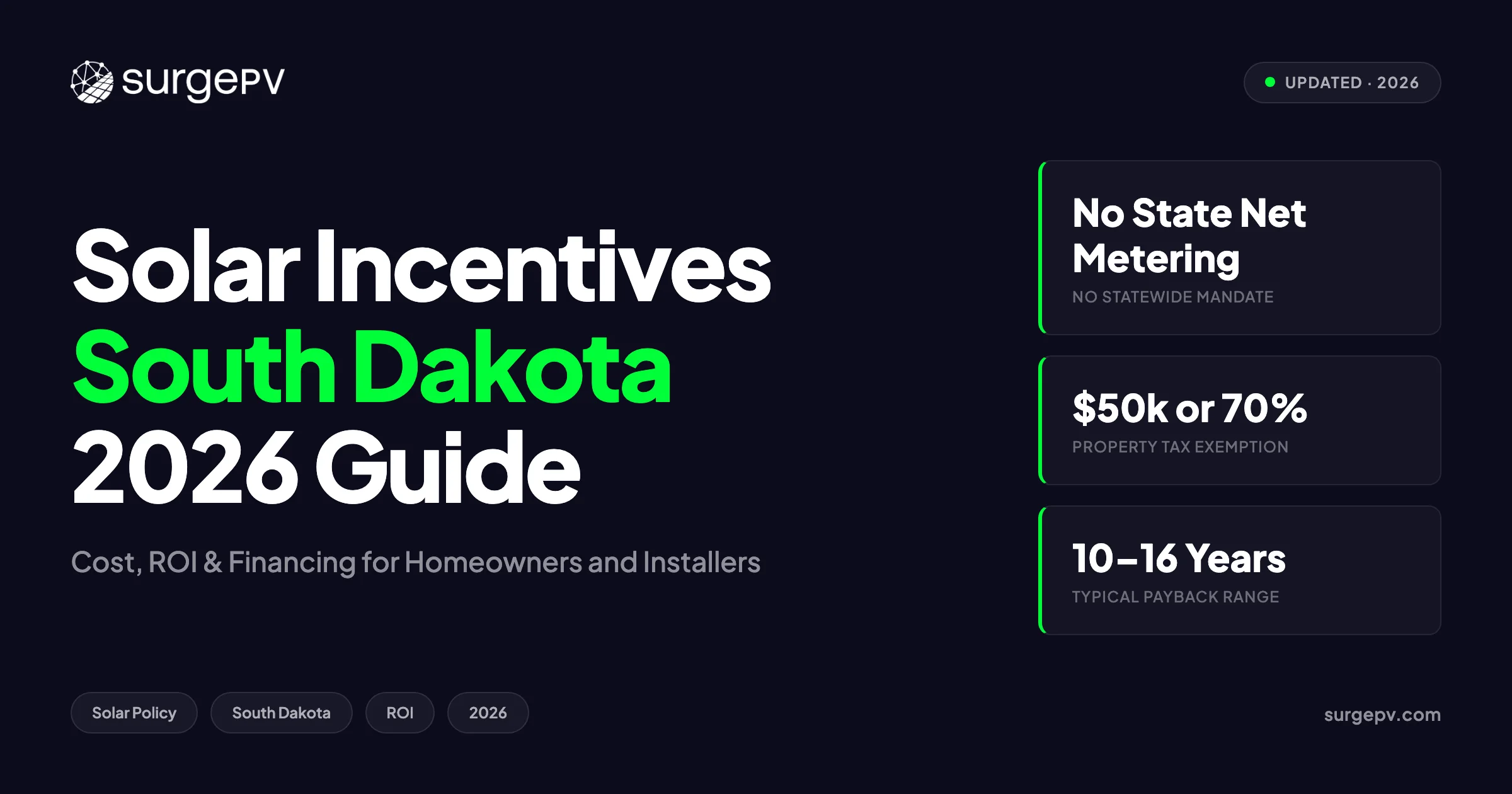
South Dakota solar incentives in 2026 are limited. The state has no statewide net metering law, no state income tax credit, and no sales tax exemption for solar. The main state benefit is a property tax exemption covering the first $50,000 or 70% of assessed system value under SDCL 10-4-44. The federal Residential Clean Energy Credit expired for homeowner-owned systems after December 31, 2025. Payback typically ranges from 10 to 16 years depending on the utility’s export policy.
In this guide:
- Latest 2026 status of every active South Dakota solar incentive
- How the federal residential tax credit expiration changes the math
- South Dakota property tax, sales tax, and state credit rules
- Net metering reality by utility type, including Xcel and Black Hills Energy
- Real-world ROI scenarios by utility territory
- Financing options and rural energy programs
- Common mistakes and how to avoid them
Latest Updates: South Dakota Solar Incentives 2026
South Dakota did not add new solar rebates or tax credits in 2026. The state’s main financial protection, the property tax exemption, remains in place. The federal residential tax credit disappeared. What changed most is that installers can no longer rely on a 30% federal credit to rescue weak export economics. Every proposal must now be built around the customer’s actual utility and self-consumption profile.
South Dakota Solar Incentive Status — June 2026
| Incentive | Type | Status | Key Terms |
|---|---|---|---|
| Federal Section 25D residential credit | Federal income tax credit | Expired | Systems placed in service after December 31, 2025 do not qualify |
| Federal Section 48E commercial credit | Federal investment tax credit | Active, deadlines apply | 30% for projects beginning construction by July 4, 2026, or placed in service by December 31, 2027 |
| South Dakota property tax exemption | State property tax exemption | Active and continuous | First $50,000 or 70% of assessed renewable energy property value under SDCL 10-4-44 |
| Net metering | Utility bill credit | No statewide mandate | Policy varies by utility; Xcel Energy does not offer it in SD |
| State solar tax credit | State income tax credit | Does not exist | South Dakota has no state income tax |
| Sales tax exemption | State sales tax exemption | Does not exist | Solar equipment is subject to state and local sales tax |
| REAP grants and loans | Federal rural incentive | Active | USDA grants up to 50% and loans up to 75% for eligible rural small businesses and farms |
| C-PACE | Commercial financing | Limited availability | Property-assessed clean energy for approved commercial properties |
The most important row is net metering. In most states, this single program determines whether solar pays back in 8 years or 15 years. In South Dakota, the absence of a statewide rule means the value of solar changes block by block.
South Dakota Solar Incentives at a Glance — 2026
South Dakota’s 2026 incentive stack is thin but not empty. The property tax exemption is the only statewide financial benefit written specifically for solar. Everything else depends on federal deadlines, utility territory, or rural status.
| Incentive | 2026 Status | Typical Value |
|---|---|---|
| Federal residential ITC (Section 25D) | Expired | $0 for new homeowner-owned systems |
| Federal Section 48E | Active with deadlines | 30% for eligible commercial, lease, or PPA systems |
| Property tax exemption | Active | First $50,000 or 70% of assessed value, whichever is greater |
| Net metering | No statewide policy | Varies by utility; often weak or absent |
| State solar tax credit | None | $0 |
| Sales tax exemption | None | Solar pays state and local sales tax |
| REAP grants | Active | Up to 50% of project cost for eligible rural applicants |
| REAP loans | Active | Up to 75% of project cost for eligible rural applicants |
The biggest misconception is that solar is “free after tax credits” in South Dakota. That was never fully true, and it is false for homeowner-owned systems installed in 2026.
How the Federal Solar Tax Credit Changed in 2026
The federal Residential Clean Energy Credit, often called the Investment Tax Credit or ITC, allowed homeowners to claim 30% of qualified solar costs on their federal tax return. It was created under the Energy Policy Act of 2005, expanded by the Inflation Reduction Act in 2022, and terminated for residential systems by the One Big Beautiful Bill Act signed on July 4, 2025.
What Ended and What Survived
For homeowner-owned residential systems placed in service on or after January 1, 2026, the Section 25D credit is zero. There is no phase-down. The credit simply does not apply. Homeowners who installed systems in 2025 can still claim the credit on their 2025 tax return and carry forward unused portions under existing IRS rules.
Commercial projects and third-party-owned residential systems still have a path. Section 48E, the Clean Electricity Investment Tax Credit, offers a 30% credit for qualified facilities and energy storage technology. To qualify, construction must begin by July 4, 2026, or the system must be placed in service by December 31, 2027. This is why solar leases and power purchase agreements can still advertise lower monthly payments in 2026: the financing company owns the system and claims the commercial credit.
| Ownership Type | Federal Credit in 2026 | Mechanism |
|---|---|---|
| Homeowner-owned residential | 0% | Section 25D expired |
| Third-party lease or PPA | 30% passed through by financier | Section 48E |
| Commercial or nonprofit-owned | 30% | Section 48E |
The practical impact is significant. A $20,000 residential system that would have cost $14,000 after the 30% credit in 2025 now costs $20,000 in 2026, assuming the same gross price. That extends the simple payback by roughly 4 to 6 years.
South Dakota State Solar Incentives
South Dakota has no state income tax, which means it cannot offer a state income tax credit. It also does not exempt solar equipment from sales tax. The only state-level incentive is the property tax exemption.
Property Tax Exemption
Under SDCL 10-4-44, the first $50,000 or 70% of assessed renewable energy property value, whichever is greater, is exempt from real property tax. The exemption applies to renewable energy facilities with less than 5 MW of nameplate capacity. Solar, wind, biomass, hydrogen, hydroelectric, and geothermal systems used to produce electricity or energy all qualify.
The exemption is continuous and permanent, according to the South Dakota Department of Revenue Renewable Resource Property guide. For geothermal systems that produce energy but not electricity, the exemption is limited to four years for residential and three years for commercial. For solar photovoltaic systems, there is no time limit.
For a typical residential system assessed at $25,000, the entire value is exempt because it falls under the $50,000 allowance. In a county with a 1.2% effective property tax rate, that saves roughly $300 per year, or $7,500 over 25 years. For a $75,000 commercial system, the exemption is 70%, or $52,500, which at a 1.2% rate saves roughly $630 per year.
There is no formal application. Homeowners should contact their county Director of Equalization after installation to confirm the exemption is applied. The assessor must still value the system before applying the exemption.
No State Solar Tax Credit or Sales Tax Exemption
South Dakota does not have a state solar tax credit. Because the state has no income tax, a credit against state income tax liability is impossible. Some neighboring states, such as Minnesota and Iowa, offer state tax credits or rebates. South Dakota does not.
South Dakota also does not exempt solar equipment from sales tax. The state sales tax rate is 4.5%, and municipalities can add up to 2% more. On a $20,000 system, sales tax adds roughly $900 to $1,300 to the upfront cost. Installers should include this in every proposal.
Net Metering in South Dakota — The Biggest Hurdle
Net metering is the single most important policy for residential solar economics in most states. South Dakota is one of only a few states with no statewide net metering law, according to SEIA South Dakota solar policy data. That means each utility decides whether, and how, to compensate solar exports.
No Statewide Mandate
Without a statewide law, utilities are not required to offer net metering or any export credit. Some do. Many do not. The value of a solar system can change dramatically depending on which side of a utility boundary a home sits.
This creates three practical design rules for South Dakota:
- Size systems to maximize self-consumption rather than annual production.
- Do not assume full retail credit for exports.
- Always confirm the utility’s current interconnection tariff before signing a contract.
Xcel Energy South Dakota
Xcel Energy serves roughly 85,000 customers in South Dakota, including parts of Sioux Falls. However, Xcel Energy does not offer net metering in South Dakota, according to EnergySage Xcel Energy net metering data. It offers net metering in Colorado, Michigan, Minnesota, New Mexico, North Dakota, Texas, and Wisconsin, but not South Dakota.
Xcel South Dakota solar customers should confirm whether any export compensation is available. As of mid-2026, Xcel did not operate a standard residential solar export program in the state. For Xcel customers, solar economics depend almost entirely on self-consumption.
Black Hills Energy
Black Hills Energy serves the Rapid City area and parts of western South Dakota. In 2021, Black Hills Energy proposed a new solar tariff that would have charged solar customers market-rate prices for power they consumed and paid less than 25% of the market price for exported electricity, according to WORC reporting on the Black Hills Energy solar tariff case. The proposal was rejected by the South Dakota Public Utilities Commission after intervention by Dakota Rural Action and others.
In November 2023, Black Hills Energy stated it was no longer proposing rate changes for solar customers, according to South Dakota Public Broadcasting. The company said it would continue evaluating solar market conditions. As of mid-2026, Black Hills Energy customers should confirm the current export policy directly with the utility.
Rural Electric Cooperatives
Rural electric cooperatives serve much of South Dakota. Because cooperatives are member-owned, they set their own rates and interconnection policies. Some cooperatives offer limited net metering, often with caps around 10 kW, according to University of Illinois rural cooperative solar guidance. Others offer avoided-cost buyback or no export compensation at all.
Examples of cooperatives active in South Dakota include East River Electric, West Central Electric, Central Electric, and many smaller distribution cooperatives. The policy can vary even among co-ops served by the same generation and transmission provider. Installers should contact the specific cooperative before quoting export value.
Municipal Utilities
Municipal utilities such as Sioux Falls Light and Power set their own rules. Some may offer simple interconnection with no export compensation. Others may offer bill credits. Because municipal utilities are not regulated by the South Dakota Public Utilities Commission in the same way as investor-owned utilities, their policies can be difficult to find online. A direct call to the utility’s engineering or customer service department is usually required.
| Utility Type | Typical Export Policy | What to Verify |
|---|---|---|
| Investor-owned (Xcel, Black Hills) | Usually no net metering or limited export credit | Current tariff and any pending rate cases |
| Rural electric cooperative | Varies; some offer 10 kW net metering caps | Interconnection agreement and credit rate |
| Municipal utility | Varies by city | Engineering department and billing rules |
The key takeaway: South Dakota installers cannot use a single net metering assumption for the whole state. Every proposal must be utility-specific.
Solar Cost and ROI in South Dakota by Utility Type
The financial case for solar in South Dakota depends on three variables: system cost, electricity rate, and export policy. The first two are relatively stable. The third is not.
Cost Benchmarks
According to Electric Choice solar cost data (2026), the average cost of solar in South Dakota is roughly $2.70/W before incentives. A 7 kW system costs about $18,900 before incentives. SolarReviews South Dakota cost data (2026) places the average closer to $2.85/W, making a typical 7.2 kW system roughly $20,520 before incentives.
For this guide, we use a conservative $2.75/W gross cost. A 7 kW residential system costs $19,250 before incentives. With the federal residential credit gone, the net cost remains $19,250, minus any utility rebate and the embedded property tax savings.
Production and Rates
South Dakota receives roughly 4.5 to 5.5 peak sun hours per day, according to NREL solar resource data. A 7 kW system in South Dakota might produce 9,500 to 11,500 kWh per year depending on location, roof orientation, and shading.
The average residential electricity rate in South Dakota is roughly 13 to 14 cents per kWh, according to EcoWatch South Dakota solar analysis. The average household uses about 1,037 kWh per month, higher than the national average. High usage helps solar economics even when rates are moderate.
ROI Scenarios
The table below shows three realistic scenarios for a 7 kW system costing $19,250 in South Dakota in 2026.
| Scenario | Export Policy | Annual Production | Annual Savings | Simple Payback |
|---|---|---|---|---|
| Cooperative with 10 kW net metering | Full retail credit up to cap | ~10,500 kWh | ~$1,300–$1,500 | 10–13 years |
| Utility with avoided-cost buyback | ~3–4 cents/kWh for exports | ~10,500 kWh | ~$900–$1,100 | 13–16 years |
| No export compensation; high self-consumption | $0 for exports | ~10,500 kWh | ~$700–$900 | 16–20 years |
These scenarios assume a cash purchase, no federal tax credit, and a well-sited south-facing roof. They do not include financing costs. A loan at 6–8% interest will extend payback by 2 to 4 years.
The scenario with no export compensation assumes the homeowner uses 60–70% of solar production as it is generated. Without a battery, that requires shifting loads to daytime hours. With a battery, self-consumption can reach 80–90%, but the battery adds $8,000 to $15,000 to the system cost.
Financing Options for South Dakota Solar in 2026
Without the federal tax credit, financing choice matters more. The right structure can make or break the monthly savings story.
Cash Purchase
A cash purchase delivers the strongest long-term return. The homeowner captures 100% of the energy savings, pays no interest, and benefits directly from the property tax exemption. In a cooperative net metering territory with a 10 to 13 year payback, the remaining 12 to 15 years of system life produce near-pure savings.
Solar Loan
A solar loan lets the homeowner own the system and claim the property tax exemption while spreading payments over 10 to 25 years. In 2026, loan rates typically range from 6% to 9%. The key question is whether the monthly loan payment is lower than the average monthly electric bill being offset. In high-usage homes with cooperative net metering, this is often true. In homes with no export compensation, it may not be unless the system is very efficient. Compare ownership costs against SurgePV’s solar software pricing before choosing a financing structure.
Lease or Power Purchase Agreement
Leases and PPAs require no upfront payment and provide immediate monthly savings, but the homeowner does not own the system. The financing company captures any commercial tax benefits under Section 48E. South Dakota’s property tax exemption does not apply to leased systems because the homeowner is not the owner. Leases make sense for homeowners who cannot use a loan or who want zero maintenance responsibility, but they produce lower lifetime savings than ownership.
REAP Grants and Loans
The USDA Rural Energy for America Program, or REAP, offers grants and loans to agricultural producers and rural small businesses. REAP grants can cover up to 50% of project costs, and loans can cover up to 75%, according to USDA REAP program guidance. Eligible applicants must be in a rural area, typically defined as a city or town with fewer than 50,000 residents. This program is one of the strongest incentives available for rural South Dakota farms and small businesses.
C-PACE for Commercial Projects
Commercial Property Assessed Clean Energy, or C-PACE, allows commercial property owners to finance solar through a special assessment on the property tax bill. C-PACE is available in some South Dakota jurisdictions. It can make solar accessible without a traditional credit score barrier, but interest rates and fees vary. Not all installers offer C-PACE, and it is not available in every county.
Common Mistakes When Modeling South Dakota Solar
The most expensive errors in South Dakota solar proposals come from ignoring the state’s specific rules. Avoid these four mistakes.
Assuming Net Metering Exists
Many proposal templates assume full retail net metering. In South Dakota, that assumption can overstate annual savings by 30 to 50%. Always confirm the utility’s export policy before modeling.
Assuming the Federal Credit Still Applies
Homeowners still search for “federal solar tax credit” and assume it is 30%. For homeowner-owned systems installed in 2026, it is 0%. Installers must make this clear in writing before the contract is signed.
Ignoring Utility Type
A proposal built for a cooperative customer will fail for an Xcel customer. The same system can have a 5 to 10 year payback difference depending on export policy. Every proposal should use the correct utility rate and export rules.
Missing the Property Tax Exemption
The exemption is not always automatic. Homeowners should contact the county Director of Equalization after installation. Missing this step can cost thousands of dollars in property taxes over the life of the system.
How to Apply for South Dakota Solar Incentives
The application process in South Dakota is simpler than in states with multiple rebate programs, but each step has a deadline.
- Confirm utility territory and export policy: Verify the customer’s utility and current export credit rules before designing the system.
- Size the system to self-consumption: Use 12 months of billing history to size the system around daytime load, not annual production.
- Choose financing and ownership structure: Decide whether cash, loan, lease, or REAP makes sense.
- Install and interconnect: Submit the interconnection application to the utility. Export credits begin only after the utility approves the agreement.
- File for property tax exemption: Contact the county Director of Equalization to confirm the renewable energy property exemption is applied.
- Monitor production and bills: Track actual savings and confirm export compensation matches the proposal.
For solar installers managing multiple South Dakota projects, SurgePV’s solar design software can store utility-specific export assumptions and automate payback calculations. The solar financial modeling models rate escalation, self-consumption, and financing scenarios in one place.
Model South Dakota Solar Incentives Accurately in Every Proposal
Utility-specific export rules and the lack of statewide net metering change the math on every South Dakota project. SurgePV’s financial modeling applies the right rates so your customer sees real net cost and payback.
Explore Financial ModelingNo commitment required · 20 minutes · Live project walkthrough
Conclusion
South Dakota solar incentives in 2026 are limited but not zero. The federal residential tax credit is gone for homeowner-owned systems. The state offers no income tax credit and no sales tax exemption. The one structural tailwind is the permanent property tax exemption under SDCL 10-4-44.
- Confirm the utility territory and export policy before quoting any savings.
- Size systems around self-consumption, especially where net metering is unavailable.
- Contact the county Director of Equalization to secure the property tax exemption.
For installers, accurate South Dakota proposals require precise modeling of utility-specific export rules, self-consumption rates, and financing costs. SurgePV’s solar design software helps you design systems that match each customer’s load profile. The solar financial modeling lets you build proposals that show real payback and ROI for both residential and commercial projects. For a broader view, see our solar incentives in the USA 2026 guide.
Frequently Asked Questions
What solar incentives are available in South Dakota in 2026?
South Dakota’s main solar incentive is a property tax exemption under SDCL 10-4-44 that removes the first $50,000 or 70% of assessed renewable energy property value, whichever is greater, for systems under 5 MW. The state has no state income tax credit, no sales tax exemption, and no statewide net metering mandate. The federal Residential Clean Energy Credit expired for new homeowner-owned systems after December 31, 2025.
Does South Dakota have net metering?
No. South Dakota does not have a statewide net metering law. Whether a solar customer receives any credit for exported electricity depends entirely on the utility. Xcel Energy does not offer net metering in South Dakota. Black Hills Energy has no approved solar tariff. Some rural electric cooperatives offer limited net metering, often capped around 10 kW.
Is the federal solar tax credit still available in South Dakota in 2026?
No. The 30% Residential Clean Energy Credit under Internal Revenue Code Section 25D expired for homeowner-owned systems placed in service after December 31, 2025. Commercial, lease, and power purchase agreement systems may still qualify under Section 48E if construction begins by July 4, 2026, or the system is placed in service by December 31, 2027.
What is the South Dakota property tax exemption for solar?
Under SDCL 10-4-44, the first $50,000 or 70% of assessed renewable energy property value, whichever is greater, is exempt from real property tax for systems under 5 MW. For most residential systems valued under $50,000, this effectively exempts the entire solar installation. The exemption is continuous and permanent, unlike some states with sunset clauses.
How much do solar panels cost in South Dakota in 2026?
South Dakota residential solar costs average roughly $2.70 to $2.85 per watt before incentives in 2026. A typical 7 kW system costs $18,900 to $19,950 before incentives. Because the federal residential tax credit expired, the net cost for a homeowner-owned system is the full gross cost, minus any utility-specific rebate.
What is the typical solar payback period in South Dakota in 2026?
Typical residential solar payback in South Dakota ranges from 10 to 16 years in 2026, depending on the utility’s export credit policy, the customer’s self-consumption rate, and financing. Homes with cooperative net metering or high daytime usage see shorter paybacks. Homes served by utilities with no export compensation may see paybacks beyond 16 years unless paired with a battery.
Can I lease solar in South Dakota and still get incentives?
Leases and power purchase agreements do not pass the South Dakota property tax exemption to the homeowner because the third-party owner holds the system title. The financing company may claim any available Section 48E commercial tax credit, which is reflected as lower monthly payments. Homeowners who want the property tax exemption should purchase the system with cash or a loan.
Are solar batteries incentivized in South Dakota in 2026?
No. South Dakota does not offer a state-specific battery rebate or tax credit. A battery can still make sense if the utility provides little or no export credit, because storing daytime solar for evening use avoids buying grid power at the retail rate. The financial case depends on the utility rate, export policy, and outage risk.
What is the most common mistake when applying for South Dakota solar incentives?
The most common mistake is assuming net metering exists. Many installers build proposals using full retail-rate export credits, but South Dakota has no statewide net metering law. Another frequent error is missing the county assessor notification for the property tax exemption. Homeowners should confirm their utility’s export policy and contact the county Director of Equalization after installation.
Does South Dakota have a state solar tax credit?
No. South Dakota does not have a state income tax, so it cannot offer a state income tax credit. The state also does not provide a sales tax exemption specifically for solar equipment. The only statewide financial incentive is the property tax exemption under SDCL 10-4-44.
Where this fits
This article is part of SurgePV's Solar Incentives & Policy hub, which works through the topic from first principles to the decisions a project team actually has to make.
