

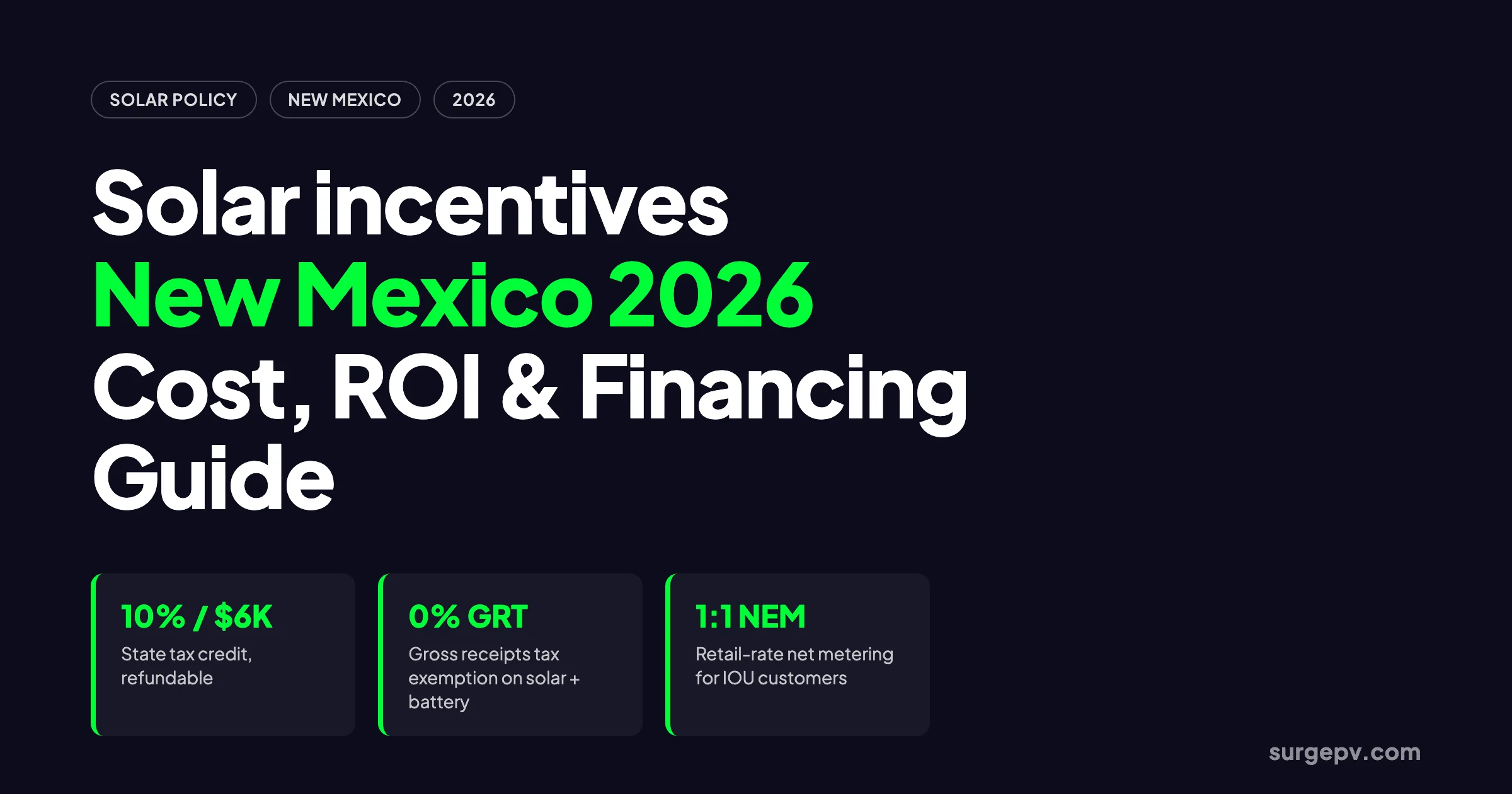
New Mexico had 4,291 MWdc of installed solar capacity by mid-2026, enough to power more than 1 million homes, according to SEIA. The state ranks 17th nationally in cumulative solar and 15th in 2025 additions, with 75 solar and storage companies operating locally. For anyone researching solar incentives New Mexico, that scale means competitive pricing and plenty of installer experience.
The incentive story changed on January 1, 2026. The federal Residential Clean Energy Credit under Section 25D expired for homeowner-owned systems. New Mexico homeowners can no longer subtract 30% of system cost from federal taxes. But New Mexico still has one of the stronger state-level incentive stacks in the Southwest. The 10% state tax credit, gross receipts tax exemption, property tax exemption, and retail-rate net metering can offset thousands of dollars in upfront cost.
For installers and EPCs, the shift means proposals must be built around state and utility incentives first. A home in PNM territory can access SREC payments. A home served by El Paso Electric or Xcel Energy faces a slightly different net metering calculus. This guide explains every active 2026 incentive. It also covers the real dollar value of each program and how to model payback accurately. For the national context, see our solar incentives in USA 2026 guide. For payback modeling, SurgePV’s generation and financial tool can pull New Mexico utility rates and net metering rules into a single proposal.
Quick Answer
New Mexico’s 2026 solar incentives include the 10% New Solar Market Development Tax Credit up to $6,000, a gross receipts tax exemption on solar equipment and labor, a permanent property tax exemption, and retail-rate net metering for PNM, El Paso Electric, and Xcel Energy customers. The federal residential tax credit expired in 2025; commercial and third-party-owned systems may still use Section 48E.
In this guide:
- Latest 2026 status of every active New Mexico solar incentive
- How the federal ITC expiration changes the math
- The 10% state tax credit and how to claim it
- Gross receipts tax and property tax exemptions
- Net metering rules by utility territory
- PNM SREC purchases and community solar
- Financing options and who should lease versus buy
- Three real-world ROI scenarios by utility
- Common mistakes and how to avoid them
Latest Updates: New Mexico Solar Incentives 2026
New Mexico did not lose its solar incentives in 2026. It lost the federal residential credit. The state and utility programs that remain are meaningful, but they are more fragmented than a single national tax credit. Programs also have deadlines, funding caps, and eligibility rules that differ by utility.
New Mexico Solar Incentive Status — June 2026
| Incentive | Type | Status | Key Terms |
|---|---|---|---|
| Federal residential ITC | Tax credit | Expired | Section 25D ended December 31, 2025 |
| Federal Section 48E | Tax credit | Active for commercial/TPO | 30% through 2027 with safe-harbor deadlines |
| New Solar Market Development Tax Credit | State tax credit | Active | 10% of cost, up to $6,000 per year; authorized through 2031 |
| Gross receipts tax exemption | Tax exemption | Active | Applies to solar equipment, labor, and paired battery storage through July 1, 2034 |
| Property tax exemption | Tax exemption | Active | Added system value excluded from assessment under NMSA 1978 § 7-36-21.2 |
| Net metering | Export credit | Active for IOUs | Retail-rate credits for PNM, El Paso Electric, and Xcel Energy |
| PNM SREC purchase | Performance payment | Active | $0.0025 per kWh for eight years |
| Community solar | Subscription credit | Active | Available to PNM, El Paso Electric, and Xcel Energy customers |
Key Changes Since 2025
Federal ITC expiration: The 30% residential Investment Tax Credit expired for systems placed in service after December 31, 2025, under the One Big Beautiful Bill Act. Homeowners who buy solar with cash or a loan in 2026 cannot claim it. Commercial, third-party-owned, and leased systems may still qualify under Section 48E, according to IRS guidance.
Battery storage added to GRT exemption: As of July 1, 2024, the Legislature expanded the gross receipts tax exemption to cover energy storage equipment paired with solar or wind systems. The expansion is in effect through July 1, 2034, according to NMSA 1978 § 7-9-112.
Community solar expansion: The first community solar projects in New Mexico reached completion in 2025, four years after the Community Solar Act was signed. The program now gives renters and unsuitable-roof homeowners a way to participate without installing panels.
Key Takeaway
2026 is a state-incentive year in New Mexico. The 10% tax credit, GRT exemption, property tax exemption, and net metering are durable. The federal residential credit is gone, so proposals must show accurate payback using state and utility programs.
Why New Mexico Solar Economics Still Work in 2026
New Mexico is one of the sunniest states in the country. Albuquerque receives about 6.57 peak sun hours per day on average, based on NREL PVWatts data. That level of resource means a smaller array produces more energy than the same array would in cloudier markets. Higher production shortens payback.
Market Size and Targets
New Mexico had 4,291 MWdc of installed solar capacity and 62,758 solar installations by mid-2026, according to SEIA. Solar supplied more than 17% of the state’s electricity. The industry supports more than 2,100 jobs and $6.8 billion in investment. The state is projected to add another 3,391 MW over the next five years.
The state’s Renewable Portfolio Standard requires utilities to provide 50% renewable energy by 2030 and 80% by 2040. That long-term target supports interconnection and utility programs that make distributed solar easier to connect.
Utility Rate Snapshot — Spring 2026
The average residential electricity price in New Mexico reached 15.15¢/kWh in April 2026, according to the U.S. Energy Information Administration (2026). That is below the national average but up from the 13.8¢/kWh often used in older estimates. Higher rates improve solar economics because every kilowatt-hour offset by solar avoids a more expensive grid purchase.
| Utility | Service Area | Approximate Residential Rate (2026) |
|---|---|---|
| PNM | Albuquerque, Santa Fe, central and northern New Mexico | 15¢/kWh – 16¢/kWh |
| El Paso Electric | Las Cruces, Deming, southern New Mexico | 14¢/kWh – 15¢/kWh |
| Xcel Energy (SPS) | Northeastern New Mexico | 13¢/kWh – 14¢/kWh |
| Rural cooperatives | Varies by cooperative | 12¢/kWh – 16¢/kWh |
For system sizing and production modeling, SurgePV’s solar design software can pull local irradiance, roof tilt, and shading into a single design.
New Mexico State Solar Tax Credit: 10% Up to $6,000
The New Solar Market Development Tax Credit is the centerpiece of the state’s residential solar stack. It is a 10% credit on the installed cost of a qualifying solar photovoltaic or solar thermal system, capped at $6,000 per taxpayer per year.
How the Credit Works
The credit applies to equipment, materials, and labor. A $25,000 system receives a $2,500 credit. A $60,000 system receives the full $6,000. The program is authorized through 2031, with annual funding capped at $30 million. Certificates are issued on a first-come, first-served basis, according to the New Mexico Energy, Minerals and Natural Resources Department.
The credit is fully refundable for systems placed in service after 2021. If the credit exceeds your New Mexico tax liability, the state refunds the difference. You do not need a large tax bill to benefit from the full amount. Unused credits can be carried forward for up to five years.
How to Claim It
The process has two steps:
- Apply to the Energy, Minerals and Natural Resources Department for a certificate of eligibility.
- File the credit with the New Mexico Taxation and Revenue Department using Form TRD-41406.
Processing typically takes three to four weeks. Applications must be submitted within one year of the taxable year of installation, or until annual funds are exhausted. Installers should help homeowners start the application immediately after final inspection.
Gross Receipts Tax Exemption: The Quiet Money Saver
New Mexico does not levy a traditional sales tax. It levies a gross receipts tax on businesses, which solar contractors normally pass through to customers. Solar energy systems are exempt from this tax under NMSA 1978 § 7-9-112.
The exemption applies to the sale and installation of qualifying solar energy systems. It also covers paired battery storage equipment when used to store energy from solar or wind, through July 1, 2034. The savings are applied automatically at the point of sale, so the contractor simply does not charge GRT on qualifying equipment or labor.
The effective savings depend on the local GRT rate, which ranges from roughly 5% to 8.813% across jurisdictions. On a $25,000 system, that is $1,250 to $2,200 in avoided tax. On a $40,000 solar-plus-storage system, the exemption can save $2,000 to $3,500 upfront.
No homeowner paperwork is required. The installer maintains a written purchase and use statement on file. The exemption is one reason New Mexico’s net upfront cost is lower than in states with only a sales tax exemption or no exemption at all.
Property Tax Exemption: No Penalty for Added Value
Solar panels can increase a home’s resale value. Studies by Zillow and Lawrence Berkeley National Laboratory have found that owned solar systems add 3% to 4% to home value in many markets. Without an exemption, that added value would raise the annual property tax bill.
New Mexico prevents that increase. NMSA 1978 § 7-36-21.2 excludes the value of a solar energy system from property tax assessments. A $20,000 solar installation does not add $20,000 to the taxable value of the home. At a typical New Mexico property tax rate of 1% to 1.5%, that saves $200 to $300 per year.
The exemption is automatic and permanent. The county assessor applies it without a separate application. The savings continue for as long as the homeowner owns the system.
Net Metering by Utility in New Mexico
Net metering is the single most valuable solar incentive for many homeowners. New Mexico requires investor-owned utilities regulated by the Public Regulation Commission to offer it. The three major IOUs are PNM, El Paso Electric, and Xcel Energy’s Southwestern Public Service.
Under net metering, excess solar production is sent to the grid and credited at the retail rate. Those credits offset grid purchases at night or on cloudy days. The result is a lower electric bill without needing a battery.
Net Metering Comparison — June 2026
| Utility | Service Area | System Size Limit | Export Credit | Rollover |
|---|---|---|---|---|
| PNM | Albuquerque, Santa Fe, central/northern NM | Under 10 kW residential | Full retail rate | Monthly, indefinite |
| El Paso Electric | Las Cruces, Deming, southern NM | Up to 120% of annual consumption | Full retail rate | Monthly, indefinite |
| Xcel Energy (SPS) | Northeastern NM | Under 10 kW residential | Full retail rate | Monthly, indefinite |
| Rural cooperatives | Varies | Varies | Varies by cooperative | Varies by cooperative |
The statewide system size cap is 80 MW, far above any residential project. There is no aggregate capacity cap, which means new customers are not blocked by earlier enrollees.
PNM customers receive 1:1 retail-rate credits that roll over month to month indefinitely. Annual surplus is cashed out at a lower avoided-cost rate. El Paso Electric allows systems sized up to 120% of annual consumption, which is useful for homeowners planning to add an electric vehicle or heat pump. Xcel Energy credits exports at the full retail rate and carries credits forward monthly. Many rural electric cooperatives also offer net metering, but terms vary and should be confirmed directly with the cooperative.
For installers, the lesson is simple: verify the utility territory before modeling savings. A PNM customer and a cooperative customer can have very different payback periods even with identical roofs and identical systems. SurgePV’s shadow analysis and generation and financial tool let you pair the right utility assumptions with the right roof production.
PNM SREC Purchases and Community Solar
Beyond net metering, PNM offers two additional programs worth understanding.
PNM Solar Renewable Energy Credit Purchase Program
PNM purchases the renewable energy credits produced by residential and small commercial solar systems. The program pays $0.0025 per kWh of solar production for eight years from the contract date, according to Palmetto’s New Mexico solar guide. Payouts are issued once accumulated credits exceed $20.
For a typical 7.5 kW system producing 11,500 kWh per year, that is about $29 per year, or $230 over eight years. The payment is modest, but it is guaranteed and requires little effort after enrollment. Homeowners can enroll directly with PNM or register their RECs through the Western Renewable Energy Generation Information System for a lower application fee.
New Mexico Community Solar Program
The Community Solar Act allows customers of PNM, El Paso Electric, and Xcel Energy to subscribe to a share of an off-site solar farm. Subscribers receive bill credits without installing panels. The program is open to renters, condo owners, and homeowners with unsuitable roofs. Income-qualified households can receive deeper savings of 15% to 28% on their utility bills, according to Palmetto.
Community solar is not a substitute for rooftop solar for homeowners who can install panels and claim the state tax credit. But it is a useful option for households that cannot go solar on their own property.
Financing Options: Cash, Loan, Lease, and PPA
The right financing structure depends on whether the homeowner wants to capture the state incentives.
Cash Purchase
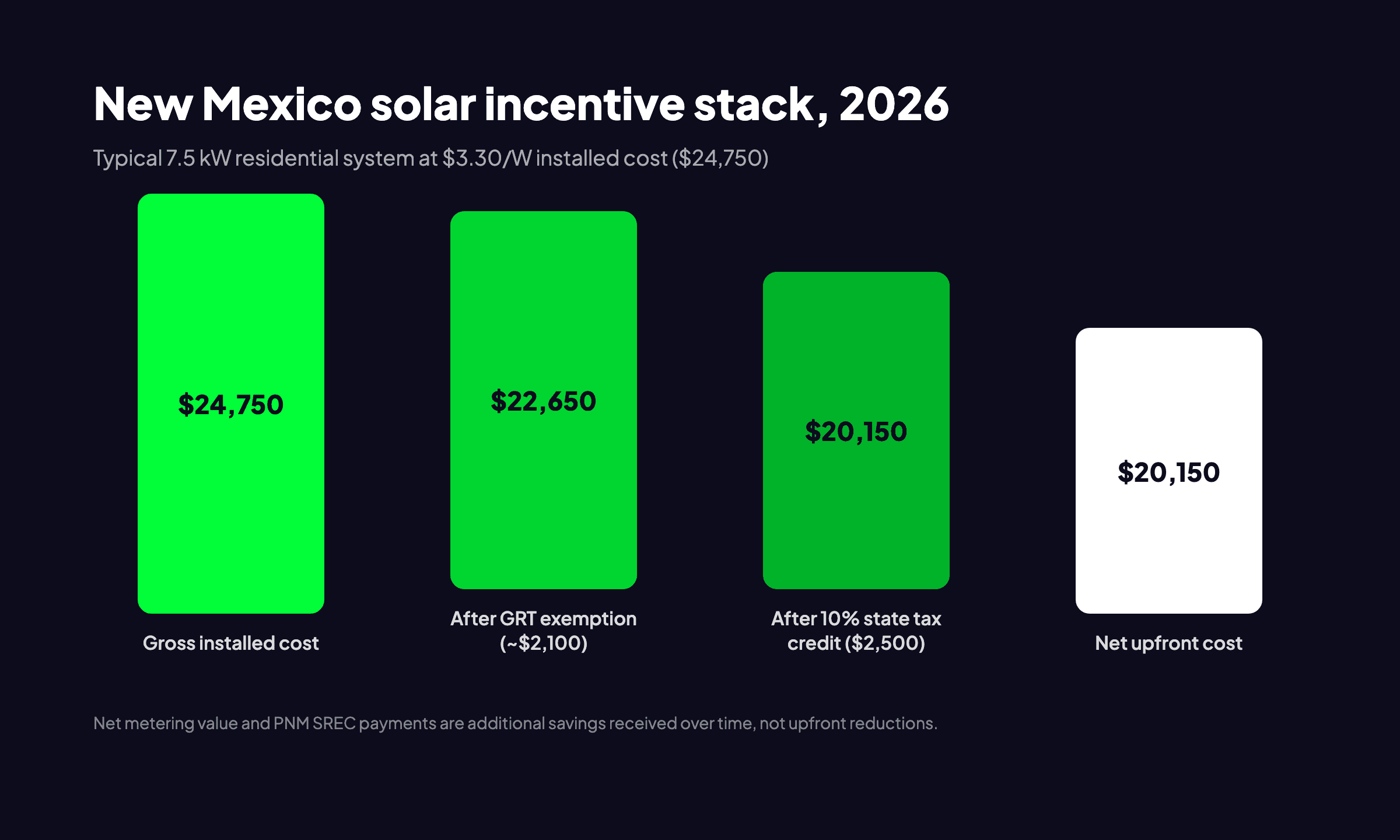
A cash purchase captures the full state tax credit, GRT exemption, and property tax exemption. It also delivers the highest lifetime savings because there is no interest. The main barrier is the upfront cost. In 2026, a typical 7.5 kW system in New Mexico costs roughly $24,750 before incentives.
Solar Loan
A solar loan spreads the upfront cost over 10 to 20 years. The homeowner still owns the system and can claim the state tax credit and exemptions. The loan payment often replaces the electric bill, and the system is paid off before the end of its useful life. Interest reduces total savings, but the net present value often remains positive in New Mexico’s sunny, rate-rising market.
Lease and Power Purchase Agreement
Leases and PPAs require little or no upfront cost. The financing company owns the system and may claim commercial tax benefits such as Section 48E. Those benefits are passed through as lower monthly payments. However, the homeowner does not receive the New Mexico state tax credit, GRT exemption, or property tax exemption directly. Leases and PPAs make sense for homeowners who cannot use the tax credit or who prefer zero maintenance responsibility.
Which Option Is Best?
For homeowners with tax liability and cash or loan access, ownership is usually the better financial outcome. For renters or homeowners with limited tax liability, community solar or a lease may be the only practical path. Installers should model all three scenarios side by side rather than defaulting to one product.
Real 2026 ROI Scenarios by Utility Territory
The table below shows a typical 7.5 kW system in three New Mexico territories. Assumptions: $3.30/W installed cost, 11,500 kWh annual production, 3% annual utility rate escalation, 25-year system life, no federal residential tax credit.
| Scenario | PNM | El Paso Electric | Rural Cooperative |
|---|---|---|---|
| Gross system cost | $24,750 | $24,750 | $24,750 |
| GRT exemption savings | $1,650 | $1,650 | $1,650 |
| State tax credit (10%) | $2,475 | $2,475 | $2,475 |
| Net upfront cost | $20,625 | $20,625 | $20,625 |
| First-year bill savings | $1,725 | $1,610 | $1,380 |
| PNM SREC value (8 yr) | $230 | $0 | $0 |
| Simple payback | 11.5 years | 12.2 years | 14.0 years |
| 25-year net savings | $24,500 | $21,800 | $15,200 |
The PNM scenario includes the SREC purchase program and uses a 15¢/kWh average rate. The El Paso Electric scenario uses a 14¢/kWh rate and allows 120% sizing for future load growth. The rural cooperative scenario assumes a 12¢/kWh rate and no SREC income. These are illustrative ranges; actual results depend on roof orientation, shading, usage, and specific cooperative rules.
The key insight is that even without the federal residential credit, ownership pays back in 8 to 14 years across most of New Mexico. After payback, the system produces free electricity for another decade or more. For installers, the competitive advantage is accurate modeling. SurgePV’s solar proposals feature lets you present these numbers in a client-ready format.
Common Mistakes and How to Avoid Them
New Mexico’s incentive stack is generous but easy to mishandle. The most expensive errors are usually paperwork or sizing mistakes.
Assuming the Federal Tax Credit Still Exists
Many homeowners still expect a 30% federal credit. For cash or loan purchases placed in service after December 31, 2025, it is gone. Proposals should lead with the net cost after state incentives, not a federal credit that no longer applies.
Missing the State Tax Credit Application Window
The New Solar Market Development Tax Credit requires an EMNRD certificate before filing. Applications are first-come, first-served. Waiting until tax season can mean missing the annual funding cap. Installers should submit the application within weeks of final inspection.
Oversizing Beyond 120% of Consumption
A system that produces far more than the household uses leaves value on the table. Annual surplus is settled at avoided-cost rates, not retail rates. Size for 90% to 110% of annual consumption unless the customer plans to add an electric vehicle or heat pump.
Ignoring Utility Territory
PNM, El Paso Electric, Xcel Energy, and rural cooperatives have different net metering rules and rate structures. The same system can have very different payback depending on the utility. Always confirm the service territory before running financials.
Leasing Without Comparing Ownership
Leases and PPAs are simple, but they give away the state tax credit and property tax exemption. Homeowners who qualify for the credit almost always come out ahead by owning the system with a loan.
Commercial and Agricultural Considerations
Commercial and agricultural customers in New Mexico have additional tools. The Section 48E credit can cover 30% of project cost for projects that meet construction or placed-in-service deadlines. Businesses can also use MACRS depreciation, which front-loads tax deductions over five years.
Agricultural operations may qualify for USDA REAP grants and loan guarantees. REAP can cover up to 50% of project cost, but applications must be submitted before construction begins. Early planning is critical.
For commercial project modeling, SurgePV’s solar design software can size arrays, run shade analysis, and export production and financial reports. The solar proposals feature can package the incentive stack into a client-ready document.
Frequently Asked Questions
What solar incentives are available in New Mexico in 2026?
New Mexico offers a 10% state income tax credit up to $6,000 through the New Solar Market Development Tax Credit, a gross receipts tax exemption on solar equipment and installation labor, a permanent property tax exemption, and retail-rate net metering for customers of PNM, El Paso Electric, and Xcel Energy. PNM also purchases Solar Renewable Energy Credits from residential customers at $0.0025 per kWh for eight years.
Is the federal solar tax credit still available in New Mexico in 2026?
No. The 30% federal Residential Clean Energy Credit under Internal Revenue Code Section 25D expired for homeowner-owned systems placed in service after December 31, 2025. Commercial projects and third-party-owned residential systems, including leases and power purchase agreements, may still qualify under Section 48E.
How much is the New Mexico state solar tax credit in 2026?
The New Solar Market Development Tax Credit equals 10% of the installed cost of a qualifying solar photovoltaic or solar thermal system, up to a maximum of $6,000 per taxpayer per year. The credit is fully refundable for systems installed after 2021, and unused portions can be carried forward for up to five years.
Does New Mexico have a sales tax exemption for solar?
New Mexico does not have a traditional sales tax, but it exempts the sale and installation of qualifying solar energy systems from its gross receipts tax. The exemption applies automatically at the point of sale and covers both solar equipment and paired battery storage through July 1, 2034.
Will solar increase my property taxes in New Mexico?
No. New Mexico excludes the added value of a qualifying solar energy system from property tax assessments under NMSA 1978 § 7-36-21.2. The home itself can still appreciate for other reasons, but the solar equipment value is not taxed. No application is required.
Does New Mexico have net metering for solar?
Yes. Investor-owned utilities regulated by the New Mexico Public Regulation Commission must offer net metering. PNM, El Paso Electric, and Xcel Energy credit excess solar exports at retail rates. Many rural electric cooperatives also offer net metering, though terms vary by cooperative.
What is the PNM Solar Renewable Energy Credit program?
PNM purchases the renewable energy credits produced by residential and small commercial solar systems at $0.0025 per kWh for eight years. Payments are issued once accumulated credits exceed $20. The program is available only to PNM customers and requires enrollment after interconnection.
Are solar batteries incentivized in New Mexico in 2026?
There is no standalone state battery tax credit in 2026. However, paired battery storage is exempt from gross receipts tax when installed with a qualifying solar or wind system, and batteries can benefit from retail-rate net metering if they are part of a grid-tied solar system.
What is the typical solar payback period in New Mexico in 2026?
Well-designed residential solar systems in New Mexico typically pay back in 8 to 12 years in 2026. Payback is shorter in PNM and El Paso Electric territories with strong net metering and higher usage, and longer in rural cooperative territories with weaker export crediting.
Can I lease solar in New Mexico and still get incentives?
Leases and power purchase agreements do not pass state incentives to the homeowner. The financing company owns the system and may claim commercial tax benefits such as Section 48E, which are reflected as lower monthly payments. Homeowners who want the state tax credit, gross receipts tax exemption, and property tax exemption should purchase the system with cash or a loan.
Bottom Line
New Mexico solar in 2026 is still a strong investment, but the decision is no longer driven by a single federal tax credit. The best projects stack the 10% state tax credit, gross receipts tax exemption, property tax exemption, and retail-rate net metering with accurate consumption-based sizing.
Three actions will put you ahead:
- Confirm your utility territory first, because net metering value and SREC income vary by service area.
- Apply for the New Solar Market Development Tax Credit immediately after final inspection; the program is first-come, first-served.
- Size the system for 90% to 110% of annual consumption unless the homeowner plans to add significant future load.
For installers, accuracy is the new competitive advantage. SurgePV’s generation and financial tool lets you pull New Mexico utility rates, net metering assumptions, and incentive values into one proposal. Book a demo to see how it works, or check pricing for your team.
Where this fits
This article is part of SurgePV's Solar Incentives & Policy hub, which works through the topic from first principles to the decisions a project team actually has to make.
