

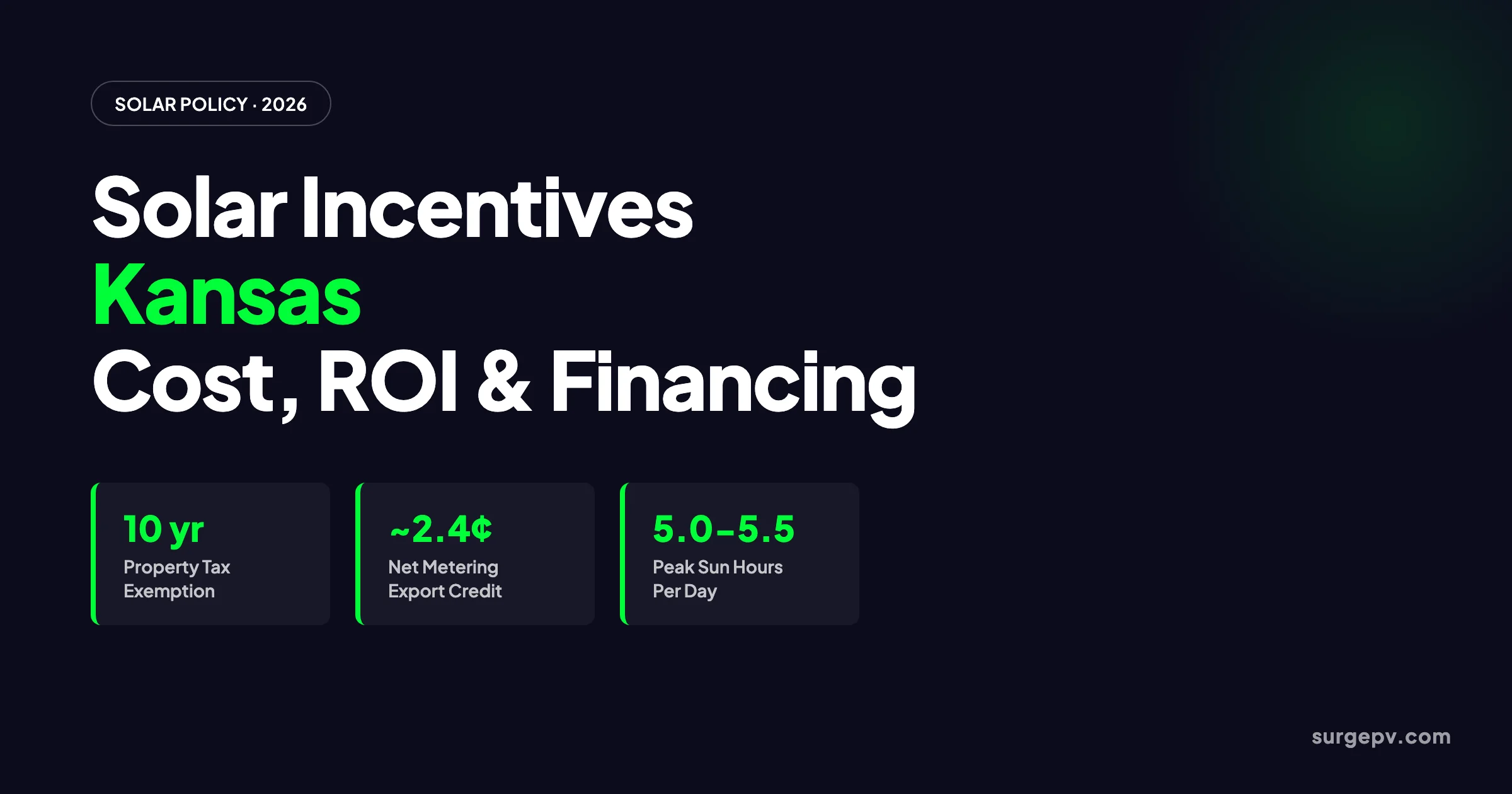
Kansas homeowners paid an average residential electricity rate of 15.78 cents per kWh in April 2026, up from 14.82 cents a year earlier, according to the U.S. Energy Information Administration (2026). That is below the national average of 18.83 cents, but the 6.5% year-over-year increase is what matters for solar math. Kansas also gets about 5.0 to 5.5 peak sun hours per day across most of the state, according to NREL PVWatts data cited by TheGreenWatt (2026). The combination of strong sun and rising rates keeps solar viable, even though the incentive stack is thin.
This guide explains every active Kansas solar incentive in 2026, what disappeared at the federal level, and how the numbers actually work by utility territory. For installers and EPCs, the proposals that win in Kansas are the ones that size systems around weak export credits, not around a large federal tax credit. SurgePV’s solar design software and solar yield and financial analysis let you model each rate, incentive, and financing option in one place. For the national picture, see our solar incentives in USA 2026 guide and state solar incentives in the US overview.
Quick Answer
Kansas solar incentives in 2026 include a 10-year property tax exemption under K.S.A. 79-201 Eleventh, net metering for Evergy and Liberty Utilities under K.S.A. 66-1263, and federal Section 48E for commercial projects. There is no state solar tax credit, no sales tax exemption, and the federal residential ITC expired for homeowner-owned systems after 2025.
In this guide:
- Kansas solar incentive snapshot and what changed in 2026
- Federal tax credit status for homeowners and businesses
- How net metering works under K.S.A. 66-1263
- Utility-specific rules for Evergy, Liberty Utilities, Empire District, co-ops, and munis
- Property tax, sales tax, and HOA rules
- Cost, ROI, and payback scenarios by territory
- Financing options and common mistakes
Kansas Solar Incentives at a Glance — 2026
Kansas is not a high-incentive state. The economics work because of sun, rising rates, and the property tax exemption, not because of big rebates. The table below summarizes the main programs active in 2026.
| Incentive | Type | 2026 Status | Typical Value / Notes |
|---|---|---|---|
| Federal residential ITC (Section 25D) | Tax credit | Expired | $0 for cash or loan residential purchases placed in service after 2025 |
| Federal Section 48E ITC | Commercial tax credit | Active, deadlines apply | 30% for eligible commercial, lease, or PPA systems |
| Kansas state solar tax credit | Tax credit | Not available | $0 |
| Kansas property tax exemption | Tax exemption | Active | 10-year exemption under K.S.A. 79-201 Eleventh |
| Kansas sales tax exemption | Tax exemption | Not available | 6.5% state sales tax plus local taxes apply |
| Net metering (Evergy, Liberty Utilities) | Utility bill credit | Active | Excess credited at ~2.4 cents/kWh system average cost |
| Parallel generation / net billing (co-ops, munis) | Utility bill credit | Required for some utilities | 1.5 times avoided cost for exported generation |
| Federal battery storage credit (Section 25D) | Tax credit | Active | 30% for standalone batteries of 3 kWh or larger through 2032 |
| USDA REAP grants | Rural grant | Active | Up to 50% of eligible project cost for farms and rural small businesses |
| Kansas Electric Cogeneration Facility Tax Credit | State tax credit | Active for commercial | 10% on first $50 million invested for qualifying facilities |
| Solar easements | Legal protection | Active | Voluntary agreements under K.S.A. 58-3801 |
The key takeaway is that Kansas solar math is driven by offsetting retail-rate usage, not by selling excess power back to the grid. A system that is sized to cover daytime consumption and a small annual surplus will outperform a system that overproduces in summer and gives energy away at wholesale rates.
Key Takeaway
Kansas solar works in 2026 because of strong sun and rising electricity rates, not because of a deep incentive stack. The property tax exemption and net metering are the two main state-side benefits. Export-heavy designs perform poorly because excess generation is credited at roughly 2.4 cents per kWh.
Federal Solar Tax Credit Status in Kansas for 2026
The biggest change for Kansas homeowners in 2026 is federal. The 30% Residential Clean Energy Credit under Internal Revenue Code Section 25D expired for homeowner-owned systems placed in service after December 31, 2025. That means a Kansas homeowner who buys a system with cash or a loan in 2026 should not expect a federal residential tax credit.
Commercial, lease, and power purchase agreement systems may still qualify under Section 48E. The safe-harbor rules are tight. Eligible projects generally must begin construction by July 4, 2026, or be placed in service by December 31, 2027, to claim the 30% Investment Tax Credit. This is why some third-party ownership products and installer financing partnerships still advertise a 25% or 30% benefit in 2026: the owner of the system is a commercial entity that can claim Section 48E, and part of that benefit is passed through as a lower monthly payment.
For homeowners who want the direct tax benefit, the window closed. For homeowners who want solar anyway, the math shifts to utility-rate savings, the property tax exemption, and financing that does not depend on tax equity.
Net Metering in Kansas: How It Works
Kansas net metering is governed by K.S.A. 66-1263 through 66-1271, the Net Metering and Easy Connection Act. The law requires investor-owned utilities to offer net metering to eligible customer-generators. In practice, the two utilities most Kansas homeowners deal with are Evergy and Liberty Utilities. Empire District Electric, now part of Liberty Utilities, also operates under these rules.
Export Credit Value
The critical detail is the credit rate. Kansas does not require full retail net metering. Instead, excess generation is credited at the utility’s monthly “system average cost,” which is a wholesale-style rate. That rate is roughly 2.4 cents per kWh, compared with a retail rate of about 13.62 cents per kWh, according to SolarReviews (2026). A kilowatt-hour you use on-site saves you 13.62 cents. A kilowatt-hour you export earns you about 2.4 cents.
Credit Rollover and True-Up
Unused credits carry forward from month to month. That lets summer overproduction help pay winter bills. But the credits expire annually on March 31. You cannot bank credits indefinitely, and you cannot cash them out. This annual expiration is another reason to avoid oversizing.
System Size Limits
The 2014 amendments to Kansas net metering raised the residential system size cap to 150 kW AC. For systems placed in service on or after January 1, 2026, generation capacity is limited to 50% of export capacity. In plain terms, your system can be sized to cover your usage, but not to become a power plant. Evergy’s residential tariffs often have practical caps well below the statutory maximum, so always pull the current tariff before sizing.
Co-Ops and Municipal Utilities
Rural electric cooperatives and municipal utilities are not required to offer net metering, but they must offer a “parallel generation” or net billing program. Under parallel generation, exported solar is paid at 1.5 times the utility’s avoided cost, converted to a dollar-value bill credit. The exact terms vary by utility. Some Kansas co-ops have friendly programs. Others impose fees, restrictions, or low compensation. If you serve co-op or muni customers, verify the tariff before you quote.
Utility-Specific Rules in Kansas
Kansas is split between two large investor-owned utility territories and dozens of smaller providers. The territory determines the rate, the net metering tariff, and often the interconnection timeline.
Evergy Kansas Metro
Evergy Kansas Metro is the former Kansas City Power & Light Kansas service area. It covers Johnson and Wyandotte counties, including Kansas City, Overland Park, Olathe, Shawnee, and Lenexa. The 2023 Kansas Corporation Commission rate case resulted in a net $42.9 million rate decrease for this territory, lowering average residential bills by roughly $6 per month. Households here tend to have larger homes and higher usage, which improves solar economics.
Evergy Kansas Central
Evergy Kansas Central is the former Westar Energy territory. It covers Wichita, Topeka, Lawrence, Manhattan, Salina, Hutchinson, and most of central and western Kansas. This territory serves roughly 700,000 customers. The 2023 KCC rate case brought a net $74 million rate increase, adding about $4.64 per month to average residential bills. Rate pressure is likely to continue as Evergy recovers grid investments.
Liberty Utilities / Empire District Electric
Liberty Utilities, through its Empire District Electric subsidiary, serves southeastern Kansas. The same K.S.A. 66-1263 net metering rules apply, but the rate schedules and interconnection process differ from Evergy. Customers here should confirm the current export credit rate and system size cap directly with Liberty.
Rural Electric Cooperatives
Kansas has a large number of rural electric cooperatives. Net metering is not mandatory, so policies range from favorable to restrictive. Some co-ops offer parallel generation at reasonable rates. Others impose standby charges, capacity fees, or low buyback rates. For installers, co-op territories require a quick tariff review before proposal.
Property Tax, Sales Tax, and Other State Rules
Property Tax Exemption
Kansas law (K.S.A. 79-201 Eleventh) exempts from property taxation “all property actually and regularly used predominantly to produce and generate electricity utilizing renewable energy resources or technologies.” For residential solar systems installed after December 2016, the exemption lasts for 10 taxable years following the year of installation.
Solar panels typically add about 4.1% to home value, according to EcoWatch (2025). On a $250,000 home, that is about $10,250 in added value. At Kansas’s average effective property tax rate of roughly 1.33%, the exemption saves about $136 per year, or $1,360 over 10 years. The exemption is automatic in most counties once the system is assessed, but homeowners should verify with their county appraiser.
Important: the Kansas Department of Revenue has ruled that the property tax exemption does not apply to batteries used in residential systems. If you add a battery, expect the added value of the battery to be included in your property tax assessment.
Sales Tax
Kansas does not offer a sales tax exemption for residential solar equipment. The state sales tax rate is 6.5%, and local rates can add another 1% to 3% or more. On a $25,000 system, sales tax can add $1,500 to $2,500. Homeowners should make sure the sales tax is included in the quoted price, not added as a surprise.
HOA Rules
Kansas does not have a statewide solar access law that limits HOA restrictions. Homeowners associations can enforce covenants that prohibit or restrict rooftop solar unless the restriction is otherwise invalid. A few Kansas cities, including Overland Park, have supported state legislation to limit HOA bans, but no statewide law has passed as of mid-2026.
Homeowners can create a solar easement under K.S.A. 58-3801 to protect access to sunlight. A solar easement is a voluntary written agreement between neighboring property owners. It is useful when a future building or tree could shade your array, but it does not override HOA covenants.
Cost, ROI, and Payback Scenarios for Kansas in 2026
The table below shows realistic 2026 numbers for three Kansas homes. Assumptions: $2.75 per watt installed cost, 0.5% annual system degradation, 3% annual utility rate escalation, and net metering export credit of 2.4 cents per kWh.
| Scenario | System Size | Pre-Incentive Cost | Annual Production | Annual Savings | Simple Payback |
|---|---|---|---|---|---|
| Wichita home, high usage | 10 kW | $27,500 | 13,500 kWh | $1,750 | 15.7 years |
| Overland Park home, moderate usage | 8 kW | $22,000 | 10,800 kWh | $1,450 | 15.2 years |
| Topeka home, low usage | 6 kW | $16,500 | 8,100 kWh | $1,100 | 15.0 years |
These paybacks assume no federal residential tax credit. They also assume the system is sized to offset annual usage without massive summer overproduction. A system that exports heavily in summer will have a longer payback because exported kilowatt-hours are credited at 2.4 cents, not 15.78 cents.
Financing Impact on ROI
A cash purchase produces the highest lifetime savings but requires the most upfront capital. A solar loan spreads the cost over 10 to 25 years. In 2026, with no federal tax credit to reduce loan principal, loan payments can be close to or even exceed monthly utility savings in the early years. A lease or PPA requires no upfront cost and may offer immediate monthly savings, but the homeowner does not own the system or receive the property tax exemption directly.
For commercial and agricultural projects, the picture is different. A Kansas farm or rural small business that qualifies for Section 48E, MACRS depreciation, and a USDA REAP grant can see simple payback in 4 to 7 years.
Financing Options for Kansas Solar in 2026
Cash Purchase
Cash is the cleanest option. The homeowner owns the system, captures all utility savings, and benefits from the property tax exemption. With no federal residential tax credit, the payback is longer than it was in 2024 or 2025, but lifetime savings are still positive for most homes with good sun and moderate-to-high usage.
Solar Loan
Solar loans are widely available through installers, credit unions, and national lenders. In 2026, the absence of the federal tax credit means there is no large lump sum to pay down the loan in year one. Borrowers should compare total interest cost against expected savings. A loan with a low teaser rate and a balloon payment can turn solar into a net negative if refinancing is required.
Lease and PPA
Leases and power purchase agreements remain available. The system owner, usually a financing company, claims any available commercial tax benefits and passes part of the savings through as a lower monthly payment. Homeowners should compare the lease rate to their current and projected utility rates. They should also understand who pays for inverter replacements, roof repairs, and system removal at the end of the term.
USDA REAP
The USDA Rural Energy for America Program offers grants and guaranteed loans to agricultural producers and rural small businesses. Grants can cover up to 50% of eligible project costs, and loan guarantees can cover up to 75%. Agricultural producers can apply regardless of location. Rural small businesses must be in an eligible area with a population under 50,000. REAP is one of the best financing tools for Kansas farms.
Commercial Tax Benefits
Kansas businesses can still use Section 48E for solar projects. Combined with MACRS depreciation and the Kansas Electric Cogeneration Facility Tax Credit, commercial projects can reach effective costs 40% to 60% below sticker price. The Kansas Electric Cogeneration Facility Tax Credit provides 10% on the first $50 million invested and 5% on amounts above $50 million, taken in 10 equal annual installments.
Common Mistakes When Planning Kansas Solar
The most common mistake is oversizing for export. Because Kansas credits excess at roughly 2.4 cents per kWh, a system that produces 120% of annual usage is not 20% more valuable than a system that produces 100%. In fact, the extra summer production can destroy value. The safer rule is to size for 90% to 100% of annual usage and treat any export as a small bonus.
Another mistake is assuming the federal residential tax credit still applies. Installers should be explicit in 2026 proposals: no Section 25D for homeowner-owned systems placed in service after 2025. Any financing product that claims a tax benefit should explain whether it is using Section 48E, a third-party ownership structure, or another mechanism.
A third mistake is ignoring sales tax. Kansas charges sales tax on solar equipment, and local rates vary. A proposal that shows a pre-tax price can be misleading by $1,000 to $2,500.
Finally, many homeowners skip the HOA check. Kansas does not protect solar access at the state level. If you live in a covenant-controlled community, review the CC&Rs before signing a contract.
FAQ
What solar incentives are available in Kansas in 2026?
Kansas offers a 10-year property tax exemption for qualifying renewable energy property under K.S.A. 79-201 Eleventh, net metering for customers of investor-owned utilities under K.S.A. 66-1263, and federal Section 48E for eligible commercial, lease, or PPA systems. There is no state solar tax credit, no statewide sales tax exemption, and no state solar rebate.
Does Kansas have a state solar tax credit in 2026?
No. Kansas does not offer a state income tax credit for residential solar installations. The main state-level benefit is the property tax exemption, which shields the added value of a solar system from property taxes for 10 years.
Is the federal solar tax credit still available in Kansas in 2026?
The 30% federal Residential Clean Energy Credit under Internal Revenue Code Section 25D expired for homeowner-owned systems placed in service after December 31, 2025. Commercial, lease, and power purchase agreement systems may still qualify under Section 48E. Construction must generally begin by July 4, 2026, or the system must be placed in service by December 31, 2027.
Does Kansas have net metering for solar?
Yes. Kansas law requires investor-owned utilities, including Evergy and Liberty Utilities, to offer net metering to residential customers. Excess generation is credited at the utility’s monthly system average cost, roughly 2.4 cents per kWh, not the full retail rate. Unused credits carry forward monthly and expire annually on March 31.
How does Evergy net metering work in Kansas?
Evergy offers net metering under K.S.A. 66-1263. Solar customers receive a bi-directional meter. Excess kilowatt-hours sent to the grid are credited at the monthly system average cost rate, which is about 2.4 cents per kWh. Credits roll forward month to month, but any remaining balance is reset to zero each March 31.
What is the Kansas property tax exemption for solar?
Kansas law exempts property used predominantly to generate electricity from renewable energy resources from property taxation for 10 years after installation. The exemption applies automatically in most counties and covers the added value of the solar array, but it does not extend to battery storage systems used in residential installations.
Does Kansas have a sales tax exemption for solar equipment?
No. Kansas does not exempt residential solar equipment from state or local sales tax. The state sales tax rate is 6.5%, and local sales taxes can add 1% to 3% or more. Installers should include sales tax in the quoted system price.
Can an HOA ban solar panels in Kansas?
Kansas does not have a statewide solar access law that limits homeowners association restrictions. An HOA can prohibit or restrict rooftop solar through its covenants unless the restriction violates other law. Homeowners can create a voluntary solar easement under K.S.A. 58-3801 to protect access to sunlight.
What is the typical solar payback period in Kansas in 2026?
A well-designed residential solar system in Kansas typically pays back in 11 to 16 years in 2026 without the federal residential tax credit. Payback is shorter for homes with high electricity usage, good sun exposure, and retail-rate offset. Customers who export heavily see weaker returns because excess generation is credited at wholesale rates.
Are solar batteries worth it in Kansas?
Batteries are rarely a pure economic win in Kansas because net metering provides a bill credit for excess solar and there is no state battery incentive. The federal Residential Clean Energy Credit for standalone battery storage remains available at 30% through 2032 for qualifying systems of 3 kWh or larger. Backup power during tornadoes and ice storms is the most common reason Kansas homeowners add batteries.
The bottom line for Kansas solar in 2026 is simple: the deal is not about incentives. It is about locking in your electricity cost while rates keep rising and the sun keeps shining. The property tax exemption helps. Net metering helps. But the real value is using solar production on-site during the day.
If you are an installer, the winning proposal is the one that models the customer’s actual utility, rate trajectory, and self-consumption pattern. SurgePV’s solar design software and generation and financial tool let you build accurate Kansas proposals, generate professional solar proposals in minutes, then check pricing or book a demo.
Where this fits
This article is part of SurgePV's Solar Incentives & Policy hub, which works through the topic from first principles to the decisions a project team actually has to make.
