

Answer
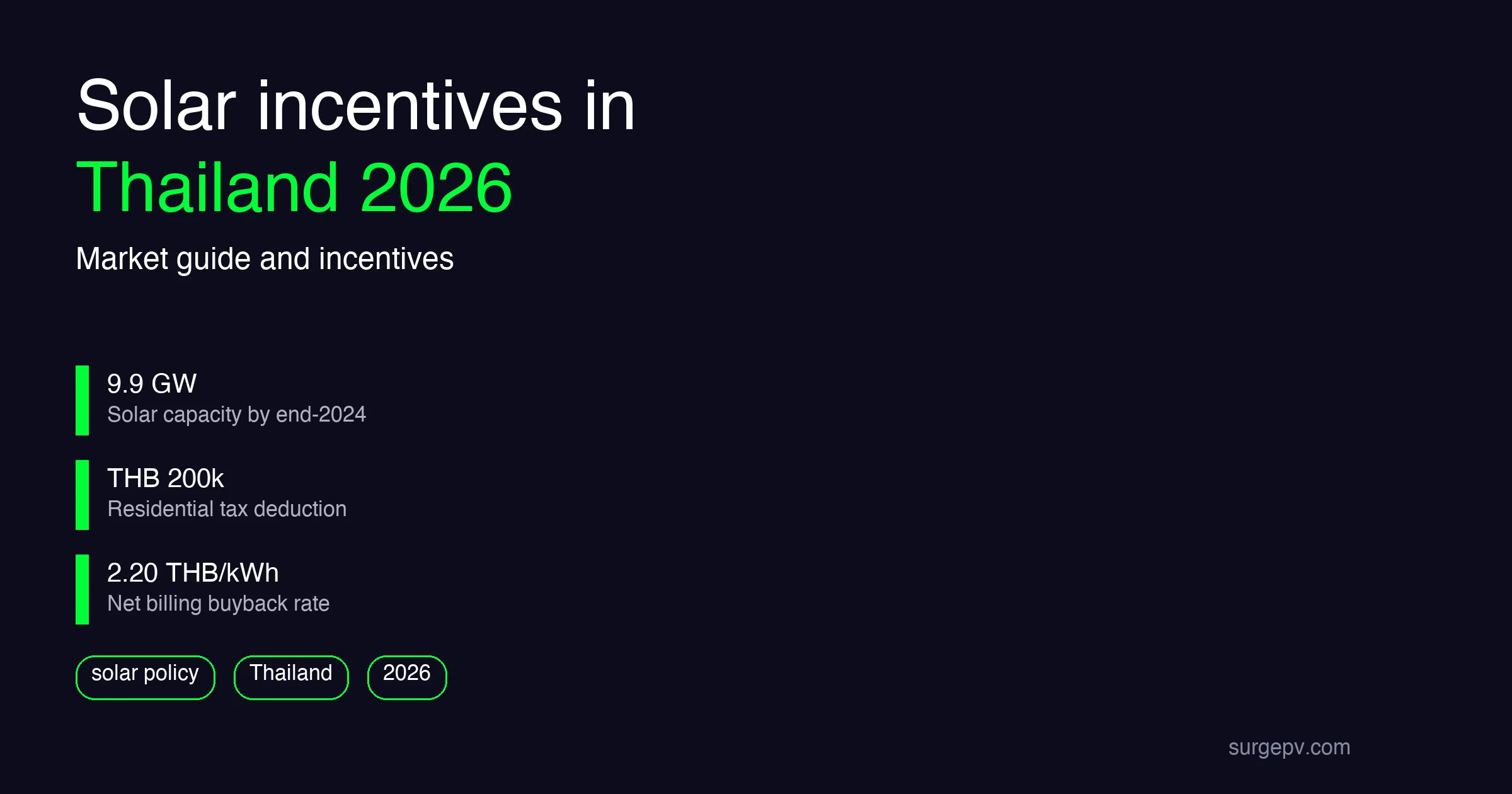
Thailand's 2026 solar incentives include a personal income tax deduction up to THB 200,000 for residential rooftop systems up to 10 kWp, a 150% corporate depreciation allowance for certified energy-efficient equipment, an 8-year BOI corporate income tax exemption for renewable energy projects, residential net billing at 2.20 THB/kWh under a newly expanded 500 MW cap, and a 1,500 MW community solar program at up to 2.25 THB/kWh.
Thailand ended 2024 with roughly 9.94 GW of cumulative installed solar capacity, made up of 6.33 GW ground-mounted, 3.31 GW rooftop, 281 MW floating solar, and 17 MW off-grid systems, according to IEA PVPS country data (2026). Rooftop solar alone has grown from 2 MW in 2019 to 3.3 GW by 2024, accounting for about one-third of total solar capacity, according to Zero Carbon Analytics analysis of ERC reports (2026). For installers, EPCs, and property owners, the message is that Thailand is moving from early pilot programs to a structured, multi-layered incentive system.
This guide covers the 2026 incentive framework in plain terms. It explains who qualifies for each program, how the tax benefits actually work, how net billing affects return on investment, and the mistakes that waste money. For regional comparisons, see our solar payback period by country guide.
If you are designing systems or writing proposals for Thai clients, a solar design platform that models local tariffs, self-consumption ratios, and net billing rules can save hours per project. Model payback and export value automatically, then generate solar proposals in minutes. Check pricing or book a demo to see how SurgePV handles Thailand.
Thailand’s 2026 solar incentive stack is real, but it is not a single subsidy. The value comes from combining the residential tax deduction, corporate accelerated depreciation, BOI tax holidays for larger generators, net billing for surplus residential power, and community solar or direct PPA routes for developers.
TL;DR — Solar Incentives in Thailand 2026
Active mechanisms: personal income tax deduction up to THB 200,000 for residential systems up to 10 kWp; 150% corporate depreciation for certified energy-efficient machinery; BOI Category 7.1 renewable energy with 8-year CIT exemption and import duty relief; residential net billing at 2.20 THB/kWh under an expanded 500 MW cap; and a 1,500 MW community solar program at up to 2.25 THB/kWh. Self-consumption remains the primary economic driver because export rates are roughly half retail tariffs.
In this guide:
- Latest 2026 status of every active Thai solar incentive
- Who qualifies for the residential tax deduction and how much it saves
- Corporate incentives: BOI, 150% depreciation, and direct PPAs
- How net billing works and why it differs from net metering
- Community solar, VSPP, SPP, and FiT procurement routes
- Market size, targets, and regional differences
- Three real-world stacking scenarios with payback impact
- Common mistakes and how to avoid them
Latest Updates: Thailand Solar Incentives 2026
The Thai solar policy environment changed materially in 2025 and early 2026. The government published Royal Decree No. 805, expanded the net billing framework, approved a community solar program, and continued streamlining rooftop permitting.
Thailand Solar Incentive Status — June 2026
| Incentive | Type | Status | Key Terms |
|---|---|---|---|
| Residential rooftop tax deduction | Personal income tax relief | Active | Up to THB 200,000, systems up to 10 kWp, through 31 Dec 2028 |
| 150% depreciation for energy-efficient equipment | Corporate tax deduction | Active | DEDE or EGAT 5-star certified machinery, through 31 Dec 2028 |
| BOI Category 7.1 renewable energy | CIT holiday + duty relief | Active | 8-year CIT exemption, import duty exemption on machinery |
| Residential net billing (Solar Prachachon) | Surplus buyback | Expanded, applications pending | 2.20 THB/kWh, 10-year PPA, 500 MW per-round cap approved |
| Community solar program | Feed-in tariff | Approved, regulations pending | 1,500 MW, up to 10 MW per project, up to 2.25 THB/kWh, 25-year PPA |
| Direct PPA / Utility Green Tariff | Corporate green procurement | Pilot active | 2,000 MW pilot, source-specific green power via UGT2 |
| ERC FiT Big Lot | Competitive auction | Active, some capacity frozen | Phase 1 awarded 4,952 MW; Phase 2 awarded 2,145 MW |
| Rooftop permit simplification | Regulatory | Active | Factory license amendment removed for rooftop solar Dec 2024 |
Key Changes Since 2025
March 2026 — Royal Decree No. 805 B.E. 2569: The Royal Gazette published the decree on 2 March 2026, effective 3 March 2026. It grants individual taxpayers a deduction of up to THB 200,000 for residential rooftop solar installations up to 10 kWp and a 150% depreciation allowance for certified energy-efficient business machinery. Both measures run through 31 December 2028, according to Enviliance Asia (2026).
April 2026 — NEPC Resolution 1/2569: The National Energy Policy Council approved a residential solar rooftop net billing program with a 500 MW national cap and a 5 kW per-meter export limit. The 2.20 THB/kWh tariff and 10-year PPA carry over from the earlier Solar Prachachon program. The Energy Regulatory Commission must issue implementing regulations by end-June 2026, with applications expected to open in the second half of 2026, according to Lexcelsiam (2026).
Late 2025 — Community solar program: NEPC approved a 1,500 MW community-based solar program for projects up to 10 MW each, with a feed-in tariff of up to 2.25 THB/kWh under 25-year non-firm PPAs, according to Nagashima Ohno & Tsunematsu (2025).
December 2024 — Factory license exemption: A Ministerial Regulation removed the requirement to amend the factory license for rooftop solar installations, cutting a 30 to 60 day paperwork step for commercial and industrial projects, according to CapSolar (2026).
Key Takeaway
2026 is a transition year. The most reliable incentives are the residential tax deduction, corporate accelerated depreciation, and BOI promotion, because net billing and community solar details are still being implemented. Size systems for self-consumption first, export second.
Why Thailand’s Solar Market Matters in 2026
Thailand has strong solar resources and a clear policy target, yet solar still makes up a small share of total generation. That gap is the opportunity.
Market Size and Targets
Thailand’s cumulative solar capacity reached 9.94 GWp by the end of 2024, with rooftop solar at 3.31 GWp, according to IEA PVPS (2026). Independent satellite analysis estimates total installed rooftop solar at roughly 3.60 GW as of early 2026, with a 16% uncertainty range, according to TransitionZero (2026).
The draft Alternative Energy Development Plan 2024 targets 38,974 MWp of solar PV plus 2,789 MWp of floating solar hybrid with hydropower by 2037, and a 37% share of renewable energy in total final energy consumption, according to IEA PVPS (2026). The broader National Energy Plan aims for renewables to supply 51% of the electricity mix by 2037, up from about 20% in 2023, according to Mordor Intelligence (2026).
The Electricity Price Driver
Rising retail tariffs are a major reason households and businesses adopt solar. The average retail electricity price rose from THB 3.61 per kWh in 2021 to THB 4.18 per kWh in 2024, according to Zero Carbon Analytics (2026). For May to August 2026, the Energy Regulatory Commission announced a tariff of THB 3.95 per unit, with possible increases above THB 4.00 later in 2026 if global liquefied natural gas prices stay high.
Every additional baht on the tariff improves the payback of a solar system. A 5 kW residential system that generates 600 to 700 kWh per month can save roughly THB 2,200 to THB 3,500 per month at the standard tariff, and more under time-of-use rates, according to Green Energy Thailand (2026).
Regional Concentration
Central Thailand, including Bangkok, hosted about 35% of installed solar capacity in 2025. The Eastern Economic Corridor contributed another 28% and remains the main destination for new commercial and industrial projects. Northern provinces are emerging as agro-photovoltaic hubs, while southern resort areas like Phuket see hotel rooftop adoption despite lower capacity factors during the monsoon, according to Mordor Intelligence (2026).
For solar professionals, the practical implication is that design must match local tariffs, load profiles, and grid constraints. Modern solar design software can model each of these variables by province.
The Residential Rooftop Tax Deduction
Royal Decree No. 805 is the most accessible incentive for Thai homeowners in 2026. It is a tax deduction, not a rebate or tax credit, so the cash value depends on the taxpayer’s marginal rate.
How It Works
- Eligible taxpayers can deduct up to THB 200,000 of the actual cost of a grid-connected rooftop solar system.
- The system must be installed on a residential building and rated at 10 kWp or below.
- The electricity meter must be registered in the taxpayer’s name.
- The installer must be VAT-registered and issue a valid e-Tax invoice.
- The deduction is claimed once in the tax year the system is connected to the MEA or PEA grid.
- The window runs from 3 March 2026 to 31 December 2028.
Real Cash Value by Tax Bracket
| Marginal Tax Bracket | Maximum Deduction | Cash Tax Saving |
|---|---|---|
| 35% | THB 200,000 | THB 70,000 |
| 30% | THB 200,000 | THB 60,000 |
| 20% | THB 200,000 | THB 40,000 |
| 10% | THB 200,000 | THB 20,000 |
A household earning THB 500,000 annually saves only about THB 20,000, roughly 13% of a basic 3 kW system cost. A household in the top bracket saves THB 70,000, enough to cut the payback of a 5 kW system by 1 to 2 years, according to Green Energy Thailand (2026).
What Most Homeowners Get Wrong
Many buyers treat the THB 200,000 figure as a cash rebate. It is not. The value is the deduction multiplied by the marginal tax rate. Lower-income households should weigh the deduction against the much larger long-term value of bill savings.
Net Billing and Net Metering in Thailand
Thailand uses net billing, not net metering. The difference shapes system sizing and payback.
Net Billing Mechanics
Under net billing, the utility pays a fixed rate for surplus solar exported to the grid, while the customer pays the full retail rate for grid imports. The current residential buyback rate is 2.20 THB/kWh under a 10-year PPA, while standard retail rates are roughly 3.88 to 4.42 THB/kWh for higher consumption blocks, according to CapSolar (2026).
That means a self-consumed kilowatt-hour is worth roughly twice as much as an exported one. This is intentional: it protects utility revenue, reduces grid stress, and rewards systems sized to match on-site load.
Program Status: From 90 MW to 500 MW
The original Solar Prachachon program had a 90 MW nationwide cap for 2021 to 2030. That cap was filled in 2024, halting new applications. In April 2026, NEPC Resolution 1/2569 replaced the long-term 90 MW cap with a 500 MW per-round cap, kept the 2.20 THB/kWh tariff, and added a 5 kW per-meter export limit. The ERC is expected to issue implementing regulations by end-June 2026, with applications opening in the second half of 2026, according to Lexcelsiam (2026).
Net Metering Is Not Available
Full net metering, where exported kilowatt-hours offset imported ones at the retail rate, has been discussed but not adopted. The global trend is away from net metering toward net billing as solar penetration rises, according to CapSolar (2026). Do not size a Thai system assuming net metering will arrive.
Sizing Rule
Target 70% to 90% annual self-consumption. A 10 kW system generating 1,200 kWh per month with 70% self-consumption saves about THB 4,110 per month; at 50% self-consumption, savings drop to about THB 3,690 per month, according to CapSolar (2026).
Corporate and Industrial Incentives
Businesses have access to stronger incentives than homeowners, but the structure is more complex.
150% Depreciation for Certified Equipment
Royal Decree No. 805 also allows companies to deduct 150% of the cost of certified energy-efficient machinery, including solar equipment, from taxable income. Requirements include:
- Equipment must carry a DEDE or EGAT 5-star energy efficiency label.
- Equipment must be new and unused.
- Purchase must be from a VAT-registered supplier with a valid e-Tax invoice.
- Equipment must be acquired and placed in use by 31 December 2028.
- The benefit cannot be combined with BOI or EEC privileges for the same asset.
For a company in the 20% corporate tax bracket, a THB 1,000,000 solar investment with 150% depreciation creates THB 1,500,000 of deductible expense, producing THB 300,000 of tax relief.
BOI Category 7.1 Renewable Energy
The Board of Investment promotes renewable electricity generation under Category 7.1. Benefits include:
- 8-year corporate income tax exemption.
- Exemption from import duty on machinery not manufactured in Thailand.
- Work permit facilitation for foreign specialists.
- Foreign land ownership rights for promoted projects where applicable.
The application must be submitted before operations begin. A 2 MW commercial rooftop with THB 55 million capital expenditure can save roughly THB 8.8 to THB 11 million in corporate income tax over eight years, according to CapSolar (2026).
Eastern Economic Corridor Stacking
Factories located in Rayong, Chonburi, or Chachoengsao can stack an additional 50% on the BOI CIT exemption period. An 8-year BOI exemption becomes 12 years in an EEC promotion zone, though the project must also meet EEC industry criteria.
Self-Consumption Only for Most Factories
Most C&I rooftop systems below 1 MW connect for self-consumption only. Surplus beyond on-site load is not compensated unless the project pursues a separate VSPP license. Systems of 1 to 10 MW need a Very Small Power Producer license from the ERC. Systems above 10 MW need a Small Power Producer or Independent Power Producer license.
For C&I installers, the design priorities are different from residential work. Demand-charge analysis, load profiling, and shadow analysis matter more than simple bill offset.
Developer Routes: Community Solar, FiT, and Direct PPAs
Larger developers and investors can access utility-scale and corporate procurement routes beyond rooftop net billing.
Community Solar Program
The 1,500 MW community solar program approved in late 2025 targets communities, cooperatives, schools, and small developers. Key terms:
- Individual projects capped at 10 MW.
- Classified as VSPPs.
- Feed-in tariff of up to 2.25 THB/kWh.
- 25-year non-firm PPA.
- First-come-first-served allocation.
The tariff is only slightly above the residential net billing rate, but the 25-year term provides longer revenue certainty than the 10-year residential PPA.
ERC Feed-in Tariff Big Lot
The ERC’s competitive FiT program allocates PPAs for ground-mounted solar, wind, biogas, and solar-plus-storage. Phase 1 awarded 4,952 MW in April 2023. Phase 2 awarded 2,145 MW in December 2024, but approximately 1,500 MW of Phase 2 capacity remained frozen pending the next Power Development Plan, according to Fangda Partners (2026). Clearing prices in Phase 1 were THB 2.1679 per kWh for solar and THB 2.8331 per kWh for solar-plus-storage, according to Global Deal (2026).
Direct PPA and Utility Green Tariff
Thailand launched a 2,000 MW direct power purchase pilot, allowing large consumers to buy renewable electricity directly from producers via EGAT’s transmission grid. The second-generation Utility Green Tariff program, UGT2, pairs source-specific green power from the FiT pipeline with I-REC(E) certificates under 10-year retail energy service agreements, according to Fangda Partners (2026).
This matters for data centers, electronics manufacturers, and exporters facing carbon disclosure or CBAM requirements. It also offers an alternative to building on-site solar where roof space or grid capacity is limited.
Permitting and Regulatory Framework
The permitting burden for rooftop solar dropped significantly in late 2024, but grid connection and ERC notification remain required.
Permit Requirements by System Size
| System Size | ERC License | Factory License Amendment | Grid Connection |
|---|---|---|---|
| Residential / C&I under 1 MW self-consumption | Notification only | Not required since Dec 2024 | MEA or PEA approval |
| 1 MW to 10 MW | VSPP license | May still apply in some cases | MEA or PEA approval |
| Above 10 MW | SPP or IPP license | Required as applicable | EGAT coordination |
Residential systems under 1,000 kVA can complete a simple online notification of exemption from an energy production license, according to Green Energy Thailand (2026).
Equipment Standards
The Thai Industrial Standards Institute introduced mandatory TIS standards for solar panels equivalent to IEC 61215 and IEC 61730. PEA and MEA maintain approved inverter lists, typically requiring anti-islanding certification such as UL 1741 or IEEE 1547, according to Siriteja (2026).
Interconnection Timeline
A typical residential system takes 3 to 5 days to install, but grid connection approval can take 30 to 90 days depending on the utility and feeder capacity. Commercial systems of 100 kW to 1 MW typically require 16 to 24 weeks end-to-end, according to CapSolar (2026).
How to Stack Incentives: Three Real-World Scenarios
The following examples are illustrative, based on typical 2026 costs and incentive rates. Actual figures depend on location, tariff, installer quote, and tax status.
Scenario 1 — 5 kW Residential Rooftop, Bangkok
| Item | Amount |
|---|---|
| Gross installed cost | THB 150,000 |
| Tax deduction value (20% bracket) | −THB 40,000 |
| Net effective cost | THB 110,000 |
| Annual bill savings (self-consumption) | THB 28,000 |
| Export income if net billing opens (assumed 20% export) | THB 1,900 |
| Payback | 3.6 years |
Without the tax deduction, payback stretches to about 5.4 years.
Scenario 2 — 500 kW Commercial Rooftop, Eastern Economic Corridor
| Item | Amount |
|---|---|
| Gross installed cost | THB 13,750,000 |
| 150% depreciation tax value (20% CIT) | −THB 4,125,000 |
| Net effective cost | THB 9,625,000 |
| Annual avoided electricity + demand charges | THB 2,800,000 |
| Payback | 3.4 years |
If BOI Category 7.1 is also applied, the CIT exemption on savings can improve payback further.
Scenario 3 — 5 MW Community Solar Ground-Mount
| Item | Amount |
|---|---|
| Gross CAPEX | THB 175,000,000 |
| BOI import duty savings | −THB 8,000,000 |
| Annual FiT revenue (2.25 THB/kWh, 18% capacity factor) | THB 17,700,000 |
| Annual O&M | THB 2,650,000 |
| Simple payback | 11.6 years |
The 25-year PPA makes the project bankable, but land cost, grid connection, and EIA timelines are the main risks.
Common Mistakes and Misconceptions
Even experienced installers lose money in Thailand by misunderstanding how incentives interact.
Oversizing for Export
The single most expensive mistake is designing a system that exports more than the customer consumes. At 2.20 THB/kWh export versus 3.88 to 4.42 THB/kWh retail import, every exported kilowatt-hour is worth roughly half a self-consumed one. Size for self-consumption, not maximum generation.
Treating the Tax Deduction as a Rebate
The THB 200,000 residential deduction is a reduction in taxable income, not a cash payment. A household in the 10% bracket receives only THB 20,000 of value. Sales teams should model the actual tax saving, not the headline cap.
Assuming Full Net Metering Will Arrive
Some homeowners delay installation hoping for net metering. There is no clear signal from the ERC that net metering will be adopted. The global trend is toward net billing. Size systems for net billing economics.
Ignoring Grid Capacity
Bangkok and some industrial estates have saturated low-voltage feeders. MEA or PEA can refuse new interconnections until substation upgrades are complete. Check feeder capacity before signing a contract.
Combining Incentives Incorrectly
The 150% depreciation allowance cannot be combined with BOI or EEC benefits for the same equipment. The residential tax deduction cannot be combined with BOI privileges for the same system. Always confirm the stacking rules with a Thai tax advisor.
Underestimating Interconnection Time
Residential approval can take 30 to 90 days. Commercial systems can take four to six months. Build realistic timelines into contracts and customer expectations.
Conclusion
Thailand’s solar incentive framework in 2026 is a stack built from a residential tax deduction, corporate accelerated depreciation, BOI tax holidays, net billing for surplus residential power, and community solar or direct PPA routes for developers. None of these mechanisms is as simple as a single upfront rebate, but combined they make solar one of the most attractive generation options in the country.
For solar professionals, the competitive edge is the ability to model the right compensation scheme, size for self-consumption, and stack tax benefits correctly. Tools like Clara AI and SurgePV’s generation and financial tool can automate that workflow for Thai projects.
Three actions to take now:
- Verify the compensation scheme before sizing — net billing, self-consumption-only, VSPP, or FiT changes the optimal system size.
- Stack tax benefits correctly — homeowners should claim the THB 200,000 deduction; businesses should compare 150% depreciation against BOI promotion.
- Size for self-consumption — exported energy in Thailand is worth far less than avoided retail purchases.
For regional comparisons, see our solar payback period by country guide. For installers scaling in Thailand, our guide for solar installers covers proposal automation and compliance workflows.
Frequently Asked Questions
What solar incentives are available in Thailand in 2026?
Thailand offers a personal income tax deduction up to THB 200,000 for residential rooftop solar up to 10 kWp, a 150% corporate depreciation allowance for certified energy-efficient machinery, an 8-year BOI corporate income tax exemption for renewable energy projects, residential net billing at 2.20 THB/kWh under an expanded 500 MW cap, and a 1,500 MW community solar feed-in tariff at up to 2.25 THB/kWh.
Does Thailand have a tax credit for residential solar?
No. Thailand does not offer a direct tax credit. Instead, homeowners can deduct up to THB 200,000 of the installed cost from taxable income under Royal Decree No. 805 B.E. 2569. The actual cash value depends on the taxpayer’s marginal income tax bracket, ranging from roughly THB 20,000 to THB 70,000.
How does Thailand’s net billing program work?
Under the Solar Prachachon net billing program, surplus electricity from residential rooftop systems is purchased by the utility at a fixed 2.20 THB/kWh under a 10-year agreement. Grid imports remain billed at the normal retail tariff, so self-consumed solar is worth more than exported solar. The original 90 MW cap was filled in 2024; NEPC Resolution 1/2569 approved a 500 MW per-round expansion in April 2026, with applications expected to reopen in the second half of 2026.
What is the difference between net metering and net billing in Thailand?
Net metering credits exported kilowatt-hours against imported kilowatt-hours at the retail rate. Net billing pays a separate, lower rate for exports while imports are billed at the full retail rate. Thailand uses net billing for residential rooftop solar, so designing for high self-consumption produces the best return.
Can commercial and industrial projects access solar incentives in Thailand?
Yes. C&I rooftop projects can use the 150% depreciation allowance for DEDE or EGAT 5-star certified equipment. Larger projects can apply for BOI Category 7.1 renewable energy promotion, which grants an 8-year corporate income tax exemption and import duty exemptions. Factories in the Eastern Economic Corridor can stack an additional 50% CIT exemption period. Most factory rooftop systems operate self-consumption-only unless they pursue a separate VSPP license.
What is the community solar program in Thailand?
The community solar program approved in late 2025 allocates 1,500 MW of capacity for ground-mounted projects up to 10 MW each, owned by communities, cooperatives, or small developers. Projects qualify as Very Small Power Producers and receive a 25-year non-firm power purchase agreement at up to 2.25 THB/kWh on a first-come-first-served basis.
What is the typical solar payback period in Thailand?
Well-designed residential systems typically pay back in 5 to 8 years, while commercial and industrial systems often pay back in 3 to 5 years. The residential tax deduction can shorten payback by 1 to 2 years for higher tax brackets. Payback is driven mainly by self-consumption savings, because the export buyback rate is roughly half the retail tariff.
What is the maximum residential solar system size eligible for the tax deduction?
Royal Decree No. 805 limits the personal income tax deduction to grid-connected rooftop solar systems of 10 kWp or smaller installed on a residential building. The electricity meter must be registered in the taxpayer’s name and the installer must issue a valid e-Tax invoice.
What permits are required for rooftop solar in Thailand?
Residential and small commercial systems need grid connection approval from MEA or PEA and online notification to the Energy Regulatory Commission. Systems under 1 MW for self-consumption no longer need a factory license amendment following the December 2024 regulatory change. Systems of 1 to 10 MW need a VSPP license, and systems above 10 MW need an SPP or IPP license.
What is the most common sizing mistake for Thai solar projects?
Oversizing for export. Because Thailand compensates surplus exports at only 2.20 THB/kWh while retail imports cost roughly 3.88 to 4.42 THB/kWh, every exported kilowatt-hour is worth far less than a self-consumed one. Systems should be sized to match daytime load, not maximum roof area.
Where this fits
This article is part of SurgePV's Solar Incentives & Policy hub, which works through the topic from first principles to the decisions a project team actually has to make.

