

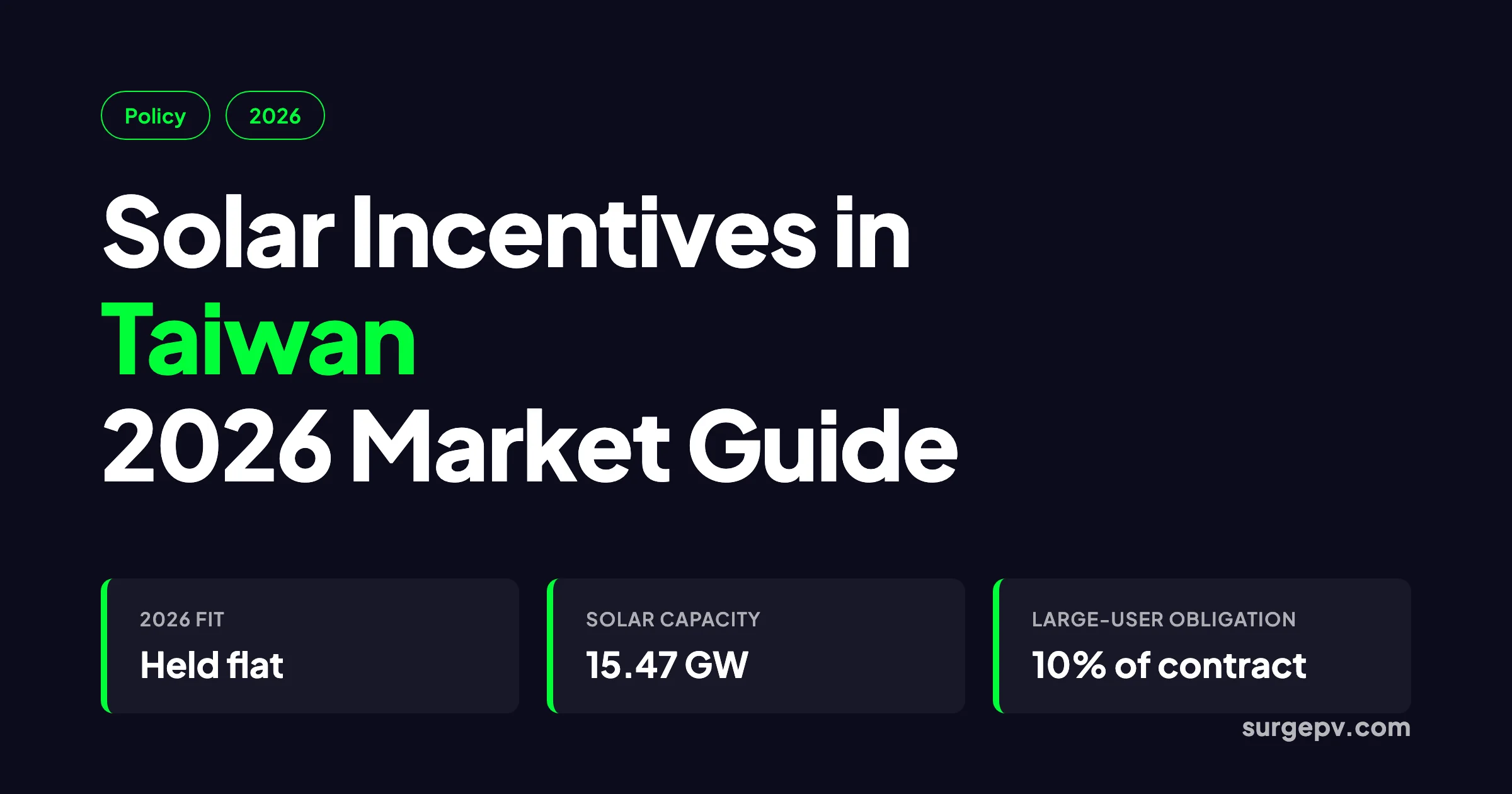
By the end of 2025, Taiwan’s solar fleet reached 15,474 MW and produced 16.74 million MWh, according to Taiwan Power Company data (2026). That is a record level, yet it is still well below the government’s 20 GW solar target for 2025, as Eco-Business reported in March 2026. The result is a market that still has room to run, but one where the rules are changing from a simple subsidy story to a more layered policy framework.
This guide explains the incentives that actually matter in Taiwan in 2026. It covers the feed-in tariff, the legal foundation, the major-electricity-user clause, T-REC trading, tax credits, and the practical mistakes that slow projects down. If you are sizing systems or writing proposals, SurgePV’s solar design software and solar yield and financial analysis can model FiT revenue, self-consumption, and corporate PPA options side by side. You can also build solar proposals in minutes, then check pricing or book a demo.
Quick Answer
Taiwan’s 2026 solar incentives are built around a flat feed-in tariff, a 20-year power-purchase contract with Taipower, mandatory renewable obligations for large consumers, tradable Taiwan Renewable Energy Certificates, investment tax credits for qualifying energy-saving and carbon-reduction equipment, and a new repowering mechanism for aging systems.
In this guide:
- Latest 2026 status of Taiwan’s solar feed-in tariff
- How the Renewable Energy Development Act shapes the market
- 2026 FIT rates for rooftop, ground-mounted, and floating solar
- Taiwan Renewable Energy Certificates and corporate PPAs
- The major-electricity-user clause and C&I routes
- Tax credits and fiscal incentives
- Common mistakes and how to avoid them
Latest Updates: Taiwan Solar Incentives 2026
The headline for 2026 is stability. Taiwan’s Ministry of Economic Affairs (MOEA) announced the 2026 feed-in tariffs on February 23, 2026, and left solar rates unchanged from the second half of 2025, according to TaiyangNews (2026). The move was intended to keep investment momentum after a year of policy uncertainty and tighter environmental rules.
Two other changes matter just as much as the rates. First, MOEA introduced a repowering mechanism for aging solar systems. The exact tariff for repowered equipment has not been set, but the mechanism is aimed at replacing older modules with higher-efficiency hardware. Second, the Renewable Energy Development Act was amended in June 2025, tightening rules on grid connection, large-consumer obligations, and building-integrated solar.
2026 Solar Feed-in Tariff Rates
The official rates, published by MOEA’s Energy Administration (2026), are:
| Category | Capacity range | First phase rate (TWD/kWh) | Second phase rate (TWD/kWh) |
|---|---|---|---|
| Rooftop | 1 kW to under 10 kW | 5.6279 | 5.6279 |
| Rooftop | 10 kW to under 20 kW | 5.3819 | 5.3819 |
| Rooftop | 20 kW to under 50 kW | 4.2505 | 4.2505 |
| Rooftop | 50 kW to under 100 kW | 4.0459 | 4.0459 |
| Rooftop | 100 kW to under 500 kW | 3.7152 | 3.7152 |
| Rooftop | 500 kW and above | 3.6236 | 3.6236 |
| Ground-mounted | 1 kW and above | 3.5037 | 3.5037 |
| Floating | 1 kW and above | 3.8948 | 3.8948 |
The rates are the same for both Phase I and Phase II approvals in 2026. Systems must sign a 20-year electricity purchase contract with Taipower at the tariff in force when the project goes commercial.
Why Taiwan’s Solar Market Matters in 2026
Taiwan is a major solar manufacturing hub, but its domestic deployment has trailed its ambitions. Solar supplied about 13.1% of electricity generation in 2025, while coal still accounted for 35.4%, according to Eco-Business (2026). The government has now shifted its 20% renewable-electricity target beyond 2026.
The long-term direction is still clear. The administration is targeting 50% natural gas, 30% renewables, and 20% coal by 2030, according to TaiyangNews (2026). Solar capacity planning points to roughly 31.2 GW by 2030 and more than 35 GW by 2035, as shown in Energy Taiwan market data.
For installers and developers, the practical picture is a mix of opportunity and constraint. Rooftop solar has been the easier route. Ground-mounted solar has been slowed by land-use and environmental reviews. Floating solar is expanding but faces grid-connection and licensing complexity. Corporate demand is rising because of supply-chain pressure on semiconductor and electronics giants.
The Legal Foundation: Renewable Energy Development Act
Taiwan’s solar market is governed by the Renewable Energy Development Act, last amended in June 2025. The law creates four building blocks for solar projects:
- Feed-in tariff. Article 9 requires MOEA to set annual wholesale purchase rates and calculation formulas. Taipower, the state-owned utility, must buy the electricity at the announced rate.
- Grid connection. Article 8 obliges the grid operator to connect renewable generators and allows cost sharing for grid upgrades beyond the existing network.
- Large-consumer obligation. Article 12 requires electricity users with a contract capacity above a threshold to install renewables, provide space, purchase green power and certificates, or pay a substitution fee.
- Building mandate. Article 12-1 requires new buildings and major reconstructions to install solar PV above a minimum capacity unless light conditions are unsuitable.
Projects under 2,000 kW are approved by municipal or county governments. Projects of 2,000 kW or more require central approval from MOEA. This split matters because it affects permitting timelines and whether a project can use the standard distributed-generation route.
How Taiwan’s Feed-in Tariff Works
The feed-in tariff is not a rebate or a tax credit. It is a long-term power-purchase price. A generator sells all eligible output to Taipower at the rate fixed when the project becomes operational.
Key Rules
- 20-year contract. The purchase price is locked for 20 years from commercial operation.
- Rate at operation date. The tariff that applies is the one announced in the year the system starts generating, not the year the contract is signed.
- Sell-all default. Most small rooftop systems sell their entire output to Taipower.
- Surplus sale option. Self-consumers can sell surplus electricity to Taipower at the applicable FiT, according to Article 9 of the Renewable Energy Development Act.
The economics are straightforward for residential and small commercial rooftops. A 10 kW rooftop system in the highest tariff band earns TWD 5.6279 for every kilowatt-hour it exports. At typical Taiwanese irradiance, that can produce a payback period in the 6 to 9 year range for a well-sited system, depending on installed cost and financing.
For larger systems, the tariff drops to roughly TWD 3.50 to 3.90 per kWh. That is still attractive in a country with high industrial electricity prices, but it means project returns are sensitive to capacity factor, grid delays, and environmental permitting.
Taiwan Renewable Energy Certificates and Corporate PPAs
Taiwan’s green-power market runs on Taiwan Renewable Energy Certificates (T-RECs). One certificate represents one megawatt-hour of verified renewable generation, issued by the National Renewable Energy Certification Center (T-REC Center).
There are three main ways for companies to acquire green power, according to InfoLink Consulting (2023):
| Route | What it is | Best for |
|---|---|---|
| Corporate PPA | Long-term direct contract with a renewable generator, usually bundled with T-RECs | Large manufacturers with steady demand |
| Self-consumption | On-site rooftop or ground-mount solar, T-RECs issued automatically | Factories and warehouses with available space |
| Unbundled T-REC | Purchase of certificates only, no physical power delivery | Companies that need green credentials but cannot host generation |
In 2022, 81% of Taiwan’s green energy was acquired through corporate PPAs, with semiconductor companies leading demand. Unbundled T-RECs are not allowed to satisfy the major-electricity-user obligation, so on-site generation or bundled PPAs are usually preferred for compliance.
The Major-Electricity-User Clause
The Renewable Energy Development Act requires large electricity users to participate in the energy transition. The T-REC Center summarized the rules in June 2021:
- Who is covered: Users with a Taipower contract capacity of 5,000 kW or more.
- Obligation: 10% of the contract capacity must be met with renewables.
- Compliance options: Install self-use renewable generation, install energy storage, purchase renewable electricity and T-RECs, or pay a monetary substitution.
- Buffer period: A five-year buffer applies, with early-performance discounts.
This clause is one of the strongest drivers of C&I solar in Taiwan. A factory with 10,000 kW of contract capacity must effectively cover 1,000 kW with renewables or pay the substitution fee. For many companies, rooftop solar plus a PPA is cheaper than the fee and also supports supply-chain decarbonization requirements.
Tax Credits and Fiscal Incentives
Taiwan does not have a direct federal tax credit for homeowners who install solar. The value for businesses comes from the Statute for Industrial Innovation and from low-cost public financing.
Statute for Industrial Innovation
The Executive Yuan (2024) and PwC’s Taiwan tax summary (2026) explain that the amended statute, effective through 2029, offers:
- Investment tax credit: Up to 5% of qualifying expenditure credited against current-year corporate income tax, or 3% spread over three years.
- Eligible scope: Smart machinery, 5G, cybersecurity, AI, energy conservation, and carbon reduction.
- Cap: The credit cannot exceed 30% of current-year corporate income tax plus profit-retention tax.
Solar PV investments that qualify as energy-conservation or carbon-reduction equipment can fall under this credit. Companies should confirm the specific asset classification with their tax advisor before claiming it.
Financing and Grants
The Acclime Taiwan guide (2026) notes that the National Development Fund offers low-interest loans for strategic green-energy projects, and grants are available through programs such as the Global Innovation Partnership Initiatives Programme and the Taiwan Industry Innovation Platform Programme.
Common Mistakes and Misconceptions
Even experienced developers lose time and money in Taiwan by misreading the incentive stack.
Assuming Net Metering Exists
Taiwan is not a net-metering market. The standard residential and small-commercial route is a sell-all FiT contract. Designers should model revenue against the fixed Taipower purchase price, not against retail bill offsets.
Ignoring the 20-Year Lock-In
The FiT rate is fixed for 20 years from operation. That is a long-term revenue anchor, but it also means the project is exposed to any changes in grid fees, land costs, or module degradation. Finance models should stress-test these variables.
Underestimating Permitting for Ground and Floating Solar
Rooftop projects under 500 kW usually move fastest. Ground-mounted and floating projects face environmental impact assessment, land-use classification, fisheries, and grid-connection reviews. These reviews have become stricter since late 2024 amendments.
Overlooking the Major-Electricity-User Obligation
C&I developers sometimes pitch solar purely on bill savings and miss the compliance value. For a covered user, avoiding the monetary substitution fee can improve project economics and shorten payback.
Misapplying the Investment Tax Credit
Not every solar purchase automatically qualifies for the Statute for Industrial Innovation credit. The equipment must be classified as energy-saving or carbon-reduction property under MOEA and Ministry of Finance guidance, and the claim must be documented correctly.
Conclusion
Taiwan’s 2026 solar incentive framework is stable but layered. The feed-in tariff is the headline, but the real value for many projects comes from combining the FiT with the major-electricity-user clause, T-REC trading, and business tax credits. Ground-mounted and floating projects remain opportunities, yet permitting discipline separates successful developers from stalled ones.
For solar professionals, the edge is no longer just installation cost. It is the ability to model the correct revenue stream, size the system for the actual tariff band, and present a credible proposal fast. SurgePV’s solar design software, generation and financial tool, and solar proposals can do that in one workflow.
Three actions to take now:
- Confirm the revenue model — sell-all FiT, self-consumption with surplus sale, or corporate PPA/T-REC — before sizing.
- Check tax-credit eligibility early and align procurement documentation with MOEA guidance.
- Build realistic permitting timelines for ground-mounted and floating projects, especially environmental review.
For regional comparisons, see our global solar market forecast. For installer workflows, visit our guide for solar installers.
Frequently Asked Questions
What solar incentives are available in Taiwan in 2026?
Taiwan’s main 2026 solar incentives are a fixed 20-year feed-in tariff purchased by Taipower, mandatory renewable-energy obligations for large electricity users, Taiwan Renewable Energy Certificates for green-power trading, and investment tax credits under the Statute for Industrial Innovation for qualifying energy-saving and carbon-reduction equipment.
What are Taiwan’s 2026 solar feed-in tariffs?
For 2026, MOEA kept solar feed-in tariffs unchanged from the second half of 2025. Rooftop systems from 1 kW to under 10 kW earn TWD 5.6279/kWh, the 500 kW and above rooftop band earns TWD 3.6236/kWh, ground-mounted systems earn TWD 3.5037/kWh, and floating solar earns TWD 3.8948/kWh.
How does Taiwan’s solar feed-in tariff system work?
Generators sign a 20-year electricity purchase contract with Taipower at the tariff announced in the year the system becomes operational. Most small rooftop systems sell all output to Taipower. Larger consumers can also self-consume and sell surplus, or procure green power through corporate PPAs and T-RECs.
Are there tax credits for solar equipment in Taiwan?
Taiwan does not offer a direct residential solar tax credit. Businesses can claim an investment tax credit of up to 5% of qualifying expenditure in the current year, or 3% spread over three years, for smart machinery, energy-saving, and carbon-reduction investments under the Statute for Industrial Innovation, subject to a 30% corporate income tax cap.
What is Taiwan’s major electricity user clause?
Users with a Taipower contract capacity of 5,000 kW or more must meet an obligation equal to 10% of that capacity with renewable energy generation, energy storage, T-REC purchases, or a monetary substitution payment.
What is a T-REC in Taiwan?
A Taiwan Renewable Energy Certificate (T-REC) represents one megawatt-hour of renewable generation. Certificates can be bundled with a corporate PPA or sold unbundled, allowing companies to meet the major-electricity-user obligation or corporate renewable-energy commitments.
What is Taiwan’s solar target?
Taiwan originally aimed for 20 GW of solar capacity by 2025 and 20% renewable electricity, but the deadline was pushed back. By the end of 2025, installed solar capacity reached 15,474 MW. Longer-term planning points to roughly 31.2 GW by 2030.
What is the most common mistake when planning a solar project in Taiwan?
The most common mistake is assuming Taiwan uses net metering. The dominant model is a sell-all feed-in tariff, so systems must be sized and financed against the fixed Taipower purchase price, not against offsetting a retail bill. Missing the environmental review for ground-mounted or floating projects is another frequent delay.
Where this fits
This article is part of SurgePV's Solar Incentives & Policy hub, which works through the topic from first principles to the decisions a project team actually has to make.

