

Quick Answer
Sri Lanka's 2026 solar incentives are a mix of tariff-based export schemes and tax relief rather than upfront cash rebates. Homeowners and businesses can choose net metering, net accounting, or net plus arrangements with CEB or LECO, while projects above 1 MW qualify for duty-free imports of capital equipment.
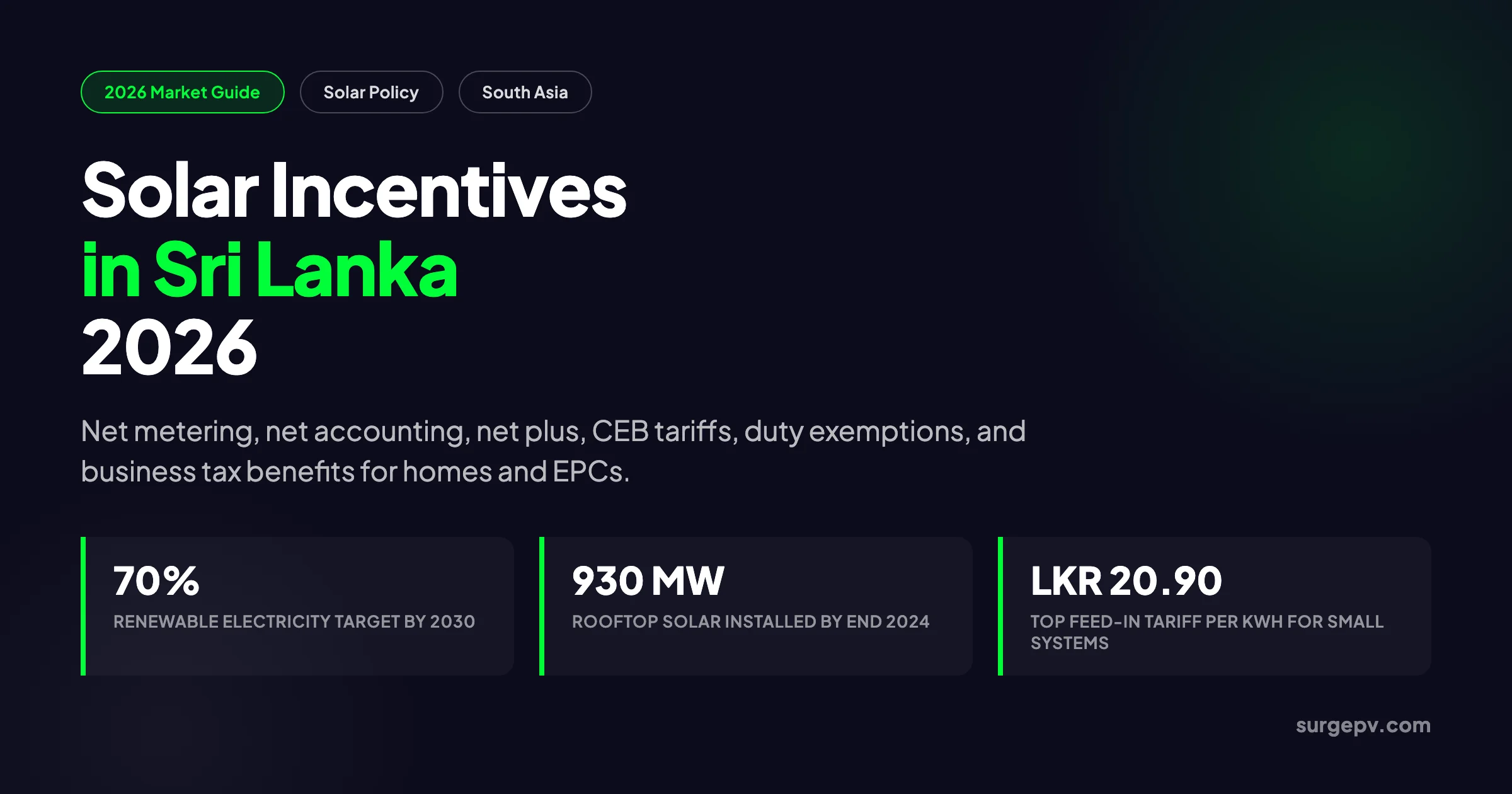
Sri Lanka reached a renewable-energy milestone in June 2025. For the first time since the early 1990s, the island’s grid averaged 70 percent generation from renewables over a full month, according to Sri Lanka Business data attributed to the Ceylon Electricity Board (2025). Rooftop solar has been a quiet but important part of that shift, with roughly 930 MW installed across more than 93,000 units by the end of 2024. For homeowners, factory owners, installers, and EPCs, the question in 2026 is not whether solar works in Sri Lanka. It is which incentive structure to use.
This guide covers the 2026 policy framework, the three export schemes, the new tariff schedule, import concessions, business tax benefits, and the practical mistakes that reduce returns. If you are modeling projects for Sri Lankan clients, a solar design platform that handles time-of-use consumption, export tariffs, and duty scenarios can cut proposal time significantly. You can explore pricing or book a demo to see how SurgePV handles these calculations.
Sri Lanka’s 2026 solar incentive framework is not a single subsidy. It is a stack of tariff-based export schemes, import tax relief for large projects, and business tax deductions. The value you capture depends almost entirely on the scheme you choose and how accurately you size the system.
Quick Answer
Sri Lanka’s 2026 solar incentives combine three CEB/LECO export schemes, duty-free imports for projects above 1 MW or 1 MWh, and capital allowances for businesses. New rooftop agreements signed from January 2026 are placed on a net plus basis under the National Electricity Policy, with feed-in tariffs ranging from LKR 14.46 to LKR 20.90 per kWh depending on system size.
In this guide:
- 2026 policy status and the National Electricity Policy changes
- How net metering, net accounting, and net plus work
- Current CEB feed-in tariffs and export values
- Import duty exemptions and who qualifies
- Business tax benefits and depreciation rules
- Residential and commercial payback outlook
- Common mistakes when sizing and applying
- Where SurgePV tools fit into the workflow
Latest Updates: Sri Lanka Solar Incentives 2026
The Sri Lankan solar market changed direction in late 2025 and early 2026. A new National Electricity Policy reshaped rooftop solar agreements, CEB cut feed-in tariffs, and the government expanded duty exemptions for large renewable-energy projects. The result is a market that still rewards solar adoption, but with a stronger emphasis on self-consumption and competitive procurement.
Sri Lanka Solar Incentive Status — June 2026
| Incentive | Type | Status | Key Terms |
|---|---|---|---|
| Net metering | Surplus credit | Active for existing agreements | Credits roll forward up to 10 years |
| Net accounting | Surplus payment | Active for existing agreements | LKR 22/kWh years 1–7, LKR 15.50/kWh years 8–20 on older contracts |
| Net plus | Gross feed-in tariff | Required for new rooftop agreements from Jan 2026 | All generation sold at CEB tariff; customer buys at retail |
| CEB rooftop feed-in tariffs | Feed-in tariff | Active, reduced June 2025 | LKR 20.90/kWh down to LKR 14.46/kWh by size |
| Battery night discharge tariff | Time-based export premium | Active | LKR 45.80/kWh for discharge 6:30 PM–10:30 PM |
| Duty exemption on capital goods | Import tax relief | Active for 1 MW+ generation or 1 MWh+ storage | Bonded warehouse facility from Oct 2025 |
| Capital allowances / accelerated depreciation | Business tax relief | Active | Deductible against taxable income for commercial systems |
| Soorya Bala Sangramaya | National rooftop program | Active | Target 1,500 MW rooftop solar by 2030 |
Key Changes Since 2025
June 2025 — CEB tariff reduction: The Cabinet approved a new solar tariff schedule announced by CEB. Rates fell by 20 to 40 percent compared with previous levels. Rooftop systems up to 5 kW now receive LKR 20.90 per kWh, while systems above 1 MW receive LKR 14.46 per kWh. The reduction reflects falling global solar costs and the government’s push for cost-reflective pricing, but it also tightens project economics for new entrants.
January 2026 — National Electricity Policy: The policy requires all new rooftop solar agreements, and extensions of existing agreements, to be signed on a net plus basis. This means generation and consumption are metered separately. Rooftop systems must also include smart meters that distribution licensees can access remotely. The policy additionally introduced competitive aggregator pilots for rooftop solar procurement.
October 2025 — Duty exemption expansion: An official gazette notice allowed duty-free imports of capital goods for renewable-energy or storage projects of at least 1 MW or 1 MWh. The bonded warehouse facility removes customs duty, the Port and Airport Development Levy, and certain other levies for qualifying equipment.
Battery night tariff: CEB introduced a LKR 45.80 per kWh tariff for solar-charged battery systems that discharge into the grid during evening peak hours. This creates a new revenue stream for hybrid systems and may accelerate battery adoption despite high import taxes on batteries.
Key Takeaway
2026 is a transition year. Existing net metering and net accounting contracts retain their terms, but new rooftop projects must accept net plus and lower tariffs. Design for self-consumption first, and treat export revenue as a secondary benefit.
Why Sri Lanka’s Solar Market Matters in 2026
Sri Lanka has excellent solar resources. Average daily solar radiation ranges from 4.5 to 6.0 kWh per square meter across most of the country, and the technical potential for solar power is estimated at roughly 6,000 MW, according to Sri Lanka Business (2025).
Market Size and Targets
The country had installed around 137.4 MW of ground-mounted solar PV and 930 MW of rooftop solar systems by late 2024. The rooftop segment alone reached more than 93,000 units, according to the National Electricity Policy of Sri Lanka (2026). The government’s long-term targets are 70 percent renewable electricity by 2030 and carbon neutrality by 2050.
The economics are driven by two forces. First, grid electricity tariffs are high and rising, especially for domestic consumers above 120 kWh per month and general-purpose commercial users. CEB notes that households consuming over 120 kWh per month pay around LKR 41 per kWh, while general-purpose consumers can pay LKR 25 or more per kWh for daytime power, according to EconomyNext reporting on CEB statements (2025). Second, solar module prices have fallen globally, making the levelized cost of rooftop solar competitive with grid supply.
The Soorya Bala Sangramaya Program
The national rooftop solar program, launched by the Ministry of Power and State Minister of Solar, Wind and Hydro Power Generation Projects Development, targets 1,000 MW by 2025 and 1,500 MW by 2030. It is implemented with CEB, LECO, and the Sri Lanka Sustainable Energy Authority. Under the program, consumers can install rooftop solar through registered service providers and select a compensation scheme.
For installers, the practical message is that demand remains strong but the design rules have changed. Every proposal now needs to show net plus economics under the new tariff schedule.
The Three Rooftop Solar Schemes Explained
CEB and LECO offer three compensation routes for rooftop solar. The right choice depends on the customer’s load profile, tariff category, and whether the system is new or existing.
Net Metering
Net metering is the simplest mechanism. Excess solar generation is exported to the grid and recorded as a credit. The customer pays only for the net electricity consumed in a billing period.
- Credits can be carried forward for up to ten years.
- No cash payment is made for surplus credits.
- Best for customers whose daytime generation closely matches daytime consumption.
- Existing net metering agreements remain valid, but new agreements are no longer offered under the 2026 National Electricity Policy.
Net Accounting
Net accounting pays the customer for exported surplus while the customer continues to pay retail rates for imports.
- Older contracts typically pay LKR 22 per kWh for the first seven years and LKR 15.50 per kWh for the next 13 years, according to the Council on Energy, Environment and Water (2024).
- Unlike net metering, surplus exports create a cash income stream.
- Existing net accounting agreements remain valid, but new rooftop projects must use net plus.
Net Plus
Net plus separates generation and consumption completely. The rooftop system sells all output to the grid at a feed-in tariff, and the customer buys all electricity from the grid at retail rates.
- Required for all new rooftop solar agreements from January 2026.
- Two meters are installed: one for exports and one for imports.
- The feed-in tariff depends on system capacity under the June 2025 CEB schedule.
- Works best when the feed-in tariff is attractive relative to the customer’s retail tariff, or when the site has limited daytime load.
2026 CEB Feed-In Tariff Schedule
| System Type and Capacity | Tariff (LKR/kWh) |
|---|---|
| Rooftop solar PV, 0–5 kW | 20.90 |
| Rooftop solar PV, 5–20 kW | 19.61 |
| Rooftop solar PV, 20–100 kW | 17.46 |
| Rooftop solar PV, 100–500 kW | 15.49 |
| Rooftop solar PV, 500–1,000 kW | 15.07 |
| Rooftop solar PV, 1 MW and over | 14.46 |
| Ground-mounted solar PV, up to 10 MW | 17.62 |
| Floating solar PV | 24.33 |
Source: Mayer Brown summary of CEB announcement (2025).
For most residential and commercial customers, self-consumption is now more valuable than export. A household that avoids buying grid power at LKR 41 per kWh saves more per unit than it earns by exporting at LKR 20.90 per kWh. That changes the optimal system size.
Import Duty and Tax Incentives
Sri Lanka does not offer a direct federal tax credit like the U.S. Investment Tax Credit. The real incentives are import duty relief for large projects and business tax deductions for commercial installations.
Duty Exemption for Large Projects
An October 2025 gazette notice allows duty-free import of capital goods for the construction of renewable-energy or storage facilities. The exemption applies under the bonded warehouse facility and covers customs duty, the Port and Airport Development Levy, and certain other levies.
- Minimum project size: 1 MW for generation or 1 MWh for storage.
- Applies to new projects and extensions of existing facilities.
- Covers equipment such as modules, inverters, mounting structures, and batteries.
- Smaller residential and commercial systems below the threshold still pay standard import taxes.
This makes medium-to-large commercial and industrial projects, ground-mounted arrays, and battery storage plants the biggest beneficiaries of 2026 import policy.
Standard Import Tax Burden
Systems that do not qualify for the duty exemption face the full import tax stack. According to the Federation of Renewable Energy Developers, batteries for solar power can attract roughly 46 percent in taxes at import, made up of approximately 25 percent import duty, 5 percent Port and Airport Development Levy, and 18 percent VAT, as reported by EconomyNext (2025). Because electricity is not under Sri Lanka’s VAT regime, developers cannot recover this VAT by invoicing CEB, so it becomes a permanent capital cost.
Business Tax Benefits
Commercial solar installations are generally treated as capital assets. Businesses can claim:
- Capital allowances against taxable income.
- Accelerated depreciation for qualifying renewable-energy investments.
- Reduced corporate tax liability and improved cash flow in early years.
For example, a company with LKR 10 million in taxable profit that installs a LKR 3 million solar system may reduce its taxable income to LKR 7 million in the relevant period, creating both tax savings and electricity bill reductions. Always confirm the exact treatment with a chartered accountant, because eligibility depends on asset classification and industry.
Battery Storage and the Night Discharge Tariff
Sri Lanka’s grid faces a well-known evening peak shortage. Solar generation is abundant at midday but does not help after sunset. To address this, CEB introduced a premium tariff for battery-stored solar energy discharged into the grid during evening peak hours.
How the Battery Tariff Works
- CEB pays LKR 45.80 per kWh for solar energy stored during the day and discharged between 6:30 PM and 10:30 PM, according to EconomyNext reporting on CEB statements (2025).
- The battery must be charged primarily from the rooftop solar system, not from the grid.
- The tariff is designed to shift solar generation from low-demand daytime hours to high-demand evening hours.
The Battery Cost Problem
The main barrier is the high cost of imported batteries. With roughly 46 percent import taxes, battery storage is expensive compared with solar-only systems. The LKR 45.80 per kWh night tariff helps the economics, but installers should model battery cycle life, depth of discharge, and warranty terms carefully. The Federation of Renewable Energy Developers has argued that the 10-year contract period commonly offered is too short relative to battery asset life.
For installers, this is a design opportunity. A generation and financial tool can model solar-plus-battery cash flows under net plus and the night discharge tariff, helping customers decide whether storage makes sense.
Residential and Commercial Payback Outlook
Payback periods in Sri Lanka depend heavily on the customer’s electricity tariff slab, the export scheme, and how much generation is self-consumed. High-tariff customers who use most of their solar power during the day see the fastest returns.
Typical Payback Ranges
| Customer Type | System Size | Key Drivers | Typical Payback |
|---|---|---|---|
| Residential, low consumption | 3–5 kW | Bill offset, net plus export | 6–8 years |
| Residential, high consumption | 5–10 kW | Avoid high domestic tariffs, high self-consumption | 5–6 years |
| Commercial / office | 20–100 kW | Daytime load match, tax allowances | 4–6 years |
| Industrial | 100 kW–1 MW+ | Demand charge reduction, duty exemption, depreciation | 3–5 years |
| Ground-mounted / utility | 1 MW+ | PPA or feed-in tariff, duty-free imports | Varies by PPA terms |
These ranges are illustrative. Actual payback depends on roof orientation, shading, equipment choice, financing cost, and future tariff changes.
A Simple Residential Example
Consider a household in Colombo with a monthly bill of LKR 25,000 and a proposed 5 kW rooftop system.
| Item | Amount |
|---|---|
| Gross installed cost | LKR 1,400,000 |
| Annual bill savings from self-consumption | LKR 240,000 |
| Annual export revenue under net plus | LKR 45,000 |
| Effective first-year benefit | LKR 285,000 |
| Simple payback | 4.9 years |
If the same household sized the system too large and exported most of its generation, the payback could stretch beyond 7 years because export tariffs are lower than retail rates.
Regulatory Framework and Key Institutions
Understanding who does what saves time during project development.
Ceylon Electricity Board (CEB)
CEB is the state-owned utility that distributes electricity to most of Sri Lanka. It accepts rooftop solar applications, signs net metering/net accounting/net plus agreements, and manages grid interconnection for most customers.
Lanka Electricity Company (LECO)
LECO serves parts of the Western Province, including Colombo. It operates parallel rooftop solar programs under the same national policy framework.
Sri Lanka Sustainable Energy Authority (SLSEA)
SLSEA is the apex institution for renewable energy. It owns renewable energy resources under Section 15 of the SLSEA Act, sets technical standards for solar equipment, registers service providers, and administers Soorya Bala Sangramaya.
Public Utilities Commission of Sri Lanka (PUCSL)
PUCSL regulates electricity tariffs, licenses, and consumer protection. The National Electricity Policy and tariff determinations require PUCSL oversight. In 2025, solar service providers challenged the CEB tariff cuts in court on the grounds that PUCSL approval was not obtained, according to Mayer Brown (2025).
National System Operator (NSO)
The Electricity Act No. 36 of 2024, amended by Act No. 14 of 2025, created a National System Operator that acts as the single buyer of electricity and conducts competitive procurement for new renewable projects. Large-scale solar and battery developers will increasingly deal with the NSO rather than CEB directly.
Common Mistakes and Misconceptions
The shift to net plus and lower tariffs makes accurate design more important than ever. These are the most common mistakes that reduce returns.
Oversizing for Export
Under net plus, exporting energy at LKR 20.90 per kWh is less valuable than avoiding a LKR 41 per kWh grid purchase. Every kilowatt of surplus export earns less than a kilowatt self-consumed. Size the system to match daytime load.
Ignoring the New Net Plus Requirement
New agreements from January 2026 must be on net plus terms. Installers still quoting net metering economics for new projects are using outdated assumptions. Always verify the agreement type before modeling payback.
Underestimating Grid Approval Time
CEB and LECO interconnection approvals involve site inspections, meter installation, and technical compliance checks. Timelines vary by location and can take several months. Build realistic schedules into contracts.
Choosing the Wrong Inverter or Panel
SLSEA has updated technical standards for solar imports. Equipment must meet IEC standards and obtain the correct certifications. Substandard or uncertified equipment may be rejected for grid connection.
Missing Business Tax Benefits
Commercial customers often fail to claim capital allowances and accelerated depreciation. These can improve project returns by 20 percent or more in the early years. Work with an accountant who understands renewable-energy asset classification.
How SurgePV Helps with Sri Lankan Solar Projects
Accurate incentives modeling is the difference between a winning proposal and an unhappy customer. SurgePV’s solar design software lets installers and EPCs model rooftop systems with the correct CEB tariffs, time-of-use load profiles, and export schemes.
For teams managing multiple projects, Clara AI can speed up system layout and shading analysis, while the generation and financial tool produces customer-ready payback charts. Finished proposals can be generated through the solar proposals workflow. For teams that want a closer look, book a demo or view pricing.
Conclusion
Sri Lanka’s 2026 solar incentives still make rooftop and commercial solar attractive, but the rules have tightened. The National Electricity Policy has moved new rooftop projects to net plus, CEB has reduced feed-in tariffs, and large projects now benefit from duty-free capital imports. The winning strategy is no longer to install as many panels as possible. It is to match generation to daytime consumption, choose the right scheme, and claim every available tax benefit.
Three actions to take now:
- Model net plus economics for every new project — net metering and net accounting are no longer available for new agreements.
- Size for self-consumption, not export — avoided retail purchases are worth more than export payments for most customers.
- Stack business tax benefits for commercial systems — capital allowances and accelerated depreciation can materially shorten payback.
For regional comparisons, see our solar payback period by country guide. For installers scaling in South Asia, our guide for solar installers covers proposal automation and compliance workflows.
Frequently Asked Questions
What solar incentives are available in Sri Lanka in 2026?
Sri Lanka offers three main rooftop solar schemes through CEB and LECO: net metering, net accounting, and net plus. Net metering credits exports against future imports, net accounting pays a fixed rate for surplus, and net plus pays for all generation. Projects above 1 MW also qualify for duty-free import of capital equipment, and businesses can claim capital allowances.
Does Sri Lanka offer a direct cash rebate for residential solar?
No. Sri Lanka does not provide a direct upfront cash rebate for residential solar. The value comes from avoided electricity bills, export payments under net accounting or net plus, import duty concessions that lower system prices, and capital allowances for commercial installations.
How do net metering, net accounting, and net plus differ in Sri Lanka?
Net metering rolls exported units forward as credits against future imports for up to ten years. Net accounting pays a fixed tariff for excess exports while the customer pays normal retail rates for imports. Net plus treats the rooftop system as a separate generator that sells all output to the grid at a feed-in tariff while the customer buys all consumption at retail rates.
What are the 2026 feed-in tariffs for rooftop solar in Sri Lanka?
New CEB tariffs approved in June 2025 range from LKR 20.90 per kWh for systems up to 5 kW down to LKR 14.46 per kWh for systems above 1 MW. Ground-mounted systems up to 10 MW receive LKR 17.62 per kWh, while floating solar receives LKR 24.33 per kWh. These rates apply to new agreements and are significantly lower than earlier tariffs.
Are solar panels exempt from import duty in Sri Lanka?
Projects of 1 MW or above, or battery storage systems of 1 MWh or above, can import capital goods duty-free under a bonded warehouse facility introduced by an October 2025 gazette notice. Smaller residential and commercial systems still pay standard import duties, VAT, and the Port and Airport Development Levy, which can add roughly 46 percent to battery costs.
What is the typical solar payback period in Sri Lanka?
Well-designed residential systems typically pay back in 5 to 7 years, while commercial systems with high daytime self-consumption can pay back in 4 to 6 years. Payback depends on the customer’s electricity tariff slab, the export scheme selected, system sizing, and future tariff increases.
Can businesses get tax benefits for installing solar in Sri Lanka?
Yes. Commercial solar systems are usually treated as capital assets, allowing businesses to claim capital allowances and accelerated depreciation against taxable income. This reduces corporate tax liability and improves cash flow in the early years of the project.
What is the Soorya Bala Sangramaya program?
Soorya Bala Sangramaya, or Battle for Solar Energy, is a national rooftop solar program launched by the Ministry of Power. It aims to add 1,000 MW of rooftop solar by 2025 and 1,500 MW by 2030 through household, commercial, industrial, and institutional installations connected to CEB or LECO.
Who regulates solar power in Sri Lanka?
The Ceylon Electricity Board and Lanka Electricity Company are the distribution licensees that accept rooftop solar applications. The Sri Lanka Sustainable Energy Authority owns renewable energy resources under the SLSEA Act, sets technical standards, and runs Soorya Bala Sangramaya. The Public Utilities Commission of Sri Lanka regulates tariffs and licensing.
What is the biggest mistake when sizing a solar system in Sri Lanka?
The biggest mistake is oversizing for export under the new net plus framework. Because 2026 export tariffs are below retail electricity rates for most customer categories, every unit self-consumed on site is worth more than a unit exported. Systems should be sized to match daytime load, not maximum roof area.
