

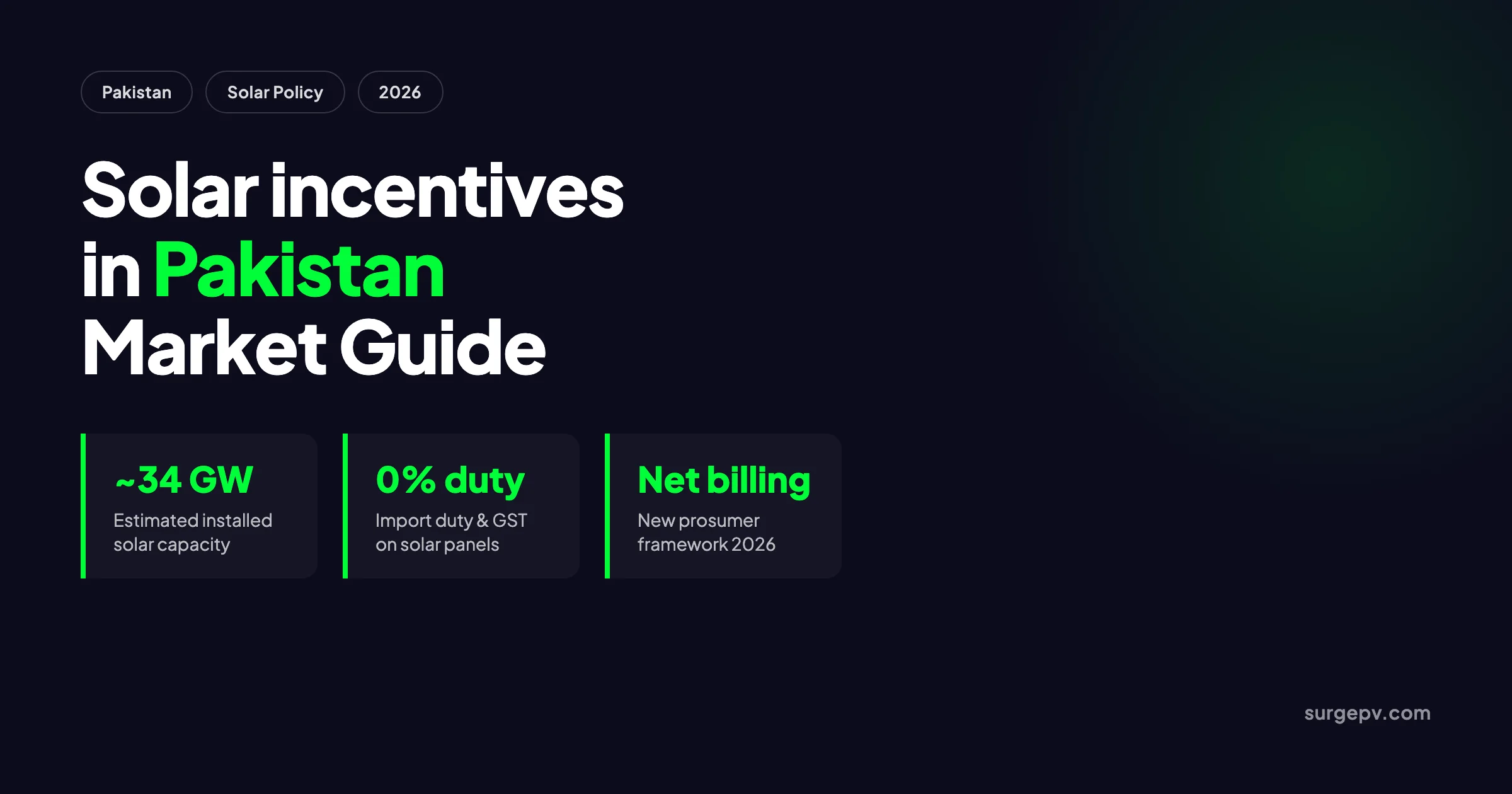
Pakistan’s solar market has become one of the fastest consumer-led energy transitions in South Asia. A joint study by TransitionZero and the Pakistan Research Institute for Energy and Development estimated total installed solar capacity at roughly 34 GW by early 2025. Much of that capacity sits behind-the-meter or off-grid, outside official statistics, according to TransitionZero (2025). For installers, EPCs, and property owners, the real story is not just growth. It is how quickly the rules have changed.
This guide is a practical incentive manual for 2026. It covers the new NEPRA prosumer framework, the shift from net metering to net billing, tax treatment of solar equipment, federal and provincial support schemes, and the sizing mistakes that now cost money. If you design systems or write proposals for Pakistani clients, a solar design platform can model net billing tariffs and self-consumption ratios. That turns a complex policy shift into a clear customer decision. You can also generate solar proposals in minutes, check pricing, or book a demo to see how SurgePV handles Pakistan.
Pakistan’s 2026 solar incentive stack is built on cheap hardware access and regulated grid participation rather than large cash subsidies. The value comes from combining zero import duty on panels, GST relief, NEPRA net billing for exports, State Bank refinance for borrowers, and provincial schemes for low-income households.
Quick Answer
Pakistan’s 2026 solar incentives are a mix of low hardware costs and regulated grid access rather than direct subsidies: zero import duty and GST on solar panels, NEPRA prosumer net billing for systems up to 1 MW, SBP refinance at up to 6% markup, and provincial programs such as the CM Punjab free solar scheme for low-consumption households.
TL;DR — Solar Incentives in Pakistan 2026
Active mechanisms: zero import duty and GST on solar panels, NEPRA prosumer net billing replacing one-to-one net metering, State Bank refinance for residential to utility-scale projects, and provincial free-panel schemes for protected consumers. The biggest change is that exported solar is now paid at the national average energy purchase price, not the retail tariff.
In this guide:
- Latest 2026 status of every active Pakistani solar incentive
- The legal foundation: NEPRA, AEDB, and the Prosumer Regulations 2026
- How net billing differs from the old net metering model
- Tax treatment: duty, GST, and what is not exempt
- Federal and provincial financing and subsidy programs
- Commercial and industrial routes beyond rooftop net billing
- Regional differences across DISCOs and solar resource zones
- Three real-world sizing scenarios under net billing
- Common mistakes and how to avoid them
Latest Updates: Pakistan Solar Incentives 2026
The Pakistani solar policy environment shifted sharply in early 2026. On February 9, 2026, the National Electric Power Regulatory Authority notified the NEPRA (Prosumer) Regulations, 2026 through S.R.O. 251(I)/2026. These rules replace the earlier 2015 Distributed Generation and Net Metering Regulations, according to Energy Update (2026). The new rules change the economics of rooftop solar for every new connection.
Pakistan Solar Incentive Status — June 2026
| Incentive | Type | Status | Key Terms |
|---|---|---|---|
| Zero import duty on solar panels | Customs relief | Active | Solar panels exempt from import duty under renewable-energy SROs |
| GST exemption on solar panels | Sales tax relief | Active | 18% GST proposed in 2025-26 budget was not imposed in 2026-27 |
| NEPRA prosumer net billing | Export compensation | Active for new connections | Export paid at national average energy purchase price |
| Legacy net metering | Export credit | Protected until expiry | Existing agreements keep terms until renewal |
| SBP refinance for renewable energy | Concessionary finance | Active | Up to 6% markup for eligible projects |
| CM Punjab free solar scheme | Provincial subsidy | Ongoing | 1-3 kW systems for households under 200 units/month |
| Distributed generation cap | Regulatory | 1 MW | Applies to 400V and 11kV consumers |
| Sanctioned load cap | Regulatory | Active | System size cannot exceed premises sanctioned load |
| Concurrence fee | Regulatory fee | Rs. 1,000/kW | One-time fee for prosumer agreement |
Key Changes Since 2025
February 2026 — NEPRA Prosumer Regulations: Net billing replaced net metering as the default arrangement for new distributed generation connections. Exported electricity is now purchased by the distribution company at the national average energy purchase price, while imported electricity is billed at the full applicable consumer tariff.
Agreement term shortened to five years: New prosumer agreements run for five years instead of the previous seven, with renewal subject to mutual consent and the rules then in force.
Capacity capped at sanctioned load: A prosumer facility cannot exceed the sanctioned load of the premises. This prevents customers from installing oversized systems purely to export.
Concurrence fee introduced: A one-time fee of Rs. 1,000 per kW of installed capacity is payable for the prosumer agreement.
Load flow study for larger systems: Installations of 250 kW or above must submit a load flow study carried out by the licensee or a Pakistan Engineering Council-registered consultant.
Key Takeaway
2026 is a transition year. Existing net metering customers keep their terms until expiry, but every new rooftop system must be modelled on net billing economics. Self-consumption is now the primary value driver.
Why Pakistan’s Solar Market Matters in 2026
Pakistan has some of the best solar resources in the world. The country receives roughly 5-7 kWh per square metre of solar radiation daily and more than 300 sunny days per year, according to solar market data attributed to the Alternative Energy Development Board (2026). The estimated technical potential exceeds 2.9 million MW, according to AIP Advances (2026).
Market Size and Drivers
Pakistan’s installed solar capacity is now measured in tens of gigawatts, but the exact figure depends on methodology. The TransitionZero and PRIED study estimated roughly 34 GW of total installed solar by early 2025, including unreported behind-the-meter and off-grid systems, according to TransitionZero (2025). Of that, net-metered grid-tied capacity was reported at around 6.1 GW with more than 51,000 active connections, according to net-metering market data (2026).
Growth has been driven by three factors:
- High grid tariffs. Residential consumers in 2026 pay between Rs. 65 and Rs. 80 per unit in peak hours, according to Alternative Resources League (2026).
- Unreliable supply. Load shedding and voltage fluctuations push households and businesses toward self-generation.
- Falling hardware costs. Global panel prices declined, and Pakistan maintained a zero-duty import regime that kept landed costs low.
Macroeconomic Impact
The solar boom has also changed Pakistan’s energy trade balance. The country avoided more than USD 12 billion in oil and gas imports between 2018 and February 2026 because of solar deployment. Fossil fuel imports dropped by 40% between 2022 and 2024, according to Centre for Research on Energy and Clean Air (2026).
For solar professionals, the opportunity is to show customers both bill reduction and energy security. That requires hourly load modelling and accurate shading analysis, both of which are built into modern solar design software.
The Legal Foundation: NEPRA, AEDB, and Distributed Generation
Pakistan’s renewable-energy sector is governed by two main bodies. The National Electric Power Regulatory Authority sets tariffs and grid-interconnection rules. The Alternative Energy Development Board promotes and facilitates renewable-energy projects, including certification and vendor registration.
NEPRA Prosumer Regulations 2026
The NEPRA (Prosumer) Regulations, 2026, were notified on February 9, 2026. They create a single framework for consumers who generate electricity from solar, wind, or biogas and connect to the distribution network, according to EBill Pakistan’s summary of S.R.O. 251(I)/2026 (2026). Key provisions include:
- Eligible consumers on 400V or 11kV connections, including domestic, commercial, industrial, agricultural, and general services categories.
- Distributed generation facilities up to 1 MW.
- Installed capacity cannot exceed the sanctioned load of the premises.
- A standardized NEPRA-approved agreement format between the licensee and the prosumer.
- Billing based on a 30-day cycle.
AEDB Role
The Alternative Energy Development Board certifies installers and vendors, maintains lists of approved equipment, and supports project registration. Most banks require AEDB certification or vendor empanelment before approving SBP refinance. Installers should confirm that their equipment and workmanship meet AEDB requirements before quoting customers.
Technical Requirements
| Requirement | Threshold | Detail |
|---|---|---|
| Load flow study | 250 kW and above | Must be carried out by the licensee or a PEC-registered consultant |
| Metering | All sizes | Bidirectional or dual-meter configuration approved by NEPRA |
| Capacity cap | All sizes | Cannot exceed sanctioned load |
| Agreement term | New systems | Five years, renewable under rules then in force |
| Concurrence fee | New systems | Rs. 1,000 per kW |
For installers, the practical implication is that most residential and small commercial projects fall under a clear route as long as they stay within sanctioned load and use certified equipment. A well-documented generation and financial tool can check sanctioned load, estimated export, and payback under the new net billing rates.
Net Billing vs Net Metering: How Compensation Changed in 2026
The shift from net metering to net billing is the single biggest change in Pakistan’s 2026 solar framework. It alters how every new system should be sized.
Net Metering (Pre-2026 Framework)
Under the 2015 regulations, exported kWh were offset against imported kWh. Surplus units were typically compensated at the consumer’s off-peak tariff or a regulated buyback rate. Industry sources reported effective buyback rates around Rs. 19-25.9 per unit for existing agreements, according to Solar Price Info (2026).
Net Billing (2026 Framework)
Under net billing, imported electricity is billed at the full retail rate. Exported electricity is purchased by the distribution company at the national average energy purchase price. This price is significantly lower than the retail tariff, with market reports placing it in the Rs. 8-11 per unit range, according to Solar Price Info (2026).
Why the Change Matters
A kilowatt-hour consumed on site avoids a retail bill of Rs. 65-80. A kilowatt-hour exported earns only Rs. 8-11. The ratio is roughly 6:1 to 8:1. That makes oversizing for export a fast way to destroy project returns.
The 2026 regulations also introduce monthly settlement instead of quarterly adjustment, with any surplus credit either carried to the next bill or paid quarterly. Existing net metering agreements remain valid until expiry, after which renewals fall under net billing.
A generation and financial tool that models hourly import, export, and the new buyback rate is now essential for accurate Pakistani proposals.
Tax and Fiscal Incentives
Pakistan does not offer a direct federal tax credit for residential solar buyers comparable to the former U.S. Investment Tax Credit. The real value lies in customs duty relief, sales tax treatment, and concessionary finance.
Import Duty Exemption
Solar panels are exempt from import duty under statutory regulatory orders issued to promote renewable energy. This exemption has been in place for several years and survived the 2026-27 federal budget, according to Enon Traders (2026).
GST Treatment
Solar panels are currently zero-rated for GST. In mid-2025, the government proposed an 18% GST on imported panels, but the final 2026-27 Finance Bill did not impose it, according to Solar Citizen (2026). The uncertainty alone caused short-term price spikes, which shows how sensitive Pakistani solar economics are to tax policy.
What Is Not Exempt
The full system is not tax-free. Typical treatment for other components in 2026 is:
| Component | Typical Duty/Tax Status |
|---|---|
| Solar panels | 0% import duty, 0% GST |
| Inverters | 5-10% import duty, GST may apply |
| Lithium batteries | 10-15% import duty |
| Mounting structures | 10-15% import duty |
| Wiring, breakers, accessories | Standard rates, often 10-20% |
No Direct Residential Tax Credit
Individual homeowners cannot claim a federal income-tax credit for buying solar panels. Businesses can depreciate solar assets under normal tax rules, which improves C&I returns, but there is no blanket renewable-energy investment deduction like Mexico’s 100% ISR deduction.
Federal and Provincial Programs
Beyond tax relief, two channels reduce the upfront cost of solar in Pakistan: State Bank refinance and provincial free-panel schemes.
State Bank Refinance Scheme for Renewable Energy
The State Bank of Pakistan operates a Financing Scheme for Renewable Energy with three categories, according to State Bank of Pakistan (2026):
- Category I: Projects above 1 MW and up to 50 MW, with financing up to Rs. 6 billion per project and tenor up to 12 years.
- Category II: Small-scale systems from 4 kW to 1 MW for own use and/or supply to the distribution company, with financing up to Rs. 400 million per customer and tenor up to 10 years.
- Category III: Renewable energy investment entities that lease or sell equipment, with a cumulative limit of Rs. 2 billion per entity.
The markup is up to 6% per year, well below commercial lending rates. Several banks channel the facility, including Meezan Bank, Bank Alfalah Islamic, HBL, Faysal Bank, and JS Bank, according to Solar Citizen (2026).
CM Punjab Free Solar Panel Scheme
The Punjab government runs a free solar panel scheme for households consuming less than 200 electricity units per month. Eligible households receive 1-3 kW systems, typically standalone off-grid or basic hybrid kits without net metering or batteries, according to Solar Citizen (2026). The portal is cmsolarscheme.punjab.gov.pk.
Other Provincial Schemes
Other provinces have announced or piloted similar programs, but details change frequently. Always verify the latest notification from the provincial energy department or AEDB before quoting a customer.
Commercial and Industrial Solar Incentives
C&I solar in Pakistan operates under different economics than residential rooftop. The drivers are demand-charge reduction, captive power, and long-term tariff hedging rather than export income.
Prosumer Net Billing for C&I
Commercial and industrial consumers with 400V or 11kV connections can install systems up to 1 MW under the prosumer regulations. No generation licence is required. The same net billing rules apply: imports at retail, exports at the national average energy purchase price.
State Bank Category I and Corporate PPAs
For projects above 1 MW, the State Bank Category I refinance supports captive or grid-sale plants up to 50 MW. Larger consumers can also explore corporate power purchase agreements, although the Pakistani open-access market is still developing compared with India or the Middle East.
Tax Depreciation
Businesses can depreciate solar assets under normal income-tax rules. Combined with high retail tariffs and the 6% SBP refinance rate, this often makes C&I solar the lowest-cost source of daytime electricity for factories with suitable rooftops or land.
For C&I installers, the design priorities are different from residential work. Load profiling, demand-charge analysis, and shadow analysis matter more than simple bill offset.
Regional Variations and DISCOs
Pakistan’s solar market is spread across multiple distribution companies and resource zones. Local rules and irradiance vary enough to change project returns.
Distribution Companies
Grid-tied solar in Pakistan is processed through the relevant distribution company. The main DISCOs include LESCO, IESCO, MEPCO, FESCO, PESCO, HESCO, SEPCO, and K-Electric for Karachi. LESCO and IESCO have historically led in net-metered capacity, reflecting high-tariff urban load centres in Punjab.
Solar Resource Zones
The best solar resource is in Balochistan, Sindh, and Southern Punjab. The Quaid-e-Azam Solar Park in Bahawalpur, Punjab, demonstrates utility-scale potential with an installed capacity of 1,000 MW, according to solar market data (2026). Northern regions have lower irradiance but strong demand for off-grid and hybrid systems.
Practical Tip
Always model the local DISCO tariff, not a national average. The same 10 kW system can have a very different payback in Karachi under K-Electric rates versus a subsidised rural rate zone.
How to Size Systems Under Net Billing: Three Scenarios
The following examples are illustrative, based on typical 2026 costs and incentive rates. Actual figures depend on location, tariff slab, installer quote, equipment choice, and whether the customer is a business or individual.
Scenario 1 — 5 kW Residential Rooftop, Lahore
| Item | Amount |
|---|---|
| Gross installed cost | PKR 800,000 |
| Duty/GST saving on panels | −PKR 120,000 |
| Net effective cost | PKR 680,000 |
| Annual bill savings at 80% self-consumption | PKR 180,000 |
| Annual export earnings at net billing | PKR 18,000 |
| Payback | 3.4 years |
If the same system were sized for 50% export, payback would stretch toward 5-6 years.
Scenario 2 — 50 kW Commercial Rooftop, Karachi
| Item | Amount |
|---|---|
| Gross installed cost | PKR 5,500,000 |
| Tax depreciation benefit (estimated) | −PKR 550,000 |
| Net effective cost | PKR 4,950,000 |
| Annual avoided electricity + demand charges | PKR 1,400,000 |
| Annual export earnings | PKR 95,000 |
| Payback | 3.5 years |
High self-consumption and demand-charge avoidance drive the return. Export earnings are a small bonus.
Scenario 3 — 500 kW Industrial Captive Plant, Faisalabad
| Item | Amount |
|---|---|
| Gross installed cost | PKR 45,000,000 |
| SBP Category II refinance at 6% | PKR 33,750,000 financed |
| Annual energy generation | 730,000 kWh |
| Annual savings at captive use | PKR 12,000,000 |
| Debt service at 6% over 10 years | PKR 4,500,000/year |
| Cash-flow payback | 4-5 years |
Large C&I projects benefit most from scale, high daytime load, and cheap SBP refinance.
Common Mistakes and Misconceptions
Even experienced installers lose money in Pakistan by misunderstanding how incentives interact. Here are the most common errors.
Oversizing for Export
The single most expensive mistake is designing a system that exports more than the customer consumes. Under net billing, export value is a fraction of retail import cost. Size for self-consumption, not maximum generation.
Assuming Old Net Metering Rates
Many customers and some installers still quote payback based on the old one-to-one net metering model. New systems must be modelled on net billing rates, or the proposal will mislead the buyer.
Ignoring the Sanctioned Load Cap
The prosumer regulations cap system size at the premises sanctioned load. A design that exceeds this cap will not receive interconnection approval.
Using Non-Certified Equipment
Banks and DISCOs increasingly require AEDB-certified equipment and installers. A cheap, uncertified system may fail inspection or disqualify the customer from refinance.
Underestimating Interconnection Time
DISCO approval, meter change-out, and inspection can take several weeks to a few months. Build realistic timelines into contracts and customer expectations.
Forgetting Currency and Tax Risk
Global panel prices may fall, but rupee depreciation can offset the saving. Tax exemptions are reviewed each budget. Proposals should make clear that future hardware and tax costs can change.
Conclusion
Pakistan’s solar incentive framework in 2026 is a stack built from cheap hardware access, zero panel duty, GST relief, NEPRA net billing, State Bank refinance, and provincial free-panel schemes. None of these mechanisms is as simple as a single upfront rebate, but combined they keep solar attractive even after the shift from net metering to net billing.
For solar professionals, the competitive edge is no longer just installation price. It is the ability to model the right self-consumption ratio, size within sanctioned load, and stack finance and tax benefits correctly. Tools like Clara AI and SurgePV’s generation and financial tool can automate that workflow for Pakistani projects.
Three actions to take now:
- Verify the compensation model before sizing — existing net metering and new net billing produce very different optimal system sizes.
- Maximise self-consumption — exported energy in Pakistan is worth far less than avoided retail purchases.
- Confirm equipment certification and financing eligibility — AEDB approval and SBP refinance can materially reduce customer cost.
For regional comparisons, see our solar payback period by country guide. For installers scaling in Pakistan, our guide for solar installers covers proposal automation and compliance workflows.
Frequently Asked Questions
What solar incentives are available in Pakistan in 2026?
Pakistan’s 2026 solar incentives include zero import duty and GST exemption on solar panels, NEPRA prosumer net billing for distributed generation up to 1 MW, State Bank refinance for renewable energy at up to 6% markup, and provincial programs such as the CM Punjab free solar panel scheme for households consuming under 200 units per month.
What is the difference between net metering and net billing in Pakistan?
Net metering offset exported units against imported units at retail tariffs, often near Rs. 19-25.9 per unit. Net billing, introduced under NEPRA Prosumer Regulations 2026, bills imported electricity at full retail rates but pays for exports at the lower national average energy purchase price, widely reported in the Rs. 8-11 per unit range.
Are solar panels tax-free in Pakistan in 2026?
Solar panels are exempt from import duty and GST as of the 2026-27 federal budget. However, inverters, batteries, mounting structures, wiring, and electrical protection devices may still attract customs duty or GST. The total system cost is therefore not completely tax-free.
How big is Pakistan’s solar market in 2026?
Estimates vary because much of the market is behind-the-meter or off-grid. A TransitionZero and PRIED study estimated total installed solar capacity at roughly 34 GW by early 2025, while net-metered grid-tied capacity was reported around 6.1 GW with more than 51,000 active connections.
Can commercial and industrial projects access solar incentives in Pakistan?
Yes. C&I systems up to 1 MW can connect under NEPRA prosumer net billing without a generation licence. Larger projects can use the State Bank Category I refinance scheme for 1-50 MW plants, captive power arrangements, or corporate power purchase agreements.
What is the maximum system size allowed under Pakistan’s prosumer regulations?
The NEPRA Prosumer Regulations 2026 allow distributed generation facilities up to 1 MW for eligible domestic, commercial, industrial, agricultural, and general services consumers on 400V or 11kV connections. The installed capacity cannot exceed the sanctioned load of the premises.
What is the payback period for solar in Pakistan under net billing?
Well-sized residential and commercial systems typically pay back in 3-5 years under old net metering agreements and 5-7 years under the new net billing framework, depending on self-consumption ratio, tariff slab, system cost, and financing terms.
What is the CM Punjab Solar Panel Scheme?
The CM Punjab free solar panel scheme provides 1-3 kW solar systems to low-income households consuming less than 200 electricity units per month. The kits are typically standalone off-grid or basic hybrid systems and do not include net metering or batteries.
Do existing net metering agreements change under the 2026 regulations?
Existing net metering agreements remain valid until expiry, after which renewals fall under the new prosumer net billing framework. During the remaining contract term, existing prosumers are generally compensated at the national average power purchase price.
What is the most common mistake when sizing a solar system in Pakistan in 2026?
The most common mistake is oversizing for export. Because net billing pays only the national average energy purchase price for exported units while charging full retail rates for imports, every kilowatt consumed on site is worth more than a kilowatt exported. Systems should be sized for self-consumption first.
Where this fits
This article is part of SurgePV's Solar Incentives & Policy hub, which works through the topic from first principles to the decisions a project team actually has to make.

