

Norway’s solar market hit a clear inflection point in 2025. The country added 117 MW of solar, down from 148.68 MW in 2024. NVE published the figures, which were reported by pv magazine sources (2026). Cumulative capacity reached roughly 876 MW. What stands out is the split: commercial and industrial systems contributed 81 MW, while residential added only 13 MW. The residential segment, once the engine of Norwegian solar growth, slowed sharply.
This guide is a practical incentive manual for installers, EPCs, property owners, and energy managers. It covers every active 2026 Norwegian solar incentive, the plusskunde framework, the Norgespris support scheme, the new commercial energy-sharing rules, and the mistakes that cost money. For a broader European comparison, see our European solar incentives guide. For installers designing Norwegian systems, a solar design platform with local tariff and self-consumption logic can turn a complex quote into a clear decision.
If you design systems or write proposals for Norwegian clients, model payback, self-consumption, and stacked incentives automatically, then generate solar proposals in minutes. Check pricing or book a demo to see how SurgePV handles Norway.
Norway’s 2026 solar incentive framework is smaller than many European markets, but it is still usable. The headline tools are the Enova residential grant, the Norgespris fixed-price electricity support, and the new commercial energy-sharing exemption. The key is matching the right incentive to the right project type.
Quick Answer
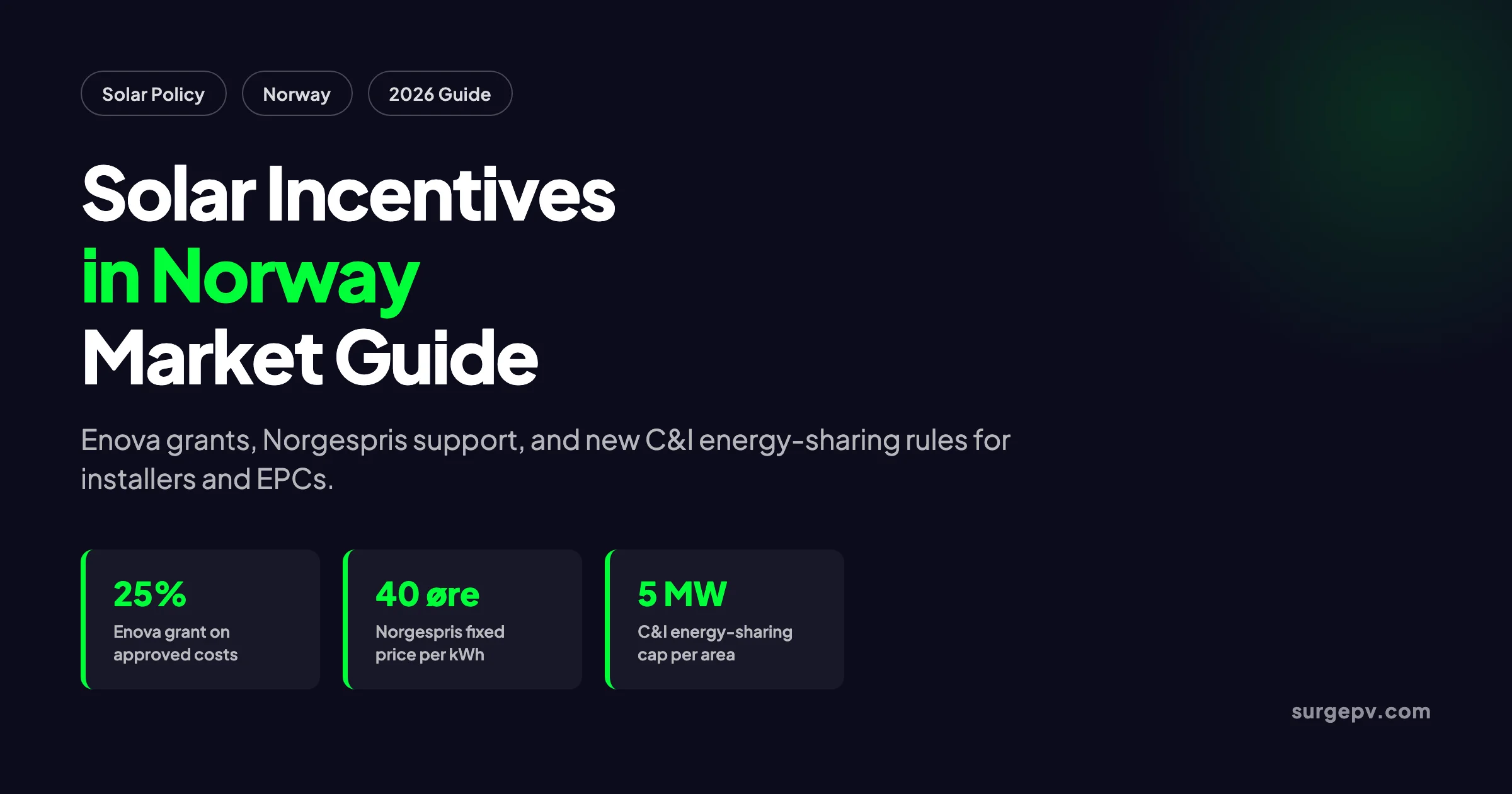
Norway’s 2026 solar incentives include the Enova residential grant covering 25% of approved solar costs up to NOK 2,500 per kW, the Norgespris fixed-price household support scheme at 40 øre/kWh, and new commercial energy-sharing rules that exempt shared solar within industrial areas from electricity taxes and grid fees.
In this guide:
- Latest 2026 status of every active Norwegian solar incentive
- Market context: why C&I solar is now outpacing residential
- Enova grants — rates, caps, and application rules
- The plusskunde framework and how export income works
- Norgespris and the electricity support scheme
- New 2026 commercial energy-sharing rules
- Tax treatment, grid tariffs, and the reduced electricity tax
- Three real-world stacking scenarios with payback impact
- Common mistakes and how to avoid them
Latest Updates: Norway Solar Incentives 2026
The Norwegian solar policy environment in 2026 is defined by two themes: support for self-consumption and stronger incentives for commercial clusters. Residential subsidies are still available but less generous than in 2022. C&I projects gained a significant new exemption on 1 January 2026.
Norway Solar Incentive Status — June 2026
| Incentive | Type | Status | Key Terms |
|---|---|---|---|
| Enova residential solar grant | Capital grant | Active | 25% of approved costs; NOK 2,500/kW cap |
| Norgespris fixed-price support | Bill support | Active until 31 Dec 2026 | 40 øre/kWh excl. VAT; optional alternative to strømstøtte |
| Strømstøtte electricity support | Bill support | Active | 90% of price above NOK 0.77/kWh excl. VAT |
| C&I energy sharing | Tax and grid-fee exemption | Active from 1 Jan 2026 | Up to 5 MW per industrial area |
| Reduced electricity tax | Tax reduction | Active in 2026 | Flat 4.18 øre/kWh |
| Prosumer export income | Market income | Active | Spot-market or supplier rate; no retail net metering |
| Solar mandate for government buildings | Regulatory mandate | Active from 2024 | Solar required on new government buildings |
| License threshold raised | Regulatory | Active | Projects under 10 MW no longer need a license |
Key Changes Since 2025
1 January 2026 — Commercial energy-sharing rules take effect: Renewable power from plants up to 5 MW can be shared within a defined industrial or commercial area without paying electricity taxes or grid fees. The Norwegian Energy Regulatory Authority (RME) and the Ministry of Energy prepare the detailed guidelines. The exemption was announced by the Norwegian government and reported by pv magazine (2025).
2026 — Electricity tax reduced: The government cut the electricity tax to a flat 4.18 øre/kWh for the full year, according to Prop. 1 LS (2025–2026) (Regjeringen, 2025).
October 2025 — Norgespris introduced: Households gained a voluntary fixed-price alternative to the existing strømstøtte support scheme. The fixed rate of 40 øre/kWh excl. VAT runs through December 2026.
Key Takeaway
2026 is a transition year. Residential incentives are still available but the real policy momentum is behind commercial and industrial solar, especially energy sharing in industrial areas.
Why Norway’s Solar Market Matters in 2026
Norway does not have the solar resource of Southern Europe. Annual solar irradiance ranges from roughly 700 kWh/kWp in the far north to 1,100 kWh/kWp in the south. Yet the market has grown almost every year because of high retail electricity prices, a simple subsidy model, and a strong cultural preference for self-sufficiency.
Market Size and Targets
Norway added 117 MW of solar in 2025. Cumulative capacity reached approximately 876 MW by year-end, according to NVE data reported in early 2026. The market split was unusual: 81 MW came from commercial and institutional installations, while residential added only 13 MW.
| Segment | 2025 MW Added | Share of Total |
|---|---|---|
| Residential | 13 MW | 11% |
| Commercial and institutional | 81 MW | 69% |
| Other / utility | 23 MW | 20% |
| Total | 117 MW | 100% |
Norway has no binding national solar capacity target, but the government has stated a desire to accelerate solar deployment. A study published in 2024 calculated that Norwegian buildings could host up to 31 GW of solar capacity. That is roughly 35 times the current installed base.
What the Residential Slowdown Means
The residential slowdown was caused by several factors. Lower spot prices reduced the value of exported solar. High interest rates made financed systems more expensive. The Norgespris scheme, while helpful for cost predictability, also reduced the perceived urgency of self-generation. It caps household electricity prices. Industry stakeholders cited Norgespris as a factor that reduced solar demand, according to Multiconsult comments reported by pv magazine sources (2026).
For solar professionals, the lesson is clear: Norwegian residential proposals must now prove value under capped or fixed electricity prices. The case rests on self-consumption, not export revenue.
Why Solar Still Makes Sense for Some Households
Despite the slowdown, solar still works for households with three characteristics. First, high daytime consumption from home offices, heat pumps, or electric vehicle charging. Second, roofs with good orientation and limited shading. Third, owners who plan to stay in the home long enough to absorb the long payback.
A household that consumes 15,000 kWh per year and can self-consume 75% of its solar generation will still see meaningful bill reductions. The economics improve further if the household is in the high-price NO2 price zone in southern Norway, where daytime spot prices and retail rates are highest.
Enova: The Main Residential Solar Subsidy
Enova SF is Norway’s state-owned clean-energy agency. It manages the country’s main residential solar grant. The grant is not a feed-in tariff. It is an upfront capital subsidy paid after installation and verification.
How the Enova Grant Works
The grant covers 25% of approved invoiced costs for a residential solar system. The subsidy is capped at NOK 2,500 per kW of installed capacity. The system must be permanently connected to the home’s electrical installation. Invoices must show all costs, including materials and labour, the installer’s organisation number, and the installed capacity. Rules are published by Enova (2026).
The grant is paid after the system is installed, paid for, and documented. Homeowners must finance the full cost during construction.
Historical Changes to Enova Support
Enova’s support level has changed over time. In 2022, the agency increased the per-kW cap from NOK 1,250 to NOK 2,000. It also expanded the eligible system size from 15 kW to 20 kW. The cap later rose to NOK 2,500 per kW. The government funded these changes with an additional NOK 750 million allocation to Enova, as reported by pv magazine (2022).
The current NOK 2,500/kW cap means the Enova grant is more valuable for smaller systems. On a 6 kWp system costing NOK 90,000, the grant is NOK 15,000. On a 20 kWp system costing NOK 280,000, the grant is capped at NOK 50,000, which is only 18% of cost.
2026 Rates and Caps
| Element | Value |
|---|---|
| Base rate | 25% of approved invoiced costs |
| Cap | NOK 2,500 per kW installed |
| Eligible system | Grid-connected residential PV |
| Application timing | Before work begins |
| Payment | After installation and verification |
For a 10 kWp system costing NOK 150,000, the grant would be NOK 25,000, not NOK 37,500, because the 25% cap is reached first. For a 10 kWp system costing NOK 200,000, the cap limits the grant to NOK 25,000.
Eligibility and Application Rules
Key requirements include:
- The system must be permanently connected to the dwelling’s electrical installation.
- Invoices must come from the company that performed the work.
- The application must be submitted and approved before installation begins.
- Documentation must be submitted within the deadline after completion.
The most expensive mistake is starting work before Enova approval. Late applications are normally rejected.
Solar Yield and System Sizing in Norway
Norwegian solar economics depend heavily on yield and consumption timing. A system that produces most of its electricity when no one is home will export cheaply and buy back expensively. A system matched to daytime loads will avoid the full retail rate.
Expected Solar Yield by Region
| Region | Approximate Annual Yield | Notes |
|---|---|---|
| Southern Norway (NO2) | 950–1,100 kWh/kWp | Best solar resource, highest prices |
| Eastern Norway (NO1) | 850–1,000 kWh/kWp | Large population, good conditions |
| Western Norway (NO5) | 800–950 kWh/kWp | Cloudier coastal climate |
| Central Norway (NO3) | 750–900 kWh/kWp | Shorter winter days |
| Northern Norway (NO4) | 650–800 kWh/kWp | Midnight sun offsets low winter output |
These figures are indicative. Actual yield depends on roof pitch, orientation, shading, module temperature coefficient, and snow losses. Snow can cover panels for weeks in winter, but the annual energy loss is often modest because winter production is low anyway.
Sizing for Self-Consumption
The optimal system size in Norway is usually smaller than in sunnier markets. A household that consumes 12,000 kWh per year with 35% daytime consumption might install a 6–8 kWp system rather than a 10 kWp system. The smaller system achieves a higher self-consumption ratio and a shorter payback.
Design tools that model hourly consumption and generation profiles are essential. SurgePV’s solar design software includes self-consumption and battery-dispatch logic that helps installers avoid the oversizing trap.
Net Metering, Net Billing and the Prosumer Framework
Norway does not use net metering in the traditional sense. Small producers become plusskunder, or prosumers, under an agreement with their local grid company.
Plusskundeavtale (Prosumer Agreement)
A plusskundeavtale allows a household or business with solar panels to consume its own generation and sell the surplus to the grid. The agreement is signed with the local distribution system operator. A bidirectional meter records imports and exports separately.
The value of solar in Norway comes mainly from self-consumption. Every kWh used on site avoids the full retail electricity price, including grid tariffs, taxes, and supplier charges. Exported kWh are paid only the market value of the energy itself.
What You Get Paid for Exported Solar
Exported electricity is typically settled at the hourly Nord Pool spot price for the relevant price zone, minus the grid company’s handling fee. In 2025 and early 2026, spot prices in southern Norway often ranged from NOK 0.30/kWh to NOK 1.00/kWh depending on the season and price zone. Northern price zones were generally lower.
The retail electricity price for households in late 2025 was roughly NOK 1.53/kWh all-in, according to market analysis citing Q4 2025 data. That means a self-consumed kWh is worth roughly two to four times more than an exported kWh.
Norgespris and the Electricity Support Scheme
Households can choose between two support schemes:
- Norgespris: a fixed price of 40 øre/kWh excl. VAT from October 2025 to December 2026. Grid fees, taxes, and supplier charges are added. The cap is 4,000 kWh per month for primary homes and 1,000 kWh per month for holiday homes. Details were announced by the Ministry of Energy (Regjeringen, 2025).
- Strømstøtte: the existing support scheme pays 90% of the electricity price above NOK 0.77/kWh excl. VAT, up to 5,000 kWh per month.
For solar economics, Norgespris matters because it caps the effective electricity price a household pays. If a household is on Norgespris, the value of self-consumed solar is the avoided cost under that scheme, not the full spot price. This makes accurate load profiling even more important.
Commercial and Industrial Solar Incentives
Commercial and industrial solar is now the strongest segment in Norway. Three policy factors support it: the new energy-sharing rules, the reduced electricity tax, and the raised licensing threshold.
Energy Sharing in Industrial Areas
From 1 January 2026, renewable power from plants up to 5 MW can be shared among customers within the same industrial area. The shared electricity is exempt from electricity taxes and grid fees. The area must be geographically delimited, with co-located businesses that share common infrastructure. Urban and city-centre commercial buildings do not qualify.
This is a major shift for Norwegian C&I solar. Grid fees and electricity taxes can make up a large share of the Norwegian power bill. Removing them for on-site shared solar substantially improves project economics. The rules were announced by the Ministry of Energy and reported by pv magazine (2025).
Tax Treatment for Businesses
Businesses can depreciate solar assets under normal corporate tax rules. Solar installations are generally treated as production equipment with accelerated depreciation options. Operating costs, maintenance, and financing expenses are deductible. The reduced electricity tax of 4.18 øre/kWh applies to business consumption too.
For shared industrial solar, the tax exemption applies to the shared electricity itself. That means participating businesses avoid both the electricity tax and the variable grid fee on the portion they consume.
PPAs and Merchant Sales for Larger Projects
Projects above the energy-sharing limit, or projects that do not fit within a qualifying industrial area, typically use power purchase agreements or merchant sales. A corporate PPA fixes a long-term price for the electricity. A merchant project sells directly into the Nord Pool spot market.
Norway’s utility-scale solar market is still small but growing. The government raised the licensing threshold to 10 MW in 2025, which removed a major barrier for mid-scale projects. Several multi-megawatt solar parks were in early development by late 2025.
Licensing Threshold Raised to 10 MW
The Norwegian government raised the licensing threshold for power plants from 1 MW to 10 MW. Smaller projects no longer need a formal license from NVE, reducing permitting time and cost. This change has encouraged pre-licensed mid-scale projects and is one reason utility-scale interest is growing.
Tax Benefits and Grid Tariffs
Norway’s electricity bill has three main parts: the energy price, the grid tariff, and taxes. Solar affects each part differently.
Reduced Electricity Tax in 2026
The electricity tax was reduced to a flat 4.18 øre/kWh for 2026. The reduction applies to households and businesses and was intended to lower electricity costs broadly. For solar, the tax reduction slightly reduces the total bill savings per self-consumed kWh, because taxes are part of the avoided cost. However, it also lowers the all-in cost of electricity for businesses that cannot self-consume everything.
VAT Treatment
Residential solar installations in Norway are subject to the standard 25% VAT. Unlike some European markets, Norway has not introduced a reduced or zero VAT rate for residential solar. The VAT is part of the gross installed cost and is included in the Enova grant base.
For VAT-registered businesses, the input VAT is recoverable. The VAT is therefore largely neutral for C&I projects, but it is a real additional cost for private households.
Grid Tariffs and Capacity Charges
Norwegian grid tariffs have two parts: an energy charge per kWh and a capacity charge based on peak demand. The energy charge is reduced when consumption is offset by solar generation. The capacity charge depends on the highest hourly consumption during the month, which means that adding solar without storage does not always reduce the capacity charge.
For example, a factory that consumes 100 kW at night but generates 80 kW during the day may still pay the capacity charge for 100 kW. Batteries or load shifting are needed to reduce the capacity charge.
Local and Municipal Support
Norway does not have a nationwide network of municipal solar grants comparable to Spain’s IBI discounts or Italy’s regional top-ups. Most local support comes in the form of information campaigns, energy advice, or pilot programmes rather than direct cash subsidies.
What to Check Locally
Homeowners and businesses should check three sources:
- The local municipality website for any active energy-renovation programmes.
- The regional energy agency for advice and possible co-funding.
- The grid company for local connection incentives or reduced grid tariffs for renewable generation.
Because local budgets are small and programmes change frequently, do not rely on municipal support when quoting a project. Treat it as a bonus, not a base-case assumption.
How to Stack Incentives: Three Real-World Scenarios
The following examples are illustrative. Actual figures depend on location, installer quote, electricity contract, self-consumption ratio, and price zone.
Scenario 1 — 8 kWp Residential, Oslo
| Item | Amount |
|---|---|
| Gross installed cost | NOK 140,000 |
| Enova grant (25%, capped at NOK 2,500/kW) | −NOK 20,000 |
| Net investment | NOK 120,000 |
| Estimated annual generation | 7,500 kWh |
| Self-consumption ratio | 70% |
| Annual savings at NOK 1.30/kWh all-in | NOK 6,825 |
| Annual export income at NOK 0.50/kWh | NOK 1,125 |
| Simple payback | 14–15 years |
This household has a high self-consumption ratio but still faces a long payback because Norwegian residential solar is expensive and the Enova grant is modest.
Scenario 2 — 12 kWp with Battery, Bergen
| Item | Amount |
|---|---|
| Gross installed cost (PV + battery) | NOK 250,000 |
| Enova grant on PV portion (25%, capped) | −NOK 30,000 |
| Net investment | NOK 220,000 |
| Estimated annual generation | 10,500 kWh |
| Self-consumption ratio with battery | 85% |
| Annual savings at NOK 1.30/kWh all-in | NOK 11,603 |
| Annual export income at NOK 0.45/kWh | NOK 709 |
| Simple payback | 17–18 years |
The battery raises self-consumption but adds significant upfront cost. In Norway’s high-cost market, batteries often extend rather than shorten payback unless they also reduce capacity charges or enable participation in flexibility markets.
Scenario 3 — 500 kWp Industrial Rooftop, Trondheim Industrial Area
| Item | Amount |
|---|---|
| Gross installed cost | NOK 5,500,000 |
| Energy-sharing tax and grid-fee exemption benefit | −NOK 1,100,000 over project life |
| Net effective cost | NOK 4,400,000 |
| Annual generation | 475,000 kWh |
| Annual avoided electricity and grid costs | NOK 570,000 |
| Simple payback | 7.7 years |
This project relies on avoided consumption during daytime factory operations and the new energy-sharing exemption. The exemption is the strongest incentive in the Norwegian market in 2026.
Common Mistakes and Misconceptions
Even experienced installers lose money on Norwegian projects by mishandling the incentive sequence. Here are the most common errors.
Starting Installation Before Enova Approval
The Enova grant requires application and approval before work begins. A homeowner who signs a contract, orders equipment, and then applies risks losing the entire grant.
Oversizing for Export
Because exported kWh earn only the spot price while self-consumed kWh avoid the full retail rate, oversized systems perform poorly. A system sized for 70–80% self-consumption usually outperforms a larger system with high export.
Ignoring Price Zones
Norway has five electricity price zones. Southern zones have higher prices and better solar economics than northern zones. A proposal for Trondheim should not use Oslo prices.
Forgetting Capacity Charges
Commercial customers pay a capacity charge based on peak demand. Solar alone does not reduce peak demand if consumption spikes remain during non-solar hours. Storage or load shifting is needed.
Assuming Norgespris Will Continue
Norgespris is temporary. The 40 øre/kWh rate applies until 31 December 2026. Proposals should not assume the same support level beyond that date.
Misclassifying Commercial Energy Sharing
The energy-sharing exemption only applies to defined industrial or commercial areas with shared infrastructure. A standard office building in a city centre does not qualify. RME and the Ministry of Energy issue the detailed guidelines.
Ignoring Snow and Shading Losses
Norwegian winters bring snow, low sun angles, and short days. A design that ignores snow shedding or winter shading will underperform. South-facing roofs with a pitch of 30–45 degrees typically shed snow best. East-west arrays can extend summer production but often have lower annual yield.
Underestimating Grid Connection Lead Times
Grid companies in Norway can take weeks or months to install bidirectional meters and approve plusskunde agreements. Delays here can push back commissioning and miss grant deadlines. Apply early.
Conclusion
Norway’s 2026 solar incentive framework is modest but targeted. The Enova grant remains the main residential support. The Norgespris scheme gives households short-term price predictability. The real policy shift is commercial: the new energy-sharing rules and the raised licensing threshold are designed to unlock C&I and mid-scale solar.
For solar professionals, the competitive edge is no longer just installation price. It is the ability to model the full Norwegian cost stack, including grid tariffs, taxes, capacity charges, and the self-consumption ratio. Tools like Clara AI and SurgePV’s generation and financial tool can automate that workflow for Norwegian projects.
Three actions to take now:
- Apply to Enova before signing the construction contract — approval before work begins is the gate that determines whether the residential grant is available.
- Size for self-consumption — a self-consumed kWh is worth far more than an exported kWh in every Norwegian price zone.
- Check industrial-area eligibility for C&I projects — the energy-sharing exemption is the strongest incentive in the 2026 market.
For the broader European picture, see our European solar incentives guide. For installers looking to scale, our guide for solar installers covers proposal automation and compliance workflows.
Frequently Asked Questions
What solar incentives are available in Norway in 2026?
Norway’s 2026 solar incentives include the Enova residential grant covering 25% of approved solar costs up to NOK 2,500 per kW installed, the Norgespris fixed-price household support scheme at 40 øre/kWh excluding VAT, and new commercial energy-sharing rules that exempt shared solar within industrial areas from electricity taxes and grid fees.
How much is the Enova solar subsidy in Norway?
Enova pays 25% of approved invoiced costs for residential solar systems, capped at NOK 2,500 per kW of installed capacity. The subsidy applies to systems that are permanently connected to the home’s electrical installation. Homeowners must apply and receive approval before work begins.
What is Norgespris in Norway?
Norgespris is a voluntary state-funded support scheme that gives households a fixed electricity price of 40 øre/kWh excluding VAT from October 2025 through December 2026. It covers consumption up to 4,000 kWh per month for primary homes and 1,000 kWh per month for holiday homes. Grid tariffs, taxes, and supplier charges are added on top.
Does Norway have net metering for solar?
Norway does not offer full retail-rate net metering. Small producers sign a plusskundeavtale with their grid company. Exported electricity is paid at the spot-market price or the rate in the supplier agreement, which is usually far below the full retail rate. Self-consumption therefore delivers the highest value.
What changed for commercial solar in Norway in 2026?
From 1 January 2026, renewable power from plants up to 5 MW can be shared within a defined industrial area. The shared power is exempt from electricity taxes and grid fees. The scheme requires geographically delimited zones with co-located businesses and shared infrastructure. Urban and city-centre buildings are not eligible.
How do I apply for the Enova solar grant?
Homeowners apply through the Enova portal before installation begins. The application requires documentation of the system size, installer details, and cost estimates. After approval, the system must be installed and paid for, and invoices must be submitted within the deadline. Enova pays the grant after verification.
What is the electricity tax rate in Norway in 2026?
The Norwegian government reduced the electricity tax to a flat 4.18 øre/kWh for 2026, applying throughout the year to both households and businesses. The change was part of the 2026 tax programme and is intended to lower electricity costs across the board.
Is solar income taxed in Norway?
For residential prosumers, income from self-consumed solar electricity reduces the electricity bill directly. It is generally not treated as taxable income. Exported solar is typically settled as a sale of electricity. It should be reported according to standard tax rules, though small amounts often fall below practical reporting thresholds. Commercial systems are subject to normal business taxation and can be depreciated.
What is the payback period for residential solar in Norway?
Payback depends heavily on system size, self-consumption ratio, electricity price zone, and whether the household chooses Norgespris or the standard subsidy scheme. Typical residential systems in southern Norway with high self-consumption can pay back in 8–12 years. Systems sized mainly for export may take 15 years or more.
Can I combine Enova support with other grants?
Enova support can generally be combined with other public support, but total public aid cannot exceed the maximum aid intensity allowed under Norwegian state-aid rules. Homeowners should declare any other grants received when applying to Enova.
Where this fits
This article is part of SurgePV's Solar Incentives & Policy hub, which works through the topic from first principles to the decisions a project team actually has to make.

