

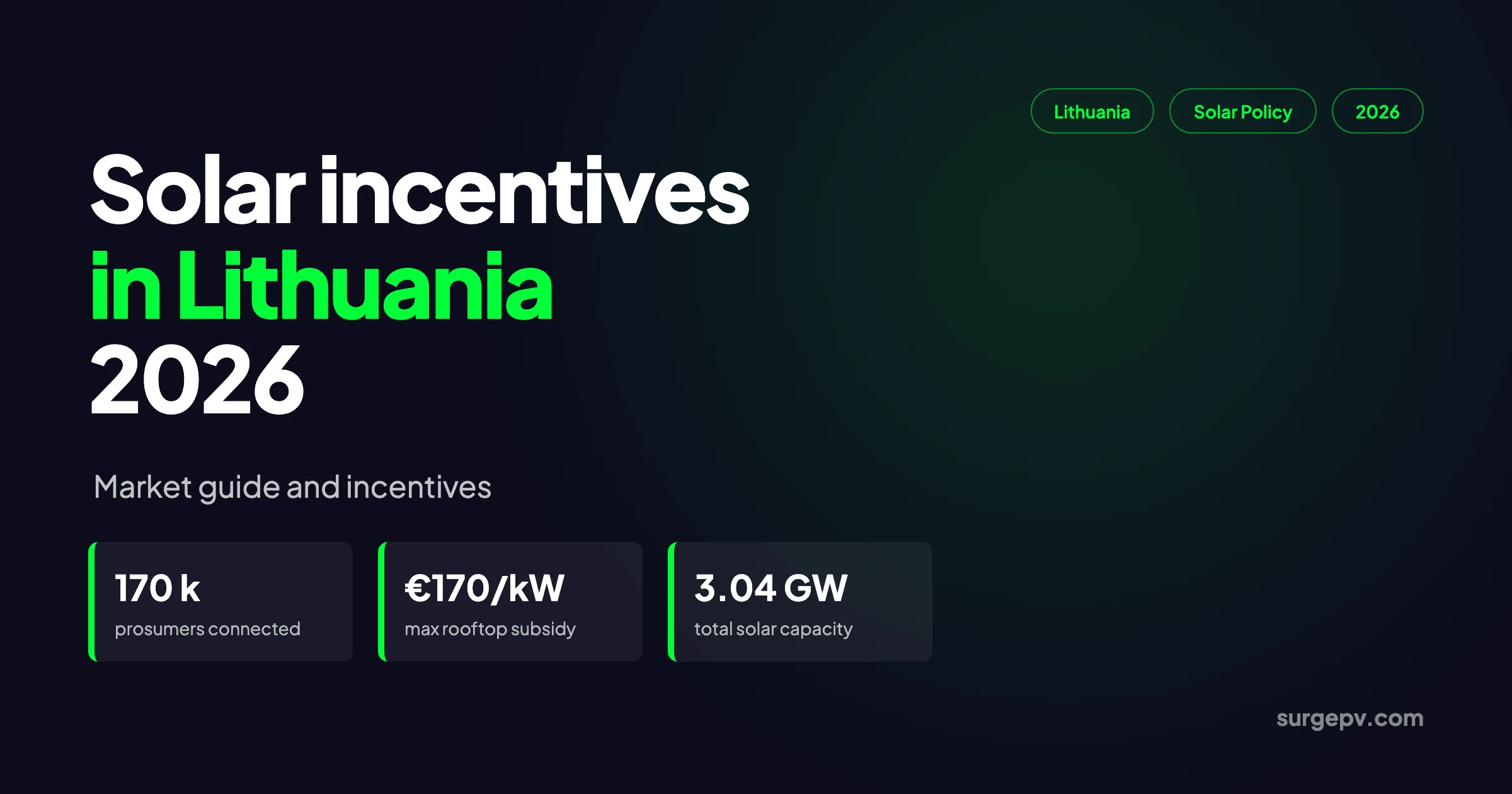
Lithuania is one of Europe’s most surprising solar success stories. In 2022 the country had only 26 MW of installed solar PV. By the end of 2025 cumulative capacity reached 3,040 MW, and around 170,000 prosumers were connected to the grid, according to IEA-PVPS Country Updates 2025. Solar generation covered 14.2% of national electricity consumption in 2025.
That growth was not accidental. A clear policy mix made it possible: generous but declining household subsidies, investment grants for businesses and energy communities, simple net metering, and a regulatory culture that treats small prosumers as participants rather than obstacles. In 2026 the support framework is changing again. Subsidy rates are lower, caps are tighter, and the market is shifting from rooftop-only toward storage, remote solar parks, and larger commercial projects.
This guide explains what is actually available in 2026, who qualifies, how the money flows, and how installers and homeowners should size systems under the new rules. If you are modeling Lithuanian solar projects, a cloud solar design platform with local irradiance, tariff, and subsidy data will save hours on every proposal.
Quick Answer
Solar incentives in Lithuania in 2026 include APVA rooftop subsidies up to €170/kW for households, LEA investment grants covering 35–45% of project costs for businesses and energy communities up to 500 kW, net metering for households, and a grid contribution fee capped at €0.01/kWh for exported electricity.
In this guide:
- Lithuania solar market snapshot: capacity, generation, and 2030 targets
- 2026 incentive overview: APVA, LEA, net metering, and tax treatment
- APVA household rooftop and remote solar park subsidies
- LEA business and energy community investment support
- Net metering, net billing, and the new prosumer contribution model
- System costs, payback, and sizing examples
- Commercial and utility-scale solar pathways
- Common mistakes and how to avoid them
- Step-by-step application checklist
Lithuania Solar Market 2026: The Numbers Behind the Boom
Lithuania’s solar expansion is unusual because the residential prosumer segment led it. In most markets utility-scale solar arrives first. In Lithuania, households installed first, commercial parks followed, and now grid capacity is the binding constraint.
The IEA-PVPS Country Updates 2025 report shows the country added approximately 600 MW in 2025, taking total capacity to 3,040 MW. Prosumers produced roughly 70% of Lithuania’s solar electricity that year. The national target under the updated National Energy Independence Strategy is 100% renewable electricity by 2030, with a solar capacity target of 4,100 MW by the same year.
| Metric | Value | Source |
|---|---|---|
| Cumulative solar capacity end-2025 | 3,040 MW | IEA-PVPS (2026) |
| Annual solar generation 2025 | 1.79 TWh | IEA-PVPS (2026) |
| Share of national consumption | 14.2% | IEA-PVPS (2026) |
| Prosumer connections | ~170,000 | Industry estimates 2026 |
| Solar per capita | 1,053 W | IEA-PVPS (2026) |
| 2030 solar target | 4,100 MW | Lithuanian Ministry of Energy |
The Baltic states synchronized their grids with Continental Europe in February 2025. That ended dependence on the Russian-controlled BRELL ring and made Lithuania a full participant in the EU electricity market. For solar owners it means access to the Nord Pool price area, dynamic tariffs, and a more liquid market for exported power.
The challenge is no longer policy ambition. It is physical integration. ESO, the distribution system operator, increasingly restricts new connections in areas where transformer capacity is exhausted. Installers who used to sell purely on subsidy size now need to model self-consumption, grid limits, and battery economics accurately. That is where precise PV shade analysis and production forecasting become competitive advantages.
Lithuania’s 2030 Targets and the Role of Solar
Lithuania’s energy policy is built on energy independence. The 2019 National Energy Independence Strategy set three goals: eliminate dependence on Russian electricity imports by 2023, generate 45% of electricity from renewables by 2030, and produce 80% of all final energy from renewables by 2050. The 2024 update moved the 100% renewable electricity target forward to 2030.
Solar is expected to deliver a large share of that target. The Ministry of Energy’s solar capacity target is 4,100 MW by 2030. Wind will also play a major role. In 2025 wind farms produced 4.29 TWh from 2.47 GW of capacity, covering 34% of domestic demand. Together, solar and wind covered 68.1% of Lithuania’s domestic electricity demand in 2025, according to IEA-PVPS Country Updates 2025.
Reaching 100% renewable electricity in five years requires roughly 1 GW of additional solar and wind each year. That pace is technically feasible but constrained by permitting, grid capacity, and skilled labor. For solar installers, the implication is clear: the market remains open, but winning projects will be those that can demonstrate reliable grid integration and accurate production forecasts.
The synchronization with Continental Europe also changed market dynamics. Lithuania now trades electricity through the Nord Pool exchange. Day-ahead prices fluctuate hourly, which creates opportunities for flexible consumers and storage owners. It also means that solar export revenue is no longer fixed; it follows market prices. This reinforces the case for self-consumption and batteries.
Lithuania Solar Incentives at a Glance
Lithuania runs two parallel solar support systems in 2026. APVA administers household and small-scale subsidies through the national Climate Change Program. LEA administers business and energy-community grants through the EU Recovery and Resilience Facility.
The policy direction is clear: reduce the per-kilowatt subsidy but keep support available to more households. This follows the global pattern as solar costs fall and markets mature. Germany, the Netherlands, and Belgium have all reduced or restructured household solar support in recent years.
| Incentive | Administrator | Recipient | Support Level | Cap |
|---|---|---|---|---|
| Rooftop PV subsidy | APVA | Households | ~€170/kW | 7 kW per object |
| Remote solar park share | APVA | Households | ~€200/kW | 7 kW per object |
| Solar + battery grant | APVA | Households | €3,500 flat | Integrated system |
| Battery-only subsidy | APVA | Households | ~€170/kWh | 15 kWh per object |
| Business/ community investment grant | LEA | Companies, farmers, energy communities | 35–45% of fixed cost | 500 kW per project |
| Net metering | ESO / suppliers | Households, non-profits | 1:1 kWh offset | Generally no hard household cap |
| Net billing | ESO / suppliers | C&I prosumers | Market-linked export price | Size rules vary by connection |
The headline change for 2026 is lower per-kW support but wider access. APVA reduced the rooftop rate from roughly €255/kW to €170/kW and the remote-park rate from €323/kW to €200/kW. The maximum supported capacity per household dropped from 10 kW to 7 kW. The idea is to spread the same budget across more households rather than maximize each individual subsidy.
For installers this changes the sales conversation. A 10 kW system still makes sense for a large household, but only the first 7 kW receives the grant. The incremental 3 kW must pay back from bill savings alone. Accurate generation and financial modeling becomes the difference between a sold project and a confused prospect.
APVA Subsidy History
| Year | Rooftop Subsidy | Remote Park Subsidy | Max Supported Capacity |
|---|---|---|---|
| 2022 | ~€323/kW | ~€323/kW | 10 kW |
| 2024 | ~€255/kW | ~€323/kW | 10 kW |
| 2026 | ~€170/kW | ~€200/kW | 7 kW |
The decline in per-kW support is offset by lower module and inverter prices. A household installing 7 kW in 2026 often pays a similar net price to a household installing 5 kW in 2022. The policy succeeds when it broadens access rather than maximizing each individual payment.
APVA Household Subsidies: Rooftops, Remote Parks, and Batteries
APVA, the Environmental Project Management Agency, manages Lithuania’s household renewable-energy subsidies. The 2026 program continues support but at reduced rates, with a stronger emphasis on storage and remote participation. For a broader view of residential solar design, see our residential solar overview.
Rooftop Solar Subsidy
The 2026 APVA plan pays approximately €170 per kW of newly installed rooftop solar capacity. The maximum supported capacity is 7 kW per electricity consumption object. A household installing a 7 kW system can receive up to €1,190 in direct support. The system must be new, use certified equipment, and be connected to the ESO grid before the payment request is submitted.
This is a reimbursement model. The homeowner pays the installer first, commissions the system, and then submits invoices and compliance documents to APVA through the APVIS system. Processing times vary, but many households receive payment within a few months of a complete application.
Eligibility is limited to private individuals who own the property or have the owner’s consent. The building must have a registered electricity consumption point, and the applicant must not have received APVA support for the same object in the same call. Equipment must meet EU standards and carry the required warranties: at least 10 years for modules and 5 years for inverters. These rules are designed to prevent low-quality hardware from entering the market and to protect consumers.
The shift from €255/kW to €170/kW reflects falling module costs and a policy choice to support more households rather than larger individual systems. A household that would have installed 10 kW under the old rules may now prefer 7 kW plus a battery, because the battery subsidy can add another €1,500–€2,550 of support. This changes the optimal system design.
Remote Solar Park Participation
Lithuania was the first European country to create a digital platform allowing households to buy or lease shares of remote solar parks. Apartment owners, renters, and households with unsuitable roofs can participate. The 2026 APVA plan supports remote solar shares at roughly €200/kW, capped at 7 kW per object, according to Energingai’s APVA 2026 summary.
The model works as virtual net billing. The household owns a slice of a solar park elsewhere. The generation is credited against the household’s own electricity bill through the grid. It decouples solar ownership from roof ownership, which is why it has been widely copied across the Baltics.
Battery Storage Subsidy
The 2026 plan introduces a dedicated battery call, expected in the second half of the year. The proposed rate is approximately €170/kWh of installed usable battery capacity, up to 15 kWh per household. There is also a €3,500 flat grant for combined solar-plus-battery systems, as reported by ViaSolis.
Batteries matter because Lithuania is gradually moving from net metering toward net billing. A battery lets a household store midday solar output for evening use, avoiding the lower export price. For solar installers, this means every proposal should include a battery option and a clear self-consumption calculation.
Pro Tip — Apply Early
APVA calls are budget-limited and close once funds are allocated. Do not wait until the published deadline. Prepare grid connection conditions, equipment certificates, and a signed installer contract before the call opens. The most common delay is missing ESO technical conditions at submission.
LEA Business and Energy Community Grants
For companies, farms, and energy communities, the relevant program is the LEA “Investment Support for Ground-Mounted Solar” scheme. It is financed through Lithuania’s EU Recovery and Resilience Plan, “Naujos kartos Lietuva.”
Support Levels
The LEA program calculates support using a fixed unit cost of €1,073.42 per kW excluding VAT. Eligible recipients receive a percentage of that fixed amount, not a percentage of the actual invoice.
| Recipient Type | Support Rate | Typical €/kW |
|---|---|---|
| Private companies and farmers | 35% | ~€376/kW |
| Renewable energy communities (RESC) | 45% | ~€483/kW |
| Citizen energy communities (PEB) | 45% | ~€483/kW |
| Non-profit entities preparing community status | 45% | ~€483/kW |
The maximum project size is 500 kW. The program funds both producer and prosumer projects. Applicants must submit ESO grid connection conditions with the application. For systems up to 100 kW with zero export permission, a commitment to build can replace the formal conditions.
Applications are evaluated on a first-come, first-served basis until the call budget is exhausted. Required documents typically include the application form, ESO technical conditions or a build commitment, a project budget, proof of legal status, and confirmation that the applicant is registered for at least one year before submission. Farmers must be registered in the Farmers’ Register. Energy communities must provide statutes showing their community-benefit purpose.
The fixed unit cost of €1,073.42/kW excludes VAT. The grant is calculated from that fixed amount, not from the actual invoice. If your installer quotes €900/kW, the support is still based on €1,073.42/kW. If your quote is €1,300/kW, the support is capped at the fixed amount. This creates an effective support floor and ceiling that applicants must factor into their financial model.
Budget and Timeline
The overall project budget is €76.2 million. The target is to create 170.38 MW of new renewable capacity, according to LEA’s program page. The program runs until May 2026 for projects from the 2024 call, so applicants in 2026 must check the latest call documents for implementation deadlines and payment request dates.
For businesses the value proposition is strong. A 200 kW rooftop system receiving 35% support cuts the effective capital cost by roughly €75,000. With commercial electricity near €0.17/kWh and annual generation around 950 kWh/kW, simple payback can fall below six years. Energy communities receive even stronger support, which is why Lithuanian municipalities and housing associations are forming them rapidly.
Net Metering, Net Billing, and Grid Contribution
Lithuania’s metering rules are in transition. Households still benefit from net metering, but commercial prosumers are moving to net billing. Understanding the difference is essential for correct financial modeling.
Net Metering for Households
Under net metering, exported solar electricity is credited against imported grid electricity over an accounting period. For many households this means annual netting: the surplus kilowatt-hours generated in summer reduce the winter bill. The practical effect is that every self-consumed kilowatt-hour is worth the full retail electricity price, currently around €0.23/kWh for households.
Net metering historically had no hard capacity cap for households, which encouraged rapid growth. The IEA-PVPS 2025 update notes that net metering is still applied to households and non-profit entities, while commercial companies have transitioned to net billing.
Net Billing for Commercial Prosumers
Net billing treats import and export as separate financial transactions. The prosumer pays the retail rate for electricity drawn from the grid and receives a market-linked price for exported solar. The export price is well below retail. This makes export-heavy systems much less attractive than under net metering.
The shift reflects a broader European trend. The Netherlands will end net metering at the end of 2026, Belgium’s Flanders region already moved to wholesale export credits, and several German states are rebalancing prosumer tariffs. Lithuania’s approach has been to preserve household net metering while moving larger consumers to market-based settlement.
Fair Contribution Reform
The Lithuanian Ministry of Energy proposed a reform to make prosumer grid use fairer. The plan, summarized by Voice of Renewables, would cap the additional charge for electricity supplied to the network at €0.01/kWh excluding VAT. Remaining network costs would be spread across all consumers. The reform was planned to take effect on April 1, 2026.
This matters for payback. A €0.01/kWh grid contribution is small compared with the retail rate. It preserves the household business case while addressing the legitimate argument that prosumers use the grid as a backup battery and should help pay for it.
Key Takeaway — Size to Consumption
Under net metering, oversizing can still work because annual credits roll over. Under net billing, every exported kilowatt-hour is worth far less than one consumed on site. For commercial projects, size the system to match daytime load. For households, model annual consumption carefully before adding extra capacity beyond the subsidized 7 kW.
Taxes, VAT, and Grid Fees
Lithuania does not offer a dedicated solar VAT exemption for households. Standard VAT, currently 21%, generally applies to solar installations unless the supply structure qualifies for a reduced or exempt rate. Businesses can recover VAT as input tax, so the net cost is neutral for VAT-registered entities. Residential consumers should confirm with the installer whether the quote includes VAT and whether any reduced-rate structure applies.
Grid fees are regulated by the State Energy Regulatory Council (VERT). They cover distribution, transmission, public interest services (VIAP), and system balancing. For prosumers, the bill has two parts: charges for electricity imported from the grid, and credits or payments for electricity exported. Network charges are not eliminated by solar generation; they apply to the grid electricity still consumed.
VIAP is the public interest service component. It funds strategic energy objectives including renewable support and security of supply. In 2024 the regulator set a zero VIAP price for households, but this can change with policy. Smart-meter customers can also choose dynamic tariffs linked to the Nord Pool day-ahead price. These tariffs can be cheaper for households that shift consumption to low-price hours, but they add complexity.
Electricity prices for Lithuanian households averaged roughly €0.239/kWh in late 2025, according to GlobalPetrolPrices. Medium-sized business consumers paid around €0.17/kWh in late 2024, according to Trading Economics citing Eurostat. These prices are below the EU average but still high enough to make self-consumed solar valuable.
For solar buyers, the key tax question is whether VAT is included in installer quotes. A €1,000/kW quote excluding VAT becomes €1,210/kW including VAT. Businesses recover this as input tax. Households generally cannot. Always ask whether the price includes VAT, connection fees, and any required electrical upgrades.
Solar System Costs and Payback in Lithuania
System costs in Lithuania have fallen as global module prices declined. The IEA-PVPS report notes that average installed system prices, with incentives, stabilized around $0.90/W. Lithuanian installer quotes for residential rooftop systems typically range from €900 to €1,200 per kW all-in, depending on roof complexity, inverter choice, and whether a battery is included.
Typical Residential Costs 2026
| System Size | Installed Cost | APVA Subsidy (7 kW cap) | Net Cost |
|---|---|---|---|
| 5 kW | €4,500–€6,000 | €850 | €3,650–€5,150 |
| 7 kW | €6,300–€8,400 | €1,190 | €5,110–€7,210 |
| 10 kW | €9,000–€12,000 | €1,190 | €7,810–€10,810 |
A 10 kW system only receives subsidy on the first 7 kW. The unsubsidized 3 kW must be justified by higher self-consumption or future needs such as an electric vehicle.
Payback Example: 7 kW Household System
Assume a 7 kW system in central Lithuania producing 950 kWh per kW per year. Annual generation is 6,650 kWh. The household consumes 60% of that generation directly and exports 40%.
- Self-consumed: 3,990 kWh × €0.23/kWh = €918/year
- Exported under net metering: 2,660 kWh × €0.23/kWh = €612/year
- Total first-year value: €1,530
- Net cost after subsidy: €6,000 average
- Simple payback: €6,000 ÷ €1,530 = 3.9 years
If the household moves to net billing before the system pays back, the export credit drops. At an export price of €0.08/kWh, the exported portion is worth only €213/year. Total value falls to €1,131/year, and payback stretches to 5.3 years. That is why battery storage and load shifting are becoming central to Lithuanian solar design.
For businesses the math is similar but the support is larger. A 200 kW commercial rooftop system at €950/kW costs €190,000 before support. With 35% LEA support the net cost is roughly €123,500. At €0.17/kWh, 85% self-consumption, and 190,000 kWh/year generation, annual savings are around €27,500. Simple payback is approximately 4.5 years.
Model Lithuanian Solar Payback Accurately
SurgePV’s solar proposal software includes Lithuanian irradiance, retail tariffs, APVA subsidies, and net-metering logic. Build a branded proposal with real payback and self-consumption numbers in minutes.
Book a DemoNo commitment · 20 minutes · Walkthrough with your real Lithuanian project
Commercial and Utility-Scale Solar Pathways
Projects above 500 kW fall outside the LEA subsidy cap. They typically pursue one of three routes: technology-neutral renewable energy auctions, corporate power purchase agreements (PPAs), or merchant market sales. Our commercial solar page covers the design and financial principles that apply to larger rooftops and ground-mounted systems.
Lithuania has held competitive auctions for renewable energy, including solar, under the national support scheme. Winners receive a feed-in premium or contract-for-difference that tops up market revenue to a reference price. Large operational projects include the 100 MW Molėtai solar park and the 252 MW Jonava Solar Park, as noted in a Lithuanian Ministry of Energy presentation.
Corporate PPAs are growing. Large consumers can contract directly with solar park developers for physical or virtual supply. This avoids subsidy dependence but requires creditworthy offtakers and long-term contracts. The EU Clean Energy Package and Baltic grid synchronization make cross-border PPAs more feasible than before. Data centers, manufacturers, and cold-storage operators are the most active offtakers because they have large, stable daytime loads.
Utility-scale developers face the same grid constraint as prosumers. Technical permits for an additional 4 GW of solar have been issued, but connection capacity is limited, according to pv magazine. This is pushing developers toward hybrid solar-plus-storage projects, grid reinforcement participation, and strategic siting in less congested regions.
The largest project pipeline belongs to developers such as Green Genius and Ignitis Renewables. Their projects often pair solar with battery storage to improve grid connection prospects and capture higher evening prices. Storage also reduces curtailment risk when local grids cannot absorb midday solar output.
For EPCs and project developers, this environment rewards precise early-stage design. Tools that combine solar design software, shadow analysis, and financial modeling help identify the sites and system configurations that actually pencil out under grid limits.
Small Solar and Plug-In Systems
Lithuania legalized plug-in solar systems in 2023. These are small balcony or facade units, typically under 0.8 kW, that connect to a standard socket. They require no formal grid connection permit. The owner simply informs ESO after installation.
As of mid-2025, Lithuania had registered 661 such systems, with Vilnius and Kaunas counties leading, according to industry estimates. Basic kits start around €359. With APVA support the effective cost can fall to about €155. Payback for these systems is typically 2–4 years without subsidy, or 1–2 years with support.
Plug-in solar is best for small consumers using under 70 kWh per month. At 0.8 kW and 950 kWh/kW/year, annual output is roughly 760 kWh. That covers a meaningful share of base load for apartments, dachas, and small offices. It also introduces solar to people who would never install a rooftop system, which expands the political and market base for the technology.
Common Mistakes and Tradeoffs
Lithuanian solar economics look simple on the surface, but several recurring mistakes reduce returns.
Oversizing beyond consumption. A 10 kW system on a household that uses 3,000 kWh per year will export most of its output. Under net metering this still works, but under net billing the economics collapse. Size to annual consumption, not to the maximum subsidized capacity.
Ignoring grid connection delays. In popular solar counties, ESO connection queues are growing. Some projects wait months for transformer upgrades. Start the grid conditions process before ordering equipment.
Skipping storage modeling. Batteries add €400–€700 per kWh installed. They only pay back if the household has enough evening consumption to use the stored energy. Model daily load curves, not just annual totals.
Assuming subsidy rates are fixed. APVA adjusts rates each call. The 2026 plan is preliminary. Read the official call documents rather than relying on earlier-year figures.
Mixing net metering and net billing assumptions. Households and businesses face different settlement rules. Apply the right model to each customer segment.
The most important tradeoff is subsidy versus grid independence. A smaller system with a battery and high self-consumption often delivers better lifetime value than a larger system that depends on export credits. This is the same shift seen in Belgium’s Flanders region after net metering ended, as we covered in our Belgium solar guide.
What the 2026 Changes Mean for Installers
The Lithuanian solar market is maturing, and installer business models must mature with it. In 2022 a salesperson could close deals by mentioning the subsidy. In 2026 the subsidy is smaller, the customer is better informed, and the design must be precise.
First, lead with self-consumption, not the grant. A household that uses 60% of its solar output on site saves far more than one that exports half. Show daily load curves, battery cycling, and the difference between net metering and net billing. Use solar proposal software that visualizes this in the customer’s language.
Second, grid connection is now a project risk. ESO queues are longer in high-penetration areas. Offer a connection-condition check as a paid first step. If the local transformer is saturated, recommend a smaller system, battery storage, or a remote solar park share.
Third, diversify into storage and energy communities. The 2026 APVA plan increases support for batteries and combined systems. Energy communities receive 45% LEA support. Installers who can design, register, and commission community projects will have a growing pipeline.
Fourth, documentation is the new battlefield. APVA and LEA reject incomplete applications. Build a checklist into your CRM or project management tool. Collect ESO conditions, equipment certificates, warranties, and invoices at commissioning, not weeks later.
Fifth, train sales teams on policy uncertainty. Subsidy rates, caps, and call dates change every year. A proposal that quotes last year’s €255/kW rate will lose credibility. Link to official APVA and LEA pages, and include a review date on every quote.
How to Apply: Checklist for Homeowners
If you are ready to install solar in Lithuania, follow this sequence to avoid delays.
- Check your annual electricity consumption. A 7 kW system suits a household using 5,000–8,000 kWh per year.
- Request ESO technical conditions. Apply through the ESO customer portal. This is mandatory for the APVA application.
- Choose certified equipment. Modules need at least a 10-year product warranty and a 25-year performance warranty. Inverters need a 5-year warranty.
- Get at least three installer quotes. Compare all-in prices, warranty terms, and whether the installer handles APVA paperwork.
- Install and commission. The system must be operational before you submit the payment request.
- Submit APVA payment request. Use the APVIS system, attach invoices, ESO connection documents, and equipment certificates.
- Monitor and optimize. Track self-consumption, export, and battery cycling. Adjust appliance use to maximize daytime consumption.
For businesses the LEA process is similar but requires a project budget, grid conditions, and proof of legal status. Energy communities need statutes that show non-profit or community-benefit purpose. Both applications run through the LEA Submittable portal.
Frequently Asked Questions
What solar incentives are available in Lithuania in 2026?
Lithuania offers APVA rooftop subsidies up to €170/kW for households, APVA remote solar park support up to €200/kW, battery subsidies up to €170/kWh, and LEA investment grants covering 35–45% of fixed costs for businesses and energy communities up to 500 kW. Net metering still applies to household prosumers, while larger commercial systems typically use net billing.
How much is the Lithuanian solar subsidy for homes?
The 2026 APVA plan pays approximately €170 per kW of installed rooftop solar capacity, capped at 7 kW per household. Remote solar park participation is supported at roughly €200/kW, also capped at 7 kW. Combined solar-plus-battery systems can receive a flat €3,500 grant, and standalone batteries are subsidized at about €170/kWh up to 15 kWh.
Is net metering still available in Lithuania?
Yes. Net metering remains available for Lithuanian households and non-profit entities, allowing exported solar generation to offset imported grid electricity over a defined accounting period. Commercial and industrial prosumers have generally moved to net billing, where exports are paid at a market-linked price rather than offset against retail consumption.
Can Lithuanian businesses get solar subsidies?
Yes. The Lithuanian Energy Agency runs an investment support program for ground-mounted and rooftop solar up to 500 kW. Private companies and farmers receive 35% of the fixed unit cost, while energy communities and non-profit entities can receive 45%. The program is financed from the EU Recovery and Resilience Facility.
What is the solar payback period in Lithuania?
A well-sized residential system in Lithuania typically pays back in 5–8 years. A 7 kW system producing about 6,650 kWh per year can save €900–€1,200 annually through self-consumption and net metering credits. Lower module prices, the €170/kW APVA subsidy, and retail electricity near €0.23/kWh keep payback short.
How do I apply for the Lithuanian solar subsidy?
Householders apply through the APVIS information system when an APVA call is open. You must own the property, obtain ESO grid connection conditions, install certified equipment, commission the system, and submit a payment request with invoices and compliance documents. Businesses apply through the LEA Submittable portal with grid conditions and a project budget.
Can apartment owners get solar in Lithuania?
Yes. Lithuania pioneered remote solar parks, allowing households to buy or lease a share of an off-site solar farm and receive virtual net billing credits against their own electricity bill. This model opened solar ownership to apartment dwellers and renters who do not have a suitable roof.
Are battery storage systems subsidized in Lithuania?
Yes. The 2026 APVA plan includes a dedicated call for battery storage, paying about €170/kWh of installed usable capacity up to 15 kWh per household. There is also a combined solar-plus-battery grant of €3,500 for integrated systems. Batteries help maximize self-consumption and reduce grid export losses.
What are the main solar market trends in Lithuania in 2026?
Lithuania reached 3,040 MW of total solar capacity by the end of 2025, up from 26 MW in 2022. Prosumers account for roughly 170,000 connections and about 70% of solar generation. Growth is now constrained by grid capacity rather than policy support, making accurate system sizing and storage integration more important.
Do solar owners pay grid fees in Lithuania?
Yes. Prosumers pay standard network charges for electricity drawn from the grid. A proposed fair-contribution reform caps the additional charge for electricity supplied to the network at €0.01/kWh excluding VAT, with remaining system costs spread across all consumers. This is designed to keep prosumer economics attractive while covering grid costs.
Bottom Line
Lithuania’s solar incentive framework in 2026 is less generous than in 2022 or 2023, but the market has matured enough that lower subsidies still produce strong returns. The winning strategy is no longer to maximize the grant. It is to maximize self-consumed solar, avoid grid export losses, and size systems to real load.
If you are planning a project, take three actions now:
- Request ESO grid conditions before you finalize system size.
- Model payback under both net metering and net billing assumptions.
- Compare a battery option using real daily consumption data.
For installers and EPCs, the competitive edge in Lithuania is now design accuracy. Use a cloud solar design platform with local tariffs, subsidies, and shading analysis to deliver proposals that reflect the 2026 market. Book a SurgePV demo to see how the platform handles Lithuanian solar economics end to end.
Where this fits
This article is part of SurgePV's Solar Incentives & Policy hub, which works through the topic from first principles to the decisions a project team actually has to make.

