

Quick Answer
Solar energy in Belgium costs €1,300–€1,700/kWp installed. Flanders offers premiums up to €750/kWp for residential systems. Wallonia provides tax deductions and green certificates. Brussels has additional regional grants. Net metering (saldering) remains available but is being phased toward prosumer tariffs.
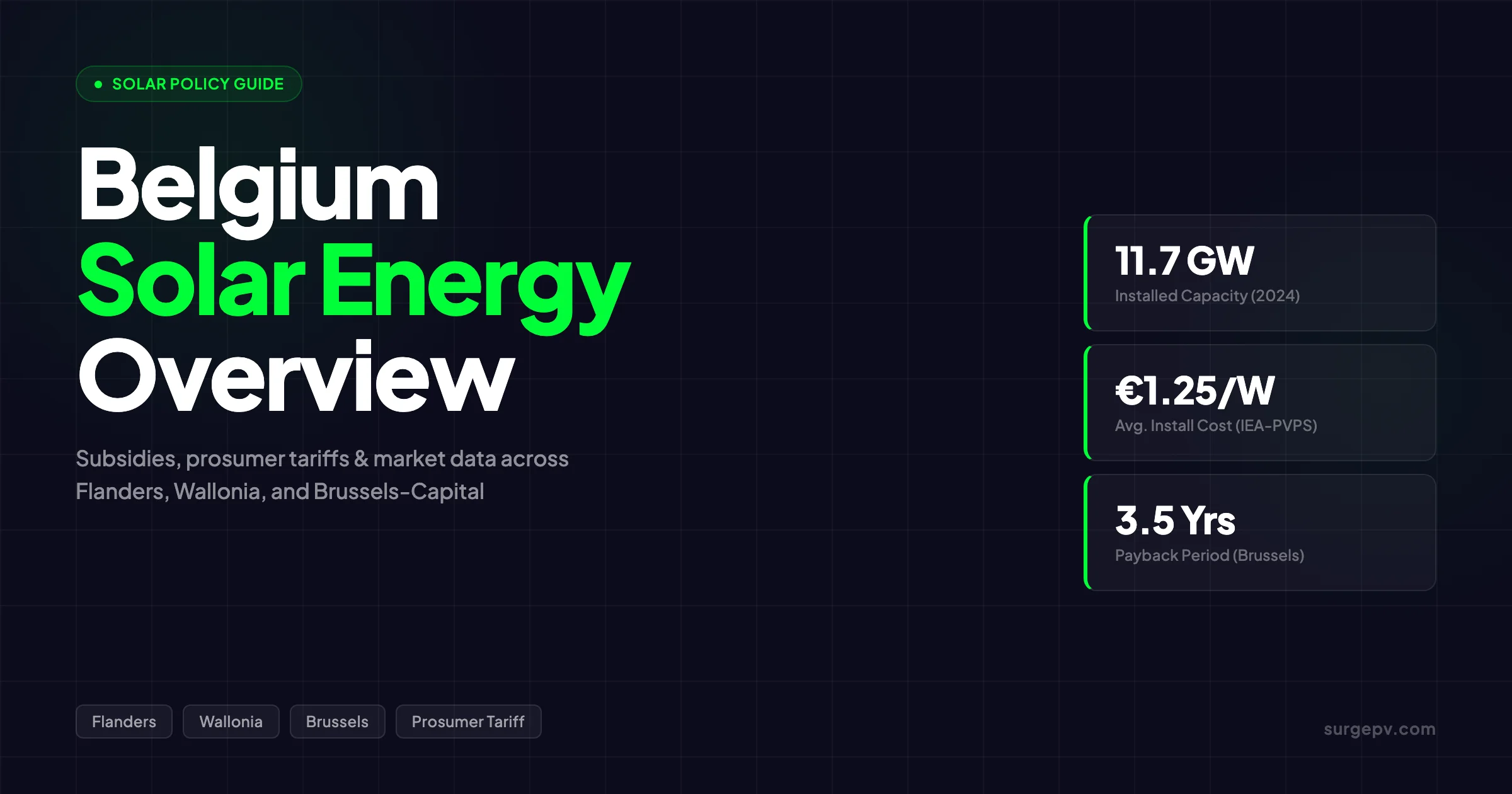
Belgium reached 11.7 GW of installed solar capacity by end 2024 — making it one of the highest solar-per-capita markets in the world at 994 W per person, ranking 8th globally. In 2025, Belgian solar panels generated 10.1 TWh of electricity, a 20-year record, with solar accounting for roughly 10-12% of the country’s total electricity consumption. For installers and project developers, Belgium represents a mature, active market with continuing commercial and institutional demand. For homeowners, the decision depends almost entirely on which of Belgium’s three regions you live in — because the subsidies, tariff structures, and economics are starkly different across Flanders, Wallonia, and Brussels-Capital.
Solar energy in Belgium costs €1,300–€1,700/kWp installed. Flanders offers premiums up to €750/kWp for residential systems. Wallonia provides tax deductions and green certificates.
Solar energy in Belgium costs €1,300–€1,700/kWp installed. Flanders offers premiums up to €750/kWp for residential systems. Wallonia provides tax deductions and green certificates. Brussels has additional regional grants. Net metering (saldering) remains available but is being phased toward prosumer tariffs.
TL;DR — Solar Energy in Belgium
Belgium has 11.7 GW installed and generated 10.1 TWh from solar in 2025. Subsidies are regional: Brussels is the most generous (net metering + green certificates + €2,500-€3,500 grant, 3.5-4.5 year payback), Wallonia has green certificates until 2028 (6-9 year payback), and Flanders ended all residential subsidies in December 2023 (6-9 year payback). Average installation cost is €1.25/W. A Flemish solar mandate requires large commercial consumers to install by April 1, 2026.
Belgium Solar Market at a Glance
Belgium’s solar capacity has grown from 71 MW in 2008 to 11.7 GW at end 2024 — a 160-fold increase in 16 years. Despite receiving only about 1,585 sunshine hours per year (lower than Germany’s southern states and far below Spain), Belgium outranks far sunnier countries on a per-capita basis because of its combination of high electricity prices, historically generous subsidies, and a compact, rooftop-dense built environment. Also see: Germany solar subsidies. Also see: Spain net metering.
| Metric | Figure |
|---|---|
| Cumulative installed capacity (end 2024) | 11.7 GW |
| New capacity added (2024) | ~1.4 GW |
| Record new additions (2023) | ~2.5 GW |
| Solar generation (2025) | 10.1 TWh (+21% vs 2024) |
| Per-capita solar capacity | 994 W/person |
| Global ranking (2023) | 8th |
| Annual average yield | 850-1,000 kWh/kWp/year |
| Solar share of electricity mix (2024) | ~10-12% |
| Negative electricity price hours (2025) | 520+ hours |
The 2025 figure of 10.1 TWh is a 20-year record, driven by a combination of above-average irradiance — spring yields were 29% above 2024 levels — and continued capacity additions. Elia, Belgium’s transmission system operator, recorded a monthly solar generation record of 1,370 GWh in June 2025.
One consequence of this rapid growth is grid saturation during peak production periods. Belgium recorded more than 520 hours of negative wholesale electricity prices in 2025. During those hours, injecting electricity to the grid earns nothing or costs money for producers without storage or smart tariff contracts. This is increasingly shaping the business case for battery storage in new Belgian installations. Read Adding Battery Storage Services for a complete walkthrough.
Flanders accounts for 64.35% of total installed capacity (approximately 7.46 GW), followed by Wallonia at 30.55% and Brussels at 5.10%. But the policy picture is nearly the reverse: Brussels has the strongest incentive stack, while Flanders — with the most capacity — has the least.
Pro Tip
Belgium’s grid connects to France, Germany, the Netherlands, and Luxembourg. Solar exports flow automatically during high-generation periods. As Belgium approaches 15 GW by 2030, peak-hour self-consumption and battery storage will become progressively more valuable than grid injection — especially during the 500+ annual hours when wholesale prices are negative.
See our guide on Agricultural Solar Case Study for more. For the latest details on Germany, see Community Solar Projects Germany.
Understanding Belgium’s Energy Governance: Three Regions, Three Regulators
Belgium is a federal state where energy policy is split between the federal government and three regional governments. Understanding this governance structure is the first step to navigating Belgian solar correctly. A homeowner in Ghent (Flanders) and a homeowner in Liège (Wallonia) operate under fundamentally different rules even though they are 90 km apart.
| Level | Scope | Regulator |
|---|---|---|
| Federal | Transmission grid, nuclear policy, EU negotiations | CREG |
| Flanders | Distribution, subsidies, prosumer tariff, mandate | VREG |
| Wallonia | Distribution, subsidies, green certificates | CWaPE |
| Brussels-Capital | Distribution, subsidies, net metering | Brugel |
The federal regulator CREG sets rules for the high-voltage transmission grid and cross-border interconnections. It does not control the subsidies, net metering rules, or distribution tariff structures that affect most solar installations — those are entirely regional decisions.
Each region also operates its own distribution system operator (DSO): Fluvius handles grid connections in Flanders, Ores and Resa cover Wallonia, and Sibelga serves Brussels. All new solar installations must register with the relevant DSO and obtain a prosumer agreement or grid injection contract before commissioning.
The practical consequence: there is no single Belgian solar subsidy. Quoting payback periods or incentive amounts without specifying the region is meaningless. Start with the region, then apply the applicable policy framework.
Solar Subsidies and Incentives by Region
Flanders: A Subsidy-Free Market Since December 2023
Flanders was, for many years, the most generous solar region in Belgium. Green certificates, investment premiums, and net metering drove rapid adoption and placed Flanders among Europe’s leading solar regions per capita. That era is over. Also see: European Solar Tax Credits.
The prosumer premium — which paid installers up to €750 per installed kWp, then cut to €375/kWp — was abolished entirely on December 31, 2023. No replacement residential investment subsidy has been announced. Green certificates for Flanders were phased out years earlier.
What Flanders currently offers solar owners:
| Mechanism | Status | Detail |
|---|---|---|
| Prosumer premium | Abolished Dec 31, 2023 | No replacement subsidy |
| Green certificates | Phased out | No longer issued |
| Net metering | Abolished 2025 (all digital meter holders) | Replaced with wholesale injection credit |
| Capacity tariff | Active since 2023 | Bills based on monthly peak demand, not kWh consumed |
| Prosumer tariff | Active | ~€57.91/kWp of inverter capacity per year |
| VAT (homes >10 yrs) | 6% | Permanent reduction on materials and labour |
The Prosumer Tariff
Flanders introduced the prosumer tariff to ensure solar owners contribute to grid maintenance costs even when they reduce their net consumption. It is charged per kWp of inverter capacity — not per kWh. For a household with a 5 kWp inverter, the annual charge is roughly €289. This is billed in addition to standard distribution and transmission levies.
The Capacity Tariff
Since 2023, Flanders bills household electricity on a capacity-based tariff rather than a purely volumetric one. Each household’s distribution charge is determined by its highest monthly peak consumption (in kW) over the rolling 12 months, not the total kWh consumed. Solar owners can lower this peak by shifting loads to midday and deploying battery storage — but the system rewards active energy management rather than passive generation.
Market Impact
The combined effect of abolishing the investment premium and ending net metering was immediate: Flanders saw a 46% decline in new residential solar installations in 2024 compared to 2023. By August 2025, PV Magazine reported that 81% of Flemish solar prosumers had digital meters — virtually completing the transition away from the old analogue-meter net metering regime.
For businesses, the picture changed sharply with the introduction of the Flemish solar mandate — covered in detail below.
Wallonia: Green Certificates and the 2026 Reform
Wallonia’s incentive structure is more layered than Flanders but is also being reshaped.
Green Certificates (Certificats Verts)
Wallonia’s primary solar incentive is the green certificate system, overseen by CWaPE. Producers receive one green certificate per MWh of electricity generated. The certificates are sold on the open market, with a guaranteed minimum purchase price of €65 per certificate set by Elia.
A 5 kWp system in Wallonia generating approximately 4,500 kWh per year earns 4-5 certificates annually, worth €260-325 at the guaranteed floor price. The green certificate scheme for new installations closes in 2028 — installations commissioned after that date will not receive certificates.
Net Metering Status
Net metering in Wallonia ended in 2023 for new installations. Households certified with analogue meters before January 1, 2024 retain a transitional prosumer tariff arrangement until the end of 2030. After that, all Walloon solar households operate under direct injection tariffs.
2026 Time-of-Use Reform
CWaPE is launching a new 5-slot incentive tariff for Wallonia beginning January 2026. The tariff differentiates electricity prices by time of day:
| Slot | Hours | Rationale |
|---|---|---|
| Green | 1-7 AM, 11 AM-5 PM | Reward off-peak and midday consumption |
| Orange | 7-11 AM, 10 PM-1 AM | Moderate transitional rates |
| Red | 5-10 PM | Premium rates during evening demand peak |
This structure rewards solar owners who shift consumption to midday production windows and use battery storage to cover evening demand. It is a direct incentive for combined PV-plus-storage systems rather than PV-only.
Key Takeaway — Wallonia
Green certificates offer a guaranteed €65 per certificate through 2028. A 5 kWp system earns 4-5 certificates per year. After 2028, the 5-slot time-of-use tariff reform becomes the primary financial framework. Analogue-meter holders certified before January 2024 retain transitional benefits until 2030.
Brussels-Capital: Belgium’s Most Generous Solar Region
Brussels-Capital remains the strongest incentive environment for residential solar in Belgium. Three mechanisms combine to produce payback periods that are exceptional by European standards.
1. Net Metering (Still Active)
Brussels is the only Belgian region with active 1:1 net metering. Solar electricity injected to the grid is credited at the full retail rate (approximately €0.28-0.35/kWh), then deducted from consumption during low-generation periods. This is the single most valuable financial mechanism available to Belgian solar owners today.
Brugel’s transition roadmap indicates that net metering in Brussels is expected to end in 2027-2028. Installations connected before the end date retain their metering rights for a fixed subsequent period.
2. Green Certificates (3 per MWh for Systems ≤5 kWp)
Brussels offers more certificates per MWh than Wallonia. Systems up to 5 kWp receive 3 green certificates per MWh generated, each worth approximately €65. The certificate scheme is valid for 10 years from installation date.
For a 4 kWp system generating 3,600 kWh per year: approximately 10-11 certificates annually, worth €650-715 per year at the guaranteed minimum price.
3. Prime Energie Grant
Brugel’s Prime Energie programme provides an upfront installation grant of €2,500-€3,500. Combined with net metering and green certificates, this is what drives the 3.5-4.5 year payback period that makes Brussels arguably the best residential solar market in Western Europe right now.
| Incentive | Brussels Details |
|---|---|
| Net metering | 1:1 retail credit, active until ~2027-2028 |
| Green certificates | 3/MWh for systems ≤5 kWp, ~€65 each, 10 years |
| Prime Energie grant | €2,500-€3,500 per installation |
| Payback period | 3.5-4.5 years (typical 4 kWp system) |
Net Metering and the Prosumer Tariff: The Policy Shift That Reshaped Belgian Solar
Net metering transformed Belgian solar economics between 2015 and 2023. Under net metering, a solar owner’s electricity meter runs backwards when surplus power flows to the grid — crediting that electricity at the full retail rate. It was the simplest, most legible incentive available and drove mass adoption.
Belgium’s progressive abandonment of net metering is the most consequential policy change in the market in the past decade:
| Region | Net Metering Status | Current Mechanism for Grid Injection |
|---|---|---|
| Flanders | Abolished 2025 (all digital meter holders) | Wholesale injection credit (~€0.04-0.06/kWh) |
| Wallonia | Ended 2023 (new installations) | Prosumer tariff until 2030 for pre-2024 analogue-meter holders |
| Brussels | Active (expected to end 2027-2028) | Still 1:1 retail credit |
The Financial Impact in Flanders
Under net metering, injecting 1 kWh to the grid was worth roughly €0.30 (the retail electricity price). Under the wholesale injection credit now paid to Flemish prosumers, that same kWh is worth €0.04-0.06. A solar owner who previously received full retail credit for surplus power now receives 80-85% less for the same electricity exported.
This is why self-consumption maximisation has become the dominant strategy for new solar installations in Flanders. Every kWh consumed on-site is worth €0.30. Every kWh injected is worth €0.05. The system design and sizing logic has shifted accordingly: smaller systems sized to consumption profiles, with batteries to capture afternoon production for evening use.
Why This Matters for System Design
Accurate production modelling and shading analysis have always been important in Belgium. At 50-51° latitude, winter sun angles are low — under 20° from horizontal in December — which means obstructions that cause minimal shading in summer create significant winter losses. Installers working in Flanders need precise solar shadow analysis software to model full-year production profiles, not just peak-summer output, and to correctly calculate the fraction of generation that will be self-consumed versus exported.
For the self-consumption fraction, a typical Belgian household without active energy management achieves 30-40% self-consumption from a standard rooftop system. Adding a 10 kWh battery raises that to 60-70%. In Flanders, where the difference between self-consumed kWh (worth ~€0.30) and injected kWh (worth ~€0.05) is €0.25 per kWh, a battery can recover its cost in 5-8 years and materially improve total system payback.
VAT, Permits, and Installation Costs
VAT Rates
VAT is a meaningful cost component for Belgian solar installations, and it varies by property type:
| Property Type | VAT Rate | Notes |
|---|---|---|
| Residential home over 10 years old | 6% | Permanent rule; applies to materials and installation labour |
| New build or home under 10 years old | 21% | Temporary 6% rate expired December 31, 2024 |
| Commercial/industrial (VAT-registered) | 21% (recoverable) | Businesses can claim input VAT |
The temporary 6% VAT extension for newer homes expired at end 2024. For the majority of Belgian residential installations — which are in the older housing stock — the permanent 6% rate applies. This represents a meaningful saving on a €7,000 system: approximately €1,050 compared to the 21% rate.
Permit Requirements
Belgium simplified its permit requirements following EU REPowerEU directives, but regional variations remain:
- Rooftop systems below 10 kWp on an existing residential building in most municipalities require only a simplified notification to the municipality — no full building permit.
- Systems above 10 kWp, ground-mounted arrays, flat-roof ballasted installations, and buildings in protected heritage zones require a full urban planning permit application.
- Grid connection goes through the relevant DSO: Fluvius (Flanders), Ores/Resa (Wallonia), Sibelga (Brussels). DSO processing times range from 3-8 weeks for standard residential connections.
Installation Costs
Module prices fell approximately 35% year-on-year in 2024 globally, and that reduction has flowed through to Belgian installers. According to IEA-PVPS Belgium data (2024), the average turnkey price for a 5-10 kWp residential system is €1.25 per watt including VAT. For Global-specific compliance details, see Global net-metering-by-country. For Global-specific compliance details, see Global solar-permitting-speed-by-country.
| System Size | Indicative Cost (incl. 6% VAT) |
|---|---|
| 3 kWp residential | €3,600-€4,500 |
| 5 kWp residential | €6,000-€7,000 |
| 8 kWp residential | €9,500-€11,000 |
| 10 kWp residential/SME | €12,000-€14,000 |
| Battery storage (10 kWh) | Add €3,500-€6,000 |
These are turnkey prices including panels, inverter, mounting structure, cabling, and installation labour. Prices vary across regions, installers, and roof complexity. A south-facing pitched roof costs less to install on than a flat commercial roof with ballasted racking. VAT at 21% for new builds adds approximately €1,000-€1,500 to a typical residential quote.
An 8-panel system (3.24 kWp) cost approximately €5,683 before VAT in 2022. By winter 2023/24, the equivalent system had dropped to €5,030 — a 12% fall in 18 months. Continued module price declines into 2025 push the per-watt cost lower still.
Pro Tip
Always request quotes with and without battery storage. In Flanders especially, the business case for a 5-10 kWh battery has improved substantially since net metering ended. Raising self-consumption from 30% to 60-70% cuts the annual injection loss to near-zero and can reduce payback by 2-3 years compared to a PV-only system at current wholesale injection rates.
For commercial and industrial projects, customer-ready solar proposals allows installers to model multiple scenarios — varying system size, battery capacity, and self-consumption assumptions — and present results in a format that supports clear client decision-making. This is increasingly important in Belgium, where the economics are now non-linear and depend heavily on the site’s consumption profile.
Solar Payback Period: What to Expect by Region
Payback period is the question every Belgian homeowner and business asks first. Here are the realistic ranges for 2026 installations based on current tariff structures, incentive levels, and electricity prices:
| Region | Payback (PV Only) | With Battery Storage | Primary Driver |
|---|---|---|---|
| Brussels-Capital | 3.5-4.5 years | 4-6 years | Net metering + green certificates + Prime Energie grant |
| Wallonia | 6-9 years | 5-8 years | Green certificates + electricity price + self-consumption |
| Flanders | 6-9 years | 5-7 years | Electricity price + self-consumption (no net metering or subsidies) |
Brussels in Detail
A typical 4 kWp system in Brussels costs approximately €5,500 after the Prime Energie grant. With net metering active, the system generates roughly €900-1,000 in avoided electricity costs plus €650-715 in annual green certificate income — totalling €1,550-1,715 in annual benefits. At those figures, payback falls at 3.2-3.5 years, with longer estimates accounting for variation in generation, self-consumption rates, and certificate price fluctuations.
Flanders in Detail
The same 4 kWp system in Flanders costs approximately €5,500 with no grant available. Without net metering, annual benefits depend on the self-consumption fraction:
| Self-Consumption Rate | Annual Benefit (4 kWp, Flanders) |
|---|---|
| 30% (PV only, no battery) | ~€650-750/year |
| 50% (modest load shifting) | ~€800-900/year |
| 65% (10 kWh battery) | ~€950-1,050/year |
At 30% self-consumption, payback on a €5,500 installation is 7.5-8.5 years. At 65% with battery (total investment ~€10,000), payback is 9-11 years for the combined system but the battery itself can be justified separately if it reduces capacity tariff peaks and increases self-consumption value.
Belgium’s Solar Resource
Solar irradiance is relatively uniform across Belgium. Average annual yield is 850-1,000 kWh per installed kWp, with long-run averages cited at approximately 1,088 kWh/kWp according to PVKnowhow’s Belgium solar report. The south of Belgium (Luxembourg Province, parts of Wallonia) averages slightly higher yields than the coastal north. The difference across the country is roughly 10-15% — far smaller than the policy and incentive differences between regions.
Belgian electricity prices for households averaged €0.28-0.35/kWh in 2025, among the higher rates in Western Europe. This underpins the economics of self-consumed solar: every kWh generated and used on-site displaces expensive grid electricity.
Model Your Belgium Solar Project Accurately
SurgePV’s generation and financial tool calculates region-specific payback periods, including Belgium’s prosumer tariffs, green certificate income, capacity tariff impacts, and time-of-use pricing scenarios.
Book a DemoNo commitment required · 20 minutes · Live project walkthrough
The Flemish Solar Mandate for Large Consumers
One of the most significant recent developments in Belgian solar is the Flemish mandate requiring certain businesses to install solar — regardless of commercial preference. This is not an incentive: it is a legal obligation.
Who It Applies To
- Companies with annual electricity consumption above 1 GWh per year AND a roof area of at least 250 m²
- Public buildings with annual consumption above 250 MWh/year (threshold lowers to 100 MWh/year from 2030)
- Ground-mounted installations on company land near the site are an accepted alternative where the roof is structurally unsuitable
What Is Required
| Phase | Deadline | Installation Requirement |
|---|---|---|
| Phase 1 | April 1, 2026 | 12.5 Watt-peak per m² of horizontal roof area |
| Phase 2 | 2030 | 18.75 Watt-peak per m² of horizontal roof area |
The original Phase 1 deadline was January 2025. It was postponed to April 1, 2026 following business lobbying about implementation timelines. Companies that have signed a contractual commitment with a certified installer by the deadline meet the compliance requirement even if physical installation is not yet complete.
Penalties
Non-compliance carries a fine of €400 per missing kWp. Paying the fine does not extinguish the obligation — companies must still install afterward. For a company with a 3,000 m² roof requiring 37.5 kWp under Phase 1, non-compliance costs €15,000 in fines, after which installation remains mandatory.
What This Means in Practice
For a 5,000 m² industrial rooftop at 12.5 Wp/m², Phase 1 requires a minimum 62.5 kWp installation. Phase 2 raises that to 93.75 kWp. Most compliance consultants recommend sizing to full self-consumption capacity from the outset, since the marginal cost per additional kWp is substantially lower when the installation is already underway than it would be to add capacity later.
The mandate has generated a substantial wave of commercial solar assessments in Flanders since 2024. Many affected companies had never previously evaluated solar. For installers equipped with solar design tools that can rapidly calculate area-based Wp/m² compliance, produce mandate-compliant design documentation, and generate professional proposals — this represents a direct commercial pipeline that will continue through 2026 and into the Phase 2 cycle.
Key Takeaway — Flemish Mandate
If your business consumes more than 1 GWh/year in Flanders and has a roof area above 250 m², you face a legal deadline of April 1, 2026. The penalty for missing it is €400 per kWp short — and the obligation persists after payment. If you have not yet commissioned a compliance assessment, the window is narrow.
Belgium’s Solar Targets and EU Obligations
Belgium’s solar ambitions under its National Energy and Climate Plan (NECP) are among the most aggressive in Europe relative to country size:
| Target | Milestone |
|---|---|
| Belgium solar capacity by 2030 | 15.5 GW |
| Flanders solar target by 2030 | 13.2 GW |
| Belgium solar ambition by 2035 | 33.6 GW |
| Renewable energy share by 2030 | 18.3% of final energy consumption |
Reaching 15.5 GW by 2030 from 11.7 GW today requires adding approximately 950 MW per year. In 2024, Belgium added roughly 1.4 GW — ahead of the required pace. The 2023 record of 2.5 GW new additions was exceptional, though the 46% drop in Flemish residential installations in 2024 signals that commercial and utility-scale projects must absorb a larger share of future capacity growth.
EU EPBD Obligations
The Energy Performance of Buildings Directive (EPBD) must be transposed into Belgian law by May 29, 2026. It introduces mandatory solar installations on buildings:
| Building Type | Solar Requirement | Deadline |
|---|---|---|
| New public/non-residential buildings >250 m² | Solar panels mandatory | December 31, 2026 |
| Existing public buildings >2,000 m² | Solar panels mandatory | December 31, 2027 |
| Existing public buildings >750 m² | Solar panels mandatory | December 31, 2028 |
| New residential buildings | Technical feasibility assessment required | December 31, 2029 |
These EPBD deadlines apply across all three Belgian regions and are separate from the existing Flemish mandate. They create a multi-year pipeline of public-sector installations: school buildings, municipal offices, healthcare facilities, and other public buildings above the 250 m² threshold will need assessments and installations by end 2026-2027 to comply.
The broader EU solar rooftop mandate context places Belgium among the earlier-acting member states given the pre-existing Flemish mandate. Belgium’s combined policy framework — regional mandate plus EPBD — creates one of the most demanding near-term commercial solar pipelines in Europe.
For a comparison of how other European countries are handling solar incentive reform, see our guide to European solar incentives. See our guide on Floating Solar Farms France for more.
Commercial and Industrial Solar in Belgium
Commercial and industrial (C&I) solar accounts for 51.83% of Belgium’s total installed capacity — the majority of the market. This reflects Belgium’s industrial base, the structure of Flemish electricity tariffs that reward large consumers who can use solar to offset capacity charges, and the mandate creating non-voluntary demand.
Several notable C&I projects completed in 2025-2026 illustrate the scale of activity:
| Project | Capacity | Detail |
|---|---|---|
| Obourg floating solar (Holcim/TotalEnergies) | 31 MW | Europe’s largest self-consumption floating solar; inaugurated March 2026; 30 GWh/year |
| ArcelorMittal, Ghent | Large rooftop | 27,104 panels on industrial roof |
| Kristal Solar Park | 100 MW | Ground-mount utility-scale |
| Belga Solar manufacturing (Wallonia) | 50 MW plant | First production line launched 2024; 500 MW assembly capacity planned |
The Obourg floating solar installation at a Holcim quarry lake demonstrates a growing segment: water-surface solar on industrial reservoirs, quarry lakes, and water treatment basins. Floating solar generates 5-10% more energy than equivalent ground-mount due to passive panel cooling, and it does not occupy land that might otherwise have agricultural or commercial use. Belgium’s many industrial water bodies make it a natural market for this format.
Design Complexity in Belgian C&I Projects
Large-scale commercial projects in Belgium involve several layers of technical analysis that go beyond standard residential installation:
- Shading analysis of industrial rooftops — HVAC units, skylights, parapets, smoke stacks, and irregular geometries require detailed irradiance modelling. At 50-51° latitude, a 2-metre HVAC unit on a flat roof creates more shade in winter than summer. Accurate annual production figures require modelling every obstacle, not just the obvious ones.
- Battery sizing for capacity tariff optimisation — Flemish capacity tariffs bill on peak monthly demand. A 1 MW industrial consumer with a 200 kWp solar system and 500 kWh battery can significantly reduce its capacity tariff peak, creating a second financial return stream on top of self-consumption savings.
- Mandate compliance documentation — Flemish mandate projects require area-based Wp/m² calculations, roof suitability assessments, and formal design documentation showing compliance with Phase 1 requirements.
- Green certificate income modelling — Wallonia C&I projects must project certificate issuance over the remaining scheme period (until 2028), incorporating current certificate market prices and the Elia minimum floor.
This is where solar PV design software moves from a convenience to an operational requirement for installers. Manual calculations for a 500 kWp rooftop with 30+ obstacles and a Flemish capacity tariff optimisation model are not feasible at commercial scale. Automated tools that produce bankable production estimates and mandate-compliant outputs are a competitive advantage.
Plug-and-Play Solar: Belgium’s 2025 Balcony Solar Legalisation
On April 17, 2025, Belgium officially legalised plug-and-play (balcony) solar under the Synergrid C10/26 standard. This places Belgium alongside Germany, Austria, and the Netherlands in formally enabling tenant-accessible small-scale solar.
What Is Permitted
- Devices up to 800 VA connected via a standard household socket
- Panels installed on balconies, terraces, south-facing walls, or garden fences
- No inverter replacement, grid connection paperwork, or Fluvius/Sibelga notification required
- Tenants can install without requiring the landlord to make any electrical modifications
- Micro-storage batteries paired with balcony solar systems are also permitted
The Certification Timeline
| Date | Milestone |
|---|---|
| October 17, 2024 | Synergrid opens C10/26 certification applications for manufacturers |
| March 17, 2025 | First certified plug-and-play devices published on official list |
| April 17, 2025 | Legal grid access begins for certified devices |
Economics of Balcony Solar in Belgium
A 2-panel plug-and-play system (typically 600-800 Wp) in Belgium generates approximately 600-700 kWh per year. At €0.30/kWh in avoided electricity costs, this represents €180-210 in annual savings. At a device cost of €400-700, payback is 2-4 years. In Brussels, where net metering remains active, any surplus injection to the grid is credited at the full retail rate, improving the economics slightly.
The Belgian market for certified plug-and-play devices was nascent in Q2 2025 but growing. Major consumer electronics retailers began stocking certified devices following the April 2025 legalisation.
Pro Tip
Balcony solar devices in Belgium must carry the Synergrid C10/26 certification mark. Devices certified under the German VDE-AR-N 4105 standard or other EU standards do not automatically qualify for the Belgian grid. Always check the official Belgian certified device list before purchasing.
Floating Solar: Belgium’s Emerging Utility Segment
Belgium has limited available land for large ground-mount solar farms. Floating solar on industrial water bodies has emerged as the primary route to utility-scale capacity additions without land-use conflicts.
The Obourg project — 31 MW on a Holcim quarry lake, developed by TotalEnergies — is Europe’s largest self-consumption floating solar installation and generates 30 GWh per year for on-site industrial use. It demonstrates the economic model that is driving interest across Belgium’s heavy industrial base: captive consumption, no grid injection, immunity from wholesale price volatility, and direct cost reduction on large electricity bills. For more on this topic, see Design Commercial Solar System 1MW.
Separately, a project near Namur in Wallonia is targeting the world’s first commercial hydrogen solar park, with a 2026 commissioning target. The project would use solar electricity to produce green hydrogen for industrial applications.
Belgium’s many quarry lakes, industrial reservoirs, and water treatment basins represent a substantial floating solar resource that is being actively assessed by EPC firms. For solar companies designing these projects, floating solar presents different design challenges from rooftop work: mooring systems, pontoon layouts, water surface reflectance (albedo gain), cable routing, and O&M access all require specialised planning tools.
Is Solar Still Worth It in Belgium in 2026?
The honest answer differs by region, system type, and how you define “worth it.”
Brussels: Yes, clearly. Net metering at 1:1 retail credit combined with green certificates and the Prime Energie grant produces a 3.5-4.5 year payback. This is among the best residential solar economics in Western Europe today. The caveat: net metering is expected to end in 2027-2028, so the window of maximum financial advantage is closing. An installation completed in 2026 under net metering locks in those economics for the remaining meter period.
Wallonia: Yes, with context. A 6-9 year payback at current electricity prices is a sound investment for a 20-25 year panel lifespan. Green certificates at €65/certificate provide supplemental income through 2028. Adding storage in preparation for the 2026 time-of-use tariff reform makes strategic sense for new installations — the 5-slot tariff rewards battery owners who can shift consumption away from red-hours peak pricing.
Flanders: Yes, but configuration matters. The end of net metering removed the simplest route to a short payback. A PV-only system with 30% self-consumption faces a 7.5-8.5 year payback. A PV-plus-battery system at 65% self-consumption reaches 5-7 years total. The Flemish capacity tariff also rewards systems designed to flatten peak demand rather than maximise total generation. Oversizing panels relative to load and undersizing the battery is the wrong configuration for Flanders in 2026.
For Flanders businesses facing the mandate: The investment decision is no longer voluntary. The question is whether to do the minimum (12.5 Wp/m²) or optimise for full economic benefit. Since installation costs are incurred either way, the incremental cost of adding capacity above the mandate minimum is low, and the financial return on additional capacity is often positive over a 10-year horizon given Belgian electricity prices.
The broader picture is positive. Solar generation hit a 20-year record in 2025. Module prices are at historic lows. The EPBD creates a sustained public-sector pipeline through 2027-2028. Belgium’s per-capita solar density means the country is accumulating operational expertise in high-density installation environments, complex shading scenarios, and battery integration — capabilities that transfer directly to the next phase of market growth.
For installers and developers, the Belgian market in 2026 rewards companies that can work accurately and efficiently across all three regional frameworks, model the full financial picture including capacity tariffs and time-of-use reforms, and deliver compliant commercial documentation for mandate-driven projects. Solar software platforms built for European market complexity — regional tariff structures, multi-scenario financial modelling, shading analysis at latitude 51° — are the operational foundation for competing in this market.
Further Reading
For broader European context, see our guides on European solar incentives by country and the solar energy policies across Europe. The EU EPBD solar rooftop mandate guide covers the full building-level compliance timeline.
Conclusion
Three observations for installers, developers, and property owners assessing solar in Belgium in 2026:
- Region determines economics. Brussels offers Western Europe’s best residential solar payback. Flanders has no subsidies but a mandatory commercial market. Wallonia sits between them. Never apply a national average to a regional decision.
- Self-consumption is the new incentive. In Flanders and increasingly in Wallonia, the gap between what self-consumed solar saves (€0.30/kWh) and what injected solar earns (€0.04-0.06/kWh) makes battery sizing and load management the primary financial engineering task for new installations.
- The commercial pipeline is mandatory and large. The Flemish mandate (April 2026) and EPBD obligations (2026-2028) are creating non-voluntary institutional demand that will drive C&I installation volumes regardless of subsidy conditions.
Frequently Asked Questions
Are solar panels worth it in Belgium in 2026?
In Brussels, solar panels typically pay back in 3.5-4.5 years thanks to net metering and green certificates, making them a strong investment. In Flanders and Wallonia, payback stretches to 6-9 years after net metering ended, but high electricity prices of €0.28-0.35/kWh still support a positive business case, especially with battery storage.
What subsidies are available for solar panels in Belgium?
Belgium’s subsidies vary sharply by region. Brussels offers net metering, green certificates worth roughly €65 each, and a Prime Energie grant of €2,500-€3,500. Wallonia has green certificates at a guaranteed minimum of €65 each until 2028, plus a new 5-slot incentive tariff launching in 2026. Flanders ended all residential subsidies in December 2023 — no investment premium exists, though 6% VAT applies for homes over 10 years old.
Does Belgium still have net metering for solar panels?
Net metering was abolished in Flanders in 2025 for virtually all prosumers and ended in Wallonia in 2023 for new installations. Brussels-Capital is the only Belgian region still offering 1:1 net metering, and that is expected to end in 2027-2028. Flanders replaced net metering with wholesale injection credits of €0.04-0.06/kWh — a steep drop from retail rates of €0.28-0.35/kWh.
How long is the payback period for solar panels in Belgium?
Payback periods differ significantly by region: Brussels averages 3.5-4.5 years with net metering still active, while Flanders and Wallonia average 6-9 years after net metering reform. Adding a battery raises self-consumption from 30-40% to 60-70%, which can cut the payback period by 2-3 years in regions without net metering.
How much do solar panels cost in Belgium in 2026?
Average turnkey price for a 5-10 kWp system is approximately €1.25 per watt including VAT, per IEA-PVPS 2024 data. A typical 5 kWp residential system costs €6,000-€7,000. Module prices fell approximately 35% year-on-year in 2024, making this the lowest-cost entry point for Belgian solar in years.
What is the Flemish solar mandate for large consumers?
Flanders requires businesses consuming more than 1 GWh of electricity per year with a roof area of at least 250 m² to install solar panels by April 1, 2026. Phase 1 requires 12.5 Watt-peak per m² of horizontal roof area. The penalty is €400 per missing kWp, and companies must still install after paying the fine. A Phase 2 requirement of 18.75 Wp/m² applies from 2030.
Where this fits
This article is part of SurgePV's Solar Incentives & Policy hub, which works through the topic from first principles to the decisions a project team actually has to make.

