

Back to Blog
solar policy 17 min read

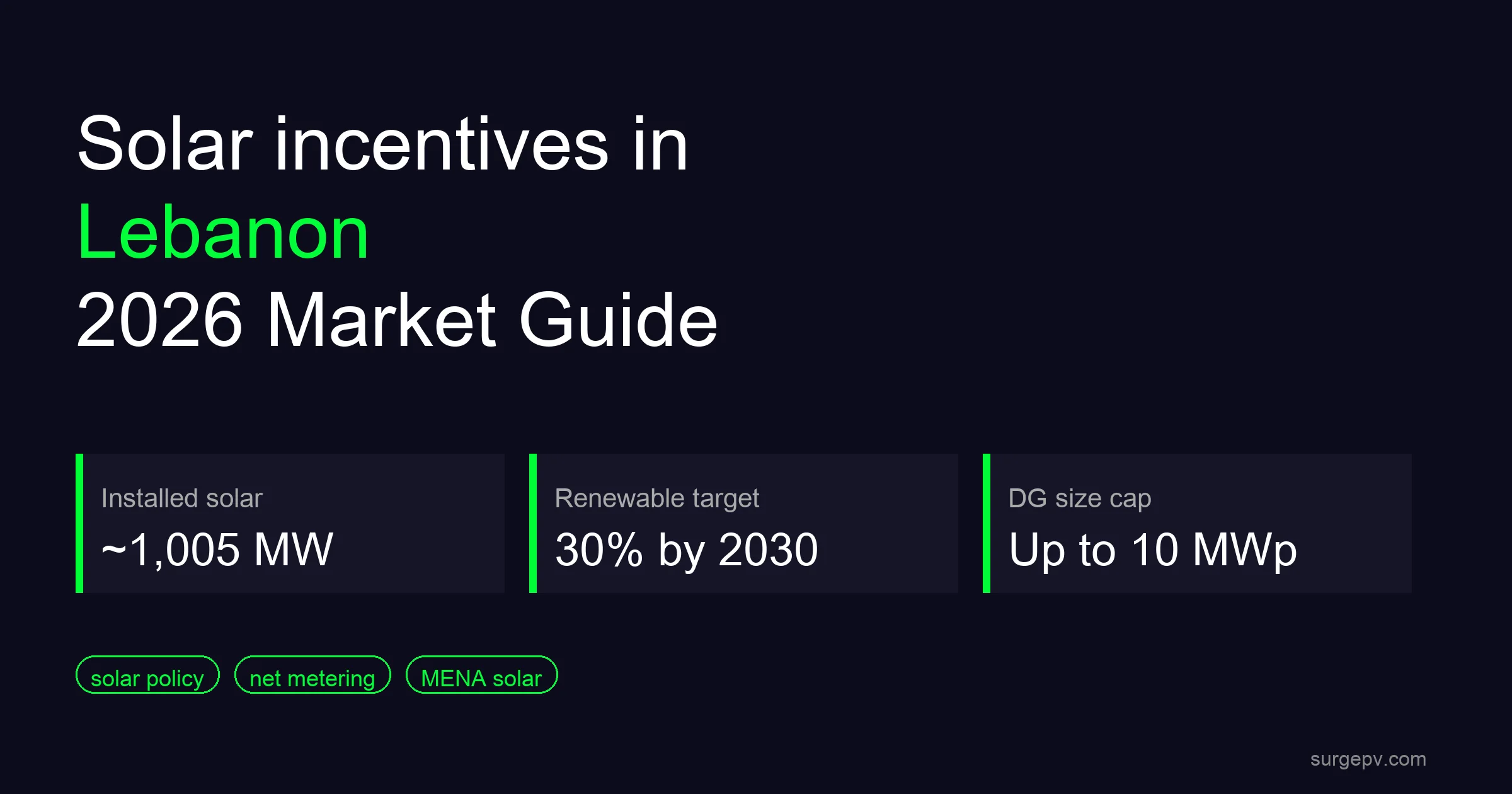
Solar incentives in Lebanon 2026: Market Guide and Incentives

Lebanon solar incentives 2026: net metering under Law 318/2023, VAT/customs exemptions, NEEREA loans, EDL DG, and 30% renewables by 2030.

Keyur Rakholiya

Written by

Keyur Rakholiya

CEO & Co-Founder · SurgePV

Rainer Neumann

Edited by

Rainer Neumann

Content Head · SurgePV

Published ·Updated

Quick Answer

Lebanon's 2026 solar incentives are shaped by crisis-driven adoption rather than large subsidies: the 2023 Distributed Renewable Energy Law legalises net metering and peer-to-peer trading, EDL operates a net-metering portal with monthly rollover, solar equipment has benefited from temporary VAT and customs-duty exemptions, the NEEREA subsidised-loan scheme financed hundreds of projects before the economic crisis, and the NREAP 2025-2030 targets 30% renewable electricity by 2030.

Lebanon’s solar market is unlike any other in the Middle East. It did not grow from a generous feed-in tariff or a national subsidy program. It grew from blackout. Distributed solar capacity surged from roughly 90 MW in 2020 to about 1,005 MW by 2023, according to UNDP policy data citing IRENA (2026). Most of that capacity is on rooftops, behind meters, and paired with batteries.

For installers, EPCs, and property owners, the opportunity in 2026 is to move this boom from emergency hardware to bankable, grid-integrated projects. The legal framework is now in place, but implementation is uneven. This guide explains the incentives that actually exist, the regulators that matter, and the practical traps that waste money.

If you are designing systems or writing proposals for Lebanese clients, a solar design platform that models net metering, self-consumption, battery cycling, and avoided generator cost can cut hours from every project. Generate solar proposals in minutes, or check pricing and book a demo to see how SurgePV handles Lebanon.

Lebanon’s 2026 solar incentive stack is real, but it is built on crisis economics rather than subsidies. The value comes from avoiding EDL and private-generator costs, using net metering where the grid allows, capturing temporary VAT and customs relief on equipment, and stacking the right battery size for daily outages.

TL;DR — Solar Incentives in Lebanon 2026

Active mechanisms: net metering under Law No. 318/2023 for systems up to 10 MWp, temporary VAT and customs-duty exemptions on solar equipment, the legacy NEEREA subsidised-loan scheme, NREAP 2025-2030 targeting 30% renewable electricity by 2030, and the EDL Cost Recovery Plan adding 315 MW of utility-scale solar. The Electricity Regulatory Authority was formally established in September 2025 but is not yet operational.

In this guide:

  • Latest 2026 status of every active Lebanese solar incentive
  • Why Lebanon’s solar boom happened and where it is heading
  • The legal foundation: Law 318/2023, EDL, and the ERA
  • How net metering and distributed generation actually work
  • VAT, customs, and fiscal incentives
  • NEEREA financing and what replaced it after the crisis
  • Utility-scale solar and IPP routes
  • Off-grid solar and battery storage economics
  • Three real-world stacking scenarios with payback impact
  • Common mistakes and how to avoid them

Latest Updates: Lebanon Solar Incentives 2026

Lebanon’s solar policy environment is defined by a single fact: most of the installed capacity exists outside the formal incentive framework. The country has more than one gigawatt of distributed solar, yet only a small fraction is net metered.

Lebanon Solar Incentive Status — June 2026

IncentiveTypeStatusKey Terms
Net metering under DRE LawDistributed generationActive, rolling outSystems up to 10 MWp; monthly rollover; annual settlement
VAT exemption on solar equipmentSales tax reliefTemporary / extended inconsistently11% VAT exemption introduced 2022, verify current status
Customs duty exemption on solar equipmentImport tax reliefTemporary / extended inconsistentlyExemption from customs duty and 3% additional duty
NEEREA green loansSubsidised financingDisrupted by crisisLegacy approvals exceed USD 250 million
NREAP 2025-2030Policy roadmapActive30% renewable electricity by 2030
EDL Cost Recovery PlanUtility reformActive 2024-2028315 MW utility-scale solar, loss reduction, tariff reform
Peer-to-peer energy tradingMarket mechanismLegal but limitedAdjacent plots only under Law 318/2023
Electricity Regulatory AuthorityRegulatorEstablished, not operationalFormally created September 2025

Key Changes Since 2025

NREAP 2025-2030 launched. In September 2025, the Ministry of Energy and Water launched the updated National Renewable Energy Action Plan with UK technical support, according to UK government news (2025). It replaces the 2016-2020 plan and sets implementation priorities for the next five years.

ERA formally established. The Electricity Regulatory Authority, mandated by Law 462/2002, was formally created on 11 September 2025 after more than two decades of delay, according to the Renewable Energy Governance Index (2025). However, it remains non-operational and its net-metering rulebook is not expected until late 2026.

Distributed solar continued to grow informally. By 2024, Lebanon had an estimated 1,200 to 1,300 MW of decentralized solar capacity, according to The Century Foundation (2025). Most of this capacity is not net metered and operates as off-grid or hybrid backup.

EDL advanced its Cost Recovery Plan. The five-year plan targets a 25% reduction in the cost of service by 2028, 315 MW of utility-scale solar, and a cut in network losses from 40.2% to 20.7%, according to EDL’s Cost Recovery Plan (2024).

Key Takeaway

2026 is a transition year. The most reliable value for solar owners is avoided electricity cost, because net metering is still being rolled out and the ERA has not yet issued its rulebook. Treat grid-connected and off-grid systems as separate markets with different design rules.


Why Lebanon’s Solar Market Matters in 2026

Lebanon has excellent solar resources. Coastal and inland areas receive strong year-round irradiation, and the country has a high proportion of flat rooftops ideal for PV. The economic driver, however, is not sunshine alone. It is the gap between the cost of solar and the cost of every alternative.

Market Size and Targets

Lebanon’s installed solar capacity reached approximately 1,005 MW by 2023, according to PVKnowHow market data (2026). That is a more than tenfold increase from roughly 90 MW in 2020. The same source estimates that about 50,000 households, or roughly 4% of the country’s 1.3 million households, now have rooftop solar.

The government’s target is 30% renewable electricity by 2030, with a long-term vision of more than 5,000 MW of renewable installations, according to the National Renewable Energy Action Plan 2025-2030 (2025). Reaching that target would save nearly USD 250 million per year in the power sector, mainly through avoided fossil-fuel imports, according to IRENA (2020).

The Grid Reliability Driver

Average daily electricity availability from the national grid is highly variable. Some regions receive 12 to 16 hours per day, while others receive as little as 3 hours, according to PVKnowHow market data (2026). This forces most households and businesses to rely on private diesel generators, which are expensive, polluting, and noisy.

Solar-plus-battery systems replace both EDL purchases and generator runtime. The economics are driven by the avoided cost of generator diesel, which has risen sharply with currency devaluation and subsidy removal.

The Diesel Substitution Driver

For industrial users, solar offsets diesel consumption directly. The 2018 Solar PV Status Report found that industrial solar systems could deliver payback periods of six years or less when diesel prices were high, because savings from offsetting diesel created positive cash flows year-round, according to LCEC (2019). In 2026, with higher diesel costs and lower module prices, the case is even stronger.

For solar professionals, the design priority is to model the customer’s actual outage pattern and generator cost. A system sized only for annual kWh offset will fail if it cannot cover evening or multi-day outages. Modern solar design software can model load profiles, battery dispatch, and backup duration together.


Lebanon’s renewable-energy sector rests on three pillars: the 2023 Distributed Renewable Energy Law, the national utility EDL, and the long-delayed Electricity Regulatory Authority.

Distributed Renewable Energy Law No. 318/2023

Law No. 318/2023 was ratified by Parliament on 14 December 2023. It is the most important legal development for distributed solar in Lebanon’s history, according to the Lebanese Center for Policy Studies (2024). The law:

  • Legalises net metering for renewable-energy systems up to 10 MWp.
  • Allows multiple-tenant and collective net metering.
  • Permits peer-to-peer renewable-energy trading through corporate PPAs or equipment leasing.
  • Limits peer-to-peer trading to adjacent plots, which restricts its practical use.
  • Creates a Directorate for Renewable Energy within EDL.
  • Vests significant regulatory powers in the ERA.

The law is broad. Its implementing decrees and the ERA rulebook are still pending. Until those are issued, many details, including surplus compensation rates and grid-fee structures, remain undefined.

Electricité du Liban (EDL)

EDL holds a legal monopoly over electricity generation, transmission, and distribution under Decree No. 16878/1964. It operates the national grid, sets net-metering technical standards, and runs the online net-metering portal at edlnetmetering.com.

EDL has indicated several operational challenges to net metering, including the need for smart-metering investment, clearer roles between EDL and private distribution providers, and difficulties with three-phase meter customers, according to UNDP (2026). Despite this, the utility has gained enough experience to handle more applications as the framework matures.

Electricity Regulatory Authority (ERA)

The ERA was mandated by Law 462/2002 but was only formally established in September 2025. It is not yet operational. Once functional, it will issue licenses, approve tariffs, set net-metering and net-billing rules, and supervise private-sector participation in generation and distribution.

The absence of the ERA is the single biggest regulatory bottleneck in Lebanon. Large-scale IPPs, clear surplus compensation rates, and standardized grid connection procedures all depend on it. The NREAP 2025-2030 identifies ERA operationalisation as a fundamental step to attract international financing.


Net Metering and Distributed Generation

Net metering in Lebanon has existed as an EDL pilot since 2010, but the 2023 law turned it into a national framework. In practice, adoption remains low because grid instability makes off-grid systems more attractive.

How Net Metering Works

Under EDL net metering, exported solar generation is credited against imported grid consumption. Key rules, based on EDL and UNDP guidance, include:

  • Energy credits carry over from one billing period to the next.
  • The net-metering period runs for one year, typically from January 1 to December 31.
  • At the annual settlement, unused credits are reset and lost.
  • Systems must be sized to match consumption to avoid lost surplus.
  • A bidirectional meter and compliance with EDL technical standards are required.

A typical household consuming about 6,900 kWh per year can cover much of that demand with a 3.6 kWp system under Beirut climatic conditions, according to UNDP-CEDRO net-metering guidelines.

Current Net-Metering Uptake

As of 2024, Lebanon had approximately 1,005 MW of distributed solar PV, but only about 35 MW, or 3-4%, had applied for net metering, according to UNDP (2026). Of the approved capacity, roughly 10.3 MW had been connected by mid to end 2025. Approximately 63% of applications were for systems equal to or smaller than 10 kWp.

Virtual and Community Net Metering

The UNDP CEDRO project piloted community net metering in Qabrikha, a village in South Lebanon, with a 250 kWp shared solar system. Subscribers own a pre-agreed share of the system, and EDL credits each subscriber’s bill in proportion to that share. This Village 24, or V24, model is specifically cited as permissible under Law 318/2023, according to UNDP (2026).

Distributed Generation Size Limit

Law 318/2023 caps distributed renewable-energy systems at 10 MWp. This covers most residential, commercial, and industrial rooftops, as well as small ground-mounted community systems. Systems above this threshold move into the IPP and PPA regime.

A well-modeled generation and financial tool can test net-metering value against off-grid or hybrid designs using real Lebanese tariff and outage data.


Tax, Customs, and Fiscal Incentives

Lebanon does not offer a direct federal tax credit for homeowners who buy solar panels. The real fiscal value lies in temporary VAT and customs exemptions, plus the legacy NEEREA financing scheme.

VAT Exemption

The 2022 Budget Law exempted solar power equipment used to generate electricity from Lebanon’s 11% VAT from 15 November 2022 to 31 December 2023, according to PwC Worldwide Tax Summaries (2026). The exemption was intended to lower import costs and encourage adoption, but implementation was inconsistent and in practice lasted only a few months in 2023, according to the Arab Reform Initiative (2025).

Customs Duty Exemption

The same 2022 budget provision exempted solar power equipment from customs duties and the additional 3% customs fee. As with VAT, the exemption has been extended in some budget discussions but should be verified at the time of import. As of late 2025, imported finished solar panels under HS code 8541.40 were subject to a 5% customs duty, while raw materials for local manufacturing, such as solar cells, EVA film, and solar glass, could enter duty-free, according to PVKnowHow customs analysis (2026).

NEEREA Financing

NEEREA is the National Energy Efficiency and Renewable Energy Action, created by Central Bank of Lebanon Circular 236 in 2010. It offered subsidised loans for energy-efficiency and renewable-energy projects through Lebanese commercial banks. Key terms, according to the IEA policy database (2017) and MPRA policy research (2025), included:

  • Interest rates as low as roughly 0.6%.
  • Loan ceilings up to USD 20 million.
  • Repayment periods up to 14 years, with grace periods of 6 months to 4 years.
  • A grant component released after project completion.

NEEREA approved more than 200 projects totaling over USD 250 million, with about 60% allocated to solar PV, according to MPRA (2025). Subsidised lending was disrupted by Lebanon’s financial crisis after 2019. A few commercial banks, including Banque de l’Habitat, later introduced household solar loans at around 4.99% interest over five years, according to the same source.

Corporate Tax Treatment

Businesses can generally depreciate renewable-energy assets under standard Lebanese tax rules. There is no dedicated accelerated depreciation scheme for solar comparable to some other markets, but the avoided cost of diesel and EDL power often produces short paybacks without additional tax incentives.


Utility-Scale and IPP Routes

While rooftops have dominated Lebanon’s solar boom, the government has also pursued utility-scale solar through tenders and power purchase agreements.

EDL Cost Recovery Plan

EDL’s five-year Cost Recovery Plan, covering 2024-2028, aims to increase low-cost supply in the generation mix. It includes the commissioning of 315 MW of utility-scale solar PV plants with grid reinforcements, according to EDL (2024). The plan also targets reducing network losses from 40.2% to 20.7% and shortening the billing cycle from 12 to 3 months.

Utility-Scale Solar Tenders

Lebanon has signed contracts for the construction of 11 solar farms, according to PVKnowHow market data (2026). These include the 8 MW Beirut River solar plant, which was open for bids in 2024. Larger IPP projects require licensing under amendments to Law 462/2002 and depend on the ERA becoming operational.

Grid Reinforcement Needs

Integrating large amounts of solar requires a rebuilt National Control Center and transmission network reinforcements. The World Bank is preparing a USD 250 million loan to support the National Control Center, advanced metering infrastructure, and approximately 150 MW of grid-connected solar across four sites, according to EDL (2024).

For utility-scale developers, the lesson is that grid connection is often the bottleneck, not permitting or land. Early engagement with EDL on connection studies is essential.


Off-Grid Solar and Battery Storage

Off-grid and hybrid solar-plus-battery systems are the real Lebanese solar market. They are not technically an incentive, but they are the reason most customers buy solar.

Why Off-Grid Dominates

The EDL grid is unreliable. Daily supply ranges from a few hours in some areas to around 20 hours in better-served regions. Private generators fill the gap at high cost. A solar-plus-battery system that can cover evening loads and generator downtime replaces the most expensive electricity the customer buys.

Most net-metering applications below 10 kWp are coupled with energy storage, according to UNDP (2026). This shows that Lebanese buyers think of solar and batteries as a single resilience investment rather than only a grid-export asset.

Sizing for Outages

A household or business designing an off-grid or hybrid system must answer three questions:

  1. How many hours per day does the grid fail?
  2. What loads are essential during outages?
  3. How many cloudy days must the battery cover?

In Beirut, a 5 kW solar array with 10 kWh of battery storage can cover essential loads during typical daily outages. In areas with longer blackouts, larger batteries or generator backup are needed.

Battery Economics

Battery prices have fallen globally, and Lebanese importers have benefited from lower module and lithium-ion costs. However, currency devaluation and banking restrictions have kept local prices high for cash buyers. Systems are often priced in fresh US dollars, which limits access to households with savings or remittances, according to The Century Foundation (2025).

For installers, the design priority is to match battery size to the outage profile. Oversizing batteries adds cost without adding value; undersizing leaves the customer running the generator at night. SurgePV’s shadow analysis and battery-dispatch modeling can help size systems for Lebanese conditions.


How to Stack Incentives: Three Real-World Scenarios

The following examples are illustrative, based on typical 2026 costs and incentive assumptions. Actual figures depend on exchange rates, installer margins, equipment quality, and whether VAT or customs exemptions are passed through.

Scenario 1 — 5 kW Residential Hybrid System, Beirut

ItemAmount
Gross installed costUSD 6,500
VAT/customs exemption benefit (if passed through)−USD 700
Net costUSD 5,800
Annual avoided EDL and generator costUSD 1,400
Simple payback4.1 years

High self-consumption and diesel substitution drive the return. Without battery storage, payback is longer because the system cannot cover evening outages.

Scenario 2 — 100 kW Commercial Rooftop, Mount Lebanon

ItemAmount
Gross installed costUSD 95,000
Customs/VAT relief (if applicable)−USD 10,000
Net costUSD 85,000
Annual avoided EDL and generator costUSD 22,000
Simple payback3.9 years

Commercial systems with daytime loads benefit from high avoided costs and fast payback. Net metering adds value if the grid is stable enough to accept exports.

Scenario 3 — 1 MW Industrial Cogeneration Replacement, Bekaa

ItemAmount
Gross installed costUSD 750,000
Annual avoided diesel and EDL costUSD 220,000
Simple payback3.4 years

Industrial users with high diesel consumption see the fastest paybacks. The system may operate primarily off-grid, with grid connection used only when EDL supply is available.


Common Mistakes and Misconceptions

Even experienced installers lose money in Lebanon by misunderstanding how the market works. Here are the most common errors.

Treating Lebanon Like a Normal Net-Metering Market

In most countries, net metering is the default value stream. In Lebanon, the grid is unreliable, net metering is still being rolled out, and the ERA is not yet operational. A system designed only for export will fail if the grid is down when the sun is shining.

Assuming VAT and Customs Exemptions Are Automatic

The 2022 exemptions were temporary and implementation was inconsistent. Importers should confirm the current status with Lebanese Customs and structure invoices correctly. Customers should ask installers whether quoted prices assume the exemption.

Oversizing Panels Without Enough Battery

A large PV array generates plenty of energy during the day, but without enough battery storage, that energy cannot cover evening outages. The standard design rule for Lebanese hybrid systems is to size the battery for the longest typical outage, then size the array to recharge it.

Ignoring Currency Risk

Solar equipment is typically priced in US dollars, while some EDL and generator costs are quoted in Lebanese pounds. Currency devaluation can change the economics quickly. Proposals should show costs and savings in a stable currency and note where local-currency assumptions apply.

Underestimating Generator Runtime

Some installers assume solar will eliminate generator use entirely. In practice, most Lebanese systems still need a generator for extended outages or heavy loads. Proposals should show generator runtime before and after installation, instead of only annual kWh offset.

Designing for Irradiance Without Checking Roof Structure

Many Lebanese buildings were not designed to carry solar arrays. Structural checks are essential, especially for older residential buildings and concrete roofs with water tanks. Wind and seismic loads also matter.


Conclusion

Lebanon’s solar incentive framework in 2026 is not a single subsidy. It is a stack of crisis-driven economics, temporary tax relief, a new distributed-energy law, and the promise of a future regulated market. The most reliable value today comes from avoiding EDL and private-generator costs, especially for systems paired with batteries.

For solar professionals, the competitive edge is the ability to model the right mix of grid-tied, hybrid, and off-grid operation, size batteries for actual outages, and present honest payback numbers that account for currency and regulatory uncertainty. Tools like Clara AI and SurgePV’s generation and financial tool can automate that workflow for Lebanese projects.

Three actions to take now:

  1. Choose the right system architecture — grid-tied net metering, hybrid backup, or off-grid depending on the customer’s grid reliability and budget.
  2. Verify tax and customs treatment — confirm whether VAT and duty exemptions apply to the specific equipment and invoice structure.
  3. Size batteries for outages, not only annual kWh — in Lebanon, backup value often matters more than export revenue.

For regional comparisons, see our solar payback period by country guide. For installers scaling in Lebanon, our guide for solar installers covers proposal automation and compliance workflows.


Frequently Asked Questions

What solar incentives are available in Lebanon in 2026?

Lebanon’s 2026 solar incentives include net metering under the 2023 Distributed Renewable Energy Law, temporary VAT and customs-duty relief on solar equipment, the legacy NEEREA subsidised-loan scheme, and the NREAP 2025-2030 renewable-energy roadmap. Most real-world value currently comes from avoiding high EDL and private-generator costs rather than from upfront subsidies.

Does Lebanon have net metering?

Yes. Lebanon’s Distributed Renewable Energy Law No. 318/2023 legalises net metering and allows consumers to connect renewable-energy systems up to 10 MWp to the grid. EDL operates an online net-metering portal, credits surplus generation month to month, and settles the annual balance. Only a small share of the country’s distributed solar capacity has formally applied for net metering because grid instability and long approval timelines make off-grid systems more attractive.

Is solar equipment exempt from VAT and customs duty in Lebanon?

The 2022 Budget Law exempted solar power equipment from 11% VAT and from customs duties, including the 3% additional duty, from 15 November 2022 to 31 December 2023. The exemption has been extended in subsequent budget discussions, but implementation has been inconsistent. Importers should verify the current status with Lebanese Customs before assuming the exemption applies.

What is NEEREA?

NEEREA is the National Energy Efficiency and Renewable Energy Action, a Central Bank of Lebanon financing mechanism launched in 2010. It provided subsidised loans, sometimes near 0.6% interest, for energy-efficiency and renewable-energy projects through Lebanese commercial banks, with a ceiling of up to USD 20 million and terms of up to 14 years. NEEREA approved more than 200 projects worth over USD 250 million, but subsidised lending was disrupted by Lebanon’s financial crisis.

What is the maximum size for a distributed solar system in Lebanon?

Law No. 318/2023 allows distributed renewable-energy systems up to 10 MWp. Systems can be connected under net metering, or they can sell power through corporate power purchase agreements and peer-to-peer contracts. Peer-to-peer trading is currently limited to adjacent plots, which restricts its practical use.

What is Lebanon’s renewable-energy target?

Lebanon targets 30% renewable electricity by 2030. The National Renewable Energy Action Plan 2025-2030, launched in September 2025, updates the roadmap and identifies roughly 5,000 MW of renewable capacity as a long-term ambition. The country had about 1,005 MW of installed solar capacity by 2023.

Why is off-grid solar so common in Lebanon?

Off-grid solar is common because EDL grid supply is unreliable, with daily availability often ranging from 12 to 16 hours and some areas receiving only a few hours. High EDL and private-generator tariffs, combined with the devaluation of the Lebanese pound, make solar-plus-battery systems attractive for households and businesses that can afford the upfront cost.

What is the typical payback period for residential solar in Lebanon?

Well-sized residential solar-plus-battery systems in Lebanon typically pay back in 4 to 7 years, driven by high avoided costs from EDL and diesel-generator substitution. Payback depends heavily on system cost, self-consumption ratio, battery size, and whether VAT or customs exemptions are passed through by the installer.

Who regulates solar projects in Lebanon?

The Ministry of Energy and Water sets policy, Electricité du Liban operates the grid and the net-metering programme, and the Lebanese Center for Energy Conservation supports implementation and technical standards. The Electricity Regulatory Authority was formally established in September 2025 but remains non-operational; its rulebook on net metering and surplus compensation is expected towards the end of 2026.

What is the most common mistake when sizing a solar system in Lebanon?

The most common mistake is ignoring the load profile and grid availability. Because net metering is still being rolled out and the grid is unstable, many systems are designed as off-grid or hybrid. Oversizing panels without enough battery storage or without matching daytime consumption wastes generation, while undersizing batteries leaves households without backup during long outages.

About the Contributors

Author
Keyur Rakholiya
Keyur Rakholiya

CEO & Co-Founder · SurgePV

Keyur Rakholiya is CEO & Co-Founder of SurgePV and Founder of Heaven Green Energy Limited, where he has delivered over 1 GW of solar projects across commercial, utility, and rooftop sectors in India. With 10+ years in the solar industry, he has managed 800+ project deliveries, evaluated 20+ solar design platforms firsthand, and led engineering teams of 50+ people.

Editor
Rainer Neumann
Rainer Neumann

Content Head · SurgePV

Rainer Neumann is Content Head at SurgePV and a solar PV engineer with 10+ years of experience designing commercial and utility-scale systems across Europe and MENA. He has delivered 500+ installations, tested 15+ solar design software platforms firsthand, and specialises in shading analysis, string sizing, and international electrical code compliance.

Get Solar Design Tips in Your Inbox

Join 2,000+ solar professionals. One email per week - no spam.

No spam · Unsubscribe anytime

Book Free Demo
