

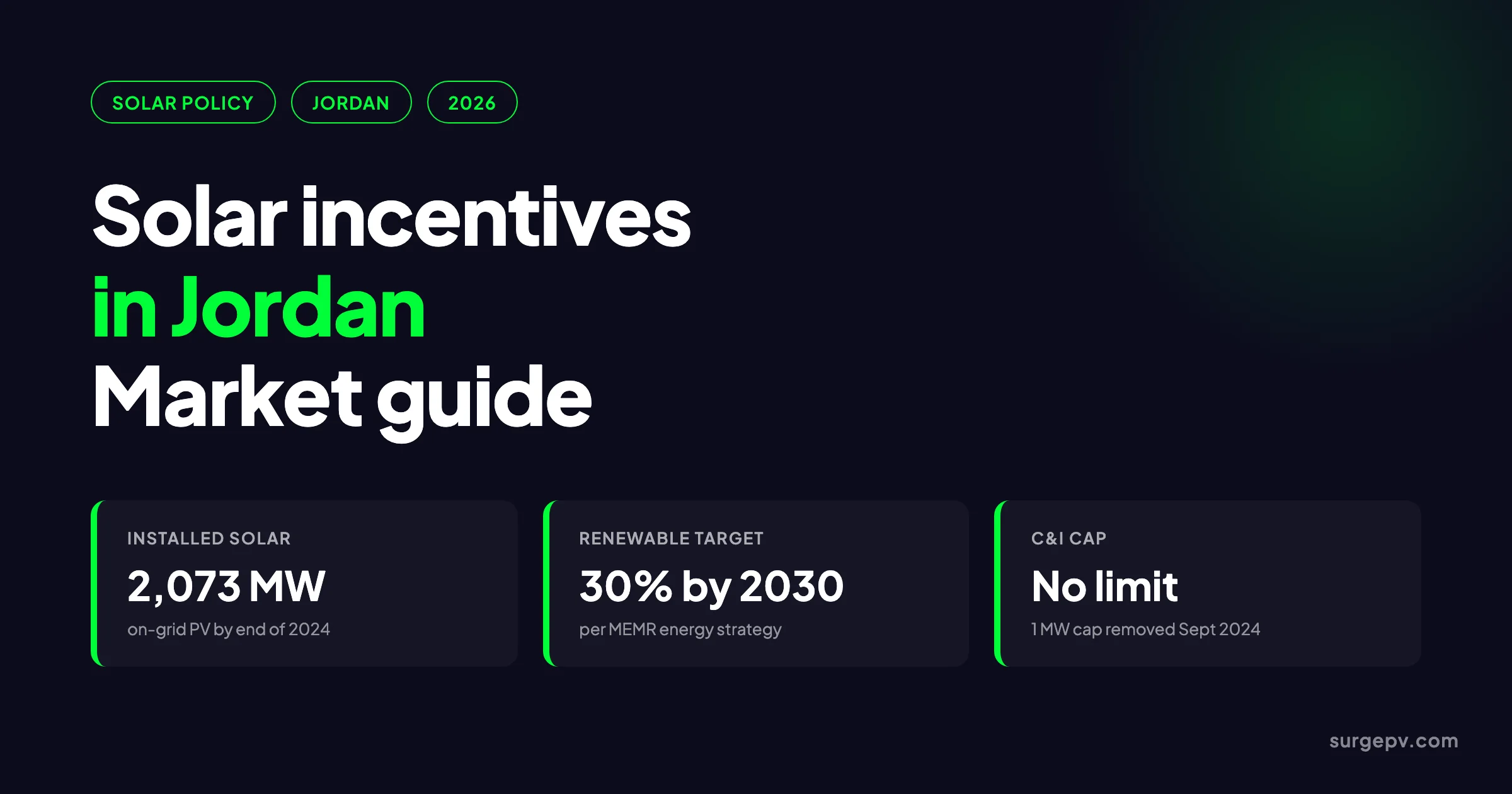
Jordan’s on-grid solar capacity reached 2,073 MW by the end of 2024, an extraordinary figure for a country with a population under 11 million, according to EcoMENA analysis of MEMR data (2025). The Kingdom imports roughly 90% of its primary energy, so every megawatt of domestic solar replaces imported fuel and reduces exposure to volatile commodity markets. For installers, EPCs, and property owners, the practical question in 2026 is not whether solar works in Jordan, but which incentive stack to use and how to avoid the new rules that can quietly destroy project returns.
This guide is a market-focused incentive manual. It covers the 2026 legal framework, the real mechanisms that reduce project cost, how the four Bylaw 58 connection schemes work, and the mistakes that waste money. For the broader Middle East picture, see our Middle East solar compliance guide. For payback benchmarks across markets, see solar payback period by country.
If you are designing systems or writing proposals for Jordanian clients, a solar design platform that models local tariffs, self-consumption ratios, grid fees, and time-of-use periods can save hours per project. Model payback and export value automatically, then generate solar proposals in minutes. Check pricing or book a demo to see how SurgePV handles Jordan.
Jordan’s 2026 solar incentive stack is real, but it is not a handout. The value comes from combining customs and sales tax exemptions on qualifying equipment, JREEEF grants and soft financing, net billing or buy-all/sell-all export mechanisms, the removal of the 1 MW C&I cap, and income-tax relief for projects in development zones.
Quick Answer
Jordan’s 2026 solar incentives are a stack rather than a single subsidy: customs and sales tax exemptions on qualifying renewable-energy equipment, JREEEF grants and soft financing for targeted sectors, net billing and buy-all/sell-all mechanisms under Bylaw 58, the removal of the 1 MW AC cap for C&I projects, and income-tax relief for projects in development zones.
In this guide:
- Latest 2026 status of every active Jordanian solar incentive
- The legal foundation: REEEL, the 2024 update, and Bylaw 58
- How net billing, self-consumption, buy-all/sell-all, and wheeling actually work
- Tax incentives: customs, sales tax, income-tax relief, and Investment Law draft benefits
- JREEEF grants, subsidies, and who can access them
- Commercial and industrial routes beyond residential rooftops
- Regional differences and where the market is hottest
- Two real-world stacking scenarios with payback impact
- Common mistakes and how to avoid them
Latest Updates: Jordan Solar Incentives 2026
The Jordanian solar policy environment shifted in 2024. The Renewable Energy and Energy Efficiency Law was updated to Law No. 12 of 2024, Bylaw 58 of 2024 replaced the old net metering framework, and the Council of Ministers lifted the 1 MW AC cap on C&I projects. In 2026, the Investment Law is being amended again to expand incentive eligibility.
Jordan Solar Incentive Status — June 2026
| Incentive | Type | Status | Key Terms |
|---|---|---|---|
| Customs duty exemption on RE equipment | Import tax relief | Active | Applies to qualifying solar equipment under REEEL |
| Sales tax exemption on RE equipment | Sales tax relief | Active | Exempts systems and equipment for renewable projects |
| JREEEF grants and soft loans | Direct support | Active | Residential, public, industrial, and agricultural sectors |
| Net billing | Surplus sale | Active | Bylaw 58; export purchased at regulated rate |
| Buy-all/sell-all | Energy sale | Active | No grid fee; all generation sold to utility |
| Self-consumption with export | Surplus sale | Active | Surplus exported; grid fee applies |
| Wheeling / off-site solar | Energy transport | Active | For eligible C&I and institutional users |
| C&I capacity cap removal | Regulatory | Removed Sept 2024 | No 1 MW AC ceiling for commercial systems |
| Income-tax reduction in development zones | Corporate tax relief | Active / expanding | 2026 Investment Law draft |
| Land lease incentives | Public land support | Active | Preferential terms via Ministry of Investment |
Key Changes Since 2024
June 2024 — Renewable Energy and Energy Efficiency Law updated: Law No. 12 of 2024 replaced the original Law No. 13 of 2012. It provides the legal basis for Bylaw 58 and the four connection mechanisms now in force.
September 2024 — Bylaw 58 takes effect: The bylaw ended net metering and introduced net billing, self-consumption with export, buy-all/sell-all, and wheeling. It fixed the annual specific production assumption at 1,800 kWh/kWp/year and set DC:AC ratios at 1.5 for residential and 1.2 for other sectors.
September 2024 — 1 MW cap removed: The Council of Ministers lifted the 1 MW AC cap on solar project sizes. This enabled large C&I installations and ground-mount projects, including a reported 50 MW solar plant financed by Cairo Amman Bank under construction, according to EcoMENA (2025).
April 2026 — Investment Law amendments advanced: The Cabinet advanced draft amendments to expand incentive eligibility, streamline licensing, and attract fresh capital to priority sectors including clean power generation, as reported by Global Law Experts (2026).
April 2026 — 30% renewable target reaffirmed: The Petra News Agency reported that Jordan reaffirmed its target of reaching a 30% renewable energy share by 2030, anchored in the MEMR Energy Strategy 2020–2030.
Key Takeaway
2026 is a transition year. The most reliable incentives are customs and sales tax exemptions, JREEEF support, and the value of self-consumption, because export rates and grid fees reduce the return on surplus generation. Size systems for self-consumption first, export second.
Why Jordan’s Solar Market Matters in 2026
Jordan has some of the best solar resources in the Middle East. The country receives high global horizontal irradiance across most of its territory, with the southern and eastern governorates offering the strongest resource. That solar wealth, combined with a near-total dependence on imported energy, makes PV a national priority.
Market Size and Targets
Jordan’s on-grid solar PV capacity reached 2,073 MW by the end of 2024, according to EcoMENA (2025). Total renewable capacity, including wind, is substantially higher. The government targets a 30% renewable electricity share by 2030.
The country imports approximately 90% of its primary energy, according to Global Law Experts (2026). Solar reduces that import bill and improves energy security. It also shields consumers from exchange-rate risk, because the Jordanian dinar is pegged to the U.S. dollar while fuel prices fluctuate.
The Tariff Driver
Jordan’s residential electricity tariffs are structured in tiered blocks. A supported meter for a Jordanian family pays roughly USD 0.0705/kWh for the first 300 kWh per month, USD 0.141/kWh for the next 300 kWh, and USD 0.282/kWh above 600 kWh, according to EcoMENA (2025). Additional meters and non-Jordanians face unsupported tariffs starting at roughly USD 0.1693/kWh.
Solar offsets consumption at the marginal tariff tier. That makes rooftop PV particularly attractive for high-consumption households, villas, and businesses that pay the top rates. For solar professionals, the opportunity is to show both generation and bill avoidance at the customer’s actual tariff tier. That requires hourly load modeling and accurate shading analysis, both of which are built into modern solar design software.
The Legal Foundation: REEEL, Bylaw 58, and Distributed Generation
Jordan’s renewable energy sector is governed by a clear legal stack. The Renewable Energy and Energy Efficiency Law, originally No. 13 of 2012 and updated to Law No. 12 of 2024, sets the policy framework. Bylaw 58 of 2024 fills in the technical and commercial rules for distributed solar.
Key Institutions
| Institution | Role |
|---|---|
| MEMR | Ministry of Energy and Mineral Resources — policy, strategy, tenders, direct proposals |
| EMRC / EMRA | Energy and Minerals Regulatory Commission — licensing, grid code, technical standards |
| NEPCO | National Electric Power Company — transmission and wholesale market |
| JEPCO | Jordan Electric Power Company — distribution in Amman and central region |
| IDECO | Irbid District Electricity Company — northern distribution |
| EDCO | Electricity Distribution Company — southern distribution including Aqaba |
| JREEEF | Jordan Renewable Energy and Energy Efficiency Fund — grants and soft financing |
| MOI | Ministry of Investment — incentive applications and public land allocation |
Connection Mechanisms Under Bylaw 58
Bylaw 58 of 2024 introduced four on-grid connection mechanisms effective September 2024. The exact naming varies across sources, but the economic effect is consistent.
| Mechanism | How It Works | Typical User |
|---|---|---|
| Net billing | Surplus daytime generation is purchased by the distribution company at a regulated rate | Residential and small commercial |
| Self-consumption with export | System prioritizes own use; surplus exported at regulated rate | Commercial with high daytime load |
| Buy-all/sell-all | All generation sold to utility; consumer buys all consumption separately | Large C&I and independent producers |
| Wheeling / off-site | Solar generated at one site offsets consumption at another via the grid | Multi-site C&I, universities, camps |
For installers, the practical implication is that most residential projects use net billing, most large C&I projects use buy-all/sell-all or wheeling, and grid fees matter for every mechanism except buy-all/sell-all.
Net Billing, Self-Consumption, Buy-All/Sell-All, and Wheeling
The shift from net metering to net billing in September 2024 changed how solar owners are compensated. Choosing the wrong mechanism can cut project returns.
Net Billing
Under net billing, imported energy is billed at the full retail rate, while exported energy is paid at a separate regulated rate.
- Monthly settlement rather than annual rollover.
- Export rate is typically lower than the retail import rate.
- Best for customers whose daytime generation matches daytime consumption.
- A grid fee applies, reducing the value of surplus export.
A 2025 techno-economic study of residential PV in Jordan found that net billing and net metering offered the shortest payback periods, roughly 3 years for optimally sized systems, according to Alrbai et al. (2025). The same study identified a feed-in tariff threshold of approximately USD 0.055/kWh at which net billing becomes as attractive as net metering.
Self-Consumption with Export
This mechanism prioritizes on-site consumption and exports only the surplus. It suits commercial buildings with high daytime loads such as factories, warehouses, and offices.
- Self-consumed kWh avoid the full retail tariff.
- Exported kWh earn the regulated export rate.
- Grid fee applies to the connection.
Buy-All/Sell-All
In a buy-all/sell-all arrangement, the generator sells all output to the distribution company and buys all consumption at the retail rate. This is effectively a small power producer model.
- No grid fee applies under Bylaw 58.
- Common for large C&I rooftops and ground-mount systems.
- Requires a power purchase or sale agreement.
Low-consumption residential users below 300 kWh/month can also install under buy-all/sell-all without grid fees, according to EcoMENA (2025).
Wheeling
Wheeling allows a generator to produce electricity at one site and use it to offset consumption at another site through the grid. It is particularly useful for universities, industrial parks, and organizations with multiple meters or campuses.
- Off-site solar can serve dispersed loads.
- Grid usage charges apply.
- The regulatory framework has been available for several years and was retained under Bylaw 58.
A well-modeled generation and financial tool can test each mechanism against the customer’s actual hourly consumption profile and local tariff structure.
Tax and Fiscal Incentives
Jordan does not offer a direct federal tax credit for homeowners who buy solar panels. The real tax value lies in customs and sales tax exemptions, business tax relief, and import benefits.
Customs Duty Exemption
The Renewable Energy and Energy Efficiency Law and Bylaw No. 13 of 2015 exempt renewable energy sources, systems, and energy efficiency devices from customs duties, according to UNESCWA (2021). The 2026 Investment Law draft is expected to expand customs exemptions on imported equipment, machinery, and materials used in qualifying clean-energy projects, according to Global Law Experts (2026).
Sales Tax Exemption
The same framework exempts renewable energy systems and equipment from sales tax. This lowers the upfront cost of modules, inverters, mounting structures, and electrical equipment.
For end users, the practical benefit depends on whether the installer passes the tax savings through. Customers should ask whether the quoted price includes or excludes sales tax and whether the equipment qualifies under the exemption.
Income-Tax Reduction
Projects located in designated development zones or governorates outside Amman may qualify for income-tax reductions, according to Global Law Experts (2026). The 2026 Investment Law draft is expected to expand eligibility for these reductions in priority sectors including renewable energy.
Land Incentives
The Ministry of Investment can facilitate the sale or lease of public treasury land to qualifying projects at preferential terms, typically on 25 to 49 year leases aligned with PPA tenors. This is especially relevant for utility-scale and large C&I ground-mount projects.
JREEEF and Subsidy Programs
The Jordan Renewable Energy and Energy Efficiency Fund plays a central role in financing solar deployment. It was established under REEEL and launched in 2013 by MEMR.
What JREEEF Provides
According to UNESCWA (2021), JREEEF provides:
- Grants and subsidies for privately operated renewable energy facilities.
- Interest-rate subsidies on commercial loans.
- A public equity fund to support private investment.
- A renewable energy guarantee facility to ease credit access.
- Research and technical cooperation grants.
- Feasibility studies.
Who Can Access JREEEF
JREEEF supports projects across residential, educational, health, industrial, and agricultural sectors, according to Alrbai et al. (2025). Both national and foreign private companies can apply for support when setting up renewable energy generation projects.
For installers, JREEEF is a useful lever for customers who need help with upfront capital. It is not a blanket subsidy, so applications must be prepared with clear project documentation and financial projections.
Commercial and Industrial Solar Incentives
C&I solar in Jordan operates under different rules than residential rooftop. The economics are usually driven by avoided demand charges, self-consumption optimization, and corporate power structures rather than net billing.
Removal of the 1 MW Cap
The most important C&I change in 2024 was the removal of the 1 MW AC cap. Large factories, commercial parks, and industrial facilities can now install multi-megawatt systems. A 50 MW solar plant financed by Cairo Amman Bank was already under construction after the cap was lifted, according to EcoMENA (2025).
Time-of-Use Tariffs
Time-of-use electricity tariffs were introduced for six sectors in July 2024 and expanded to twelve sectors in January 2025, with plans to cover all sectors. The off-peak period runs from 05:00 to 14:00, overlapping with peak solar generation. This structure rewards customers who shift load to solar hours, according to EcoMENA (2025).
Corporate and Institutional Structures
- Buy-all/sell-all: Large C&I generators sell all output to the utility.
- Wheeling: Off-site solar serves multiple meters or campuses.
- Direct proposals: Developers can submit unsolicited proposals to MEMR for utility-scale projects.
- Competitive tenders: MEMR periodically issues RFPs for defined capacity blocks.
For C&I installers, the design priorities are different from residential work. Load profiling, demand-charge analysis, and solar shading analysis matter more than simple bill offset.
Regional Variations
Jordan’s solar market is concentrated geographically, but the resource is strong across much of the country.
Amman and the Central Region
Amman has the largest pool of high-consumption residential and commercial customers. JEPCO serves the central region. Grid capacity and interconnection queues are the main practical constraints.
Aqaba and the South
Aqaba benefits from strong solar irradiance and the Aqaba Special Economic Zone, which offers its own licensing and land-allocation pathway. The region hosts some of Jordan’s largest utility-scale solar projects.
Ma’an and the Eastern Desert
Ma’an governorate and the eastern desert regions have the strongest solar resource in the country. Large solar parks, including the Shams Maan project, are located here.
Northern Governorates
Irbid, Ajloun, and Jerash are served by IDECO. The north has strong commercial demand and good irradiance, though slightly lower than the south and east.
Practical Tip
Always model the local distribution tariff and time-of-use periods, not a national average. The same 500 kW system can have a very different payback between a high-tariff industrial zone and a subsidized rural rate zone.
How to Stack Incentives: Two Real-World Scenarios
The following examples are illustrative, based on typical 2026 costs and incentive rates. Actual figures depend on location, tariff, installer quote, and whether the customer qualifies for JREEEF support.
Scenario 1 — 5 kW Residential Rooftop, Amman
| Item | Amount |
|---|---|
| Gross installed cost | JOD 4,500 |
| Sales tax and customs exemption benefit | −JOD 600 |
| JREEEF grant (if eligible) | −JOD 500 |
| Net cost | JOD 3,400 |
| Annual bill savings (high-tier offset + net billing) | JOD 700 |
| Payback | 4.9 years |
Without the tax exemptions and grant, the same system would pay back in roughly 7–8 years.
Scenario 2 — 1 MW Commercial Rooftop, Aqaba
| Item | Amount |
|---|---|
| Gross installed cost | USD 650,000 |
| Customs and sales tax exemption benefit | −USD 90,000 |
| Income-tax reduction benefit (development zone) | −USD 45,000 |
| Net effective cost | USD 515,000 |
| Annual avoided electricity + export revenue | USD 110,000 |
| Annual grid fee (13 JOD/kWac/month × 1,000 kW) | −USD 22,000 |
| Payback | 5.3 years |
The removal of the 1 MW cap is what makes this project size possible. Under the old rules, the system would have been split or downsized.
Common Mistakes and Misconceptions
Even experienced installers lose money in Jordan by misunderstanding how incentives interact. Here are the most common errors.
Oversizing for Export
The single most expensive mistake is designing a system that exports more than the customer consumes. Net billing export rates are below retail import rates, and grid fees reduce returns further. Size for self-consumption, not maximum generation.
Ignoring Grid Fees
Bylaw 58 introduced grid fees on net billing and self-consumption mechanisms. A 1 MW commercial system can face roughly USD 22,000 per year in grid fees. Buy-all/sell-all avoids the fee but changes the revenue structure.
Assuming a U.S.-Style Tax Credit
Many international installers pitch solar by referencing the former U.S. Investment Tax Credit. Jordan does not have a comparable residential credit. The value is in customs and sales tax exemptions, JREEEF support, and bill savings.
Using Generic Irradiance Data
Jordan’s Bylaw 58 fixes the compliance calculation at 1,800 kWh/kWp/year, but site-specific yield can vary. Use satellite-derived TMY data for the project location, not regional averages. A solar design platform with Jordan-specific datasets will produce more accurate projections.
Underestimating Interconnection Time
Distribution company queues can take several months, especially in high-growth areas. Meter change-out, inspection, and approval delays are common. Build realistic timelines into contracts and customer expectations.
Misapplying Tax Exemptions
Not every solar panel purchase automatically qualifies for customs and sales tax exemptions. The equipment must meet the legal criteria, and the transaction must be documented correctly. A customs or tax advisor should review the invoice structure before procurement.
Conclusion
Jordan’s solar incentive framework in 2026 is a stack built from customs and sales tax exemptions, JREEEF grants and soft financing, net billing and buy-all/sell-all mechanisms, the removal of the C&I capacity cap, and income-tax relief in development zones. None of these mechanisms is as simple as a single upfront rebate, but combined they make solar one of the most attractive generation options in the country.
For solar professionals, the competitive edge is no longer just installation price. It is the ability to model the right connection mechanism, size for self-consumption, and stack tax benefits correctly. Tools like Clara AI and SurgePV’s solar yield and financial analysis can automate that workflow for Jordanian projects.
Three actions to take now:
- Verify the connection mechanism before sizing — net billing, self-consumption, buy-all/sell-all, or wheeling changes the optimal system size.
- Stack tax benefits correctly — confirm customs and sales tax exemption eligibility; C&I projects should check development-zone income-tax relief.
- Size for self-consumption — exported energy in Jordan is worth less than avoided retail purchases.
For regional comparisons, see our solar payback period by country guide. For installers scaling in Jordan and the Middle East, our guide for solar installers covers proposal automation and compliance workflows.
Frequently Asked Questions
What solar incentives are available in Jordan in 2026?
Jordan’s 2026 solar incentives include customs and sales tax exemptions on qualifying renewable-energy equipment, JREEEF grants and concessional financing for residential, public, and industrial projects, net billing and buy-all/sell-all export mechanisms under Bylaw 58, the removal of the 1 MW AC cap for commercial and industrial systems, and income-tax reductions for projects in designated development zones.
Does Jordan have net metering for solar in 2026?
No. Jordan replaced net metering with net billing in September 2024 under Bylaw 58 of the Renewable Energy and Energy Efficiency Law. Under net billing, surplus daytime generation is purchased by the distribution company at a regulated rate rather than credited against future consumption at the retail tariff.
How does net billing work in Jordan?
Under Jordan’s net billing mechanism, a bidirectional meter records energy imports and exports each month. The customer pays the full retail rate for grid imports and receives a cash credit for exported solar generation at a regulated rate. A monthly grid fee applies to most connection mechanisms except buy-all/sell-all.
What is the maximum size for a residential solar system in Jordan?
Residential solar systems in Jordan are capped at 5.4 kWp for single-phase meters and 15 kWp for three-phase meters under Bylaw 58. The bylaw also fixes the annual specific production assumption at 1,800 kWh/kWp/year and the DC:AC ratio at 1.5 for residential systems.
What is the maximum size for a commercial solar system in Jordan?
Jordan removed the 1 MW AC cap on commercial and industrial solar projects in September 2024. Large C&I rooftops, ground-mount systems, and industrial parks can now be sized without this ceiling, typically using the buy-all/sell-all mechanism or wheeling arrangements.
What is the grid fee for solar in Jordan?
Bylaw 58 introduced a monthly grid fee on most distributed solar mechanisms except buy-all/sell-all. The commercial sector grid fee is reported at 13 JOD per kWac per month, roughly USD 18.3 per kWac per month. Low-consumption residential users below 300 kWh/month can install under buy-all/sell-all without grid fees.
Are solar panels exempt from customs duty and sales tax in Jordan?
Yes. Jordan’s Renewable Energy and Energy Efficiency Law and associated bylaws exempt systems and equipment for renewable energy projects from customs duties and sales tax. The 2026 draft amendments to the Investment Law also expand customs exemptions for imported equipment used in qualifying clean-energy projects.
What is JREEEF and how does it support solar?
The Jordan Renewable Energy and Energy Efficiency Fund is a government fund that provides grants, interest-rate subsidies, equity support, credit guarantees, and technical assistance for renewable energy and energy efficiency projects. It supports residential, educational, health, industrial, and agricultural sectors.
What is the typical solar payback period in Jordan?
Well-designed residential and commercial solar systems in Jordan typically pay back in 4 to 7 years, driven by high irradiance, rising retail tariffs, and the value of self-consumption. Optimal net billing systems can pay back faster, while systems sized mainly for export can take longer because export rates are below retail tariffs.
What is the most common mistake when sizing a solar system in Jordan?
The most common mistake is oversizing for export. Because net billing and buy-all/sell-all pay for exported energy at regulated rates below the retail import tariff, every surplus kilowatt-hour is worth less than a kilowatt-hour consumed on site. Systems should be sized to maximize self-consumption first.
Where this fits
This article is part of SurgePV's Solar Incentives & Policy hub, which works through the topic from first principles to the decisions a project team actually has to make.

