

Answer
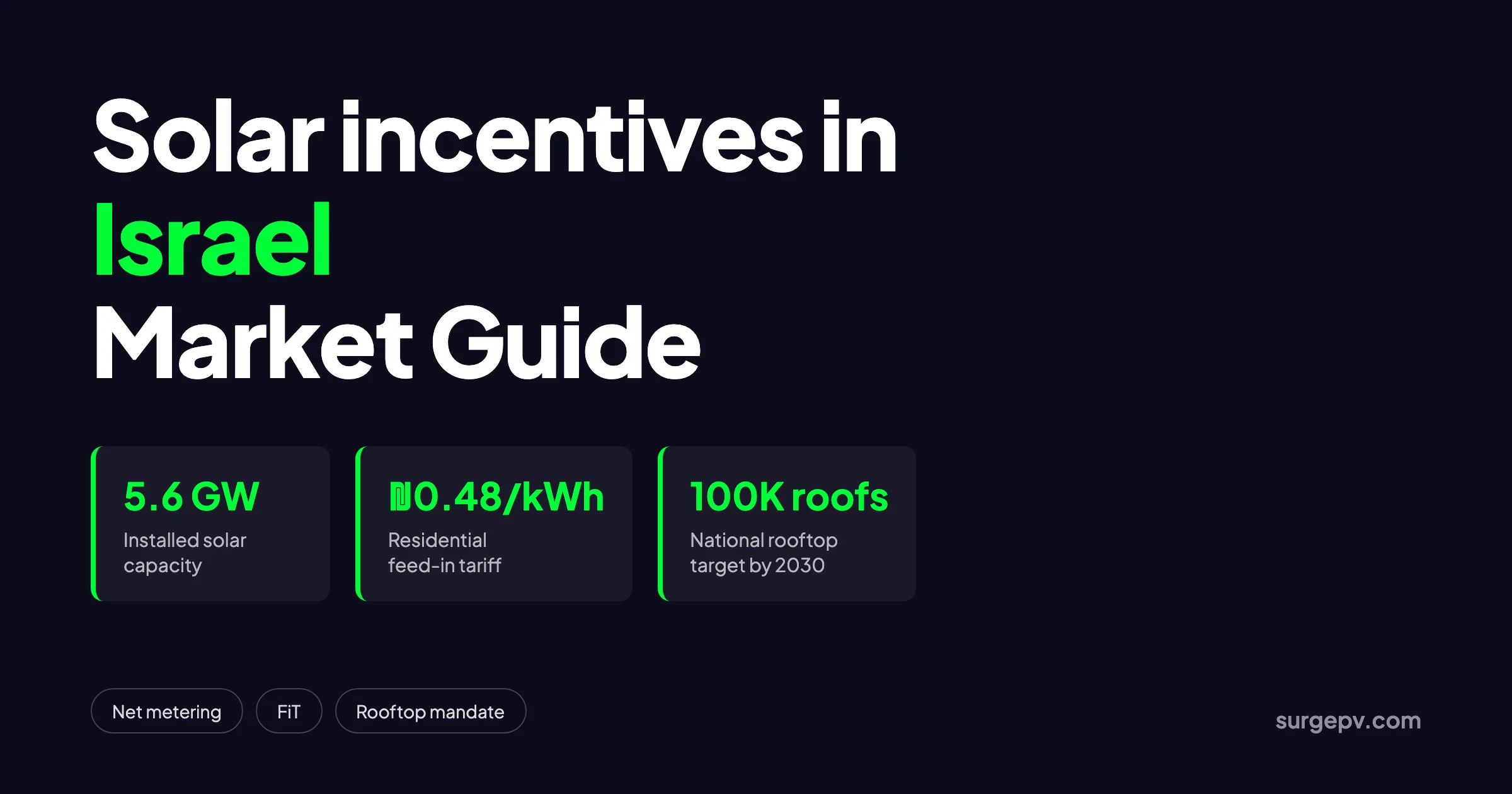
Israel's 2026 solar incentives combine a mandatory rooftop-solar rule for new buildings, fixed feed-in tariffs of roughly NIS 0.48/kWh (higher in large cities), net metering for surplus, tax breaks for home producers and land lessors, and competitive tenders/PPAs for large-scale and C&I projects.
Israel’s solar market reached a decisive inflection point in late 2025. On 11 December 2025, rooftop photovoltaic systems became mandatory on new residential and many non-residential buildings, turning a feed-in-tariff program into a national building-code requirement. By the end of 2024 the country had roughly 5.6 GW of installed solar capacity, according to IRENA data reported by StatRanker (2026). The government is targeting 30% renewable electricity by 2030, yet renewable generation still supplies only about 15% of the country’s electricity, according to Globes (2025). That gap is the market opportunity.
For installers, EPCs and property developers, the incentive stack matters: a base feed-in tariff around NIS 0.48/kWh for small rooftop systems, higher rates in large cities, net metering for surplus, income-tax relief and accelerated depreciation, streamlined permitting for new buildings, and utility-scale tenders that have pushed PPAs below NIS 0.07/kWh. This guide explains how each mechanism works, who qualifies, and where the economics break.
If you are modeling Israeli systems for clients, a solar design platform that handles local tariffs, self-consumption ratios and export values can cut hours from every project. Generate solar proposals in minutes, or check pricing and request a demo to see how SurgePV handles Israel.
TL;DR — Solar Incentives in Israel 2026
Active mechanisms: mandatory rooftop PV on new buildings from December 2025, residential feed-in tariffs around NIS 0.48–0.56/kWh, net metering for surplus, income-tax relief and 25% depreciation, municipal/betterment levy exemptions for small systems, and competitive tenders/PPAs for large-scale and C&I solar-plus-storage projects.
In this guide:
- Latest 2026 status of every active Israeli solar incentive
- Mandatory rooftop solar: rules, exemptions and sizing
- How net metering and feed-in tariffs actually work
- Optional two-track tariff reform and its impact on payback
- Tax breaks, depreciation and hidden charges
- Large-scale tenders, storage auctions and corporate PPAs
- Common mistakes and how to avoid them
- Three real-world payback scenarios
Latest Updates: Israel Solar Incentives 2026
The Israeli framework is not a single subsidy. It is a layered set of regulations, tariffs and tax treatments that changed shape in 2025 and early 2026.
Israel Solar Incentive Status — June 2026
| Incentive | Type | Status | Key Terms |
|---|---|---|---|
| Mandatory rooftop solar on new buildings | Building-code requirement | Active from 11 Dec 2025 | Min 5 kW for homes; non-residential: roof area ÷ 20, capped at 15 kW |
| Residential feed-in tariff | Fixed FiT | Active | ~NIS 0.48/kWh for systems up to 15 kW; ~NIS 0.56/kWh in large cities |
| Two-track tariff reform | Optional tariff routes | Proposed / optional | Fast-return track: NIS 0.60/kWh for 5 years, then NIS 0.3807; CPI-linked track: NIS 0.39 starting |
| Net metering | Surplus compensation | Active | Self-consumption offsets retail bill; surplus paid at FiT |
| System-management charge | Grid-use fee | Active | ~NIS 0.09/kWh on self-consumed solar electricity |
| Income-tax relief for home producers | Tax benefit | Active | Exemptions/relief under the Law to Encourage Investment in Renewable Energies |
| 25% accelerated depreciation | Tax benefit | Active | For PV or solar-thermal generation facilities |
| Municipal/betterment levy exemptions | Local tax relief | Active for small systems | Exemptions for qualifying small renewable-energy installations |
| Utility-scale solar tenders | Auction / PPA | Active | Record low tariffs; 20-year contracts |
| 1.5 GW storage tender (Feb 2025) | Grid-scale storage | Awarded | Winners include Enlight, EDF and Ormat |
| C&I rooftop program | Auction | Active 2025–2030 | 1.6 GW target; 100 MW/year small systems, 400 MW/year larger systems |
Key Takeaway
2026 is a transition year. The most reliable incentives for residential and small commercial projects are the mandatory-building-code route, the fixed feed-in tariff and tax relief. For larger projects, bankability depends on auction PPAs and storage co-location.
Why Israel’s Solar Market Matters in 2026
Israel has some of the best solar resources in the Middle East. The Negev and Arava deserts receive roughly 2,200–2,800 kWh/m²/year of solar irradiation, according to Mordor Intelligence (2026). Solar capacity factors in the south can exceed 25%, making PV the country’s cheapest new-build generation source.
Targets and Progress
Israel’s official target is 30% renewable electricity by 2030, with an interim goal of 20% by the end of 2025, according to Israel’s updated NDC (2021). Coal-fired generation is scheduled to end by 2026. The Ministry of Environmental Protection has also published a roadmap that explores a 40% renewable share by 2030, which would require 18–23 GW of solar and 5.5 GW/33 GWh of storage, according to Enerdata (2022).
By the end of 2024, installed solar capacity stood at roughly 5.6 GW, up from 4.8 GW a year earlier, according to StatRanker (2026) citing IRENA. Solar made up about 88.85% of Israel’s installed renewable capacity in 2025, according to Mordor Intelligence (2026). Closing the gap to 30% requires adding several gigawatts every year through the end of the decade.
Cost Competitiveness
Utility-scale solar is already the cheapest new-build option. In 2024, EDF Renewables won a 300 MW tender in the Negev with a bid of ILS 0.07/kWh, equivalent to roughly USD 0.019/kWh, according to TaiyangNews (2024). In May 2026, EDF closed financing for the 265 MW Dimona project at under NIS 0.065/kWh, the lowest tariff recorded in the country, according to Globes (2026).
That cost advantage is now being pushed down to rooftops through the mandatory rule and up to large projects through storage-tender requirements.
Mandatory Rooftop Solar on New Buildings
Israel became one of the first countries to make rooftop PV a national building-code requirement. The regulation took effect on 11 December 2025.
Who Must Install
Under rules approved by the National Planning and Building Council and the Ministry of Energy and Infrastructure, two categories of buildings must install solar, according to Globes (2025):
- New detached homes with roof areas larger than 100 m² must install a minimum 5 kW PV system.
- New non-residential buildings with rooftops larger than 250 m² must install capacity equal to the roof area in m² divided by 20, capped at 15 kW.
A 250 m² non-residential roof therefore requires 12.5 kW. A 300 m² or larger roof hits the 15 kW cap.
Exemptions
The following are exempt from the mandate:
- Wall-less sheds and agricultural structures
- Jewish ritual baths (mikvahs)
- Buildings on the immediate coastline
- Protected historical structures
- Low-pitched or structurally unsuitable roofs
- City engineers may waive the requirement where solar would conflict with architectural or development plans
Expected Capacity Impact
The Ministry estimates the mandate will add 100,000 to 150,000 solar rooftops by 2030 and up to 3,500 MW of capacity by 2040, according to TaiyangNews (2025). Because most of the obligated roof area sits on large non-residential buildings, roughly 75% of the added capacity is expected to come from commercial and industrial rooftops, even though the residential rule grabs the headlines.
Installation Cost
A typical residential rooftop installation costs between NIS 45,000 and NIS 90,000, according to a GreenDays price review cited by Globes (2025). Adding battery storage raises the price but is not required by law.
Net Metering and Feed-in Tariffs
Israel’s small-scale solar program is best understood as a net-metering and feed-in-tariff hybrid. The system owner consumes solar electricity on site, reducing the bill at the full retail rate. Surplus generation is exported to the grid and paid at a fixed feed-in tariff.
Current Tariffs
As of 2026, the standard residential feed-in tariff is about NIS 0.48/kWh for rooftop systems producing up to 15 kW, according to PV Magazine (2025). In large cities with populations over 50,000, the tariff can rise to roughly NIS 0.56/kWh, according to Globes (2025). Both rates are typically locked for 25 years.
For comparison, large commercial solar fields receive tariffs around NIS 0.07/kWh, according to Globes (2026). That spread is deliberate: it compensates homeowners for the higher per-kWh cost of small urban systems while steering the bulk of cheap capacity toward utility-scale projects.
Optional Two-Track Reform
In March 2025, the Ministry of Energy and Infrastructure proposed two alternative tariff tracks, according to PV Magazine (2025):
- Fast-return track: NIS 0.60/kWh for the first five years, then NIS 0.3807/kWh for the remaining contract term. Available for systems up to 30 kW, but the higher rate applies only to the first 15 kW.
- Inflation-linked track: A starting tariff of NIS 0.39/kWh, adjusted upward by the Consumer Price Index over time. Available for systems up to 15 kW.
The two tracks are designed to produce the same total payments over the contract life, but they shift cash flow. The fast-return track improves early payback, while the CPI-linked track protects against inflation.
The Hidden Charge That Erodes Returns
Every kWh consumed on site is also subject to a system-management charge of roughly NIS 0.09/kWh, according to Globes (2026). The Israel Electric Corporation began collecting this charge from October 2025 and billed some homeowners retroactively for prior periods. The charge covers grid balancing and frequency services, but it was not always disclosed clearly by installers.
For a household that self-consumes 5,000 kWh per year, the charge adds roughly NIS 450 to annual costs. That is enough to extend payback by several months. Good proposals should model it explicitly.
Retail Tariff Context
The value of self-consumption is the retail tariff avoided. Israeli household tariffs vary by consumption block but are generally well above the export FiT. That is why the standard design rule is the same as in other net-metering markets: size the system to maximize self-consumption, not total generation.
A well-modeled generation and financial tool can test each tariff track against the customer’s actual hourly load profile.
Tax and Fiscal Incentives
Israel’s tax benefits are less visible than feed-in tariffs, but they materially improve project economics for homeowners, landlords and project developers.
Income-Tax Relief for Home Producers and Land Lessors
The 2016 Law to Encourage Investment in Renewable Energies grants tax benefits to home electricity producers on income from the sale of solar power, according to Y-Tax (2024). Individuals who lease land or roofs that host PV or wind facilities can choose between:
- A full exemption track, with income up to an annual threshold fully exempt (NIS 5,600 in 2024)
- A reduced final tax rate of 10% on the entire leasing income
The conditions require that the income is not business income, that a written lease confirms renewable-energy use, and that the tax authority is notified.
Accelerated Depreciation
Solar generation facilities qualify for 25% depreciation in the year they enter service, according to Y-Tax (2024). This applies to both photovoltaic and solar-thermal technologies. For investors and businesses, this front-loads the tax shield and improves early cash flow.
Municipal and Betterment Levy Exemptions
Small renewable-energy installations have historically received exemptions from municipal tax and betterment levies, and permitting has been streamlined, according to OECD (2020). These local-level benefits reduce both upfront and ongoing costs for distributed systems.
VAT and Import Duty
Most solar equipment transactions are subject to Israel’s standard VAT. Import-duty treatment depends on whether the equipment qualifies under the Encouragement of Capital Investments Law or other sectoral exemptions. Because VAT and customs rules change frequently and depend on invoice structure, installers should confirm treatment with a local tax advisor before procurement.
Large-Scale, C&I and Storage Incentives
While residential rooftops get the highest per-kWh tariffs, the bulk of Israel’s renewable growth will come from auctions, corporate PPAs and storage.
Utility-Scale Tenders
The Electricity Authority and Ministry of Finance issue competitive tenders for solar and solar-plus-storage projects. Winners receive long-term power purchase agreements, typically for 20 to 25 years. Recent results show how far prices have fallen:
- EDF Renewables’ 300 MW Dimona project: ILS 0.07/kWh (USD 0.019/kWh) in 2024, according to TaiyangNews (2024)
- EDF’s 265 MW Dimona financial close in 2026: under NIS 0.065/kWh, according to Globes (2026)
These tariffs make solar cheaper than new gas-fired generation and close to the marginal cost of existing gas plants.
Storage Auctions
In February 2025, the Electricity Authority awarded 1.5 GW of grid-scale battery storage across northern Israel, the Arava and the Western Negev. Winning developers included Enlight, EDF and Ormat, with prices between roughly USD 49 and USD 74 per kWh of storage capacity, according to ESS News (2025). The projects are expected online by 2027 and are designed to absorb midday solar surplus and discharge during evening peak.
C&I Rooftop Program
Israel’s Electricity Authority runs a dedicated rooftop program aiming to add 1.6 GW by 2030, according to PVKnowHow (2025). The program allocates:
- 100 MW per year for smaller systems between 10 kW and 400 kW
- 400 MW per year for larger systems between 400 kW and 5 MW
Each annual auction is split equally between residential and commercial sectors. Expected tariffs are lower than the residential FiT, around NIS 0.30–0.32/kWh, so C&I projects must rely on high self-consumption or corporate PPAs.
Corporate PPAs
A 2024 deregulation allowed direct power purchase agreements, letting large consumers contract renewable energy without going through the Israel Electric Corporation. Tech campuses, defense contractors and industrial facilities are now signing 10- to 20-year PPAs that bundle solar and battery capacity for 24/7 clean power, according to Mordor Intelligence (2026).
For C&I installers, the design priorities shift from bill offset to demand-charge analysis, load profiling and shadow analysis.
Notable Projects and Market Players
Israel’s pipeline is dominated by a handful of integrated developers and a fast-growing storage sector. These projects set the tariff and technology benchmarks that smaller installers and EPCs must beat.
- Ashalim Solar Thermal Power Station (Negev): a 121 MW concentrating solar power tower with molten-salt storage, completed in 2019. It remains Israel’s flagship dispatchable renewable asset and the benchmark for solar-plus-storage proposals.
- Ketura Sun (Arava Valley): one of Israel’s first commercial PV plants at 4.95 MW, originally developed by Arava Power. Its early feed-in contract helped prove that commercial solar could compete with conventional generation in Israel’s sunny south.
- EDF Renewables Dimona complex: a 300 MW solar PV project awarded at a record-low tariff around ILS 0.07/kWh in 2024, with 265 MW reaching financial close in 2026 under a tariff below NIS 0.065/kWh, according to Globes (2026). The project demonstrates the scale and financing depth that global developers now bring to Israel.
- Enlight Renewable Energy solar-plus-storage cluster: a 254 MW solar PV plant paired with 594 MWh of battery storage, selected in recent storage auctions. Co-locating solar and storage lets the project reduce midday curtailment and capture evening peak pricing.
- Doral Group, Shikun & Binui and Ormat: active across C&I rooftop leasing, ground-mounted EPC and grid-scale storage, with projects in northern Israel, the Arava and the Western Negev, according to PVKnowHow (2025).
For a residential installer, these large projects may seem remote. They are not. Their PPA tariffs anchor the price that the electricity sector is willing to pay for new solar, which shapes how aggressively the Ministry of Energy can cut rooftop feed-in tariffs in future years.
Common Mistakes and Tradeoffs
Even experienced installers lose money in Israel by misunderstanding how incentives interact. Here are the most common errors.
Oversizing for Export
A rooftop kWh exported to the grid is worth the feed-in tariff, not the retail rate. At current rates, every exported kWh in a large city is worth roughly NIS 0.56, while every self-consumed kWh avoids a retail bill that can exceed NIS 0.65. Size for self-consumption first.
Ignoring System-Management Charges
The NIS 0.09/kWh charge on self-consumed solar electricity is real and now being enforced. Proposals that ignore it overstate returns. Model it from day one.
Assuming One National Tariff
City size changes the feed-in tariff. A 5 kW system in Tel Aviv does not earn the same export rate as an identical system in a small town. Verify the municipality tier before quoting.
Designing for Irradiance Without Checking Grid Headroom
Three high-renewable zones already exceed local switching-station ratings at midday, forcing 5–8% curtailment in 2024, according to Mordor Intelligence (2026). The Israel Electric Corporation plans to invest NIS 20 billion by 2027 to add 738 km of 400 kV lines, but the build-out lags behind solar additions. Developers now pre-screen sites for grid headroom before they optimize for irradiance.
Treating the Residential FiT as Permanent
The high residential feed-in tariff is expensive for the electricity sector. A National Economic Council study cited by Globes (2025) found that large ground-mounted solar fields are more cost-effective for the economy than widespread rooftop subsidies. The Ministry of Energy defends rooftops on energy-security and land-scarcity grounds, but the tariff for new installers could fall after 2026.
The honest tradeoff is this: rooftop solar is attractive for individual homeowners today, but it is not the cheapest path for the national system. A proposal that presents only the homeowner view without mentioning the regulatory risk is incomplete.
How the Incentives Stack: Three Scenarios
The examples below are illustrative. They use 2026 market assumptions and do not replace a site-specific feasibility study.
Scenario 1 — 5 kW Residential Rooftop, Tel Aviv
| Item | Amount |
|---|---|
| Installed cost | NIS 55,000 |
| Annual generation | 8,000 kWh |
| Self-consumption (60%) | 4,800 kWh |
| Retail tariff avoided | NIS 0.65/kWh |
| Self-consumption value | NIS 3,120/year |
| Export (40%) at large-city FiT | 3,200 kWh × NIS 0.56 = NIS 1,792/year |
| System-management charge on self-consumption | 4,800 × NIS 0.09 = NIS 432/year |
| Net annual benefit | ~NIS 4,480/year |
| Simple payback | ~12 years |
If the household self-consumes only 40% and lives outside a large city, payback stretches closer to 15 years. The Ministry’s 15% annual return figure depends on high self-consumption, high retail tariffs and optimistic cost assumptions.
Scenario 2 — 100 kW Commercial Rooftop, Central Israel
| Item | Amount |
|---|---|
| Installed cost | NIS 220,000 |
| Annual generation | 150,000 kWh |
| Self-consumption (85%) | 127,500 kWh |
| Retail tariff avoided | NIS 0.55/kWh |
| Self-consumption value | NIS 70,125/year |
| Export (15%) at C&I rate | 22,500 × NIS 0.30 = NIS 6,750/year |
| System-management charge | 127,500 × NIS 0.09 = NIS 11,475/year |
| Net annual benefit | ~NIS 65,400/year |
| Simple payback | ~3.4 years |
High self-consumption is the driver. A factory that operates daytime shifts can capture most of the value at the retail tariff.
Scenario 3 — 300 MW Utility-Scale Solar Park, Negev
| Item | Amount |
|---|---|
| PPA tariff | NIS 0.065/kWh |
| Capacity factor | ~25% |
| Annual generation | ~657 GWh |
| Annual PPA revenue | ~NIS 42.7 million |
| Storage co-location | 4-hour battery, ~20% of solar capacity |
| Project IRR | Mid-teens, depending on capex and financing |
Utility-scale economics depend on land availability, grid connection cost, module pricing and the storage tender outcome. The record-low PPA tariffs leave little margin for cost overruns.
Conclusion
Israel’s 2026 solar incentive framework is a stack built from a building-code mandate, high residential feed-in tariffs, net metering, tax relief and competitive large-scale auctions. None of these mechanisms is as simple as a single upfront rebate, but combined they make solar attractive across residential, commercial and utility-scale segments.
For solar professionals, the competitive edge is no longer just installation price. It is the ability to model the right tariff track, size for self-consumption, disclose hidden charges and verify grid headroom. Tools like Clara AI and SurgePV’s PV generation and financial modeling can automate that workflow for Israeli projects.
Three actions to take now:
- Verify the tariff tier before sizing — city size changes the feed-in tariff, and optional tracks change payback.
- Model system-management charges — the NIS 0.09/kWh charge on self-consumed energy is real and now enforced.
- Size for self-consumption — exported rooftop energy is worth far less than avoided retail purchases.
For regional comparisons, see our solar payback period by country guide. For installers scaling in Israel, our guide for solar installers covers proposal automation and compliance workflows.
Frequently Asked Questions
What solar incentives are available in Israel in 2026?
Israel’s 2026 solar incentives include mandatory rooftop PV on new buildings, a base residential feed-in tariff around NIS 0.48/kWh (higher in large cities), optional fast-return and inflation-linked tariff tracks, net metering for surplus, income-tax relief and 25% depreciation, municipal/betterment levy exemptions for small systems, and competitive tenders/PPAs for utility-scale and C&I projects.
How does net metering work in Israel?
Solar generation first offsets on-site consumption at the retail tariff. Surplus electricity is exported to the grid and paid at a fixed feed-in tariff. Self-consumed solar is also subject to a system-management charge of roughly NIS 0.09/kWh for grid balancing and frequency services.
What is the feed-in tariff for rooftop solar in Israel?
Small rooftop systems up to 15 kW typically receive about NIS 0.48/kWh on a 25-year contract. In large cities with populations over 50,000, the rate can reach roughly NIS 0.56/kWh. Optional tracks include a fast-return rate of NIS 0.60/kWh for five years followed by NIS 0.3807/kWh, and an inflation-linked track starting at NIS 0.39/kWh.
Is rooftop solar mandatory on new buildings in Israel?
Yes. From 11 December 2025, new detached homes with roofs over 100 m² must install at least 5 kW of PV. New non-residential buildings with rooftops over 250 m² must install capacity equal to roof area divided by 20, capped at 15 kW. Several exemptions apply, including sheds, protected buildings and coastal front-line structures.
What tax benefits exist for solar panels in Israel?
The Law to Encourage Investment in Renewable Energies offers income-tax relief on electricity sales and on income from leasing roofs or land that host PV. Solar facilities also qualify for 25% accelerated depreciation. Small installations may be exempt from municipal tax and betterment levies. VAT and import-duty treatment depend on the specific transaction.
What is the typical payback period for residential solar in Israel?
The Ministry of Energy estimates annual returns of up to 15%, implying simple paybacks of roughly 6 to 8 years for well-sited systems. Real-world payback depends on self-consumption ratio, retail tariff, city-specific FiT, system-management charges and installation cost.
Can commercial and industrial projects access solar incentives in Israel?
Yes. C&I projects can participate in the 1.6 GW national rooftop program, sign corporate PPAs under 2024 deregulation, or compete in utility-scale tenders. Large rooftop or ground-mounted systems receive much lower export tariffs than residential systems, so C&I economics rely on high self-consumption or long-term PPAs.
What are the main mistakes when sizing a solar system in Israel?
The most common mistakes are oversizing for export, ignoring the NIS 0.09/kWh system-management charge, assuming one national tariff when city size changes the rate, and designing for irradiance without checking grid headroom. In 2026, export value is lower than avoided retail purchases, so systems should maximize self-consumption.
How do large-scale solar tenders work in Israel?
The Electricity Authority and Ministry of Finance run competitive auctions for solar and solar-plus-storage projects. Winners receive long-term PPAs. Recent results include EDF Renewables’ 300 MW Dimona project at a record low tariff and a February 2025 tender that awarded 1.5 GW of battery storage.
Are batteries subsidized in Israel?
There is no dedicated national subsidy for home batteries in 2026. Batteries are optional under the rooftop mandate, with the owner bearing the cost. Grid-scale storage is procured through competitive tenders, with 1.5 GW awarded in February 2025 to support solar integration.
Where this fits
This article is part of SurgePV's Solar Incentives & Policy hub, which works through the topic from first principles to the decisions a project team actually has to make.

