

Answer
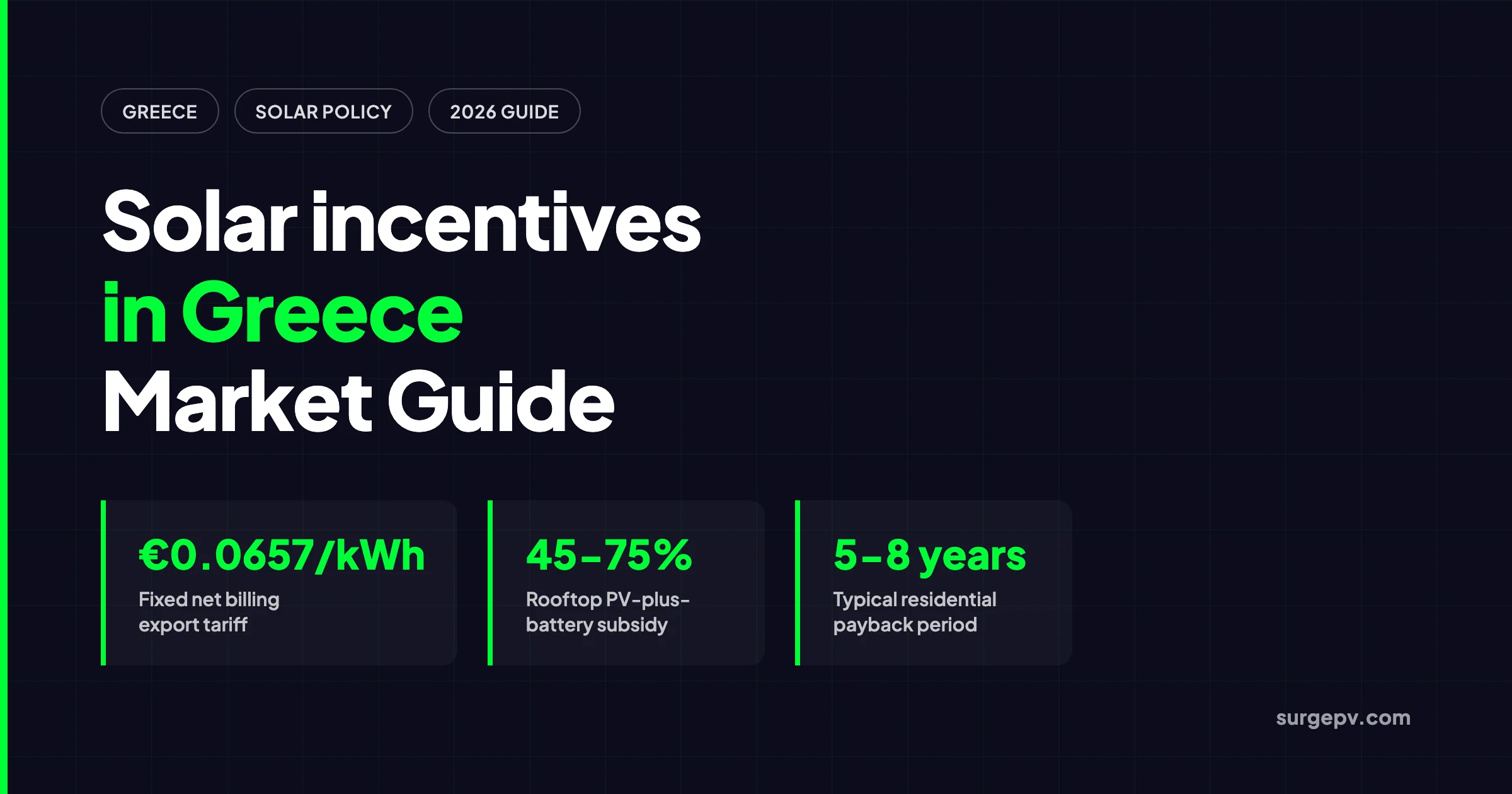
Greece solar incentives in 2026 focus on net billing (active since September 2024), the 'Photovoltaics on the Roof' subsidy covering 45-75% of household PV-plus-battery costs, and energy community virtual net metering. A typical 6 kWp residential system costs €6,300-€8,700 before subsidies and pays back in 5-8 years in Athens or Thessaloniki.
Greece added roughly 1.9 GW of solar in 2025, bringing cumulative installed capacity to about 11.5 GW, according to the Hellenic Association of Photovoltaic Companies (HELAPCO). That is a sharp slowdown from the 2.6 GW installed in 2024, but it still places Greece among the fastest-growing solar markets in Europe, according to pv magazine and HELAPCO estimates. The bigger story is not the headline capacity number. It is the policy reset that happened underneath it.
In May 2024, Greece closed net metering to most new applicants under Law 5106/2024. In September 2024, a net billing framework took over. A €238 million rooftop PV-plus-storage subsidy program began paying grants through the Greece 2.0 Recovery and Resilience Facility. Energy communities gained clearer rules under Law 4513/2018. For homeowners, installers, and EPCs, the question is no longer whether solar works in Greece. It is which incentive regime applies, how to structure the application, and what the new economics look like after the switch from net metering to net billing.
This guide covers every active Greece solar incentive in 2026: net billing mechanics, the “Photovoltaics on the Roof” grant, energy community virtual net metering, tax treatment, current installation costs, payback periods by region, and the practical mistakes that delay approvals or reduce returns. For context on how Greece fits into the broader European framework, see our guide to solar self-consumption rules in Europe. For teams designing Greek projects, solar design platform with local tariff and incentive data can speed up accurate proposals. Use a cloud solar design platform that models HEDNO net billing, shadow analysis for Greek roof geometries, and financial payback automatically. See SurgePV pricing or book a demo for Greece-specific modeling.
Quick Answer
Greece solar incentives in 2026 focus on net billing (active since September 2024), the “Photovoltaics on the Roof” subsidy covering 45-75% of household PV-plus-battery costs, and energy community virtual net metering. A typical 6 kWp residential system costs €6,300-€8,700 before subsidies and pays back in 5-8 years in Athens or Thessaloniki.
TL;DR — Solar incentives in Greece 2026
Net metering is closed to most new applicants as of May 2024. Net billing pays €0.0657/kWh for exports under 20-year contracts. The “Photovoltaics on the Roof” program covers 45-75% of household PV-plus-battery costs. Energy communities can share solar through virtual net metering. Residential payback is 5-8 years on the mainland and 4-6 years on islands. Total Greek solar capacity is on track to exceed the 13.5 GW 2030 target during 2026.
In this guide:
- Latest 2026 policy updates — Greece solar incentive status table
- Net metering vs net billing: what changed and who still qualifies
- The “Photovoltaics on the Roof” subsidy program explained
- Energy communities and virtual net metering rules
- Tax incentives and VAT treatment for Greek solar
- Solar installation costs and payback by region
- Utility-scale solar, auctions, and corporate PPAs
- Common mistakes, tradeoffs, and installer tips
- FAQ
Solar incentives in Greece 2026: Quick Answer
Greece’s solar incentive framework shifted decisively in 2024. The country moved from retail-rate net metering to a net billing model that values exported electricity at the wholesale price. For most homeowners and businesses, the core incentive is now the combination of high retail electricity prices (€0.22-€0.30/kWh), the fixed net billing export tariff (€0.0657/kWh), and the “Photovoltaics on the Roof” capital grant for PV-plus-storage systems.
| Incentive | Status 2026 | Key Detail |
|---|---|---|
| Net metering | Restricted | Only municipalities, government bodies, farmers up to 30 kW, and energy-poverty households |
| Net billing | Active | 15-minute settlement; fixed export tariff €65.74/MWh for systems up to 1 MWp; 20-year contract |
| Photovoltaics on the Roof grant | Active (budget-limited) | 45-75% household PV-plus-battery subsidy; 40-60% farmer subsidy |
| Energy community virtual net metering | Active | Collective sharing within same network area; up to 1 MWp or 3 MWp |
| VAT on residential solar exports | Exempt | Residential prosumer exports carry no VAT |
| Feed-in tariffs for small PV | Largely closed | New systems generally require competitive auctions or merchant market exposure |
The practical impact: a well-designed residential system in Athens or Thessaloniki still pays back in 5-8 years, but the design priority has changed. Maximizing self-consumption now matters more than maximizing exported energy, because a self-consumed kilowatt-hour avoids the full retail rate while an exported kilowatt-hour earns only the wholesale-linked net billing tariff.
Latest updates: Greece solar policy status 2026
For anyone tracking Greece solar incentives news today, the most important fact is the 2024 switch from net metering to net billing. Law 5106/2024, published in May 2024, rewrote the rules for distributed solar. It also introduced tighter capacity limits, expanded curtailment authority for grid operators, and clarified the pathway for energy communities.
Greece solar incentive status — June 2026
| Program / Mechanism | Status | Key Detail |
|---|---|---|
| Net metering | Restricted | Closed to most new applicants from May 16, 2024 |
| Net billing | Active | Fixed €65.74/MWh export tariff; 20-year contract; up to 1 MWp |
| Photovoltaics on the Roof grant | Active | €238 million RRF-funded; PV-plus-battery; first-come, first-served |
| Energy community virtual net metering | Active | Law 4513/2018 framework; same network area sharing |
| Small PV feed-in tariff | Closed (with limited extensions) | New systems generally go to auction or merchant market |
| Utility-scale auctions | Active | RAE competitive procedures for projects above certain thresholds |
| VAT on residential exports | Exempt | No VAT on prosumer export income for households |
| Prosumer capacity limits | Reduced | 10 kW households, 100 kW businesses under Law 5106/2024 |
| Grid curtailment framework | Expanded | IPTO and HEDNO can curtail RES injection to manage congestion |
Key changes since 2024
Net metering closure. Law 5106/2024 ended net metering for most new residential and commercial prosumers. HEDNO continued accepting new net metering applications only for specific categories after the law took effect: the “Photovoltaics on the Roof” program until its deadline, farmers up to 30 kW, general government bodies, and systems serving energy-poverty households.
Net billing launch. From September 2024, new prosumers move to net billing. Surplus energy is settled at 15-minute intervals based on wholesale prices, but prosumers can lock in a fixed export tariff of €65.74/MWh (€0.0657/kWh) for 20 years for systems up to 1 MWp.
Capacity caps tightened. Household prosumers are now limited to 10 kW maximum installed capacity. Business prosumers are limited to 100 kW. These caps were reduced from previous limits of up to 3 MW, drawing criticism from industrial consumers who argued the change hurts competitiveness, as reported by Balkan Green Energy News.
Curtailment rules expanded. Law 5106/2024 gave IPTO (Independent Power Transmission Operator) and HEDNO (Hellenic Electricity Distribution Network Operator) broader authority to curtail renewable energy injection to manage grid congestion. This matters for utility-scale and large commercial projects because curtailment reached an estimated 2 TWh in 2025 and could rise further.
Key Takeaway — 2026 Incentive Priority
The most important action for Greek solar in 2026 is to confirm which regime applies before designing the system. Net metering is no longer the default. Households should check eligibility for the “Photovoltaics on the Roof” grant immediately because the budget is finite and allocated first-come, first-served. Businesses should model net billing economics with 15-minute settlement and the fixed export tariff rather than assuming retail-rate net metering.
Net metering vs net billing in Greece
Understanding the difference between net metering and net billing is the single most important step for any Greek solar project in 2026. The two mechanisms sound similar but produce very different financial outcomes.
How Greek net metering worked
Under net metering, exported solar electricity was credited against grid consumption, usually on an annual basis. A kilowatt-hour exported during the day offset a kilowatt-hour imported at night, valued at the retail electricity rate. This made oversizing attractive because every exported unit was worth roughly the same as a consumed unit.
Net metering in Greece was governed by Article 14A of Law 3468/2006 and ministerial decisions. It was a major driver of the 400 MW of net-metered solar installed in 2024 before the May cutoff, including approximately 300 MW commercial and 100 MW residential.
How Greek net billing works
Net billing separates consumption and production financially. Surplus electricity is sold to the grid at a market-based or regulated export price. The consumer still buys grid electricity at the retail rate. The two flows are settled in euros, not in kilowatt-hours.
Key parameters of Greek net billing in 2026:
- Settlement interval: 15 minutes
- Fixed export tariff option: €65.74/MWh (€0.0657/kWh) for systems up to 1 MWp
- Contract duration: 20 years
- VAT on residential exports: Exempt
- Eligible systems: Most new residential and commercial prosumers after September 2024
The fixed export tariff is the safety net. Without it, prosumer exports would be exposed to wholesale price volatility, which has seen low and even negative prices during sunny midday periods in Greece.
Why the shift matters for payback
Under net metering, a kilowatt-hour exported was worth roughly €0.22-€0.30, the retail rate. Under net billing, that same kilowatt-hour earns €0.0657. The value of self-consumption has therefore increased by a factor of approximately 3-5.
This changes system design priorities:
- Size to consumption, not roof area. Oversizing no longer pays because exports are worth less.
- Add storage. A battery shifts midday solar generation to evening consumption, increasing self-consumption and avoiding the retail rate.
- Shift loads. Running washing machines, EV chargers, and heat pumps during solar production hours improves economics.
A 6 kWp system in Athens that self-consumes 60% of its output under net billing will save more than a 10 kWp system that exports 70% of its output, even though the smaller system costs less upfront.
Who still qualifies for net metering
Net metering remains available only for:
- Municipalities and general government bodies
- Farmers with systems up to 30 kW for agricultural use
- Households in certified energy poverty
- Systems already approved under transitional rules before the May 2024 cutoff
Everyone else must use net billing. Installers who quote Greek projects using outdated net metering assumptions will understate payback periods and overstate returns.
The “Photovoltaics on the Roof” subsidy program
The most significant direct subsidy for Greek solar in 2026 is the “Photovoltaics on the Roof” program (Φωτοβολταϊκά στη Στέγη). It is funded through Greece’s Recovery and Resilience Facility allocation (Greece 2.0) and administered by HEDNO.
Program basics
| Element | Detail |
|---|---|
| Total budget | €238 million |
| Target beneficiaries | Households and farmers |
| System type | Rooftop PV with battery storage |
| Maximum household grant | €16,000 |
| Maximum farmer grant | €10,000 |
| PV subsidy rate (households) | 45-75% depending on income |
| PV subsidy rate (farmers) | 40-60% |
| Battery subsidy rate | 90-100% |
| Administration | HEDNO |
The program is structured in income tiers. Vulnerable households, people with disabilities, single parents, and multi-child families receive priority access and the highest subsidy rates. Households with individual income up to €20,000 or family income up to €40,000 receive support from a €100 million tranche. Households above those thresholds access a separate €63 million tranche at lower rates.
Why batteries are mandatory
The program requires battery installation. This is not accidental. Greece’s grid is experiencing high solar penetration and rising curtailment. By pairing PV with storage, the program increases self-consumption, reduces evening peak demand, and provides flexibility to the distribution network.
A typical household system under the program might look like this:
- 5 kWp rooftop PV
- 5-10 kWh lithium-ion battery
- Smart inverter and monitoring
- Total cost before subsidy: €8,000-€12,000
- Net cost after 60% grant: €3,200-€4,800
Application process
Applications are submitted through the HEDNO program portal. The process generally requires:
- Property ownership or legal use documentation
- Recent tax clearance and income statements
- Technical study from a licensed installer
- HEDNO connection application
- Battery and inverter specifications meeting program requirements
Because the program operates on a first-come, first-served basis, eligible households should apply as soon as a qualified installer confirms the project is technically feasible.
Farmer eligibility
Professional and special-status farmers can install PV systems with or without battery storage for self-consumption with virtual net metering. The farmer category has a dedicated €30 million budget. Systems can support agricultural operations such as irrigation, cold storage, and processing.
Pro Tip — Combining Subsidies and Net Billing
The “Photovoltaics on the Roof” grant reduces upfront capital, while net billing provides long-term export income. Design the system for maximum self-consumption, not maximum production. A 5 kWp system with a 7 kWh battery will usually outperform a 10 kWp system with no battery under Greece’s 2026 net billing rules.
Energy communities and virtual net metering
Greece’s energy community framework is one of the more developed collective self-consumption models in Southern Europe. It allows groups of households, businesses, municipalities, and farmers to share renewable energy production without every participant needing their own rooftop system.
Legal framework
Energy communities in Greece are governed by Law 4513/2018. They are typically organized as cooperatives and must operate on a not-for-profit or limited-profit basis. The law distinguishes between renewable energy communities and citizen energy communities, aligned with the EU Clean Energy Package.
Key features:
- Cooperative governance: One member, one vote regardless of capital contribution
- Local benefit: Surpluses are reinvested or distributed according to community rules
- Open participation: Natural persons, local authorities, and small enterprises can join
- Vulnerable household inclusion: Energy communities can include low-income households without requiring formal membership
Virtual net metering
Virtual net metering is the mechanism that makes collective sharing work. It allows energy produced at one location to be credited against consumption at other meters within the same administrative region or network area. The physical electricity still flows through the grid, but the billing is adjusted to reflect the shared production.
Under Ministerial Decision 7598/2019, energy communities can develop virtual net metering projects. Important limits include:
- Projects must generally be in the same administrative region as participating consumers
- Exceptions apply for Attica and non-interconnected islands
- Participants must use the same electricity supplier
- Production capacity is typically limited to 100% of members’ consumption
Size limits
Energy community projects can be larger than individual prosumer systems. Depending on structure and location, community solar projects can reach:
- Up to 1 MWp under the standard energy community framework
- Up to 3 MWp for certain cooperative structures under Law 4759/2020
This makes energy communities attractive for apartment buildings, small municipalities, agricultural cooperatives, and commercial clusters that cannot fit enough PV on a single roof.
Why energy communities matter for Greece
More than half of Greek households live in apartment buildings. Many of these buildings have suitable rooftops but fragmented ownership. Energy communities solve the split-incentive problem by allowing residents to co-own a shared system and share the benefits through virtual net metering.
For installers, this is a significant market expansion. A single apartment building project can serve 10-30 households, with a project size of 30-150 kWp. The sales cycle is longer because it requires cooperative formation and member agreements, but the per-project value is higher.
Tax incentives and VAT treatment
Greece’s tax treatment of solar is favorable for residential prosumers but more complex for commercial operators.
VAT on residential solar
Residential solar installations in Greece generally attract the standard VAT rate of 24% on supply and installation, although the exact application can depend on contract structure and whether the system is bundled with energy-saving materials. Importantly, residential prosumer exports under net billing are exempt from VAT.
Unlike Germany, the Netherlands, or Ireland, Greece has not adopted a 0% VAT rate for residential solar as of 2026. This makes the “Photovoltaics on the Roof” grant even more important because it directly offsets the upfront capital cost including VAT.
VAT on commercial solar
Commercial solar installations are subject to standard VAT. Businesses can generally reclaim input VAT on the installation through their regular VAT returns, so the net cash-flow impact is neutral for VAT-registered companies. Export income from net billing is treated as taxable supply at the standard rate.
Income tax treatment
Self-consumed solar electricity is not treated as taxable income for residential prosumers. Export income is generally not significant enough to trigger income tax issues for households.
For businesses, net billing export income is part of taxable revenue. The system is depreciated as a fixed asset, and businesses can deduct operating and maintenance costs. Commercial investors should work with a Greek accountant to optimize depreciation schedules and VAT treatment.
Property tax and permits
Solar installations on rooftops generally do not increase property tax assessments. Ground-mount systems may face different treatment depending on land use and zoning. Building permit requirements vary by municipality, but rooftop systems below certain sizes often qualify for simplified notification rather than full building permits.
Solar costs and payback in Greece
Greece combines high solar irradiance, high electricity prices, and competitive installation costs. These three factors make solar economically attractive even after the shift from net metering to net billing.
Solar installation costs Greece 2026
| System Size | Total Installed Cost | Cost Per kWp | Notes |
|---|---|---|---|
| 3 kWp | €3,150-€4,350 | €1,050-€1,450 | Suitable for small households |
| 5 kWp | €5,250-€7,250 | €1,050-€1,450 | Most common residential size |
| 6 kWp | €6,300-€8,700 | €1,050-€1,450 | Typical family home |
| 8 kWp | €8,400-€11,600 | €1,050-€1,450 | Larger homes or small businesses |
| 10 kWp | €10,500-€14,500 | €1,050-€1,450 | Near household prosumer cap |
All-in costs include monocrystalline PV modules, string or hybrid inverter, mounting system, DC/AC cabling, labor, HEDNO connection application, bidirectional meter, and commissioning. Battery storage adds €4,000-€8,000 for a 5-10 kWh system.
Greek residential costs are competitive by European standards. The solar installation cost per kWp Europe guide places Greece at €1,050-€1,450/kWp, below Germany, France, and Italy.
Regional payback comparison
| Region | Irradiance | Residential Payback (Net Billing) | Notes |
|---|---|---|---|
| Athens / Attica | 1,700-1,900 kWh/m²/year | 5-7 years | Highest demand, strong irradiance |
| Thessaloniki / Central Macedonia | 1,600-1,800 kWh/m²/year | 5-8 years | Good irradiance, lower install costs |
| Crete | 1,800-2,000 kWh/m²/year | 4-6 years | Excellent solar resource |
| Aegean islands | 1,800-2,000 kWh/m²/year | 4-6 years | High electricity prices boost savings |
| Peloponnese | 1,700-1,900 kWh/m²/year | 5-7 years | Strong agricultural PV segment |
| Northern Greece | 1,500-1,700 kWh/m²/year | 6-8 years | Lower irradiance, longer payback |
The mainland averages 5-8 years, while islands can achieve 4-6 years because of higher irradiance and often higher electricity prices. Read more in our solar payback period by country analysis.
Worked example: 6 kWp system in Athens
Consider a household in Athens with a 6 kWp rooftop system costing €7,500 all-in before subsidies. The system produces approximately 9,500 kWh per year. The household consumes 4,500 kWh of that on-site and exports 5,000 kWh.
- Self-consumed value: 4,500 kWh × €0.27/kWh = €1,215/year
- Export value: 5,000 kWh × €0.0657/kWh = €329/year
- Total annual benefit: €1,544/year
- Simple payback: €7,500 / €1,544 = 4.9 years
If the household adds a 7 kWh battery for €5,500 and raises self-consumption from 47% to 72%, the math changes:
- New self-consumed value: 6,840 kWh × €0.27/kWh = €1,847/year
- New export value: 2,660 kWh × €0.0657/kWh = €175/year
- Total annual benefit: €2,022/year
- Total system cost: €13,000 before subsidy
- After 60% Photovoltaics on the Roof grant: €5,200
- Simple payback: €5,200 / €2,022 = 2.6 years
This example shows why the subsidy and storage together can produce payback periods well below the mainland average.
Commercial and industrial economics
Commercial systems in Greece typically cost €720-€920/kWp at 50-200 kWp scale. With net billing, C&I projects must model:
- Self-consumption rate during daylight hours
- Retail electricity rate vs export tariff
- Capacity charges and demand charges
- Curtailment risk for larger systems
A 100 kWp commercial system with 70% self-consumption can achieve 4-6 year payback in high-irradiance regions, but the business case depends heavily on load profile matching.
Utility-scale solar and auctions
While this guide focuses on distributed solar incentives, the utility-scale segment shapes the broader market and affects grid availability for smaller projects.
Market size and growth
Greece installed approximately 1.9 GW of solar in 2025, bringing cumulative capacity to about 11.5 GW, according to pv magazine and HELAPCO estimates. The 2030 target is 13.5 GW, but industry analysts now expect Greece to reach 21.5 GW by 2030 if grid constraints are resolved. The original 2030 target is likely to be met during 2026.
Auction framework
Large-scale solar projects in Greece typically secure revenue through competitive auctions organized by RAE (Regulatory Authority for Energy). Winning projects receive either:
- Feed-in premium contracts: A top-up payment when market prices fall below a reference price
- Power purchase agreements (PPAs): Direct contracts with corporate buyers
Recent auctions have produced some of the lowest solar prices in Europe, with levelized costs for fixed-tilt utility-scale PV estimated at around €33/MWh.
Grid constraints
The biggest risk to Greek solar growth is grid saturation. Greece has licensed approximately 72.4 GW of PV projects against a grid hosting capacity of roughly 19 GW. Curtailment reached an estimated 2 TWh in 2025 and could rise to 3.3-3.7 TWh in 2026.
For distributed solar, this means:
- Connection approvals may take longer in saturated areas
- New projects may face grid reinforcement cost allocations
- Battery storage improves project economics by shifting generation away from midday curtailment hours
Greece is addressing this through transmission upgrades, smart meter deployment, and energy storage tenders. HEDNO signed contracts in 2024 for 2.76 million smart meters, with full deployment targeted by 2030.
Common mistakes and tradeoffs
Greek solar in 2026 rewards careful planning. These are the most common errors and the tradeoffs every prosumer should understand.
Mistake 1: Designing for net metering
Many installers and homeowners still use net metering assumptions. Under net billing, oversizing reduces returns. Design the system to match daytime consumption, with storage to capture evening use.
Mistake 2: Ignoring the 15-minute settlement
Net billing settles at 15-minute intervals. A system that exports heavily at midday and imports heavily in the evening will see lower savings than a system with load shifting or storage. Hourly consumption data is essential for accurate modeling.
Mistake 3: Missing the grant window
The “Photovoltaics on the Roof” program has a finite budget. Households who delay application may find the program closed or their income tier fully subscribed.
Tradeoff: Battery cost vs self-consumption gain
Batteries add €4,000-€8,000 to project cost but can raise self-consumption from 45-55% to 70-80%. In Greece’s net billing environment, the battery payback is typically 3-5 years when combined with the rooftop PV grant.
Tradeoff: Rooftop vs energy community
Households with small or shaded roofs may get better economics by joining an energy community than by installing a small standalone system. Energy communities require more coordination but offer scale advantages and shared maintenance.
Tradeoff: Standard VAT vs grant-eligible installation
Some households consider self-installation or using non-certified installers to save money. This usually disqualifies the project from the “Photovoltaics on the Roof” grant. The grant’s 45-75% subsidy typically outweighs any savings from informal installation.
FAQ
What solar incentives are available in Greece in 2026?
Active Greece solar incentives in 2026 include the net billing framework (replacing net metering for most new prosumers), the “Photovoltaics on the Roof” grant covering 45-75% of PV-plus-battery costs for households and 40-60% for farmers, virtual net metering for energy communities, and a fixed export tariff of €65.74/MWh (€0.0657/kWh) for systems up to 1 MWp under 20-year contracts.
Is net metering still available in Greece in 2026?
Net metering in Greece is now restricted. Law 5106/2024 closed net metering to most new applicants from May 16, 2024. It remains available only to municipalities, general government bodies, farmers up to 30 kW, and households in certified energy poverty. All other residential and commercial prosumers must use the net billing framework that began in September 2024.
How does net billing work in Greece?
Under Greek net billing, surplus solar electricity is settled at 15-minute intervals against wholesale market prices. Prosumer systems up to 1 MWp can sign a 20-year contract at a fixed export tariff of €65.74/MWh (€0.0657/kWh). Consumers pay only for net grid purchases after export credits are applied, and residential exports are exempt from VAT.
What is the “Photovoltaics on the Roof” program in Greece?
The “Photovoltaics on the Roof” (Φωτοβολταϊκά στη Στέγη) program is a €238 million Recovery and Resilience Facility-funded subsidy for rooftop PV systems paired with battery storage. Households receive grants covering 45-75% of eligible costs up to €16,000, while farmers receive 40-60% up to €10,000. Battery storage subsidies reach 90-100%. The program is administered by HEDNO.
How much does a residential solar system cost in Greece in 2026?
Residential solar in Greece costs approximately €1,050-€1,450 per kWp all-in, including panels, inverter, mounting, cabling, labor, permits, and HEDNO connection. A 6 kWp system typically costs €6,300-€8,700 before subsidies. With the “Photovoltaics on the Roof” grant, eligible households can reduce upfront costs by 45-75%.
What is the solar payback period in Greece?
The solar payback period in Greece is 5-8 years for residential systems on the mainland, and 4-6 years on high-irradiance islands such as Crete and Rhodes. High electricity prices (€0.22-€0.30/kWh), strong solar irradiance (1,600-1,900 kWh/m²/year), and available subsidies all support strong returns.
Can apartment buildings share solar in Greece?
Yes. Greece allows virtual net metering for energy communities and collective self-consumption. Apartment buildings and small commercial clusters in the same network area can share production from a single rooftop or ground-mount installation. Energy communities can develop projects up to 1 MWp or 3 MWp depending on structure, with vulnerable households able to participate without becoming formal members.
What is the maximum solar system size for prosumers in Greece?
Law 5106/2024 reduced the maximum capacity for household prosumers to 10 kW and for business prosumers to 100 kW. Energy communities can develop larger shared systems, typically up to 1 MWp under the energy community framework or 3 MWp for specific cooperative structures. Farmers may still qualify for systems up to 30 kW under certain net metering exceptions.
Are solar exports taxed in Greece?
Self-consumed solar electricity is not treated as taxable income in Greece. Residential users are exempt from VAT on exported electricity under the net billing framework. Commercial prosumer systems may face standard VAT and corporate tax treatment on export income, so businesses should confirm their specific structure with a local accountant.
What is Greece’s solar target for 2030?
Greece’s National Energy and Climate Plan targets 13.5 GW of solar capacity by 2030, with some industry observers now forecasting 21.5 GW by 2030. Cumulative installed solar capacity reached approximately 11.5 GW by the end of 2025, meaning the original 2030 target is likely to be met during 2026.
Where this fits
This article is part of SurgePV's Solar Incentives & Policy hub, which works through the topic from first principles to the decisions a project team actually has to make.

