

Answer
Estonia's 2026 solar incentives are narrow but meaningful. Residential installations benefit from 0% VAT. The KredEx small-house reconstruction grant and the apartment-building solar grant are closed to new applicants. Microproducers can receive a €0.0537/kWh feed-in premium, capped at 3.68 kW single-phase or 11 kW three-phase. Commercial and utility-scale projects rely on merchant power sales, PPAs, and standard corporate tax depreciation, not capital grants.
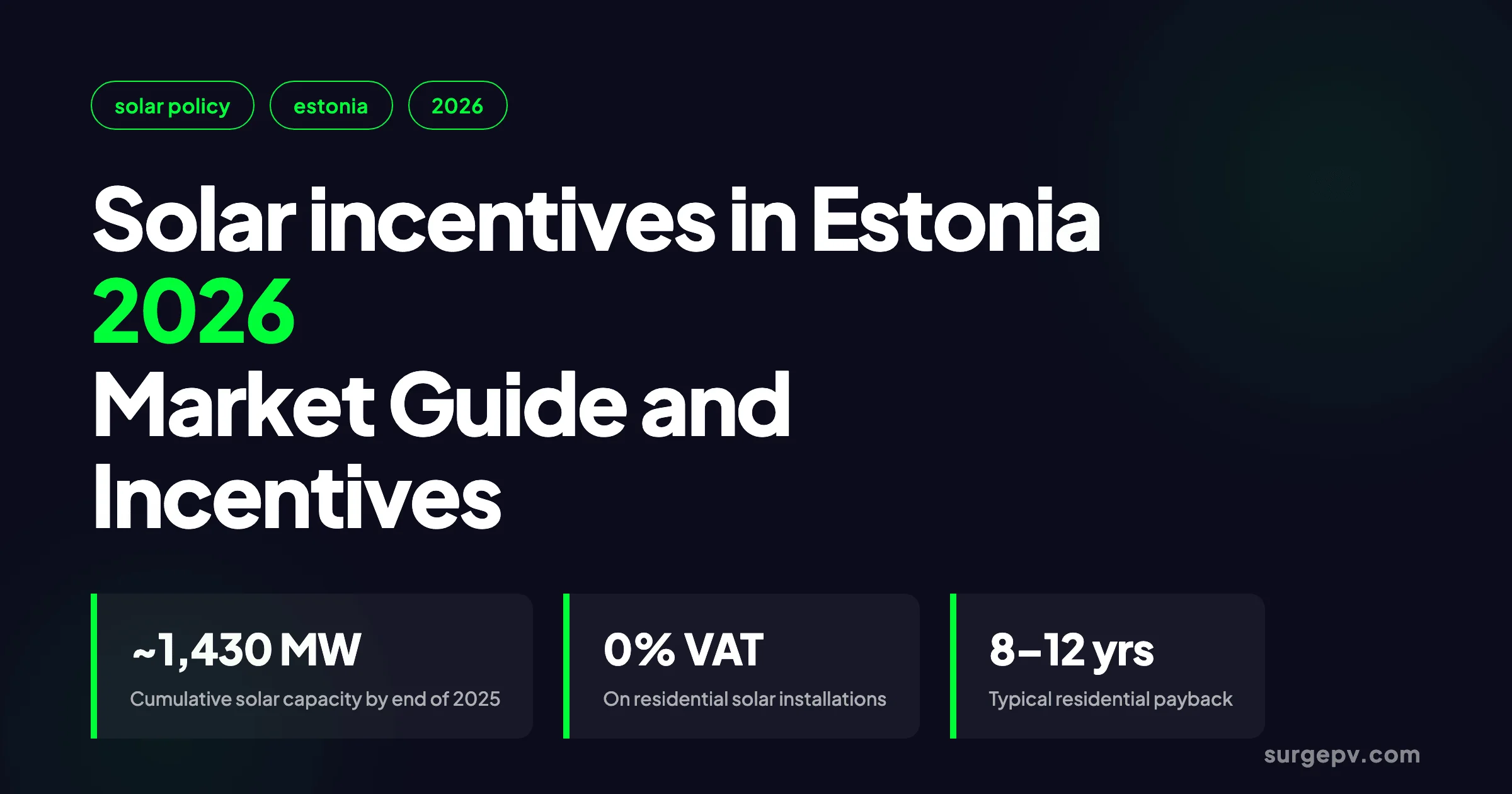
Estonia’s solar market has grown from almost nothing a decade ago to one of the most active in Northern Europe. The country added 105 MW of solar in 2025, taking cumulative capacity to roughly 1,430 MW by year-end, according to the Estonian Chamber of Renewable Energy, reported by pv magazine (2026). The 2025 figure is down from a record 513 MW added in 2024. The early residential boom is maturing, and the market is shifting toward utility-scale solar parks paired with batteries.
The policy story is unusual. Estonia offers 0% VAT on residential solar, which is a real upfront saving. But the KredEx small-house reconstruction grant and the apartment-building solar grant are closed. There is no net metering at full retail rate. Instead, small producers register as microproducers and receive a €0.0537/kWh premium for exports. The lesson for homeowners, installers, and EPCs is clear. The Estonian case rests on low hardware costs, high electricity prices, and careful sizing for self-consumption. It does not rest on a stack of grants.
This guide focuses on incentives and the market mechanics that make them work. For a broader European comparison, see our European solar incentives guide. For VAT treatment across the continent, see European solar tax credits. If you are quoting Estonian projects, a platform that models export premiums, self-consumption, and local tariffs can cut hours from every proposal. Generate solar proposals, run shadow analysis, and test payback in SurgePV’s generation and financial tool. Check pricing or book a demo.
Estonia’s 2026 incentive stack is thin, but the market fundamentals are strong. The headline tool is zero VAT. The hidden engine is self-consumption optimisation.
Quick Answer
Estonia’s 2026 solar incentives are narrow but meaningful. Residential installations benefit from 0% VAT. The KredEx small-house reconstruction grant and the apartment-building solar grant are closed to new applicants. Microproducers can receive a €0.0537/kWh feed-in premium, capped at 3.68 kW single-phase or 11 kW three-phase. Commercial and utility-scale projects rely on merchant power sales, PPAs, and standard corporate tax depreciation, not capital grants.
In this guide:
- Latest 2026 status of every active Estonian solar incentive
- How 0% VAT works and who qualifies
- What closed: KredEx small-house and apartment-building grants
- How the microproducer premium works and why it is not net metering
- Commercial and utility-scale options without subsidies
- Solar yield and design constraints across Estonia
- Three real-world stacking examples with payback impact
- Common mistakes and how to avoid them
Estonia Solar Incentives at a Glance 2026
Estonia’s incentive framework is leaner than those of Germany, Italy, or Austria. The country deliberately moved away from capital grants after the 2024–2025 KredEx round and now relies on tax relief, a small export premium, and market-driven economics.
Incentive Status Table — June 2026
| Incentive | Type | Status | Key Terms |
|---|---|---|---|
| 0% VAT on residential solar | Purchase tax break | Active | Applies to residential PV installations since 1 May 2023 |
| Microproducer feed-in premium | Export premium | Active | €0.0537/kWh; 3.68 kW single-phase / 11 kW three-phase cap |
| KredEx small-house reconstruction grant | Capital subsidy | Closed | Closed 1 March 2025; 30% of unit cost, €28M budget |
| Apartment-building solar grant | Capital subsidy | Closed | Closed 13 November 2023; up to €150,000 per association |
| Corporate tax depreciation | Tax benefit | Active | Standard depreciation for business assets |
| Net metering at retail rate | Export credit | Not available | Estonia does not offer full retail-rate net metering |
| Reduced VAT for commercial solar | Purchase tax break | Not available | Standard 24% VAT applies to commercial installations |
Key Changes Since 2025
2023 — 0% VAT introduced: Estonia applied a 0% VAT rate to residential solar installations from 1 May 2023. This zero rate remains active in 2026, even though the standard VAT rate increased to 24% in July 2025.
2025 — KredEx grant closed: The small-house reconstruction grant, which covered 30% of solar and battery unit costs, closed on 1 March 2025 after its €28 million budget was fully allocated. The apartment-building solar grant had already closed in November 2023.
2025 — Market shift to utility scale: Estonia added 105 MW of solar in 2025, down from 513 MW in 2024. The largest new project was the 53 MW Pihlaka solar park. The market is now driven by large solar parks with storage rather than rooftop subsidies.
Key Takeaway
Estonia has one of Europe’s smallest direct incentive stacks, but 0% VAT and high retail electricity prices keep residential solar viable. Commercial viability depends on self-consumption, PPAs, or merchant market exposure.
Why Estonia’s Incentive Stack Matters in 2026
Estonia is not a high-irradiance market, but it is not poor either. Global horizontal irradiation is roughly 960 kWh/m2 per year in Tallinn, 969 kWh/m2 in Tartu, and 1,026 kWh/m2 in Vilsandi. These figures come from PVGIS training materials cited by the Skill Alliance (2020). A well-oriented residential system can expect roughly 950–1,050 kWh/kWp per year.
The market is growing for three reasons:
- High electricity prices: Household electricity including taxes was around €0.23/kWh in late 2025, according to Country Economy (2025). That is below Germany but well above the Nordic average.
- 0% VAT on residential solar: The upfront tax saving is immediate and applies to the full installation.
- Energy independence: Estonia aims to cover 100% of annual electricity demand with renewables by 2030. Solar is part of that mix alongside onshore and offshore wind.
Market Size and Targets
| Metric | Value | Source |
|---|---|---|
| Cumulative solar capacity, end 2025 | ~1,430 MW | Eesti Taastuvenergia Koda / pv magazine (2026) |
| Solar capacity added in 2025 | ~105 MW | pv magazine (2026) |
| Solar capacity added in 2024 | ~513 MW | pv magazine (2026) |
| Renewable electricity target | 100% by 2030 | IEA / Bankwatch |
| EU ranking for solar per capita | 6th | Invest in Estonia (2024) |
| Sopi-Tootsi hybrid park output | ~750 GWh/year | Enefit / Invest in Estonia |
Small-scale solar started the boom, but utility-scale solar parks now dominate additions. The 74 MW Sopi solar park, part of the Sopi-Tootsi hybrid area, came online in 2025. Sunly is building the 244 MW Risti solar park. It is expected to be operational by 2027, according to the European Investment Bank (2025).
What the Growth Means for Incentives
The absence of a capital grant does not mean the market is stalled. It means the economics must be modelled honestly. An Estonian installer who assumes too much export income will overstate savings. One who ignores 0% VAT or the microproducer premium will understate them. Accurate modelling of self-consumption, export volumes, and local tariffs is the competitive advantage.
For solar professionals, this is where solar design software pays for itself. A proposal that captures Estonia’s 0% VAT and microproducer premium correctly will show a different payback than one that treats exports as lost revenue.
0% VAT on Residential Solar
The most important active residential incentive is the zero VAT rate on solar panel installations. Estonia’s standard VAT rate increased to 24% in July 2025, according to KPMG (2025). That makes the 0% residential exemption even more valuable in cash-flow terms.
How It Works
The 0% rate applies to the supply and installation of solar panels on residential buildings. It covers the panels, inverter, mounting, cabling, and installation labour. Because the exemption applies at the point of sale, the customer does not pay VAT upfront and does not need to reclaim it later.
For a typical €10,000 system, the difference is material:
| Scenario | Gross cost with 24% VAT | Cost with 0% VAT | Saving |
|---|---|---|---|
| €10,000 pre-tax system | €12,400 | €10,000 | €2,400 |
| €15,000 pre-tax system | €18,600 | €15,000 | €3,600 |
Who Qualifies
The zero rate applies to residential installations. The property must be used as a dwelling. Commercial and industrial installations pay the standard 24% VAT, although VAT-registered businesses can normally reclaim this through their VAT returns.
Practical Impact on Quoting
Installers should quote residential customers on a VAT-inclusive basis that reflects the 0% rate. A quote that shows a pre-VAT price without explaining the exemption can confuse customers. Always show the full saving relative to the standard 24% rate.
Pro Tip for Installers
Show the 0% VAT saving as a line item on the proposal. Customers respond better when they see the €2,000–€4,000 tax saving explicitly, rather than buried in a net price.
KredEx Grants: What Closed and What Could Return
Estonia’s most significant recent solar incentives were KredEx grants, now administered through the Estonian Investment Centre (EIS). Both major residential channels are closed to new applicants in 2026, but understanding them matters because new rounds may reopen.
Closed: Small-House Reconstruction Grant
The small-house reconstruction grant covered solar panels, inverters, and batteries as part of wider energy renovation work. It closed on 1 March 2025 after its €28 million budget was fully allocated, according to ProfiElekter (2026).
The previous terms were:
- Grant rate: 30% of the unit price.
- Panel unit price: €1,140/kW, including the inverter and design work.
- Battery unit price: €642/kWh.
- Maximum inverter capacity: 15 kW.
- Maximum battery capacity: 20 kWh.
- Maximum solar grant per home: €5,130.
- Maximum battery grant per home: €3,852.
Example: a 10 kW system with a 10 kWh battery qualified for €3,420 in panel support plus €1,926 in battery support, for a total grant of €5,346.
Closed: Apartment-Building Solar Grant
The apartment-building grant was open to housing associations, not individual apartment owners. It closed on 13 November 2023. The terms were:
- Maximum grant: €150,000 per association.
- Grant rate: 30% if the system covered general building consumption; 40% if it also covered apartment consumption, used building-integrated panels, or included storage.
- Maximum system capacity: 200 kW.
- Location: Panels had to be installed on the building roof or facade.
Will They Reopen?
Both grants were funded from the EU Recovery and Resilience Facility (RRF). New rounds depend on remaining RRF allocations and political decisions. ProfiElekter recommends preparing the technical documentation, energy label, and project design in advance so a new round can be applied for quickly. Check eis.ee for the latest status.
Microproducer Support: Premium, Not Net Metering
Estonia does not offer full retail-rate net metering. Instead, small producers can register as microproducers and receive a premium on exported electricity. This is a different mechanism and produces different economics.
How the Microproducer Premium Works
The microproducer tariff pays a premium of €0.0537/kWh for electricity exported to the grid. The premium typically runs for up to 12 years, according to ProfiElekter (2026) and KPMG (2025). The producer also receives the market price for the exported electricity.
This is not a net metering credit. In a net metering scheme, exported kWh offset imported kWh one-for-one on the bill. In Estonia, exported kWh are paid at market price plus the premium. Imported kWh are charged at the full retail rate, including grid fees, taxes, and supplier margin.
Capacity Limits
| Connection | Maximum capacity |
|---|---|
| Single-phase | 3.68 kW |
| Three-phase | 11 kW |
These caps, documented in an EU study on residential prosumers (2017), mean most residential systems fall under the microproducer rules. Larger systems must register as commercial producers and sell electricity under market terms.
Why It Matters Financially
With household electricity at roughly €0.23/kWh and export revenue at roughly market price plus €0.0537/kWh, self-consumed kWh are worth far more than exported kWh. If the market price averages €0.05–€0.08/kWh, exported kWh might earn €0.10–€0.13/kWh total. Self-consumed kWh save the full €0.23/kWh retail rate.
This makes self-consumption optimisation the single most important design consideration in Estonia. Oversizing a system beyond daytime load can sharply reduce returns.
Opinion: Self-Consumption Is the Real Estonian Incentive
Estonian policymakers did not build solar demand through generous grants. They built it through 0% VAT, high retail prices, and a modest export premium. The result is a market where the best returns go to households that use their own solar during the day, not to those who export the most.
Commercial and Utility-Scale Solar
There is no national capital grant or tax credit open specifically to new commercial, industrial, or utility-scale solar installations in 2026. The economics for these segments are built around power markets and corporate offtake.
What C&I and Utility Projects Use
- Power purchase agreements (PPAs): A corporate buyer agrees to purchase electricity from a solar park for a fixed term. The park may be on-site, off-site, or virtual.
- Merchant spot-market sales: Large plants sell into the Nord Pool spot market. This can be profitable but exposes the project to price volatility, including negative prices.
- Direct private-wire arrangements: An industrial consumer connects directly to a nearby solar plant, avoiding some grid charges.
- Corporate tax depreciation: Solar assets are depreciated under normal Estonian corporate tax rules, providing a standard time-value-of-money benefit.
- Grid services: Large plants can prequalify for frequency restoration reserve markets. The 74 MW Sopi solar park did this for aFRR and mFRR in 2025, according to emsys VPP (2025).
The Negative Price Challenge
Estonia recorded low or negative electricity prices during sunny midday hours in 2025. The average spot market price during sunny hours was around €46/MWh. That is roughly half the annual average, according to the Estonian Chamber of Renewable Energy, reported by pv magazine (2026). This is pushing developers to pair solar with batteries or flexible consumption.
The Market Split
Utility-scale solar is the fastest-growing segment. While residential rooftops started the boom, large projects now drive annual additions. These projects are usually financed through long-term PPAs, corporate balance sheets, or project finance, not grants.
For C&I installers, the financial model is built around avoided grid consumption, not export income. A factory or data centre that consumes electricity during daylight hours can justify a rooftop system even without subsidies.
Regional and Practical Design Factors
Estonia’s latitude of 57–59°N and long winter nights shape every design decision. Incentives matter, but orientation, tilt, and consumption timing matter just as much.
Solar Yield by Region
| Location | Approximate global horizontal irradiation | Notes |
|---|---|---|
| Tallinn | ~960 kWh/m2/yr | Capital region; largest installer market |
| Tartu | ~969 kWh/m2/yr | Slightly higher yield than Tallinn |
| Pärnu | ~980–1,000 kWh/m2/yr | South-west coast, better winter light |
| Vilsandi | ~1,026 kWh/m2/yr | Highest irradiance, island location |
| Narva | ~940–960 kWh/m2/yr | North-east, lower winter yields |
Figures are illustrative and based on PVGIS data cited by the Skill Alliance training materials (2020). Actual yields depend on roof orientation, tilt, shading, and local weather.
Orientation and Tilt
At Estonia’s latitude, roof orientation matters:
- South-facing at 30–40° tilt: optimal.
- East- or west-facing: roughly 15–20% lower annual yield.
- North-facing: generally not recommended.
- Flat roofs: use tilt frames set to 30–40°.
Snow and Seasonality
Snow cover is real but often overstated. South-facing panels at 30–40° tilt usually shed snow naturally within a few days because the dark surface warms quickly when sunlight hits it. Flat roofs may need occasional clearing. Snow losses are typically 3–5% of annual production, concentrated in December–February when output is already low.
The bigger constraint is the four-month winter deficit. From November to February, Estonian solar production is minimal. A battery can shift afternoon production to evening, but it cannot cover winter heating demand. Homes should plan for full grid dependency during those months.
Consumption Timing
Because there is no full net metering, timing matters more than in Finland. Self-consumed kWh save the full retail rate of roughly €0.23/kWh. Exported kWh earn only market price plus €0.0537/kWh. Timing heavy loads — EV charging, water heating, dishwashers — to midday solar hours improves returns significantly.
How to Stack Incentives: Three Real-World Scenarios
The following examples are illustrative, based on typical 2026 costs and incentive rates. Actual figures depend on location, installer quote, electricity contract, and self-consumption ratio.
Scenario 1 — 5 kWp Rooftop, Tallinn Family Home
| Item | Amount |
|---|---|
| Gross pre-tax system cost | €7,500 |
| VAT saving at 24% | €1,800 |
| Net effective cost | €7,500 |
| Annual production | ~4,750 kWh |
| Self-consumption rate | 45% |
| Annual savings at €0.23/kWh | ~€492 |
| Annual export revenue at €0.12/kWh | ~€313 |
| Total annual benefit | ~€805 |
| Simple payback | ~9.3 years |
This household uses nearly half its production directly. The 0% VAT is the only direct incentive.
Scenario 2 — 8 kWp Rooftop with Battery, Tartu
| Item | Amount |
|---|---|
| Gross pre-tax system cost | €15,000 |
| VAT saving at 24% | €3,600 |
| Net effective cost | €15,000 |
| Annual production | ~7,600 kWh |
| Self-consumption without battery | 35% |
| Self-consumption with battery | 55% |
| Annual savings at €0.23/kWh | ~€960 |
| Annual export revenue at €0.12/kWh | ~€456 |
| Total annual benefit | ~€1,416 |
| Simple payback | ~10.6 years |
The battery adds upfront cost but raises the self-consumption ratio from roughly 35% to 55%. Without full net metering, the battery’s value depends heavily on evening tariff avoidance.
Scenario 3 — 250 kWp C&I Rooftop, Pärnu
| Item | Amount |
|---|---|
| Gross system cost | €200,000 |
| VAT | €48,000 (reclaimable) |
| Incentive | None |
| Annual production | ~237,500 kWh |
| Self-consumption rate | 80% |
| Avoided grid cost at €0.13/kWh | €24,700/year |
| Export revenue at €0.10/kWh | €4,750/year |
| Total annual benefit | ~€29,450 |
| Simple payback | ~6.8 years |
Without subsidies, the business case rests on avoided grid purchases. This is why C&I projects in Estonia are usually sized to match daytime consumption.
Common Mistakes and How to Avoid Them
1. Assuming the KredEx Grant Is Still Open
Some older marketing materials still reference the 30% KredEx grant. It closed on 1 March 2025. The only direct residential incentives now are 0% VAT and the microproducer premium.
2. Treating the Microproducer Premium as Net Metering
The €0.0537/kWh premium is paid on exports. It does not offset imports one-for-one. A system sized to maximise exports will usually underperform one sized for self-consumption.
3. Ignoring the 0% VAT Line Item
Customers may not realise how much 0% VAT saves them. Show it explicitly. A €12,400 system at 24% VAT becomes €10,000 with the exemption.
4. Quoting Payback Without Seasonality
An Estonian system produces almost nothing from November to February. Payback calculations that assume uniform monthly production will mislead customers. Model production by month and show the winter deficit.
5. Oversizing Beyond Self-Consumption
Without full net metering, exported kWh are worth roughly half of self-consumed kWh. Size the system to match daytime and annual load, not roof area.
6. Forgetting Commercial VAT Rules
The 0% VAT rate applies only to residential installations. Commercial projects pay 24% VAT, which is reclaimable for VAT-registered businesses but still affects cash flow.
Frequently Asked Questions
What solar incentives are available in Estonia in 2026?
The main active incentive is 0% VAT on residential solar panel installations. Microproducers can also receive a €0.0537/kWh feed-in premium, capped at 3.68 kW single-phase or 11 kW three-phase. The KredEx small-house reconstruction grant and apartment-building solar grant are closed. Businesses rely on standard corporate tax depreciation, power purchase agreements, and merchant market sales.
Is there a KredEx grant for solar panels in Estonia in 2026?
No. The KredEx small-house reconstruction grant covered 30% of solar and battery unit costs. It closed on 1 March 2025 after its €28 million budget was fully allocated. The apartment-building solar grant for housing associations closed on 13 November 2023. New rounds are possible but not confirmed as of mid-2026.
Does Estonia have net metering for solar?
Estonia does not operate a full retail net metering scheme. Instead, small producers can register as microproducers and receive a €0.0537/kWh premium for exported electricity, typically for up to 12 years. Microproducer capacity is capped at 3.68 kW for single-phase connections and 11 kW for three-phase connections.
What is the microproducer tariff in Estonia?
The microproducer support pays a premium of €0.0537 per kWh for electricity fed into the grid. This is not a net metering credit. It is a fixed premium added to the market price received for exported electricity. The scheme applies to installations up to 3.68 kW single-phase or 11 kW three-phase.
Does Estonia apply reduced VAT to solar panels?
Yes. Estonia applies 0% VAT to residential solar panel installations. This zero rate has been in effect since 1 May 2023. The country’s standard VAT rate is 24% as of July 2025, so the zero-rate exemption represents a meaningful upfront saving for homeowners.
What is the typical payback period for residential solar in Estonia?
Typical residential payback in Estonia is 8–12 years, depending on system size, orientation, self-consumption rate, and electricity tariff. Household electricity prices including taxes are around €0.23/kWh. A well-oriented 5 kWp system in Tallinn or Tartu can produce roughly 4,750–5,250 kWh per year.
What is Estonia’s renewable energy target?
Estonia aims to cover 100% of its annual electricity demand with renewable sources by 2030. Solar capacity reached roughly 1,430 MW by the end of 2025. The country added 105 MW in 2025, down from a record 513 MW in 2024, as the market shifts toward larger solar parks paired with storage.
Do businesses get solar incentives in Estonia?
Businesses do not receive a dedicated solar capital grant or tax credit in 2026. Commercial and industrial projects rely on avoided grid purchases, power purchase agreements, merchant spot market sales, and standard corporate tax depreciation. The 0% VAT rate applies only to residential installations.
What are the main solar parks in Estonia?
The largest operating solar asset is the 74 MW Sopi solar park, part of the Sopi-Tootsi wind-solar hybrid area in Pärnu County. The 244 MW Risti solar park is under construction by Sunly and is expected to become operational by 2027. The 53 MW Pihlaka solar park in Anija came online in 2025.
How do I apply for the microproducer tariff in Estonia?
You register your grid-connected solar system as a microproducer with your electricity supplier and distribution system operator. The installer usually handles the grid connection application. You need a bidirectional meter to measure exports. Once registered, the feed-in premium is paid through your electricity supplier.
Conclusion: Three Actions for Estonian Solar Projects
Estonia’s 2026 solar market is a case study in market-driven growth. The direct incentives are small, but 0% VAT, high retail prices, and a modest export premium keep residential projects viable.
- Size for self-consumption, not the roof. Without full net metering, every self-consumed kWh is worth roughly twice an exported kWh.
- Model the real stack. Include 0% VAT, the microproducer premium, and standard commercial VAT rules. Do not assume closed grants are available.
- Design for the latitude and winter deficit. South-facing orientation, 30–40° tilt, and honest winter production assumptions are non-negotiable for credible Estonian quotes.
If you are quoting Estonian solar projects, a platform that captures local incentives, seasonal yield, and self-consumption can make the difference between a credible proposal and a costly mistake. Try SurgePV’s solar design software, build solar proposals with Estonian tariff logic, or book a demo to see the full workflow.
Where this fits
This article is part of SurgePV's Solar Incentives & Policy hub, which works through the topic from first principles to the decisions a project team actually has to make.

