

Answer
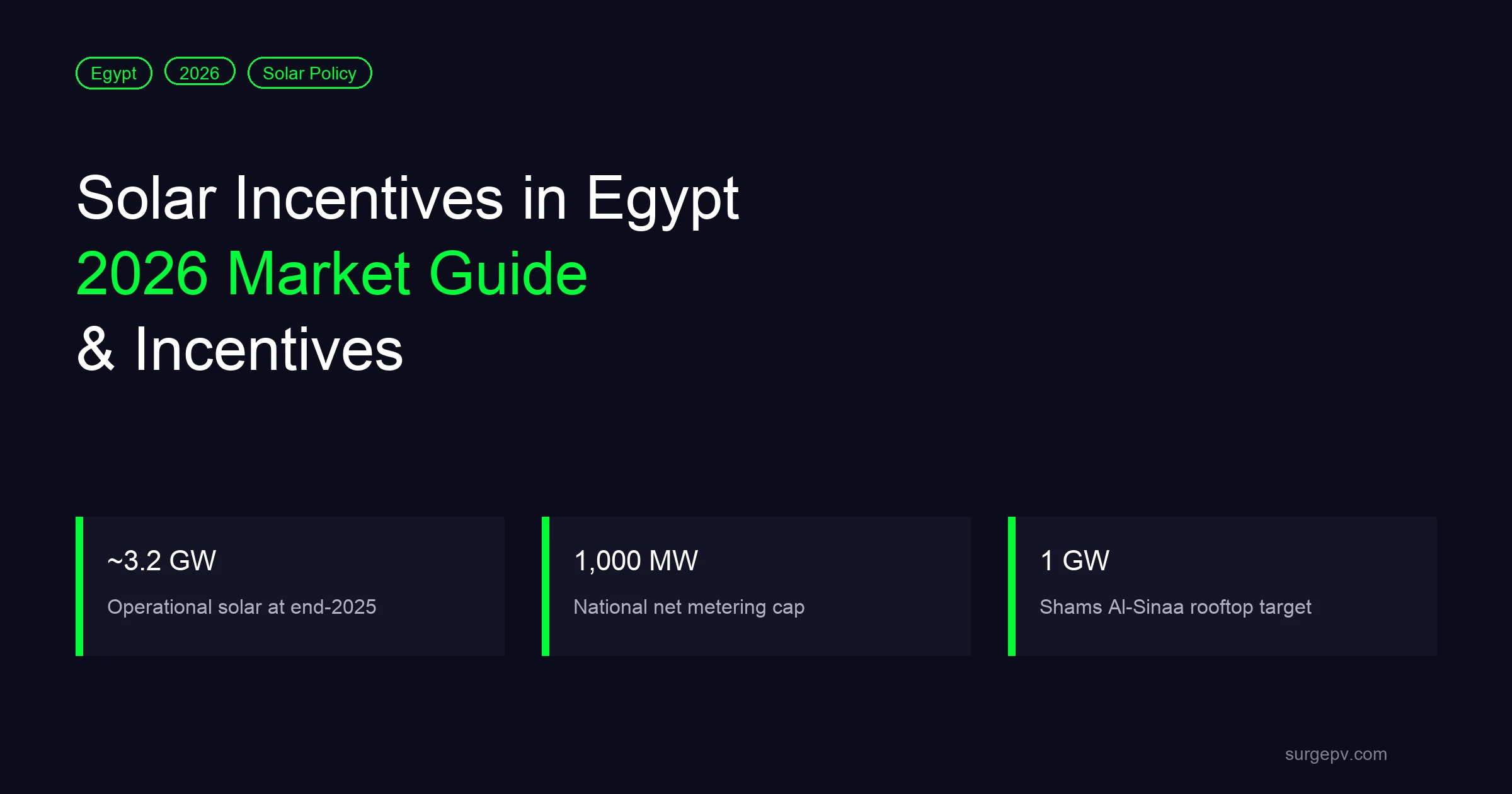
Egypt's 2026 solar incentives center on net metering and net billing for distributed generation, a 2% customs duty rate for qualifying solar equipment, the Shams Al-Sinaa industrial rooftop initiative, and utility-scale routes under the 2014 Renewable Energy Law.
Egypt’s solar market is entering a new phase in 2026. The country had roughly 3.2 GW of operational solar capacity by the end of 2025, with total renewable capacity reaching 9.1 GW, according to Renewables Now (2026). Solar has now overtaken wind as Egypt’s largest renewable source. The government wants renewable sources to supply 42% of electricity by 2030, with some officials talking about 45% and even 60% by 2040.
For installers, EPCs, and factory owners, the opportunity is clear. Egypt receives some of the highest solar irradiance on Earth, and rising electricity tariffs are making self-generation economically attractive. But the incentive framework is not a single subsidy. It is a stack of mechanisms. These include net metering and net billing for distributed generation, customs duty relief for equipment, the Shams Al-Sinaa program, and utility-scale routes. Each mechanism has its own rules, limits, and paperwork.
This guide explains how those mechanisms work in 2026. It covers the regulators, the tariff structure, the practical steps to connect a system, and the mistakes that waste money. For installers working across the Middle East and Africa, see our Middle East solar compliance guide and Africa solar compliance guide. For payback comparisons, see solar payback period by country.
If you are designing systems or writing proposals for Egyptian clients, a solar design platform can cut hours from every project. It should model local tariffs, net metering settlement rules, and export value. Model payback and export value automatically, then generate solar proposals in minutes. Check pricing or book a demo to see how SurgePV handles Egypt.
Egypt’s 2026 solar incentive stack is real, but it rewards precise execution. The value comes from combining the EgyptERA net metering framework, customs duty relief on qualifying equipment, the Shams Al-Sinaa rooftop push, and utility-scale procurement routes. None of these is a simple upfront rebate, but together they make solar one of the cheapest electricity options for factories and large buildings.
TL;DR — Solar Incentives in Egypt 2026
Active mechanisms: net metering and net billing under EgyptERA, a 2% customs duty rate for qualifying solar equipment, a 1,000 MW national aggregate cap for distributed solar, the Shams Al-Sinaa 1 GW industrial rooftop initiative, and utility-scale procurement through competitive tenders and bilateral PPAs. The government targets 42% renewable electricity by 2030, with solar now the country’s largest renewable source at roughly 3.2 GW.
In this guide:
- Latest 2026 status of every active Egyptian solar incentive
- The legal foundation: Renewable Energy Law, Electricity Law, and key regulators
- How net metering and net billing actually work
- Feed-in tariffs, competitive tenders, and IPP routes
- Customs, tax, and fiscal incentives
- Shams Al-Sinaa and the industrial rooftop opportunity
- Utility-scale solar and storage pipeline
- Three real-world stacking scenarios with payback impact
- Common mistakes and how to avoid them
Latest Updates: Egypt Solar Incentives 2026
The Egyptian solar policy environment is moving fast in 2026. The government is trying to reduce dependence on imported fuel, meet rising electricity demand, and position the country as a green energy export hub. Several new developments matter for anyone sizing or pricing a system today.
Egypt Solar Incentive Status — June 2026
| Incentive | Type | Status | Key Terms |
|---|---|---|---|
| Net metering | Distributed generation | Active | Up to 25 MW per project, 30 MW per customer, 1,000 MW national cap |
| Net billing | Distributed generation | Active | Typically 50–500 kW commercial, cash payment for exports |
| Feed-in tariff | Utility-scale and distributed | Legacy + tender-based | 20-year PPA for solar under Renewable Energy Law |
| Competitive tenders | Utility-scale | Active | EETC and NREA run BOO/IPP rounds |
| Customs duty reduction | Import tax relief | Active | 2% customs fee for qualifying solar PV equipment |
| Merger fee exemption | Grid fee relief | Active | Exempt for net metering/self-consumption projects up to 10 MW |
| Shams Al-Sinaa | Industrial rooftop program | Launched 2026 | 1 GW across ~7,000 factories |
| Green Hydrogen Incentives Law | PtX support | Active | 33–55% tax rebates, VAT exemption for eligible projects |
| Renewable share target | Policy target | 42% by 2030 | Officials also cite 45% by 2030 and 60% by 2040 |
Key Changes Since 2025
National renewable capacity hit 9.1 GW. Egypt’s installed renewable capacity reached 9.1 GW by the end of 2025, with solar overtaking wind as the largest renewable source, according to Renewables Now (2026). Solar alone stood at roughly 3.2 GW.
Shams Al-Sinaa launched. In mid-2026 the Egyptian Cabinet advanced a 1 GW industrial rooftop solar initiative. It targets about 7,000 factories and roughly seven million square meters of rooftop space, according to Egypt Oil & Gas (2026).
Major storage and hybrid projects moved forward. The 500 MW / 1,000 MWh Nefertiti battery project at Benban and the 250 MW / 500 MWh Horus project near the Gulf of Suez received EBRD financing study, according to Zawya (2026). Scatec’s 1 GW Obelisk solar-plus-storage complex in Qena also reached milestones.
Commercial tariffs rose sharply. In April 2026 the government raised commercial electricity prices by 20% to 91% while protecting lower residential tiers, according to Al-Ahram (2026). This directly improves the business case for C&I solar.
Key Takeaway
2026 is a transition year. The most reliable incentives for distributed solar are net metering value, customs duty relief, and rising tariff avoidance. Utility-scale developers should watch tender timelines and grid connection availability, while industrial users should position for Shams Al-Sinaa.
Why Egypt’s Solar Market Matters in 2026
Egypt has world-class solar resources. The country sits in the solar belt. Annual global horizontal irradiance ranges from roughly 2,000 kWh/m² in the north to more than 2,600 kWh/m² in southern governorates, according to Mordor Intelligence (2026). The Benban site in Aswan records around 2,300 kWh/m²/year and capacity factors near 26%, making it one of the best utility-scale locations globally.
Market Size and Targets
Egypt’s total renewable energy market was valued at 9.81 GW in 2025 and is projected to grow to 11.79 GW in 2026 and 29.64 GW by 2031, according to Mordor Intelligence (2026). Solar PV and concentrated solar power supplied roughly 27.84% of renewable capacity in 2025 and are expected to add 8 GW by 2031.
The government’s official target under the Integrated Sustainable Energy Strategy is 42% renewable electricity by 2030. Some recent statements cite 45% by 2030 and 60% by 2040, according to Egypt Oil & Gas (2026). In 2025, renewable sources supplied roughly 11.7% of generation, so the gap is large and the pipeline is ambitious.
The Electricity Tariff Driver
One of the strongest economic drivers for solar is the restructuring of electricity subsidies. Residential tariffs remain low for small consumers, but higher tiers and commercial users face much higher rates. The top residential tier was around EGP 1.95/kWh as of September 2024, with the highest bracket rising to EGP 2.58/kWh or more in some announcements, according to Newsbase (2026). Commercial users saw increases of 20% to 91% in April 2026.
For solar professionals, the design priority is to model the customer’s actual tariff tier. A villa in the top residential bracket will have a completely different payback than a subsidized rural consumer. Modern solar design software can import Egyptian tariff schedules and test system sizes against real consumption profiles.
The Legal Foundation: Renewable Energy Law, Electricity Law, and Key Regulators
Egypt’s renewable energy sector rests on two main laws and three main authorities. Understanding who does what saves months of paperwork.
Renewable Energy Law No. 203 of 2014
The Renewable Energy Law introduced four private-sector participation mechanisms, according to IEA policy database (2025):
- Competitive bidding run by NREA for EPC projects later operated by NREA.
- Build-Own-Operate (BOO) tenders run by EETC for private developers.
- Feed-in tariff (FiT) allowing investors to build, own, and operate plants and sell to EETC via 20-year solar PPAs.
- Independent power production through third-party access, allowing bilateral corporate PPAs subject to wheeling fees.
Electricity Law No. 87 of 2015
The Electricity Law reformed the power sector, created EgyptERA as the regulator, and established cost-reflective tariffs as the guiding principle. It also set the framework for grid access and licensing.
Key Regulators
| Authority | Role |
|---|---|
| EgyptERA | Licenses generation facilities, sets net metering rules, approves tariffs |
| EETC | National transmission company; handles connection for MV/HV projects |
| NREA | Land allocation, manufacturer certification, installer registration, utility-scale project development |
| Distribution companies | Handle LV net metering applications and connections |
For projects above 500 kW, engage EETC early. Connection studies and meter installation can add 8 to 16 weeks to the pre-commissioning timeline, according to SurgePV’s own Middle East solar compliance guide.
Net Metering and Net Billing in Egypt
The EgyptERA net metering framework is the main route for distributed solar. It has been in place since 2013 and has been expanded several times. The current rules create two practical pathways depending on project size.
Net Metering
Under net metering, exported solar kWh are credited against imported grid kWh. The customer pays only the net difference.
- Typically available for residential systems up to 50 kW.
- Credits roll forward and are settled periodically.
- The plant capacity may not exceed the customer’s maximum annual load.
- Best for customers whose daytime generation matches daytime consumption.
Net Billing
Net billing applies to larger commercial and industrial systems. Exported energy is paid at a regulated rate rather than offset against imports.
- Typically covers systems from 50 kW to 500 kW.
- Export payment is usually below the retail import rate.
- Better for factories with large daytime loads and surplus rooftop space.
Size Caps and Fees
| Parameter | Rule |
|---|---|
| National aggregate cap | 1,000 MW for net metering and self-consumption combined |
| Max size per project | 25 MW |
| Max total per customer | 30 MW across all projects |
| Merger fee | 25.7 to 32.9 piasters/kWh depending on voltage level |
| Merger fee exemption | Projects up to 10 MW |
| Battery capacity limit | Up to 20% of plant capacity for self-consumption systems |
The 1,000 MW national cap is the most significant constraint. Once cumulative registered capacity reaches that level, new applications pause until the cap is raised. Egypt has already raised the cap from 300 MW to 1,000 MW, so future increases are possible but not guaranteed.
Licensing Steps
Projects above 500 kW need an EgyptERA license before applying for grid connection. Projects below 500 kW can be exempt from licensing upon request. All grid-connected systems need approval from the local distribution company or EETC, plus a bidirectional meter and a technical inspection.
A generation and financial tool that models each compensation scheme against hourly load profiles is essential. SurgePV’s generation and financial tool can test net metering, net billing, and self-consumption scenarios for Egyptian projects.
Feed-in Tariffs and Competitive Tenders
The original FiT program launched in 2014 with a 4.3 GW renewable target, including 2.3 GW of solar. It produced the Benban Solar Park, one of the world’s largest solar complexes. In 2026, new utility-scale capacity is procured mainly through competitive tenders and bilateral agreements.
Feed-in Tariff Legacy
Under the FiT program, private developers sign a PPA with EETC or a licensed distribution company. Solar PPAs run up to 20 years. Payments are typically split between local and foreign currency to manage exchange-rate risk. The original formula weighted 15% to 30% of the tariff at a fixed exchange rate. The remainder used the rate on the bill issuance date, according to World Bank (2017).
Competitive Tenders
EETC and NREA now run competitive bidding for BOO and IPP projects. These tenders have produced some of the lowest solar tariffs in the region. Recent awards include Scatec’s 1 GW Obelisk project and AMEA Power’s 500 MW Abydos plant.
Third-Party Access and Corporate PPAs
The Renewable Energy Law allows independent power producers to sign bilateral contracts with eligible consumers. They can wheel power through the national grid, and EETC charges a grid access fee. This route is attractive for large industrial buyers who want fixed-price renewable electricity without owning the asset.
Tax, Customs, and Fiscal Incentives
Egypt does not offer a direct federal tax credit for homeowners who buy solar panels. The real fiscal value lies in customs duty relief, merger fee exemptions, and accelerated depreciation for businesses.
Customs Duty Reduction
Presidential Decree 184/2013 reduces customs fees on solar PV systems and related spare parts. The rate is 2% of the shipment value or the due import taxes, whichever is lower, according to Energypedia procedural guide. To benefit, the importer must obtain a letter from NREA confirming eligibility before customs clearance.
Merger Fee Exemption
Net metering and self-consumption projects up to 10 MW are exempt from the merger fee. The merger fee is otherwise charged for integrating electricity into the grid, according to Adsero summary of EgyptERA Circular 3/2023.
Corporate Tax Treatment
Renewable energy assets generally qualify for standard depreciation schedules. Eligible companies can also explore incentives under the Investment Law and special economic zone frameworks. Green hydrogen projects receive tax rebates of 33% to 55% and VAT exemption under the Green Hydrogen Projects Incentives Law No. 2 of 2024, according to Chambers and Partners (2023).
Industrial Solar: Shams Al-Sinaa and C&I Opportunities
The industrial sector is the fastest-growing addressable market for distributed solar in Egypt. Factories pay high commercial tariffs, have large flat roofs, and face carbon-border pressure from European buyers.
Shams Al-Sinaa Initiative
In June 2026 the Egyptian Cabinet advanced the Shams Al-Sinaa, or Industry’s Sun, program. It aims to install nearly 1 GW of rooftop solar across about 7,000 factories. The program requires roughly seven million square meters of rooftop space, according to Egypt Oil & Gas (2026). The average system size is expected to be around 150 kW per factory, with larger systems for energy-intensive facilities.
The program has three strategic goals:
- Reduce industrial electricity costs and natural gas demand.
- Improve energy security for manufacturers.
- Lower the carbon intensity of Egyptian exports ahead of the EU Carbon Border Adjustment Mechanism.
C&I Net Metering and Net Billing
Factories that are not part of Shams Al-Sinaa can still connect under the standard EgyptERA framework. A 500 kW rooftop system on a factory with high daytime load can often pay back in 4 to 6 years. The key is to match generation to consumption, because exported energy is worth less than avoided imports.
For C&I installers, the design priorities are load profiling, demand-charge analysis, and shadow analysis. SurgePV’s design tool can model Egyptian rooftop geometries, irradiance, and tariff inputs to produce bankable proposals.
Utility-Scale and IPP Routes
Utility-scale solar dominates Egypt’s installed capacity. The segment is driven by competitive tenders, NREA projects, and green-hydrogen-linked developments in the Suez Canal Economic Zone.
Benban Solar Park
Benban in Aswan is the flagship project. It covers 37.2 km² and has around 1.65 GW to 1.8 GW of capacity across dozens of plants, according to Construction Frontier (2026). The park was developed under the FiT program with financing from EBRD, IFC, AIIB, and MIGA.
Recent and Pipeline Projects
| Project | Location | Capacity | Notes |
|---|---|---|---|
| Obelisk | Qena | 1 GW solar + storage | Scatec; 500 MW phase 1 inaugurated early 2026 |
| Energy Valley | Minya | 1.7 GW solar + 4 GWh storage | Scatec; PPA with EETC |
| Abydos | Kom Ombo | 500 MW | AMEA Power; operational |
| Nefertiti | Benban | 500 MW / 1,000 MWh BESS | AMEA Power; EBRD financing study |
| Horus | Gulf of Suez | 250 MW / 500 MWh BESS | AMEA Power; standalone storage |
These projects show that new utility-scale solar in Egypt is increasingly bundled with battery storage. Developers should plan for storage integration from the start.
How to Stack Incentives: Three Real-World Scenarios
The following examples are illustrative, based on typical 2026 costs and incentive rates. Actual figures depend on location, tariff, installer quote, and exchange rates.
Scenario 1 — 10 kW Residential Rooftop, Cairo
| Item | Amount |
|---|---|
| Gross installed cost | EGP 110,000 |
| Annual bill savings (top residential tier) | EGP 18,000 |
| Payback | 6 years |
Without net metering, the same system would rely entirely on self-consumption and pay back more slowly.
Scenario 2 — 500 kW Commercial Rooftop, Alexandria
| Item | Amount |
|---|---|
| Gross installed cost | EGP 4,500,000 |
| Customs duty reduction benefit | −EGP 450,000 |
| Annual avoided electricity cost | EGP 900,000 |
| Payback | 4.5 years |
The combination of high commercial tariffs and customs duty relief makes C&I rooftop solar highly attractive.
Scenario 3 — 25 MW Industrial Net Metering Plant, Suez
| Item | Amount |
|---|---|
| Gross installed cost | USD 18,000,000 |
| Merger fee exemption benefit | Significant saving vs. standard fee |
| Annual avoided electricity + export revenue | USD 2,500,000 |
| Payback | 7–8 years |
Large industrial systems benefit from scale and the 10 MW merger fee exemption. Returns depend heavily on self-consumption ratio and grid connection timing.
Common Mistakes and Misconceptions
Even experienced installers lose money in Egypt by misunderstanding how incentives interact. Here are the most common errors.
Oversizing for Export
The single most expensive mistake is designing a system that exports more than the customer consumes. Net billing export rates are below retail import rates, and net metering credits reset. Size for self-consumption, not maximum generation.
Ignoring the 1,000 MW National Cap
New net metering applications may pause once the national cap is reached. Verify current cap utilization before signing contracts with long lead times.
Assuming a Simple Upfront Subsidy
Egypt does not offer a direct federal rebate like some markets. The value is in tariff avoidance, customs relief, and tax depreciation. Proposals must show these stacked benefits clearly.
Underestimating Permitting Time
The EgyptERA licensing and EETC connection process can take 3 to 6 months for mid-size C&I projects. Build realistic timelines into contracts and customer expectations.
Using Non-Certified Equipment or Installers
NREA registration matters for both equipment and installers. Projects without proper certification can face rejection during inspection. Verify that panels carry IEC 61215 certification and that the installation team is NREA-registered.
Conclusion
Egypt’s solar incentive framework in 2026 is a stack. It is built from net metering and net billing, customs duty relief, the Shams Al-Sinaa rooftop push, and utility-scale procurement routes. None of these mechanisms is as simple as a single upfront rebate. Combined, they still make solar one of the most attractive generation options in the country.
For solar professionals, the competitive edge is no longer just installation price. It is the ability to model the right compensation scheme, size for self-consumption, and stack customs and tax benefits correctly. Tools like Clara AI and SurgePV’s generation and financial tool can automate that workflow for Egyptian projects.
Three actions to take now:
- Verify the compensation scheme before sizing — net metering, net billing, or self-consumption changes the optimal system size.
- Stack customs and fee benefits — confirm NREA eligibility for the 2% customs rate and the merger fee exemption up to 10 MW.
- Size for self-consumption — exported energy in Egypt is worth less than avoided retail purchases.
For regional comparisons, see our solar payback period by country guide. For installers scaling in Egypt, our guide for solar installers covers proposal automation and compliance workflows.
Frequently Asked Questions
What solar incentives are available in Egypt in 2026?
Egypt’s 2026 solar incentives include the EgyptERA net metering and net billing schemes. Other incentives include a 2% customs duty rate for qualifying solar equipment, the Shams Al-Sinaa rooftop initiative, and utility-scale feed-in tariffs. Competitive tenders and bilateral corporate PPAs round out the stack.
How does net metering work in Egypt?
Under EgyptERA net metering, exported solar generation is credited against imported grid consumption. Residential systems are typically limited to 50 kW, while commercial systems can reach 500 kW under net billing. The national aggregate cap for net metering and self-consumption projects is 1,000 MW, and the maximum size per project is 25 MW.
What is the difference between net metering and net billing in Egypt?
Net metering offsets surplus kWh against future grid imports on a rolling basis, so the customer pays only the net difference. Net billing pays the generator a regulated cash rate for exported energy while the customer continues to pay the full retail rate for imports. Net metering suits residential self-consumption; net billing suits larger commercial exporters.
Does Egypt offer a feed-in tariff for solar projects?
Yes. Egypt introduced feed-in tariffs under the 2014 Renewable Energy Law for solar PV and wind. Solar projects can sign 20-year power purchase agreements with EETC or licensed distribution companies. New utility-scale capacity is now primarily procured through competitive tenders and bilateral agreements rather than the original FiT program.
What is the Shams Al-Sinaa initiative?
Shams Al-Sinaa, or Industry’s Sun, is a 2026 Egyptian government initiative to install nearly 1 GW of rooftop solar across approximately 7,000 factories. It aims to cut industrial electricity costs, reduce natural gas demand, and improve the competitiveness of Egyptian exports under carbon-border regulations.
What are the customs and tax incentives for solar equipment in Egypt?
Presidential Decree 184/2013 reduces customs fees on solar PV systems and related spare parts. The rate is 2% of the shipment value or due import taxes, whichever is lower. Projects under the net metering and self-consumption framework are also exempt from the merger fee up to 10 MW.
What is the maximum size for a distributed solar project in Egypt?
The maximum size for a single net metering project is 25 MW, and a single customer can hold up to 30 MW across multiple projects. The national aggregate cap for all net metering and self-consumption solar projects is 1,000 MW.
Who regulates solar projects in Egypt?
The Egyptian Electric Utility and Consumer Protection Regulatory Agency, known as EgyptERA, licenses solar generation facilities. The Egyptian Electricity Transmission Company, or EETC, handles connection approval and metering for medium- and high-voltage projects. The New and Renewable Energy Authority, or NREA, manages land allocation, manufacturer certification, and installer registration.
What is the typical solar payback period in Egypt?
Well-designed commercial and industrial systems in Egypt typically pay back in 4 to 6 years because of high irradiance, rising retail tariffs, and net metering savings. Residential payback is longer, often 8 to 10 years when future tariff increases are included, though high-consumption villas can beat this range.
What is the most common mistake when sizing a solar system in Egypt?
The most common mistake is oversizing for export. Exported energy under net billing is paid at a rate below the retail import tariff, and net metering credits reset annually. Systems should be sized to maximize self-consumption rather than total generation.
Where this fits
This article is part of SurgePV's Solar Incentives & Policy hub, which works through the topic from first principles to the decisions a project team actually has to make.

