

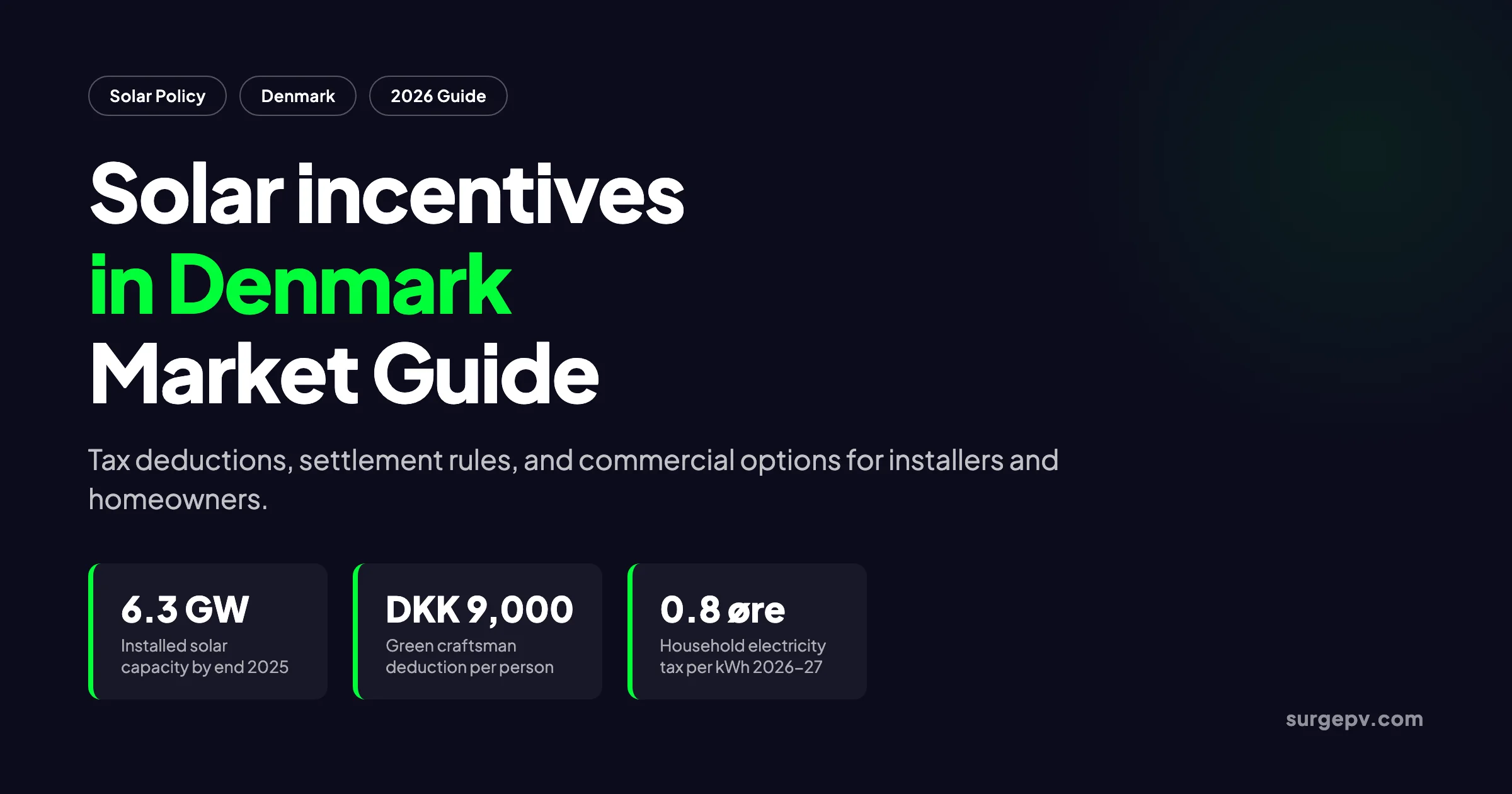
Denmark’s solar market reached a record 6.3 GW of installed capacity by the end of 2025, after adding 1,548 MW in a single year. Yet the headline number hides a split story. Utility-scale ground-mount projects supplied 1.34 GW of that growth, while residential and commercial rooftops added only 202 MW. The reason is not a lack of sunshine or engineering skill. It is that Denmark has deliberately moved solar from a subsidy-driven market to a commercial one.
This guide covers the 2026 incentive stack for homeowners, installers, and businesses in Denmark. It explains what direct support remains, how the settlement rules work, why self-consumption matters more than export, and how commercial projects now finance themselves. For broader Danish market context, including yield and technology choices, see our Solar energy in Denmark 2026 guide. For a country-by-country comparison, see European solar incentives.
If you are designing or proposing Danish solar projects, a platform that models local tariffs, self-consumption ratios, and spot-market export can cut hours from every quote. Generate solar proposals, run shadow analysis, and test payback in SurgePV’s generation and financial tool. Check pricing or book a demo.
Denmark’s 2026 solar incentive stack is a tax-and-settlement model, not a grant model. The headline tools are the green craftsman deduction, the temporary electricity tax reduction, tax-free solar sales up to DKK 7,000 per year, and commercial depreciation. Direct capital subsidies for new installations are gone.
Quick Answer
Denmark’s 2026 solar incentives center on the green craftsman deduction (håndværkerfradrag), which cuts labour costs by up to DKK 9,000 per person for installations including solar. Households also benefit from a temporary electricity tax of 0.8 øre/kWh through 2027 and tax-free solar sales up to DKK 7,000 per year. Direct capital subsidies for new solar are gone; new projects rely on market prices, PPAs, and commercial depreciation.
In this guide:
- Latest 2026 status of every active Danish solar incentive
- How the green craftsman deduction works and who qualifies
- How the instant settlement scheme affects residential payback
- Commercial and industrial options without direct grants
- Local, municipal, and EU support that may still apply
- Three real-world scenarios with payback impact
- Common mistakes and how to avoid them
Latest Updates: Denmark Solar Incentives 2026
The Danish solar policy environment shifted decisively in 2024 and 2025. The government issued a new solar strategy in mid-2024, parliament reintroduced the craftsman deduction from 1 January 2025, and the household electricity tax was cut to the EU minimum from 1 January 2026. For installers, the message is clear: Denmark is streamlining permits but it is not handing out new solar grants.
Denmark Solar Incentive Status — June 2026
| Incentive | Type | Status | Key Terms |
|---|---|---|---|
| Green craftsman deduction (håndværkerfradrag) | Tax deduction | Active | Up to DKK 9,000/person/year for labour; solar eligible |
| Household electricity tax (elafgift) | Tax reduction | Active until 31 Dec 2027 | 0.8 øre/kWh instead of planned 72.7 øre/kWh |
| Schematic arrangement for solar sales | Income tax relief | Active | First DKK 7,000/year tax-free; 60% above |
| Commercial depreciation basis | Tax allowance | Active in 2026 | 108% of investment cost |
| Net metering / hourly settlement | Settlement scheme | Closed to most new systems | New systems use instant settlement (Group 3) |
| Feed-in tariff / premium tariff | Subsidy | Closed to new plants | Only legacy plants receive support |
| National capital grant for rooftop solar | Grant | Not available | No general solar grant open in 2026 |
Key Changes Since 2025
Mid-2024 — Danish solar strategy launched: The government published a five-point strategy focusing on fast-tracking the green transition, rural solar, rooftop solar, solar on public buildings, and small energy cooperatives. The goal was to remove administrative hurdles rather than introduce new subsidies, according to Gorrissen Federspiel (2024).
1 January 2025 — Green craftsman deduction reintroduced: The håndværkerfradrag returned in a green form, covering energy and climate improvements including solar panel installation. In 2026 the cap is DKK 9,000 per adult.
1 January 2026 — Electricity tax cut to EU minimum: The household electricity tax (elafgift) dropped to 0.8 øre/kWh for 2026 and 2027, according to MoneySavvy (2025). The planned rate had been 72.7 øre/kWh.
2025 market rotation: Denmark added 1,548 MW of solar, but 1,340 MW was utility-scale ground-mount, while building-mounted solar fell to 202 MW from 217.5 MW in 2024, according to pv magazine (2026).
Key Takeaway
2026 is a post-subsidy year for new Danish solar. The remaining support is tax-based and settlement-based. Residential economics now depend on self-consumption and the craftsman deduction, while commercial economics depend on avoided grid purchases and PPAs.
Why Denmark’s Incentive Stack Matters in 2026
Denmark has lower solar irradiance than southern Europe, but the market still grew almost tenfold between 2016 and 2025. The reason was a mix of historically high retail electricity prices, simple net settlement, and a feed-in tariff that made export valuable. Those conditions have changed. Today, a self-consumed kilowatt-hour is worth far more than an exported one.
Market Size and Targets
Denmark added 1,548 MW of solar in 2025, bringing cumulative capacity to roughly 6.3 GW, according to pv magazine (2026). The Danish Energy Agency expects solar to reach more than 12 GW by 2030 and 18 GW by 2035, according to IEA-PVPS Country Updates 2025.
| Segment | 2025 MW Added | Share of 2025 Additions |
|---|---|---|
| Utility-scale ground-mount | 1,340 MW | 87% |
| Commercial rooftop | 141 MW | 9% |
| Residential rooftop | 61 MW | 4% |
| Utility-sized rooftop | 6.3 MW | under 1% |
| Total | 1,548 MW | 100% |
Solar supplied about 6.1% of Danish electricity consumption in 2022, and the Danish Energy Agency projects that share to roughly double in the coming years as more large-scale plants connect.
What the Market Split Means for Incentives
The 2025 data shows two markets operating in parallel. Utility-scale solar is driven by corporate PPAs, merchant spot-market sales, and land availability. Rooftop solar is driven by household savings, tax deductions, and self-consumption. Installers who treat Denmark as one uniform market will misquote payback.
For solar professionals, the competitive edge is accurate modelling. A proposal that assumes old net-metering rules will overstate savings. A proposal that models the instant settlement scheme, the low electricity tax, and the craftsman deduction will match reality. That is why a solar design platform with Danish tariff and spot-price logic is now essential.
The Legal Foundation: Green Craftsman Deduction
Every current residential solar incentive in Denmark sits under one practical umbrella: the green craftsman deduction, or grønt håndværkerfradrag. It is not a direct payment. It is a tax deduction that reduces the cost of labour for energy and climate improvements.
How the Deduction Works
The deduction applies to the labour portion of an invoice from a VAT-registered Danish company. The customer pays the full invoice but claims the deduction through Skat. The tax saving is roughly 26% of the deductible labour cost, according to Dokument24 (2026).
Key conditions, according to Bolius (2026) and ProjectZero (2026):
- The work must be carried out by a VAT-registered company in Denmark.
- The invoice must separate labour costs from material costs.
- Payment must be made digitally: bank transfer, debit card, or MobilePay. Cash does not qualify.
- The property must be a private dwelling or holiday home used by the owner.
- Solar panel installation, including systems paired with batteries, qualifies.
- You cannot claim the deduction for the same project that also receives a public grant.
2026 Craftsman Deduction Rates
| Category | Maximum Deduction | Tax Value | Typical Cash Saving |
|---|---|---|---|
| Green craftsman deduction | DKK 9,000 per adult | ~26% | ~DKK 2,340 |
| Combined for a couple | DKK 18,000 | ~26% | ~DKK 4,680 |
The cap is per person, not per household. Two adults living together can each claim up to DKK 9,000, giving a combined ceiling of DKK 18,000. The cap applies to all green craftsman work combined, not just solar.
Example: 6 kWp Residential System in Aarhus
Consider a typical 6 kWp rooftop system costing DKK 90,000 including VAT, of which DKK 30,000 is labour.
- Labour cost: DKK 30,000
- Deductible amount: DKK 9,000 (capped)
- Tax saving at ~26%: ~DKK 2,340
- Effective net cost after deduction: ~DKK 87,660
The deduction is modest compared with old feed-in tariffs, but it is real and immediate. The main economic driver is still avoided electricity purchases, not the deduction itself.
Settlement Rules: Instant Netting for New Systems
Denmark’s settlement framework is where most installers and homeowners make mistakes. New private systems do not receive true net metering. They receive instant settlement, which values export at the spot-market price and forces self-consumption in real time.
What Changed
From 2010 to 2012, Denmark had a generous annual net metering scheme. A less favourable hourly net settlement scheme ran until 2017. Since 2017, new installations have been placed in the instantaneous settlement scheme, according to REKK / ECF Self-consumption Study (2024).
Under instant settlement:
- Self-consumed electricity is consumed in real time and is free of electricity tax.
- Exported electricity is paid at the hourly Nord Pool spot price through the electricity supplier.
- Network charges and taxes apply to grid consumption, not to self-consumed solar.
- Smart meters are universal in Denmark, so the settlement is automated.
Why Self-Consumption Wins
A kilowatt-hour consumed on site avoids the full retail price, which includes the supplier tariff, network charges, and taxes. A kilowatt-hour exported earns only the spot price, which in Denmark has been low in recent years. The gap can be several Danish kroner per kWh.
This is why battery storage, heat pumps, electric vehicle chargers, and smart load shifting have become important. They turn midday solar production into evening or night-time consumption. For installers, this means every Danish quote should include a realistic self-consumption ratio.
Battery Storage, Heat Pumps, and Smart Controls
Denmark’s 2026 incentives do not include a dedicated battery subsidy, but the policy design rewards systems that raise self-consumption. A battery, heat pump, or EV charger is not an extra accessory. It is the mechanism that makes solar pay back under instant settlement.
Batteries
Home batteries store midday solar production for use in the evening. This shifts consumption from expensive grid electricity to free solar electricity. Under Denmark’s instant settlement, this is often worth more than exporting the same kilowatt-hour at the spot price. A 5–10 kWh battery paired with a 6 kWp system can raise the self-consumption ratio from 30% to 60% or higher. The green craftsman deduction covers battery installation when it is combined with a solar system, because the work falls under renewable energy installation.
Heat Pumps and EV Chargers
A heat pump converts solar electricity into heating or hot water. An EV charger stores solar electricity in the car battery. Both create large, flexible daytime loads that match solar production. For a household with a heat pump, solar self-consumption can be 30–50% higher than for a household with only baseload appliances. The Danish government cut the electricity tax partly to encourage this electrification, so solar-plus-heat-pump systems align with the policy intent.
Smart Controls
Smart home energy management systems can automatically run the dishwasher, washing machine, heat pump, or EV charger when solar production is high. These controls are cheap compared with batteries and can raise self-consumption by 10–20 percentage points. For installers, offering a basic smart-control package with every quote is a low-cost way to improve payback.
The Installer Opportunity
The shift from export-based to self-consumption-based solar changes the installer business model. The sale is no longer just panels and an inverter. It is a home energy system that includes storage, flexible loads, and controls. Installers who can model this full stack, including the craftsman deduction and the spot-market export value, will win the Danish rooftop market in 2026.
Tax Treatment of Exported Solar
Private individuals who sell solar electricity face a specific tax rule called the schematic arrangement. It is simpler than full business taxation, but it has a clear ceiling.
The Schematic Arrangement
Under the schematic arrangement, according to Xolta (2026):
- The first DKK 7,000 of annual solar sales are tax-free.
- Income above DKK 7,000 is taxed at 60%.
- Own consumption is always tax-free.
This creates a strong incentive to keep export below DKK 7,000 per year, or to avoid export altogether. A household with a 6 kWp system and moderate self-consumption might export enough to stay under the threshold. A larger system or one with low daytime load will exceed it and face a heavy tax on the surplus.
Comparison with Business Taxation
Alternatively, a homeowner can opt to treat the solar system as a business activity. This allows deducting costs but subjects all income to normal tax rules. For most residential systems, the schematic arrangement is simpler and usually better. A tax adviser should confirm which route fits a specific system size and consumption pattern.
The Electricity Tax Cut of 2026
From 1 January 2026 through 31 December 2027, Denmark cut the household electricity tax from a planned 72.7 øre/kWh to just 0.8 øre/kWh, the EU minimum. The government announced the measure to ease cost-of-living pressure and support electrification, including heat pumps and electric vehicles.
Impact on Solar Economics
The cut has two sides. It lowers grid electricity bills, which makes solar appear less urgent. It also reduces the value of self-consumed solar, because there is less electricity tax to avoid. However, the supplier tariff and network charges remain, so self-consumption still saves money.
For households, the cut is estimated to save a typical detached-house family around DKK 4,000 per year, according to MoneySavvy (2025). For solar installers, the cut means proposals must use post-2026 electricity prices, not historical high-tax bills, when calculating savings.
Commercial and Industrial Solar Incentives
There is no national capital grant or premium tariff open to new commercial or industrial solar installations in 2026. Danish policy treats solar as a mature technology that should compete on price. Commercial projects still have tools available, but they are financial rather than subsidised.
What C&I and Utility-Scale Projects Use Instead
- Power purchase agreements (PPAs): A corporate buyer signs a long-term contract with a solar park at a fixed or indexed price. This is the dominant model for new Danish utility-scale capacity.
- Merchant spot-market sales: Large plants sell directly into the Nord Pool spot market. Revenue varies with hourly prices.
- Corporate self-consumption: Industrial consumers install rooftop or ground-mount systems to offset daytime load and hedge against volatile electricity prices.
- 108% depreciation basis: In 2026, commercial and industrial solar assets can be depreciated on a basis of up to 108% of the investment cost, according to IEA-PVPS Country Updates (2025).
- VAT deduction: VAT-registered businesses can deduct input VAT on solar investments.
The Market Split
The 2025 data shows the split plainly. Utility-scale projects dominated new capacity, while rooftops stagnated. The projects that moved forward were backed by corporate offtakers, merchant price expectations, or balance-sheet financing. C&I installers should model avoided consumption, grid charge reductions, and depreciation rather than grant income.
Opinion: Denmark Has Chosen Scale Over Subsidies
The Danish government is not anti-solar; it is pro-market. By removing direct subsidies and cutting red tape, it has pushed the market toward large, subsidy-free parks and corporate PPAs. Installers who master merchant revenue modelling and self-consumption design will thrive. Installers who still sell systems based on old feed-in tariffs will disappoint customers.
Local, Regional, and EU Support
Denmark does not offer nationwide municipal property-tax breaks or construction-tax exemptions for solar in the way Spain or some U.S. states do. There is no IBI-style discount for installing panels.
Municipal-Level Support
Some municipalities have run local information campaigns, free energy-advisor consultations, or small pilot grants. The Danish Energy Agency administers a grant scheme for community energy projects and local acceptance initiatives, according to REScoop (2023). Because local budgets are small and deadlines change quickly, do not rely on municipal support when quoting a project.
EU Funds
Denmark has received Next Generation EU and REPowerEU funding, but the bulk flows through national programmes such as building renovation, industrial electrification, and grid modernisation rather than direct rooftop solar subsidies. The green craftsman deduction is a national tax-policy tool, not an EU grant.
Energy Communities
Small energy cooperatives are one of the five focus areas of the 2024 solar strategy. Energy communities can own shared solar projects and distribute the production among members. The regulatory framework exists, but deployment has been slower than utility-scale solar. Installers working with housing associations or rural communities should check the latest executive orders on collective self-consumption.
What This Means for Quoting
For most Danish projects in 2026, the only reliable incentives are the craftsman deduction, the low electricity tax, and tax-free solar sales up to DKK 7,000. Commercial projects should model avoided consumption, PPAs, and depreciation. Any proposal should treat regional or municipal support as a bonus, not a base-case assumption.
How to Stack Incentives: Three Real-World Scenarios
The following examples are illustrative, based on typical 2026 costs and incentive rates. Actual figures depend on location, installer quote, electricity contract, and self-consumption ratio.
Scenario 1 — 6 kWp Rooftop with High Self-Consumption, Aarhus
| Item | Amount |
|---|---|
| Gross installed cost | DKK 90,000 |
| Labour portion | DKK 30,000 |
| Green craftsman deduction (capped) | −DKK 2,340 in tax value |
| Net investment | DKK 87,660 |
| Estimated annual savings | DKK 8,500–10,000 |
| Payback | 9–10 years |
This household runs a heat pump and home office during the day, consuming most solar production directly. The craftsman deduction is modest but the high self-consumption ratio keeps payback short.
Scenario 2 — 6 kWp Rooftop with Low Self-Consumption, Same Household
| Item | Amount |
|---|---|
| Gross installed cost | DKK 90,000 |
| Green craftsman deduction tax value | −DKK 2,340 |
| Net investment | DKK 87,660 |
| Estimated annual savings + export | DKK 5,000–6,500 |
| Payback | 13–17 years |
Without storage or daytime load, much of the summer production is exported at low spot prices. The payback is longer because exported kWh are worth far less than self-consumed kWh.
Scenario 3 — 500 kWp Commercial Rooftop, Odense
| Item | Amount |
|---|---|
| Gross installed cost | DKK 4,500,000 |
| Available national grants | None |
| 108% depreciation benefit (illustrative) | −DKK 180,000 over schedule |
| Net effective cost | DKK 4,320,000 |
| Annual avoided electricity cost | DKK 650,000 |
| Payback | 6.5–7 years |
This project relies on avoided consumption during daytime factory operations. The economics come from the spread between retail electricity prices and the all-in cost of solar, not from grants. Accurate load profiling and generation and financial modelling are essential before committing capital.
Common Mistakes and Misconceptions
Even experienced installers lose money on Danish projects by mishandling the incentive and settlement rules. Here are the most common errors.
Assuming Net Metering Still Applies
New residential systems use instant settlement, not annual net metering. A proposal that credits exported kWh at the full retail rate is misleading. Export earns only the Nord Pool spot price.
Oversizing for Export
Because exported kWh earn only the spot price while self-consumed kWh avoid the full retail rate, every oversized kilowatt wastes capital. A system sized for 70–80% self-consumption ratio usually outperforms a larger system with high export.
Ignoring the DKK 7,000 Tax-Free Limit
Households that export more than DKK 7,000 of solar per year face a 60% tax on the surplus. Installers should model expected annual export income and warn customers when the schematic arrangement may become less favourable than business taxation.
Using the Wrong Electricity Tax Rate
The household electricity tax is 0.8 øre/kWh in 2026 and 2027. Proposals that assume the old high tax rate will overstate savings. Always use current rates and note that the cut is temporary.
Missing the Craftsman Deduction Documentation
The invoice must separate labour from materials, and payment must be digital. A lump-sum invoice or cash payment will void the deduction. Remind customers to request the correct paperwork before work starts.
Forgetting Grid Connection Delays
Long municipality and utility approval times have slowed the Danish rooftop market, according to IEA-PVPS Country Updates (2025). Build realistic lead times into project schedules.
Conclusion
Denmark’s 2026 solar incentive framework is small by design. Direct subsidies are gone, but the market is still growing through utility-scale PPAs, corporate self-consumption, and household systems that maximise self-consumption. The green craftsman deduction, the temporary electricity tax cut, and tax-free solar sales up to DKK 7,000 per year are the remaining residential tools. Commercial projects rely on avoided grid purchases, PPAs, and the 108% depreciation basis.
For solar professionals, the competitive edge is no longer just installation price. It is the ability to model the full post-incentive cost, apply the correct settlement rules, and size systems for the customer’s actual load profile. Tools like Clara AI and SurgePV’s generation and financial tool can automate that workflow for Danish projects.
Three actions to take now:
- Quote with 2026 rules — use instant settlement, 0.8 øre/kWh electricity tax, the DKK 9,000 craftsman deduction, and the DKK 7,000 tax-free sales limit.
- Size for self-consumption — a self-consumed kWh is worth more than an exported kWh under Denmark’s spot-market settlement.
- Pair solar with flexible loads — heat pumps, EV chargers, batteries, and smart controls raise self-consumption and shorten payback.
For more on Danish system design and payback, see our Solar energy in Denmark 2026 guide. For installers looking to scale, our guide for solar installers covers proposal automation and compliance workflows.
Frequently Asked Questions
What solar incentives are available in Denmark in 2026?
Denmark’s main 2026 solar incentives are the green craftsman deduction (håndværkerfradrag), which offers up to DKK 9,000 per person in labour-cost relief for solar installations; a temporary household electricity tax cut to 0.8 øre/kWh through 2027; and tax-free solar sales up to DKK 7,000 per year under the schematic arrangement. There are no direct capital grants for new solar. Commercial projects use market prices, PPAs, and the 108% depreciation basis available in 2026.
Is net metering available in Denmark for solar panels?
True net metering is not available for new installations. Since 2017, new private solar systems use an instant settlement scheme (Group 3). This means exported electricity is paid at the spot-market price and self-consumed electricity is consumed in real time. Some older systems still operate under hourly net settlement, but new residential systems cannot offset exports against imports on a kWh-for-kWh basis.
How much is the green craftsman deduction for solar panels in Denmark?
In 2026, the green craftsman deduction (grønt håndværkerfradrag) covers up to DKK 9,000 of labour costs per adult for energy and climate improvements, including solar panel installation. A couple living together can claim up to DKK 18,000. Only labour costs qualify, not materials, and the installer must be a VAT-registered Danish company. The work must be paid digitally, not in cash.
Do businesses get solar incentives in Denmark?
No major national capital grants are open to new commercial solar installations in 2026. Businesses typically finance solar through power purchase agreements (PPAs), merchant spot-market sales, balance-sheet capex, and standard corporate tax depreciation. The 2026 budget allows an expanded depreciation basis of 108% for industrial and commercial solar assets.
Is solar still worth it in Denmark after subsidies ended?
Yes, but the value depends on self-consumption. Because exported solar earns only the Nord Pool spot price, systems that consume most of their production during the day pay back faster than export-heavy systems. A typical residential system in Denmark can still achieve payback in 10–14 years when combined with the craftsman deduction and high self-consumption, while commercial systems can pay back in 6–9 years through avoided grid purchases.
What happened to Denmark’s solar subsidies?
Denmark historically used feed-in tariffs and net metering to grow its solar market. Those direct support schemes have been phased out for new plants. Danish policy now treats solar as a mature technology that should compete on commercial terms. The current incentive stack consists of tax relief, low electricity taxes, and accelerated depreciation rather than grants or premium tariffs.
How is exported solar electricity taxed in Denmark?
Private individuals who sell electricity from solar panels can use the schematic arrangement. The first DKK 7,000 of annual solar sales are tax-free. Income above DKK 7,000 is taxed at 60%. Own consumption is always tax-free. This structure rewards households that self-consume rather than export large surpluses.
How do I apply for the green craftsman deduction?
You claim the deduction through Skat TastSelv by entering it in your preliminary tax assessment (forskudsopgørelse). Keep the itemised invoice that separates labour from materials, and pay digitally via bank transfer, debit card, or MobilePay. Cash payments do not qualify. The installer must have a valid Danish CVR number. For work done in 2026, the deadline is typically 1 May 2027.
What is the electricity tax for households with solar in 2026?
From 1 January 2026 through 31 December 2027, Denmark temporarily reduced the household electricity tax (elafgift) to 0.8 øre/kWh, the EU minimum. The planned rate had been 72.7 øre/kWh. The cut lowers grid electricity bills, but it also narrows the tax saving from self-consumed solar because there is less tax to avoid.
What is the largest solar farm in Denmark?
Kassø Solar Park in southern Denmark is the largest operating solar farm at 300 MW. Commissioned in July 2022, it is owned by European Energy. Other large parks include the 215 MW Lolland project, the 207 MW Bur/Gedmose park owned by Bestseller, and the 155 MW Vandel III solar park on the former Vandel airfield in Jutland.
Where this fits
This article is part of SurgePV's Solar Incentives & Policy hub, which works through the topic from first principles to the decisions a project team actually has to make.

