

Answer
China's 2026 solar incentives are no longer upfront subsidies. New projects compete in contract-for-difference auctions with strike prices and partial generation coverage, while distributed PV must meet rising self-consumption ratios. Green certificates, carbon-market revenue, and local incentives add value, but the core driver is now low installed cost rather than guaranteed tariffs.
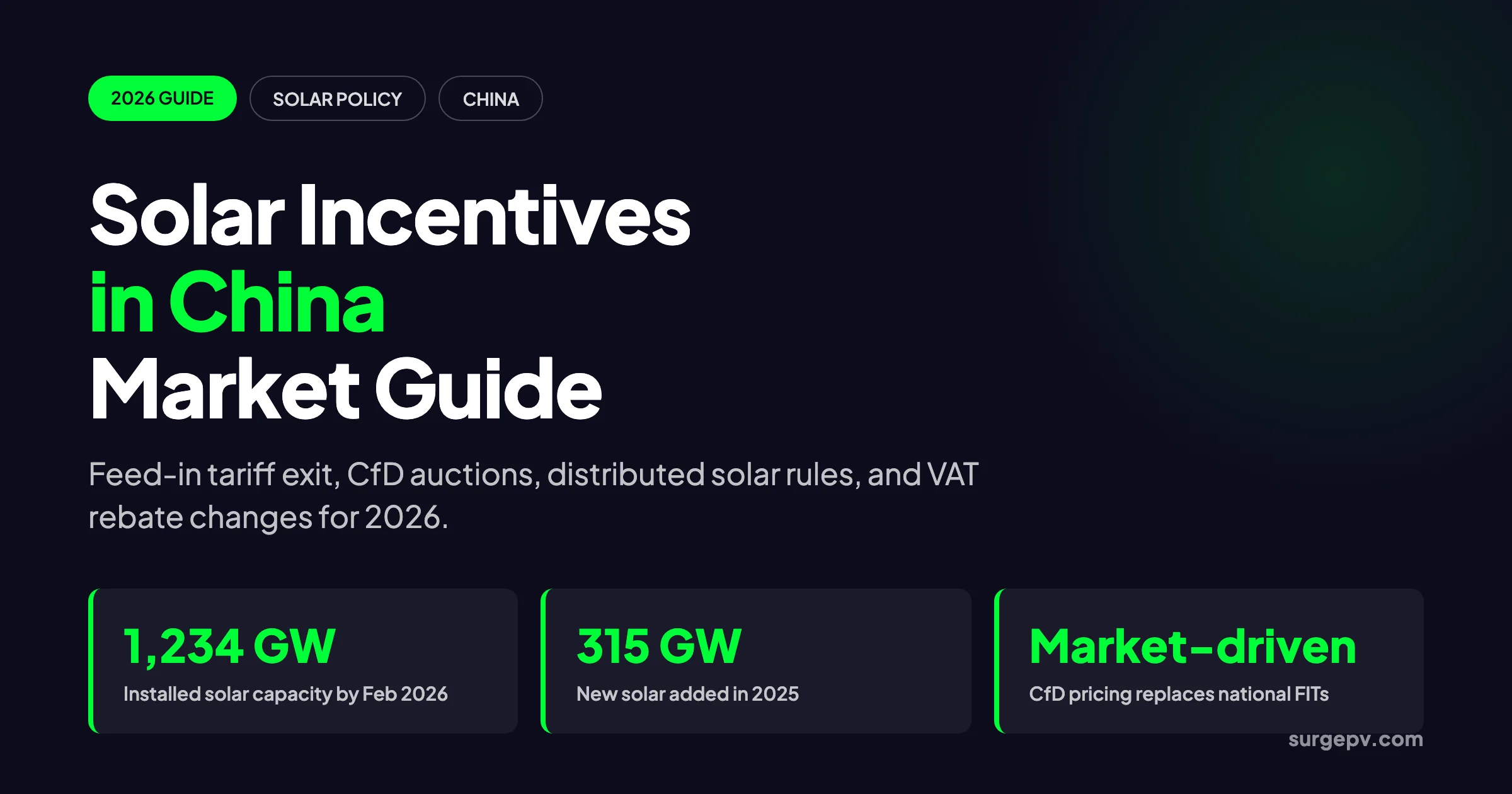
China’s solar market crossed a historic threshold in early 2026. Total installed photovoltaic capacity reached 1,234 GW by the end of February, up 33.2% year-on-year, according to the National Energy Administration (NEA) data reported by Mercom India (2026). The country added 315 GW of solar in 2025 alone, more than half of all new solar capacity installed worldwide, according to Carbon Brief analysis of official data (2026).
For installers, developers, and investors, the headline is no longer just scale. It is the end of the subsidy era. China’s 2026 solar market runs on competitive auctions, self-consumption mandates, green certificates, and carbon-market revenue rather than guaranteed feed-in tariffs. This guide explains how the new mechanisms work, who can access them, and how to avoid the mistakes that now punish outdated assumptions.
If you are designing systems or writing proposals for Chinese clients, a solar design platform that models hourly production, self-consumption ratios, and local tariff structures can cut errors and save hours per project. SurgePV’s solar design software and solar proposals let you build accurate, incentive-aware quotes. See pricing or book a demo to see how it works for China.
China’s 2026 solar incentive framework is a market mechanism, not a subsidy stack. The value comes from low equipment costs, competitive contract-for-difference revenue, green certificate sales, carbon-market income for eligible projects, and selective local support for distributed and agrivoltaic solar.
TL;DR — Solar Incentives in China 2026
Active mechanisms: provincial contract-for-difference auctions with strike prices and partial generation coverage; Green Electricity Certificates for approved renewable generators; national carbon-market revenue for qualifying projects; VAT relief on domestic transactions; and local incentives for whole-county rooftop pilots and agrivoltaics. National feed-in tariffs ended for new projects on 1 June 2025.
In this guide:
- Latest 2026 status of every active Chinese solar incentive
- Why national feed-in tariffs ended and what replaced them
- How the contract-for-difference auction system works
- Distributed PV self-consumption rules and provincial variations
- Green Electricity Certificates and carbon-market revenue
- VAT rebate changes affecting module and battery exports
- Local and provincial incentives still available
- Three real-world stacking scenarios with payback impact
- Common mistakes and how to avoid them
Latest Updates: China Solar Incentives 2026
The Chinese solar policy environment shifted decisively in 2025. The central government ended national feed-in tariffs for new projects, introduced a contract-for-difference pricing mechanism, tightened self-consumption rules for distributed solar, and adjusted VAT rebates on exported clean-energy equipment.
China Solar Incentive Status — June 2026
| Incentive | Type | Status | Key Terms |
|---|---|---|---|
| National feed-in tariff | Guaranteed price | Ended for new projects | Last applied to projects connected before 1 June 2025 |
| Contract-for-difference auctions | Revenue stabilisation | Active | Provincial strike prices, 40–80% generation coverage typical |
| Green Electricity Certificates | Tradable certificate | Active | One certificate per MWh; demand from RPS obligations |
| National carbon market | Carbon credit revenue | Active for power sector | Eligible renewable projects can earn CCERs |
| VAT relief on domestic sales | Sales tax relief | Active | Normal VAT treatment applies; no extra solar-specific rebate |
| Export VAT rebate on solar panels | Export incentive | Removed April 2026 | Rebate cut from 9% to 0% |
| Export VAT rebate on batteries | Export incentive | Phasing out | Reduced from 9% to 6% April 2026; full removal January 2027 |
| Distributed PV self-consumption rules | Grid integration | Active | 50% minimum for standard C&I up to 6 MW; full self-consumption above 6 MW |
| Whole-county rooftop pilot | Local deployment | Active | County-wide rooftop solar rollouts with policy support |
| Agrivoltaics and fishery PV | Dual-use support | Active, regulated | Encouraged under 14th FYP; land-use rules tightening |
| Ultra-high-voltage transmission | Infrastructure | Active | Moves western solar to eastern demand centers |
Key Changes Since 2025
1 June 2025 — End of national FITs: New solar and wind projects no longer receive a guaranteed tariff linked to coal benchmark prices. Projects connected before this date keep their existing terms.
February 2025 — Contract-for-difference framework announced: The National Development and Reform Commission (NDRC) and National Energy Administration directed provinces to introduce a sustainable new-energy pricing mechanism. The system resembles a two-sided contract for difference, with strike prices set through competitive auction.
October 2024 / May 2025 — Distributed PV self-consumption rules: The NEA issued new guidelines encouraging self-consumption of distributed solar to ease grid congestion. Full grid access for C&I projects was cancelled, and self-consumption minimums took effect.
April 2026 — Export VAT rebate removal: The 9% export VAT rebate on solar panels was removed. The battery rebate was cut to 6% and will disappear fully in January 2027, according to VAT Update (2026).
Key Takeaway
2026 is the first full year without national FITs. The most reliable incentives are now low installed cost, CfD auction revenue, and green certificate income. Developers must model market price risk and self-consumption ratios rather than assuming a guaranteed tariff.
Why China’s Solar Market Matters in 2026
China is the world’s largest solar market by every measure. It dominates manufacturing, installed capacity, and annual additions. In 2025 it added more solar than the rest of the world combined, and by early 2026 it became the first country to pass 1.2 TW of installed solar capacity.
Market Size and Targets
China’s installed solar capacity reached 1,234 GW by February 2026, with wind at 650 GW, according to NEA data reported by Mercom India (2026). The 1,200 GW combined wind and solar target for 2030 was already met by the end of 2024, six years ahead of schedule, according to Official Energy Asia (2025).
The 14th Five-Year Plan for Renewable Energy set a target for renewable electricity to supply 33% of generation by 2025 and 3,300 TWh of annual renewable generation, according to Sino-German Climate Cooperation (2024). Under the 15th Five-Year Plan (2026–2030), the China Electricity Council expects annual renewable additions of 200–300 GW.
Manufacturing Dominance
China produces more than 80% of the world’s solar panels across all key manufacturing stages. This scale is itself an incentive, because it keeps module prices far below global averages. The “new three” industries — electric vehicles, lithium batteries, and solar — accounted for more than 10% of China’s economic growth in 2024, according to Official Energy Asia (2025).
For solar professionals, the opportunity is not just installation. It is the ability to model project economics under market-based pricing, prove self-consumption ratios, and stack green certificate and carbon revenue. A modern solar yield and financial analysis can automate that workflow.
The End of National Feed-in Tariffs
China introduced a national solar feed-in tariff in 2011 at ¥1.15/kWh. The tariff was reduced several times and eventually replaced by competitive auctions. The final phase-out for new projects took effect on 1 June 2025.
Why the FIT Ended
The FIT was designed to build an industry. It worked. Solar costs fell so far that guaranteed tariffs became unnecessary and, in the government’s view, distorting. The coal-fired benchmark price used to set FITs was last updated in 2017 and no longer reflected renewable generation costs, according to Carbon Brief (2025).
Ending the FIT also shifted the financial burden of integration — curtailment, flexibility, and grid upgrades — toward market signals rather than administrative prices.
What Happens to Existing Projects
Projects that connected before 1 June 2025 keep their existing FIT or benchmark-price contracts for their original term. This creates a two-tier market:
- Stock projects: Pre-June 2025 assets with stable, regulated revenue.
- Incremental projects: Post-June 2025 assets exposed to market pricing and CfD auctions.
The split matters for valuation. Older projects trade as income assets. New projects must be underwritten with merchant price risk.
Contract-for-Difference Auctions: The New Core Incentive
The replacement for FITs is a provincial contract-for-difference mechanism. The policy was set at the central level in NDRC/NEA Document 136, with provinces implementing the details.
How the CfD Mechanism Works
Under the new system:
- Provincial governments set an annual quota of renewable capacity.
- Developers bid in competitive reverse auctions for a strike price.
- Winning projects receive a two-sided settlement for a share of their generation.
- If the market reference price is below the strike price, the project is paid the difference.
- If the market reference price is above the strike price, the project pays back the difference.
The reference price is usually the monthly average spot or medium-to-long-term market price for the same technology in the province. The settlement frequency is monthly.
Partial Coverage Is the Key Difference
Unlike UK CfDs, which typically cover 100% of output, Chinese CfDs cover only part of a project’s generation. Coverage ratios of 40–80% are common, according to Eco-Business (2026). The uncovered share is sold at market rates.
This creates a hybrid revenue profile: stable baseline income from the CfD, plus variable upside or downside from the open market.
Strike Prices and Profitability
Strike prices are set by auction and vary by province and technology. In some western provinces with excellent solar resource, solar strike prices have fallen to levels that barely cover capital costs, according to Eco-Business (2026). In eastern provinces with higher power prices, returns can be stronger.
The system is designed to keep prices low, not to guarantee developer margins. Projects with the lowest cost of capital and best resource win.
Installer Implication
For utility-scale and large C&I projects, proposals must show capture price, CfD coverage ratio, and merchant price exposure. A single strike price is not enough to value a project.
Distributed Solar and Self-Consumption Rules
Distributed solar has been the fastest-growing segment in China. In the first quarter of 2025, China installed a record 60 GW of new solar, 60% of it rooftop, according to Rystad Energy (2025). The new NEA guidelines aim to control that growth by forcing projects to consume more power on site.
National Rules Effective May 2025
The NEA directive introduced three important categories:
| Project Type | Size | Grid Access Rule |
|---|---|---|
| Residential rooftop | Typically under 20 kW | Net metering or net billing, varies by province |
| Standard C&I rooftop | Up to 6 MW | Minimum 50% self-consumption; surplus can export |
| Large C&I rooftop | Above 6 MW | Full self-consumption; no grid sales allowed |
Provincial Variations
Provinces can set stricter rules. Notable examples include:
- Inner Mongolia: 90% minimum self-consumption for standard C&I projects up to 6 MW.
- Jilin: 80% minimum self-consumption for standard C&I projects up to 6 MW.
- Jiangsu and Guangdong: No self-consumption minimum for standard C&I projects, with more flexible pathways for large projects to connect as utility-scale.
These differences mean the same 5 MW rooftop design can have completely different economics in Guangzhou, Changchun, or Hohhot.
Why Self-Consumption Matters
Self-consumed solar avoids buying grid power at retail rates. Exported solar is paid at market-based rates that are often far lower. In provinces with high solar penetration, midday spot prices can approach zero or turn negative. Every kilowatt-hour used on site is worth more than one exported.
For designers, this makes load profiling essential. A energy and financial modeling tool that models hourly consumption against hourly production can prove whether a project meets the self-consumption threshold and what the real payback is.
Green Electricity Certificates and Carbon Revenue
Beyond power sales, two market-based instruments add revenue for Chinese solar projects: Green Electricity Certificates and the national carbon market.
Green Electricity Certificates
China’s Green Electricity Certificates verify that one megawatt-hour of electricity was generated from renewable sources. Large consumers, grid companies, and provinces with renewable portfolio obligations must buy certificates to meet their targets. This creates demand and a secondary revenue stream.
Solar projects can earn certificates for generation that is not already subsidized by FITs. The price fluctuates with supply and policy changes, so developers should not assume a fixed value.
National Carbon Market
China’s national emissions trading scheme covers the power sector. Eligible renewable projects can earn China Certified Emission Reductions (CCERs) for avoided emissions. CCERs can be sold to covered emitters that need offsets.
The carbon price has risen gradually but remains modest compared with European markets. Carbon revenue is a useful add-on, not the main return driver.
Stacking Certificates and Carbon Credits
A solar project can sell electricity, green certificates, and carbon credits at the same time. The combination improves project economics but also adds complexity. Each instrument has its own registration, verification, and settlement rules.
VAT and Fiscal Treatment
China does not offer a direct federal tax credit for homeowners or businesses that buy solar panels. The fiscal value lies in VAT treatment, import duty structures, and accelerated depreciation for businesses.
Domestic VAT Treatment
Solar equipment and installation services are subject to normal VAT rules. There is no nationwide additional VAT rebate for rooftop solar purchases. Some local governments have experimented with subsidies or reduced fees, but these are patchy and often short-lived.
Export VAT Rebate Changes
From 1 April 2026, China removed the 9% export VAT rebate on solar panels. The rebate on batteries was reduced from 9% to 6% and will be fully removed on 1 January 2027, according to VAT Update (2026).
The change raises the export price of Chinese modules and batteries. For international buyers, this means the ultra-low panel prices of 2024–2025 may not continue beyond mid-2026. For Chinese exporters, it pushes margins lower or forces price increases.
Business Tax Depreciation
Chinese companies can depreciate solar assets under normal tax rules. Some local governments offer additional incentives for renewable energy manufacturing or investment in designated zones. These are negotiated case by case.
Local and Provincial Incentives
While national subsidies have ended, local support remains available in specific forms.
Whole-County Rooftop Pilots
The whole-county rooftop solar pilot program encourages county-level governments to deploy distributed solar across public, commercial, industrial, and residential rooftops. Participants may benefit from streamlined permitting, bulk procurement, and preferential grid connection. The model is aimed at rural and semi-urban areas with available roof space.
Agrivoltaics and Fishery PV
The 14th Five-Year Plan encouraged dual-use solar applications such as agrivoltaics and fishery-solar hybrid projects. These projects generate electricity while allowing limited agriculture or aquaculture underneath. Land-use rules have tightened recently, and projects must prove they do not displace food production.
Industrial Park and Public Building Mandates
Some provinces require government buildings, schools, hospitals, and industrial parks above a certain size to install rooftop solar. These mandates are not direct subsidies, but they create a guaranteed pipeline of projects.
Western Utility-Scale Bases
China has planned ten renewable energy mega bases, mostly in western provinces such as Xinjiang, Gansu, Qinghai, and Inner Mongolia. These bases combine solar, wind, and storage and feed power to eastern load centers through ultra-high-voltage transmission lines. Projects in these zones benefit from land availability, excellent resource, and transmission access.
Regional Market Differences
China’s solar market is split between resource-rich western provinces and demand-rich eastern provinces.
Western China: Utility-Scale Dominance
Xinjiang, Qinghai, Gansu, and Inner Mongolia have the best solar resource and lowest land costs. These regions host most utility-scale solar and the mega bases. The challenge is curtailment and the need for long-distance UHV transmission.
Eastern China: Distributed Solar Leaders
Shandong, Jiangsu, Zhejiang, Henan, and Guangdong lead distributed solar. Shandong alone had 49.5 GW of total solar capacity by mid-2023, of which 35.7 GW was distributed, according to Rystad Energy (2023). These provinces have high power demand, higher retail prices, and limited land, making rooftops valuable.
Grid Congestion and Curtailment
Rapid solar growth has caused grid congestion in some regions. Curtailment rates remain low nationally but can spike locally. The response has been to require storage, limit exports, and push self-consumption. New utility-scale projects no longer face a blanket storage mandate, but many provinces still require co-located storage for grid connection.
How to Stack Incentives: Three Real-World Scenarios
The following examples are illustrative, based on typical 2026 costs and incentive rates in China. Actual figures depend on province, tariff, self-consumption ratio, and developer cost.
Scenario 1 — 20 kW Residential Rooftop, Jiangsu
| Item | Amount |
|---|---|
| Gross installed cost | CNY 60,000 |
| Local rooftop subsidy | −CNY 6,000 |
| Net cost | CNY 54,000 |
| Annual bill savings (self-consumption + export) | CNY 8,500 |
| Payback | 6.4 years |
Jiangsu has relatively supportive distributed solar rules and good self-consumption potential for households with daytime load.
Scenario 2 — 5 MW Commercial Rooftop, Guangdong
| Item | Amount |
|---|---|
| Gross installed cost | CNY 12,500,000 |
| Green certificate revenue (annual) | +CNY 350,000 |
| Annual avoided electricity purchase | CNY 1,800,000 |
| Annual export revenue (surplus 20%) | CNY 200,000 |
| Payback | 5.8 years |
Guangdong’s high commercial power prices and flexible distributed solar rules make self-consumption-focused projects attractive.
Scenario 3 — 100 MW Utility-Scale Solar Park, Qinghai
| Item | Amount |
|---|---|
| Gross CAPEX | CNY 280,000,000 |
| CfD coverage | 60% of generation at strike price |
| Merchant market price | CNY 0.22/kWh average |
| Green certificate revenue | +CNY 0.03/kWh |
| LCOE with incentives | ~CNY 0.18/kWh |
| Project IRR | 7–9% |
Western utility-scale projects have low LCOE but face merchant price risk and curtailment. CfD coverage provides baseline stability.
Common Mistakes and Misconceptions
Even experienced developers lose money in China by misunderstanding the post-FIT framework.
Designing for Export Under Old FIT Rules
The old FIT made exports valuable. The new system does not. Oversized systems that export most of their generation face low market prices, self-consumption penalties, or connection refusal.
Ignoring Provincial Differences
National guidelines set minimums, but provinces write the detailed rules. A project that works in Jiangsu may fail in Inner Mongolia because of stricter self-consumption requirements.
Treating CfDs as Guaranteed Tariffs
CfDs cover only part of generation and settle against monthly reference prices. They reduce risk but do not eliminate it. Merchant exposure remains significant.
Assuming Green Certificate Prices Are Stable
Green certificate prices fluctuate with supply and renewable portfolio targets. Projects that depend on certificate revenue for viability are vulnerable to policy changes.
Overlooking the Export VAT Rebate Impact
Chinese module and battery prices may rise for international buyers after April 2026. Projects that assumed continuing price declines should revise their cost assumptions.
Neglecting Load Profiling for C&I Rooftops
A 6 MW rooftop must prove it can self-consume at least 50% in most provinces. Without detailed hourly load and production data, the project may not get approved.
Conclusion
China’s solar incentive framework in 2026 is a market-driven system, not a subsidy menu. The national feed-in tariff is gone. In its place are provincial contract-for-difference auctions, green certificate markets, carbon credits, and strict self-consumption rules for distributed solar. The country’s manufacturing scale keeps installed costs low, but developers must now manage market price risk, provincial rule differences, and grid integration constraints.
For solar professionals, the competitive edge is the ability to model the new incentives accurately. A proposal that shows capture price, CfD coverage, self-consumption ratio, and certificate revenue is more persuasive than one that quotes a simple price per watt. Tools like SurgePV’s solar design software, shading analysis software, and generation and financial tool can automate that workflow for Chinese projects.
Three actions to take now:
- Verify the provincial rules before sizing — self-consumption minimums and CfD terms vary by province.
- Size for self-consumption first — exported power is worth less than avoided retail purchases under the new framework.
- Model market price exposure — CfDs provide partial coverage; the rest is merchant revenue.
For regional comparisons, see our solar payback period by country guide. For installers scaling in China, our guide for solar installers covers proposal automation and compliance workflows.
Frequently Asked Questions
What solar incentives are available in China in 2026?
China’s 2026 solar incentives include provincial contract-for-difference auctions that guarantee part of a project’s revenue at a strike price, green electricity certificates sold to corporates with renewable energy obligations, national carbon-market revenue for approved projects, VAT relief on domestic sales, and select local subsidies for distributed solar, whole-county rooftop pilots, and agrivoltaic projects.
Does China still have feed-in tariffs for solar in 2026?
No. National feed-in tariffs for new solar projects ended on 1 June 2025. Existing projects with valid FIT contracts continue under their original terms, but new capacity must compete in market-based mechanisms such as contract-for-difference auctions or sell power through bilateral contracts and spot markets.
How does China’s contract-for-difference system work for solar?
Provincial governments run competitive auctions to set a strike price for a share of a project’s generation, often 40–80%. If the market price is below the strike price, the project receives the difference. If the market price is higher, the project pays back the surplus. The remainder of output is sold at market rates, exposing developers to price volatility.
What is the minimum self-consumption rule for distributed solar in China?
National Energy Administration guidelines effective from May 2025 require most standard commercial and industrial rooftop projects up to 6 MW to self-consume at least 50% of generation. Projects above 6 MW must generally achieve full self-consumption. Some provinces set stricter rates, such as Inner Mongolia at 90% and Jilin at 80%.
Are solar panels still eligible for VAT rebates in China in 2026?
Domestic solar transactions retain normal VAT treatment, but from 1 April 2026 the 9% export VAT rebate on solar panels was removed. The battery export VAT rebate was reduced from 9% to 6% and is scheduled for full removal on 1 January 2027.
How big is China’s solar market in 2026?
China’s installed solar capacity reached 1,234 GW by February 2026, up 33.2% year-on-year, according to the National Energy Administration. The country added 315 GW of new solar in 2025, more than half of all global additions. The China Photovoltaic Industry Association forecasts 180–240 GW of new solar in 2026.
Can rooftop solar owners in China sell excess power to the grid?
Yes, but the value of exports has fallen. Residential and small commercial systems can still receive net metering or net billing credits, depending on the province and utility. Commercial and industrial projects above 6 MW face full self-consumption requirements in many regions, limiting grid sales.
What are China Green Electricity Certificates?
Green Electricity Certificates are tradeable proof that one megawatt-hour of renewable electricity was generated. Large consumers and grid companies must meet renewable portfolio obligations, creating demand. Solar projects can earn additional revenue by selling certificates, though prices vary with supply and policy changes.
Which Chinese provinces have the most solar capacity?
Shandong, Hebei, Henan, Jiangsu, and Xinjiang are among the largest solar provinces. Shandong leads in distributed solar, with 35.7 GW of distributed capacity as of mid-2023. Western provinces such as Qinghai, Gansu, and Xinjiang host most utility-scale solar, connected to eastern demand centers through ultra-high-voltage transmission lines.
What is the most common mistake when sizing solar in China in 2026?
The most common mistake is oversizing for export under the old FIT mindset. With market-based pricing and self-consumption rules, exported power is worth less than avoided retail purchases. Systems should be sized to match on-site load, and C&I projects must prove they can meet the required self-consumption ratio.
Where this fits
This article is part of SurgePV's Solar Incentives & Policy hub, which works through the topic from first principles to the decisions a project team actually has to make.

