

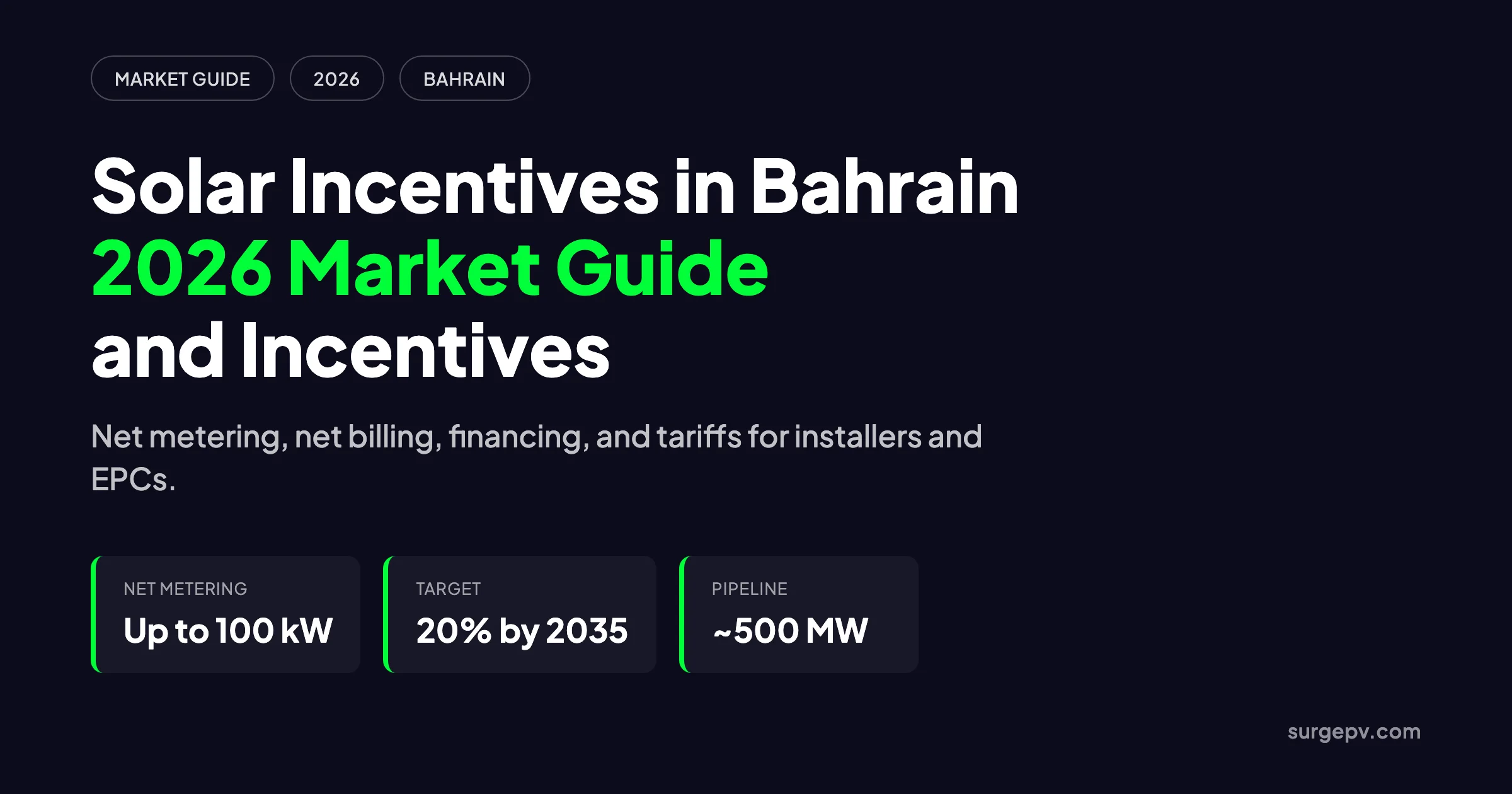
Bahrain’s solar market is small but changing quickly. The Kingdom has set a 20% renewable electricity target by 2035, up from an earlier 10% goal, and the Electricity and Water Authority (EWA) now reports more than 140 MW of renewable generation in operation plus a distributed renewable pipeline estimated at around 500 MW, according to EWA’s distributed renewable energy page (2026). For installers, EPCs, and property owners, the opportunity is not a large upfront subsidy. It is a stack of mechanisms: net metering, net billing, subsidised enterprise financing, Renewable Energy Certificates, and tariff savings.
This guide is a practical market manual for 2026. It covers the current policy framework, how EWA compensates surplus generation, the financing options that actually exist, and the mistakes that waste money. For regional comparisons, see our solar payback period by country guide. For installers designing systems across the Gulf, our solar design software supports accurate irradiance, tariff, and self-consumption modelling.
If you are preparing proposals for Bahraini clients, a tool that models EWA tariffs, net metering carry-forward, and net billing export value can cut hours from each project. Generate solar proposals automatically, then check pricing or book a demo to see how SurgePV handles Gulf markets.
Quick Answer
Bahrain’s 2026 solar incentives are built around EWA net metering for residential systems up to 100 kW, net billing for non-residential and larger systems, Tamkeen’s subsidised solar financing for enterprises, Renewable Energy Certificates for qualifying generation, and avoided electricity costs under the 2026 tariff structure.
In this guide:
- Latest 2026 status of every active Bahrain solar incentive
- How EWA net metering and net billing actually work
- Tamkeen financing and bank solar loans
- Renewable Energy Certificates and green building rules
- 2026 EWA tariffs and real payback economics
- Commercial and industrial project routes
- Common mistakes when sizing and applying
Latest Updates: Bahrain Solar Incentives 2026
The Bahraini solar policy environment in 2026 is defined by one fact: the mechanisms are in place, but the market is still scaling. The National Renewable Energy Action Plan (NREAP) was revised to 20% renewable electricity by 2035. EWA’s distributed renewable energy service is live on the Benayat platform. Tariffs for non-subsidised customers rose to 32 fils/kWh in January 2026.
Bahrain Solar Incentive Status — 2026
| Incentive | Type | Status | Key Terms |
|---|---|---|---|
| Net metering | Bill credit | Active | Residential systems up to 100 kW; credits carried forward |
| Net billing | Export sale | Active | Non-residential and residential over 100 kW |
| Tamkeen Solar Financing | Enterprise loan | Active | BHD 5,000 to 500,000; up to 10 years; 70% profit-rate support |
| Bank solar loans | Personal/commercial loan | Active | Offered by several Bahraini banks |
| Renewable Energy Certificates | Tradable certificates | Active | 1 MWh per certificate; SEA platform |
| Renewable energy mandate | Building regulation | In development | Minimum RE share for new buildings |
| NREAP target | Policy target | Active | 20% renewable electricity by 2035 |
Key Changes Since 2025
Tariff increase to 32 fils/kWh: Effective January 2026, non-subsidised electricity charges rose from 29 fils to 32 fils per kWh, according to Lexis Middle East (2026). Subsidised tariffs for Bahraini citizens in primary residences remain unchanged.
REC platform launch: The Sustainable Energy Authority developed an electronic platform to track renewable generation and issue Renewable Energy Certificates. This supports both green building compliance and corporate sustainability reporting.
500 MW pipeline milestone: EWA reports 340 completed distributed renewable projects and 69 ongoing projects, with total estimated capacity of around 500 MW.
Key Takeaway
The most reliable 2026 incentives are net metering value for homes, net billing and tariff avoidance for businesses, and Tamkeen financing for enterprises. There is no residential cash subsidy, so accurate financial modelling matters more than chasing rebates.
Why Bahrain’s Solar Market Matters in 2026
Bahrain has excellent solar resources. Average global horizontal irradiance is roughly 1,900 to 2,100 kWh/m² per year, comparable to other Gulf markets. The limiting factor is not sunshine. It is land, grid capacity, and the pace of regulation.
Market Size and Targets
Bahrain’s NREAP originally targeted 5% renewable electricity by 2025 and 10% by 2035. The 2035 target was later raised to 20%, according to Bahrain’s SDG portal (2026). The plan equates to 255 MW of renewable capacity by 2025 and 710 MW by 2035.
Progress has been slower than the targets. By the end of 2024 Bahrain had only around 18 MW of renewable capacity installed, according to Enerdata (2025). However, EWA’s 2026 update shows the pipeline is now catching up. The Authority reports over 140 MW of renewable generation in operation and a distributed renewable pipeline of around 500 MW.
Land Scarcity Drives Rooftop Focus
Bahrain is a small island nation. Large ground-mounted solar farms are difficult. The government’s strategy emphasises decentralised urban generation, including rooftop solar, building-integrated PV, solar car parks, and government building rooftops. The 100 kW residential net metering cap and the commercial net billing route fit this rooftop-first approach.
For installers, the practical implication is clear: most projects are behind-the-meter systems on villas, schools, malls, factories, and government buildings. Accurate roof measurements, shading analysis, and load profiling are essential. Modern solar design software can automate these steps for Bahraini projects.
Net Metering and Net Billing in Bahrain
EWA operates two distinct compensation schemes for distributed solar. Choosing the wrong one changes the economics of a project.
Net Metering
Net metering is available for residential customers with solar systems up to 100 kW.
- Solar generation is used on site first.
- Surplus electricity is exported to the EWA grid.
- Exported kWh are credited and carried forward to subsequent billing months.
- The customer pays only for net electricity consumed over time.
This is a strong incentive because the credit is in energy units, not cash. A kWh exported in March offsets a kWh imported in August. The carry-forward makes it valuable for customers with seasonal consumption patterns, such as higher summer air-conditioning loads.
Net Billing
Net billing applies to all non-residential sectors and to residential systems above 100 kW.
- The customer consumes solar generation on site.
- Surplus electricity is sold to EWA at the applicable rate.
- Grid imports are billed at the full retail rate.
- The customer receives a cash credit or payment for exports.
Net billing suits commercial and industrial customers with large daytime loads. The key design question is whether the export rate is high enough to justify oversizing beyond on-site consumption.
How to Apply
All distributed renewable energy applications are submitted through the Benayat platform, Bahrain’s unified building-permit and utility-connection system. The process requires an EWA-registered engineering office and an EWA-approved contractor. EWA lists dozens of approved distributed renewable resource grid contractors and engineering offices on its platform.
What the Metering Rules Mean for Sizing
The 100 kW net metering cap makes most villa systems straightforward. A typical Bahraini villa might install 5 kW to 15 kW. Commercial rooftops and factories usually fall under net billing and should be sized based on daytime load, not roof area. Oversizing for export under net billing is risky if export rates are below retail import rates.
A well-modelled solar financial analysis tool can test each compensation scheme against the customer’s actual consumption profile.
Financing and Fiscal Support
Bahrain does not offer a direct federal cash subsidy for residential solar panels. The financial support comes through loans, financing subsidies, and bank products.
Tamkeen Solar Financing Scheme
Tamkeen, Bahrain’s Labour Fund, launched the Solar Financing Scheme in 2020 under its Tamweel programme. It is one of the most concrete incentives available.
- Financing range: BHD 5,000 to BHD 500,000.
- Repayment period: up to 10 years.
- Tamkeen supports 70% of the annual profit rate.
- Sharia-compliant structure.
- Available to enterprises registered with Tamkeen.
The scheme is aimed at companies, SMEs, and institutions, not individual homeowners. For a factory or hotel considering a 200 kW rooftop system, this can reduce the effective cost of capital materially. Details are available on Tamkeen’s announcement (2020).
Bank Solar Loans
Several Bahraini banks now offer solar-specific financing for individuals and businesses. Products typically require a quotation from a solar provider, salary certificates, and recent bank statements. Terms vary by bank, so compare profit rates and repayment periods before committing.
No Direct Residential Subsidy
Homeowners should not expect a capital grant. The value proposition is lower electricity bills through net metering and long-term tariff protection. This makes honest production and consumption modelling critical.
Renewable Energy Certificates and Green Building Rules
Bahrain has added a market-based instrument that complements net metering and net billing.
Renewable Energy Certificates
The Sustainable Energy Authority operates an electronic platform that tracks renewable generation and issues Renewable Energy Certificates (RECs). One certificate represents 1 MWh of renewable electricity.
RECs can be used in several ways:
- To verify on-site renewable generation for green building certification.
- To offset shortfalls where a building cannot install enough on-site solar.
- To support corporate ESG reporting and sustainability targets.
The platform connects to EWA’s monitoring systems to confirm eligibility. For developers, RECs provide a way to comply with the Bahrain Green Building Code even when rooftop space is limited.
Renewable Energy Mandate for New Buildings
The NREAP proposed a renewable energy mandate requiring new buildings and real estate developments to source a minimum share of energy from renewable sources. The generated energy is consumed on site, with excess fed to the grid under net metering rules.
The mandate is still being implemented in phases. New projects should check current requirements with the Ministry of Works and the Sustainable Energy Authority before finalising designs.
Electricity Tariffs and Payback Economics
Bahrain’s electricity tariff structure is the single biggest driver of solar economics. The same system can have very different payback depending on whether the customer receives subsidised citizen tariffs or pays the full commercial rate.
2026 EWA Electricity Tariffs
The following table summarises the tariffs published by EWA as of February 2026, according to EWA (2026):
| Customer Category | Consumption Range | Tariff |
|---|---|---|
| Domestic Bahraini, single account | 0–3,000 kWh | 3 fils/kWh |
| Domestic Bahraini, single account | 3,001–5,000 kWh | 9 fils/kWh |
| Domestic Bahraini, single account | 5,001–7,000 kWh | 16 fils/kWh |
| Domestic Bahraini, single account | Above 7,000 kWh | 32 fils/kWh |
| Domestic non-subsidised / commercial | All consumption | 32 fils/kWh |
A fil is one-thousandth of a Bahraini dinar. One Bahraini dinar is approximately USD 2.65. The subsidised residential rates make solar less attractive for low-consumption Bahraini households. The 32 fils/kWh commercial rate makes solar very attractive for businesses.
Payback Example: 150 kW Commercial Rooftop
The following example is illustrative. Actual figures depend on roof quality, shading, equipment choice, and contractor pricing.
| Item | Value |
|---|---|
| System size | 100 kW |
| Specific yield | 1,700 kWh/kWp/year |
| Annual generation | 170,000 kWh |
| Self-consumption ratio | 85% |
| Avoided electricity at 32 fils/kWh | BHD 4,624/year |
| Net export at assumed 12 fils/kWh | BHD 306/year |
| Total annual benefit | BHD 4,930/year |
| Installed cost estimate | BHD 35,000 |
| Simple payback | ~7.1 years |
This example assumes a well-sited roof, high self-consumption, and a competitive installed cost. Residential payback is longer because the first 3,000 kWh are priced at only 3 fils/kWh. Solar offsets the cheapest tier first, so the marginal value of each kWh is low until consumption crosses the higher tiers.
Commercial and Industrial Solar in Bahrain
C&I solar is where Bahrain’s market is most active. Malls, hotels, factories, schools, and government buildings pay the full 32 fils/kWh rate and have large daytime cooling loads.
Notable Projects
The Medical University of Bahrain solar installation achieves 65% of the university’s annual electrical energy needs, according to Bahrain’s national portal (2026). The Bahrain International Circuit launched a tender for a minimum 3 MW solar car park shade project in partnership with the Sustainable Energy Authority, according to Bahrain International Circuit (2021). Government building rooftops and public schools are also being equipped with solar systems.
Isolated Self-Consumption and IPPs
For very large consumers, isolated self-consumption and independent power producer structures are possible. These require permits and direct agreements with EWA or government entities. They are not part of the standard net metering or net billing programmes.
Design Priorities for C&I
C&I installers should focus on:
- Hourly load profiling to match daytime demand.
- Demand-charge analysis if demand charges apply.
- Shading and soiling losses from dust and nearby structures.
- Net billing export assumptions.
Solar shading analysis and accurate financial modelling become more valuable as project size grows.
Common Mistakes and Misconceptions
Even experienced installers can misread the Bahrain market. Here are the most common errors.
Oversizing for Export
Net billing export rates are typically lower than retail import rates. A system that exports 30% of its generation may look good on paper but produce lower returns than a smaller system with higher self-consumption. Size for load first, export second.
Expecting a Residential Subsidy
Many homeowners ask about a government grant for solar panels. Bahrain does not offer one. The pitch should focus on bill savings, net metering credits, and protection against future tariff increases.
Ignoring the Subsidised Tariff Tiers
For Bahraini citizens on subsidised rates, the first 3,000 kWh cost only 3 fils/kWh. Solar savings in that tier are minimal. A homeowner with low consumption may never reach the higher tiers where solar economics become attractive.
Underestimating Dust and Heat
Bahrain’s climate is hot and dusty. Soiling losses can reach 20% or more without regular cleaning. Inverter derating and panel temperature coefficients also reduce output in summer. Use local weather files and realistic degradation assumptions.
Using Non-Approved Contractors
EWA requires approved engineering offices and contractors for distributed renewable connections. Using an unregistered installer can delay or block approval. Verify contractor status before quoting.
Conclusion
Bahrain’s 2026 solar incentive framework is not a simple rebate. It is a combination of net metering for homes, net billing for businesses, Tamkeen financing for enterprises, bank loans for individuals, Renewable Energy Certificates, and green building requirements. The real value depends on the customer’s tariff category and daytime consumption pattern.
For solar professionals, the competitive edge is accurate modelling. A system sized for a subsidised villa will fail on a commercial roof, and vice versa. Tools like SurgePV’s energy and financial modeling tool and Clara AI can automate load matching, shading analysis, and proposal generation for Bahraini projects.
Three actions to take now:
- Confirm the customer’s tariff category — subsidised residential, non-subsidised, or commercial — before sizing.
- Choose the right compensation scheme — net metering for homes up to 100 kW, net billing for larger and non-residential systems.
- Match generation to daytime load — export is worth less than avoided retail purchases.
For installers scaling in the Gulf, our guide for solar installers covers proposal automation, compliance workflows, and multi-market design standards.
Frequently Asked Questions
What solar incentives are available in Bahrain in 2026?
Bahrain’s 2026 solar incentives include EWA net metering for residential systems up to 100 kW, net billing for non-residential systems and residential systems above 100 kW, Tamkeen’s subsidised solar financing for enterprises, Renewable Energy Certificates issued through the Sustainable Energy Authority, and avoided electricity costs under the 2026 EWA tariff structure. There is no direct cash subsidy for residential rooftop solar.
Does Bahrain have a feed-in tariff for solar?
Bahrain’s National Renewable Energy Action Plan originally proposed tender-based feed-in tariffs for government building solar projects, but the primary customer-facing mechanism in 2026 is net metering and net billing through the Electricity and Water Authority. Large government-owned rooftop projects have been procured through competitive tenders and power purchase agreements instead.
How does net metering work in Bahrain?
Under EWA net metering, residential customers with solar systems up to 100 kW can consume their generation on site and export surplus electricity to the grid. The surplus is credited in kWh and carried forward to subsequent billing months, reducing future bills. Customers pay only for the net electricity consumed over time.
What is the difference between net metering and net billing in Bahrain?
Net metering applies to residential solar systems up to 100 kW and credits exported kWh against future consumption. Net billing applies to non-residential sectors and to residential systems above 100 kW; the customer sells surplus electricity to EWA at the applicable rate while continuing to pay the retail rate for grid imports. Net metering suits homeowners; net billing suits larger commercial and industrial installations.
What is the maximum solar system size for net metering in Bahrain?
The residential net metering programme in Bahrain allows systems up to 100 kW. Systems above 100 kW, and all non-residential systems, fall under the net billing arrangement.
Is there a government subsidy for residential solar in Bahrain?
No. Bahrain does not offer a direct upfront cash subsidy for residential solar installations. The financial value comes from net metering bill credits, lower effective electricity costs, Tamkeen financing for enterprises, and bank solar loans for individuals.
What is Tamkeen’s Solar Financing Scheme?
Tamkeen’s Solar Financing Scheme, launched under the Tamweel programme, provides Sharia-compliant financing to enterprises for purchasing and installing solar panels. Loans range from BHD 5,000 to BHD 500,000 with repayment periods of up to 10 years, and Tamkeen subsidises 70% of the annual profit rate.
What are Renewable Energy Certificates in Bahrain?
Renewable Energy Certificates are tradable instruments issued through the Sustainable Energy Authority’s electronic platform. Each certificate represents 1 MWh of renewable generation and can be used to verify compliance with green building requirements or corporate sustainability targets, or to offset shortfalls in on-site renewable generation.
What are Bahrain’s renewable energy targets?
Bahrain’s National Renewable Energy Action Plan originally targeted 5% renewable electricity by 2025. The target was revised upward to 20% renewable electricity by 2035. EWA reports more than 140 MW of renewable generation in operation and a distributed renewable project pipeline of around 500 MW.
What is the typical payback period for solar in Bahrain?
Well-designed commercial and industrial solar systems in Bahrain typically pay back in 5 to 8 years, driven by high unsubsidised tariffs of 32 fils/kWh, strong solar irradiance, and net billing revenue. Subsidised residential payback is longer because the first consumption tiers are priced at only 3 fils/kWh.
Where this fits
This article is part of SurgePV's Solar Incentives & Policy hub, which works through the topic from first principles to the decisions a project team actually has to make.

