

Answer
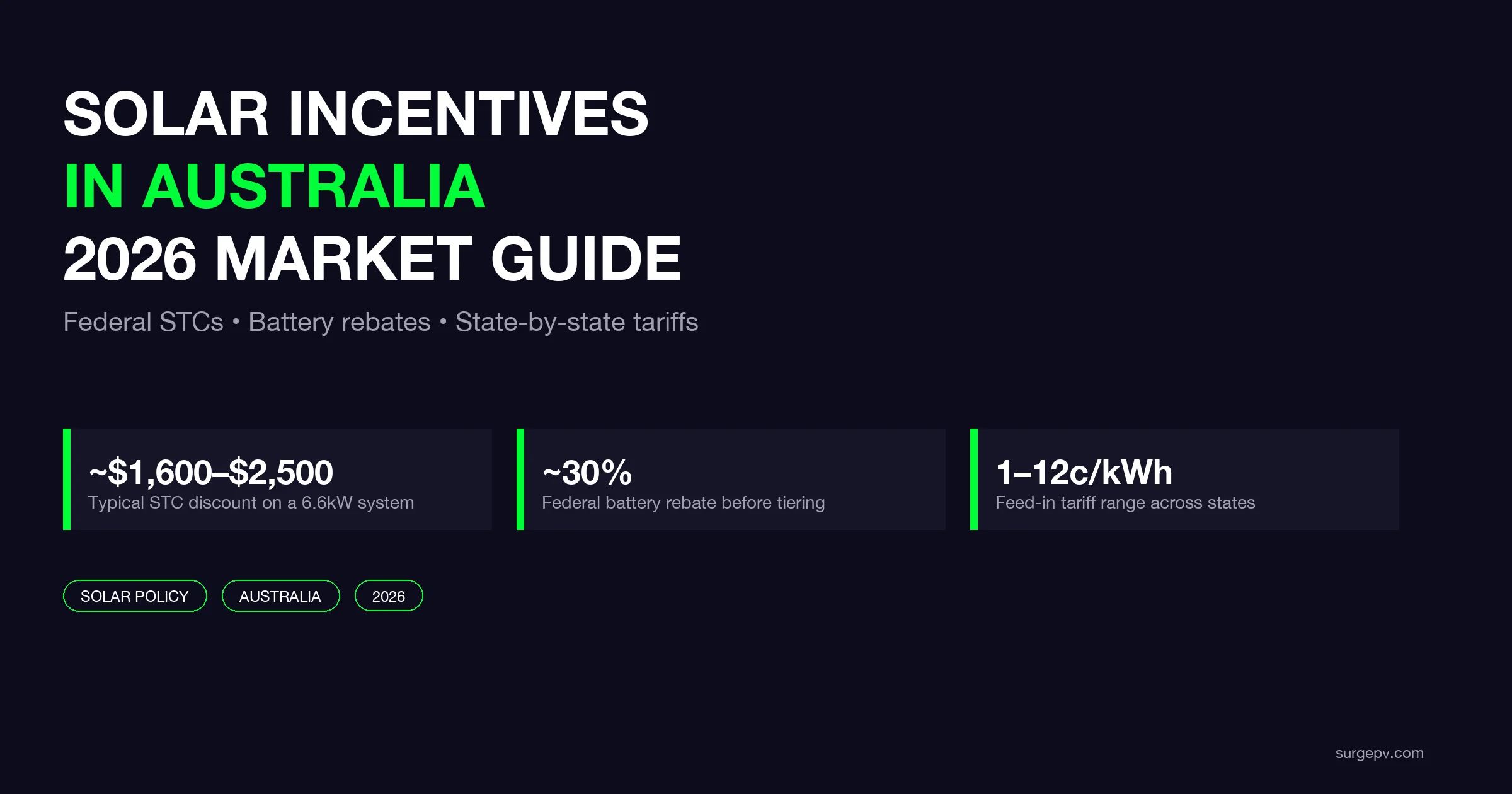
Australia's 2026 solar incentives are a layered stack. The federal Small-scale Renewable Energy Scheme (STCs) cuts the upfront cost of rooftop solar by roughly $1,600–$2,500 on a typical 6.6kW system. The Cheaper Home Batteries Program discounts eligible batteries by around 30%. State programs add further rebates, interest-free loans, or VPP incentives, while feed-in tariffs pay 1–12c/kWh for exported energy.
Australia has the highest rooftop solar penetration of any major economy. More than 4.3 million homes and small businesses had solar panels installed by early 2026, and the Clean Energy Regulator reports that small-scale systems now total over 28 GW of capacity. The federal government wants 82% renewable electricity by 2030, and rooftop solar is carrying a large share of that load.
For homeowners and installers, the important question is not whether solar works in Australia. It is which incentives still matter in 2026, how they stack, and where the traps are. This guide covers the federal STC rebate, the Cheaper Home Batteries Program, every active state incentive, feed-in tariffs by state, and the mistakes that cost people money.
If you are quoting Australian solar projects, a design tool that models STC discounts, self-consumption, and state-specific feed-in tariffs can cut proposal time and reduce errors. SurgePV’s solar design software and solar proposals let you build accurate, incentive-aware quotes. See pricing or book a demo to see how it works for Australian projects.
Australia’s 2026 solar incentive stack is real, but it is not automatic. The value comes from combining federal STCs, the battery rebate, state programs, and the right feed-in tariff. Miss one layer and the payback can stretch by years.
TL;DR — Solar Incentives in Australia 2026
Active mechanisms: federal STCs cut rooftop solar upfront costs by roughly $1,600–$2,500 on a 6.6kW system; the Cheaper Home Batteries Program discounts batteries by about 30% (tiered from 1 May 2026); Victoria offers up to $1,400 plus a $1,400 loan for solar panels; NSW offers interest-free loans up to $15,000 and a VPP incentive up to $1,500; WA adds battery rebates up to $1,300–$3,800; feed-in tariffs range from 1–12c/kWh depending on state and retailer.
In this guide:
- Latest 2026 status of every active Australian solar incentive
- How the federal STC scheme works and when it ends
- The Cheaper Home Batteries Program and May 2026 tiering changes
- State-by-state rebates, loans, and battery incentives
- Feed-in tariff rates by state and territory
- How to stack incentives in three real-world scenarios
- Common mistakes and how to avoid them
Latest Updates: Australia Solar Incentives 2026
The Australian solar policy environment shifted in late 2025 and early 2026. The Cheaper Home Batteries Program expanded, several state battery schemes closed, and feed-in tariffs continued to fall as rooftop solar penetration rose.
Australia Solar Incentive Status — June 2026
| Incentive | Type | Status | Key Terms |
|---|---|---|---|
| Small-scale Renewable Energy Scheme (STCs) | Federal upfront discount | Active | Applies to solar systems up to 100kW; deeming period now 5 years |
| Cheaper Home Batteries Program | Federal battery discount | Active, tiered from May 2026 | ~30% off eligible batteries; 5–100kWh nominal, rebate on first 50kWh usable |
| Victoria Solar Homes Program | State rebate + loan | Active | Up to $1,400 rebate + $1,400 interest-free loan for solar panels |
| NSW Home Energy Saver Program | State loan + discount | Active | Interest-free loans up to $15,000; discounts up to $4,000 for eligible households |
| NSW Peak Demand Reduction Scheme (VPP) | State battery incentive | Active | Up to $1,500 for VPP-ready batteries |
| WA Residential Battery Scheme | State battery rebate | Active | Up to $1,300 for Synergy customers, up to $3,800 for Horizon Power customers |
| Queensland Supercharged Solar for Renters | State landlord rebate | Active | Up to $3,500 for solar on rental properties |
| Queensland Battery Booster | State battery rebate | Closed | Ceased accepting new applications |
| SA Home Battery Scheme | State battery rebate | Closed | Direct rebates ended; some loan options may remain |
| NT Home and Business Battery Scheme | Territory battery rebate | Closed | Funding allocation exhausted |
| ACT Sustainable Household Scheme | Low-interest loan | Active | Loans from $2,000–$15,000 at around 3% for solar, batteries, and efficiency upgrades |
Key Changes Since 2025
1 January 2026 — STC deeming period drops to five years. The Small-scale Renewable Energy Scheme’s deeming period fell from six years to five years, reducing the STC discount on a typical 6.6kW system by roughly $300–$500. The scheme ends completely on 31 December 2030.
1 May 2026 — Cheaper Home Batteries Program tiered. The federal battery rebate switched from a flat STC factor to a tiered structure. Batteries with 0–14kWh of usable capacity receive the full rate, 14–28kWh receive 60%, and 28–50kWh receive 15%. The program funding was expanded from $2.3 billion to $7.2 billion over four years in December 2025, according to EcoGeneration (2026).
June 2026 — NSW Home Energy Saver Program launches. The NSW Government announced the Home Energy Saver Program with zero-interest loans up to $15,000 and discounts up to $4,000 for eligible lower-income households, according to NSW Government (2026).
Key Takeaway
2026 is a transition year for battery incentives. The federal rebate is still generous but shrinking faster, and most state battery rebates have closed. If a customer is battery-ready, the financial case is strongest in the first half of the year.
Federal Incentives: STCs and the Cheaper Home Batteries Program
The two federal programs are the backbone of Australian solar incentives. Both use Small-scale Technology Certificates (STCs) to create an upfront discount.
Small-scale Renewable Energy Scheme (SRES)
The SRES issues STCs for eligible solar, wind, hydro, solar water heater, and heat pump installations. For solar PV, the discount is typically passed through by the installer as a point-of-sale reduction.
The number of STCs depends on three factors:
- System size in kilowatts.
- Solar zone based on irradiance (Zone 1 = highest, Zone 4 = lowest).
- Deeming period — the years remaining until the scheme ends in 2030.
For a 6.6kW system in Zone 3, which covers Sydney, Melbourne, Adelaide, and Brisbane, the 2026 STC discount is approximately $1,600–$2,500, according to SolarQuotes (2026). Darwin in Zone 1 receives the highest STC value in the country.
| Solar Zone | Example Locations | Relative STC Value |
|---|---|---|
| Zone 1 | Darwin, far north Queensland | Highest |
| Zone 2 | Most of Queensland, northern WA, northern SA | High |
| Zone 3 | Sydney, Melbourne, Adelaide, Brisbane, Perth, Canberra | Medium |
| Zone 4 | Hobart, Tasmania | Lowest |
The SRES is scheduled to end on 31 December 2030. Each year the deeming period drops by one, so delaying installation reduces the rebate.
How STCs Are Calculated
The formula used by the Clean Energy Regulator is:
STCs = system size (kW) × zone rating × deeming period (years)
The zone rating reflects expected annual output per kilowatt installed:
| Solar Zone | Zone Rating | Example Annual Output per kW |
|---|---|---|
| Zone 1 | 1.622 | ~1,700–1,800 kWh/kW |
| Zone 2 | 1.536 | ~1,550–1,650 kWh/kW |
| Zone 3 | 1.382 | ~1,350–1,450 kWh/kW |
| Zone 4 | 1.185 | ~1,100–1,200 kWh/kW |
For a 6.6kW system installed in Sydney (Zone 3) in 2026, the calculation is 6.6 × 1.382 × 5 = 45.6, rounded down to 45 STCs. At a market price of $38 per STC, the discount is $1,710. The same system installed in Darwin (Zone 1) generates 6.6 × 1.622 × 5 = 53.5 STCs, worth roughly $2,030. That is why installers in the Northern Territory often quote larger STC discounts than installers in Hobart.
Cheaper Home Batteries Program
Launched on 1 July 2025, the Cheaper Home Batteries Program extends the SRES to battery storage. Eligible households and small businesses receive an upfront discount of around 30% on battery installation costs.
Key rules in 2026:
- Battery must be 5–100kWh nominal capacity, with the rebate calculated on the first 50kWh of usable capacity.
- Must be installed by a Solar Accreditation Australia (SAA) accredited installer.
- Battery must be Clean Energy Council (CEC) approved and VPP-capable.
- Must be connected to a new or existing rooftop solar system.
From 1 May 2026, the rebate is tiered:
| Usable Capacity Tier | Rebate Rate | Example Rebate per kWh |
|---|---|---|
| 0–14kWh | 100% | ~$272/kWh |
| 14–28kWh | 60% | ~$163/kWh |
| 28–50kWh | 15% | ~$41/kWh |
A typical 10kWh battery installed before May 2026 received roughly $3,000–$3,700 off. After May, the same battery receives roughly $2,400–$2,800, according to CHOICE (2026).
State and Territory Solar Incentives 2026
State programs change often. The table below summarises what is active in mid-2026.
| State/Territory | Solar Panel Incentive | Battery Incentive | Other Notes |
|---|---|---|---|
| Victoria | Up to $1,400 rebate + $1,400 loan | Federal only; previous state loan closed | Hot water rebate up to $1,400; Solar for Rentals up to $1,400 |
| NSW | No state panel rebate | VPP incentive up to $1,500; Home Energy Saver loans up to $15,000 | Discounts up to $4,000 for low-income households |
| Queensland | No state panel rebate | Federal only; Battery Booster closed | Supercharged Solar for Renters up to $3,500 |
| South Australia | No state panel rebate | Federal only; SA HBS direct rebate closed | City of Adelaide rebates for residents and businesses |
| Western Australia | No state panel rebate | Up to $1,300 (Synergy) / $3,800 (Horizon) | Interest-free loans up to $10,000; DEBS feed-in tariff |
| ACT | No state panel rebate | Low-interest loans $2,000–$15,000 | Sustainable Household Scheme at ~3% interest |
| Tasmania | No state rebate | Federal only | Aurora Energy feed-in tariff around 8.8c/kWh |
| Northern Territory | No state panel rebate | Federal only; NT scheme closed | Highest STC zone in Australia |
Victoria
Victoria runs the most active state solar incentive program. The Solar Homes Program offers eligible owner-occupiers a rebate of up to $1,400 on solar panels, plus an optional interest-free loan of the same amount, according to RACV (2026). From 1 July 2026, the household income cap drops from $210,000 to $150,000.
To qualify, applicants generally must:
- Be the owner-occupier of an existing property or owner of a home under construction.
- Have a property value below the current threshold.
- Have a combined household taxable income under the cap.
- Not have received a previous solar panel or battery rebate at the same address.
- Use approved products installed by an authorised solar retailer.
The state also offers:
- Solar for Rentals: up to $1,400 for landlords installing solar on rental properties.
- Solar Hot Water rebate: up to $1,000, or $1,400 for Australian-made systems.
- Solar for Apartments: up to $2,800 per participating household.
Victoria’s previous battery loan program closed in May 2025. Victorian battery buyers now rely on the federal Cheaper Home Batteries Program.
New South Wales
NSW does not offer a direct state solar panel rebate in 2026. The value comes from federal STCs plus two state programs:
- Home Energy Saver Program: Zero-interest loans up to $15,000 for solar, batteries, insulation, air conditioning, and other energy upgrades. Lower-income households can receive discounts up to $4,000.
- Peak Demand Reduction Scheme (PDRS): Up to $1,500 for connecting a VPP-ready battery to an approved Virtual Power Plant.
For apartment and strata buildings, NSW also offers grants of up to $150,000 for shared solar systems.
Queensland
Queensland relies on federal incentives for most households. The state-level Battery Booster program has closed. Two programs remain:
- Supercharged Solar for Renters: Rebates of $2,500–$3,500 for landlords installing solar on rental properties.
- Regional feed-in tariff: The Queensland Competition Authority sets a fixed rate for Ergon network customers. It is 8.66c/kWh for 2025–26 and drops to 6.006c/kWh from 1 July 2026, according to Solar Calculator (2026).
Early adopters who applied for the 44c/kWh Solar Bonus Scheme between 2008 and 2012 still receive that premium rate until 1 July 2028.
Western Australia
WA has one of the few remaining state battery rebates. The WA Residential Battery Scheme offers:
- Up to $1,300 for Synergy customers in Perth and the south-west.
- Up to $3,800 for Horizon Power customers in regional WA.
- Interest-free loans up to $10,000.
VPP participation is required for some incentives. WA also runs the Distributed Energy Buyback Scheme (DEBS), which pays 10c/kWh for exports during peak hours (3–9pm) and 2c/kWh off-peak.
South Australia
South Australia no longer offers a direct state battery rebate. The SA Home Battery Scheme’s upfront grants ended, though subsidised loan options may still be available through approved financiers. The City of Adelaide offers local rebates for concession card holders, tenants, and strata properties:
- 20% off solar PV, up to $1,000 for systems under 10kW.
- 20% off solar PV, up to $2,500 for 10–20kW systems.
- 50% off battery storage, up to $1,000 for businesses.
SA has no regulated minimum feed-in tariff. Retailer rates vary widely, with some plans offering as little as 0c/kWh and others up to 8–10c/kWh, according to Solar Calculator (2026).
Australian Capital Territory
The ACT Sustainable Household Scheme provides low-interest loans of $2,000–$15,000 at around 3% for solar, batteries, EV chargers, and efficiency upgrades. The ACT no longer offers direct solar rebates for most households, but the loan program helps spread upfront costs.
Tasmania
Tasmania has no state solar panel or battery rebate in 2026. The federal STC and battery discounts apply. Aurora Energy offers a fixed feed-in tariff around 8.8c/kWh.
Northern Territory
The Northern Territory has the highest solar irradiance in Australia and therefore the highest STC values. However, the NT Home and Business Battery Scheme reached its funding cap and closed to new grants in 2025, according to Solar Choice (2026). NT households now rely on federal incentives only.
Commercial and Industrial Solar Incentives
Commercial and industrial (C&I) solar in Australia follows largely the same federal rules as residential solar, but the economics differ because of scale, tax treatment, and grid connection rules.
STCs for Commercial Systems
Systems up to 100kW qualify for the Small-scale Renewable Energy Scheme. Above 100kW, projects earn Large-scale Generation Certificates (LGCs) instead. LGCs are created annually based on actual generation, not upfront, and are sold to liable entities under the Renewable Energy Target. They require registration, metering, and ongoing compliance, which adds administrative cost but can provide a long-term revenue stream for large rooftops or ground-mount arrays.
Tax Treatment
Businesses can claim depreciation on solar assets. The federal government has also allowed temporary full expensing for eligible assets in recent years, though specific rules depend on the financial year and entity size. A business in the 25% corporate tax bracket that installs a $50,000 solar system and claims an immediate deduction can reduce its tax bill by $12,500 in the first year. This is separate from and additional to the STC or LGC value.
Network Export Limits and DNSP Rules
C&I systems often face export limits set by the Distributed Network Service Provider (DNSP). These limits cap how much surplus energy a site can send to the grid and vary by location, transformer capacity, and voltage level. In some areas, a 100kW commercial system may be allowed to export nothing, which makes self-consumption modelling essential. A battery can absorb midday surplus and discharge during peak demand, improving both economics and grid compliance.
For C&I installers, the design priorities are different from residential work. Load profiling, demand-charge analysis, and shadow analysis matter more than simple bill offset. SurgePV’s solar design software can model these constraints for commercial rooftops.
Grid Export Limits and Solar Saturation
Australia’s rooftop solar success has created a new problem: too much solar generation at midday. On sunny days, South Australia and parts of Queensland and Victoria now regularly see periods where rooftop solar alone can meet most local demand. This saturation pushes wholesale electricity prices low or negative and puts downward pressure on feed-in tariffs.
What This Means for Households
Retailers are responding in several ways:
- Lower daytime feed-in tariffs, sometimes close to zero.
- Time-of-use export tariffs that pay more for evening exports.
- Export limits that cap how much solar a household can send to the grid.
- Solar export charges in some networks, such as SA Power Networks’ two-way pricing trial.
A household that exports 50% of its solar at 3c/kWh earns far less than a household that consumes 80% of its solar on site. This is why batteries, load shifting, and right-sizing matter more in 2026 than in previous years.
What This Means for Installers
Proposals should show the customer two numbers: total generation and self-consumed generation. The second number drives the financial return. A generation and financial tool that models hourly consumption, solar production, and battery dispatch can make this clear. It also helps installers justify battery upgrades where export limits would otherwise waste generation.
Feed-in Tariffs by State and Territory 2026
Feed-in tariffs are retailer credits for exported solar. They are not government incentives, but they affect payback. In 2026, the value of exports has fallen well below the value of self-consumed solar.
| State/Territory | Typical Feed-in Tariff Range | Notes |
|---|---|---|
| NSW | 4–10c/kWh | No regulated minimum; varies by retailer |
| Victoria | 0.8–12c/kWh | Minimum rate set by Essential Services Commission |
| Queensland (SEQ) | 3–12c/kWh | Market rates; no regulated minimum |
| Queensland (regional) | 8.66c/kWh (to 30 June 2026), then 6.006c/kWh | Fixed Ergon network rate |
| South Australia | 0–10c/kWh | No regulated minimum; high solar penetration suppresses rates |
| Western Australia | 2–10c/kWh | DEBS peak/off-peak structure |
| Tasmania | ~8.8c/kWh | Fixed Aurora Energy rate |
| ACT | 3.5–10c/kWh | Limited retailer competition |
| Northern Territory | 9.3–12.1c/kWh | Highest rates due to isolated grid and high solar resource |
The key insight is that self-consumption is worth 3–6 times more than export. If you pay 35c/kWh for grid electricity, every kilowatt-hour you use from your own solar saves 35c. Exporting that same kilowatt-hour earns only 5–10c.
This gap explains why the smartest solar strategy in 2026 is not to chase the highest feed-in tariff. It is to maximise the share of solar generation consumed on site. That means sizing the inverter and panel array to match daytime load, shifting appliances and EV charging to solar hours, and considering battery storage where export rates are low.
For installers, this means proposals should model self-consumption ratio, not just system size. Tools like SurgePV’s generation and financial tool can show customers the real value of using solar on site.
How to Stack Incentives: Three Real-World Scenarios
The following examples are illustrative, based on typical 2026 costs and incentive rates. Actual figures depend on location, retailer, installer margin, and eligibility.
Scenario 1 — 6.6kW Residential Rooftop, Melbourne
| Item | Amount |
|---|---|
| Gross installed cost | AUD 6,500 |
| Federal STC discount | −AUD 2,100 |
| Victorian Solar Homes rebate | −AUD 1,400 |
| Net cost | AUD 3,000 |
| Annual bill savings (self-consumption + FiT) | AUD 1,100 |
| Payback | 2.7 years |
Adding a 10kWh battery would add roughly AUD 10,000 gross, minus AUD 2,700 federal rebate, for a net add of AUD 7,300. Battery payback would stretch to roughly 7–9 years.
Scenario 2 — 10kW Commercial Rooftop, Sydney
| Item | Amount |
|---|---|
| Gross installed cost | AUD 12,000 |
| Federal STC discount | −AUD 3,800 |
| NSW Home Energy Saver loan | Covers remaining balance interest-free |
| Annual bill savings | AUD 3,200 |
| Payback on net out-of-pocket | 2.6 years |
Businesses that cannot use the loan still receive the STC discount and can claim depreciation on the remaining system cost.
Scenario 3 — 6.6kW + 10kWh Battery, Perth
| Item | Amount |
|---|---|
| Solar gross cost | AUD 6,500 |
| Solar STC discount | −AUD 2,200 |
| Battery gross cost | AUD 10,500 |
| Federal battery rebate | −AUD 2,800 |
| WA Residential Battery Scheme (Synergy) | −AUD 1,300 |
| Net system cost | AUD 10,700 |
| Annual bill savings + DEBS export | AUD 1,800 |
| Payback | 5.9 years |
The WA state battery rebate stacks with the federal rebate, which is one of the better combinations available in 2026.
Common Mistakes and Misconceptions
Even with generous incentives, Australian solar buyers and installers lose money through avoidable errors.
Believing the “$7,000 Rebate” Still Exists
The NSW $7,000 solar rebate ended in 2024. Some advertisements still use the figure by adding up multiple programs, but no single state rebate pays that amount anymore. Always ask which specific program each claim refers to.
Ignoring the STC Deeming Period
The STC discount drops every 1 January. A quote received in December 2026 will be higher than a quote for the same system in January 2027. If a customer is close to year-end, installing before 31 December can save several hundred dollars.
Oversizing for Export
Because feed-in tariffs are low, exporting large amounts of surplus solar is poor economics. Systems should be sized to match daytime load. Adding a battery or shifting loads to solar hours is usually more valuable than adding extra panels that export most of their output.
Missing State Eligibility Rules
Victoria’s Solar Homes Program has income caps, property value limits, and a rule that the property cannot have received a previous rebate. NSW’s Home Energy Saver Program requires a credit assessment. Missing one requirement can void an application.
Using Non-CEC-Approved Products
Federal rebates require CEC-approved products and accredited installers. A cheaper system that does not qualify for STCs can end up costing more than a compliant system after the discount is lost.
Treating the Battery Rebate as Permanent
The Cheaper Home Batteries Program reduces every six months and ends with the SRES in 2030. Customers who wait lose rebate value, but rushing into a battery that does not suit their load profile can waste even more.
Conclusion
Australia’s solar incentive framework in 2026 is a stack of federal and state programs, not a single rebate. The federal STC scheme remains the largest and most reliable incentive for rooftop solar. The Cheaper Home Batteries Program has made storage affordable for many households but is shrinking faster than the solar rebate. State programs fill gaps in Victoria, NSW, WA, and the ACT, while feed-in tariffs provide modest ongoing value.
For solar professionals, the competitive edge is the ability to model the full stack accurately. A proposal that shows STC discount, self-consumption ratio, feed-in tariff, and battery payback is more persuasive than one that simply quotes a system price. SurgePV’s solar design software, PV shade analysis, and generation and financial tool can automate that workflow for Australian projects.
Three actions to take now:
- Verify which incentives apply before quoting — federal, state, and local programs have different rules and eligibility dates.
- Size for self-consumption first — exports are worth far less than avoided grid purchases in every state.
- Model battery payback carefully — the federal rebate helps, but batteries only make sense when the load profile supports them.
For a deeper look at the Australian market, see our solar energy in Australia 2026 guide. For installers scaling in Australia, our guide for solar installers covers proposal automation and compliance workflows.
Frequently Asked Questions
What solar incentives are available in Australia in 2026?
Australia’s 2026 solar incentives include the federal Small-scale Renewable Energy Scheme (STCs), which provides an upfront discount on rooftop solar; the Cheaper Home Batteries Program, which cuts battery costs by about 30%; state rebates and interest-free loans in Victoria, NSW, Queensland, WA, and the ACT; and retailer feed-in tariffs that credit exported solar at 1–12c/kWh depending on location.
How much is the federal solar rebate (STCs) in Australia in 2026?
For a typical 6.6kW rooftop system in a major city, the STC discount in 2026 is approximately $1,600–$2,500. The exact amount depends on system size, solar zone, the STC market price (typically $35–$40 per certificate), and the deeming period, which dropped to five years on 1 January 2026.
What is the Cheaper Home Batteries Program?
The Cheaper Home Batteries Program is a federal initiative that expands the Small-scale Renewable Energy Scheme to battery storage. Eligible batteries receive an upfront discount of roughly 30%, delivered through STCs claimed by your installer. From 1 May 2026, the rebate is tiered: full rate for the first 14kWh of usable capacity, 60% for 14–28kWh, and 15% for 28–50kWh.
Which Australian state has the best solar rebates in 2026?
Victoria offers the strongest state-level solar panel rebate, with up to $1,400 plus an optional $1,400 interest-free loan through the Solar Homes Program. Western Australia provides additional battery rebates up to $1,300–$3,800 through the WA Residential Battery Scheme. NSW offers interest-free loans up to $15,000 and a VPP connection incentive of up to $1,500.
What are feed-in tariffs in Australia in 2026?
Feed-in tariffs are credits paid by electricity retailers for surplus solar exported to the grid. In 2026, rates typically range from 1–12c/kWh. Queensland’s regional Ergon network pays 8.66c/kWh in 2025–26, dropping to 6.006c/kWh from 1 July 2026. Western Australia’s DEBS pays 10c/kWh during peak hours (3–9pm) and 2c/kWh off-peak. Victoria has no regulated minimum, with retailer offers ranging from 0–12c/kWh.
Is the NSW $7,000 solar rebate still available?
No. The NSW $7,000 solar rebate closed in 2024. In 2026, NSW households can access the federal STC rebate, the federal Cheaper Home Batteries Program, the Peak Demand Reduction Scheme VPP incentive of up to $1,500, and the Home Energy Saver Program, which offers interest-free loans up to $15,000 and discounts up to $4,000 for eligible lower-income households.
Can I get a rebate for adding a battery to existing solar panels?
Yes. The federal Cheaper Home Batteries Program applies to batteries added to existing rooftop solar systems, as well as to new solar-plus-battery installations. The battery must be CEC-approved, VPP-capable, installed by an accredited installer, and have a usable capacity of at least 5kWh.
What is the typical solar payback period in Australia in 2026?
Well-sized residential solar systems in Australia typically pay back in 4–7 years. Payback is fastest in high-irradiance states such as Queensland and South Australia, and slowest where self-consumption is low or export rates are poor. Adding a battery usually extends payback to 6–10 years but improves energy independence and can provide VPP income.
Do feed-in tariffs make solar worth it in 2026?
Feed-in tariffs help, but they are no longer the main driver of solar savings. Self-consumption is more valuable: using your own solar avoids buying grid electricity at 30–40c/kWh, while exports earn only 1–12c/kWh. The best strategy is to size the system for daytime load and add a battery or shift loads if export rates are low.
What is the most common mistake when claiming solar incentives in Australia?
The most common mistake is assuming every advertised price already includes all rebates. STCs are usually embedded in installer quotes, but state rebates, loans, and VPP incentives have separate eligibility rules and application steps. Always confirm which incentives are included, whether products are CEC-approved, and whether the installer is accredited.
Where this fits
This article is part of SurgePV's Solar Incentives & Policy hub, which works through the topic from first principles to the decisions a project team actually has to make.

