

Answer
Argentina's 2026 solar incentives center on Ley 27.424 net metering for distributed generation, FODIS preferential financing, provincial top-ups, and utility-scale mechanisms like RenovAr, MATER, and RIGI. There is no single national subsidy; incentives vary by province, system size, and offtake structure, with the strongest economics in high-irradiance provinces such as San Juan, Mendoza, Jujuy, and Salta.
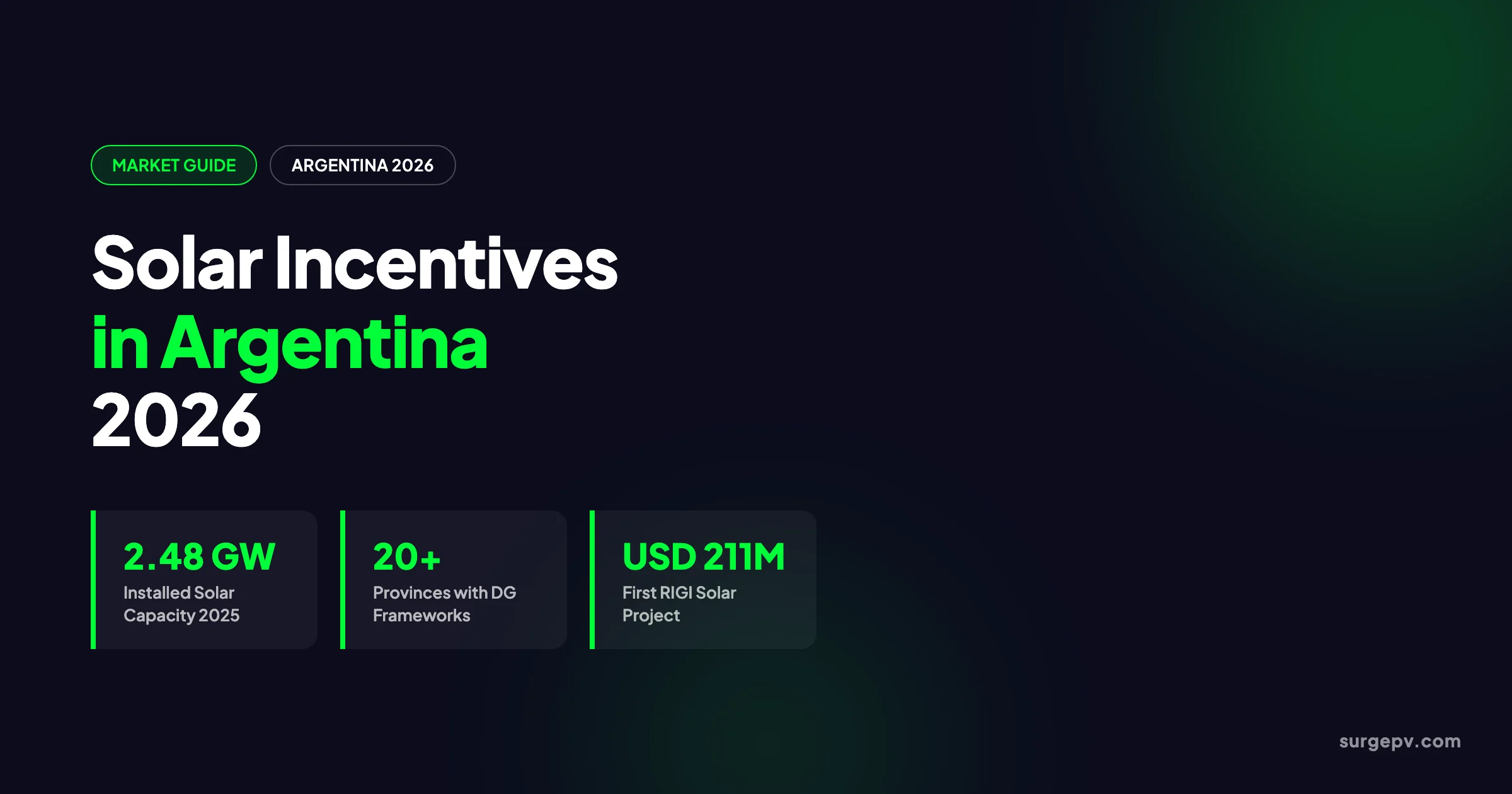
Argentina’s solar market is at a crossroads. The country added roughly 810 MW of solar PV capacity in 2025. Total installed solar reached 2,483 MW, according to CAMMESA data reported by PV Magazine (2026). That growth is real, but it is concentrated in utility-scale parks and large commercial projects. Residential solar remains a sliver of the market. The national policy framework that once drove renewables is now being reshaped by fiscal austerity, provincial experimentation, and a new large-investment regime.
For installers, EPCs, financiers, and property owners, the practical question is not whether solar works in Argentina. The question is which incentive stack applies to a specific project in a specific province under a specific offtake structure. A 50 kW rooftop in Mendoza, a 1 MW corporate PPA in Buenos Aires, and a 100 MW park under RIGI face entirely different economics.
This guide is a market-focused incentive manual, not an installation tutorial. It covers the national legal base, the full 2026 incentive stack, provincial variation, and the common errors that cost projects money. For the technical side of Argentine connections, see our solar drafting services in Argentina guide. For proposal automation, explore SurgePV’s solar proposals and generation and financial tool.
Quick Answer
Argentina’s 2026 solar incentives center on Ley 27.424 net metering for distributed generation, FODIS preferential financing, provincial top-ups, and utility-scale mechanisms like RenovAr, MATER, and RIGI. There is no single national subsidy. Incentives vary by province, system size, and offtake structure, with the strongest economics in high-irradiance provinces such as San Juan, Mendoza, Jujuy, and Salta.
In this guide:
- Latest 2026 status of every active Argentine solar incentive layer
- The legal foundation: Ley 27.424, usuario-generadores, and net metering
- National financing tools: FODIS, FONDER, and Law 27.191 tax benefits
- Provincial distributed generation frameworks and where they differ
- Utility-scale and C&I mechanisms: RenovAr, MATER, and RIGI
- How export compensation and capacity limits affect project design
- Three real-world stacking examples with payback impact
- Common mistakes and how to avoid them
Latest Updates: Argentina Solar Incentives 2026
The Argentine solar policy environment changed in 2025 and early 2026. Several national programs weakened, provincial governments stepped in, and a new large-investment regime began approving its first renewable energy projects.
Argentina Solar Incentive Status — June 2026
| Incentive | Type | Status | Key Terms |
|---|---|---|---|
| Ley 27.424 net metering | Regulatory / compensation | Active, provincial adhesion required | Surplus credited at wholesale price; 100% demand cap |
| FODIS distributed generation fund | Preferential financing | Limited operation | Residential, commercial, and industrial DG projects |
| Law 27.191 tax benefits | Tax incentives | Active but law expiring/uncertain | Accelerated depreciation, early VAT, import duty exemptions |
| FONDER renewable energy fund | Payment guarantees / loans | Largely inactive | Created under Law 27.191 |
| RenovAr auctions | Utility-scale PPA program | Legacy pipeline active; no new large rounds | 20-year dollar-indexed PPAs |
| MATER term market | Corporate PPA platform | Active, main growth channel | Private contracts between generators and large users |
| RIGI large investment regime | Tax / customs / FX stability | Active, approvals growing | USD 200M+ minimum, 30-year stability |
| Provincial DG top-ups | Varies by province | Active in Santa Fe, Mendoza, others | Credit lines, guaranteed tariffs, tax breaks |
Key Changes Since 2025
February 2026 — Solar capacity milestone: Argentina reached 2,483 MW of installed solar capacity after adding about 810 MW in 2025, according to CAMMESA data reported by PV Magazine (2026). Cuyo and the Northwest continue to dominate new capacity.
May 2026 — First RIGI solar project commissioned: YPF Luz commissioned the 305 MW El Quemado solar park in Mendoza. It was the first solar project approved under RIGI. The USD 211 million project represents about 11% of national solar capacity, according to Enerdata (2026).
Ongoing — Law 27.191 uncertainty: Law 27.191, which created the 20% renewable target and FONDER, reached its 2025 deadline without the target being met. An extension under discussion in Congress would maintain incentives until 2045 but lacks new renewable participation targets, according to The Energy Pioneer (2026).
Ongoing — Provincial leadership: National programs are constrained, so provinces such as Santa Fe, Mendoza, Córdoba, and Neuquén are pushing distributed generation. They use their own regulations, credit lines, and guaranteed tariffs.
Key Takeaway
2026 is a transition year. The strongest opportunities are no longer national subsidy programs. They are provincial distributed generation frameworks, corporate PPAs through MATER, and large projects that can qualify for RIGI.
Why Argentina’s Incentive Stack Matters in 2026
Argentina has some of Latin America’s best solar resources. High-irradiance provinces such as Jujuy, Salta, Catamarca, San Juan, and Mendoza receive 2,200-2,400 kWh/m² per year, according to Mordor Intelligence (2026). Yet solar still represents a small share of the national electricity mix. The gap is not sunlight; it is policy fragmentation, currency risk, and financing cost.
Market Size and Targets
Total installed solar capacity reached 2.48 GW in 2025. It is forecast to grow to 3.25 GW in 2026 and 6.5 GW by 2031, according to Mordor Intelligence (2026). Utility-scale plants command about 78.5% of the market. The commercial and industrial segment is the fastest-growing at a projected 19.3% compound annual growth rate.
Law 27.191 set a target of 20% renewable electricity by 2025. Argentina reached only about 16%, according to The Energy Pioneer (2026). Large hydropower, wind, and solar together cover more than 20% of demand at peak moments, but the structural target was missed.
What the Slowdown Means for Incentives
The national government’s focus has shifted from broad subsidies to fiscal stability for large investors. The result is a two-speed market. Utility-scale and large C&I projects can access RenovAr legacy contracts, MATER corporate PPAs, and RIGI benefits. Small residential and commercial projects must navigate provincial rules, FODIS limitations, and net metering at wholesale prices.
For installers, this means every proposal must be built on the correct stack for the customer’s location and project size. A generic quote that assumes a national incentive can misstate payback by several years. That is where a solar design platform with Argentine provincial templates becomes a competitive tool.
Model Argentine Incentives Accurately in Every Proposal
Ley 27.424 compensation, provincial adhesion rules, and MATER PPA pricing change the math on every project. SurgePV’s financial modeling applies the right framework so your customer sees real net cost and payback.
Explore Financial ModelingNo commitment required · 20 minutes · Live project walkthrough
The Legal Foundation: Ley 27.424 and Net Metering
Almost every discussion of Argentine distributed solar incentives starts with the same law. Ley 27.424 on Distributed Renewable Energy Generation, passed in 2017 and regulated by Decree 986/2018, created the usuario-generador framework. It allows homes, businesses, and institutions to generate their own renewable electricity, inject surplus into the grid, and receive compensation.
What Ley 27.424 Changed
| Before Ley 27.424 | After Ley 27.424 |
|---|---|
| No legal framework for grid-connected self-supply | Usuario-generador category created |
| Surplus generation had no compensation path | Net metering and surplus payment introduced |
| Distributors could block connections | Non-discriminatory access required for compliant projects |
| Residential solar market almost nonexistent | Distributed generation market opened, though growth remains slow |
Five Core Rules of the Regime
- Net energy metering: Injected kWh are deducted from the next billing period’s consumption. If accumulated production exceeds consumption over 12 consecutive months, the positive balance is paid in cash at the wholesale energy value.
- Capacity limit: The installation cannot exceed 100% of the user’s average demand over the previous 12 months. This keeps systems sized for self-consumption.
- Bidirectional metering: The local distributor must install a smart meter that records both consumption and injection.
- Non-discriminatory access: Distributors cannot deny connection to users who meet technical requirements.
- Provincial adhesion required: The national law only takes effect in provinces that formally adhere and publish their own procedures.
How Compensation Actually Works
The critical detail for project economics is the compensation value. Under Ley 27.424, surplus energy is credited at the wholesale market price, not the full retail rate. The wholesale value is typically around 0.7 times the retail tariff, according to SurgePV’s Argentina solar software guide (2026). That makes self-consumed kilowatt-hours far more valuable than exported ones.
A kilowatt-hour consumed on site avoids the full retail rate. For C&I users, retail rates range from roughly USD 0.08/kWh to USD 0.15/kWh depending on province and tariff category. A kilowatt-hour exported earns the wholesale price, often closer to USD 0.05/kWh to USD 0.10/kWh. Correct sizing therefore targets self-consumption, not maximum generation.
National Financing and Tax Incentives
Beyond net metering, Argentina offers several national mechanisms that reduce project cost or improve financing terms. Their practical availability varies significantly by project type and year.
FODIS: The Distributed Generation Fund
The Fondo para el Desarrollo de la Generación Distribuida de Energías Renovables (FODIS) provides preferential financing for distributed generation projects. It covers residential, commercial, and industrial systems under Ley 27.424. In principle, it offers lower-interest loans or credit enhancements that improve project bankability.
In practice, FODIS has suffered from institutional instability and under-execution of resources, according to FARN (2025). Installers should treat FODIS as a potential supplement, not a guaranteed layer. Availability depends on the current budget cycle and provincial implementation.
FONDER: The Renewable Energy Development Fund
FONDER was established under Law 27.191 to support renewable energy development through payment guarantees, loans, and project investments. It was central to the RenovAr auction de-risking architecture, backed in part by World Bank guarantees.
Since 2024, FONDER has been left largely inactive, according to The Energy Pioneer (2026). The change affects the pipeline of large projects that relied on FONDER-backed payment security. New projects increasingly depend on corporate PPAs, multilateral loans, or RIGI stability rather than FONDER guarantees.
Law 27.191 Tax Benefits
Law 27.191 created a suite of fiscal incentives for renewable energy projects, including solar. Eligible projects can access:
- Import duty exemptions on capital goods, equipment, machinery, and components not available domestically.
- Accelerated depreciation of capital goods for corporate income tax purposes.
- Early VAT recovery or reimbursement on qualifying capital purchases.
- Tax credit certificates for investments in new renewable generation that incorporate locally made components.
- Reduced tax rates or fiscal stability agreements in some cases.
These benefits remain relevant for new projects, but the law’s renewal is uncertain. Any project relying on Law 27.191 incentives should confirm the current legal status before structuring finance.
Law 27.742 and the RIGI Framework
Law 27.742, known as the Ley de Bases, created the Régimen de Incentivo para Grandes Inversiones (RIGI). It is not a solar-specific incentive, but it has become the most important federal mechanism for large renewable projects in 2026.
RIGI offers a 30-year stability package covering tax, customs, and foreign-exchange rules for investments over USD 200 million in strategic sectors, including energy. Key benefits include:
- Federal income tax reduced from 35% to 25%.
- Dividend withholding tax of 7% initially, falling to 3.5% after year seven.
- Customs exemptions and streamlined import procedures.
- Foreign-exchange flexibility for loans and dividend remittances.
- Protection against adverse regulatory changes.
The first approved solar project under RIGI was YPF Luz’s 305 MW El Quemado park in Mendoza. The USD 211 million project is described in Enerdata (2026). By May 2026, RIGI had approved 16 projects totaling roughly USD 30 billion, including additional energy and mining projects, according to DLA Piper (2026).
Provincial and Distributed Generation Incentives
Because Ley 27.424 requires provincial adhesion, Argentina effectively has 20-plus distributed generation markets. Each province sets its own distributor rules, processing timelines, and optional incentives. The following profiles cover the most active jurisdictions.
Mendoza
Mendoza is one of Argentina’s solar leaders. The province combines strong irradiance, existing renewable infrastructure, and a clear distributed generation procedure under Provincial Law 9025. Distributors include EDEMSA and EDESA.
- Processing time: roughly 60 days.
- Strengths: High irradiance, experienced installers, RIGI-approved utility-scale projects nearby.
- Local dynamics: Mendoza is also home to the El Quemado 305 MW solar park, which demonstrates bankable large-project economics in the province.
Buenos Aires
The Buenos Aires metropolitan area is Argentina’s largest electricity market. Distributed generation operates under ENRE resolutions, with EDENOR and EDESUR as the main distributors.
- Processing time: 45-90 days.
- Strengths: Large C&I demand, high electricity tariffs, strong installer competition.
- Local dynamics: ENRE periodically sets feed-in tariffs for user-generators and updates rate schedules. In 2025, ENRE approved monthly rate adjustments and new metering methodologies for user-generators, according to EDENOR regulatory filings.
Córdoba
Córdoba operates under Provincial Law 10604, with EPEC as the main distributor.
- Processing time: 60-75 days.
- Strengths: Large industrial base, good solar resource, active installer network.
- Local dynamics: EPEC’s connection manual and technical requirements are detailed; compliance is the main gate for approval.
Santa Fe
Santa Fe has developed one of the most structured provincial DG ecosystems. Its Prosumidores 4.0 program allows installations up to 1.5 MW and guarantees differential tariffs for eight years, according to The Energy Pioneer (2026).
- Processing time: 45-60 days.
- Strengths: Guaranteed tariffs, provincial credit lines, active energy efficiency ecosystem.
- Local dynamics: By August 2025, Santa Fe counted 1,407 active generator-users and more than 10,277 kW of distributed renewable capacity across programs.
Neuquén
Neuquén is known for fast processing times.
- Processing time: 30-60 days.
- Strengths: Rapid approval, growing C&I demand.
- Local dynamics: The province has adhered to Ley 27.424 and streamlined distributor coordination.
Jujuy, Salta, San Juan, and Catamarca
These northwestern provinces form the core of Argentina’s utility-scale solar boom. They offer exceptional irradiance and have attracted the bulk of RenovAr and RIGI projects.
| Province | Typical Irradiance | Notable Projects / Features |
|---|---|---|
| Jujuy | ~2,400 kWh/m²/year | Cauchari-Olaroz expansion under RIGI |
| Salta | ~2,100-2,200 kWh/m²/year | Strong mining-driven corporate PPA demand |
| San Juan | ~2,200 kWh/m²/year | Genneia’s San Juan Sur 130 MW project |
| Catamarca | ~2,300 kWh/m²/year | Strong solar resource, lithium mining load |
For distributed generation, these provinces are less mature than Mendoza or Buenos Aires, but their high irradiance makes even simple net metering projects financially attractive.
Utility-Scale and C&I Incentives: RenovAr, MATER, and RIGI
Large solar projects in Argentina operate through a different incentive architecture than rooftop systems. The three main channels are RenovAr legacy auctions, the MATER corporate PPA market, and RIGI large-investment benefits.
RenovAr Program
RenovAr launched in 2016 as a public auction program to contract renewable energy capacity. Four auction rounds awarded more than 4.5 GW of renewable projects with 20-year, dollar-indexed PPAs through CAMMESA, according to RELP (2026).
Auction prices fell sharply as the market matured. Solar prices dropped from around USD 59.75/MWh in Round 1 to roughly USD 41.52/MWh in Round 2 follow-up, according to Solarplaza (2018). The program attracted international developers and multilateral financing, backed in part by World Bank guarantees.
By 2026, RenovAr is no longer holding large new auction rounds, but the legacy pipeline remains active. Projects that already won contracts continue to build out, and administrative continuity is confirmed by new entries in the Renper registry.
MATER: The Renewable Energy Term Market
MATER has become the main growth engine for Argentine renewables in recent years. It is a platform where generators, traders, and large consumers negotiate power purchase agreements directly. Corporate buyers include Telecom Argentina, Dow, and lithium producers such as Livent, Allkem, and Ganfeng, according to Mordor Intelligence (2026).
- Contract type: Private bilateral PPAs, often U.S.-dollar-indexed.
- Typical buyers: Large industrial users, mining companies, agro-exporters, and distributors.
- Advantage: Avoids reliance on government auctions and provides offtaker-specific pricing.
- Challenge: Requires priority dispatch capacity, which can be constrained on congested transmission corridors.
Telecom Argentina, for example, allocates roughly USD 14 million annually to three solar PPAs that cover 17.5% of its electricity needs, according to Mordor Intelligence (2026). Lithium miners use MATER contracts to meet downstream ESG mandates and hedge energy costs.
RIGI for Large Solar Projects
For projects large enough to qualify, RIGI is the strongest federal incentive available in 2026. The regime targets investments over USD 200 million in strategic sectors, including electricity generation from renewable sources.
The YPF Luz 305 MW El Quemado project is the clearest example. It was approved under RIGI in early 2025 and commissioned in May 2026. The USD 211 million park benefits from reduced income tax, customs advantages, and 30-year regulatory stability, according to Aduana News (2025).
A proposed Súper RIGI regime was sent to Congress in May 2026. It would target new industrial activities that do not yet exist in Argentina at scale, including solar and wind manufacturing. It requires USD 1 billion minimum investment and offers a 15% income tax rate, according to DLA Piper (2026).
How Export Compensation and Capacity Rules Shape Design
Two technical rules determine whether a distributed solar project in Argentina makes financial sense: the 100% demand cap and the wholesale compensation rate.
The 100% Demand Cap
Ley 27.424 limits system capacity to the user’s average demand over the previous 12 months. This prevents users from building commercial power plants under a self-consumption law. For a factory with average monthly demand of 50,000 kWh, a 400 kWp system is typically the practical ceiling. For a home using 500 kWh per month, the cap is roughly 3-5 kW.
The cap means installers cannot simply maximize roof coverage. They must size against historical consumption, with allowance for planned load growth in some provincial interpretations.
Wholesale vs Retail Compensation
Under Ley 27.424, exported energy is compensated at the wholesale market price. Retail rates in Argentina vary by province, user category, and subsidy status, but C&I users often pay roughly USD 0.08/kWh to USD 0.15/kWh. Wholesale prices are typically lower, around USD 0.05/kWh to USD 0.10/kWh.
This ratio makes on-site self-consumption roughly 1.5 to 2 times more valuable than export. A system sized to cover 80-90% of daytime load usually outperforms a larger system that exports heavily at midday.
The Role of Batteries
Battery storage is not explicitly subsidized under Ley 27.424, but it improves project economics in two ways. First, it shifts midday solar production to evening peak hours, increasing self-consumption. Second, it protects against grid outages, which are a real concern in some provinces.
For C&I users with time-of-use tariffs or demand charges, batteries can materially improve payback. For residential users, the math is harder unless retail rates are high and financing is cheap.
How to Stack Incentives: Three Real-World Scenarios
The following examples are illustrative, based on typical 2026 costs, tariffs, and incentive rates. Actual figures depend on province, distributor, installer quote, and exchange rate.
Scenario 1 — 50 kW Commercial Rooftop in Mendoza
| Item | Amount |
|---|---|
| Gross installed cost | USD 55,000 |
| FODIS preferential financing benefit (effective interest saving) | -USD 3,000 |
| Net metering value over 10 years | USD 75,000 |
| Net present value of savings | USD 52,000 |
| Effective net investment | USD 52,000 |
| Simple payback | 5-6 years |
This scenario assumes 70% self-consumption, 30% export at wholesale price, and Mendoza’s high irradiance. The key driver is avoided retail purchases, not export revenue.
Scenario 2 — 1 MW C&I Solar PPA in Buenos Aires Province
| Item | Amount |
|---|---|
| Gross installed cost | USD 850,000 |
| Law 27.191 tax benefits (accelerated depreciation + VAT recovery) | -USD 110,000 |
| 10-year MATER PPA revenue at USD 55/MWh | USD 1,050,000 |
| Effective net investment | USD 740,000 |
| Annual energy revenue + avoided retail purchases | USD 130,000 |
| Payback | 5.7 years |
This scenario assumes a large industrial offtaker signs a dollar-indexed MATER PPA for a portion of output and consumes the rest on site. The project may also benefit from provincial property or turnover tax exemptions.
Scenario 3 — 100 MW Utility-Scale Solar Park in San Juan under RIGI
| Item | Amount |
|---|---|
| Gross installed cost | USD 75,000,000 |
| RIGI income tax saving (10 percentage point reduction on eligible income) | -USD 5,000,000 |
| Customs and import duty savings | -USD 3,000,000 |
| 20-year PPA / MATER revenue at USD 45-55/MWh | USD 95,000,000+ |
| Effective net cost | USD 67,000,000 |
| Annual revenue | USD 55,000,000 |
| Payback | 6-7 years |
This scenario is hypothetical and illustrates how RIGI stability and long-term PPAs de-risk large projects. Actual returns depend on financing terms, local content rules, and transmission availability.
Common Mistakes and Misconceptions
Even experienced developers lose money on Argentine solar projects by misreading the incentive stack. Here are the most common errors.
Assuming National Rules Apply Uniformly
Ley 27.424 is national, but it only takes effect after provincial adhesion. A project in Jujuy does not follow the same procedure as a project in Buenos Aires. Always confirm the province’s adhesion status and the local distributor’s connection manual before quoting.
Quoting Retail Compensation for Exports
Many proposals overstate export value by assuming retail-rate net metering. Ley 27.424 pays the wholesale market price for annual surpluses. Use the correct compensation rate or the payback estimate will be wrong.
Oversizing Beyond the Demand Cap
A system larger than 100% of historical demand will not be approved under Ley 27.424. Size to consumption first, then consider planned load growth if the provincial rules allow it.
Ignoring Currency Risk
With inflation running 100-150% annually and the peso near 850 ARS/USD, every dollar-denominated cost or revenue line matters. Proposals should show both peso and USD economics where relevant, and account for exchange-rate pass-through in tariffs.
Missing Provincial Top-Ups
Homeowners and businesses often apply for Ley 27.424 net metering but miss provincial credit lines, guaranteed tariff programs, or local tax exemptions. Santa Fe’s Prosumidores 4.0 and Mendoza’s provincial frameworks are examples of programs that require separate applications.
Relying on Inactive National Funds
FONDER and FODIS are often referenced in older guides as active financing tools. In 2026, their practical availability is limited. Verify current budget and operational status before building a project around them.
Conclusion
Argentina’s solar incentive framework in 2026 is a layered, province-specific stack rather than a single national subsidy. Distributed generation relies on Ley 27.424 net metering, FODIS where available, and provincial top-ups. Utility-scale and large C&I projects rely on RenovAr legacy contracts, MATER corporate PPAs, and RIGI fiscal stability.
For solar professionals, the competitive edge is the ability to match the right project structure to the right location and offtake. Tools like Clara AI and SurgePV’s generation and financial tool can automate that workflow for Argentine projects.
Three actions to take now:
- Confirm the province and distributor first — the rules that matter are local, not only national.
- Size for self-consumption — under Ley 27.424, avoided retail kWh are worth far more than exported kWh.
- Verify the active incentive stack — FODIS, FONDER, and Law 27.191 status change frequently; do not assume last year’s rules still apply.
For broader Latin American context, see our solar drafting services in Argentina guide. For installers looking to scale, our guide for solar installers covers proposal automation and compliance workflows.
Frequently Asked Questions
What solar incentives are available in Argentina in 2026?
Argentina’s 2026 solar incentives include Ley 27.424 net metering for distributed generation, FODIS preferential financing, and provincial adhesion programs. Utility and C&I projects can use RenovAr and MATER power purchase agreements, plus the RIGI large-investment regime. Tax benefits under Law 27.191 include accelerated depreciation, early VAT recovery, and import duty exemptions, though several national instruments face funding or continuity uncertainty.
How does net metering work under Ley 27.424?
Ley 27.424 allows residential, commercial, and industrial users to become usuario-generadores. Surplus kilowatt-hours injected into the grid are credited against future bills. If generation exceeds consumption over 12 consecutive months, the positive balance is paid in cash at the wholesale market price. System capacity is capped at 100% of the user’s average demand over the previous 12 months.
Which provinces in Argentina have active distributed generation frameworks?
More than 20 provinces have adhered to Ley 27.424 and implemented operating frameworks. The most active markets include Mendoza, Buenos Aires, Córdoba, Santa Fe, Neuquén, Jujuy, Salta, San Juan, and Catamarca. Each province sets its own distributor rules, processing times, and optional top-up incentives.
What is the difference between RenovAr and MATER in Argentina?
RenovAr is a public auction program that awards long-term power purchase agreements for renewable energy projects, primarily utility-scale solar and wind. MATER is the Renewable Energy Term Market, a private contract platform where generators and large consumers negotiate corporate PPAs directly. RenovAr provides regulated offtake; MATER provides market-driven offtake and has become the main growth channel in recent years.
What is RIGI and how does it benefit large solar projects?
RIGI is the Régimen de Incentivo para Grandes Inversiones created under Law 27.742. It offers 30-year regulatory stability and tax, customs, and foreign-exchange benefits for investments over USD 200 million in strategic sectors, including energy. The first approved solar project, YPF Luz’s 305 MW El Quemado park in Mendoza, benefits from a reduced income tax rate and other fiscal protections.
Are there upfront grants or rebates for residential solar in Argentina?
There is no nationwide upfront residential solar rebate. The closest mechanism is FODIS, which provides preferential financing for distributed generation projects, but it has faced operational and budget constraints. Some provinces and municipalities offer their own credit lines, tax exemptions, or subsidized-rate programs, so eligibility depends on location.
What tax benefits apply to renewable energy projects in Argentina?
Under Law 27.191, eligible renewable projects can access several tax benefits. These include accelerated depreciation of capital goods, early VAT recovery, and import duty exemptions on capital equipment. Projects using locally made components can also receive tax credit certificates. RIGI projects can additionally access a reduced 25% income tax rate and a lower dividend withholding tax.
How much does a residential solar system cost in Argentina in 2026?
Residential rooftop solar in Argentina typically costs roughly USD 1,200-1,500 per kW before incentives, according to market observers. A 5 kW residential system therefore ranges from USD 6,000-7,500 gross. Payback periods vary widely by province, tariff, and financing, often landing between 5 and 10 years in high-irradiance regions.
What is the biggest mistake when applying for Argentine solar incentives?
The most expensive mistake is assuming one incentive framework applies nationwide. Argentina’s solar incentives are layered across national law, provincial adhesion, distributor rules, and sector-specific regimes like RIGI. Installers who apply Buenos Aires rules in Mendoza, quote retail-rate compensation when the law pays wholesale rates, or miss provincial adhesion requirements can overstate project economics.
Is Argentina on track to meet its renewable energy targets?
No. Law 27.191 set a target of 20% renewable electricity by 2025, but Argentina reached only about 16% by the deadline. Distributed generation remains a tiny share of the market, with residential uptake under 1% of renewable capacity. Utility-scale solar is growing faster, driven by RenovAr, MATER, and RIGI, but transmission constraints and macroeconomic volatility continue to slow progress.
Where this fits
This article is part of SurgePV's Solar Incentives & Policy hub, which works through the topic from first principles to the decisions a project team actually has to make.

