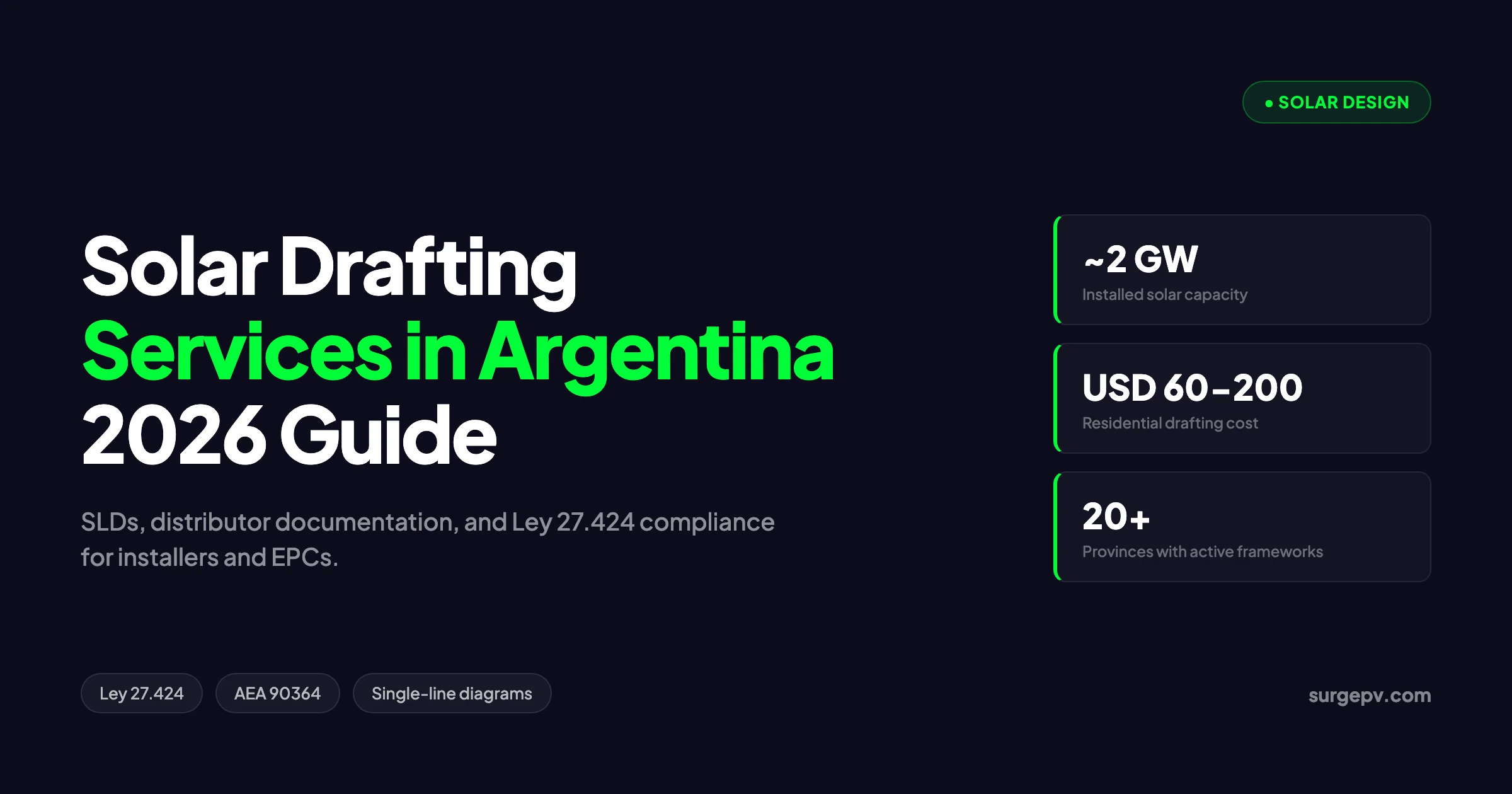
Argentina reached nearly 2 GW of installed solar capacity by mid-2025, with distributed generation passing 58.9 MW across 2,290 usuario-generador units, according to CAMMESA and Argentina’s Ministry of Energy (2025). The commercial and industrial segment drives most of that growth. Every connection, from a 3 kW rooftop in Mendoza to a 500 kW warehouse array in Cordoba, starts with a set of drawings a distributor will accept.
Solar drafting services produce those drawings. For installers and EPCs working across Argentina’s 24 jurisdictions, drafting is the step that turns a sold project into an approved connection. Get the single-line diagram or protection scheme wrong, and the distributor sends it back, delaying revenue by weeks.
This guide covers how solar drafting works in Argentina in 2026. In this guide:
- What solar drafting services deliver and who provides them
- How Ley 27.424 and provincial rules shape every drawing
- Real cost ranges in USD and pesos
- The standards your SLD must follow (AEA, IRAM)
- When manual drafting beats software, and when it does not
- How to set up a drafting workflow that scales
Quick Answer
Solar drafting services in Argentina create single-line diagrams, layout plans, and the usuario-generador documentation distributors require under Ley 27.424. Residential sets cost USD 60-200; commercial packages USD 400-1,500. Compliant SLDs must follow AEA standards and each distributor’s connection manual.
What Solar Drafting Services Actually Deliver
A solar drafting service is the technical drawing arm of a project. The installer sells the system and handles the site. The drafter turns site data, equipment choices, and local rules into a document package the distributor can review.
In Argentina, a standard residential package includes:
- Site layout plan showing module placement, roof or ground area, and access paths
- Single-line diagram (SLD) mapping the electrical path from modules through inverter, protections, and the bidirectional meter to the grid
- String configuration with module count per string and voltage windows
- Equipment schedule listing modules, inverter, protections, and cable sizing
- Usuario-generador application forms for the local distributor
- Yield estimate in kWh/year for the proposal
Commercial and industrial projects add structural calculations for the mounting system and a stamped report from a matriculated engineer. Utility-scale plants connecting through CAMMESA need full studies, including grid-impact analysis and medium-voltage protection coordination.
The people doing this work are usually ingenieros electricistas matriculados or técnicos electromecánicos. The matrícula matters: many distributors require a stamped, signed drawing from a registered professional before they approve a connection above a set threshold.
A drafting service that does not understand the local distributor’s manual is a liability. The same SLD that EDENOR accepts in Buenos Aires may need rework for EPEC in Cordoba.
How Ley 27.424 Shapes Every Drawing
Ley 27.424, passed in 2017 and regulated in 2018, created Argentina’s national distributed generation framework. It established the usuario-generador: a grid-connected user who consumes their own solar energy and injects surplus to the grid for credit. This is the legal basis for almost every rooftop and small commercial drafting job in the country.
The law is national, but it only takes effect in a province once that province formally adheres and publishes its own procedures. By early 2025, more than 20 provinces had active frameworks, according to industry trackers. This is the single most important fact for drafters: the rules change by jurisdiction.
Pro Tip
Before drafting, confirm two things: that the project’s province has adhered to Ley 27.424, and which distributor serves the site. The distributor’s connection manual, not the national law, sets the exact SLD format and protection requirements you must match.
Processing times vary widely by province. Neuquen runs one of the fastest tracks at roughly 30-60 days, while Buenos Aires can take 45-90 days, according to provincial energy agencies (2025). A clean drawing package shortens the review side of that window. A package with errors restarts it.
The technical core that every drawing must show is the bidirectional meter and the protection scheme that lets the inverter disconnect safely from the grid. The bidirectional meter is what measures both consumption and injection, and no usuario-generador connection is approved without it.
Who Reviews Your Drawings: The Approval Chain
Argentina has no single national permitting body for distributed solar. Approval runs through the local electricity distributor, overseen by a regulator.
| Body | Role | Examples |
|---|---|---|
| Distributor | Reviews and approves usuario-generador connections | EDENOR, EDESUR, EPEC, EPE, EDEMSA |
| ENRE | Federal regulator for the Buenos Aires metro concession area | Oversees EDENOR, EDESUR |
| Provincial EPRE | Regulates distributors in each province | EPRE Mendoza, ERSeP Cordoba |
| CAMMESA | Wholesale market and dispatch coordinator for large generators | Utility-scale connections |
For a homeowner or small business, the distributor is the gatekeeper. Each distributor publishes a connection manual with its own SLD layout, symbol set, protection table, and form templates. A drafter’s job is to match that manual exactly.
For utility-scale plants, CAMMESA enters the picture. CAMMESA coordinates dispatch, sets wholesale prices, and administers economic transactions for the wholesale market, according to CAMMESA (2025). Drawings for these projects are an order of magnitude more complex and almost always manual.
This fragmented chain is why a generic, imported solar drawing rarely passes the first review. Argentina is not a single market for drafting purposes. It is two dozen.
What Solar Drafting Costs in Argentina
Pricing depends on system size, complexity, and whether a stamped engineer’s signature is required. Currency is its own factor: many services quote in USD to hedge peso volatility, then invoice in pesos at the official rate.
| Project type | Typical scope | Cost range (USD) |
|---|---|---|
| Residential (under 10 kW) | Layout, SLD, forms | 60-200 |
| Small commercial (10-50 kW) | Above plus equipment schedule | 200-500 |
| Commercial (50-300 kW) | Above plus structural calc and stamp | 400-1,500 |
| Industrial / MV (300 kW+) | Full studies, MV protection | 1,500-6,000 |
| EPC monthly retainer (20+ projects) | Bundled drafting at volume | 1,200-5,000/mo |
These are market-observed ranges, not published tariffs. A matriculated engineer’s stamp adds cost on its own, often USD 80-300 depending on system size, because it carries professional liability.
For an EPC running 30 projects a month, drafting at USD 120 per residential set is USD 3,600 monthly, plus turnaround time that gates how fast you can close. That math is exactly why many installers move to solar design software for the standard projects and reserve manual drafting for the hard ones.
Draft Argentine SLDs in Minutes, Not Days
SurgePV generates layout plans, single-line diagrams, and yield reports from one model, so your team stops waiting on outsourced drafting for standard projects.
Book a DemoNo commitment required · 20 minutes · Live project walkthrough
The Standards Your SLD Must Follow
Argentine solar drawings sit on two pillars of technical standards plus the distributor manual.
The first is the Asociación Electrotécnica Argentina (AEA). AEA 90364 governs low-voltage electrical installations and is the reference for protection, grounding, and conductor sizing in most distributed solar work. Distributors build their connection manuals on top of it.
The second is IRAM, Argentina’s standards body. IRAM standards define the symbols, component specs, and testing references your equipment schedule should cite. Using non-standard symbols on an SLD is a common reason for a first-round rejection.
The third, and the one that actually decides approval, is the distributor connection manual. This document tells you the exact protection devices, the disconnect arrangement, the meter type, and the drawing format. Two projects identical on paper can need different SLDs simply because they sit in EDENOR versus EPEC territory.
A drafter who knows AEA 90364 but ignores the distributor manual will still get rejected. The reverse is also true. Both layers have to line up.
Manual Drafting vs Software: The Real Tradeoff
There is no universal winner here, and anyone selling you one is wrong.
Manual drafting in AutoCAD gives a skilled engineer full control. For a one-off utility-scale plant with custom medium-voltage protection, that control is worth the 4-6 hours and the fee. The drawing reflects judgment a template cannot capture.
Software flips the economics for repeatable work. A platform generates the layout, runs the shadow analysis, sizes the strings, and produces the SLD from one model in well under an hour. For a residential set, the cost per project drops from USD 100-plus to a few dollars of software time.
| Factor | Manual drafting | Design software |
|---|---|---|
| Cost per residential SLD | USD 60-200 | A few USD of seat time |
| Turnaround | 24-72 hours | Same day |
| Best for | Utility-scale, custom MV, civil works | Residential, standard C&I |
| Revisions | Re-billed each time | Edit the model, regenerate |
| Distributor templates | Manual setup | Configurable once, reused |
The mistake most installers make is treating this as either/or. The efficient setup is hybrid: software for the 80% of standard projects, and a manual drafter on call for the 20% that genuinely need an engineer’s stamp and custom work.
The other common error is assuming any software output passes automatically. It does not. The SLD still has to match the distributor manual. Good software lets you configure that template once and reuse it; weak tools force you back into manual cleanup.
Building a Drafting Workflow That Scales
A drafting bottleneck caps how many projects you can close. Here is a workflow that holds up as volume grows.
- Standardize site capture. Use a fixed checklist: roof or ground area, azimuth, tilt, available meter space, distributor name, and province. Missing the distributor name is the single most common cause of rework.
- Confirm the jurisdiction rules early. Check Ley 27.424 adhesion and pull the current distributor manual before drawing anything.
- Generate the standard set in software. Layout, SLD, string config, and yield from one model. Reserve manual drafting for the exceptions.
- Build a financial model alongside the drawing. A yield estimate and payback figure turn a drawing package into a proposal that closes.
- Keep a matriculated engineer in the loop for stamps. Have a relationship in place so the stamp is a same-week step, not a two-week scramble.
The teams that scale fastest in Argentina are the ones that stopped treating every project as bespoke. Standard residential and small C&I work runs through software; the engineer’s time goes to the projects that actually need judgment.
For installers comparing tools, our breakdown of solar design software for installers covers what to look for in a platform built for grid-code variation.
Drafting Costs vs Project Value: A Worked Example
Consider a 20 kW commercial rooftop in Cordoba (EPEC territory). The inputs:
- System size: 20 kW
- Manual drafting quote: USD 350 (layout, SLD, equipment schedule, structural notes)
- Stamp: USD 150
- Turnaround: 9 business days
Now the software path:
- Software seat (shared across projects): effectively USD 5-10 of seat time for this project
- Stamp: USD 150 (still required)
- Turnaround: 1 day for the package, plus the stamp
The drawing-only cost drops from USD 500 to roughly USD 160, and turnaround falls from over a week to days. Across 25 commercial projects a year, that is roughly USD 8,500 saved and dozens of days of pipeline unlocked. The stamp cost does not change, because that is professional liability, not drafting labor.
This is a hypothetical example using market-observed rates, but the structure holds across most C&I work: software cuts drafting labor, not the engineer’s stamp.
Conclusion
Solar drafting in Argentina is a jurisdiction problem before it is a drawing problem. Three actions for installers and EPCs in 2026:
- Map your distributors. Build a folder of current connection manuals for every territory you work in. The manual, not the national law, decides what your SLD must show.
- Move standard work to software. Generate residential and routine C&I sets from a single model, and keep manual drafting for utility-scale and custom MV projects.
- Lock in stamp capacity. Keep a matriculated engineer on retainer so the signature step never becomes the bottleneck.
The market is growing past 2 GW and the C&I segment is leading it. The installers who win the volume are the ones whose drafting stops being the slowest step.
Frequently Asked Questions
What are solar drafting services in Argentina?
Solar drafting services in Argentina are technical providers that create single-line diagrams (SLDs), layout plans, equipment schedules, and the documentation distributors require under Ley 27.424. They are usually staffed by matriculated electrical engineers (ingenieros matriculados) or técnicos who understand AEA and IRAM standards plus the local distributor’s connection rules.
How much do solar drafting services cost in Argentina?
Residential drafting for a usuario-generador typically runs USD 60-200 per project. Full commercial documentation with structural calculations and distributor submission packages costs USD 400-1,500. Monthly retainers for EPCs handling 20 or more projects range from USD 1,200-5,000, often billed in pesos at the official exchange rate.
What is Ley 27.424 and why does it matter for solar drafting?
Ley 27.424 is Argentina’s national distributed generation law. It created the usuario-generador framework that lets owners inject surplus solar energy into the grid and receive credit. Every drafting deliverable for a grid-tied system must meet the technical requirements set by the law’s reglamentation and the local distributor, including a bidirectional meter and protection scheme.
Can solar design software replace manual drafting in Argentina?
For residential and most commercial projects, yes. Software like SurgePV generates compliant SLDs and layouts in under an hour at a few dollars per project. Manual drafting still matters for utility-scale plants connecting through CAMMESA, custom civil works, and medium-voltage studies that need a stamped engineer’s review.
What deliverables should I expect from an Argentine solar drafting service?
Standard deliverables include a site layout plan, single-line diagram with protection and disconnect details, string configuration, equipment schedule, structural notes for rooftop mounts, the usuario-generador application forms, and a yield estimate. Larger projects add structural calculations and a stamped engineering report.
How long does solar drafting take in Argentina?
A residential plan set takes 24-72 hours from a drafting service. Commercial projects with structural calculations need 5-12 business days. Utility-scale projects with full studies take 3-6 weeks. Software-generated drafts are usually same-day.
Which authorities review solar drafting documentation in Argentina?
The local electricity distributor reviews and approves usuario-generador connections, examples include EDENOR and EDESUR in Buenos Aires, EPEC in Cordoba, and EPE in Santa Fe. ENRE regulates federal-area distributors while provincial EPRE bodies regulate the rest. CAMMESA handles dispatch for large generators.
What standards govern solar electrical drawings in Argentina?
Drawings follow Asociación Electrotécnica Argentina (AEA) rules, mainly AEA 90364 for low-voltage installations, plus relevant IRAM standards for symbols and components. Each distributor publishes its own connection manual that the SLD and protection scheme must match.
Where this fits
This article is part of SurgePV's Solar Design hub, which works through the topic from first principles to the decisions a project team actually has to make.