

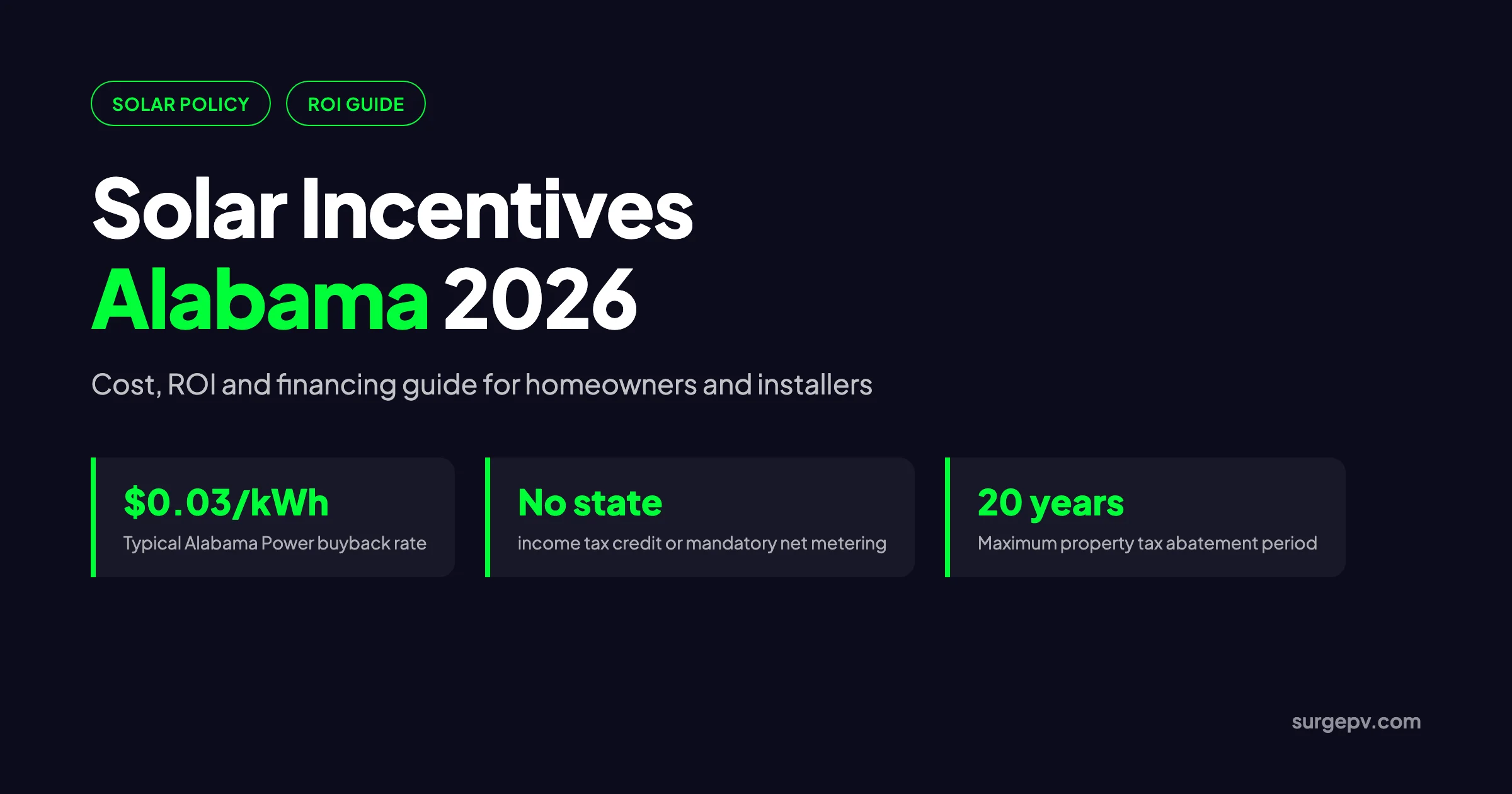
Alabama had 966 MWdc of installed solar capacity as of mid-2026, ranking 38th nationally, according to SEIA. That capacity powers roughly 105,000 homes and represents less than 1% of the state’s total electricity supply. The market is small, the job base is thin at 798 solar workers, and the policy stack is one of the weakest in the Southeast.
Alabama solar incentives in 2026 are not generous, but they are not zero. The state has no mandatory net metering law, no statewide solar rebate, and no state income tax credit. What it does have is strong sunshine, a local-option property tax abatement, two very different utility systems, and a federal tax credit that has changed sharply for 2026.
This guide explains what is actually available, how Alabama Power and TVA territory differ, how to model ROI without assuming the federal residential credit, and how installers should size systems to match Alabama’s weak export compensation.
Quick Answer
Alabama has no state solar tax credit or mandatory net metering. Homeowners can use the federal Residential Clean Energy Credit if eligible, a local-option renewable energy property tax abatement, and utility-specific buyback programs such as Alabama Power Rate PAE or TVA Dispersed Power Production in northern Alabama.
TL;DR — Alabama Solar Incentives 2026
Available incentives: federal Residential Clean Energy Credit only for eligible systems placed in service by December 31, 2025; local-option property tax abatement for up to 20 years; Alabama Power Rate PAE buyback at a few cents per kWh; TVA Green Connect installer network plus Dispersed Power Production in northern Alabama. No state tax credit, no statewide rebate, no mandatory net metering, and no state battery incentive. Verify current utility rates before signing a contract.
In this guide:
- Alabama solar market snapshot and why incentives look different here
- Federal solar tax credit: current status and how to claim it if eligible
- Alabama property tax abatement and how to apply
- Alabama Power Rate PAE: how the buyback actually works
- TVA territory in northern Alabama: Green Connect and Dispersed Power Production
- Rural electric cooperatives and other local utility programs
- Solar batteries and self-consumption strategy
- 2026 cost, ROI and payback scenarios for Alabama homeowners
- Financing options: cash, loans, leases, and PPAs
- Common misconceptions and mistakes
- What installers and EPCs should model in every proposal
Alabama Solar Market Snapshot: Two Utilities, One Weak Policy Stack
Alabama gets more than 210 sunny days per year, according to ElectricChoice. The state has the solar resource of a top-tier market but the policy framework of a laggard. The reason is structural. Alabama has no Renewable Portfolio Standard, no statewide net metering mandate, and no broad solar rebate.
The state is effectively split into two power systems:
- Alabama Power territory: Southern and central Alabama, including Birmingham, Montgomery, Mobile, Tuscaloosa, Auburn, and Dothan. Regulated by the Alabama Public Service Commission. Retail rates average around 15 cents per kWh.
- TVA distributor territory: Northern Alabama, including Huntsville, Decatur, and Florence. TVA sells wholesale power to local distributors such as Huntsville Utilities and Decatur Utilities. Retail rates are typically lower than Alabama Power.
This split matters because your utility determines your buyback rate, interconnection rules, and the value of self-consumed versus exported solar. A system that works financially in Huntsville may not look the same in Birmingham, even with identical equipment.
Federal Solar Tax Credit: What Changed in 2026
The federal Residential Clean Energy Credit under Internal Revenue Code Section 25D historically allowed homeowners to claim 30% of qualified solar and battery costs. The credit applied to equipment, labor, wiring, permits, and energy storage. Current guidance is maintained on the IRS Residential Clean Energy Credit page.
As of mid-2026, the residential credit is not available for new systems placed in service after December 31, 2025, based on current federal law. Homeowners who installed qualifying systems in 2025 can still claim the credit on their 2025 tax return using IRS Form 5695.
The credit is non-refundable, so it can reduce federal tax liability to zero, and unused amounts can carry forward. It applies to the net cost after utility rebates, not the gross cost.
For leased systems and power purchase agreements, the financing company may still claim a business credit under Section 48E. Construction must generally begin before July 4, 2026, or the system must be placed in service by December 31, 2027, for the credit to apply. Those savings can show up as lower monthly payments for the homeowner, but the homeowner does not claim the credit directly.
Installers should model every 2026 Alabama proposal with and without the federal credit. Promising a 30% tax credit for a new system without verifying current IRS guidance is a compliance and customer-relations risk.
Alabama State-Level Solar Incentives
Property tax abatement for renewable energy facilities
Alabama does not have a blanket property tax exemption that applies automatically to every rooftop solar system. Instead, it has a local-option abatement for qualifying renewable energy facilities, including solar. The program is described on the DSIRE Alabama property tax abatement page.
Key points:
- The local governing body — municipality, county, or public industrial authority — must approve the abatement before the system is placed in service.
- The initial abatement can last up to 10 years and may be extended for another 10 years, for a maximum of 20 years.
- Only the non-educational portion of property tax can be abated.
- The system owner applies to the governing body where the property is located.
Because approval is local and must happen before installation, the abatement is not automatic. Homeowners should confirm with their county or city before signing a contract. Industry sources estimate the average annual savings from the abatement at roughly $70 per year for a typical residential system, but actual savings depend on local tax rates and system value.
No state solar tax credit or sales tax exemption
Alabama does not levy a state income tax credit for residential solar. Solar equipment is also generally subject to state and local sales tax unless a specific commercial exemption applies. For most homeowners, the property tax abatement is the only statewide incentive that directly reduces the lifetime cost of going solar.
Alabama Power Rate PAE: How the Buyback Actually Works
Alabama Power serves about 1.5 million customers and covers most of the state. The utility does not offer net metering. Instead, residential solar customers typically interconnect under Rate PAE, the Purchase of Alternate Energy tariff. The rate schedule is published by Alabama Power.
Rate PAE is a buyback program, not a net metering program. The customer pays the full retail rate for every kilowatt-hour imported from the grid. Exported kilowatt-hours are credited at a lower energy rate. According to EnergySage, recent PAE export rates have ranged from roughly 3 to 4.3 cents per kWh in summer peak periods and even lower in off-peak months.
For a customer paying around 15 cents per kWh for imported electricity, exporting solar at 3 cents per kWh means the exported portion is worth about one-fifth of the self-consumed portion. This is why system sizing and load matching matter more in Alabama than in states with true net metering.
Alabama Power also applies rate riders and standby charges to solar customers. These fees vary by system size and rate option, so the only safe approach is to model savings using the customer’s actual rate schedule and current tariff.
TVA Territory in Northern Alabama: Green Connect and Dispersed Power Production
Northern Alabama is served by local power companies that buy wholesale electricity from the Tennessee Valley Authority. Huntsville Utilities is the largest, with about 200,000 electric customers in the state’s fastest-growing metro area.
TVA does not offer retail net metering. Instead, residential customers can participate in programs such as:
- TVA Green Connect: An installer-qualification and consumer-education program that helps homeowners connect with vetted solar contractors and verifies that systems meet TVA standards. Huntsville Utilities describes Green Connect in its solar FAQs.
- TVA Dispersed Power Production: A program that pays participating customers for excess generation, typically based on TVA’s avoided cost rather than the retail rate. A second meter is installed to measure exported energy separately.
Huntsville Utilities customers can choose to connect a system on the customer side of the meter to maximize on-site use, or on the utility side for a sell-all arrangement. Most residential systems connect on the customer side and participate in Dispersed Power Production only for surplus generation. TVA rates are generally lower than Alabama Power rates, but export compensation is still weak, so self-consumption remains the largest source of savings.
Rural Electric Cooperatives and Other Utility Programs
Beyond Alabama Power and TVA distributors, Alabama has dozens of rural electric cooperatives. Each co-op sets its own interconnection and buyback rules. Few offer solar-specific rebates, but many offer energy efficiency financing or rebates that can reduce overall electricity use.
Examples include low-interest loans and rebates for heat pumps, water heaters, insulation, and smart thermostats. Reducing baseline electricity use can let a homeowner install a smaller solar system and improve payback. Check directly with your co-op for current programs.
Solar Batteries and Self-Consumption Strategy
Alabama has no state battery incentive. Standalone or paired batteries may only qualify for a federal credit if placed in service by December 31, 2025, under current IRS guidance.
Despite the lack of incentives, batteries can make sense in Alabama because buyback rates are low. A battery stores midday solar production for evening use, turning exported kilowatt-hours worth 3 cents into avoided purchases worth 15 cents. The tradeoff is upfront cost. A typical residential battery adds $10,000 to $16,000 to a project before any incentives.
For homeowners who value backup power during summer storms, the non-financial benefit can justify part of the cost. For pure bill savings, the battery only pays off if it displaces enough high-value grid purchases. For more on battery sizing, see which solar battery is the best and the battery storage glossary.
2026 Cost, ROI and Payback Scenarios for Alabama
The average cost of solar in Alabama is roughly $3.00 per watt before incentives, based on market data from EnergySage. For a 6 kW system, that is about $18,000. Because the federal residential tax credit is no longer available for new 2026 systems, the effective cash cost for most homeowners is the full contract price.
The table below shows realistic 2026 scenarios. These are illustrative examples, not guarantees.
| Scenario | 6 kW system, Alabama Power | 6 kW system, TVA distributor |
|---|---|---|
| Gross system cost | $18,000 | $18,000 |
| Federal residential credit | $0 for 2026 systems | $0 for 2026 systems |
| Effective cost | $18,000 | $18,000 |
| Estimated annual production | 8,500 kWh | 8,500 kWh |
| Self-consumed at ~$0.15/kWh | 5,950 kWh / $893 | 5,950 kWh / $744 |
| Exported at ~$0.03/kWh | 2,550 kWh / $77 | 2,550 kWh / $77 |
| Total annual benefit | ~$970 | ~$820 |
| Simple payback | ~18 years | ~22 years |
These payback periods are long. The breakeven improves if electricity rates rise, if the system is sized more aggressively for self-consumption, or if the property tax abatement is approved. They also assume no major maintenance costs and stable buyback rates.
The key insight for Alabama is that solar is not a rebate-driven investment. It is a long-term hedge against utility rate increases. Homeowners with high daytime electricity use, good roofs, and stable occupancy are the best fit.
Financing Options for Solar in Alabama
Because incentives are thin, financing structure can make or break a project.
- Cash purchase: Highest lifetime savings, no interest, full ownership of any future incentives.
- Solar loan: Spreads the cost over 10 to 25 years. Monthly payments may be lower than the electric bill they replace, but interest extends the payback period.
- Lease or PPA: No upfront cost. The financing company owns the system and may still benefit from Section 48E if construction timing rules are met. Savings are usually modest but predictable.
- HELOC or home equity loan: Can offer lower interest rates than solar-specific loans, but the home is collateral.
- C-PACE: Alabama allows commercial Property Assessed Clean Energy financing in some jurisdictions. This is generally for businesses and larger projects, not residential rooftops.
For a deeper comparison, see the solar financing options guide.
Common Misconceptions About Alabama Solar Incentives
Misinformation costs homeowners money. Here are the myths we hear most often.
Myth 1: Alabama has a state solar tax credit. False. Alabama has no state income tax credit for residential solar. The property tax abatement is the main state-level benefit.
Myth 2: Alabama requires utilities to offer net metering. False. Alabama has no statewide net metering law. Alabama Power uses Rate PAE, and TVA territory uses Dispersed Power Production or similar avoided-cost programs.
Myth 3: Alabama Power pays full retail for excess solar. False. Rate PAE credits exports at a few cents per kWh, well below the retail rate.
Myth 4: The property tax abatement is automatic. False. The abatement must be approved by the local governing body before the system is placed in service.
Myth 5: Solar does not work in Alabama without the federal tax credit. False. Payback is longer, but solar can still reduce long-term electricity costs for homeowners with high usage and good sun exposure.
What Installers and EPCs Should Model in 2026
A competitive Alabama solar proposal in 2026 should include:
- A clear federal credit scenario: eligible 2025 systems versus new 2026 systems that do not qualify for the residential credit.
- The customer’s actual utility and rate schedule, not a national average.
- Realistic export assumptions based on current buyback rates.
- A property tax abatement estimate, with a note that local approval is required before installation.
- A battery option that shows incremental cost versus incremental savings.
- A no-export or low-export sizing option that maximizes self-consumption.
SurgePV’s solar design platform and solar proposals tool let installers model territory-specific buyback rates, self-consumption, and battery value. For detailed financial modeling, the generation and financial tool can run NPV and payback across multiple scenarios.
Conclusion: Three Actions to Take This Week
Alabama solar incentives in 2026 are limited, but solar can still make sense for the right homeowner. The key is to design for self-consumption, verify utility-specific rules, and avoid over-relying on incentives that no longer exist.
- Confirm your utility and current buyback rate. Alabama Power and TVA territory have very different economics.
- Apply for the property tax abatement before installation. Retroactive approvals are generally not allowed.
- Size the system for self-consumption, not export. In Alabama, solar used on site is worth far more than solar sent to the grid.
For installers who want to build accurate Alabama proposals, book a SurgePV demo to see how utility-specific rates and self-consumption modeling can be built into every quote.
Frequently Asked Questions
What solar incentives are available in Alabama in 2026? Alabama homeowners may qualify for the federal Residential Clean Energy Credit if the system was placed in service by December 31, 2025, a local-option property tax abatement for renewable energy facilities, and utility-specific buyback programs such as Alabama Power Rate PAE or TVA Dispersed Power Production in northern Alabama. There is no statewide solar tax credit, rebate, or mandatory net metering.
Does Alabama have net metering for solar? No. Alabama does not require utilities to offer net metering. Alabama Power credits exported solar through its Purchase of Alternate Energy rate at a value well below the retail electricity rate. In TVA territory, excess generation is usually compensated through the Dispersed Power Production program at avoided-cost rates.
Is there a state solar tax credit in Alabama? No. Alabama does not offer a state income tax credit for residential solar. The main state-level financial benefit is the local-option property tax abatement for qualifying renewable energy facilities, which can last up to 20 years if approved by the local governing body before the system is placed in service.
How does the federal solar tax credit work in Alabama in 2026? The 30% federal Residential Clean Energy Credit under Internal Revenue Code Section 25D expired for homeowner-owned systems placed in service after December 31, 2025, according to current IRS guidance. Systems placed in service in 2025 may still be claimed on the 2025 tax return using IRS Form 5695. Third-party-owned systems such as leases and power purchase agreements may still access the business credit under Section 48E if construction begins before July 4, 2026, or the system is placed in service by December 31, 2027.
What is Alabama Power Rate PAE? Rate PAE, or Purchase of Alternate Energy, is Alabama Power’s solar buyback tariff. Exported kilowatt-hours are credited at an energy rate that is typically a few cents per kWh, far below the retail rate the customer pays for grid electricity. This makes self-consumption the most valuable part of a residential solar system in Alabama Power territory.
What is TVA Green Connect in Alabama? TVA Green Connect is a program available in parts of northern Alabama, including Huntsville Utilities territory, that helps residential customers connect with qualified solar installers and verifies that systems meet TVA standards. Export compensation is handled separately through TVA’s Dispersed Power Production program, not through net metering.
Do solar panels increase property taxes in Alabama? Not if the local governing body approves a renewable energy property tax abatement before the system is placed in service. Alabama allows municipalities and counties to abate property taxes on qualifying renewable energy facilities for up to 10 years, extendable to a total of 20 years. The abatement is not automatic and must be approved in advance.
Are solar batteries incentivized in Alabama? There is no Alabama-specific battery rebate or incentive. Batteries can still improve project economics by increasing self-consumption, especially because utility buyback rates are low. A standalone or paired battery may only qualify for a federal credit if placed in service by December 31, 2025, under current IRS guidance.
What is the typical payback period for solar in Alabama in 2026? Without the federal residential tax credit, a well-designed residential solar system in Alabama typically pays back in 12 to 18 years. Payback is shorter for homes with high electricity use, roofs with good sun exposure, and systems sized for self-consumption. Homes in TVA territory may see slightly better economics because retail rates are lower, but export credits remain weak.
What is the most common mistake when sizing a solar system in Alabama? The most common mistake is oversizing for export. Because Alabama utilities credit exported solar at only a few cents per kWh, excess production is worth far less than solar used on site. The safer approach is to size the system to match daytime load and treat any export credits as a small bonus.
Where this fits
This article is part of SurgePV's Solar Incentives & Policy hub, which works through the topic from first principles to the decisions a project team actually has to make.
