

Quick Answer
The US solar workforce passed 280,000 jobs in 2025 and is on track for 400,000+ by 2030 according to the Interstate Renewable Energy Council's National Solar Jobs Census. Every program named below is verified active as of May 2026 and every link goes to the official university page.
The US solar workforce passed 280,000 jobs in 2025 and is on track for 400,000+ by 2030 according to the Interstate Renewable Energy Council’s National Solar Jobs Census. Most of that growth sits in installation, but the engineering layer underneath, which covers system design, grid integration, financing, and module R&D, has tripled in five years. Hiring managers at major EPCs and module manufacturers now ask for a specific kind of credential. They want either an ABET-accredited engineering degree with documented solar coursework, or a graduate certificate stacked on top of an engineering BS.
The US solar workforce passed 280,000 jobs in 2025 and is on track for 400,000+ by 2030 according to the Interstate Renewable Energy Council’s National Solar Jobs Census. Every program named below is verified active as of May 2026 and every link goes to the official university page.
This guide covers the full universe of solar engineering education in 2026: degree types and what each one teaches, the top on-campus programs in the US and globally, the strongest online pathways, tuition cost ranges and financial aid sources, specializations within the degree, and career outcomes by degree level. Every program named below is verified active as of May 2026 and every link goes to the official university page. For Global-specific compliance details, see Global net-metering-by-country. For Global-specific compliance details, see Global solar-permitting-speed-by-country.
TL;DR — Solar Engineering Degrees in 2026
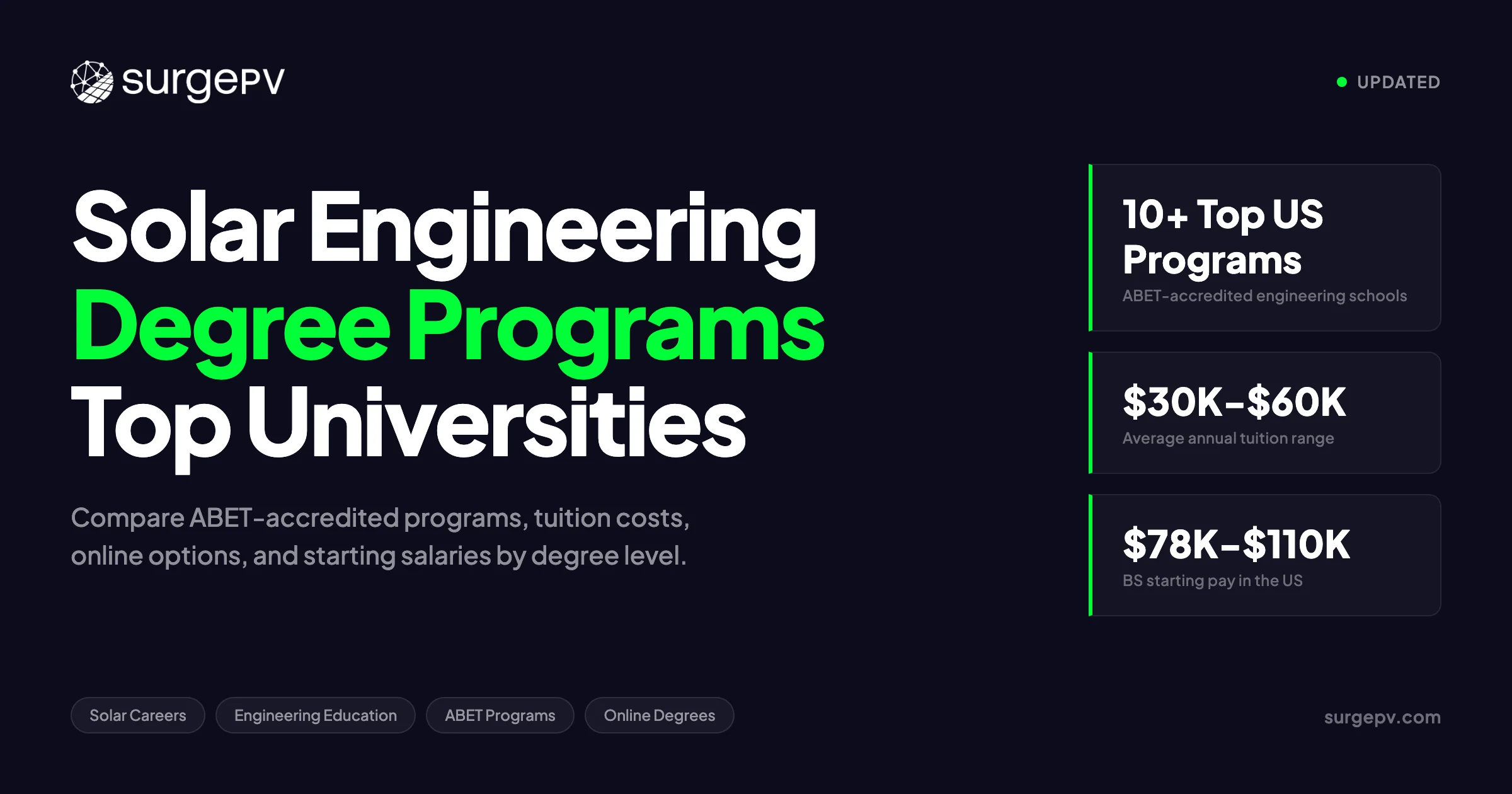
A solar engineering credential is almost always either (1) a BS in Electrical or Mechanical Engineering with a solar concentration, (2) a BS in Renewable Energy Engineering, or (3) a graduate certificate or MS stacked on a non-solar engineering BS. Strongest US programs: ASU Polytechnic, UCF (FSEC), Stony Brook, Oregon Tech, UMass Lowell, MIT, Stanford, Penn State, Georgia Tech, Colorado School of Mines. Tuition ranges from $40K total (in-state public) to $240K+ (private). Online ABET-accredited paths exist via ASU Online, Penn State World Campus, and Oregon Tech. BS starting salary: $78K-$110K. MS: $95K-$130K. PhD: $110K-$160K.
In this guide:
- Whether a solar engineering degree is worth the cost in 2026
- The four main degree types and what each one covers
- The top 10 on-campus US solar engineering programs (with tuition, ABET status, specializations)
- The strongest international programs (TU Delft, Imperial, ETH Zurich, Freiburg, IIT Bombay)
- Best online and hybrid options
- Tuition costs, scholarships, and federal aid
- Specializations within a solar engineering degree
- Career outcomes and salary by degree level
- Solar engineering vs electrical engineering vs sustainable energy
Is a Solar Engineering Degree Worth It?
The blunt answer is yes for engineering careers and no for installation careers. The decision rests on what kind of work you want to do five years from graduation.
A BS in engineering with a solar focus is the floor for almost every design, R&D, or development job at companies like First Solar, Sunrun, Qcells, NEXTracker, Enphase, and Hanwha Qcells. It is also a hard requirement for almost every federal solar job (DOE, NREL, Sandia, NASA), for state energy office roles, and for any path toward a Professional Engineer (PE) license. The US Bureau of Labor Statistics projects 5% growth for electrical engineers and 11% growth for environmental engineers from 2024 to 2034, with the solar sub-sector growing materially faster than both base lines.
Cost vs Lifetime Earnings: The Math
A four-year in-state engineering BS at a US public university costs roughly $40,000-$60,000 in tuition plus $40,000-$60,000 in living expenses, for a total all-in of $80,000-$120,000. Out-of-state and private universities push that figure to $200,000-$320,000.
Median 2026 starting salary for a solar design or PV engineer with a BS is $78,000-$110,000 according to PayScale compensation data and the Solar Energy Industries Association salary surveys. By year five, that figure rises to $95,000-$135,000. By year ten, $115,000-$165,000.
| Path | Total Cost (4 yr) | Median Year-1 Salary | Simple Payback |
|---|---|---|---|
| In-state public BS (ABET) | $80K-$120K | $78K-$95K | 3-5 yr |
| Out-of-state public BS | $160K-$240K | $80K-$100K | 6-8 yr |
| Private university BS | $220K-$320K | $85K-$110K | 7-9 yr |
| NABCEP PV Installer cert (alternative) | $1K-$5K | $42K-$55K | under 1 yr |
| Associate degree in solar tech | $8K-$24K | $48K-$62K | 1-2 yr |
The NABCEP and associate degree paths produce installation and small-business careers, not engineering careers. Both are valid. They produce dramatically different work and dramatically different ceilings. See our companion guide on how to become a solar designer in 2026 for the non-degree path.
When a Degree Is Required
- Federal or national lab employment (NREL, Sandia, ORNL, NIST)
- Most senior R&D and module engineering roles at manufacturers
- PE licensure (requires ABET-accredited BS in most US states)
- Most large-EPC project engineering positions
- University or research-institute work
- Many DoD-funded military solar projects
When a Degree Is Not Required
- Residential and small commercial installation work
- Sales engineering and consultative selling (NABCEP credentials substitute)
- Solar design at smaller installers (NABCEP PV Design Specialist + experience)
- Solar entrepreneurship and installer business ownership
- Many solar finance, policy, and project development paths (business or finance degree fits better)
Pro Tip — Pick Your Career Before Your Degree
If you want to design and stamp utility-scale plants, pursue ABET-accredited electrical engineering and plan for a PE license. If you want to do R&D on perovskite cells or tandem modules, pursue physics or materials science with a solar focus, then a PhD. If you want to run a residential installation business, skip the degree, get NABCEP certified, and start working faster. The degree is a tool, not a goal.
Types of Solar Engineering Degrees
Solar engineering is rarely its own department. It lives inside four broader degree families. Picking the right family is more important than picking the right university.
1. BS in Electrical Engineering with Solar Concentration
The most common path. Provides the strongest base for PV cell physics, power electronics, inverter design, grid integration, and battery storage controls. Almost universally ABET-accredited at major US universities. Best fit for designers, grid engineers, and inverter or power-electronics R&D. For more on this topic, see Adding Battery Storage Services.
Typical coursework: Circuit analysis, electromagnetics, semiconductor devices, power systems, power electronics, control systems, plus solar electives covering PV systems, energy storage, and grid integration.
2. BS in Mechanical Engineering with Solar Concentration
The dominant path for thermal solar, concentrated solar power (CSP), module manufacturing, mounting and racking design, and reliability engineering. Also strongly ABET-accredited. For more on this topic, see Solar Racking Design Guide.
Typical coursework: Thermodynamics, heat transfer, fluid mechanics, materials science, machine design, plus solar electives covering thermal systems, CSP, module testing, and structural analysis of racking.
3. BS in Renewable Energy Engineering or Solar Energy Engineering
A broader interdisciplinary degree covering solar PV, wind, biofuels, energy efficiency, and policy. Strong at programs like Oregon Tech, Stanford, and the University of Buffalo. Sometimes less deep in any single area than EE or ME but better as a single-credential introduction to the full sector.
Typical coursework: Mix of electrical, mechanical, thermodynamics, plus dedicated PV systems, wind, biomass, energy economics, and grid integration. Capstone projects are usually multi-technology.
4. MS in Sustainable Energy or PhD in Solar Materials/Devices
Graduate paths. An MS adds 1-2 years and shifts compensation 15-25% upward. A PhD adds 4-6 years and unlocks national-lab research, professorships, and senior R&D roles.
MS coursework: Energy systems modeling, power systems analysis, energy policy and economics, plus deep electives in PV technology, energy storage, smart grids, or solar resource assessment.
PhD work: Original research in cell efficiency, novel materials (perovskites, tandems, organic PV), grid integration algorithms, or solar resource forecasting.
For NABCEP-track designers who want to stack credentials, see our NABCEP certification guide for the certifications that complement any of these degrees.
Top On-Campus Solar Engineering Programs in the US
The ten programs below are the most commonly cited in solar-industry hiring conversations as of 2026. The table covers degree type, ABET status, tuition range, and what each program is known for.
| University | Best Degree for Solar | ABET? | Tuition (Annual) | Notable Specialization |
|---|---|---|---|---|
| Arizona State University (Polytechnic) | BS Engineering, solar energy concentration; MS Solar Energy Engineering and Commercialization | Yes (EAC) | $13K in-state / $33K out | Co-located PV testing lab, AzRISE solar institute |
| UCF (Florida Solar Energy Center) | BS/MS/PhD in EE or ME with solar focus | Yes (EAC) | $7K in-state / $23K out | FSEC is the largest state-supported solar research center in the US |
| UMass Lowell | BS in Renewable Energy Engineering | Yes (EAC) | $17K in-state / $35K out | Dedicated REE degree, PV manufacturing focus |
| Stony Brook University | BS/MS in EE; Advanced Energy Center | Yes (EAC) | $11K in-state / $30K out | Brookhaven National Lab partnership |
| Oregon Institute of Technology | BS in Renewable Energy Engineering | Yes (EAC) | $11K in-state / $29K out | First standalone REE BS in the US, on-campus PV lab |
| MIT | SB/MS/PhD in EE, ME, or MatSci with solar research focus | Yes (EAC) | $61K (private) | Photovoltaic Research Laboratory, MIT Energy Initiative |
| Stanford University | BS/MS/PhD in EE or ME with energy focus; Precourt Institute | Yes (EAC) | $63K (private) | Precourt Institute for Energy, leading PV cell R&D |
| Penn State University | BS in Energy Engineering; MS Renewable Energy and Sustainability Systems | Yes (EAC) | $19K in-state / $39K out | Energy Engineering BS, online MS option |
| Georgia Institute of Technology | BS/MS/PhD in EE or ME with energy specialization | Yes (EAC) | $11K in-state / $32K out | Strategic Energy Institute, strong power electronics |
| Colorado School of Mines | BS/MS/PhD in EE, ME, or MatSci; minor in Energy | Yes (EAC) | $19K in-state / $40K out | Adjacent to NREL Golden, deep cell R&D pipeline |
Tuition figures rounded to nearest $1K from 2025-2026 published rates. Living expenses, fees, and books add $15K-$25K per year. Out-of-state public rates apply to non-resident US students; international student rates are typically within 5-10% of out-of-state.
Program Deep Dives
Arizona State University — Polytechnic Campus. The Ira A. Fulton Schools of Engineering at the Polytechnic campus offer a BS in Engineering with a solar energy engineering concentration plus a graduate-level Professional Science Master’s in Solar Energy Engineering and Commercialization. ASU houses AzRISE, an Arizona-state-funded solar institute, and operates a 2 MW outdoor PV testing facility on campus. Curriculum includes PV systems design, power electronics for renewable systems, and a capstone using SAM (System Advisor Model) and HelioScope. Visit the ASU Polytechnic engineering page for current admissions.
University of Central Florida — Florida Solar Energy Center (FSEC). FSEC is the largest and oldest state-supported solar research center in the United States, established in 1975. While FSEC itself is a research institute rather than a degree-granting unit, UCF undergraduates and graduate students in EE, ME, and Environmental Engineering have direct access to FSEC labs, internships, and research assistantships. UCF tuition is among the lowest of any top-tier US solar program. See the UCF FSEC site.
UMass Lowell. Operates one of the few standalone BS programs in Renewable Energy Engineering with a clear PV manufacturing and reliability emphasis. UMass Lowell has historically supplied engineering talent to First Solar, GE Renewable Energy, and the Massachusetts Clean Energy Center.
Stony Brook University. The Department of Electrical and Computer Engineering plus the Advanced Energy Center give Stony Brook students access to research collaborations with Brookhaven National Laboratory. Strong PhD pipeline into national-lab solar research.
Oregon Institute of Technology. Oregon Tech launched the first standalone BS in Renewable Energy Engineering in the US in 2005. The program is ABET-accredited and structured almost identically to a traditional engineering degree, with required courses in thermodynamics, circuits, power systems, plus dedicated PV and wind sequences. Strong placement into Pacific Northwest utility, EPC, and consulting roles.
MIT. Solar research at MIT runs through the Photovoltaic Research Laboratory (PVLab), the MIT Energy Initiative (MITEI), and several materials science groups. There is no standalone “solar degree” but undergraduates can take a substantial energy minor or concentration, and graduate students work directly on cell, module, and systems research. Tuition is full private rate; financial aid is need-based and generous.
Stanford University. Houses the Precourt Institute for Energy, which connects engineering, business, and policy across campus. Stanford’s photovoltaic research includes leading work on tandem cells and perovskite stability. Like MIT, no standalone solar degree, but rich research pathways.
Penn State University. Offers a unique BS in Energy Engineering that covers solar, wind, oil and gas, and energy systems analysis in a single integrated curriculum. The John and Willie Leone Family Department of Energy and Mineral Engineering is the program home. Strong online presence via Penn State World Campus (see below).
Georgia Institute of Technology. Georgia Tech’s Strategic Energy Institute coordinates energy research across multiple engineering departments. Strong power electronics and grid integration research, plus deep ties to the Southeast solar market. Tuition is among the lowest for a top-10-ranked engineering school.
Colorado School of Mines. Located in Golden, CO, adjacent to the National Renewable Energy Laboratory (NREL). Many Mines students intern at NREL during their degree and the school has one of the highest national-lab placement rates of any US engineering program. Strong in materials science PhDs feeding cell and module R&D.
Key Takeaway — ABET Matters
If you plan to pursue a PE license or work for the federal government, only consider ABET-EAC accredited programs. All ten programs in the table above hold ABET-EAC on their EE, ME, or REE majors. Standalone “solar” programs without parent-engineering accreditation are rare and limit licensure options.
Top International Solar and Renewable Programs
For students considering study outside the US, five programs consistently rank among the world’s leading solar and renewable engineering departments.
| University | Country | Best Degree for Solar | Annual Tuition | Notable Specialization |
|---|---|---|---|---|
| TU Delft | Netherlands | MSc Sustainable Energy Technology; MSc Electrical Engineering (PV track) | EUR 2,500 (EU) / EUR 21,000 (non-EU) | World’s top-ranked PV research program; PVMD group |
| Imperial College London | UK | MSc Sustainable Energy Futures; MSc Future Power Networks | GBP 14,000 (UK) / GBP 38,000 (international) | Grid integration, energy systems |
| ETH Zurich | Switzerland | MSc Energy Science and Technology | CHF 1,500 (all students) | Photonics, semiconductor PV physics |
| University of Freiburg / Fraunhofer ISE | Germany | MSc Sustainable Systems Engineering; MSc Solar Energy Engineering | EUR 1,500-3,500 (semester fees) | Adjacent to Fraunhofer Institute for Solar Energy Systems, world-leading R&D |
| IIT Bombay | India | MTech Energy Systems Engineering; MTech in Solar Energy | INR 50,000-300,000 | National Centre for Photovoltaic Research and Education (NCPRE) |
Tuition figures are 2025-2026 published rates. EU vs non-EU pricing applies in the Netherlands, Germany, and several other EU countries. German public universities charge nominal semester fees regardless of nationality.
Program Notes
TU Delft. The Photovoltaic Materials and Devices (PVMD) group at TU Delft is consistently ranked the leading PV research group in continental Europe. The MSc in Sustainable Energy Technology has a dedicated PV specialization track. TU Delft also runs heavily attended PV MOOCs on edX that are open to anyone (see online section below). Also see: European Solar Incentives.
Imperial College London. The MSc in Sustainable Energy Futures and the MSc in Future Power Networks cover the spectrum from PV technology to grid integration and energy economics. Strong UK industry placement, particularly into National Grid, OVO, Octopus Energy, and major consulting firms. Read more about Battery Solar System Design UK.
ETH Zurich. Known for fundamental physics depth. The MSc in Energy Science and Technology covers electrochemistry, photonics, and semiconductor device physics relevant to advanced PV. Tuition is exceptionally low (CHF 1,500/year) for international standards.
University of Freiburg / Fraunhofer ISE. Co-located with Fraunhofer ISE, the largest solar research institute in Europe. Master’s students routinely complete thesis projects inside Fraunhofer labs. The MSc Sustainable Systems Engineering is delivered jointly between the University of Freiburg and Fraunhofer.
IIT Bombay. The MTech in Energy Systems Engineering and the MTech in Solar Energy run through the Department of Energy Science and Engineering and the National Centre for Photovoltaic Research and Education (NCPRE). Top destination for solar engineering education in South Asia. Tuition is heavily subsidized for Indian nationals and remains low-cost for international students. For India-specific information, see 5kW Solar Panel Price in India.
Best Online Solar Engineering Programs
Online and hybrid programs matured significantly between 2020 and 2026. Several now hold full ABET-EAC accreditation and are accepted for PE licensure. Others sit lower on the credential ladder but stack well with existing degrees or experience.
| Program | Type | ABET / Equivalent | Tuition (Total) | Best For |
|---|---|---|---|---|
| Penn State World Campus — BS Energy and Sustainability Policy | Online BS | No (policy degree) | $63K | Policy and project-development careers |
| ASU Online — BS Electrical Engineering | Online BS | Yes (ABET-EAC) | $50K | Career-changers seeking accredited EE BS |
| Oregon Tech — BS Renewable Energy Engineering (online) | Online BS | Yes (ABET-EAC) | $42K | Working professionals in solar/wind |
| Penn State World Campus — MS Renewable Energy and Sustainability Systems | Online MS | N/A (not engineering BS feeder) | $30K | Mid-career professional upskilling |
| ASU Online — Solar Energy Engineering and Commercialization (Grad Cert) | Online grad cert | N/A | $14K | Engineers adding solar specialization |
| MIT Professional Education — Solar Energy Engineering and Innovation | Online short course | N/A | $3K-$5K per course | Working engineers, executives |
| UMass Lowell — Online MS in Solar Engineering | Online MS | N/A (MS) | $25K | Engineering BS holders adding solar focus |
| edX MicroMasters — TU Delft Solar Energy Engineering | Online specialization | N/A (stackable to TU Delft MSc) | $1K-$2K | Pre-master’s preparation, international applicants |
| Coursera — University of Buffalo “Solar Energy: Fundamentals and PV Systems” | Online specialization | N/A | $50/month subscription | Introductory and continuing education |
ASU Online’s BS in Electrical Engineering is the same ABET-accredited degree awarded to on-campus students. Oregon Tech’s online BS in Renewable Energy Engineering is also fully ABET-EAC accredited.
Online Path Recommendations by Career Stage
Pre-college student wanting an accredited online BS: ASU Online BS in Electrical Engineering, then stack the ASU Solar Energy Engineering grad certificate. Total cost roughly $65K.
Career-changer with a non-engineering bachelor’s degree: Either Oregon Tech online BS in Renewable Energy Engineering (4-5 years part-time, ABET) or pair the UMass Lowell online MS in Solar Engineering with a NABCEP credential for working solar professionals.
Working engineer wanting a credential bump: ASU Solar Energy Engineering and Commercialization graduate certificate, or MIT Professional Education short courses. Total cost under $15K.
International student preparing for a master’s program: edX MicroMasters in Solar Energy Engineering from TU Delft. Credit transfers into the full TU Delft MSc program if you pass at the verified level.
General exploration before committing: Coursera’s solar specializations from University of Buffalo or Stanford, or Tony Seba’s open-content materials and the free NREL learning resources.
Pro Tip — ABET Online Programs Are Real Now
As of 2026, ABET maintains a public database of accredited programs at abet.org. Verify your target online BS appears there before enrolling. If it does not, the degree may not satisfy PE licensure boards or federal-government engineering job requirements. Penn State’s online energy-policy BS is excellent for policy careers but is not an engineering credential.
Tuition Costs and Financial Aid
US engineering education is expensive. Solar engineering education is no different. Several federal, state, industry, and university-specific funding sources exist that materially change the cost picture.
Tuition by School Type, 2025-2026
| School Type | Tuition (Annual) | Total 4-Year Tuition | Notes |
|---|---|---|---|
| In-state public university | $9K-$18K | $36K-$72K | Best ROI in the table |
| Out-of-state public university | $25K-$45K | $100K-$180K | Some schools waive out-of-state premium with merit aid |
| Private university | $55K-$70K | $220K-$280K | Need-based aid at top privates often cuts net price 40-70% |
| Online accredited BS | $10K-$20K | $40K-$80K | Same diploma at most schools; lower living costs |
| European master’s (EU students) | EUR 1K-3K | EUR 2K-6K (2 yr) | Public universities |
| European master’s (non-EU students) | EUR 12K-22K | EUR 24K-44K (2 yr) | UK and Netherlands more expensive |
Federal Aid Pathways
- FAFSA — fills out federal Pell Grants ($7,395 max annually for 2025-2026), subsidized and unsubsidized Stafford loans, and federal work-study. File at studentaid.gov as early as possible after October 1 for the next academic year.
- DOE Solar Workforce Pipeline Grants — the US Department of Energy funds workforce-development grants through the Solar Energy Technologies Office (SETO). See energy.gov/eere/solar for current funding cycles. These usually flow through universities and community colleges rather than direct to students.
- DOE Office of Energy Efficiency and Renewable Energy (EERE) Postdoctoral Research Awards — for PhD-level researchers entering the solar field.
Industry and Foundation Scholarships
- SEIA Power Forward scholarship — administered by the Solar Energy Industries Association, $5,000 per recipient for undergraduate students pursuing solar careers.
- American Solar Energy Society (ASES) scholarships — $1,000-$3,000 annual awards.
- IREC Solar Workforce Diversity Initiative — funded through DOE, supports underrepresented students entering solar engineering.
- NABCEP Foundation scholarships — for students pursuing NABCEP credentials alongside engineering degrees.
State and University Aid
Many state energy offices (California, New York, Massachusetts, Colorado) operate their own clean-energy workforce programs that subsidize engineering education for in-state students who commit to working in-state after graduation. University-level merit scholarships at ASU, Stony Brook, Georgia Tech, and Colorado School of Mines routinely cover 30-100% of out-of-state tuition for strong applicants.
Action step: Build a financial aid matrix that compares net price (sticker tuition minus all confirmed aid) across your top three universities before committing. Average net price for engineering majors at top public US universities has historically run $12,000-$22,000 per year after aid, well below the published sticker rates.
Modeling Solar Projects During or After Your Degree?
SurgePV is the solar design platform used by engineering students at 30+ universities for capstone and thesis projects. PVGIS irradiance, shading analysis, financial modeling, and full proposal output in one cloud platform. Free academic licenses available on request.
Book a DemoNo commitment required · 20 minutes · Live design walkthrough
Specializations Within a Solar Engineering Degree
Once inside a solar-track engineering program, students typically pick a specialization in years three and four. The five specializations below are the most common and most directly tied to specific job titles.
PV Cell and Module Physics
Coursework in semiconductor physics, optoelectronics, surface passivation, anti-reflection coatings, encapsulation chemistry, and module reliability testing. Capstone projects often involve cell fabrication or device characterization in university cleanrooms.
Career fit: R&D engineer, cell development engineer, reliability engineer at manufacturers (First Solar, Qcells, Maxeon, JinkoSolar). Strong pipeline to national-lab roles at NREL and Sandia.
Power Electronics and Inverters
Coursework in DC-DC converters, DC-AC inverter topologies, maximum power point tracking (MPPT) algorithms, grid-forming inverters, microinverters, and battery management systems. Lab work involves designing, simulating, and prototyping inverter circuits.
Career fit: Power electronics engineer, inverter design engineer at Enphase, SolarEdge, Tesla Energy, SMA, Sungrow. Also strong path into EV charging and grid storage companies.
Grid Integration and Power Systems
Coursework in power systems analysis, fault studies, protection coordination, grid stability under high-renewable penetration, smart grid controls, and emerging IEEE 1547/2030 standards. Heavy use of simulation tools like PSCAD, PSS/E, and DIgSILENT PowerFactory.
Career fit: Grid integration engineer, transmission planning engineer at utilities (Duke, NextEra, PG&E) and ISOs (CAISO, ERCOT, MISO). Top destination for graduates moving into the bulk-power side of solar.
Thermal Solar and CSP
Coursework in heat transfer, thermodynamics of solar collectors, concentrated solar power systems, thermal energy storage (molten salt, phase change), and solar process heat. More mechanical-engineering than electrical.
Career fit: CSP engineer at Heliogen, Vast Solar, ACWA Power, and emerging industrial solar heat companies. Smaller market than PV but high engineering depth.
Project Finance and Solar Economics
Coursework (usually in a joint engineering-business program or MS program) in project finance, capital structuring, LCOE modeling, PPA negotiation, and energy markets. Programs at Stanford GSB, MIT Sloan, and Penn State integrate these with engineering tracks.
Career fit: Project developer, financial analyst at solar developers (Lightsource bp, Origis, Recurrent, Engie). High earning ceiling once into senior development roles.
For students interested in the design-and-installation side rather than R&D, our irradiance and shading analysis and solar proposal tools tools are used in capstone projects at multiple universities listed above and provide direct exposure to industry-standard workflows.
Career Outcomes by Degree Level
Compensation, job title, and career trajectory vary substantially by degree level. The table below reflects 2026 US market data from the Solar Energy Industries Association salary survey, PayScale, and Glassdoor postings filtered to solar engineering roles.
| Degree | Common Job Titles | Median Year-1 Salary | Year-5 Salary | Year-10 Salary |
|---|---|---|---|---|
| BS (EE/ME/REE) | Solar Design Engineer, PV System Engineer, Application Engineer, Field Engineer | $78K-$110K | $95K-$135K | $115K-$165K |
| MS (Sustainable Energy or specialized) | Power Systems Engineer, Grid Integration Engineer, Senior PV Engineer, R&D Engineer | $95K-$130K | $120K-$165K | $145K-$200K |
| PhD (Solar Materials/Devices or Power Systems) | Senior R&D Engineer, Principal Scientist, National Lab Researcher, Professor | $110K-$160K | $145K-$210K | $180K-$280K |
| NABCEP-only (for comparison) | PV Installer, PV Designer (residential), Sales Engineer | $42K-$72K | $55K-$95K | $70K-$120K |
Salary ranges reflect base salary in the US. Bonus, stock, and overtime can add 10-30% at large employers. Senior positions at major manufacturers, utilities, and pure-play solar companies sit at the high end. Regional variation is significant: California, Massachusetts, New York, and Colorado pay 10-25% above the national median.
Where BS Graduates Work in 2026
- Solar installers and EPCs (40-50% of BS graduates): SunPower, Sunrun, Freedom Forever, PosiGen, Trinity Solar, IGS, Greentech Renewables. Roles in residential and commercial design, project engineering.
- Solar developers and IPPs (15-20%): Lightsource bp, Origis, Cypress Creek, EDF Renewables, Engie, NextEra. Roles in development engineering, transmission interconnection.
- Manufacturers (10-15%): First Solar, Qcells, Maxeon, Enphase, SolarEdge, NEXTracker. Roles in application engineering, manufacturing engineering, R&D.
- Utilities and ISOs (10-15%): Duke, Dominion, Xcel, PG&E, CAISO, ERCOT. Grid integration, planning, protection.
- Consulting and engineering firms (10-15%): DNV, Black & Veatch, AECOM, WSP, Burns & McDonnell. Independent engineering, owner’s engineer, due diligence.
Where MS and PhD Graduates Work
MS graduates concentrate more heavily in grid integration, R&D, and senior project engineering. PhD graduates concentrate in cell and module R&D at manufacturers, national lab research (NREL, Sandia, ORNL, Argonne, Fraunhofer ISE), and academia. About 25-35% of solar PhDs eventually return to industry from postdoctoral positions.
Geographic Salary Variation
| Region | BS Year-1 Median |
|---|---|
| San Francisco Bay Area | $110K-$135K |
| Boston / NYC metro | $95K-$115K |
| Los Angeles / San Diego | $95K-$118K |
| Denver / Boulder | $88K-$108K |
| Austin / Dallas | $85K-$105K |
| Phoenix / Las Vegas | $80K-$100K |
| Charlotte / Atlanta | $78K-$98K |
| Midwest / Plains | $75K-$95K |
Further Reading
For the non-degree path to a solar career — including NABCEP certifications, design software training, and entry-level installation roles — see how to become a solar designer in 2026 and the NABCEP certification guide.
Solar Engineering vs Electrical Engineering vs Sustainable Energy: Which Should You Choose?
For most prospective students, the choice is between three degree types: BS in Electrical Engineering, BS in Renewable or Sustainable Energy Engineering, and BS in Mechanical Engineering. The framework below comes from interviews with hiring managers at five major US solar companies in 2025.
Choose BS in Electrical Engineering If:
- You want maximum job flexibility across solar, EV, batteries, semiconductors, and traditional power
- You want the strongest path to a PE license
- You want to work on inverters, MPPT, grid integration, or BESS
- You are unsure about staying in solar long term and want a broadly-recognized credential
Choose BS in Renewable or Sustainable Energy Engineering If:
- You are certain about a career in renewable energy
- You want exposure across PV, wind, energy storage, and policy
- You plan to enter solar project development, owner’s engineering, or consulting
- You are at a school with a strong dedicated REE program (Oregon Tech, UMass Lowell, Penn State, ASU)
Choose BS in Mechanical Engineering If:
- You are interested in thermal solar, CSP, mounting design, or module reliability
- You want a path into solar manufacturing engineering
- You want flexibility into HVAC, building energy systems, or industrial applications
- You prefer working with physical systems over electrical controls
Hybrid Path: BS in EE/ME + MS in Sustainable Energy
For students who can afford a 5-year path, this combination wins in most cases. The accredited engineering BS opens federal and licensure paths. The MS in Sustainable Energy adds renewable-specific depth and a 15-25% compensation bump. Programs like Stanford’s MS in Energy Science and Engineering, Penn State’s MS in Renewable Energy and Sustainability Systems, and TU Delft’s MSc in Sustainable Energy Technology are the standard hybrid destinations.
Application Strategy: Building a Strong Solar Engineering Applicant Profile
Engineering admissions are quantitative and predictable. The five factors below carry the most weight at programs like ASU, Penn State, Georgia Tech, and Colorado School of Mines.
- Strong math and physics record. Calculus through differential equations and a year of physics with calculus are baseline. AP Physics C and AP Calc BC are strongly preferred for top programs.
- Demonstrated interest in renewable energy. High school clubs, Solar Decathlon team participation, USA Renewable Energy Olympiad performance, or independent solar projects (Arduino-controlled solar trackers, etc.) materially help.
- Standardized test scores. SAT 1400+ or ACT 32+ for top public programs; SAT 1500+ or ACT 34+ for MIT, Stanford, Georgia Tech, Colorado School of Mines.
- Engineering-relevant essays. Specific stories tying personal interest to renewable energy work, not generic “I care about the environment” framing.
- A real project portfolio. Even one well-documented project (a backyard solar system, a battery-powered IoT device, a Coursera certificate completed in high school) signals genuine intent. Also see: Us Residential Solar Market Trends 2026.
For international applicants to US programs, TOEFL 100+ or IELTS 7.5+ is standard. For applicants to European programs, IELTS 6.5-7.0 is typically sufficient for non-native English speakers.
Common Mistakes Prospective Students Make
- Picking a program by ranking alone. US News rankings reflect overall engineering reputation, not solar specialization. UCF and Stony Brook outperform their rankings significantly for solar careers.
- Ignoring ABET accreditation. Unaccredited online programs limit PE licensure and federal employment paths.
- Over-paying for private universities. Net price after aid at top privates can be lower than published rates suggest — but only for need-eligible students. Out-of-pocket cost at private universities is often 3-5x public alternatives.
- Skipping internships during the degree. Engineering employers heavily weight intern experience. Two summer internships during a BS produce dramatically better post-graduation offers than no internships.
- Treating “renewable energy” as a single major. Many universities call their degree “Renewable Energy Engineering” without standalone ABET accreditation. Verify before applying.
Solar Software Skills Every Engineering Graduate Should Have
Hiring managers consistently flag the same gap: graduates know the physics but cannot use industry-standard design tools. The five categories below are the most commonly listed in solar engineering job postings as of 2026.
| Tool Category | Common Tools | When You Need It |
|---|---|---|
| PV design and simulation | SurgePV, PVsyst, Helioscope, OpenSolar, Aurora Solar | Every design role, every interview |
| System modeling | NREL SAM, PVLib (Python) | Research, financial modeling |
| CAD and layout | AutoCAD, SketchUp, Revit (BIM) | EPC design, structural |
| Power systems simulation | PSCAD, PSS/E, DIgSILENT PowerFactory | Grid integration, utility roles |
| Programming | Python (PVLib, NumPy, Pandas), MATLAB | R&D, analytics, custom modeling |
SurgePV is used by engineering students at 30+ universities for capstone projects and offers free educational licenses. For the broader software landscape, see our roundup of solar design platform and best solar software.
Pro Tip — Learn One Tool Deeply Before Graduation
Pick one PV design tool (SurgePV, PVsyst, or Aurora) and complete five end-to-end residential and commercial designs before you graduate. Document the projects in a portfolio. Hiring managers consistently choose candidates with one deep, documented tool skill over candidates with surface knowledge of five tools.
For software options, see 7 Best PVsyst Alternatives in.
Conclusion
A solar engineering degree in 2026 is best understood as a specialization layered on top of a traditional engineering BS, not a standalone discipline. The strongest paths are an ABET-accredited BS in Electrical, Mechanical, or Renewable Energy Engineering, picked at a school with research depth in solar (ASU, UCF, Stony Brook, Oregon Tech, UMass Lowell, MIT, Stanford, Penn State, Georgia Tech, Colorado School of Mines). Online accredited options at ASU Online and Oregon Tech now match on-campus quality for working professionals. Tuition ranges from $40K total for in-state public to $280K for elite privates, with median first-year salaries of $78K-$110K for BS graduates and significantly higher for MS and PhD holders.
Three actions for prospective students:
- Verify ABET-EAC accreditation on every program before applying — only ABET-accredited programs satisfy PE licensure and federal hiring requirements.
- Build a net-price comparison across in-state public, top private with aid, and one strong online option before committing — published tuition rarely equals what you actually pay.
- Learn at least one professional solar design platform tool during your degree and document five end-to-end designs in a portfolio. This single step changes interview outcomes more than any GPA difference. See our guide on Agricultural Solar Case Study for more.
For the certification-and-experience path that complements (or substitutes for) a degree, see our companion guides on how to become a solar designer in 2026 and the NABCEP certification guide. For broader career planning, the SurgePV generation and financial tool is used in finance and ROI modules at several universities listed above.
Frequently Asked Questions
Is a solar engineering degree worth it?
Yes, for most engineering career paths. A BS in electrical, mechanical, or renewable energy engineering with a solar focus produces median starting salaries of $78,000-$110,000 in the US and clear paths to NABCEP PV Installation Professional, PV Design Specialist, or PE licensure. Payback on a $40,000-$80,000 in-state public-university degree typically lands at 3-5 years. If you only want to install systems, a 2-year associate degree or a NABCEP credential is faster and cheaper. If you want to design utility-scale plants, lead grid integration projects, or work in R&D, a BS or MS is the realistic floor.
Which university has the best solar engineering program?
Arizona State University Polytechnic offers the most direct undergraduate path through its BS in Engineering with a solar energy concentration plus a co-located PV testing lab. For research depth, MIT, Stanford, and the University of Freiburg (paired with Fraunhofer ISE) are the global leaders. UCF’s Florida Solar Energy Center, Stony Brook’s Advanced Energy Center, and the Colorado School of Mines run strong applied programs. For online study, Penn State World Campus and ASU Online deliver ABET-accredited or equivalent paths that hiring managers respect.
Is solar engineering ABET accredited?
Pure solar engineering programs are rare in ABET listings, but the engineering degrees that house solar specializations are ABET-accredited at almost every major US university. ASU, Penn State, Oregon Tech, UMass Lowell, Stony Brook, Georgia Tech, and Colorado School of Mines all hold ABET-EAC accreditation on the electrical or mechanical engineering majors that include solar concentrations. ABET status matters for PE licensure and for many federal and DoD jobs.
How much does a solar engineering degree cost in 2026?
In-state tuition at public US universities runs $10,000-$16,000 per year. Out-of-state and private universities range $30,000-$60,000 per year. International tuition for the same programs sits between $30,000 and $58,000 per year. European programs are dramatically cheaper: TU Delft charges roughly EUR 2,500 per year for EU students and EUR 21,000 for non-EU, while German public universities (Freiburg, RWTH Aachen) charge EUR 1,500-3,500 total in semester fees regardless of nationality.
Can I get a solar engineering degree online?
Yes. Penn State World Campus offers an online BS in Energy and Sustainability Policy and an online BS in Electrical Engineering Technology that both feed solar careers. ASU Online runs an ABET-accredited online BS in Electrical Engineering plus a stackable Solar Energy Engineering and Commercialization graduate certificate. Oregon Tech runs an online BS in Renewable Energy Engineering. For shorter paths, MIT Professional Education, edX MicroMasters, and Coursera offer 4-12 month online specializations from TU Delft, Stanford, and the University of Buffalo.
What is the difference between solar engineering and electrical engineering?
Solar engineering is not a standalone discipline at most universities. It is a specialization layered on top of electrical engineering, mechanical engineering, or chemical engineering. Electrical engineering with a solar focus covers PV cell physics, power electronics, inverters, and grid integration. Mechanical engineering with a solar focus covers thermal systems, concentrated solar power (CSP), mounting design, and module reliability. A pure BS in Renewable or Solar Energy Engineering is broader but sometimes less specialized than a deep EE or ME degree.
What jobs can I get with a solar engineering degree?
BS graduates work as solar design engineers, PV system designers, project engineers, application engineers, and field engineers. MS graduates move into power systems engineering, grid integration, R&D, and project development lead roles. PhD graduates work in cell/module R&D at companies like First Solar, Qcells, and Maxeon, in national labs (NREL, Sandia, Fraunhofer ISE), and in academia. Median 2026 US starting salaries: BS $78K-$110K, MS $95K-$130K, PhD $110K-$160K.
Where this fits
This article is part of SurgePV's Solar Incentives & Policy hub, which works through the topic from first principles to the decisions a project team actually has to make.

