

Quick Answer
A solar designer in 2026 spends roughly 30% of their week on tasks a properly tuned machine learning model can finish in seconds. Third, plant operators have accumulated 8 to 12 years of SCADA telemetry from utility-scale assets. For standard residential pitched roofs, leading platforms report 92 to 96% accuracy on plane segmentation and 88 to 93% on obstruction detection (measured against drone-validated ground truth).
A solar designer in 2026 spends roughly 30% of their week on tasks a properly tuned machine learning model can finish in seconds. Roof tracing from satellite imagery, shade simulation, layout iteration, yield forecasting, fault triage — none of these are bottlenecked by human judgment any longer. They are bottlenecked by the speed of a UI and the patience of whoever is clicking through it.
A solar designer in 2026 spends roughly 30% of their week on tasks a properly tuned machine learning model can finish in seconds. Third, plant operators have accumulated 8 to 12 years of SCADA telemetry from utility-scale assets.
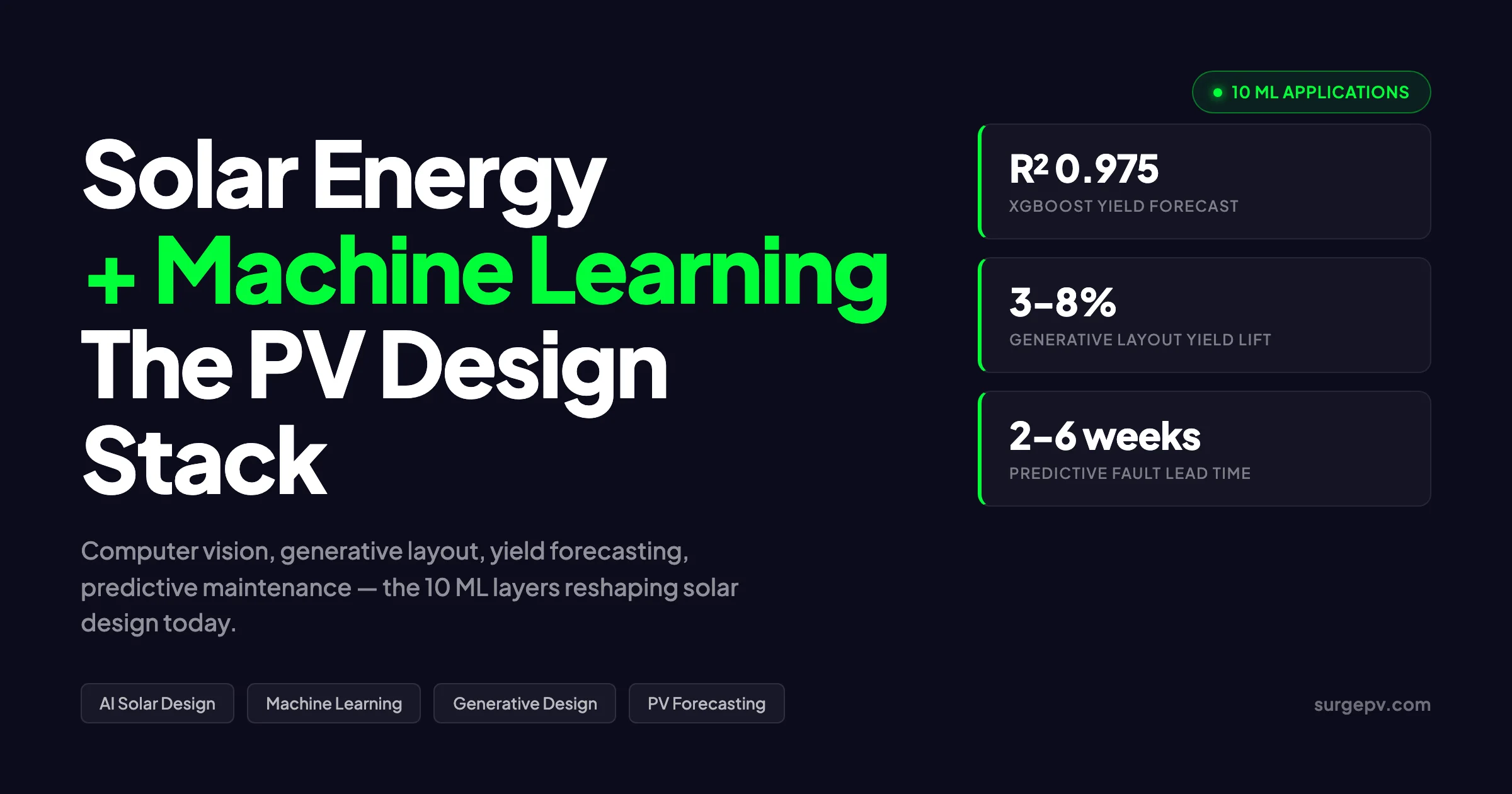
The shift is not theoretical. The global solar design tools market reached US$2.01B in 2025 and is projected to hit US$2.96B by 2032 at a 5.8% CAGR according to Intel Market Research, and the highest-growth segment inside that figure is platforms with embedded ML. Published 2025 benchmarks show XGBoost models hitting R² of 0.975 on day-ahead yield forecasts, and reinforcement-learning tracker controllers adding 2 to 5% annual production at sites already in operation. This guide walks through the 10 highest-impact applications of machine learning in PV design and operations, with the accuracy figures, the failure modes, and the buying criteria a serious installer or EPC needs before signing for any AI-branded tool.
TL;DR — Machine Learning in Solar Design
Machine learning is reshaping 10 distinct stages of the PV value chain: roof modeling, layout generation, irradiance prediction, yield forecasting, tracker control, stringing optimization, fault detection, soiling forecasting, grid dispatch, and proposal personalization. Best-in-class models report R² above 0.97 on day-ahead yield, and generative layout engines lift production by 3 to 8% over manual designs. Adopt the layers individually, not as one monolithic AI bet.
In this guide:
- The 10 ML applications already in production at large EPCs and serious installer software
- Accuracy benchmarks for each: R², RMSE, MAPE, lead time, yield uplift
- Where each model fails and what kind of human review is still required
- A 7-point buyer’s framework for evaluating any “AI solar” platform
- How SurgePV’s Clara AI fits inside this stack and where it stops
The State of Machine Learning in Solar in 2026
Three things have changed since 2022 that explain why ML-in-solar suddenly works at production scale.
First, satellite and aerial imagery is now cheap and fresh. Submeter resolution covers most of the developed world, and fly-overs in the US, EU, and Australia are refreshed every 12 to 24 months on the major commercial datasets. That means a computer vision model has a high-quality, up-to-date input for roof segmentation almost everywhere a residential or C&I project gets quoted. For Australia-specific compliance details, see Australia comparisons/lgc-vs-stc.
Second, gradient-boosted decision trees and transformer-based time series models finally beat physics-based simulations on yield forecasting at horizons under 24 hours. The XGBoost benchmark cited above is not an outlier. Peer-reviewed comparisons consistently show ensemble ML models outperforming single-model approaches and physics-only methods for the day-ahead and intra-day windows. Read more about Agricultural Solar Case Study. For France-specific information, see Floating Solar Farms France.
Third, plant operators have accumulated 8 to 12 years of SCADA telemetry from utility-scale assets. That training data did not exist five years ago. It is what makes predictive maintenance models actually predict instead of just retrospectively explain failures.
The 10 applications below are ordered roughly by adoption stage — the early items are mainstream in design software today, the later items are still expanding from utility-scale into C&I and residential.
1. Computer Vision for Roof and Site Assessment
The first ML layer in any modern PV workflow is computer vision applied to satellite, aerial, or drone imagery. The model segments the roof, classifies surface type, identifies obstructions (vents, skylights, AC units, chimneys, dormers), and outputs a 3D mesh that downstream layout tools can use directly.
What the model does
A typical pipeline runs four sub-models in sequence: a building footprint segmenter (usually a U-Net variant), a roof plane classifier that separates flat from pitched and identifies hip vs gable, an obstruction detector trained on labeled aerial datasets, and a surface tilt-and-azimuth estimator that infers geometry from image gradients and shadow length.
Accuracy in the field
For standard residential pitched roofs, leading platforms report 92 to 96% accuracy on plane segmentation and 88 to 93% on obstruction detection (measured against drone-validated ground truth). Accuracy drops on complex hip-and-valley roofs, dormered Victorians, and any roof under heavy tree canopy. Flat commercial roofs perform best — typically above 95% on both metrics.
Where it fails
Computer vision misses anything below the resolution limit of the input imagery (vent stacks under 0.3m diameter often disappear), and it cannot see structural elements that matter for module layout — joist spacing, parapet thickness, deck condition. Every responsible workflow still requires either a drone fly-over or a physical site visit before final design freeze for C&I projects.
Pro Tip
When evaluating any AI roof tool, ask the vendor for their failure case gallery — the projects where the model returned a layout that needed major revision after the site visit. A vendor that cannot show you those cases is either hiding them or has not yet shipped enough volume to know what they are.
2. Generative Layout Optimization
Generative design takes the roof model from step 1, plus a constraint set (module type, inverter, setbacks, structural load zones, electrical string limits, AHJ rules), and produces multiple valid module layouts ranked by an objective function — usually annual yield, but sometimes structural load distribution, aesthetic uniformity, or first-year revenue.
This is the single biggest workflow change since Google Earth replaced printed site surveys. A senior designer who used to iterate three or four layout options manually over a two-hour session now reviews 8 to 10 generated options in under five minutes.
How the algorithm works
Most production engines combine constrained integer programming (for the discrete placement decisions) with a neural network surrogate of the yield model (so the optimizer can score thousands of candidate layouts per second without running a full physics simulation each time). The surrogate is trained on millions of pre-computed PVsyst or SAM runs. Also see: Us Residential Solar Market Trends 2026.
Yield uplift over manual design
Published comparisons consistently show 3 to 8% higher annual yield from generative layouts versus manual CAD on the same site. The gap widens on irregular roofs, complex shading scenarios, and any project where inter-row spacing matters (ground mount, flat commercial, carport). Read Commercial Solar Carport Design Guide for a complete walkthrough. See Ground Mounted Solar Design Guide for detailed guidance.
What still needs human judgment
The optimizer maximizes whatever you tell it to maximize. If aesthetic uniformity, panel symmetry across roof faces, or mounting hardware count matters to the customer or the installer, those have to be encoded as constraints up front. Pure yield-maximizing layouts often look messy. SurgePV’s Clara AI, Aurora, and HelioScope all expose explicit aesthetic and uniformity constraints because customer feedback forced the issue.
3. Machine Learning for Shading and Irradiance Modeling
Traditional shadow analysis tools build a 3D scene and run ray-tracing for every hour of the year. The simulation is accurate but slow, and the inputs (tree heights, neighbor building geometry) are often the weakest link.
ML changes both halves. On the input side, computer vision models now estimate tree canopy height from LiDAR or stereo imagery with sub-meter accuracy. On the simulation side, neural network surrogates trained on millions of physics-based runs return per-module annual irradiance maps in a few seconds for a typical residential roof — versus 30 to 90 seconds for a full ray-trace.
Where ML wins
The ML approach lets a designer iterate layouts at the speed of UI clicks instead of waiting for a simulation to finish. For sales engineers running 10 to 20 quotes a day, that is the difference between using shade simulation on every project and skipping it on the half they are most rushed on.
Where physics still wins
For final yield bankability — investor proposals, lender-required reports, IRR-sensitive C&I bids — the surrogate is not yet accurate enough to replace a full PVsyst run. Use ML for early-stage sizing and design iteration, then validate the chosen layout with a physics-based simulation before sign-off.
The solar shadow analysis software inside SurgePV runs a hybrid approach: ML for interactive design, full ray-trace on the chosen layout before proposal export. That pattern is becoming standard across the industry.
4. Energy Yield Forecasting With Gradient-Boosted Models
Yield forecasting is where ML has the cleanest, most defensible accuracy advantage over traditional methods. Three model families lead the published benchmarks: XGBoost, Random Forest, and hybrid ensembles combining the two.
Published accuracy benchmarks
| Model | R² | RMSE | MAPE | Best Horizon |
|---|---|---|---|---|
| XGBoost (tuned) | 0.975 | 0.019 | 0.69% | Day-ahead |
| ANN (single model) | 0.870 | 0.535 | — | Day-ahead |
| Random Forest | 0.89 | 0.28 | 0.6 | 2 weeks to 1 month |
| Hybrid XGBoost + RF | Best overall | — | — | 1 week ahead |
| LSTM (deep learning) | 0.86 | 0.31 | 1.2 | Intra-day |
Sources: PMC peer-reviewed comparison, MDPI Electronics, Scientific Reports.
What this changes for design
For new project sizing, use ML yield forecasts to set realistic P50 and P90 production estimates that match what the asset will actually do in year one. Physics-based simulations (PVsyst, SAM) tend to overestimate by 4 to 7% in the first year because they do not account for soiling ramp-up, early-life shading from new construction, or the specific weather pattern of the past 18 months at the site. ML models trained on recent satellite-derived irradiance and nearby plant telemetry close most of that gap.
What this changes for finance
Lenders and tax equity investors are starting to accept ML-derived P90 numbers when the model has been validated against operational fleets. That matters because every percent of P90 confidence translates directly into debt sizing.
See ML-Powered Solar Design in Action
Watch how SurgePV’s Clara AI handles roof modeling, generative layout, shade simulation, and yield forecasting in a single 20-minute walkthrough. Bring a real project — we will design it live.
Book a DemoNo commitment required · 20 minutes · Live project walkthrough
5. Reinforcement Learning for Solar Tracker Control
Single-axis trackers used to follow a simple astronomical algorithm: point the modules at the sun, adjust the tilt every few minutes. That worked, but it left production on the table during cloudy hours, partial shade events, and back-tracking conditions.
Reinforcement learning trackers replace the fixed astronomical rule with a policy that learns from real-time irradiance, weather forecast, soiling state, and module temperature. The RL agent decides whether the marginal gain from re-pointing exceeds the energy cost of the motor and the wear on the drive.
Production gains
Operators reporting RL tracker deployments cite 2 to 5% additional annual energy yield over conventional tracker control. The gain is largest at sites with frequent partial cloud cover, high diffuse irradiance fraction, or heavy snow loading where back-tracking on adjacent rows produces measurable shading.
Implementation reality
This is still mostly a utility-scale story. RL tracker control requires a dense sensor array, edge compute at the array level, and an integration with the SCADA system. Most C&I and all residential systems will not see this layer for at least three more years. But for any utility-scale developer modeling a 100MW+ project, the 2 to 5% uplift is large enough to flip the IRR on marginal sites.
6. Machine Learning for Stringing and Inverter Sizing
Stringing optimization — deciding which modules go on which string, which strings go to which MPPT input, and how the strings get distributed across inverters — is a combinatorial problem that explodes fast. A 200-module residential system with 4 MPPTs has hundreds of valid configurations. A 5MW C&I project has billions.
What the ML layer does
Modern design tools use a two-step approach: a constraint solver enforces electrical limits (maximum string voltage at minimum temperature, MPPT voltage windows, current ratings), then an ML model ranks the surviving candidates by predicted annual yield and inverter clipping loss. The model is trained on simulated yield data across thousands of stringing topologies.
Why it matters
A bad stringing topology can lose 1 to 3% of annual production through suboptimal MPPT grouping, plus another 0.5 to 2% through avoidable inverter clipping at peak hours. Multiply that across a portfolio and the difference between a thoughtful stringing engine and a brute-force first-fit algorithm runs into real money.
Where SurgePV fits
The solar design software inside SurgePV’s Clara AI auto-generates stringing topologies, ranks them by predicted yield, and lets the designer override the top suggestion if there is a site-specific reason to prefer a different layout (cable run minimization, future expansion, MV transformer placement). For a refresher on how MPPT sizing decisions affect the math, see the auto-stringing and inverter sizing glossary entries.
7. Predictive Maintenance and Anomaly Detection
ML for solar O&M is the application that has changed asset returns the most over the past five years. The transition is from threshold-based alarms (string current 20% below expected → fire ticket) to anomaly detection models that flag underperformance weeks before it crosses a manual threshold.
How the models work
The standard architecture is an isolation forest or autoencoder trained on healthy SCADA telemetry, fed module-level or string-level data — current, voltage, power, temperature, irradiance — at one to five-minute resolution. The model learns what “normal” looks like for that specific plant under that specific weather. Anything that drifts outside the normal envelope gets flagged.
For thermal imaging, convolutional neural networks classify hot spots, PID degradation, and cell cracking from drone or inspection-vehicle imagery with 88 to 94% accuracy depending on image quality and labeling consistency.
Lead time and recovered production
Operators using ML anomaly detection typically catch faults 2 to 6 weeks earlier than threshold alarms, which is enough lead time to schedule maintenance during low-production periods instead of reacting after the inverter has already tripped. Recovered production usually lands in the 1 to 3% range annually, which is the difference between a 95% availability fleet and a 98% availability fleet.
Where it fails
The model has to be trained on plant-specific data. A model trained on a fleet of fixed-tilt installs in California will produce false positives on a single-axis tracker site in Spain. Vendors who claim a single global model are oversimplifying. Expect a 60 to 90 day calibration period at any new plant before the false positive rate drops to acceptable levels. Also see: Spain net metering. For Global-specific compliance details, see Global net-metering-by-country.
8. Soiling Loss Prediction and Cleaning Schedule Optimization
Soiling losses range from 1% annually in clean, frequently-rained climates to 15%+ in dusty, dry regions like the Atacama, the Gulf, or interior Australia. Cleaning is expensive — both the labor and the water — and over-cleaning destroys the ROI as fast as under-cleaning destroys the yield.
ML soiling models combine satellite-derived dust and rainfall forecasts with on-site soiling station measurements (or, increasingly, with module-level current data that proxies for soiling) to predict when cleaning will pay back its cost.
Accuracy and savings
Operators using ML-driven cleaning schedules report 15 to 30% reductions in cleaning costs versus fixed quarterly schedules, with no measurable yield loss versus over-cleaning. The model essentially decides “the next 10 days are forecast dry, and the soiling rate in this region is X g/m² per day, so cleaning today vs in 12 days saves $Y in marginal yield.” For background on how soiling enters the design model in the first place, see the soiling loss glossary entry.
Design implications
If you are designing a system in a high-soiling region, the ML soiling model also feeds back into the yield forecast — meaning the P50 and P90 numbers get tighter, and the financial model is more defensible. Use this as a sales tool when the project IRR is borderline. A 1% tighter P90 often unlocks an additional 5 to 8% of project debt.
9. AI-Aware Grid Integration and Battery Dispatch
Modern PV designs are rarely standalone. Most C&I and all utility-scale projects now include a battery, a grid export limit, or a hybrid inverter that has to make real-time dispatch decisions.
ML changes the dispatch problem from “follow a fixed rule” to “optimize against a price forecast and a curtailment forecast simultaneously.” The model predicts both energy market prices and likely curtailment events 24 to 72 hours ahead, then decides how to charge, discharge, and export accordingly.
What this means for design
Battery sizing is no longer a static “store the midday peak, discharge in the evening” calculation. The optimal battery size depends on the dispatch policy you intend to run, which depends on the ML forecast accuracy at the site. Designs that assume a sophisticated dispatch layer can justify smaller batteries with higher cycling and faster payback.
The generation and financial tool inside SurgePV runs hybrid system simulations that account for both fixed-rule and ML-aware dispatch, so designers can compare the financial difference at quote time. For deeper background on grid integration constraints across countries, see our grid export limitation rules by country breakdown.
Where the model still struggles
Price forecasts are accurate at the 24-hour horizon and degrade fast beyond it. Curtailment forecasts are even noisier — they depend on grid operator decisions that are not always rational. Most production hybrid systems still use ML for the easy cases (clear price signals, predictable curtailment) and fall back to a deterministic rule for everything else.
10. AI-Enhanced Sales Proposals and Lead Qualification
The last application is the one that touches the customer most directly: ML in the proposal and sales workflow itself.
Three sub-applications dominate. First, automated lead scoring — models trained on historical CRM data predict which inbound leads will close, so sales teams prioritize correctly. Second, dynamic proposal personalization — the proposal generator adjusts ROI assumptions, financing options, and visual emphasis based on the customer’s segment, region, and prior interaction. Third, conversational AI agents that handle initial qualification and objection handling before a human picks up the call.
What this changes for installers
The conversion gap between top-quartile and median solar installers is now mostly explained by sales process maturity, not pricing. ML-driven proposal personalization typically lifts close rates by 10 to 25% on the same lead pool, and lead scoring cuts wasted sales time by 30 to 50% by deprioritizing leads that historical data says will not close.
How it shows up in design software
Modern design platforms wire this directly into the design output. The same generative layout that powers steps 1 to 3 above also feeds the solar proposal software layer, which assembles the final customer-facing PDF — branded, financially modeled, and ready to e-sign. SurgePV’s Clara AI handles this end-to-end so a sales rep can go from satellite image to signed proposal in a few minutes, including the conversation. For the wider sales-enablement context, see how solar proposal software increases sales and the advantages of solar sales software.
A 7-Point Buyer’s Framework for Evaluating AI Solar Tools
Vendors are now adding “AI” to product names that have not changed materially in three years. Use this checklist before signing.
1. Which of the 10 ML layers does the platform actually cover?
Ask for documentation on each layer. A platform that covers three of the 10 well is better than one that claims all 10 superficially.
2. What is the published accuracy on each layer?
Yield forecasting models should report R², RMSE, MAPE on a held-out test set. Computer vision models should report segmentation accuracy and obstruction detection precision/recall. If the vendor cannot produce numbers, the model is not validated.
3. What is the failure case gallery?
Every ML model has cases where it returns the wrong answer. A vendor that has shipped at scale knows what those cases are and has a documented escalation path. A vendor without a failure case gallery has not shipped enough volume.
4. Is the model retrained on customer data?
A static model trained two years ago and never updated is degrading. Models retrained quarterly or continuously on new fleet data stay calibrated to current module technology, current weather patterns, and current installation practice.
5. What is the human-in-the-loop workflow?
Production AI in solar is human-supervised. The platform should make exception handling easy — flagging low-confidence outputs, supporting one-click overrides, capturing the override as training data.
6. Where does the data live, and who owns it?
ML platforms ingest project data, customer data, and sometimes site data. Verify the data residency, the deletion policy, and the customer’s rights to extract their data on contract termination.
7. What integrations are real?
“Integrates with HelioScope” can mean a CSV export. Real integration means an API that pushes design changes both directions in near real time. Ask for the integration spec, not the marketing page.
How to Roll Out ML in a Solar Business — A 90-Day Plan
The biggest mistake installers make is trying to deploy all 10 layers at once. Sequence matters. Here is the order that gets the highest ROI in the shortest time.
Days 1-30: Layout and Design Automation
Deploy a tool that combines computer vision, generative layout, and ML shade simulation in one workflow. This is where the time savings show up first — typically 60 to 75% reduction in design time per project. SurgePV’s Clara AI is built around this combined workflow.
Days 31-60: Yield Forecasting and Proposal Personalization
Replace the default PVsyst yield numbers in your proposals with ML-derived P50 and P90 forecasts. Add personalization logic to the proposal output. Track close-rate impact week over week.
Days 61-90: Operations Layer (If You Operate Plants)
If your business owns or operates plants post-installation, deploy ML anomaly detection and soiling forecasting. If you only do design and install, skip this layer for now — it does not pay back without operational responsibility.
For a deeper look at the design-to-installation handoff, see how solar plant design software saves time and the features of solar design software that matter most for production teams.
Where Machine Learning in Solar Is Heading Next
Three trends will shape the next 18 months.
First, foundation models trained specifically on solar data are emerging. These are not general LLMs — they are domain-specific transformers trained on satellite imagery, weather data, SCADA telemetry, and design files. Expect the first commercial offerings in late 2026 and early 2027.
Second, edge ML is moving down the stack. Inverter manufacturers are embedding ML models directly into the inverter firmware for MPPT optimization and rapid shutdown decisions. This eliminates the round-trip latency that currently limits real-time optimization.
Third, the regulatory layer is catching up. AHJs in California, Germany, and Australia are publishing guidance on what ML-derived design outputs require additional human review. Expect this to standardize over 2026 and 2027, which will make it easier to trust AI-generated permit packages. Also see: Germany solar subsidies. For Germany-specific information, see Community Solar Projects Germany.
Conclusion
The 10 ML applications above are not a forecast — they are the current state of the art at serious EPCs and the better solar design software platforms today. If you are evaluating tools right now:
- Adopt the design layers first. Computer vision, generative layout, and ML shade simulation deliver the fastest payback. Demand published accuracy numbers and a failure case gallery from any vendor.
- Add yield forecasting and proposal personalization next. These lift close rates and tighten financial defensibility, both of which compound across every deal you do.
- Deploy operational ML only if you operate plants. Anomaly detection and soiling optimization pay back fast for asset owners and operators, but they do not move the needle for pure design-and-install businesses.
Frequently Asked Questions
How is machine learning used in solar PV design?
Machine learning is applied across the full PV design stack: computer vision extracts roof geometry from satellite imagery, generative algorithms produce optimized module layouts in seconds, gradient-boosted models forecast energy yield with R² above 0.97, and reinforcement learning agents adjust tracker angles in real time. Most production-grade solar design software uses three to five of these layers, not one large general model.
Can AI replace solar engineers in PV design?
No. AI handles the repetitive parts of design — roof tracing, layout iteration, yield simulation, fault classification — but a licensed engineer is still required to validate compliance, sign off on structural and electrical calculations, and submit permit packages. The role is shifting from drafting to validation and exception handling.
What is the most accurate machine learning model for solar yield forecasting?
Hybrid ensemble models that combine XGBoost with Random Forest currently lead published benchmarks, with one 2025 study reporting R² of 0.975, RMSE of 0.0191, and MAPE under 0.7% for day-ahead forecasts. For longer horizons (two-week to one-month ahead), pure Random Forest still outperforms most deep learning architectures.
How much does AI improve solar energy production?
Generative AI layout typically lifts yield by 3 to 8% versus manual CAD designs by jointly optimizing orientation, inter-row spacing, and shade avoidance. Reinforcement learning tracker control adds another 2 to 5%. Predictive maintenance recovers an additional 1 to 3% of lost production by catching faults weeks earlier than threshold-based monitoring.
Which solar design software uses machine learning in 2026?
Commercial platforms with documented ML features include SurgePV (Clara AI for layout, generative design, and yield prediction), Aurora Solar (computer vision for roof modeling), HelioScope (obstruction detection), PVFARM (utility-scale optimization), and Solr.ai (vision-based site capture). Operational platforms like Raycatch and SparkMeter add ML-driven anomaly detection for plants already in production. For software options, see 7 Best Aurora Solar Alternatives in.
What is generative design in solar?
Generative design uses constrained optimization algorithms to produce multiple valid PV layout variations from a single input set — module type, inverter, roof model, setbacks, electrical limits. The designer reviews ranked options instead of drawing each one. A modern generative engine produces 8 to 10 distinct layouts in a few seconds, ranked by yield, structural load, or aesthetic score.
How does machine learning detect solar panel faults?
ML fault detection models — usually convolutional neural networks for thermal imagery and isolation forests for electrical telemetry — flag underperforming strings, hot spots, PID degradation, and inverter clipping events from the same SCADA data plant operators already collect. Detection lead time is typically 2 to 6 weeks earlier than fixed-threshold alarms, which is enough to schedule maintenance instead of reacting to outages.
Is AI accurate enough to design solar systems without a human reviewer?
Not for permit submission. AI is reliably accurate for standard rectangular roofs, tilted residential layouts, and single-tilt ground mounts inside its training data distribution. Accuracy degrades on complex hip roofs, terraced sites, dormers, non-standard module geometries, and AHJ-specific setback rules. Every major platform — including SurgePV, Aurora, and HelioScope — keeps a licensed designer in the validation loop.
Where this fits
This article is part of SurgePV's Solar Technology hub, which works through the topic from first principles to the decisions a project team actually has to make.
