Hiring a solar design engineer in 2026 is harder than it looks. Job postings attract candidates who list every tool under the sun, yet many cannot explain why a string voltage calculation matters or how a shade model changes a production guarantee. The gap between a tool operator and a real design engineer is widening as software automates more of the routine work.
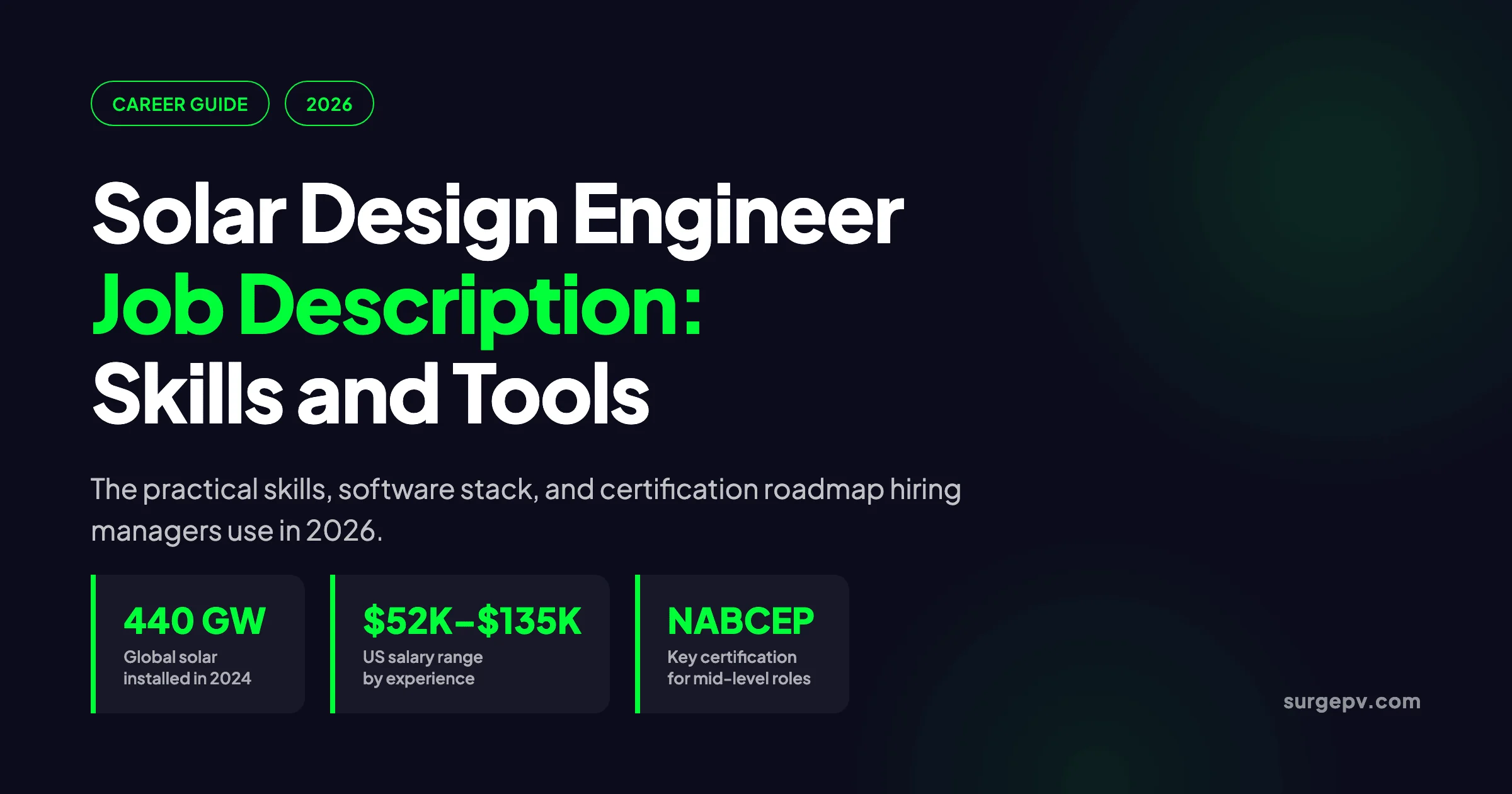
Global solar installations reached approximately 440 GW in 2024, according to IRENA’s Renewable Capacity Statistics 2025, and the industry needs more designers than universities and training programs currently produce. Employers are competing for the same limited talent pool. A clear skills and tools framework helps hiring managers screen faster and helps engineers see exactly where to invest their learning.
This guide is a practical skills-and-tools checklist. It covers the technical competencies that matter, the software stack used at each workflow stage, certification priorities, and the soft skills that separate reliable hires from risky ones. Whether you are writing a job description, preparing for an interview, or leveling up your own toolkit, use this as a working rubric.
A solar design engineer needs electrical fundamentals, simulation and CAD platform skills, code compliance knowledge, and the judgment to validate software output. In 2026, the most in-demand engineers combine platform fluency with the ability to explain the engineering behind every number.
Quick Answer
Solar design engineers in 2026 need DC electrical theory, PV system design, shade analysis, string sizing, energy simulation, NEC or IEC compliance, and proficiency in at least one cloud-based solar design platform. NABCEP PV Design Specialist certification is increasingly expected at mid-level and above. US salaries range from $52,000 entry level to $130,000+ senior.
In this guide:
- What a solar design engineer actually does
- Core technical skills every engineer needs
- Software and tools by workflow stage
- Skills and tool benchmarks by career level
- Certifications that matter in 2026
- Soft skills hiring managers actually test
- Common mistakes and misconceptions
- How to use this as a hiring rubric
- FAQ
What a Solar Design Engineer Actually Does
A solar design engineer converts site data into a permit-ready, financially sound PV system. The inputs are roof measurements, shading surveys, utility bills, load profiles, and local code requirements. The outputs are panel layouts, electrical single-line diagrams, string configurations, energy yield reports, bill of materials, and permitting packages.
The role sits between sales and installation. Sales teams need a design that converts the customer. Installation teams need a design they can build without surprises. The engineer must satisfy both while keeping the system safe, compliant, and profitable.
Four tasks repeat across most projects:
- Site assessment and data ingestion. Review aerial imagery, drone surveys, or site visit notes. Confirm usable roof area, pitch, azimuth, and obstruction positions. Flag missing data before it causes downstream rework.
- System layout and stringing. Place panels for maximum yield while respecting setbacks, fire pathways, structural load limits, and electrical constraints. Size strings to fit inverter voltage and current windows across temperature extremes.
- Simulation and loss modeling. Run energy simulations with defensible weather data, soiling assumptions, degradation rates, and shading losses. Document the P50 or P90 yield estimate that feeds the financial model.
- Documentation and permitting. Produce a clean drawing set: plan view, single-line diagram, equipment schedule, interconnection notes, and AHJ-specific forms. Resolve plan-checker comments when they come back.
The exact title varies. Some companies call the same person a solar designer, PV designer, or design engineer. At larger firms, the engineer title implies more electrical authority and may carry sign-off responsibility for stamped permit sets. At high-volume residential installers, the distinction is mostly about throughput and accuracy.
For a broader look at the full job description, salary benchmarks, and career ladder, see our complete guide on the solar design engineer job description.
Core Technical Skills Every Solar Design Engineer Needs
The technical foundation of solar design engineering has not changed much, even as the tools have become more automated. Software speeds up calculations, but it does not remove the need to understand what the calculation means.
DC Electrical Theory
Every design starts with series and parallel DC circuits. A solar design engineer must be comfortable with:
- Open-circuit voltage (Voc), maximum power voltage (Vmp), short-circuit current (Isc), and maximum power current (Imp)
- Temperature coefficients and their effect on string voltage at cold temperatures
- Maximum system voltage limits and inverter MPPT windows
- Continuous current derating for wire and overcurrent protection sizing
- Bypass diode behavior and how shading affects string performance
A common error is sizing a string based on standard test conditions without correcting for the lowest expected temperature. In cold climates, Voc can rise enough to exceed inverter input limits or void warranties. Engineers who understand this catch it before permit submission.
PV System Architecture
Designers must understand the major system topologies and when each is appropriate:
- String inverter systems: most common for residential; multiple strings per MPPT
- Microinverter systems: one inverter per module; best for complex roofs or heavy shading
- Power optimizer plus string inverter: individual module optimization with a central inverter
- AC-coupled and DC-coupled battery storage: different backup behavior, efficiency, and cost profiles
- Commercial systems: central inverters, DC combiners, medium-voltage transformers, revenue-grade metering
The choice between microinverters and string inverters is a good example of engineering judgment. Microinverters cost more per watt but can improve yield on shaded or multi-orientation roofs. A good engineer runs both scenarios and compares lifetime value, not just first cost.
Shade Analysis and Loss Modeling
Shade is the largest source of avoidable production loss in most designs. Solar design engineers must understand:
- Horizon shading versus near-field shading
- Time-of-day shade profiles across seasons
- Bypass diode operation and string-level mismatch
- When module-level power electronics change the return on investment
- How to translate shade maps into kilowatt-hour loss estimates
Professional solar shadow analysis software generates hourly shade maps for each point on the roof. The engineer’s job is to interpret the output and decide whether to relocate panels, use optimizers, or accept the loss. For example, moving two rows of panels away from a chimney can sometimes cut a 15% shading loss down to 8%.
String Sizing and Inverter Matching
String sizing is where theory meets product datasheets. Engineers must verify:
- Maximum string voltage under lowest design temperature does not exceed inverter maximum input voltage
- Minimum string voltage under highest design temperature stays within the inverter MPPT window
- String current at standard test conditions fits within inverter input current limits
- Number of strings per MPPT respects inverter channel limits and avoids excessive mismatch
This is not optional. Inverter warranty claims, permit rejections, and underperforming systems often trace back to string sizing errors.
Code Compliance
Codes vary by country and jurisdiction, but the core frameworks are consistent:
- NEC Article 690 governs PV system design in the United States, including rapid shutdown, grounding, disconnecting means, and circuit sizing
- IEC 62446 defines documentation and commissioning requirements for grid-connected PV systems internationally
- UL 1741 covers inverter grid-interconnection and safety standards in North America
- Local amendments, fire setbacks, and Authority Having Jurisdiction requirements add market-specific rules
An engineer who memorized the 2017 NEC but stopped there will produce non-compliant designs in markets that have adopted the 2023 NEC with updated rapid shutdown requirements. Continuous code awareness is part of the job.
Energy Simulation and Yield Modeling
Energy simulation turns a layout into a production estimate. Engineers must know how to:
- Select appropriate weather datasets such as TMY3, NSRDB, Meteonorm, or Solargis
- Apply soiling, degradation, temperature, and mismatch losses
- Interpret P50, P90, and uncertainty ranges
- Validate simulated output against actual production data when available
The simulation is only as good as its inputs. Two engineers using the same software can produce different yield estimates based on weather dataset choice, soiling assumptions, and shading model settings. Senior engineers document every assumption so the estimate is defensible to financiers and customers.
Technical Documentation
AHJs reject incomplete packages. Strong documentation skills include:
- Clear single-line diagrams with labeled equipment and disconnects
- Roof plans showing panel locations, setbacks, and dimensions
- Equipment schedules with model numbers, ratings, and quantities
- Conduit routing and labeling
- Site photos and notes that support design assumptions
Good engineers treat documentation as part of the design, not an afterthought. This habit directly reduces permit rejection rates and rework.
Software and Tools by Workflow Stage
A solar design engineer’s toolkit spans design platforms, simulation software, CAD tools, and productivity applications. The right stack depends on project type, company size, and market.
Cloud-Based Solar Design Platforms
These platforms handle site modeling, layout, shade analysis, string sizing, production simulation, and proposal generation in one workflow. They are the core tool for most residential and light-commercial designers.
| Platform | Best For | Standout Capability |
|---|---|---|
| SurgePV | End-to-end residential and commercial design | AI-assisted layout, integrated shadow analysis, and one-click SLD and proposal generation |
| Aurora Solar | US residential sales-focused workflows | Strong LIDAR-based roof detection and CRM integrations |
| Helioscope | Commercial and utility-scale layout | Fast prototyping and detailed string sizing for larger arrays |
| OpenSolar | Small-to-mid installers | Free tier and fast proposal generation |
SurgePV’s solar design software is built for designers who need to move from address input to permit-ready output quickly. It combines satellite imagery import, automatic roof plane detection, shade analysis, auto-stringing with live voltage validation, and proposal generation in a single workflow.
Simulation and Bankability Tools
For projects that require financing-grade yield reports, standalone simulation tools remain essential:
- PVsyst: the industry standard for bankable energy assessments on commercial and utility-scale projects
- PVSOL: detailed 3D shading and simulation popular in European markets
- PVGIS: free web tool for quick irradiance lookups and basic sizing
PVsyst has a steeper learning curve than cloud platforms but is often required by lenders and investors. Designers targeting commercial or utility-scale work should plan to learn it alongside their primary platform.
CAD and 3D Modeling Tools
- AutoCAD / AutoCAD LT: permit-ready electrical and structural drawings for commercial projects
- SketchUp: 3D site modeling when satellite imagery is insufficient
- Bluebeam Revu: PDF markup, permit package review, and AHJ comment resolution
Productivity and Collaboration Tools
- Microsoft Excel: string sizing calculations, BOM generation, financial modeling, and project tracking
- Salesforce / HubSpot: CRM integration so design output feeds sales pipelines
- Procore / Fieldwire: construction coordination on commercial projects
- Jira / Asana / Monday.com: task and queue management at larger firms
The specific tools matter less than the ability to learn new ones. Hiring managers increasingly value platform-agnostic engineers who understand the engineering first and the interface second.
Skills and Tool Benchmarks by Career Level
Not every solar design engineer needs the same depth. The following matrix maps skill and tool expectations to experience level. Use it for hiring, career planning, or team development.
| Skill Area | Junior (0–2 yrs) | Mid-Level (3–5 yrs) | Senior (6+ yrs) |
|---|---|---|---|
| DC electrical theory | Foundational | Proficient | Expert; can train others |
| PV system architecture | Knows string, micro, and optimizer systems | Can design hybrid and storage systems | Specifies complex commercial and utility-scale topologies |
| Shade analysis | Runs standard analyses | Interprets complex multi-surface shading | Validates models against field data |
| String sizing | Guided | Independent | Catches edge cases and mentors juniors |
| Energy simulation | Uses default settings | Validates assumptions and datasets | Produces bankable reports with uncertainty analysis |
| Code compliance | NEC/IEC awareness | Proficient in primary markets | Resolves AHJ disputes and sets team standards |
| Design platform | One platform at speed | Two or more platforms | Evaluates and implements new platforms |
| PVsyst | Basic or none | Intermediate | Advanced; financing-grade reports |
| CAD tools | Basic | Proficient | Produces stamped-ready drawings |
| Documentation | Assisted | Independent permit packages | Reviews and standardizes team output |
| Queue management | Few projects with supervision | 10–20 active designs | Oversees team throughput and quality |
Junior Engineer Expected Output
A competent junior designer should complete 4–8 standard residential designs per day on a familiar platform. Performance is measured by accuracy and throughput. The goal is consistent, low-rework output rather than creative problem-solving.
Mid-Level Engineer Expected Output
Mid-level engineers handle independent design queues, light-commercial projects, and some battery storage designs. They should produce permit-ready packages with minimal supervision and begin mentoring juniors.
Senior Engineer Expected Output
Senior engineers tackle complex commercial rooftops, ground-mount arrays, utility-scale projects, and AHJ escalations. They often hold NABCEP PVDS certification, may have a PE license, and are expected to improve team processes, not just their own output.
Certifications That Matter in 2026
Certifications are a signal, not a substitute for ability. In a tight hiring market, they help employers filter candidates quickly.
NABCEP PV Design Specialist (PVDS)
The PVDS is the most relevant credential for office-based solar design engineers. It covers load analysis, site assessment, system sizing, string configuration, simulation, code compliance, and documentation. Requirements include OSHA 10 training, at least 24 hours of advanced PV training including 18 hours on the PVDS Job Task Analysis, and completion of designs totaling at least 12 project credits.
Exam details from HeatSpring: the PVDS exam costs approximately $500, with a re-exam fee of $275. NABCEP issues around 2,400 PVDS certificates annually, which has not kept pace with market demand.
NABCEP PV Installation Professional (PVIP)
The PVIP is the senior NABCEP credential. It covers installation, commissioning, safety, and advanced design. It is not required for pure design roles but strengthens candidates who came up through field work or who oversee commissioning.
Professional Engineer (PE) License
A PE license allows an engineer to stamp and seal drawings. It is often required for commercial and utility-scale projects and can significantly increase compensation. Requirements vary by state and country.
Solar Energy International (SEI)
SEI certificate programs are a common pathway to NABCEP eligibility for candidates without a formal engineering degree. SEI training hours count toward NABCEP prerequisites and provide practical, project-based learning.
OSHA 10 Construction Safety
Most NABCEP credentials require at least 10 hours of OSHA Outreach training. Even where not required, safety awareness is essential for designers who visit sites or review installation plans.
For a full comparison of training paths, see our guide on solar design courses.
Soft Skills Hiring Managers Actually Test
Technical skills get the interview. Soft skills often determine whether the hire lasts.
Communication Under Disagreement
Can the engineer explain why a design decision is correct to a sales rep who wants to squeeze in more panels? Can they push back on an AHJ comment with a code citation rather than simply complying? The ability to advocate with data while remaining collaborative is highly valued.
Queue Management
Residential design engineers commonly manage 10–20 active projects at once. Strong candidates describe a clear intake system, priority rules, and communication protocols with sales or project teams. They do not need daily supervision to keep work moving.
Self-Directed Quality Assurance
The best engineers catch their own errors before submission. They build personal checklists for string voltage, setbacks, equipment schedules, and AHJ-specific requirements. They treat the reviewer as a backup, not a safety net.
Adaptability
Codes change, products go out of stock, and site conditions differ from satellite imagery. Engineers who can redesign around a substituted module or an unexpected roof obstruction without starting from scratch are more valuable than those who depend on ideal inputs.
Customer-Facing Clarity
In smaller companies, design engineers sometimes join sales calls or explain technical choices to homeowners. The ability to translate inverter clipping or shade loss into plain language helps close deals and reduce post-sale disputes.
Common Mistakes and Misconceptions
Several recurring errors separate junior engineers from reliable ones. Addressing them directly improves hiring and training.
Mistake 1: Trusting Default Simulation Settings
Every simulation platform applies default loss factors. Defaults rarely match local conditions. A designer who runs default soiling in a dusty climate or default degradation for an unusual module will produce optimistic yield estimates. Senior engineers calibrate inputs against measured data or local experience.
Mistake 2: Treating Shade as Binary
Shade is not simply present or absent. A chimney that blocks one panel for two hours in winter creates a different loss pattern than an HVAC unit that shades four panels at midday. Understanding time-of-day profiles and bypass diode behavior is essential.
Mistake 3: Neglecting Documentation
A technically perfect design can be rejected because the single-line diagram is unclear or the equipment schedule is incomplete. Documentation is part of engineering quality. Engineers who treat it as paperwork produce more rework.
Mistake 4: Over-Reliance on One Platform
Platform loyalty is fine until the company changes tools or the project requires a capability the primary platform lacks. Engineers who understand the underlying principles can adapt. Engineers who only know clicks cannot.
Misconception: AI Will Replace Solar Design Engineers
AI is automating roof detection, panel placement, and proposal generation. It is not replacing engineering judgment. Complex roofs, custom commercial systems, code interpretation, and client communication still require human expertise. The role is shifting from drafting to review, customization, and quality assurance.
A Practical 12-Month Skill-Building Plan
Candidates often ask where to start. The following plan assumes you have basic electrical knowledge but no solar-specific experience. It balances theory, software, and real project practice.
Months 1–2: Foundations. Complete a NABCEP-registered entry-level course such as the NABCEP PV Associate prep or Solar Energy International’s introductory PV design course. Study DC electrical theory, module datasheets, and basic string sizing by hand. Do not start with software shortcuts. Understanding why the numbers work matters more than clicking buttons fast.
Months 3–4: First design platform. Pick one cloud-based platform and process 50+ practice designs using real addresses. Focus on standard residential roofs first. Learn roof plane detection, setback rules, string auto-configuration, and proposal output. Aim for a 15-minute standard residential design with accurate outputs.
Months 5–6: Shade and simulation depth. Move beyond default settings. Run the same roof through multiple weather datasets and compare the results. Practice relocating panels to reduce shading loss. Learn to read hourly shade maps and understand bypass diode behavior.
Months 7–8: Commercial exposure. Take on flat-roof commercial projects under 200 kW. Learn ballasted racking, DC combiners, and basic structural load checks. This is where AutoCAD or detailed platform outputs become necessary.
Months 9–10: Code and documentation. Study NEC Article 690 or IEC 62446 in depth, depending on your market. Build a personal checklist for permit packages. Review rejected plans from colleagues or online forums to learn common failure modes.
Months 11–12: Certification and portfolio. Sit the NABCEP PVDS exam. Document 10–15 diverse designs in a portfolio with before-and-after revisions. A portfolio with real examples beats a resume with tool names.
The exception is candidates with prior electrical or construction experience. They can compress the first three months and start commercial work earlier.
How to Use This as a Hiring Rubric
Hiring managers can turn this framework into a practical scorecard. The goal is to separate tool operators from engineers who understand the work.
Screen Resumes For
- Specific platforms with years of experience, not just a list of names
- Evidence of project volume or complexity range
- Certifications in progress or completed
- Relevant education or training, including SEI or NABCEP pathways
Technical Interview Questions
- Walk me through how you would string-size a 100 kW commercial project.
- What information do you need from a site survey before starting a design?
- How do you handle shading when it cannot be fully avoided?
- What weather dataset do you typically use, and why?
- Describe a design that required significant revision after submission. What changed?
Strong answers include reasoning, assumptions, and awareness of trade-offs. Weak answers jump to software or blame the tool.
Practical Exercise
Give candidates an anonymized residential roof and ask them to produce a layout, string configuration, and brief justification. The exercise reveals whether they understand setbacks, electrical limits, and shade impact better than any resume keyword.
Red Flags
- Cannot explain simulation assumptions beyond “the software said so”
- Inconsistent knowledge of current code versions
- No demonstrated volume at the relevant project scale
- Describes quality as someone else’s responsibility
For companies needing detailed engineering or permit design support beyond in-house capacity, Heaven Designs provides solar design and engineering consultancy services including PE-stamped permit design.
Frequently Asked Questions
What skills does a solar design engineer need?
A solar design engineer needs DC electrical theory, PV system architecture, shade analysis, string sizing, energy simulation, code compliance, and technical documentation skills. Tool proficiency in at least one cloud-based design platform is essential, plus CAD or simulation depth for commercial work. Soft skills such as queue management, client communication, and self-directed quality checks are equally important in practice.
What software do solar design engineers use?
Common platforms include SurgePV, Aurora Solar, Helioscope, and OpenSolar for integrated design and proposals; PVsyst and PVSOL for bankable simulation; AutoCAD and SketchUp for custom drawings; and Excel, Bluebeam, and CRM tools for documentation and project management.
Is NABCEP certification required for solar design engineers?
NABCEP is not always legally required, but the PV Design Specialist credential is increasingly expected for mid-level and senior office-based roles. It demonstrates competence in load analysis, site assessment, system sizing, simulation, code compliance, and permitting documentation.
What is the difference between a solar designer and a solar design engineer?
The titles overlap, but a solar design engineer usually carries deeper electrical responsibility, may sign off on permit sets, and handles more complex system specification. A solar designer often focuses on layout, production modeling, and proposal generation.
How much do solar design engineers earn in 2026?
US salaries range from approximately $52,000–$68,000 at entry level, $72,000–$95,000 at mid-level, and $100,000–$135,000 or more for senior roles at commercial EPCs or utility developers, according to aggregated salary data from Glassdoor, Payscale, and ZipRecruiter. In India, entry-level design engineers earn ₹3.5–₹5.0 LPA and senior engineers earn ₹11.0–₹16.0 LPA, based on IISE Solar Blog benchmarks.
Can you become a solar design engineer without an engineering degree?
Yes, though the path is harder. Many successful designers come from electrical trades, certificate programs, or NABCEP-registered training. A strong portfolio of documented designs, software mastery, and code knowledge can substitute for a formal degree at residential and light-commercial firms. Utility-scale roles typically prefer or require an engineering degree.
What separates a good solar design engineer from a great one?
Great engineers understand the assumptions behind simulation outputs, can explain trade-offs between yield and cost, maintain low rework rates, and catch their own errors before submission. They also communicate technical decisions clearly to sales teams, clients, and AHJs.
Further Reading
- Solar Design Engineer Job Description — full role, salary, and career ladder guide
- How to Become a Solar Designer — entry path, training, and daily workflow
- Solar Design Courses — certifications and training programs
- Solar Design Software — SurgePV platform overview
- Shadow Analysis Software — shade modeling capabilities
Where this fits
This article is part of SurgePV's Solar Design hub, which works through the topic from first principles to the decisions a project team actually has to make.