

Quick Answer
The engineer is accountable for both the yield outcome and the code compliance of what gets submitted. The engineer sets weather data sources, applies soiling and degradation rates, and documents shading losses from nearby obstructions. How the engineer sets simulation inputs determines whether the production estimate is defensible or optimistic.
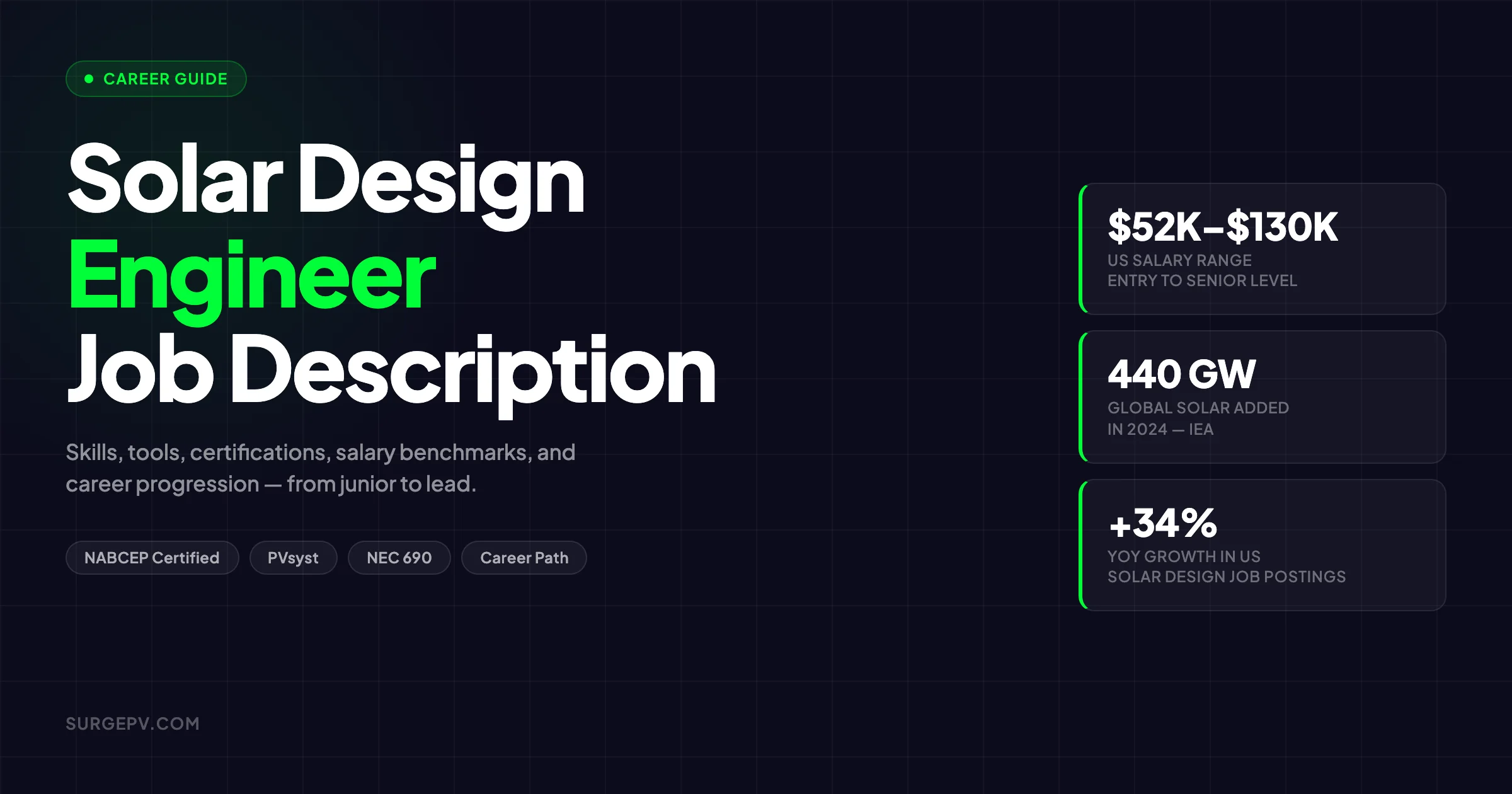
Solar design engineers apply electrical engineering fundamentals, simulation software proficiency, and code compliance knowledge to convert site data into permit-ready PV system designs. The role spans residential rooftops through utility-scale ground-mount arrays, with the core skill set anchored in string sizing, shade analysis, energy modeling, and permitting documentation. US demand for these professionals grew 34% year-over-year from Q4 2024 to Q4 2025, while global solar installations hit 440 GW in 2024 — and the qualified talent pipeline has not kept pace. For Global-specific compliance details, see Global net-metering-by-country. For Global-specific compliance details, see Global solar-permitting-speed-by-country.
The engineer is accountable for both the yield outcome and the code compliance of what gets submitted. The engineer sets weather data sources, applies soiling and degradation rates, and documents shading losses from nearby obstructions. How the engineer sets simulation inputs determines whether the production estimate is defensible or optimistic.
Whether you are a hiring manager writing a JD, an engineer evaluating a career move into solar, or a mid-level designer benchmarking your skills against what senior roles actually require, this guide covers the full picture: what the job involves, what separates good engineers from great ones, which tools and certifications matter, how the role differs across residential, commercial, and utility-scale companies, and what salary to expect at each level.
TL;DR — Solar Design Engineer Role
Solar design engineers produce permit-ready PV system drawings, energy simulation reports, and BOS specifications. The role requires electrical engineering fundamentals, proficiency in at least one simulation platform, and — for mid-level and above — NABCEP PV Design Specialist certification. US salaries range from $52K at entry level to $130K+ for senior engineers at utility developers.
What a Solar Design Engineer Does
A solar design engineer converts site data — roof measurements, shading surveys, utility bills, and customer load profiles — into bankable system designs. The output is not just a panel layout. It is a complete technical package: single-line diagrams, string configuration drawings, energy yield reports, permitting documentation, and, at most companies, a customer-facing proposal.
The day-to-day work falls into four recurring tasks.
Site assessment and data ingestion. The engineer reviews aerial imagery, drone survey data, or site visit notes to confirm usable roof area, pitch, azimuth, and obstruction positions. They import this data into a design platform and verify that the available square footage and orientation can support the proposed system size. Incomplete site data at this stage causes rework at every downstream step. Also see: Us Residential Solar Market Trends 2026.
System layout and stringing. Panel placement optimizes for yield while meeting setback requirements, fire code clearances, and structural limits. String configuration balances the electrical design — module count per string, number of strings per MPPT, inverter sizing — against voltage and current limits specified in the inverter datasheet and NEC 690. The engineer is accountable for both the yield outcome and the code compliance of what gets submitted.
Simulation and loss modeling. Every finalized design runs through energy simulation. The engineer sets weather data sources, applies soiling and degradation rates, and documents shading losses from nearby obstructions. The simulation output — typically a P50 annual yield estimate — feeds directly into the financial model and production guarantee. How the engineer sets simulation inputs determines whether the production estimate is defensible or optimistic.
Documentation and permitting. The final deliverable is a permit-ready drawing set: plan view layout, electrical single-line diagram, equipment specifications, interconnection notes, and AHJ-specific forms. At larger firms, a permit coordinator handles submission. At smaller installers, the design engineer submits directly and resolves comments from plan checkers.
Across all four tasks, solar design software has increasingly consolidated design, simulation, and proposal output into a single workflow, cutting per-project time from days to hours on residential work. The efficiency gains are real, but they do not reduce the engineering judgment required — they expose it faster.
How the Role Differs From Adjacent Positions
| Role | Primary Focus | Key Difference |
|---|---|---|
| Solar Designer | Layout, production modeling | May not hold engineering credentials or sign-off authority |
| Solar Design Engineer | Full electrical + mechanical system specification | Engineering authority; may stamp permit sets |
| Project Engineer | Field coordination, EPC management | More site time; less office design work |
| Systems Engineer | Grid integration, storage, power quality | Deeper power electronics; fewer individual designs |
| Sales Engineer | Customer-facing technical support | Proposals over permit sets; less simulation depth |
The distinction between solar designer and solar design engineer matters most at the permitting stage. Where an AHJ or utility requires a licensed PE to stamp drawings, the engineer title carries legal weight. At residential installers processing hundreds of projects per month, the titles are used interchangeably and the key requirement is throughput accuracy.
Solar Design Engineer Job Description Template
The template below reflects a mid-level role (3–6 years of experience) at a residential or light-commercial solar installer. Adjust experience and certification requirements up for senior roles or utility-scale EPCs, and down for junior or associate positions.
Position: Solar Design Engineer Department: Engineering / Design Reports to: Engineering Manager or Director of Design Location: [City, State] / Remote-eligible
About the Role
We are looking for a Solar Design Engineer to join our design team. You will produce accurate, permit-ready solar PV system designs for residential and commercial customers across [region/market]. You will work directly with our sales and project management teams to move designs from initial site data through final AHJ submission.
What You Will Do
- Design grid-tied and hybrid solar PV systems ranging from 5 kW residential to 500 kW commercial
- Produce electrical single-line diagrams, panel layout drawings, and permit packages using [design platform]
- Run energy simulations to generate P50/P90 production reports
- Perform string sizing, inverter selection, and BOS specification in compliance with NEC 690 and local AHJ requirements
- Review site assessment reports, aerial imagery, and drone survey data to validate design assumptions
- Coordinate with the permitting team to resolve AHJ comments on submitted packages
- Maintain and update component libraries (modules, inverters, racking) in the design software
- Collaborate with the proposal team to ensure design output feeds accurately into customer proposals
- Identify and escalate structural, electrical, or interconnection issues before permit submission
What We Are Looking For
- Bachelor’s degree in Electrical Engineering, Mechanical Engineering, or related field (or equivalent practical experience)
- 3–5 years of solar PV system design experience
- Proficiency in at least one of: PVsyst, Helioscope, Aurora Solar, or SurgePV
- Working knowledge of NEC 690 and applicable local codes
- NABCEP PV Design Specialist (PVDS) certification preferred
- Strong attention to detail — errors in string sizing or setback calculations have downstream consequences
- Ability to manage a queue of 10–20 active designs simultaneously
- Experience with AutoCAD, Bluebeam, or equivalent drawing tools is a plus
Compensation
- Base salary: $72,000–$95,000 depending on experience
- Benefits: [company standard package]
- Remote work: [policy]
For junior roles (0–2 years), remove the NABCEP requirement, reduce experience to 1–2 years, and add “willingness to pursue NABCEP PVDS within 18 months of hire.” For senior and lead roles, add: PE license or equivalent engineering authority, capacity to mentor junior designers, and demonstrated project volume at scale (500+ residential designs or 20+ commercial projects completed).
Pro Tip for Hiring Managers
The most predictive hiring screen is a short practical exercise — give candidates a real (anonymized) design scenario and ask them to walk through their string sizing approach before touching any software. Engineers who can reason through it verbally have internalized the fundamentals. Those who reach for the software first are often leaning on the tool as a crutch.
Core Technical Skills: What Each Level Requires
The skills a solar design engineer needs scale significantly from entry to senior. The following matrix maps core technical competencies to experience level.
| Skill | Junior (0–2 yrs) | Mid-Level (3–5 yrs) | Senior (6+ yrs) |
|---|---|---|---|
| DC electrical theory | Foundational | Proficient | Expert |
| AC system integration | Basic | Proficient | Expert |
| String sizing and MPPT matching | Guided | Independent | Catches edge cases |
| Energy simulation (PVsyst or equivalent) | Guided use | Independent | Multi-scenario; validates assumptions |
| Shade analysis and loss modeling | Basic | Proficient | Complex multi-surface shading |
| NEC 690 code compliance | Awareness | Proficient | Expert; resolves AHJ disputes |
| IEC 62446 documentation | Awareness | Familiar | Produces compliant documentation |
| Permit package generation | Assisted | Independent | Reviews others’ packages |
| Storage and hybrid design | Introductory | Familiar | Full DC/AC coupling design |
| Utility-scale layout (1 MW+) | Not required | Optional | Common |
| CAD/drawing tools | Basic | Proficient | Proficient |
| Structural load assessment | Awareness | Familiar | Working knowledge |
| Technical client communication | Guided | Independent | Leads technical meetings |
Technical Skills That Separate Good From Great
DC Electrical Theory. String voltage, maximum power point tracking, temperature coefficients, and open-circuit voltage under cold conditions are design fundamentals. An engineer who cannot calculate Voc-cold for a string in their target climate will consistently underspecify or overspecify the string count per inverter MPPT. This shows up in permit rejection rates — and it is visible in the work.
Shade Analysis. Shade is not binary. A chimney at 30 degrees azimuth from the array creates a different production loss pattern than a rooftop HVAC unit directly in front of a string. Senior engineers understand time-of-day shading profiles, diode bypass behavior, and when micro-inverters or power optimizers change the ROI calculation. The solar shadow analysis software a team uses directly affects the accuracy of this work.
Code Compliance. NEC Article 690 governs residential and commercial PV in the US. IEC 62446 sets international documentation standards. Both are updated regularly. An engineer who memorized the 2017 NEC and stopped there will produce designs with current compliance gaps — particularly on rapid shutdown requirements (NEC 690.12) that have invalidated legacy string inverter configurations in many markets.
Energy Simulation. A simulation is only as good as its inputs. Weather data source selection (TMY vs. satellite-derived vs. ground station), soiling factor calibration for local conditions, and module degradation modeling all require judgment. An engineer who runs default settings in PVsyst without validating them against local production data will consistently miss yield predictions.
Documentation. AHJs reject incomplete packages. A good engineer treats documentation as part of the design, not an afterthought. This means clear equipment schedules, labeled conduit runs, accurate site photos, and properly formatted SLDs that a plan checker can follow without calling for clarification.
Soft Skills Employers Test For
“Soft skills” sounds like a vague category, but hiring managers screen for specific behaviors:
Communication under technical disagreement. Can the engineer explain why a design decision is correct to a sales rep who does not understand NEC 690? Can they push back on an AHJ comment with a code citation rather than just complying to avoid friction?
Queue management. Residential design engineers commonly manage 10–20 active projects simultaneously. The ability to triage, prioritize, and communicate realistic turnaround times without supervision is operational.
Self-directed QA. The best engineers catch their own errors before submission. This requires building personal checklists — not relying on a reviewer to function as a safety net.
Software Tools Solar Design Engineers Use Daily
Solar software has matured considerably. The most capable platforms now handle the full workflow from aerial measurement through permit package and customer proposal in one environment. Most teams still use multiple tools, but the consolidation trend is real.
Design and Simulation Platforms
| Platform | Primary Use | Typical User |
|---|---|---|
| SurgePV | End-to-end design, simulation, and proposals | Installers, EPCs, sales teams |
| PVsyst | Bankable energy yield simulation | EPCs, utility developers, O&M teams |
| Helioscope | Residential/commercial layout + production modeling | US-focused residential teams |
| Aurora Solar | Residential design + CRM/proposals | Residential installers |
| AutoCAD | Detailed electrical drawings | Large commercial and utility projects |
| SketchUp | 3D modeling for complex commercial roofs | Commercial design teams |
| PVSOL | PV system simulation with 3D shading | European installers |
SurgePV’s integrated approach is worth examining here. Solar PV design software that combines layout, shade simulation, financial modeling, and proposal generation in one platform eliminates the export/import errors that appear when teams stitch together PVsyst reports with separately-built proposals. For teams processing high volumes of residential designs, that integration reduces per-project time without reducing output quality.
Why Platform Knowledge Matters at Interview
Employers will ask which simulation platforms a candidate knows. “Familiar with PVsyst” means different things to different engineers. Know the difference between running a standard P50 simulation and explaining the system model assumptions, loss factor structure, and weather dataset selection. Candidates who can describe how they validated their PVsyst simulations against actual production data stand out sharply from those who only know the UI.
Supporting Tools
AutoCAD or equivalent. Permit-ready SLDs for commercial projects almost always require CAD tools. Even teams using design platforms for layout typically finalize the electrical drawing in AutoCAD.
Bluebeam or Adobe Acrobat. Document markup, AHJ comment resolution, and permit package assembly all run through PDF tools. Bluebeam is the industry standard at most commercial EPCs.
Microsoft Excel. String sizing spreadsheets, custom loss calculations, and project tracking still run on Excel at most companies. An engineer who cannot build and verify an electrical design spreadsheet is leaving their judgment in a black box.
Salesforce or project CRM. Design teams at larger installers track project queues in Salesforce or similar. Not a design skill, but operationally required at many firms.
Key Takeaway — Platform Fluency
Hiring managers increasingly value engineers who are platform-agnostic: they understand the engineering first and learn the software second. A candidate who can explain why they set a specific soiling factor in Helioscope will adapt to SurgePV in a week. A candidate who only knows how to click through Aurora Solar’s interface cannot adapt at all.
For software options, see 7 Best Aurora Solar Alternatives in.
Certifications: What Is Required vs. What Helps
NABCEP PV Design Specialist (PVDS)
The NABCEP PVDS credential is the gold standard for office-based solar designers in the US. It is the certification most directly tied to the core work of a solar design engineer: load analysis, site assessment, string configuration, simulation, code compliance, and permitting documentation.
Requirements to sit the exam:
- Minimum 10 hours of OSHA 10 construction safety training
- At least 24 hours of advanced PV training, including 18 hours specifically covering the NABCEP PVDS Job Task Analysis
Exam details:
- 70 questions total (60 scored, 10 unscored pilot questions)
- Scaled passing score: 70
- Exam fee: $500 (re-exam: $275)
Recertification: 30 advanced PV training hours every 3 years
NABCEP issued approximately 2,400 PVDS certificates globally in 2024. That number has not kept pace with market demand. Companies increasingly list PVDS as required for mid-level roles and expected for senior ones — not as a differentiator but as a baseline credential. If you are currently mid-level and do not yet hold PVDS, the training requirement is the time-limiting factor, not the exam itself.
NABCEP PV Installation Professional (PVIP)
The PVIP covers physical installation, commissioning, and safety. Some design engineers also hold PVIP if they came up through installation. It is not required for pure design roles, but hiring managers at residential installers sometimes prefer dual-credential candidates who can review installation quality against the design, not just produce drawings.
Professional Engineer (PE) License
A PE license allows an engineer to stamp and seal drawings — which is legally required for permit submission in most commercial and utility projects. The PE is not required for residential design at most companies, which rely on third-party structural and electrical PE services.
At larger EPCs and utility-scale developers, PE licensure substantially elevates both compensation and responsibility. PE-licensed solar engineers can lead permit-submission processes without third-party review, reducing project timelines.
PE requirements vary by jurisdiction. Some states accept a California PE for out-of-state commercial projects. Others require state-specific registration. Check NCEES requirements for each state you intend to practice in.
IEC 62446 Familiarity
IEC 62446 defines requirements for grid-connected PV system documentation — what must be included in commissioning documentation, test records, and maintenance logs. It is the international equivalent of NEC compliance documentation. European employers almost universally expect familiarity with IEC 62446. US employers working on international projects increasingly do as well.
Solar Energy International (SEI) Courses
SEI’s certificate programs are the most common pathway to NABCEP eligibility for candidates without a formal engineering degree. SEI training hours count toward NABCEP prerequisites. An SEI-trained candidate with 2+ years of design experience is often a stronger hire than a recent electrical engineering graduate with no solar-specific training.
Pro Tip for Candidates
Do not wait until your employer asks you to pursue NABCEP. Engineers who self-initiate certification are signaling career seriousness — and the PVDS JTA (Job Task Analysis) is worth reading even before you sit the exam. It maps exactly what experienced solar design engineers are expected to know.
Career Path and Promotion Criteria
The solar design engineering career ladder follows a clear progression. What changes at each level is not just experience — it is scope of responsibility, complexity of projects handled, and the degree of independent vs. supervised work.
Career Ladder Overview
| Level | Typical Experience | Key Responsibilities | Promotion Trigger |
|---|---|---|---|
| Junior / Associate | 0–2 years | Standard residential designs, assisted QA | Consistent accuracy; NABCEP in progress |
| Mid-Level | 3–5 years | Independent design queue, commercial projects | NABCEP PVDS earned; sustained project volume |
| Senior | 6–9 years | Complex commercial/ground-mount, leads QA | PE license or verified utility-scale work |
| Lead Engineer | 8–12 years | Team oversight, process improvement, AHJ escalation | People management; cross-team authority |
| Principal Engineer | 10–15 years | Technical strategy, platform evaluation, standards | Company-wide technical impact |
| Engineering Manager | 8–15 years | Team hiring, performance management, budget | Management track; may diverge from IC path |
What Gets Engineers Promoted
Junior to Mid. Sustained design accuracy (low rework rate), NABCEP PVDS certification completed or in progress, and the ability to manage a queue without daily check-ins. The milestone is being trusted to run residential projects from intake to submission without supervision.
Mid to Senior. Demonstrated performance on commercial or complex projects — ground mounts, battery storage, large commercial rooftops. Capacity to QA junior engineers’ work. Technical communication with clients or AHJs without supervision. For more on this topic, see Adding Battery Storage Services. For more on this topic, see Ground Mounted Solar Design Guide.
Senior to Lead. The transition from individual contributor to team multiplier. A senior engineer who identifies process gaps and fixes them — rather than just surfacing them — is a lead candidate. Hiring managers watch for engineers who improve the team’s output rate, not just their own.
Lead to Principal or Manager. Two diverging paths. The principal track keeps the engineer in technical depth: evaluating new platforms, setting design standards, representing the company in technical forums. The management track moves toward team performance and organizational scale. Engineers who want the management track should start managing a junior designer on a project basis before formally requesting the role.
Key Takeaway — Career Acceleration
The fastest path from junior to senior is project volume combined with deliberate skill expansion. Engineers who stay in residential design their entire career will cap out faster than those who take on one complex commercial project per quarter even when it slows their throughput temporarily.
Salary Benchmarks by Level and Company Type
US Salary Ranges
| Level | Residential Installer | Commercial EPC | Utility Developer |
|---|---|---|---|
| Junior / Associate | $48,000–$62,000 | $52,000–$68,000 | $58,000–$72,000 |
| Mid-Level | $68,000–$85,000 | $72,000–$95,000 | $80,000–$105,000 |
| Senior | $85,000–$110,000 | $90,000–$120,000 | $100,000–$135,000 |
| Lead / Principal | $100,000–$125,000 | $110,000–$140,000 | $120,000–$155,000 |
Glassdoor’s average of $110,671 across all experience levels reflects a market weighted toward mid-level and senior roles. The BLS median for electrical and electronics engineers broadly sits at $118,780 (May 2024), which aligns with senior solar design roles at commercial EPCs and utility developers.
What Drives Premium Pay
NABCEP PVDS + PE combination. Engineers who hold both can sign off on permit packages independently. That authority eliminates third-party PE review costs for the employer — and employers price that in.
Utility-scale experience. Designing a 50 MW ground-mount array with tracker systems, MV cable runs, and substation interconnection is a different skill profile from residential design. Engineers with verified utility-scale project experience command 15–25% premiums over comparable residential-focused engineers.
Platform versatility. Knowing PVsyst and one native platform is table stakes at mid-level. Engineers fluent in PVsyst, SurgePV, Helioscope, and AutoCAD — and who can evaluate a new platform for the team — are harder to replace.
Remote work availability. Remote-eligible solar design roles reached 63% of all open positions in 2025, up from 41% in 2023. Companies offering remote work often pay at or near market median. Companies requiring in-office work in high-cost markets pay 10–20% above market to compensate.
European Salary Benchmarks
| Country | Mid-Level (Annual) | Senior (Annual) |
|---|---|---|
| Germany | €52,000–€72,000 | €68,000–€92,000 |
| Netherlands | €50,000–€68,000 | €65,000–€88,000 |
| United Kingdom | £40,000–£58,000 | £55,000–£78,000 |
| Spain | €34,000–€48,000 | €44,000–€62,000 |
| Italy | €30,000–€45,000 | €40,000–€58,000 |
European demand is particularly strong in Germany, the Netherlands, and the UK, driven by aggressive national solar expansion targets set under the REPowerEU plan and country-level capacity additions. For UK-specific information, see Battery Solar System Design UK. For Germany-specific information, see Community Solar Projects Germany.
See How SurgePV Fits Into a Design Engineer’s Workflow
From aerial measurement and shade analysis through energy simulation, financial modeling, and proposal generation — SurgePV handles the full design workflow in one platform.
Book a DemoNo commitment required · 20 minutes · Live project walkthrough
Residential vs. Commercial vs. Utility-Scale Roles
The title “solar design engineer” covers three functionally different jobs depending on the market segment. Understanding these differences matters for hiring managers writing JDs and candidates evaluating offers.
Residential Solar Design Engineer
Project size: 5–20 kW typical Volume: 10–40 designs per week per engineer Key skills: High throughput, standardized design processes, AHJ familiarity, proposal integration
Residential design is a process-optimization role. An engineer who can maintain a 97%+ first-pass permit approval rate while managing a queue of 20 active designs is far more valuable than one who produces artisanal designs slowly. Speed and accuracy are the performance metrics, not creative problem-solving.
The solar proposal software integration matters at this level. Residential customers convert better when the proposal visually represents the design accurately. Design engineers who produce clean, proposal-ready output directly accelerate the sales team’s close rate.
The best solar design tools for residential teams integrates layout, simulation, and proposal generation in one workflow — eliminating the data re-entry errors that consistently inflate error rates on high-volume queues.
Commercial Solar Design Engineer
Project size: 50 kW–5 MW typical Volume: 2–8 designs per month per engineer Key skills: Complex rooftop and ground-mount layout, battery storage design, utility interconnection, stamped drawing coordination
Commercial projects involve structural engineers, utility contacts, and AHJ reviews that require confident technical communication. An engineer who can represent the design in a utility pre-application meeting without hand-holding is worth significantly more than one who cannot.
The PV generation and financial modeling is also integral at the commercial level. Customers at this scale require detailed production guarantees and financing-grade yield reports — not just a panel layout.
Utility-Scale Solar Design Engineer
Project size: 5 MW–500 MW+ Volume: 1–4 projects per year per engineer Key skills: DC collection system design, MV cable sizing, substation and interconnection coordination, SCADA integration, bankable PVsyst simulation models
Errors in a utility-scale design are not corrected at permit review — they are discovered after steel is in the ground. Engineers who document their assumptions, maintain design version control, and catch their own errors before submission are disproportionately valuable. This is the role where a PE license and bankable PVsyst simulation experience combine to command top-of-market compensation.
For more context on what solar design roles look like in practice, including the day-by-day breakdown of what engineers actually do, see our full guide on how to become a solar designer.
Key Differences Across Role Types
| Factor | Residential | Commercial | Utility |
|---|---|---|---|
| Primary performance metric | Volume + accuracy | Technical depth + coordination | Precision + documentation |
| NABCEP requirement | Preferred | Expected | Required |
| PE license | Rarely required | Useful | Often required |
| AutoCAD proficiency | Nice to have | Required | Required |
| PVsyst depth | Basic | Intermediate | Expert |
| Storage design | Occasional | Common | Common |
| Client communication | Minimal | Regular | Frequent |
What Hiring Managers Actually Screen For
The job description is a filter, not a blueprint. What hiring managers actually evaluate differs from what the JD lists.
The Portfolio Review
Most experienced hiring managers ask candidates to share recent design work before the technical interview.
Quantity signals competency. Quality signals judgment. An engineer who has processed 300 residential designs has real pattern recognition. An engineer who has processed 10 designs and can explain every decision in each one has different (but also real) value. Know which profile you are presenting.
Error rate. If you have metrics from your current or previous employer on permit approval rates or rework frequency, share them. An engineer with a 97% first-pass approval rate on permit submissions is presenting concrete evidence of accuracy.
Complexity range. Designs that span from standard single-story residential to a complex commercial rooftop with HVAC obstructions demonstrate that the engineer does not just run templates.
The Technical Screen
Most technical screens include a practical design exercise. Common formats:
- String sizing a given inverter and module combination under specified conditions
- Identifying errors in a provided SLD
- Calculating expected production for a hypothetical site
- Explaining why a specific shade analysis result might differ from field performance
Candidates who walk through their reasoning — including where they make assumptions and why — consistently score higher than those who provide answers without explanation.
Red Flags Hiring Managers Note
Inability to explain simulation assumptions. “I just ran it through the software” with no ability to describe the weather dataset, loss model inputs, or uncertainty range is a clear flag. Software executes engineering judgment. It does not replace it.
Inconsistent code knowledge. An engineer who claims NEC 690 proficiency but cannot answer a basic rapid shutdown question — or who does not know the current code version — needs recalibration.
No demonstrated volume at relevant scale. A candidate for a mid-level residential role who has only done commercial design (or vice versa) requires retraining. Volume and project type both matter.
Passive approach to quality. Engineers who say “my reviewer catches those things” rather than describing their own QA process are telling the hiring manager how much supervision they will require.
For a broader look at what to look for when hiring solar installers and building out a technical team, that guide covers the operational side of the hiring process.
Interview Questions Solar Design Engineers Face
Knowing what to expect reduces anxiety and lets engineering judgment come through. These questions consistently appear in solar design engineer interviews.
Technical Questions
“Walk me through how you would string-size a 100 kW commercial project.”
Interviewers listen for a systematic process: starting from module Voc-cold and Vmp-hot, working toward inverter voltage and current limits, then checking MPPT window coverage. Candidates who jump to software before establishing the electrical constraints are flagging a process gap.
“How do you handle shading on a design where partial shading is unavoidable?”
Interviewers listen for awareness of bypass diode behavior, string-level vs. module-level power electronics trade-offs, and the conditions under which microinverters or optimizers change the ROI calculation. There is no single right answer — but a reasoned answer is mandatory.
“What information do you need from a site survey before you can start a design?”
A complete answer includes: roof dimensions and usable area, pitch and azimuth by plane, obstruction locations and heights, utility meter and main panel location, attic access for conduit routing, and local AHJ-specific requirements. Engineers who omit interconnection requirements or structural details are flagging incomplete process awareness.
“Describe a design that had to be significantly revised after initial submission. What happened?”
Interviewers listen for ownership of the error, clear diagnosis of what went wrong, and evidence that the engineer changed their process to prevent recurrence. Candidates who deflect blame are not strong answers.
“What weather dataset do you typically use in your simulations, and why?”
Awareness that weather dataset selection matters — TMY3, Meteonorm, Solargis, and NSRDB all have different coverage, resolution, and methodology — is what interviewers want to hear. An engineer who defaults to “whatever the platform suggests” without knowing why may be producing simulations that systematically misestimate yield for their specific geography.
“How would you explain a 12% variance between your simulated yield and actual first-year production?”
Diagnostic thinking is what this tests. A complete answer covers: soiling (was the factor realistic?), first-year degradation modeling, weather deviation from TMY, curtailment or clipping events, and inverter availability. Engineers who blame the software rather than examining their assumptions are not debugging the problem.
Behavioral Questions
“Tell me about the most complex design challenge you have solved.”
Strong answers are specific: a 400 kW commercial rooftop with three roof planes at different pitches, a challenging shade analysis involving a rooftop mechanical screen, or a residential battery retrofit that required load-profile analysis to size correctly.
“How do you manage a queue of 15 active designs with competing deadlines?”
Strong answers include a clear intake and priority system, communication protocols with the sales or project team on expected turnaround, and a QA step before submission that does not depend on a supervisor review.
“Describe a time you disagreed with a colleague or manager about a design decision.”
Strong answers demonstrate that the engineer can advocate for their technical position with data — and also recognize when to defer to more experienced judgment.
“What has been your biggest professional development focus in the past 12 months?”
Hiring managers are looking for engineers who direct their own learning. Specific answers — “I completed the SEI PVsyst advanced course and applied the Monte Carlo uncertainty modeling to our commercial simulation template” — are far stronger than “I’ve been trying to improve my skills.”
“Where do you see the biggest inefficiency in your current design workflow?”
This surfaces operational awareness. An engineer who can name a specific process bottleneck — and has thought about how to fix it — demonstrates the kind of judgment that accelerates a team, not just their own output.
Conclusion
Three actions that follow directly from this guide:
- Hiring managers: Specify the role type in your JD — residential volume, commercial complexity, or utility depth. A generic “solar design engineer” posting attracts candidates who match one of those three profiles. Being specific filters for the right one faster.
- Mid-level engineers without NABCEP PVDS: The certification is no longer a differentiator — it is a baseline expectation at most EPCs and residential installers processing commercial work. Start the training requirement now; the exam itself is not the bottleneck.
- Senior engineers considering a segment move: The transition from residential installer to commercial EPC or utility developer is not automatic. Build commercial or utility project examples into your portfolio before applying — even if that means volunteering for the next complex project that comes through your current firm before making the jump.
Frequently Asked Questions
What qualifications does a solar design engineer need?
A bachelor’s degree in electrical or mechanical engineering is the standard baseline. NABCEP PV Design Specialist (PVDS) certification significantly strengthens a candidate’s profile, particularly for mid-level and senior roles. Many employers also value 3+ years of hands-on PV system design experience over formal credentials alone.
What software do solar design engineers use?
The most common platforms are PVsyst, Helioscope, Aurora Solar, and solar software like SurgePV for energy modeling and simulation. AutoCAD or platform-native layout tools handle electrical and mechanical drawings. Proposal-ready output typically flows through dedicated solar proposal generation integrated with the design platform.
What is the salary range for a solar design engineer?
US salaries range from $52,000–$68,000 at entry level, $72,000–$95,000 at mid-level, and $88,000–$130,000 at senior level. Glassdoor reports an average of $110,671 annually across all experience levels. European markets typically pay 15–25% less but offer strong demand in Germany, the Netherlands, and the UK. For UK-specific information, see Heritage Building Solar Case Study.
Is NABCEP certification required for solar design engineer jobs?
NABCEP is not universally required but is increasingly expected. The NABCEP certification PV Design Specialist (PVDS) credential is the most relevant for office-based designers — it covers load analysis, string sizing, simulation, code compliance, and permitting documentation. Senior and lead roles at established EPCs almost always list it as preferred or required. See the NABCEP certification requirements for full eligibility details.
What is the difference between a solar designer and a solar design engineer?
The titles are often used interchangeably, but “solar design engineer” typically implies licensed or degreed engineering expertise, greater responsibility for electrical system specifications, and the ability to sign off on stamped permit sets. “Solar designer” may describe someone focused on layout and production modeling without engineering sign-off authority.
How long does it take to become a senior solar design engineer?
Most professionals reach senior level after 5–8 years of focused solar design work. Accelerated paths are possible with NABCEP PVDS certification, demonstrated project volume (200+ residential designs or 10+ commercial projects), and proficiency in multiple simulation platforms. A PE license substantially shortens the timeline at firms that stamp their own drawings. For the full career entry path, see our guide on how to become a solar designer.
Where this fits
This article is part of SurgePV's Solar Business & Operations hub, which works through the topic from first principles to the decisions a project team actually has to make.

