Kenya’s solar market is growing fast, but the rules for who can legally install a system are strict. The Energy and Petroleum Regulatory Authority, or EPRA, requires every solar contractor, vendor, manufacturer, and technician to hold a valid licence before offering services. This is not a formality. EPRA has stepped up enforcement in 2026, and unlicensed work can lead to fines, court action, and seized equipment.
This guide explains solar contractor registration with EPRA in plain language. It covers the licence classes, the exact fees, the documents you need, the online application process, and the compliance steps that keep your licence active. Whether you are starting a solar company in Kenya, hiring a contractor, or renewing an existing licence, the information here will keep you on the right side of the regulator.
Quick Answer
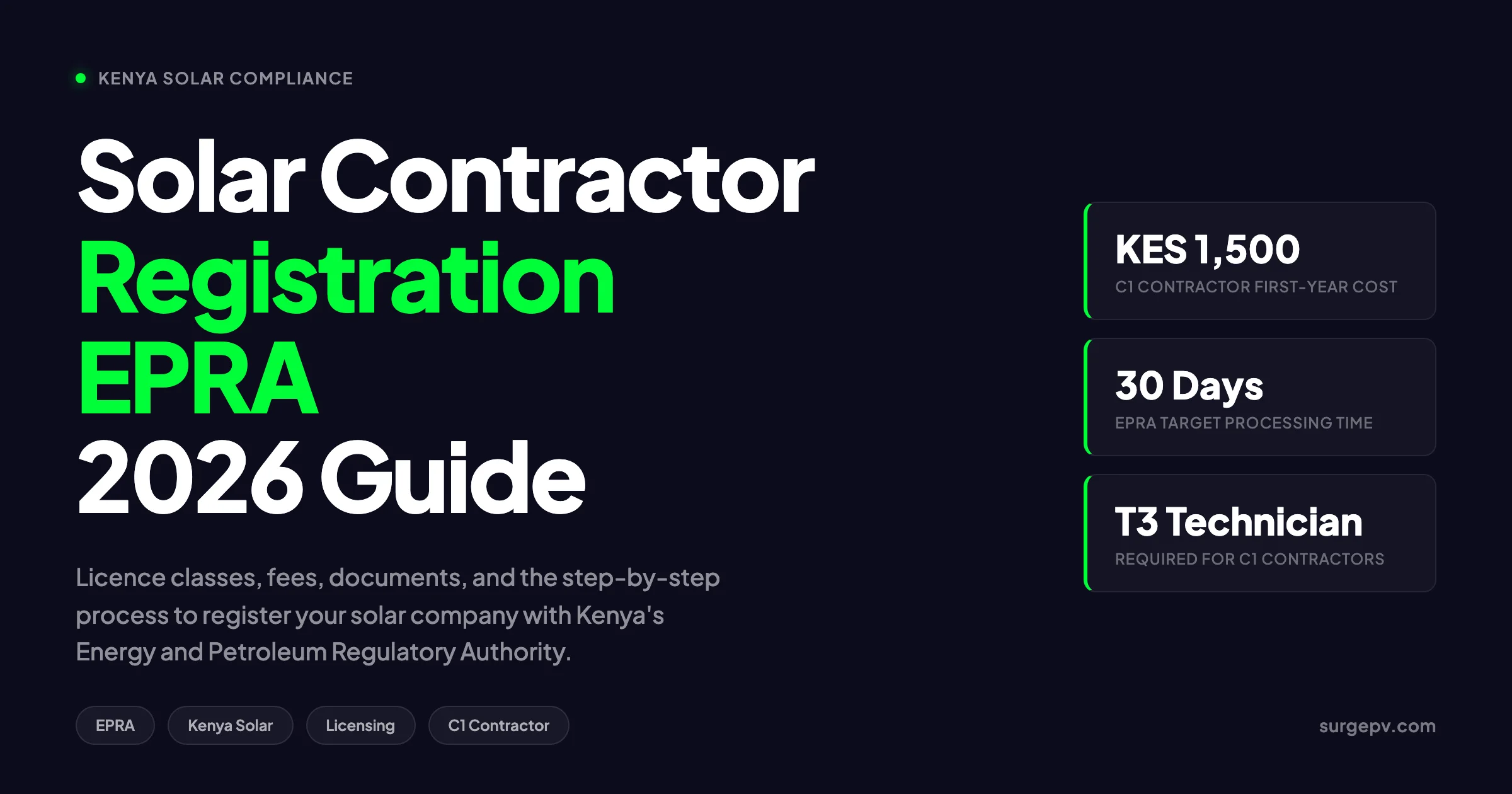
Solar contractor registration with EPRA Kenya requires a C1 Solar PV Contractor Licence for design and installation work. The application fee is KES 500, the grant fee is KES 1,000, and annual renewal is KES 1,000. A C1 contractor must employ a Class T3 EPRA-licensed technician, hold a valid KRA tax compliance certificate, and submit company documents through the EPRA online licensing portal.
In this guide:
- What EPRA is and why solar licensing matters
- EPRA solar licence classes for technicians and companies
- Fees and processing times for each licence class
- Document checklist for contractor registration
- Step-by-step application process
- Renewal, compliance, and common mistakes
- How solar design software helps Kenyan contractors stay compliant
What Is EPRA and Why Does Solar Contractor Registration Matter?
EPRA stands for the Energy and Petroleum Regulatory Authority. It is the national body that regulates Kenya’s energy sector, including petroleum, electricity, and renewable energy. EPRA replaced the older Energy Regulatory Commission when the Energy Act 2019 came into force. Among its responsibilities, EPRA licenses solar PV technicians, contractors, vendors, manufacturers, and importers.
The legal basis for solar contractor registration is the Energy (Solar Photovoltaic Systems) Regulations, 2012. These regulations say that no person shall carry out solar PV work without a valid licence from EPRA. The rules cover design, installation, sale, distribution, promotion, manufacture, and import of solar PV systems and components.
For contractors, the practical impact is simple. Without an EPRA licence, you cannot legally install solar in Kenya. You also cannot bid on most government tenders, sign contracts with corporate clients, or import solar equipment without risk of seizure at the port. For customers, hiring an unlicensed contractor means no warranty protection, no recourse to EPRA if something goes wrong, and possible rejection of a grid connection application by KPLC.
EPRA’s 2026 licensing notice, issued on 22 June 2026, reminded the market that all solar sector participants must apply through the official EPRA online licensing portal. The notice applies to technicians, contractors, vendors, manufacturers, and importers. It signals that enforcement is tightening, not relaxing.
EPRA Solar Licence Classes Explained
EPRA issues separate licences for individuals and companies. Each licence class defines what work the holder can do. Choosing the wrong class is one of the most common mistakes on the portal.
Individual Technician Licences
Individual technicians apply for a T-class licence. The class determines the size and complexity of systems they can work on.
| Licence Class | Typical Scope | Application Fee | Grant Fee | Annual Renewal |
|---|---|---|---|---|
| T1 | Small DC systems, basic installation and maintenance | KES 250 | KES 1,000 | KES 500 |
| T2 | Systems up to around 3 kW, including inverter-based setups | KES 500 | KES 2,000 | KES 750 |
| T3 | Advanced systems, grid-connected and hybrid projects | KES 750 | KES 3,000 | KES 1,000 |
T3 is the highest technician class and is required to supervise work for a C1 contractor. Technicians must also maintain at least 30 Continuous Professional Development credit points during each licence cycle. CPD credits come from approved training, conferences, and published technical work.
Company Licences
Companies apply for C-class or V-class licences. These cover commercial solar activity.
| Licence Class | Activity | Application Fee | Grant Fee | Annual Renewal |
|---|---|---|---|---|
| C1 | Design and installation of solar PV systems | KES 500 | KES 1,000 | KES 1,000 |
| V1 | Design, distribution, sale, promotion, or installation of solar PV systems | KES 1,000 | KES 2,500 | KES 1,000 |
| V2 | Manufacture or import of solar PV systems or components | KES 2,000 | KES 5,000 | KES 2,000 |
A C1 contractor must employ at least one Class T3 technician. V1 and V2 licence holders must employ at least a Class T2 technician. The technician must provide a notarised consent letter agreeing to work with the company for at least 12 months.
Pro Tip
If your company both installs and imports solar equipment, you may need more than one licence class. Many Kenyan EPCs hold C1 for installation work and V2 for import. Apply for each class separately through the portal and keep the renewals on different calendar reminders so one does not lapse unnoticed.
EPRA Solar Contractor Fees and Processing Times
The fees are low compared with the cost of running a solar business, but the penalties for non-compliance are high. The table below summarises the 2026 fee schedule published in EPRA’s June 2026 notice.
| Licence Type | Classes | Application Fee | Grant Fee | Renewal | Processing Time |
|---|---|---|---|---|---|
| Technician | T1, T2, T3 | KES 250–750 | KES 1,000–3,000 | KES 500–1,000 | Up to 60 days |
| Contractor | C1 | KES 500 | KES 1,000 | KES 1,000 | Up to 30 days |
| Vendor | V1 | KES 1,000 | KES 2,500 | KES 1,000 | Up to 30 days |
| Manufacturer / Importer | V2 | KES 2,000 | KES 5,000 | KES 2,000 | Up to 30 days |
These are official fees only. The total cost of registration includes document certification, notarisation, office lease verification, technician consent letters, and any tools or safety equipment needed to pass inspection. Kenya’s eProcedures portal estimates the full procedure cost for a manufacturer or contractor licence at around KES 12,000 when administrative costs are included.
Processing times assume the application is complete. Missing documents, expired CR12 forms, or failed inspections can add weeks. EPRA may conduct a physical inspection of office premises and tools before issuing a company licence.
Documents Required for EPRA Solar Contractor Registration
Document preparation is where most applications slow down. EPRA requires certified copies of company records, tax documents, and proof that a licensed technician will supervise the work.
Company Documents
| Document | Why EPRA Needs It |
|---|---|
| Certificate of incorporation or business registration | Confirms the company is legally registered |
| KRA PIN / VAT certificate | Confirms tax registration |
| Valid tax compliance certificate | Confirms the company is current with KRA obligations |
| CR12 or CR13 under 12 months old | Lists current directors and shareholders |
| Directors’ IDs or passports | Identifies company leadership |
| Class G work permit or notarised non-residence letter | Required for foreign directors |
| County business permit | Confirms local operating authority |
| Proof of office premises | Title deed or registered lease agreement |
Technical Documents
| Document | Why EPRA Needs It |
|---|---|
| Notarised consent letter from licensed technician | Links the company to a qualified supervisor |
| Copy of technician’s valid EPRA licence | Proves the technician is currently licensed |
| Completion certificate template | Standardises handover documentation |
| Warranty template | Protects customers and defines service terms |
| Details of solar PV design tools | Shows the company can produce compliant designs |
| Inspection-ready tools and safety gear | Confirms field capability |
The consent letter is critical. It must be attested by a Commissioner for Oaths and must specify an engagement period of at least 12 months. Without it, EPRA will reject the application even if every other document is correct.
For renewals, EPRA typically asks for a completion certificate for projects already done and proof that the supervising technician’s licence is still valid. Keeping a digital folder with expiry dates for CR12, tax compliance, county permit, and technician licence makes renewal much faster.
Step-by-Step EPRA Solar Contractor Registration Process
The entire application is submitted online. There is no paper-only path. Follow these steps to avoid common delays.
-
Confirm the correct licence class. Most installation companies need C1. If you also sell equipment, consider V1. If you import modules or inverters, add V2.
-
Prepare all documents. Use the checklist above. Make sure CR12 is under 12 months old and the tax compliance certificate is valid for the current year.
-
Register on the EPRA online licensing portal. Create a company account at portal.epra.go.ke. Use an email address that is monitored regularly.
-
Select the licence type and class. The portal will ask for business details, director information, and the class of licence you want.
-
Complete the online application form. Enter all required fields accurately. Inconsistent names or addresses are a common reason for rejection.
-
Upload documents. Scan each document clearly and keep file sizes reasonable. The portal may reject blurry or oversized uploads.
-
Pay the application fee. Generate the invoice on the portal and pay through the prescribed channel. Upload the transaction reference number.
-
Submit and wait for review. EPRA will review the application and may schedule an inspection of your premises and tools.
-
Pay the grant fee. If the application is approved, EPRA will notify you to pay the licence grant fee.
-
Download and print the licence. Once payment is confirmed, the licence is available on the portal. Display it at your office and carry copies to site visits.
Key Takeaway
The fastest way through EPRA registration is to get the technician consent letter and CR12 right before starting the online application. These two documents cause more delays than any other item. If your supervising technician’s licence is close to expiry, renew it first.
Renewal, Compliance, and Common Mistakes
EPRA solar licences are valid for one year and must be renewed annually. The renewal process is shorter than a new application but still requires current documents.
Renewal Checklist
- Valid tax compliance certificate from KRA
- Current county business permit
- Copy of the supervising technician’s valid EPRA licence
- Completion certificates for projects done during the previous licence period
- Payment of the annual renewal fee
Common Mistakes to Avoid
| Mistake | Result |
|---|---|
| Applying under the wrong licence class | Application rejected or licence does not cover intended work |
| Expired CR12 | Delay until a fresh CR12 is submitted |
| Missing notarised consent letter | Application rejected outright |
| Technician licence expired at renewal | Licence lapses until a valid technician is linked |
| No proof of office premises | Inspection failure |
| Incomplete tool inventory | Inspection failure |
Operating without a valid licence is a criminal offence. EPRA can fine the company, seize equipment, and block imports at the Port of Mombasa. Corporate clients and government tenders almost always require a copy of the current EPRA licence before awarding work.
Equipment and Standards Compliance
EPRA licensing is only one layer of compliance. Solar equipment sold or installed in Kenya must also meet Kenya Bureau of Standards requirements. Modules must comply with KS IEC 61215 for design qualification and KS IEC 61730 for safety. Inverters, batteries, and mounting systems have their own standards. Equipment that lacks valid KEBS approval can be confiscated at customs.
For grid-connected systems, the contractor must also work with KPLC on interconnection approval and net metering. For projects above 1 MW, an EPRA generation licence is required in addition to the Solar PV Licence. Larger commercial projects may also need NEMA environmental approval.
Stay Compliant with Accurate Solar Designs
SurgePV’s solar design software helps Kenyan contractors produce code-compliant designs, document equipment specs, and generate professional proposals that satisfy EPRA and client requirements.
Book a DemoNo commitment required · 20 minutes · Live project walkthrough
How Solar Contractors Can Use Design Software for EPRA Compliance
EPRA does not specify which design tools a contractor must use, but it does ask for details of the solar PV design tools the company uses. Modern solar design software helps contractors meet this requirement while improving project quality.
A good design platform produces single-line diagrams, string layouts, and bill-of-materials reports that match the documentation EPRA expects. It also tracks equipment specifications, which makes it easier to prove that modules and inverters meet KEBS standards. For companies with multiple technicians, cloud-based solar design platform access keeps designs consistent across teams.
Shadow analysis is another area where software helps. EPRA inspectors want to see that a contractor understands site conditions. Using solar shadow analysis software to document roof orientation, shading losses, and irradiance data shows professionalism and reduces the risk of design rejection.
For Kenyan contractors who also prepare client proposals, integrated financial modeling is useful. It lets you show payback, LCOE, and KPLC tariff savings in a format that corporate clients and tender committees expect. Learn more about Kenya’s broader regulatory environment in our Kenya solar regulations guide and our Kenya solar compliance page.
Frequently Asked Questions
What is EPRA solar contractor registration?
EPRA solar contractor registration is the licensing process run by Kenya’s Energy and Petroleum Regulatory Authority. Any company that designs, installs, sells, imports, or manufactures solar PV systems in Kenya must hold a valid EPRA Solar PV Licence. The most common contractor class is C1, which covers design and installation work.
How much does EPRA solar contractor registration cost?
For a C1 solar PV contractor licence, EPRA charges KES 500 application fee, KES 1,000 grant fee, and KES 1,000 annual renewal. Vendor (V1) and manufacturer/importer (V2) licences cost more. Technician licences range from KES 250 to KES 750 application fee depending on class.
How long does EPRA solar contractor registration take?
EPRA targets 30 days for company licences such as C1, V1, and V2. Technician licences take up to 60 days. In practice, a complete application with correct documents can be approved in 2 to 4 weeks. Missing documents or failed inspections add delays.
What documents are required for EPRA solar contractor registration?
A company must submit certificate of incorporation, KRA PIN and tax compliance certificate, CR12 under 12 months old, directors’ IDs, county business permit, proof of office premises, a consent letter from a licensed technician, and details of design tools and safety equipment. A C1 contractor must employ at least a Class T3 technician.
Do individual solar technicians need an EPRA licence?
Yes. Individual technicians must hold a T1, T2, or T3 EPRA Solar PV Technician Licence depending on system scope. T1 covers small systems, T2 covers systems up to around 3 kW, and T3 covers advanced work including grid-connected and hybrid systems. Technicians also need 30 CPD credit points per licence cycle.
What happens if a solar contractor works without an EPRA licence?
Operating without an EPRA Solar PV Licence is a criminal offence under Kenya’s Energy (Solar Photovoltaic Systems) Regulations 2012. Penalties can include fines, legal action, and seizure of equipment or imported solar products. Unlicensed contractors are also barred from most government and donor-funded tenders.
Where this fits
This article is part of SurgePV's Solar Installation hub, which works through the topic from first principles to the decisions a project team actually has to make.