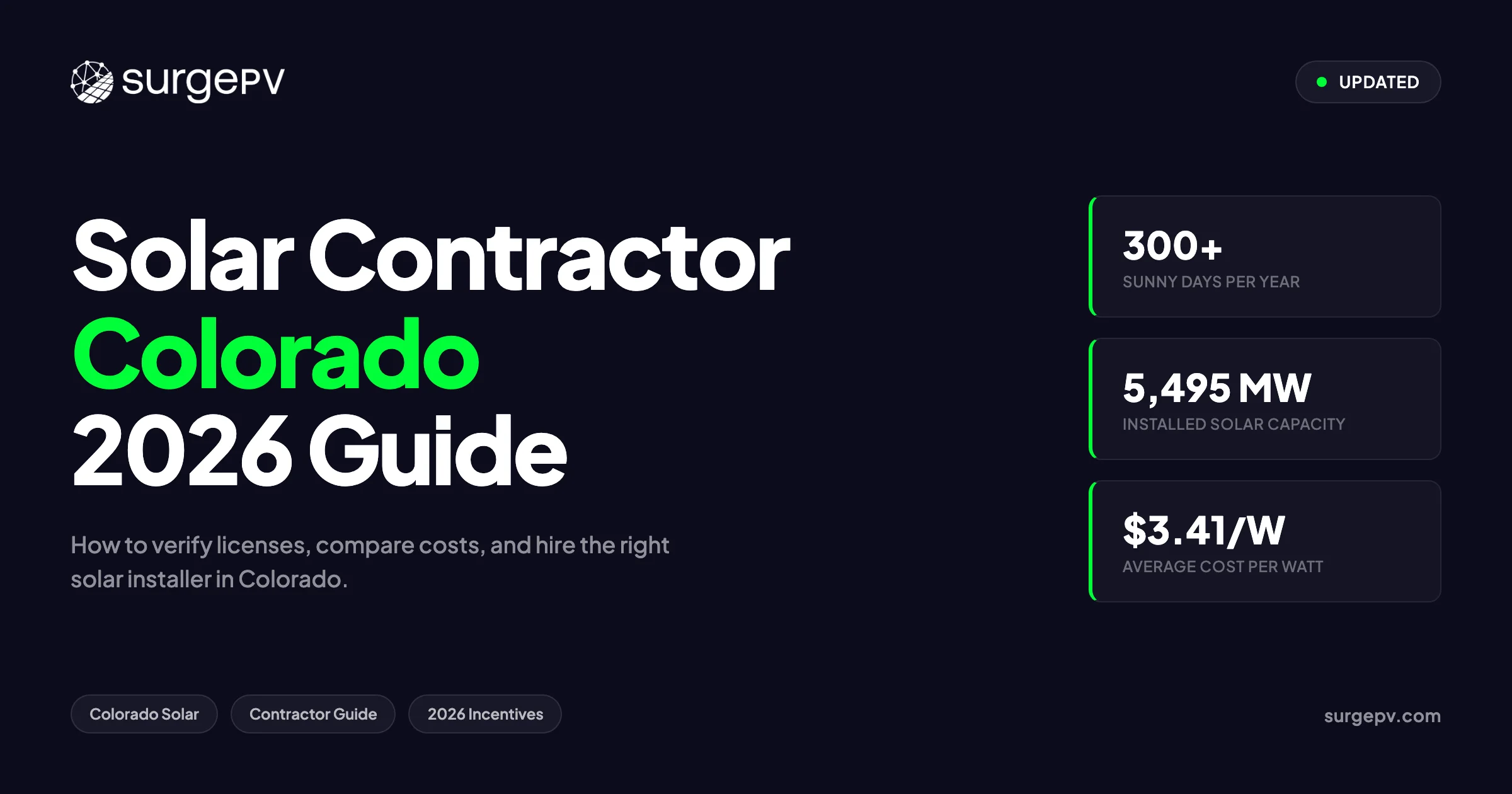
Colorado is one of the most attractive states for rooftop solar. More than 300 days of annual sunshine, high altitude, and strong utility incentives create ideal conditions for photovoltaic systems. The state now hosts over 165,000 solar installations and ranks 15th nationally in installed solar capacity, according to SEIA’s 2026 state profile. That growth has also attracted a crowded field of contractors, from small local crews to national sales organizations that subcontract the actual work.
For a homeowner or business owner, the hard part is not deciding whether solar makes sense in Colorado. The hard part is picking the right contractor. Colorado has no standalone state solar license, so the phrase “licensed solar contractor” can mean several different things. This guide explains what credentials actually matter, what solar costs in Colorado in 2026, which incentives still apply, and how to avoid the most common hiring mistakes.
In this guide:
- Why Colorado is a strong solar market for contractors and homeowners
- What a solar contractor in Colorado actually handles
- How licensing works when there is no state solar license
- Real 2026 cost data and payback estimates
- Colorado incentives, net metering, and battery programs
- An 8-point checklist for choosing a contractor
- Common mistakes Colorado homeowners make
- Notable local and regional installers to shortlist
- How to compare quotes apples-to-apples
- Frequently asked questions
Quick Answer
A solar contractor in Colorado is usually an electrical contractor registered with DORA that designs, permits, installs, and interconnects PV systems. Because Colorado has no state-level solar license, homeowners should verify the DORA Electrical Contractor License, the Master Electrician license, local registration, insurance, and NABCEP certification before signing any agreement.
Why Colorado Is a Strong Market for Solar Contractors
Colorado’s solar economics are driven by three factors that do not all appear in every state: exceptional solar resource, high retail electricity rates in the Front Range, and a policy environment that favors distributed generation.
The National Renewable Energy Laboratory places much of Colorado in the top tier for solar irradiance. Denver receives roughly 5.4 peak sun hours per day on average, and the high altitude reduces atmospheric losses that lower production at sea level. Snow can actually help production in some cases because it reflects light and often slides off tilted panels quickly.
The market scale is significant. SEIA reports Colorado had 5,495 MWdc of installed solar capacity and 2,281 MWh of battery storage by 2026. Solar supplied over 13% of the state’s electricity, and the industry employed more than 8,000 workers across 379 solar and storage companies, including 169 installers and developers.
The demand side is also strong. Xcel Energy residential rates in the Denver metro area have risen steadily, which shortens payback periods for solar owners. Colorado also has a culture of clean-energy adoption, which means contractors can build pipeline through referrals and local reputation rather than relying only on door-to-door sales.
Key Takeaway
Colorado’s combination of sunshine, rising utility rates, and supportive incentives makes solar financially viable for many homeowners. The contractor you choose matters more than the panel brand because installation quality, permitting speed, and warranty support determine the real return.
What a Solar Contractor in Colorado Actually Does
A solar contractor is responsible for far more than mounting panels. In Colorado, the typical contractor scope includes:
- Site evaluation: Roof condition, structural load, shading analysis, electrical service capacity, and azimuth/tilt optimization.
- System design: Module and inverter selection, string sizing, production modeling, and single-line diagrams.
- Permitting: Building permits, electrical permits, utility interconnection applications, and sometimes HOA or historic district approvals.
- Procurement: Ordering modules, inverters, racking, and balance-of-system components.
- Installation: Roof penetration flashing, racking, module mounting, DC and AC wiring, inverter installation, and grounding.
- Inspection: Coordinating city electrical and building inspections, plus utility witness tests if required.
- Activation: Utility permission to operate, system commissioning, and monitoring setup.
- Warranty and service: Workmanship warranty repairs, production monitoring, and seasonal maintenance.
Some Colorado contractors also offer battery storage, EV chargers, and roof replacement. A few specialize in commercial and agricultural ground-mount systems. The important point is that the contractor manages the entire project lifecycle, so their organizational skills matter as much as their electrical skills.
Many installers now use solar design software to model production and generate permit-ready plans. The accuracy of that model directly affects your expected savings. Ask prospective contractors whether they use production modeling tools and whether they guarantee annual production in writing.
Colorado Solar Contractor Licensing: What to Verify
Colorado is one of the states with no dedicated solar contractor license. That creates a verification gap that homeowners must close themselves. Here is what actually matters.
State-Level Electrical Licensing
The Colorado Department of Regulatory Agencies, through the State Electrical Board, licenses electrical contractors and electricians. For PV work, the contractor must hold a valid Colorado Electrical Contractor License, and the responsible master electrician must hold a Colorado Master Electrician License. The master electrician must pass DORA’s master electrician exam and have the required journey-level experience.
Local Registration and Permits
Most municipalities require contractors to register locally before pulling permits. Denver, Colorado Springs, Fort Collins, Boulder, Aurora, and Pueblo all maintain their own contractor registration lists. The contractor must pull an electrical permit for nearly all grid-tied systems and a building permit for roof penetrations or ground-mount footings.
NABCEP Certification
NABCEP certification is voluntary in Colorado. It is not a legal requirement to install solar. However, it is a strong signal of advanced training and is often required by manufacturer dealer programs, utility incentive applications, and commercial procurement specs. The main credential is the NABCEP PV Installation Professional certification. You can read more in our NABCEP certification guide.
Insurance
Verify general liability insurance and workers compensation coverage. Colorado does not require workers compensation for sole proprietors with no employees, but any company with staff should carry it. Ask for a certificate of insurance and confirm it is current.
License Verification
Homeowners can verify DORA electrical licenses through the Colorado DORA online license verification portal. Do this before signing a contract, not after. Also check the Better Business Bureau, Google reviews, and the Colorado Attorney General’s consumer protection page for complaints.
| Credential | Required? | Why It Matters |
|---|---|---|
| Colorado Electrical Contractor License | Yes | Legal authority to perform PV electrical work |
| Colorado Master Electrician License | Yes | Required qualifier for the electrical contractor |
| Local contractor registration | Usually | Needed to pull permits in most cities |
| NABCEP PVIP certification | No | Signals advanced training; often required for incentives |
| General liability insurance | Yes | Protects homeowner from property damage claims |
| Workers compensation insurance | If employees | Protects homeowner from on-site injury liability |
How Much Solar Costs in Colorado (2026)
Solar pricing in Colorado varies by system size, equipment choice, roof complexity, and installer. The table below summarizes 2026 estimates from published market data.
| System Size | Cost Per Watt | Gross Cost | Estimated Annual Production | Payback Period | 25-Year Savings |
|---|---|---|---|---|---|
| 6 kW | $3.41 | $20,460 | ~8,500 kWh | 9–11 years | $18,000–$24,000 |
| 8 kW | $3.41 | $27,280 | ~11,300 kWh | 9–12 years | $26,000–$34,000 |
| 10 kW | $3.41 | $34,100 | ~14,100 kWh | 10–13 years | $32,000–$42,000 |
| 12 kW | $3.41 | $40,920 | ~16,900 kWh | 10–13 years | $40,000–$52,000 |
Source: SolarReviews Colorado solar panel cost data, 2026. Production estimates assume a south-facing unshaded roof in the Denver metro area at roughly 5.4 peak sun hours per day. Savings depend on utility rate escalation and net metering policy.
Colorado’s cost per watt is slightly above the national average, largely because typical systems are smaller and fixed costs like permitting and labor are spread over fewer watts. Larger systems usually achieve a lower per-watt price.
A real-world example helps. An 8 kW system in Aurora with a gross cost of $27,280 might receive a $7,000 Xcel Solar*Rewards rebate if approved. That drops the net cash cost to $20,280. With monthly utility savings of roughly $110 to $140, the simple payback falls between 10 and 12 years. Over 25 years, the homeowner could save $26,000 to $34,000 after the system is paid off, depending on future rate increases.
The federal residential solar tax credit expired on December 31, 2025, following the 2025 Big Beautiful Bill. Homeowners installing in 2026 should not count on a 30% federal credit unless Congress extends it. This makes state and utility incentives more important than they were in previous years.
Colorado Solar Incentives and Net Metering in 2026
Colorado still offers a strong incentive stack even without the federal residential credit. Here is what applies in 2026.
State Tax Exemptions
- Sales tax exemption: Solar equipment is exempt from Colorado’s 2.9% state sales tax.
- Property tax exemption: The added value of a solar system is not included in property tax assessments. Colorado’s average property tax rate is roughly 0.6%, so this saves about $180 per year on a $30,000 system.
Xcel Energy Solar*Rewards
Xcel Energy offers the best-known utility incentive. The standard Solar*Rewards program provides an upfront rebate of $1 per watt up to $7,000 for systems up to 7 kW. There is also a production-based incentive of $0.005 per kWh for systems under 25 kW. Funds are limited and awarded first-come, first-served. Pre-approval is required before installation.
The Income-Qualified / Disproportionately Impacted Communities program offers $1,000 per kW up to $10,000 for eligible households.
Battery Storage Incentives
- Xcel Renewable Battery Connect: $350 per kW up to $5,000. Participants allow Xcel limited control of the battery during grid events.
- Holy Cross Energy: Up to $12,500 in battery incentives through the Distribution Flexibility Program or Time of Day Tariff.
- Fort Collins Utilities: $300 per kWh battery rebate.
- Colorado battery tax credit: 10% credit through December 31, 2026.
Net Metering
Colorado requires investor-owned utilities to offer net metering. Xcel Energy and Black Hills Energy both participate. Xcel customers can choose between kWh-based credits that roll forward or a year-end cash-out at the Average Hourly Incremental Cost rate, which is typically a few cents per kWh. System size is generally limited to 120% of the prior 12 months of usage.
Municipal utilities and rural electric cooperatives have more flexibility. Some cap net-metered systems at 10 kW. If you live outside the Xcel or Black Hills service territory, confirm net metering rules with your specific utility before signing a contract.
You can learn more about how net metering works in our net metering glossary entry.
How to Choose a Solar Contractor in Colorado: 8-Point Checklist
Use this checklist to screen any contractor before you sign.
- Verify the DORA Electrical Contractor License. Ask for the license number and check it on the DORA website. Confirm the license is active and in good standing.
- Confirm a Master Electrician is on staff. The electrical contractor license must be tied to a Colorado Master Electrician. Ask for the master’s name and license number.
- Check local registration. Call your city building department or check its online contractor registry. Unregistered contractors cannot pull permits in many jurisdictions.
- Ask about NABCEP certification. While not required, a NABCEP PVIP-certified installer on staff shows commitment to quality.
- Request proof of insurance. General liability and workers compensation are non-negotiable for any company with employees.
- Review workmanship warranties. A 10-year workmanship warranty is common. Some top Colorado installers offer 25-year coverage. Avoid contractors who only pass through manufacturer warranties.
- Read local reviews and ask for references. Look for recent Colorado installations, not just national review averages. Ask to speak with a local customer.
- Compare at least three written quotes. Each quote should include system size, estimated production, equipment brands, total cost, incentives assumed, warranty terms, and payment schedule.
Pro Tip
Be wary of contractors who pressure you to sign on the spot for a “limited-time” incentive. Xcel Solar*Rewards does have capacity limits, but a reputable contractor will give you time to verify credentials and compare quotes. Never sign a contract during a single sales visit.
Common Mistakes Colorado Homeowners Make
Even in a solar-friendly state, homeowners can lose money by choosing the wrong contractor or financing structure.
Trusting the “Licensed Solar Contractor” Label
Because Colorado has no solar-specific license, a contractor who advertises as a “licensed solar contractor” may only hold a general contractor or home improvement registration. That is not enough for electrical work. Always verify the DORA Electrical Contractor License separately.
Signing a Lease Without Understanding the Fine Print
Leases and power purchase agreements can lower upfront costs, but they complicate home sales and often transfer poorly to new owners. Since the federal residential tax credit expired in 2026, the lease structure has changed. Some leasing companies now claim the commercial credit and pass savings through, but the homeowner does not own the system or the incentives.
Ignoring Roof Condition
Colorado’s snow loads, hail, and freeze-thaw cycles punish roofs. A contractor who installs over a roof that needs replacement within five years is setting you up for a costly re-roof and panel removal. Get an honest roof assessment first.
Overlooking Warranty Transfer
Manufacturer warranties sometimes require registration within 90 days of installation. If you buy a home with existing solar, confirm the warranty was transferred. One Colorado homeowner paid $1,200 out of pocket for panel replacement because the warranty was still registered to the previous owner and the transfer window had closed.
Assuming All Utilities Offer the Same Net Metering
Xcel’s net metering rules differ from Holy Cross Energy, Black Hills Energy, and rural co-ops. A contractor who quotes savings using Xcel assumptions may be wrong if you are on a different utility. Confirm your actual utility and rate schedule.
Top Colorado Solar Contractors to Consider
The Colorado market includes national brands, regional installers, and long-established local companies. The list below is not a ranking. It highlights contractors with strong Colorado presence and distinct positioning. Always verify current licenses and reviews before hiring.
| Company | Headquarters / Focus | Notable Positioning |
|---|---|---|
| Namaste Solar | Boulder / Denver | Employee-owned, 21+ years, 14,000+ systems |
| Photon Brothers | Westminster | Strong regional installer, broad financing options |
| Sandbox Solar | Fort Collins | Local focus, solar + battery backup |
| Smart Wave Solar | Denver | Local installer, customer-service emphasis |
| Freedom Solar Power | Colorado presence | Large regional player, 25-year warranties |
| Blue Raven Solar | National / Colorado | Financing options, lease and loan products |
| Sunergy Construction | Colorado | Service offerings including roofing and solar |
| ARE Solar | Denver | Denver metro specialist |
This is a starting point, not an endorsement. The best contractor for your project depends on your roof, utility, financing preference, and timeline. Use the checklist above to vet any company, including those on this list.
When to Get Multiple Quotes and What to Compare
You should get at least three quotes for any residential solar project. More quotes give you negotiating leverage and reveal whether one contractor’s production estimate is unrealistic.
When comparing quotes, normalize by cost per watt and by dollar per estimated annual kilowatt-hour. A lower total price is not always better if the system uses lower-efficiency panels or a less favorable inverter layout.
| Comparison Point | What to Look For |
|---|---|
| System size (kW) | Should match your usage and roof space |
| Estimated annual production (kWh) | Compare to your last 12 months of bills |
| Module brand and model | Tier 1 manufacturer, 25-year product warranty |
| Inverter type | String, optimizer, or microinverter suited to your shading |
| Total cost and cost per watt | Include all equipment, labor, permits, and interconnection |
| Incentives assumed | Confirm which rebates are guaranteed vs. pending approval |
| Workmanship warranty | 10 years minimum; 25 years preferred |
| Payment schedule | Avoid large upfront deposits; milestone payments are safer |
| Timeline | Permitting to permission to operate |
A good contractor will walk through the solar proposal with you line by line. If a salesperson cannot explain the production model or the inverter choice, that is a red flag.
Design and Quote Solar Projects Faster
SurgePV helps solar contractors create accurate designs, production estimates, and client-ready proposals in one platform.
Book a DemoNo commitment required · 20 minutes · Live project walkthrough
Conclusion
Colorado is one of the best states in the country for solar, but the contractor you choose determines whether the project delivers on its promise. Because Colorado has no state solar license, verification falls on the homeowner. Check the DORA Electrical Contractor License, confirm a Master Electrician is on staff, verify local registration, and compare at least three quotes.
Here are three actions to take this week:
- Pull your last 12 months of electricity bills and calculate your average monthly usage.
- Verify your utility’s net metering rules and current rebate programs, especially if you are outside Xcel Energy territory.
- Shortlist three contractors, run them through the 8-point checklist, and request written quotes with identical assumptions.
Solar is a 25-year investment. Spending a few extra days on contractor due diligence is the easiest way to protect that investment.
Frequently Asked Questions
Do solar contractors need a license in Colorado?
Colorado does not issue a standalone solar contractor license. Solar contractors must hold a Colorado Electrical Contractor License from DORA and employ a Colorado Master Electrician for the wiring. Most cities, including Denver, Colorado Springs, Fort Collins, and Boulder, also require local contractor registration and permits.
How much does solar cost in Colorado in 2026?
Colorado homeowners pay an average of $3.41 per watt before incentives, according to SolarReviews (2026). A typical 6 kW system costs roughly $20,460 before incentives, while an 8 kW system runs about $27,280. Payback periods average 8.9 to 13 years depending on system size, utility rates, and available rebates.
What incentives are available for Colorado solar in 2026?
Colorado offers a full sales tax exemption, a property tax exemption, and utility rebates such as Xcel Energy Solar*Rewards at $1 per watt up to $7,000. Battery incentives include Xcel Renewable Battery Connect at $350 per kW up to $5,000, and Holy Cross Energy offers up to $12,500 for battery storage. Net metering is available from major utilities.
Is NABCEP certification required for Colorado solar installers?
No. NABCEP certification is voluntary in Colorado. It is not a legal requirement, but it signals advanced training and is often required by manufacturer dealer programs, utility incentives, and commercial buyers. Many reputable Colorado installers pursue NABCEP PVIP certification voluntarily.
What should I look for when hiring a solar contractor in Colorado?
Verify the DORA Electrical Contractor License and Master Electrician license, check local registration, confirm general liability and workers compensation insurance, ask for NABCEP certification, review workmanship warranties, request local references, and compare at least three written quotes.
Does Colorado have net metering?
Yes. Major utilities including Xcel Energy and Black Hills Energy offer net metering. Xcel customers can choose kWh-based credits that roll forward or a year-end payout at the Average Hourly Incremental Cost rate. System size is generally capped at 120% of the customer’s prior 12 months of usage.
How long does a solar installation take in Colorado?
The physical installation usually takes one to three days for a residential rooftop system. The full timeline, including design, permits, utility interconnection, and inspection, typically ranges from six to twelve weeks depending on the city and utility workload.
Should I choose a local Colorado installer or a national solar company?
Local and regional installers often provide faster service, stronger knowledge of Colorado codes and incentives, and more accountable warranty support. National companies may offer broader financing options but can be slower on permits and service calls. Compare reviews, warranties, and local references before deciding.
Where this fits
This article is part of SurgePV's Solar Installation hub, which works through the topic from first principles to the decisions a project team actually has to make.