

Solar portfolios are getting larger and more complex. A single infrastructure fund might operate 50 plants across six countries, each with different inverter brands, PPA structures, grid operators, and O&M contractors. Spreadsheet-based management breaks down around the 20 MW mark. Inverter portals work for one site but create fragmentation across a fleet. The result is missed faults, delayed maintenance, and revenue leakage that can erase 2-5% of annual production.
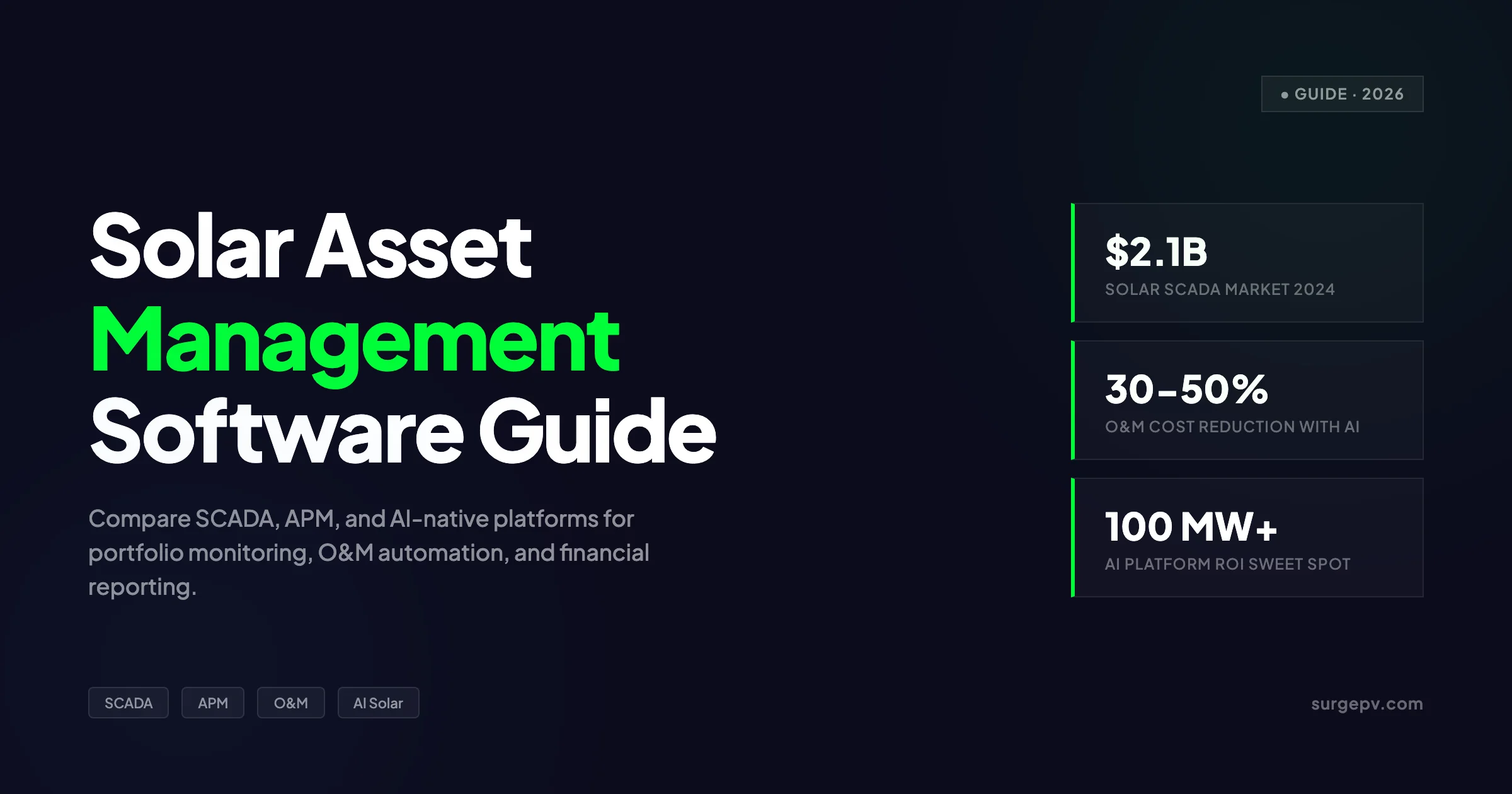
Solar asset management software solves this by unifying operational and financial data in one platform. The market has matured rapidly: AI-native platforms now claim 30-50% O&M cost reductions and 95% reductions in manual analytics time. Traditional SCADA is no longer enough for competitive fleet management.
This guide covers solar asset management software in 2026: what it does, how it differs from basic monitoring, which platforms serve different portfolio scales, and what capabilities matter for O&M teams versus financiers.
Solar asset management software unifies SCADA data, performance analytics, financial tracking, and O&M workflows across a solar portfolio — moving operators from reactive alarm response to predictive, financially informed asset management.
TL;DR — Solar Asset Management Software 2026
Solar asset management platforms monitor portfolio performance, detect faults, manage contracts and warranties, and automate O&M workflows. Leading options include ClearSpot and Invertix for AI-native autonomous operations, Power Factors and AlsoEnergy for established APM, and Fluence Nispera for storage-integrated fleets. The transition from basic monitoring to asset management software typically happens at 10-20 MW or 3+ sites. AI-native platforms show stronger ROI above 100 MW through cross-fleet learning and automated dispatch.
In this guide:
- What solar asset management software actually does
- SCADA vs monitoring vs APM vs AI-native platforms
- Key capabilities: PR tracking, fault detection, financial reporting
- Platform comparison by portfolio scale and use case
- AI in solar O&M: autonomous fault detection and dispatch
- Contract, warranty, and compliance management
- Integration architecture: SCADA, weather, drone, ERP
- How to choose the right platform for your portfolio
What Solar Asset Management Software Actually Does
A mature solar asset management platform performs six core functions that go far beyond basic production monitoring.
1. Unified Data Ingestion
The platform collects data from every source that affects asset performance:
- Inverter and SCADA systems: Real-time power, voltage, current, frequency, fault codes
- Weather data: Irradiance, temperature, wind, soiling estimates from on-site sensors and satellite
- Grid and metering: Import/export data, reactive power, curtailment events
- Inspection data: Drone imagery, thermal scans, IV curve traces
- Financial systems: PPA pricing, market rates, invoice data, budget actuals
- Work orders: CMMS data, technician notes, parts used, downtime causes
Without unification, each data source lives in a separate portal. An O&M manager spends 30-50% of their time reconciling spreadsheets instead of fixing problems.
2. Performance Analytics and Benchmarking
The platform calculates standardized performance metrics and benchmarks them across the fleet.
Key metrics:
- Performance Ratio (PR): Actual energy / Expected energy under standard test conditions, corrected for temperature
- Capacity Utilization Factor (CUF): Actual generation / (Installed capacity × Hours in period)
- Availability: Percentage of time the plant is technically available to generate
- Specific Yield: kWh per kWp installed, often used to compare sites
- Revenue per MWh: Actual revenue considering PPA, merchant, and incentive structures
Benchmarking identifies underperformers. A site with 5% lower PR than fleet average may have soiling, shading, or inverter issues that basic monitoring misses.
3. Fault Detection and Diagnosis
Modern platforms move beyond threshold alarms to ML-based anomaly detection.
Traditional SCADA: “Inverter 12 offline” — tells you something failed.
AI-native APM: “String-level current imbalance on Inverter 12 suggests potential PID degradation, estimated revenue impact €120/day, recommended action: IV curve tracing within 7 days” — tells you what is wrong, how much it costs, and what to do.
4. O&M Workflow Automation
The platform converts detected issues into work orders, prioritizes them by financial impact, and routes them to the right contractor.
Typical workflow:
- Anomaly detected by ML model
- Platform pre-diagnoses probable cause
- Work order auto-created with parts list and priority score
- Contractor receives notification with site access instructions
- Technician logs completion with photos and meter readings
- Platform verifies production recovery and closes the loop
5. Financial and Contract Management
For asset owners and financiers, operational data is meaningless without financial context.
Critical financial features:
- PPA settlement reconciliation (actual vs. contracted generation)
- DSCR (Debt Service Coverage Ratio) and LLCR (Loan Life Coverage Ratio) monitoring
- Budget variance tracking by OPEX category
- Warranty tracking by component and manufacturer
- Insurance claim documentation
- Investor and lender reporting automation
6. Compliance and Reporting
Asset managers spend weeks each quarter preparing reports for lenders, investors, and regulators. Modern platforms automate this.
Common report types:
- IEC 61724-based energy reporting
- IEC 62446-3 inspection and maintenance records
- Grid code compliance documentation
- ESG and carbon reporting
- Custom investor dashboards
SCADA vs Monitoring vs APM vs AI-Native
Not all platforms are the same. The market has four distinct tiers.
Traditional SCADA
Best for: Single-plant operational control, often installed at COD.
Capabilities:
- Real-time data from PLCs, inverters, and meters
- Threshold-based alarms
- Basic historical trending
- Limited analytics and no financial integration
Limitations: High CapEx, vendor-specific, poor at multi-site benchmarking, minimal financial context. SCADA tells operators what happened but not what to do about it.
Inverter OEM Portals
Best for: Small fleets using a single inverter brand.
Examples: SolarEdge Monitoring, Enphase Enlighten, SMA Sunny Portal, Fronius Solar.web
Capabilities:
- Device-level performance data
- Warranty and firmware management
- Basic fleet view for same-brand assets
Limitations: Vendor lock-in. Managing a multi-brand fleet through OEM portals means logging into 5-10 different systems and manually reconciling data.
Independent Monitoring / APM Platforms
Best for: Multi-brand fleets of 10-200 MW needing unified visibility.
Examples: AlsoEnergy PowerTrack, Power Factors Drive, Greenbyte
Capabilities:
- Multi-brand data aggregation
- Portfolio benchmarking
- Weather-adjusted performance analysis
- Automated reporting
- Some CMMS integration
Limitations: Less advanced AI-based fault detection. Reporting and workflow automation vary by vendor.
AI-Native Autonomous Platforms
Best for: Large fleets (100 MW+) and infrastructure funds needing predictive operations.
Examples: ClearSpot, Invertix
Capabilities:
- ML-based anomaly detection with pre-diagnosis
- Autonomous work order generation and dispatch
- Financial normalization and cross-fleet learning
- Drone and thermal inspection integration
- Automated investor-grade reporting
Limitations: Higher cost, longer implementation (30-90 days), require clean historical data for model training.
| Tier | Scale | Fault Detection | Financials | Automation | Typical Cost |
|---|---|---|---|---|---|
| SCADA | Single plant | Threshold alarms | None | Low | High CapEx |
| OEM portal | Small same-brand fleet | Device alarms | None | Low | Bundled/free |
| APM platform | 10-200 MW multi-brand | Rules + basic analytics | Moderate | Medium | $$-$$$ |
| AI-native | 100 MW+ | ML predictive | Deep | High | $$$-$$$$ |
Key Performance Metrics in Asset Management
Performance Ratio (PR)
PR measures how much of the available solar energy the plant converts into electricity, corrected for temperature.
PR = (Actual energy / Expected energy) × 100%Benchmarks:
- Utility-scale fixed-tilt: 80-85%
- Utility-scale tracking: 82-87%
- Commercial rooftop: 78-83%
- Residential: 75-82%
PR degradation of 1-2% per year is normal. Anything above 2% suggests accelerated degradation, soiling, or component failure.
Availability
Availability measures the percentage of time the plant is technically capable of generating.
Availability = (Planned production hours - Forced outage hours) / Planned production hours × 100%Target: 98.5-99.5% for utility-scale plants with robust O&M contracts.
Specific Yield
Specific yield compares output to installed capacity.
Specific Yield = Annual generation (kWh) / Installed capacity (kWp)Benchmarks by region:
- Southern Europe: 1,400-1,700 kWh/kWp/year
- Central Europe: 950-1,200 kWh/kWp/year
- UK / Northern Europe: 850-1,050 kWh/kWp/year
- Southwest US: 1,600-2,000 kWh/kWp/year
Revenue per MWh
This metric factors in PPA pricing, merchant exposure, curtailment, and incentive structures.
Revenue per MWh = Total revenue / Total generationTwo plants with identical PR can have very different revenue per MWh depending on contract structure and grid access.
Solar Asset Management Platform Comparison
ClearSpot
ClearSpot is an AI-native platform built around autonomous operations. It uses specialized agents for detection, diagnosis, dispatch, optimization, and reporting.
Strengths:
- Claims 95% reduction in manual analytics time
- Mean Time to Repair (MTTR) of ~4 hours vs. industry average ~72 hours
- 14+ specialized AI agents for different operational tasks
- Integrates SCADA, drone inspections, and inverter-agnostic monitoring
- Automated IEC 62446-3 / IEC 61724 reporting
Best for: Fleets above 20 MW, especially those with in-house O&M or multiple contractors
Pricing: Custom enterprise pricing
Invertix
Invertix targets infrastructure funds and IPPs with a financial-first approach to asset management.
Strengths:
- Real-time EUR/USD normalization for international portfolios
- DSCR, LLCR, and IRR tracking per asset
- GDPR-compliant EU data hosting
- “Invertix Standard” data quality framework targeting 99.9% availability
- Immutable audit logs for investor reporting
Best for: European infrastructure funds, debt-financed projects, and compliance-heavy portfolios
Pricing: Custom enterprise pricing
Power Factors Drive
Power Factors is one of the most established renewable APM platforms, widely used by IPPs and utilities.
Products:
- Drive: Core monitoring and analytics
- Drive Pro: Predictive modeling and advanced analytics
- Drive O&M: Enterprise asset management linking operations, maintenance, and compliance
Strengths:
- Deep renewable-specific functionality
- Strong compliance and contractual tracking
- Large user base and implementation partner network
Best for: Mid-to-large fleets (50-500 MW) needing proven APM
AlsoEnergy PowerTrack
AlsoEnergy focuses on solar portfolio monitoring with strong analytics.
Strengths:
- Real-time production data from multiple inverter brands
- Advanced fault detection
- Weather-adjusted performance analysis
- Good for commercial and industrial portfolios
Limitations: Lighter on financial tools compared to Invertix or Power Factors
Fluence Nispera
Nispera is a cloud-based APM platform that covers solar, wind, hydro, and storage.
Strengths:
- OEM-agnostic SCADA integration
- AI-based performance optimization
- Storage-integrated analytics
- Scales from 1 MW to 500+ MW
- ~9 GW under management
Best for: Mixed renewable fleets and storage-integrated solar
Greenbyte
Greenbyte is an enterprise-grade platform popular with utilities and large IPPs.
Strengths:
- SCADA and IoT integration
- Fleet benchmarking
- Lifecycle tracking
- Automated compliance reporting
Limitations: Enterprise pricing and a steeper learning curve
AI in Solar O&M: What Actually Works
AI is not magic. In asset management, it delivers value in specific, measurable areas.
1. Anomaly Detection Beyond Thresholds
Traditional SCADA triggers alarms when values cross fixed thresholds: inverter offline, string current zero, AC voltage high. AI models learn normal behavior patterns and flag deviations that thresholds miss.
Example: A string with 8% lower current than expected for current irradiance and temperature conditions. The inverter is online, so no threshold alarm fires. But the string is underperforming, possibly due to PID, soiling, or connector degradation. An ML model catches this and estimates revenue impact.
2. Pre-Diagnosis Before Truck Roll
AI platforms attempt to classify faults before dispatching technicians. This avoids sending the wrong specialist or wrong parts.
Common pre-diagnoses:
- DC connector hot spot → thermal inspection
- String current imbalance → potential PID or bypass diode failure
- Inverter reactive power clamping → grid code issue
- Production drop correlated with soiling index → cleaning required
- Sudden IV curve change → potential micro-crack or delamination
3. Cross-Fleet Learning
At scale, AI identifies patterns across plants: “Inverters from Manufacturer X in hot climates show elevated failure rate after 18 months.” This intelligence feeds into procurement, warranty claims, and preventive maintenance scheduling.
4. Automated Reporting
AI-generated natural language summaries describe fleet performance in investor reports:
“Q2 2026 fleet PR was 83.2%, 1.3% below budget due to higher-than-expected soiling at the Italian sites. O&M completed corrective cleaning at all affected plants by June 15. July production is tracking 2% above budget.”
Where AI Does Not Work Well
- New assets with limited historical data: ML models need 6-12 months of clean data for calibration.
- One-off, non-repeating faults: AI excels at pattern recognition, not novel failure modes.
- Physical defects invisible to sensors: Drone and thermal inspections still catch issues SCADA cannot.
Contract, Warranty, and Compliance Management
Asset management software is increasingly the system of record for contractual obligations.
Contract Management
Solar projects have dozens of contracts:
- EPC warranties (2-10 years)
- O&M agreements (5-25 years)
- Module warranties (12-25 years)
- Inverter warranties (5-12 years)
- PPA / offtake agreements (10-25 years)
- Land leases and easements
- Grid connection agreements
The platform tracks expiration dates, notice periods, and key terms. It alerts asset managers 90-180 days before critical deadlines.
Warranty Tracking
When a fault occurs, the platform should:
- Identify the affected component
- Check warranty status (active / expired / claim pending)
- Link to manufacturer contact and claim process
- Track claim status and replacement timeline
- Document costs for insurance or contractual recovery
Compliance Automation
Manual compliance reporting consumes 15-25% of asset management time. Automated platforms generate:
- IEC 61724 energy reports
- IEC 62446-3 maintenance records
- Grid code compliance certificates
- Environmental and ESG disclosures
- Lender technical monitoring reports
Pro Tip — Start Data Quality Before AI
AI models are only as good as the data feeding them. Before implementing an AI-native platform, audit your SCADA data quality: timestamp consistency, sensor calibration records, missing data gaps, and naming conventions. A common failure mode is deploying an expensive AI platform on dirty data and getting unreliable predictions. Spend 30-60 days cleaning data trees before model training.
Integration Architecture: How Asset Management Platforms Connect
A modern solar asset management platform sits at the center of a data ecosystem.
Data Sources
SCADA / Plant controllers: Modbus TCP, DNP3, IEC 61850, OPC-UA Inverters: OEM-specific APIs (SolarEdge, Enphase, SMA, Fronius, Huawei, Sungrow) Weather: On-site sensors, Solcast, SolarAnywhere, Meteocontrol Grid: Utility meter APIs, market data feeds Inspections: Drone software (e.g., Raptor Maps, Scanifly), thermography vendors ERP / Financial: SAP, Oracle NetSuite, QuickBooks, custom accounting systems CMMS: Fiix, UpKeep, eMaint, custom maintenance platforms
Data Flows
SCADA / Inverters → Data ingestion layer → Data quality engine → Analytics engine → User dashboards + automated reports
                                     ↓
                              CMMS / Work orders ← Fault detection + dispatch logic
                                     ↓
                              ERP / Financial systems ← Revenue and cost data
API and Webhook Patterns
REST APIs: Pull production, alarm, and financial data on schedule Webhooks: Receive real-time event notifications (alarms, work order updates) MQTT: Lightweight protocol for IoT sensor data Modbus / DNP3: Direct industrial protocol connections to plant controllers
Security Considerations
- Network segmentation: SCADA networks should be isolated from corporate IT
- Encryption: TLS 1.3 for cloud communications, VPN for remote access
- Authentication: OAuth 2.0 or SAML for user access, API keys with rotation for integrations
- Data residency: EU funds often require GDPR-compliant hosting within Europe
- Audit logging: All configuration changes, data exports, and alarm acknowledgments should be logged
Manage Solar Assets with SurgePV
Track portfolio performance, monitor production ratios, and generate asset-level financial reports from the same platform you use for design and proposals. Connect SCADA, weather, and financial data in one unified workflow.
Book a DemoNo commitment required · 20 minutes · Live project walkthrough
How to Choose Solar Asset Management Software
For Small Commercial Portfolios (Under 10 MW)
Priority: Cost and simplicity.
Recommendation: Start with inverter OEM portals if your fleet is single-brand. For multi-brand fleets, AlsoEnergy PowerTrack or a basic APM subscription provides unified visibility without enterprise complexity.
Key features:
- Multi-brand data aggregation
- Basic PR and availability tracking
- Email alerts for major faults
- Simple monthly reporting
For Mid-Size Fleets (10-100 MW)
Priority: Operational efficiency and benchmarking.
Recommendation: Power Factors Drive or Greenbyte. These platforms offer robust analytics, automated reporting, and CMMS integration without requiring an AI implementation project.
Key features:
- Fleet benchmarking
- Weather-adjusted performance analysis
- Work order automation
- Warranty and contract tracking
- Investor reporting templates
For Large Fleets and Infrastructure Funds (100 MW+)
Priority: Predictive operations and financial optimization.
Recommendation: ClearSpot or Invertix for AI-native autonomous operations. Power Factors Drive Pro as a proven enterprise alternative. Fluence Nispera if you operate storage-integrated assets.
Key features:
- ML-based anomaly detection
- Automated work order generation and dispatch
- Financial normalization (DSCR, LLCR, IRR)
- Cross-fleet learning and benchmarking
- Automated compliance and investor reporting
- API access for custom integrations
Conclusion
Solar asset management has shifted from monitoring dashboards to autonomous operations platforms. The difference is financial: a 100 MW fleet losing 2% production to undetected faults is forfeiting roughly €500,000-1,000,000 in annual revenue. Asset management software pays for itself by preventing that leakage.
The right platform depends on portfolio scale. Small fleets need unified visibility. Mid-size fleets need benchmarking and workflow automation. Large fleets need AI-driven predictive operations and deep financial integration.
Three actions to take this week:
- Audit your current data fragmentation. Count how many portals and spreadsheets your team uses. If the answer is more than three, you need a unified platform.
- Benchmark your fleet PR against weather-corrected expectations. Identify the bottom 20% of sites and investigate root causes.
- Map your reporting burden. If quarterly reporting consumes more than 40 hours, automate it.
For teams managing solar portfolios alongside design and development, solar software that unifies the full project lifecycle reduces data silos. SurgePV’s solar design platform and generation financial tool connect project development, design, and asset performance data in one workflow.
Frequently Asked Questions
What is solar asset management software?
Solar asset management software is a platform that monitors, analyzes, and optimizes solar power plant performance across a portfolio. It collects SCADA and inverter data, calculates performance ratios, detects faults, manages warranties and contracts, generates financial reports, and automates O&M workflows. The best platforms integrate operational data with financial metrics like PPA settlement, DSCR, and IRR for infrastructure funds and IPPs.
What is the difference between SCADA and asset management software?
SCADA (Supervisory Control and Data Acquisition) provides real-time operational control and basic threshold alarms for individual plants. Asset management software adds analytics, portfolio benchmarking, financial tracking, automated reporting, and O&M workflow management across multiple sites. SCADA tells you what is happening now. Asset management software tells you what it means financially and what to do next.
What is a good performance ratio for a solar plant?
A well-performing utility-scale solar plant typically achieves a Performance Ratio (PR) of 80-85% after temperature correction. Older plants or those in hot climates may run 75-80%. PR below 75% usually indicates soiling, inverter downtime, shading, or degradation issues requiring investigation. Modern asset management software benchmarks PR against weather-adjusted expectations and flags deviations automatically.
How do AI platforms reduce solar O&M costs?
AI-native asset management platforms reduce O&M costs by automating fault detection, prioritizing alarms by financial impact, pre-diagnosing failures before truck rolls, and dispatching work orders directly to technicians. Claims from leading platforms include 30-50% O&M cost reduction and 95% reduction in manual analytics time. The value compounds above 100 MW portfolio scale where cross-fleet learning identifies serial defects and common failure modes.
What should solar asset management software include for financiers?
For infrastructure funds, banks, and investors, solar asset management software must include: real-time production and revenue tracking, PPA settlement reconciliation, DSCR and LLCR monitoring, IRR tracking by asset, automated lender/investor reporting (IEC 62446-3 / IEC 61724), warranty tracking, and immutable audit logs. Financial normalization across currencies and regulatory regimes is critical for international portfolios.
How much does solar asset management software cost?
Pricing varies by scale and capability. Entry-level monitoring starts around $199 per month for small commercial portfolios. Enterprise AI-native platforms like ClearSpot, Invertix, Power Factors, and Fluence Nispera typically use per-MW or custom pricing. Most vendors do not publish enterprise rates, but expect $2-10 per MW per month for advanced APM and AI-native platforms, plus implementation fees for SCADA integration and data-tree configuration.
When should a solar portfolio switch from basic monitoring to asset management software?
The transition point is typically 10-20 MW of operating capacity or 3+ sites. Below this scale, basic inverter portals and spreadsheets suffice. Above 20 MW, the complexity of multi-site benchmarking, contract management, warranty tracking, and financial reporting justifies a dedicated asset management platform. AI-native platforms usually show stronger ROI above 100 MW due to cross-fleet learning and automated dispatch at scale.
What data does solar asset management software integrate?
Solar asset management software integrates SCADA data from inverters and plant controllers, weather station and satellite irradiance data, grid meter readings, PPA and market pricing data, drone/thermal inspection results, CMMS work order history, ERP/financial system data, and satellite-based soiling estimates. The most advanced platforms normalize all data into a single digital twin per asset for performance attribution and predictive analytics.
Where this fits
This article is part of SurgePV's Solar Business & Operations hub, which works through the topic from first principles to the decisions a project team actually has to make.

