

Most new solar installers default to an LLC. The paperwork is easy, the fees are low, and your accountant says yes without asking questions. For a one-truck residential installer in Arizona, that default is fine.
For a company planning to raise outside capital, take on tax equity partners, or sell ITC credits under IRA Section 6418, the LLC default kills the deal. The wrong structure can cost a growing solar EPC $30,000 to $300,000 a year in extra tax. It can also force a painful conversion the night before a funding round closes.
This guide breaks down LLC, S-Corp, and C-Corp choices for US solar companies in 2026. We cover the tax math, the liability rules, the ITC and depreciation flow, and the real cost of getting it wrong.
Quick Answer
Stay LLC for owner-operator installers under $60,000 in net profit. Elect S-Corp once profits clear $60,000 and the owner draws a real salary. Form a Delaware C-Corp if you plan to raise priced equity, issue stock options, or build a tax equity platform. Switch later only if you must, because conversion costs grow with company size.
Key Takeaways
- An LLC by default is taxed as a sole proprietorship or partnership. Every dollar of profit gets hit with self-employment tax.
- An S-Corp election trims self-employment tax once owner salary plus distributions exceed roughly $80,000 per year.
- A C-Corp is the only structure that can issue preferred stock, hold tax-exempt LP money, and qualify for QSBS under Section 1202.
- All three entity types can claim the federal solar Investment Tax Credit and 5-year MACRS depreciation.
- IRA Section 6418 lets all entity types sell solar tax credits to third parties for cash.
- The cost of converting from LLC to C-Corp grows with company size. Decide before your first priced round.
In this guide, you will learn:
- How LLC, S-Corp, and C-Corp differ on federal and state tax
- The real tax difference on a $2 million solar revenue company
- Which entity types work for tax equity partnerships and ITC transfers
- How investors view each structure when sizing term sheets
- The five mistakes solar founders make on entity choice
- The process and cost of switching entity types later
Why Business Structure Matters for Solar Companies in 2026
Entity choice drives four things at once. Tax rate, liability shield, owner cash flow, and access to capital. A solar company gets pulled in all four directions at the same time, often by people who do not talk to each other.
The CFO wants the lowest effective tax rate. The CEO wants outside funding. The bank wants a clean liability shield. The owner wants take-home cash this year. No single entity wins on all four, so the choice is a tradeoff.
Solar is also a tax-credit business. The federal Investment Tax Credit, MACRS depreciation, bonus depreciation, and IRA Section 6418 transferability all interact with entity choice. A misstep on entity classification can strand credits inside an entity that cannot use them, or block tax equity partners from buying in.
The stakes rose in 2025 when the One Big Beautiful Bill Act restored 100% bonus depreciation for property placed in service after January 19, 2025, according to the IRS cost recovery guidance. A 1 MW commercial solar system generates a six-figure first-year deduction. The entity that owns the system decides whose tax return absorbs it. For more on this topic, see Design Commercial Solar System 1MW.
Use solar design software like SurgePV to model the financial scenarios before you pick a structure. The output drives both the entity choice and the partner term sheet. For a direct comparison, see Arka 360 vs SurgePV.
LLC: The Default Choice and Its Limits
A Limited Liability Company is a state-law entity. The IRS does not recognize “LLC” as a tax classification. The default tax treatment depends on member count.
A single-member LLC is taxed as a sole proprietorship by default. A multi-member LLC is taxed as a partnership. Either can elect S-Corp or C-Corp treatment by filing Form 8832 or Form 2553.
What an LLC gets you
- Limited liability for members against business debts
- Pass-through taxation by default
- Flexible profit allocations among members
- Minimal annual paperwork compared to corporations
- Filing fees from $50 to $800 per year depending on state
What an LLC does not get you
- No reduction of self-employment tax on default classification
- No ability to issue preferred stock with VC-style protections
- No QSBS treatment under Section 1202
- No use of tax-exempt limited partner capital without UBTI risk
- Some states impose a franchise tax or gross receipts tax on LLCs
LLC tax math
A single-member solar LLC with $200,000 of net profit pays self-employment tax of 15.3% on the first $176,100 of earnings in 2026, plus 2.9% Medicare tax above that. The owner also pays federal income tax on the full $200,000 at marginal rates up to 37%.
The combined effective rate often runs 35% to 45% before state tax. A solar installer in California adds an additional 1.5% LLC franchise fee plus gross receipts tax over $250,000 in revenue, according to the California Franchise Tax Board.
Pro Tip
An LLC can elect S-Corp tax treatment without changing its legal form. The state still sees an LLC. The IRS sees an S-Corp. You keep operating agreements and member units while shifting payroll tax exposure. File Form 2553 within 2 months and 15 days of the start of the tax year.
When the LLC default works
Stay LLC if profits run under $60,000 a year. Stay LLC if you are the only owner and you plan to take all the cash. Stay LLC if you have foreign owners or corporate members that an S-Corp election would block.
Move on if you cross $60,000 in net profit, or if you need outside capital. The savings curve gets steep above $80,000.
S-Corporation: When Pass-Through Tax Beats LLC
An S-Corp is a federal tax election, not a legal entity. An LLC, a regular corporation, or a Professional Corporation can each elect S-Corp status by filing IRS Form 2553. The election creates a pass-through structure with a key tweak. Owner-employees must take a reasonable W-2 salary before distributions.
The salary triggers payroll tax. The distributions do not. That single rule drives the S-Corp tax advantage.
The reasonable salary rule
The IRS requires S-Corp owner-employees to draw compensation that reflects the work they actually do. For a working owner of a solar installation company, the benchmark range runs $65,000 to $110,000 in 2026, based on BLS Occupational Employment Statistics for general contractors and electricians.
The IRS reasonable compensation guidance cites nine factors. Duties, training, time devoted, dividend history, payments to non-shareholder employees, comparable salaries, hours worked, and skill required.
Audit Risk Warning
The IRS audits S-Corps with low salaries and high distributions. A 2:1 distribution-to-salary ratio is a red flag. A zero salary is a guaranteed audit if examined. The Watson v. Commissioner case reclassified $179,000 of distributions as wages, costing the owner over $30,000 in back tax plus penalties.
See Solar Sales Commission Structure for detailed guidance.
S-Corp tax math
Take the same $200,000 net profit solar company. Set the owner salary at $85,000. The remaining $115,000 flows as a distribution.
Payroll tax on the $85,000 salary runs roughly $13,005 (15.3% combined employer and employee share). The distribution avoids self-employment tax. Compared to an LLC default that would pay self-employment tax on roughly $185,000 of earnings (after the QBI deduction wrinkle), the S-Corp saves about $15,300 in payroll tax.
The owner still pays federal income tax on the full $200,000 of pass-through income. State tax follows the same pass-through path in most states.
S-Corp restrictions
S-Corps come with ownership limits that block growth-stage funding.
- Maximum 100 shareholders
- Shareholders must be US citizens or resident aliens
- No corporate, partnership, or most trust shareholders
- One class of stock only (voting differences are allowed)
- Must be a domestic corporation
These rules sound minor until you try to bring on a VC fund (corporate shareholder, blocked) or a foreign strategic investor (non-resident, blocked). Most institutional capital cannot invest in an S-Corp.
S-Corp solar EPC considerations
Solar EPCs running on S-Corp status need three controls. Document a defensible salary. Run real payroll through a service like Gusto or ADP. Pay quarterly estimated tax on the distribution income.
Use SurgePV’s design tools to project annual gross margin before you set the salary. A salary based on a single good year can lock in over-compensation when revenue dips.
C-Corporation: The Structure Investors Demand
A C-Corp is a separate taxable entity. The corporation pays tax on its earnings at the federal corporate rate of 21%. Shareholders pay tax again when the corporation distributes dividends.
This double-tax structure scares most small business owners. It also unlocks every form of institutional capital, every form of preferred equity, and the strongest founder tax break in the code.
Why C-Corps lose on small business tax
Take the same $200,000 net profit solar company. The C-Corp pays $42,000 in federal tax at the entity level. If the corporation distributes all $158,000 of after-tax profit as a dividend, the owner pays another $23,700 to $31,600 in qualified dividend tax (15% or 20%).
Total federal tax: $65,700 to $73,600. The S-Corp at the same income level pays roughly $51,000 to $58,000 in combined payroll and income tax. The C-Corp loses on every dollar that gets distributed.
Why C-Corps win on growth-stage tax
Retained earnings break the double-tax math. A C-Corp that reinvests every dollar into growth pays only the 21% corporate rate. The shareholder pays nothing until distribution or sale.
The Qualified Small Business Stock break under IRC Section 1202 lets founders exclude up to $10 million or 10x basis from federal capital gains when they sell C-Corp stock held 5 years. A solar founder who sells the company for $25 million can pay zero federal capital gains tax on $10 million of the proceeds.
QSBS applies only to C-Corps. The exit value of this break alone justifies C-Corp status for any solar founder who plans to sell the business.
What C-Corps enable
- Issue preferred stock with liquidation preferences and protective rights
- Accept investment from VC funds whose LPs cannot hold pass-through equity
- Build an Incentive Stock Option (ISO) plan for employees
- Hold operating subsidiaries inside a tax equity structure
- Qualify for QSBS treatment under Section 1202
- Access state-level R&D tax credits without partner-level limits
When C-Corps make sense for solar companies
C-Corp fits solar software platforms, solar manufacturers, large EPCs targeting national scale, and any founder planning a venture round. Series A term sheets almost always require Delaware C-Corp status as a closing condition.
A Texas solar EPC running residential installs as an owner-operator should not be a C-Corp. The double-tax cost on distributed profit beats any C-Corp benefit. The line falls roughly where outside equity enters the picture.
Model Your Solar Company’s Tax Scenarios
Project revenue, ITC value, and entity-level tax across LLC, S-Corp, and C-Corp paths in one workspace.
Book a DemoNo commitment required · 20 minutes · Live walkthrough
Tax Treatment Side-by-Side
The table below compares federal tax treatment, ownership rules, and operating mechanics across the three structures.
| Feature | LLC (Default) | S-Corp | C-Corp |
|---|---|---|---|
| Federal income tax | Pass-through to owners | Pass-through to shareholders | 21% corporate rate |
| Self-employment tax | All net earnings (15.3% up to $176,100) | Only W-2 salary | Wages only |
| Double taxation | No | No | Yes, on distributed profits |
| QBI deduction (Section 199A) | Yes, 20% subject to limits | Yes, 20% subject to limits | No |
| Ownership limit | Unlimited members | Max 100 shareholders | Unlimited shareholders |
| Foreign owners allowed | Yes | No | Yes |
| Corporate or partnership owners | Yes | No | Yes |
| Number of stock classes | Flexible membership units | One class of stock | Multiple, including preferred |
| Federal filing form | 1065 or Schedule C | 1120-S | 1120 |
| State franchise tax | Varies, often $50 to $800 | Varies, often $250 to $800 | Varies, often $250 to $1,500 |
| Payroll required | No | Yes, for owner-employees | Yes, for any employees |
| Annual compliance burden | Low | Medium | High |
| QSBS eligibility | No | No | Yes, under Section 1202 |
| VC investability | Limited | Blocked by 100-shareholder rule | Standard |
The $2 million revenue solar company example
Run a side-by-side on a residential solar installer doing $2 million in revenue at a 20% net margin. Net profit lands at $400,000. The single owner takes all cash out at year end. Texas state, no state income tax. 2026 federal rules.
| Tax Item | LLC (Default) | S-Corp | C-Corp |
|---|---|---|---|
| Net profit before owner comp | $400,000 | $400,000 | $400,000 |
| Owner W-2 salary | N/A | $110,000 | $110,000 |
| Payroll tax (employer + employee) | $0 | $16,830 | $16,830 |
| Self-employment tax (owner) | $26,815 | $0 | $0 |
| Remaining profit after salary | $400,000 | $290,000 | $290,000 |
| Federal corporate tax (21%) | $0 | $0 | $60,900 |
| After-tax profit available | N/A | N/A | $229,100 |
| QBI deduction (20% of $400K or $290K) | $80,000 | $58,000 | $0 |
| Taxable income (federal) | $293,185 | $232,000 owner + $110K salary | $110,000 salary + $229,100 dividend |
| Federal income tax (rough) | $73,000 | $63,000 | $26,000 (salary) + $42,520 (dividend at 20%) |
| Total federal tax burden | $99,815 | $79,830 | $146,250 |
| Owner take-home cash | $300,185 | $320,170 | $253,750 |
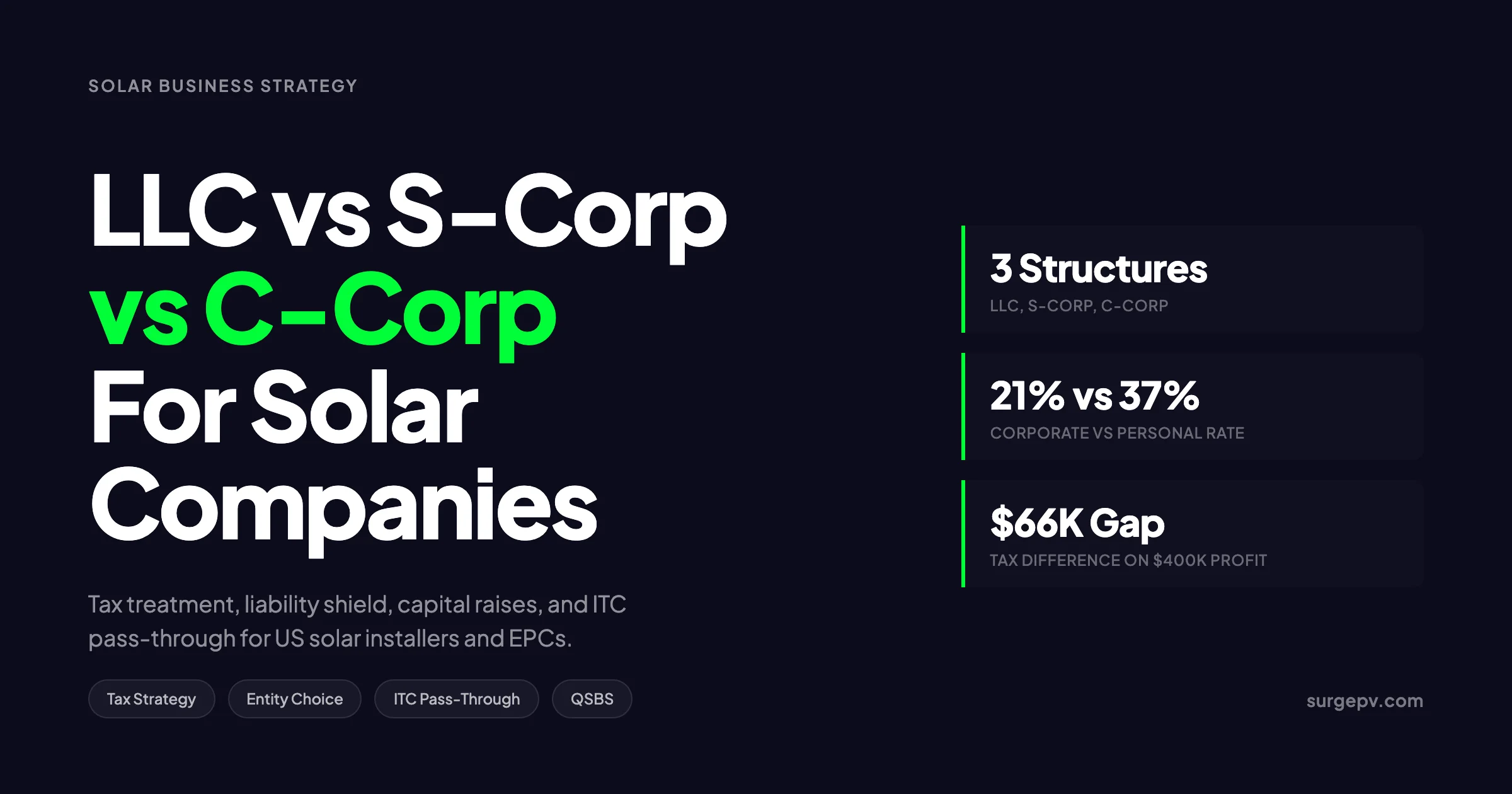
The S-Corp wins by roughly $20,000 over the LLC default and $66,000 over the C-Corp on this owner-operator profile. Numbers are illustrative, not tax advice, and ignore state nuances. Sources for rate inputs include the IRS Form 1120-S instructions and the IRS QBI deduction guide.
Where the C-Corp catches up
Rerun the scenario with no dividend. The C-Corp reinvests the full $229,100 after-tax profit into growth. The owner draws only the $110,000 salary.
Total federal tax falls to $77,830 (corporate tax plus salary tax). The C-Corp now sits within $2,000 of the S-Corp on annual cost, and the retained earnings inside the corporation grow tax-deferred. The founder also banks QSBS basis with every passing year.
The C-Corp wins on a growth model. The S-Corp wins on a take-the-cash model. The LLC default loses on both.
Liability Protection: What Each Structure Covers
All three structures shield owners from business debts and lawsuits against the business. The shield is not absolute. Courts can pierce the veil if owners commingle funds, undercapitalize the entity, or use the entity to defraud creditors.
For solar installers, liability comes from four sources. Roof damage, equipment failure, workplace injury, and warranty claims. Each entity type offers similar protection against business creditors. The differences show up in three edge cases.
Personal guarantees
Banks and material suppliers almost always require a personal guarantee from small business owners. The entity does not shield against guaranteed debt. A solar installer who signs a personal guarantee on a $500,000 line of credit owes that money regardless of LLC, S-Corp, or C-Corp status.
Professional negligence
A licensed engineer or electrician who stamps a solar design carries personal professional liability. The entity does not shield against negligent professional acts. Carry professional liability insurance separately, and confirm the policy names the licensed individual and the entity.
Charging order protection
Some states give LLCs stronger protection against creditors of an individual owner. A creditor of an LLC member can typically only obtain a charging order, not force a sale of the entity. C-Corp shares can be seized and sold. Florida, Wyoming, Nevada, and Delaware have strong charging order statutes.
For asset protection planning, an LLC often beats a C-Corp on the personal creditor side. For business creditor protection, all three structures perform similarly.
Raising Capital: Which Structures Investors Prefer
Capital sources rank entity types by what their fund agreements require. The hierarchy is consistent.
Friends and family rounds
LLC or any structure works. Small angel investors care more about deal terms than entity form. Use a SAFE or convertible note inside any entity. Convert to C-Corp before the priced round.
Tax equity investors
LLC, taxed as a partnership, is the preferred structure for tax equity transactions. The classic partnership-flip lets the investor take 99% of tax benefits in early years and flip down after the investor hits its target yield, per the Norton Rose Fulbright tax equity overview.
A C-Corp can also host a tax equity structure, but the deal usually drops a project-level LLC below the C-Corp parent. The project LLC takes the tax equity money and the credits.
Bank debt and asset-backed lending
All three structures work. Banks care about cash flow coverage, collateral, and personal guarantees. They do not care about entity form beyond basic incorporation in good standing.
Venture capital and Series A
C-Corp only. Most VC funds have tax-exempt limited partners (university endowments, foundations, pension funds). Pass-through income to a tax-exempt LP creates Unrelated Business Taxable Income. The LP agreements forbid this.
Term sheets routinely require Delaware C-Corp status as a closing condition. A solar startup operating as an LLC must convert before the close, often at a cost of $5,000 to $30,000 in legal and tax fees, plus founder time.
Private equity buyouts
Mixed. Smaller PE funds buying mid-market solar companies will purchase any entity form. Larger PE funds with institutional LPs prefer C-Corps for the same UBTI reason that constrains VCs.
Public markets
C-Corp only. Initial public offerings, SPAC mergers, and direct listings all require corporate form. An S-Corp loses its election the moment it admits a partnership or corporate shareholder.
Solar-Specific Considerations: ITC Pass-Through, Depreciation, IRA Transferability
Solar companies live and die on tax credits. The Investment Tax Credit, MACRS depreciation, and bonus depreciation each interact with entity choice differently.
The Investment Tax Credit
The federal Investment Tax Credit allows a 30% credit on qualifying solar property placed in service. The credit flows to whoever owns the system. The owning entity decides how the credit gets used.
| Entity Type | ITC Flow | Owner’s Use of Credit |
|---|---|---|
| LLC (sole prop) | Passes to owner’s Form 1040 | Offset personal income tax, subject to passive activity rules |
| LLC (partnership) | Passes via K-1 to partners | Offset partner-level tax, subject to passive activity rules |
| S-Corp | Passes via K-1 to shareholders | Offset shareholder-level tax, subject to passive activity rules |
| C-Corp | Used at corporate level | Offset 21% corporate tax, no passive activity limit |
The passive activity rules under IRC Section 469 catch a lot of small solar investors off guard. An individual with high W-2 wages and a small share of a solar partnership cannot use the credit against the W-2 income. The credit carries forward until the individual has passive income to offset.
C-Corps escape the passive activity trap. The credit applies directly against corporate income. This is one reason large solar developers structure project ownership inside C-Corp blockers, even when the parent is a partnership.
MACRS depreciation and bonus depreciation
The 5-year MACRS schedule applies to all entity types. Bonus depreciation now sits at 100% under the One Big Beautiful Bill Act for property placed in service after January 19, 2025, per IRS Publication 946.
The basis adjustment rule cuts the depreciable basis by half the ITC. A $1 million solar system taking the 30% ITC depreciates against an $850,000 basis. The basis reduction applies the same way across LLC, S-Corp, and C-Corp.
Entity choice still matters because depreciation rules follow the same pass-through paths as the ITC. An LLC partner with no passive income may not be able to use the depreciation. A C-Corp absorbs the full deduction at 21% regardless of any partner-level limit.
IRA Section 6418 transferability
The Inflation Reduction Act created Section 6418, letting taxpayers sell solar tax credits to unrelated buyers for cash. All entity types can use transferability. The mechanics differ.
- Partnerships and LLCs taxed as partnerships: The partnership makes the election at the entity level. Cash proceeds are tax-free to the partnership and distributed per the operating agreement. Final regulations issued April 2024, per the Sidley Austin update, clarified that non-cash consideration invalidates the election.
- S-Corps: Same entity-level election rule. Cash flows to shareholders per ownership share.
- C-Corps: Election made at the corporate level. Cash is tax-free.
- Sole proprietorships: The individual owner makes the election directly on Form 3800.
Pre-filing registration with the IRS is required for every transferred credit. A registration number must appear on the seller’s return. The credit can transfer only once.
Market pricing in 2024 ran 90 to 95 cents on the dollar for solar ITC credits, per Cherry Bekaert’s monetization analysis. A solar developer generating $5 million in ITC credits could raise $4.5 million in tax-free cash by selling to a profitable buyer.
This option matters for residential solar EPCs that hold systems on the balance sheet. It matters even more for commercial developers that own the project entity. Entity choice does not block transferability, but the partnership form gives the most flexibility on cash allocation.
Common Mistakes Solar Founders Make on Entity Choice
Five mistakes show up over and over in our work with solar founders. Each one costs real money.
Mistake 1: Electing S-Corp too early
A residential solar installer doing $300,000 in revenue with $40,000 in net profit elects S-Corp on the advice of a friend. Annual payroll service costs $1,800. Annual S-Corp tax prep adds $1,500 over what an LLC would cost. Total compliance cost: $3,300.
The owner saves maybe $1,500 in self-employment tax. The election costs more than it saves. Stay LLC until profits clear $60,000 and project growth supports the overhead.
Mistake 2: Electing S-Corp for a tax equity deal
A growing commercial solar EPC closes a tax equity partnership at the parent level. The S-Corp election blocks the tax equity investor from joining. Either the deal dies or the company unwinds the S-Corp election, triggering taxable gain on appreciated assets.
S-Corps are pass-through but rigid. Partnership form (LLC taxed as partnership) is the right wrapper for tax equity. Default to LLC partnership for any company planning to take tax equity capital.
Mistake 3: Staying LLC into a Series A
A solar software startup raises a $3 million Series A from a venture fund. The fund requires conversion to Delaware C-Corp before close. Legal fees run $25,000. The conversion creates phantom income for some founders depending on capital account balances.
Convert proactively before fundraising. The IRS Section 351 contribution to a new C-Corp is generally tax-free if structured correctly. Doing it under time pressure causes mistakes.
Mistake 4: Underpaying S-Corp owner salary
An EPC owner pays themselves $30,000 in salary and takes $250,000 in distributions. The IRS reclassifies $80,000 of the distribution as wages on audit. Back payroll tax, penalties, and interest run $25,000.
Pay a defensible salary. Document with BLS data. Run real payroll. The savings cap out around 10% of distributions for most solar installers, so chasing aggressive ratios is not worth the audit risk.
Mistake 5: Forgetting state-level tax differences
A California solar LLC pays the $800 annual franchise tax plus a gross receipts fee starting at $900 once revenue clears $250,000. A New York LLC owner pays the personal income tax surcharge on pass-through earnings. A Tennessee LLC pays a 6.5% franchise and excise tax.
State tax often flips the federal math. Run the calculation in your state, not a generic national model. A state-by-state LLC fee comparison from the SBA gives a starting point. For the latest details on France, see Agricultural Solar Case Study.
Why an S-Corp Election Can Backfire for Solar EPCs
The S-Corp tax break gets sold as an obvious win above $60,000 in profit. For solar EPCs, three traps cut into the math.
Trap 1: Rapid growth pulls salary up
A solar EPC growing from $40,000 to $400,000 in profit over three years needs to raise the owner’s salary along the way. The reasonable salary benchmark moves with company size and complexity. An owner running a $5 million revenue EPC cannot defend a $80,000 salary against IRS scrutiny.
As salary rises, the spread between salary and distribution narrows. The tax savings shrink. At very high profits, the S-Corp savings flatten because most income is already salary-coded.
Trap 2: The 20% QBI deduction phases out
The Section 199A QBI deduction gives pass-through owners a 20% deduction on qualified business income. For 2026, the deduction phases out between $203,000 and $253,000 single filer income, and $406,000 to $506,000 for joint filers.
Above the phase-out, the deduction depends on W-2 wages paid by the business. An S-Corp pays wages to the owner, so it usually beats an LLC default on the QBI calculation at high income. But the formula gets complex fast, and many CPAs miss the optimization.
Trap 3: Tax equity and ITC transfer rigidity
S-Corps can transfer ITC credits under Section 6418, but the single-class-of-stock rule blocks most tax equity structures. A solar EPC that elects S-Corp and later wants to bring in a tax equity partner has to revoke the election, wait 5 years before re-electing, and rebuild the cap structure.
If your business plan includes any chance of tax equity, partnership-flip structures, or institutional capital, stay LLC partnership. The S-Corp election trades flexibility for a modest annual tax saving.
Pro Tip
A holding company structure splits the difference. Keep the parent as an LLC partnership for flexibility. Drop subsidiary S-Corps for operating activities where payroll tax savings matter. This adds compliance cost but keeps the door open for tax equity at the parent level.
A Real Story: From LLC to C-Corp in 90 Days
An Austin-based solar installer ran as an LLC for three years. Revenue grew from $400,000 to $4.2 million. The founders bootstrapped through 2024.
In Q1 2025, the company received a $7 million Series A term sheet from a climate-focused venture fund. The term sheet had three closing conditions. Delaware C-Corp incorporation. A clean cap table with no SAFEs outstanding. Standard preferred stock terms with a 1x non-participating liquidation preference.
The conversion took 87 days from term sheet to close. Legal fees ran $22,000. The founders worked with a tax attorney to structure the conversion under Section 351, which let the contribution of LLC interests in exchange for C-Corp stock pass tax-free.
One painful detail surfaced. The LLC had granted profits interests to two key employees in 2023. The profits interests had to convert to common stock at fair value. The valuation cost another $8,000 in 409A appraisal fees.
Total conversion cost: $34,000 in cash plus 200 hours of founder time. The round closed on schedule. The founders now hold QSBS-eligible stock that, if held five years, could exclude up to $10 million each from federal capital gains tax on exit.
The lesson runs both ways. Stay LLC if you do not need outside equity. Convert early if you might. Converting under deal pressure is the most expensive path.
How to Switch Entity Types Later
Conversion is possible at any stage but the cost grows with company size. The four common paths.
LLC to S-Corp
The easiest conversion. File Form 2553 within 2 months and 15 days of the start of the tax year, or up to 3 years and 75 days late with reasonable cause relief. Continue operating as an LLC at the state level. The IRS treats the entity as an S-Corp.
Legal cost: under $500. Tax cost: usually none. Operational change: add payroll, separate owner draws from salary, file Form 1120-S.
LLC to C-Corp
Several paths exist. Statutory conversion in states that allow it. Section 351 contribution of LLC interests to a new C-Corp. Domestic merger of the LLC into a new C-Corp. Each has different tax consequences depending on built-in gain in LLC assets.
Legal cost: $5,000 to $30,000 for a growth-stage solar company. Tax cost: zero if structured correctly under Section 351. Operational change: file Form 1120, switch from K-1s to W-2s, establish stock option plan.
S-Corp to C-Corp
Revoke the S-Corp election by filing a written statement with the IRS. The revocation takes effect on the date filed or a specified later date. The entity becomes a C-Corp for federal tax. State filings continue unchanged.
Legal cost: under $1,000. Tax cost: built-in gains tax may apply if the company sells appreciated assets within 5 years. Operational change: file Form 1120, distributions become dividends.
C-Corp to S-Corp
File Form 2553. The election can take effect at the start of any tax year. There is a 5-year waiting period if the entity previously elected S-Corp status and revoked.
Watch for built-in gains tax under Section 1374. Any pre-conversion appreciation in C-Corp assets gets hit with corporate-level tax if sold within 5 years of the S-Corp election. For an asset-heavy solar EPC with appreciated equipment, the built-in gains tax can be substantial.
Going public
A C-Corp lists directly. An LLC or S-Corp must convert to a C-Corp before the IPO. The conversion happens 12 to 18 months before the offering. Pre-IPO conversions are common and well understood by securities counsel.
State-Level Considerations Solar Founders Often Miss
The federal tax math is only half the picture. State rules can flip the entity decision.
High-tax states with strong S-Corp value
California, New York, New Jersey, Oregon, and Hawaii have personal income tax rates above 9%. The QBI deduction federal saving is large for high-earning S-Corp owners. The state tax saving from PTET elections (pass-through entity tax) can be larger still.
A California S-Corp making a PTET election can deduct state tax at the entity level, recovering the $10,000 SALT cap deduction limit. Solar EPCs in California should run this election.
No-income-tax states with simple LLC math
Texas, Florida, Tennessee, Washington, Nevada, Wyoming, and South Dakota charge no personal income tax. The S-Corp value drops because state-level optimization disappears. An LLC default plus the federal QBI deduction often beats the S-Corp once you account for payroll service costs.
Gross receipts tax states
Washington (B&O tax), Ohio (CAT), Texas (margin tax), and Nevada (commerce tax) charge a gross receipts tax that ignores entity form. A solar EPC pays the same gross receipts tax as an LLC, S-Corp, or C-Corp. Plan for the gross receipts tax separately from federal entity choice.
Delaware franchise tax
Delaware C-Corps pay an annual franchise tax based on authorized shares or the assumed par value method. A typical VC-backed solar startup pays $200 to $5,000 per year. Calculate it before authorizing 100 million shares of common stock, which can push the tax to $180,000 without careful drafting.
Integrating Entity Choice with Solar Operations
Entity decisions interact with operational decisions in three places.
Project-level subsidiaries
Large solar developers run a parent operating company plus a separate project-level LLC for each major asset. The structure isolates project debt, allows project-level tax equity, and lets the parent sell or refinance projects without affecting the operating business.
A residential installer doing 200 homes a year does not need project subs. A commercial developer building 50 MW of utility-scale solar in 2026 needs them.
Customer-facing entity vs holding company
Some solar groups operate a customer-facing brand (LLC or S-Corp) for the EPC business while holding intellectual property, real estate, and major equipment in a separate holding entity. The structure shifts profit to lower-tax holdings and protects assets from operating-side litigation.
This planning gets aggressive fast. Get a tax attorney involved early if you go this route.
Software and design platforms
Solar software platforms always run as C-Corps from day one. The product is intellectual property, the business needs VC funding, and the exit path involves IPO or strategic acquisition. Solar manufacturers follow the same pattern.
If your business is the PV proposal software layer, the design layer, or the AI-driven sales layer, default to Delaware C-Corp. Skip the LLC stage entirely.
ROI and Financial Examples
Run the entity choice through a financial model the way you run a project ROI. The inputs are revenue, profit margin, owner cash needs, growth plan, and exit horizon. The output is annual tax cost plus expected exit tax.
Example A: Residential installer, owner-operator
- Revenue: $1.2 million per year
- Net profit: $200,000
- Owner cash need: $180,000 per year
- Growth plan: 10% per year, no outside capital
- Exit horizon: lifestyle business, no planned sale
Optimal structure: S-Corp election on an LLC. Tax saving over LLC default: roughly $15,000 per year. Compliance cost: $3,000 per year. Net benefit: $12,000 per year.
Example B: Commercial EPC, growth stage
- Revenue: $8 million per year
- Net profit: $1.2 million
- Owner cash need: $300,000 per year
- Growth plan: targeting $30 million in 3 years, raising $5 million bridge
- Exit horizon: strategic acquisition in 5 to 7 years
Optimal structure: LLC partnership at parent level, with future conversion to C-Corp at the priced equity round. Use SurgePV’s design tools and generation and financial modeling to build investor-grade financial projections.
Example C: Solar software startup
- Revenue: $400,000 ARR
- Net profit: ($800,000) loss
- Founder cash need: $120,000 per year market salary
- Growth plan: Series A in 12 months
- Exit horizon: IPO or strategic acquisition in 7 years
Optimal structure: Delaware C-Corp from day one. QSBS eligibility starts immediately. ISO plan for early hires. Standard 83(b) elections on founder stock.
Example D: Tax equity-eligible commercial developer
- Revenue: $15 million per year
- Net profit: $2.8 million
- Owner cash need: $500,000 per year
- Growth plan: 100 MW pipeline, tax equity required for project finance
- Exit horizon: dividend recap or sale in 10 years
Optimal structure: LLC partnership at parent. Project-level LLCs for each tax equity transaction. Avoid S-Corp election (blocks tax equity). Avoid C-Corp at parent (double tax on operating cash distributions).
Conclusion
Three takeaways.
- Match entity to plan, not to default. The LLC default works for owner-operators. The S-Corp election helps once profits clear $60,000 and growth is stable. The C-Corp opens institutional capital and QSBS but charges a double-tax toll on distributed profits.
- Run the math in your state. Federal rules give the framework. State personal income tax, franchise tax, and gross receipts tax flip the answer in many states. California and New York installers face different math than Texas and Florida installers.
- Decide before you raise. Conversion under deal pressure costs three to five times more than proactive conversion. Build the entity structure before you need it, not when the term sheet arrives.
Read more on solar business strategy in our guides to how to start a solar company, solar business profitability, and solar installer profit margins. For scaling tactics, see solar business growth strategies and scaling solar installation businesses. If you operate a service-led model, the solar as a service business models guide breaks down the financial structure.
The right entity is the one that supports your plan for the next three years. Pick it, document it, and revisit it every two years as the company grows.
Frequently Asked Questions
What is the best business structure for a solar company?
It depends on your stage and goals. An LLC works for owner-operators and small installers. An S-Corp election saves self-employment tax once profits clear $60,000. A C-Corp fits founders who plan to raise venture capital, issue stock options, or build a tax equity desk. Most US residential installers stay LLC. Most VC-backed solar startups choose C-Corp.
Can I switch from LLC to C-Corp later?
Yes. You can convert at any time. The cleanest method is a statutory conversion in states that allow it, or a Section 351 contribution into a new Delaware C-Corp. Plan the switch before your first priced funding round. Converting after issuing SAFEs or notes adds tax and legal complexity.
Does an LLC qualify for the federal solar Investment Tax Credit?
Yes. An LLC taxed as a partnership or sole proprietorship passes the ITC through to the owners’ personal returns. The owners apply the credit against their individual tax liability. Charities, government entities, and non-profits cannot claim the credit but can use elective pay under IRA Section 6417. Swimming pool heating systems are excluded.
Why do venture capital investors prefer C-Corps?
Three reasons. VC funds have tax-exempt limited partners who cannot accept pass-through income without triggering UBTI. C-Corps allow preferred stock with liquidation preferences and protective rights. Qualified Small Business Stock under Section 1202 only applies to C-Corp shares. Most institutional term sheets require Delaware C-Corp status as a closing condition.
How are S-Corp solar profits taxed?
Profits pass through to shareholders’ personal returns. The S-Corp itself pays no federal income tax. Owner-employees split compensation into a reasonable W-2 salary plus distributions. The salary triggers payroll tax. Distributions avoid self-employment tax. The savings can reach 15.3% of every dollar shifted from salary to distribution, capped by IRS reasonable compensation rules.
What is IRA Section 6418 transferability and which entity types can use it?
Section 6418 lets taxpayers sell clean energy tax credits to unrelated buyers for cash. The sale proceeds are tax-free to the seller. LLCs, partnerships, S-Corps, and C-Corps can all elect transferability. Partnerships make the election at the entity level, not partner by partner. The credit can only be transferred once and the transferee must follow passive activity rules.
What is reasonable compensation for an S-Corp solar installer owner?
The IRS uses a facts-and-circumstances test. For a working owner who sells, designs, and manages installations, benchmarks fall between general contractor and electrician ranges of $65,000 to $110,000 in 2026. Owners doing commercial work or multi-state operations should target the upper end. Document your salary with BLS data and a written compensation study.
Can a solar company use MACRS depreciation regardless of entity type?
Yes. All three entity types can use 5-year MACRS depreciation on qualifying solar property. Bonus depreciation rules apply identically. The difference is who claims the deduction. LLCs and S-Corps pass the deduction to owners’ personal returns. C-Corps deduct against corporate income at 21%.
Do C-Corps pay double tax on every dollar of profit?
Only on distributed profits. The corporate level pays 21%. Distributions get taxed again as qualified dividends at 15% or 20% at the shareholder level. Retained earnings avoid the second layer until distributed. C-Corp founders who reinvest profits into growth often pay less effective tax than S-Corp owners pulling out cash.
What is QSBS and does it apply to solar C-Corps?
Qualified Small Business Stock under Section 1202 lets founders exclude up to $10 million or 10x basis from federal capital gains tax on the sale of C-Corp stock held for 5 years. Solar manufacturers, software platforms, and EPCs can qualify. Pure rental businesses and finance companies cannot. QSBS is one of the strongest reasons to elect C-Corp early.
Where this fits
This article is part of SurgePV's Solar Business & Operations hub, which works through the topic from first principles to the decisions a project team actually has to make.

