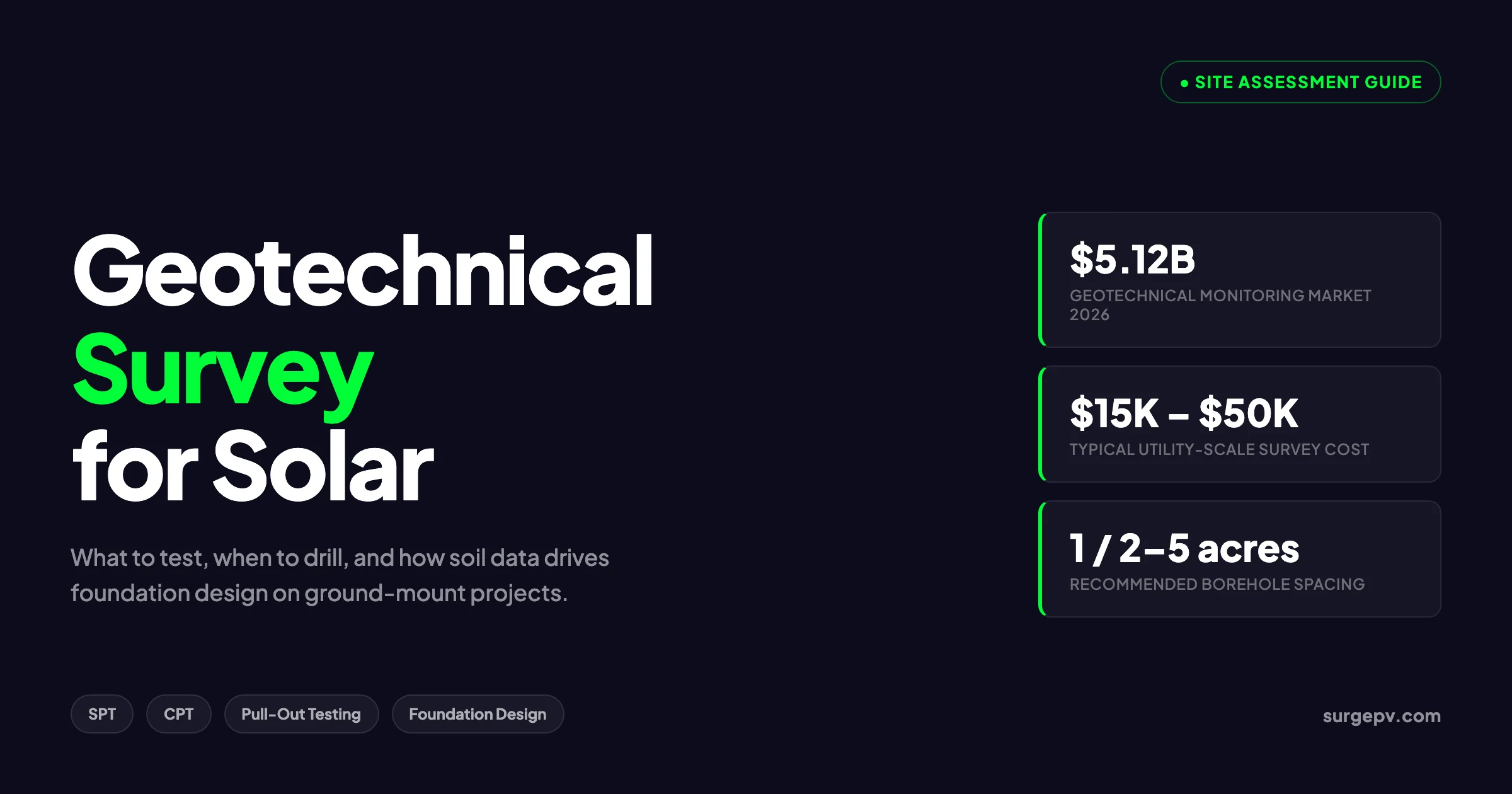
The global geotechnical instrumentation and monitoring market is projected to reach $5.12 billion in 2026, growing at 9.9 percent year over year, according to The Business Research Company (2026). That growth is not driven by skyscrapers alone. Solar developers now account for a large share of subsurface investigation work because ground-mount and utility-scale projects cannot afford foundation surprises.
Foundation costs typically represent 8 to 15 percent of total installed cost on a ground-mount solar site. The geotechnical report is the single document that determines whether those costs land at the low end or the high end. A developer in Rajasthan once leased 80 hectares for a 50 MWp fixed-tilt plant. After geotechnical surveys, setbacks, and access roads, the usable module area shrank to 52 hectares. The project dropped to 32 MWp. The PPA was already signed at 50 MWp.
This guide explains what a geotechnical survey is, when to order one, what it costs, and how to turn the report into a better foundation design.
In this guide, you will learn:
- What a geotechnical survey includes and how it differs from a topographic survey
- Which investigation methods apply to residential, commercial, and utility-scale solar
- How to read the four parameters that drive foundation cost
- How soil type maps to pile type, embedment depth, and budget
- Common mistakes that turn a $5,000 survey into a $200,000 change order
- When to commission the survey in the project timeline
Quick Answer
A geotechnical survey for solar is a subsurface investigation of soil, rock, and groundwater conditions. It determines the foundation type, pile embedment depth, and site preparation needed so a ground-mount or utility-scale solar array stays structurally sound for 25 to 35 years.
What Is a Geotechnical Survey for Solar?
A geotechnical survey — also called a geotechnical investigation or soil testing for a solar project — is a field and laboratory study of what is underground. It collects soil samples, measures bearing capacity, identifies rock layers, maps the water table, and tests for corrosive soil chemistry. The findings feed directly into foundation design.
For ground-mount and utility-scale solar, the survey answers three questions:
- Can the soil support the racking loads? Bearing capacity and soil stiffness determine whether driven piles, helical screws, ballasted footings, or concrete piers are appropriate. See our ground-mount solar design guide for a full foundation workflow.
- How deep must foundations go? Embedment depth depends on frost line, wind uplift, lateral loads, and the soil layers encountered.
- What site preparation is needed? Cut-and-fill requirements, dewatering, soil replacement, and drainage all come from the geotech report.
A geotechnical survey does not tell you where to place panels. It tells you what is underground so the structural engineer can design a foundation that stays in the ground. PV design software integrates this data with structural load calculations to optimize pile lengths across a site. For the technical definition and related terms, see our geotechnical survey glossary entry.
Geotechnical Survey vs. Topographic Survey
These two surveys are often confused because both happen early in project development. They serve different purposes.
A topographic survey maps surface features. It records elevation contours, existing structures, roads, drainage paths, vegetation, and overhead lines. Designers use it to place arrays, plan access roads, and model shading.
A geotechnical survey maps subsurface conditions. It records soil layers, bearing capacity, rock depth, groundwater, and corrosion potential. Engineers use it to design foundations.
You need both. A site can look flat and simple on a topo map but hide shallow bedrock or soft clay below ground. The opposite is also true. A hilly site may have consistent dense soil that is easy to pile. Combine the topo survey with the geotechnical report before finalizing layout and foundation design.
Deliverables You Should Expect
A complete geotechnical report for solar typically includes:
- Site description and project overview
- Boring logs with SPT N-values or CPT profiles
- Laboratory test results for grain size, moisture, Atterberg limits, and corrosion potential
- Groundwater observations and seasonal fluctuations
- Soil classification by zone
- Foundation recommendations with pile type, embedment depth, and spacing
- Construction considerations such as dewatering, pre-drilling, or rock drilling
Why Geotechnical Data Matters for Solar Foundations
Foundation design is one of the few places where a small upfront investment prevents large downstream losses. A thorough geotechnical survey on a utility-scale solar site typically costs $15,000 to $50,000, according to Nuance Energy (2025). Inadequate soil data can trigger $200,000 to $500,000 in change orders.
The most common failure modes are predictable:
- Early pile refusal on shallow rock. Piles hit bedrock before reaching design depth. The contractor must mobilize rock drilling equipment at $15,000 to $25,000 per day.
- Failed pull-out tests in soft layers. Soft clay or loose sand that was not detected requires longer or larger piles across the site.
- Groundwater during excavation. The water table measured in a dry season may rise during construction. Inverter pad excavations fill with water and require dewatering.
- Corrosion in aggressive soils. Low pH, low resistivity, or high chloride and sulfate levels shorten pile life. Uncoated or thin-walled steel may not last 25 years.
Projects that skip soil testing for solar project sites or rely on a single borehole for a 50-plus acre site routinely encounter 20 to 40 percent foundation cost overruns during construction. The geotech report is not a line item to cut. It is risk insurance priced at a fraction of one percent of total project cost.
Investigation Methods Explained
Four investigation methods cover the range of soil testing a solar project typically requires. Most utility-scale sites use at least two methods.
Borehole Drilling with Standard Penetration Test (SPT)
A drill rig advances a borehole to depths of 10 to 50 feet. At regular intervals, usually every 5 feet, a split-spoon sampler is driven into the soil. The blow count required to drive the sampler 12 inches is recorded as the SPT N-value.
SPT N-values directly indicate soil density and bearing capacity. Dense sand with N-values above 30 supports short driven piles. Soft clay with N-values below 5 requires deeper embedment or alternative foundations. This is the most common method for geotechnical surveys on solar farm sites.
Cone Penetration Testing (CPT)
A truck-mounted hydraulic ram pushes an instrumented cone into the ground at a constant rate. The cone records tip resistance, sleeve friction, and pore water pressure continuously with depth.
CPT is faster than borehole drilling and produces a continuous soil profile rather than data at discrete intervals. It excels at detecting thin soft layers or lenses that borings might miss. CPT is frequently used alongside SPT borings on large solar sites to fill in data between borehole locations.
Pull-Out Testing
A test pile is driven or screwed into the ground at the actual site. It is then loaded in tension and compression to measure real-world resistance. Pull-out testing validates the pile design derived from SPT or CPT data.
Many EPC contractors and racking manufacturers require pull-out test results before finalizing pile specifications. Tests are performed at multiple locations to capture site variability. Each test location adds $2,000 to $5,000 but can prevent redesign across thousands of piles.
Desktop Study and Geologic Review
Before any drilling begins, geotechnical engineers review published geologic maps, USDA soil surveys, FEMA flood maps, historical aerial imagery, and any existing reports from nearby sites. The desktop study identifies red flags such as shallow bedrock, expansive clay, high water tables, fill material, or contamination.
It also determines how many boreholes are needed and where they should be placed for maximum coverage of site variability. A good desktop study prevents wasted drilling and ensures the field investigation targets the areas of highest uncertainty.
Geotechnical Survey Scope by Project Size
The scope of a geotechnical investigation for a solar project scales with acreage and site complexity. The table below summarizes typical scope and cost by project size.
| Project Size | Typical Scope | Borehole Spacing | Typical Cost | Timing |
|---|---|---|---|---|
| Residential ground-mount (under 5 kW) | Desktop review of USDA soil maps; one borehole to 15 ft if slope, flood zone, or fill is present | N/A or 1 boring | $1,000 – $5,000 | Before permit application |
| Commercial ground-mount (50 kW – 1 MW) | 2 boreholes to 20-25 ft; 1 CPT sounding per acre; corrosion and grain-size lab tests | 1 per acre | $5,000 – $15,000 | Before detailed engineering |
| Utility-scale solar farm (5 MW+) | 1 borehole per 2-5 acres; CPT between borings; pull-out testing at 3-5 locations; full lab program | 1 per 2-5 acres | $15,000 – $50,000 | Before EPC contract and land lease finalization |
| Tracker or carport projects | Additional borings at post clusters; pull-out testing required; seismic/wind load review | Per structure grid | $5,000 – $20,000 | Before structural design |
NREL and DOE guidelines recommend the utility-scale spacing above, with additional borings at inverter pads, substation foundations, access road alignments, and retention pond areas. More geologically variable sites need closer spacing than uniform sites. See NREL Solar Market Research and Analysis for utility-scale solar best practices.
Reading the Report: Key Parameters
Four parameters from the geotechnical report drive most foundation decisions on solar projects.
Soil Bearing Capacity
Bearing capacity is the load the soil can support without excessive settlement. It is expressed in pounds per square foot (psf) or kilopascals (kPa). Higher values mean shorter piles or smaller footings. Lower values mean deeper embedment, larger sections, or ground improvement.
Dense sand and gravel may offer 3,000 to 5,000 psf. Soft clay or organic soils may offer under 500 psf. The foundation engineer uses this value to calculate the required pile length and section size.
Frost Depth
In cold climates, piles must extend below the local frost line. Frost heave can lift shallow foundations and misalign trackers. A pile embedded above the frost line will move seasonally and damage the array.
The required embedment is governed by two inputs. It must exceed the structural embedment depth and the local frost depth. In northern climates, frost depth can add 3 to 6 feet to pile length.
Water Table Depth
Groundwater affects excavation, dewatering, and corrosion. A high water table near inverter pads or underground conduit can add significant cost. Seasonal fluctuations matter. The water table measured in October may be 5 feet lower than in April.
If the report shows groundwater within a few feet of planned excavation depths, the project needs a dewatering plan. This is often overlooked in early budgeting.
Corrosion Potential
Soil resistivity, pH, chloride content, and sulfate content determine how aggressively the soil attacks steel piles. The thresholds are well established:
- Resistivity below 2,000 ohm-cm indicates corrosive conditions.
- pH below 5.5 indicates acidic, corrosive soil.
- Elevated chlorides or sulfates accelerate steel degradation.
In corrosive environments, hot-dip galvanizing may not be enough. Thicker pile walls, epoxy coatings, or stainless-steel hardware may be required. These decisions add cost but prevent failures at year 15 or 20.
Foundation Type Decision Matrix
The soil type encountered during a geotechnical survey directly determines the pile type, embedment depth, and foundation cost. The matrix below summarizes the relationship for common solar site conditions.
| Soil Type | Bearing Capacity | Foundation Type | Embedment Depth | Cost Impact |
|---|---|---|---|---|
| Dense sand / gravel | 3,000 – 5,000 psf | Driven steel W or C piles | 6 – 8 ft | Low |
| Stiff clay | 2,000 – 4,000 psf | Driven steel piles or helical screws | 8 – 10 ft | Low to moderate |
| Soft clay / silt | 500 – 1,500 psf | Helical piles or concrete piers | 10 – 15 ft | Moderate to high |
| Loose sand | 1,000 – 2,000 psf | Helical piles or rammed aggregate piers | 8 – 12 ft | Moderate |
| Expansive clay | 1,500 – 3,000 psf (variable) | Drilled concrete piers below active zone | 12 – 20 ft | High |
| Shallow bedrock (under 4 ft) | 10,000+ psf (rock) | Rock anchors or surface-mount ballast | 2 – 4 ft into rock | High |
| Organic / peat soils | Under 500 psf | Concrete caissons or soil replacement | 15 – 25 ft to competent layer | Very high |
| Fill material | Variable / unreliable | Must penetrate through fill to native soil | Variable | Variable |
This matrix is a starting point. The final design must be stamped by a licensed structural or geotechnical engineer who reviews the actual report data. For a deeper look at residential foundations, see our guide to residential ground-mount solar foundations and permits.
Standards and Codes That Govern Solar Geotechnical Work
Geotechnical investigations for solar projects in the United States typically follow ASTM standards and ASCE loading codes. The most relevant references are:
- ASTM D1586: Standard Test Method for Standard Penetration Test (SPT) and Split-Barrel Sampling of Soils
- ASTM D3441: Standard Test Method for Mechanical Cone Penetration Testing of Soils
- ASTM G57: Standard Test Method for Field Measurement of Soil Resistivity Using the Wenner Four-Electrode Method
- ASCE 7-22: Minimum Design Loads and Associated Criteria for Buildings and Other Structures, including wind and seismic loads on solar arrays
- IBC and local amendments: Adopted building codes that reference geotechnical reports for foundation design
International projects may use Eurocode 7, IS codes in India, or local equivalents. The investigation methods are similar. The reporting format and safety factors differ by jurisdiction. Always confirm which standard the AHJ or lender requires before commissioning the report.
Common Mistakes and How to Avoid Them
Even experienced developers make the same errors. Here are the most costly ones.
Ordering the Survey Too Late
The standard workflow is sign land, design layout, then drill geotech. This is backwards. A $5,000 geotechnical report before lease signing can prevent a $500,000 layout redesign. Drill a grid of boreholes across the site before committing to capacity.
Using One Borehole for a Large Site
A single boring cannot represent 100 acres. Soil conditions change across swales, hilltops, cut-and-fill transitions, and former agricultural fields. The cost of two extra borings is small compared to redesigning foundations for half the site.
Ignoring Seasonal Groundwater
Reports often state groundwater depth at the time of drilling. If construction occurs in a wet season, the actual water table may be higher. Plan dewatering contingencies for inverter pads, trenches, and underground conduit runs.
Designing for Worst-Case Everywhere
A 100-acre solar farm rarely has uniform soil. Use borehole and CPT data to create a soil zone map. Assign pile specifications by zone rather than using a single worst-case design for the entire site. This can reduce pile steel costs by 10 to 20 percent.
Skipping Pull-Out Testing on Borderline Soils
When SPT or CPT data shows marginal conditions, pull-out testing is not optional. It is the only way to verify that the actual pile will resist wind uplift. A failed production pull-out test after thousands of piles are driven is a project crisis.
When to Commission the Survey
Timing is the most important decision. The survey should be commissioned after site control is secured but before detailed engineering begins. The ideal sequence is:
- Site selection and desktop review. Use USDA soil maps, geologic maps, and FEMA flood data to screen the site.
- Topographic survey. Map surface contours, drainage, and access constraints.
- Geotechnical survey. Drill borings, run CPT, and perform pull-out testing concurrent with or immediately after the topographic survey.
- Foundation design. Use the geotech report to specify pile type, depth, and spacing.
- EPC pricing. Share the report with bidders so they price foundation work to actual conditions.
- Construction. Verify production piles with spot pull-out tests and document refusal conditions.
Commissioning the survey before the EPC contract is the best way to avoid foundation cost overruns. Contractors who encounter soil conditions that differ from assumptions will submit change orders. Those change orders commonly run $80,000 to $300,000 on a 500 kWp project.
Design Ground-Mount Systems with Accurate Site Data
SurgePV integrates geotechnical parameters, topographic data, and structural load calculations to produce optimized ground-mount designs with accurate foundation specifications.
Book a DemoNo commitment required · 20 minutes · Live project walkthrough
Conclusion
A geotechnical survey is not a formality. It is the data foundation for the entire ground-mount solar project. The report determines foundation type, pile depth, site preparation, and construction risk.
Three actions will improve your next project:
- Commission the survey before signing the EPC contract. The cost is small compared to the change orders it prevents.
- Match scope to project size. One borehole is enough for a residential site. A utility-scale farm needs one per 2 to 5 acres plus targeted borings at critical structures.
- Use the report to create soil zones. Designing by zone instead of worst-case can cut pile steel costs by 10 to 20 percent.
Solar projects that treat geotechnical work as an early investment finish faster, cost less, and perform better over their 25-year life. For large projects, pair the geotech report with a solar farm design guide and a financial model in SurgePV’s generation and financial tool to see how foundation assumptions affect project returns.
Frequently Asked Questions
What is a geotechnical survey for a solar project?
It is a subsurface investigation that collects soil samples, measures bearing capacity, maps rock layers and groundwater, and tests soil chemistry. The results determine foundation type, pile embedment depth, and site preparation needs for ground-mount or utility-scale solar.
How much does a geotechnical survey cost for solar?
Residential ground-mount surveys range from $1,000 to $5,000. Commercial projects typically cost $5,000 to $15,000. Utility-scale solar farms cost $15,000 to $50,000 depending on acreage, number of borings, and laboratory testing.
When should you commission a geotechnical survey for solar?
Commission the survey after site control is secured but before detailed engineering or EPC contract signing. Late surveys force redesigns and change orders. Early surveys let designers optimize foundations to actual soil conditions.
What does a geotechnical survey report include?
A typical report includes a site description, boring logs with SPT or CPT data, laboratory test results, groundwater observations, soil classification, corrosion potential, and engineering recommendations for foundation type and embedment depth.
How many boreholes are needed for a solar farm?
Industry practice and NREL guidance recommend one borehole per 2 to 5 acres for utility-scale sites, plus additional borings at inverter pads, substations, access roads, and retention ponds. More variable sites need closer spacing.
What happens if you skip the geotechnical survey?
Projects that skip or under-scope soil testing routinely see 20 to 40 percent foundation cost overruns. Common problems include early pile refusal on shallow rock, failed pull-out tests in soft layers, and unexpected groundwater requiring dewatering.
What is the difference between SPT and CPT for solar foundations?
SPT uses borehole drilling with a split-spoon sampler to measure soil resistance at discrete intervals. CPT pushes an instrumented cone continuously into the ground to produce a full soil profile. Most large sites use both methods together.
Can you use a geotechnical survey for roof-mounted solar?
Roof-mounted systems need a structural assessment of the roof framing and load capacity, not a geotechnical survey. Geotechnical surveys apply to ground-mount, carport, tracker, and utility-scale solar projects where foundations interact with soil.
Where this fits
This article is part of SurgePV's Solar Installation hub, which works through the topic from first principles to the decisions a project team actually has to make.