

A commercial solar developer in Phoenix recently asked me whether to specify First Solar CdTe modules or look at CIGS thin-film for a 2.8 MW rooftop project. The roof was a standard built-up membrane on a warehouse, the budget was tight, and the climate gets brutal. Hot. My answer was straightforward, but the reasoning matters for any commercial buyer evaluating thin-film solar in 2026.
The thin-film world has consolidated dramatically. CdTe controls roughly 5% of global PV shipments, CIGS holds about 1%, and crystalline silicon takes the remaining 94%. Within thin-film, CdTe runs effectively as a single-supplier market dominated by First Solar, while CIGS spans a handful of manufacturers that target different applications. For commercial buyers, picking between the two is less about the chemistry on the datasheet and more about which application, which climate, and which financing structure your project sits in. For Global-specific compliance details, see Global net-metering-by-country.
This guide breaks down CdTe vs CIGS solar panels for 2026 commercial deployments. Efficiency, temperature performance, manufacturing economics, bankability, and the application matrix that determines which technology wins where. If you are designing a commercial system and weighing thin-film alongside conventional silicon, you can model both options inside solar design software without leaving the same project file.
Quick Answer
For utility-scale and standard commercial ground-mount or rooftop projects in 2026, CdTe wins on efficiency, cost, and bankability. First Solar Series 7 modules ship at 18.8 to 19.7% efficiency, qualify for the US domestic content bonus, and carry a 30-year performance warranty. CIGS wins in narrow but valuable niches: flexible BIPV, lightweight rooftops, curved surfaces, and projects where aesthetics matter. CIGS commercial modules ship at 14 to 17% efficiency and rarely undercut CdTe on per-watt cost. Choose CdTe for volume. Choose CIGS for form-factor problems silicon cannot solve.
What Thin-Film Solar Actually Is
Thin-film solar deposits a photovoltaic absorber layer one to three micrometers thick onto a substrate. For comparison, a crystalline silicon cell uses a wafer roughly 150 to 180 micrometers thick. That is the entire premise. Less semiconductor material per watt, faster manufacturing throughput, and the option to use substrates other than rigid glass. For the latest details on France, see Agricultural Solar Case Study. For the latest details on Italy, see Commercial Rooftop Solar Case Study Italy.
Think of it like printing versus carving. Crystalline silicon starts with a polysilicon ingot, slices wafers, and then processes each wafer into a cell. Thin-film starts with a sheet of glass or stainless steel and deposits the active layer in a continuous coating process. The throughput numbers are different by an order of magnitude.
Three thin-film technologies reached commercial scale: cadmium telluride (CdTe), copper indium gallium selenide (CIGS), and amorphous silicon (a-Si). Amorphous silicon largely exited the market by 2018 due to low efficiency and stability issues. CdTe and CIGS remain as the two viable thin-film options for commercial buyers in 2026.
Why thin-film matters in 2026
Three forces keep thin-film relevant despite the dominance of crystalline silicon:
- Temperature performance. Lower temperature coefficients translate to better real-world yield in hot climates, where many commercial solar markets sit.
- Domestic supply chain. First Solar is the only at-scale non-Chinese module supplier in the United States. The Inflation Reduction Act domestic content bonus makes this commercially decisive for utility developers.
- Form factor flexibility. CIGS can deposit on flexible substrates, opening BIPV applications that crystalline silicon cannot serve at all.
For a commercial buyer, the question is rarely about thin-film versus silicon in the abstract. It is about whether your specific project, climate, and financing situation gets you a better outcome with one or the other.
CdTe Solar Panels: How They Work
Cadmium telluride is a II-VI semiconductor compound. The chemistry is simple: one cadmium atom paired with one tellurium atom in a stable crystalline lattice. That simplicity is the entire commercial story.
CdTe has a direct bandgap of 1.45 eV, which is almost ideal for absorbing the solar spectrum at Earth’s surface. A direct bandgap means the absorber needs very little material to capture incoming photons. About one micrometer of CdTe absorbs 99% of useful sunlight. Compare that to silicon’s indirect bandgap, which requires 150 micrometers of wafer thickness for similar absorption.
Manufacturing process
First Solar manufactures CdTe modules in a continuous process that takes about 4.5 hours from glass sheet input to finished module output. The basic stack:
- Front glass. A 3.2 mm anti-reflective coated soda-lime glass sheet enters the line.
- Transparent conductive oxide (TCO) layer. Tin oxide is deposited as the front contact.
- Cadmium sulfide (CdS) window layer. A thin n-type layer that forms the heterojunction with CdTe.
- CdTe absorber. Vapor transport deposition coats the active layer at high speed.
- Back contact. Metal stack deposited for current collection.
- Back glass and seal. A second glass sheet laminates the module into a sealed glass-glass package.
- Junction box and frame. Standard module finishing.
The whole line runs as one integrated factory, which is why First Solar’s capex per watt is competitive with high-volume Chinese silicon manufacturers despite a much smaller total production base. The company reports approximately 14 GW of US nameplate capacity in early 2026, expanding to over 17 GW by 2027 with the addition of a South Carolina finishing facility.
Series 7 specifications
The current commercial flagship is the First Solar Series 7 TR1, which carries a 540 W typical power rating in a module that is 1216 mm by 2300 mm and weighs about 35 kg. Module efficiency reaches 19.7% for the highest-binned variants, with the volume product binning at 18.8 to 19.4%.
Pro Tip
For commercial design work, model CdTe modules using their actual Pmax temperature coefficient (-0.32%/C) rather than the average thin-film rule of thumb. The First Solar datasheet temperature coefficient is more favorable than crystalline silicon but less aggressive than older CdTe figures suggest. Accurate temperature modeling is built into solar design suite so you get realistic annual energy estimates without manual derating spreadsheets.
CIGS Solar Panels: How They Work
CIGS stands for copper indium gallium selenide. Sometimes you will see CIS (copper indium selenide), which is the older two-element absorber. The gallium addition tunes the bandgap and improves efficiency, so CIGS is the standard term for modern modules.
The absorber stack is more complex than CdTe. Four elements need to deposit in the right ratio, with the right crystalline structure, on a substrate that may be glass or stainless steel or a polymer film. Process control matters. A small variation in indium-gallium ratio shifts the bandgap and changes everything downstream.
Manufacturing process
CIGS manufacturing splits into two main approaches:
Co-evaporation. All four elements are evaporated simultaneously in a vacuum chamber onto the substrate. This produces the highest-quality films and has delivered the record lab cell efficiencies, but it is slow and expensive at production scale.
Sputtering plus selenization. Copper, indium, and gallium are sputtered first, then the film is exposed to selenium vapor at high temperature to form the CIGS absorber. This is faster and cheaper than co-evaporation but harder to control for uniform composition.
The standard CIGS stack on a rigid module:
- Substrate. Soda-lime glass or stainless steel sheet.
- Molybdenum back contact. Sputtered to form the rear electrode.
- CIGS absorber. Deposited via co-evaporation or sputter-plus-selenization.
- CdS buffer layer. A thin n-type buffer (some manufacturers use Cd-free alternatives like Zn(O,S)).
- Zinc oxide window layer. Transparent n-type front contact.
- Transparent conductive oxide. Aluminum-doped zinc oxide or indium tin oxide.
- Front grid and antireflection. Final layers for current collection and light management.
The complexity shows up in yield and cost. CIGS manufacturers historically run at lower throughput and lower yield than CdTe lines, which keeps per-watt manufacturing cost higher than CdTe by 30 to 50%.
Flexible CIGS modules
The unique advantage of CIGS is that the manufacturing process works on flexible substrates. MiaSolé and Ascent Solar produce CIGS modules on stainless steel or polymer foils using roll-to-roll deposition. The result is lightweight, bendable modules that crystalline silicon physically cannot match.
MiaSolé’s FLEX-03W delivers up to 530 W in a flexible format aimed at commercial roofing where structural load constraints rule out conventional glass-glass modules. The trade-off is module efficiency typically caps at 14 to 17%, well below rigid CdTe or silicon.
CdTe vs CIGS: Complete Specification Comparison
The table below summarizes the technical specifications for current commercial CdTe and CIGS modules as of mid-2026.
| Specification | CdTe (First Solar Series 7) | CIGS (typical rigid module) | CIGS (flexible, MiaSolé FLEX) |
|---|---|---|---|
| Module efficiency | 18.8 to 19.7% | 14 to 17% | 14 to 17% |
| Cell efficiency record (lab) | 22.4% | 23.6% | 23.6% |
| Power rating (typical) | 525 to 550 W | 280 to 360 W | 350 to 530 W |
| Module dimensions | 2300 x 1216 mm | 1610 x 1257 mm | varies (roll format) |
| Module weight | ~35 kg | ~17 kg | ~8 to 15 kg |
| Power density (W/m^2) | 188 to 196 | 145 to 175 | 145 to 175 |
| Temperature coefficient (Pmax) | -0.32%/C | -0.30 to -0.36%/C | -0.30 to -0.36%/C |
| NOCT | 44 C | 45 C | 47 C |
| Light absorption start | broad spectrum | broad + better diffuse light | broad + better diffuse light |
| Substrate | glass-glass | glass or steel | flexible polymer or steel |
| Bandgap | 1.45 eV | 1.0 to 1.7 eV (tunable) | 1.0 to 1.7 eV (tunable) |
| Annual degradation | 0.5%/year | 0.7 to 1.0%/year | 0.7 to 1.5%/year |
| Product warranty | 12 years | 10 to 12 years | 5 to 10 years |
| Performance warranty | 30 years to 88% | 25 years to 80% | 10 to 15 years |
| Typical cost (USD/W, 2026) | 0.28 to 0.34 | 0.40 to 0.55 | 0.55 to 0.75 |
The numbers explain why CdTe dominates the commercial conversation. For standard glass-glass deployments, CdTe delivers higher efficiency, lower cost, and stronger warranty terms. CIGS only justifies its premium in applications where flexibility or aesthetics carry independent value.
Efficiency: Where the Marketing Hype Splits From Reality
The efficiency comparison gets confused because there are at least four different efficiency numbers floating around for each technology:
- Theoretical maximum (Shockley-Queisser limit). ~33% for both technologies at their respective bandgaps.
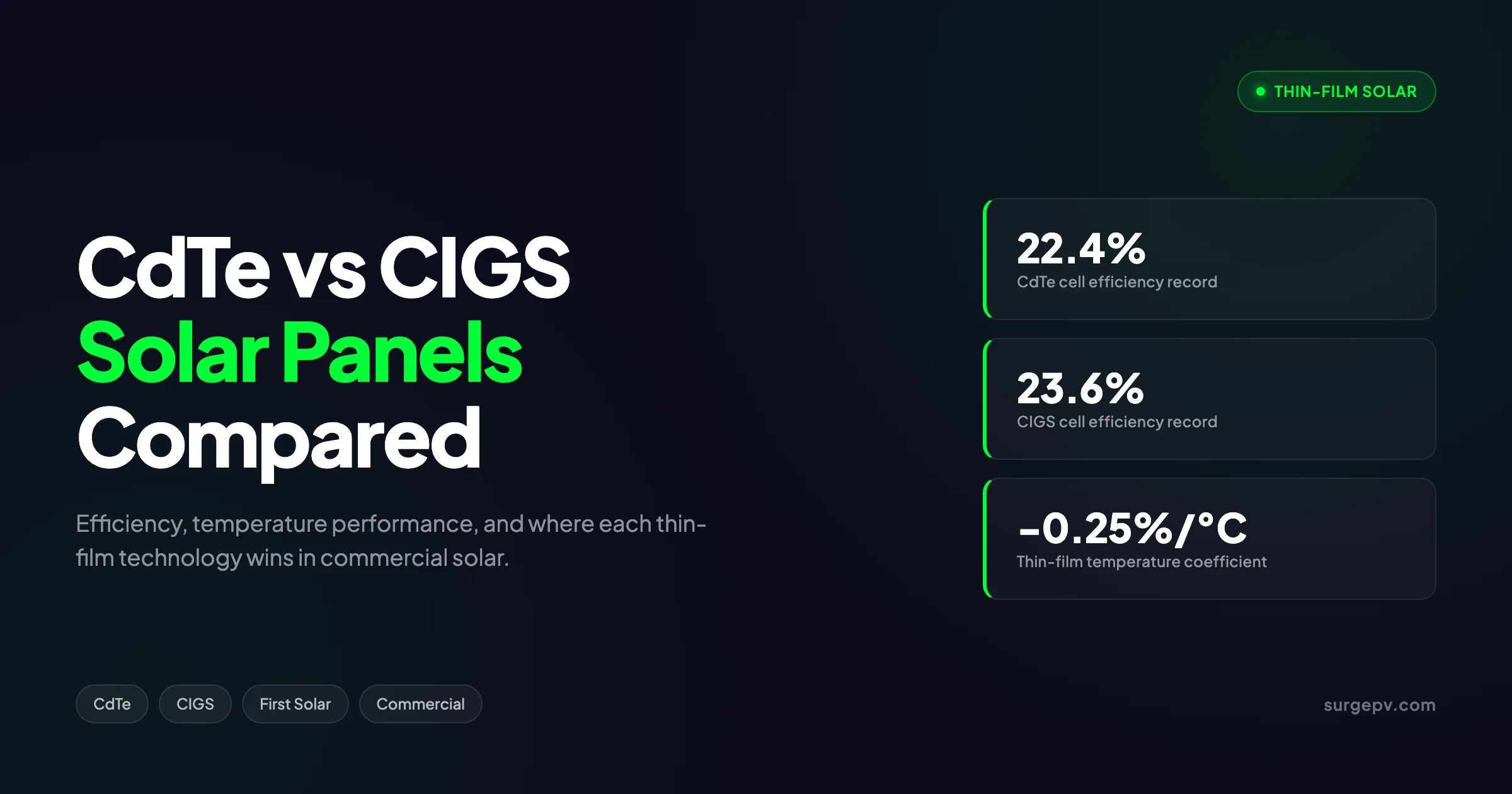
- Lab cell record. 22.4% for CdTe (First Solar 2022), 23.6% for CIGS (Solar Frontier 2019).
- Commercial module shipping efficiency. 18.8 to 19.7% for CdTe, 14 to 17% for CIGS.
- System-level yield (kWh per kW per year). Climate-dependent and where it gets interesting.
The headline lab numbers favor CIGS by 1.2 percentage points. The commercial reality favors CdTe by 2 to 5 percentage points on actual modules you can buy in 2026.
Why CIGS has not closed the production gap
CIGS won at small lab cells in 2019 and has stayed close to CdTe at the cell level ever since. But scaling from a 1 cm^2 lab cell to a 2 m^2 commercial module requires holding the four-element composition uniform across the entire substrate. CdTe needs uniform composition for only two elements that naturally maintain a 1:1 stoichiometry. The manufacturing physics tilts toward CdTe at production scale.
The result is a 5 to 8 percentage point gap between CIGS lab cell efficiency and CIGS commercial module efficiency, versus a 3 to 4 percentage point gap for CdTe.
Real-world energy yield
For commercial buyers, kWh per kW per year matters more than nameplate efficiency. Both CdTe and CIGS outperform crystalline silicon in hot climates due to lower temperature coefficients.
A typical commercial installation in Phoenix sees the following annual specific yield (kWh/kWp/year) based on published field studies:
| Technology | Specific yield (kWh/kWp/year) | vs c-Si baseline |
|---|---|---|
| Crystalline silicon (PERC) | 1,650 | baseline |
| CdTe (First Solar) | 1,720 | +4.2% |
| CIGS (rigid glass) | 1,705 | +3.3% |
| CIGS (flexible) | 1,665 | +0.9% |
The CdTe advantage in hot climates can pay for the technology choice on a 25-year DCF basis even when nameplate per-watt cost is slightly higher than imported silicon. Run the comparison through a proper solar yield and financial analysis before locking your module specification, because module choice flows through your loan sizing, ITC base, and operating cost assumptions.
Temperature Performance: The Thin-Film Advantage Most Buyers Underestimate
Solar panels degrade in performance as cell temperature rises. The relationship is linear and quantified by the temperature coefficient, expressed as a percentage power loss per degree Celsius above 25 C (Standard Test Condition).
| Technology | Pmax temp coefficient | Power at 60 C cell temp |
|---|---|---|
| Monocrystalline silicon | -0.35 to -0.40%/C | 86 to 88% of nameplate |
| Polycrystalline silicon | -0.40 to -0.45%/C | 84 to 86% of nameplate |
| CdTe | -0.28 to -0.32%/C | 89 to 90% of nameplate |
| CIGS (rigid) | -0.30 to -0.36%/C | 87 to 89% of nameplate |
| CIGS (flexible) | -0.32 to -0.40%/C | 86 to 88% of nameplate |
A 35 C ambient day with 1000 W/m^2 irradiance produces cell temperatures around 60 to 65 C in a typical commercial rooftop install. At those temperatures, the difference between -0.35%/C silicon and -0.30%/C CdTe is roughly 2 percentage points of instantaneous power, multiplied across the hottest 1,500 to 2,500 hours of the year in a hot-climate location.
Aggregated across an annual energy total, the thin-film advantage typically lands at 3 to 5% additional kWh per nameplate kW for hot-climate sites. For cooler temperate climates, the advantage shrinks to 1 to 2%.
Why temperature coefficient matters more than nameplate efficiency in hot climates
Two modules with identical nameplate ratings can produce meaningfully different annual energy depending on temperature behavior. A 540 W CdTe module rated at 19% nameplate efficiency can outproduce a 540 W silicon module rated at 21% nameplate efficiency in a Riyadh or Phoenix climate because the silicon module spends more hours throttled by heat. Always model both modules through your actual climate file before assuming higher nameplate efficiency wins.
The temperature advantage also affects mounting design. CdTe glass-glass modules dissipate heat more uniformly than glass-back-sheet silicon modules, which reduces hot-spot risk and slightly relaxes ventilation requirements under modules. For a commercial flat roof, this can mean lower-profile racking and less wind load. Read Solar Racking Design Guide for a complete walkthrough.
Low-Light and Diffuse Spectrum Performance
CIGS has a documented advantage in diffuse light and cloudy conditions compared to crystalline silicon. The mechanism is the tunable bandgap and broader spectral response of the CIGS absorber, which captures more of the longer-wavelength photons that dominate under heavy cloud cover.
Independent field measurements typically show CIGS outperforming silicon by 4 to 8% in annual energy yield at sites with high cloud cover, despite the lower nameplate efficiency. CdTe sits between silicon and CIGS for low-light performance, with a modest advantage over silicon (1 to 3%) and a small deficit to CIGS (2 to 4%) under diffuse conditions.
For commercial buyers in Northern Europe, the UK, or the US Pacific Northwest, this favors CIGS in cloudy-climate analyses. For sunny commercial markets like the US Southwest, Spain, Australia, or the Middle East, the temperature advantage of CdTe dominates and CIGS loses its diffuse-light edge. Also see: Spain net metering. Also see: European Solar Incentives. For Australia-specific compliance details, see Australia comparisons/lgc-vs-stc.
Cadmium, Toxicity, and Lifecycle Reality
Every CdTe conversation eventually surfaces cadmium toxicity concerns. The technical reality is well-documented, but it is worth setting out clearly because the public-relations narrative around cadmium has been a persistent friction point in commercial sales.
Cadmium metal is toxic. Cadmium telluride (CdTe) is a compound where cadmium is chemically bonded with tellurium into a stable, insoluble crystalline solid. The bonding energy is high, and the compound does not break down under normal environmental conditions. Module-grade CdTe is encapsulated between two sheets of glass and laminated with EVA and edge sealants designed for 30-year operational life.
Operational risk
During normal operation, CdTe modules pose no measurable exposure pathway. The cadmium is sealed in glass and bonded with tellurium. Field studies including module breakage tests show that CdTe modules cracked by hail or wind do not release measurable cadmium into surrounding soil or water under normal weathering conditions.
Fire risk
Building fires reach temperatures that can damage modules but typically do not vaporize CdTe. The compound has a melting point above 1,000 C. Independent fire studies have measured cadmium release from CdTe modules in simulated building fires at levels below applicable health-based exposure limits at any reasonable distance from the fire.
End-of-life and recycling
First Solar operates a global module recycling program that recovers over 90% of the semiconductor material and 100% of the glass and metals. The recycling pathway is one of the strongest commercial-scale closed-loop systems in the solar industry. As of 2026, First Solar has recycled modules from over 100 utility projects worldwide.
This matters for commercial buyers because procurement teams are increasingly asked to justify environmental credentials of solar deployments. CdTe with First Solar’s recycling commitment generally beats imported silicon (which lacks comparable closed-loop infrastructure) on a lifecycle cadmium-and-lead comparison, despite the upstream perception.
Regulatory landscape
CdTe modules are not currently restricted under the EU RoHS directive (which has an exemption for solar cells), the US TSCA, or any major commercial market regulation. Some jurisdictions including parts of Germany and several US states require documented end-of-life take-back, which First Solar’s recycling program satisfies. Also see: Germany solar subsidies. Read more about Community Solar Projects Germany.
CIGS contains cadmium in its CdS buffer layer (typically 0.05 to 0.1 g per module versus 6 to 8 g for a CdTe module), so the toxicity narrative does not cleanly differentiate CIGS as “cadmium-free” unless the manufacturer uses an alternative buffer like Zn(O,S). Several CIGS manufacturers have moved to Cd-free buffers, which can be a marketing advantage for specific markets.
Manufacturing Economics in 2026
The cost difference between CdTe and CIGS in 2026 reflects manufacturing physics, not marketing positioning. Three factors drive the gap:
Throughput
A single First Solar Series 7 production line throughputs 4.5 hours from glass-in to module-out, with very high uptime. CIGS lines run slower with more process steps and lower line yield. The throughput differential translates directly into per-module manufacturing cost.
Materials cost
Tellurium is rare but inexpensive at 2026 spot prices (around USD 70 to 90 per kg). Indium and gallium are individually more expensive (indium around USD 300 per kg, gallium around USD 400 per kg) and CIGS uses both. The material cost per watt for CIGS is roughly 2x to 3x CdTe.
Capex
Building new CIGS capacity at scale requires 1.5x to 2x the capex per watt of CdTe capacity, mostly due to the more complex deposition and process control equipment. This shows up in cost-of-debt and depreciation on the manufacturer’s books, which gets passed to module buyers.
The combined effect is what you see in 2026 commercial pricing: CdTe modules ship at USD 0.28 to 0.34 per watt for utility-scale buyers, while rigid CIGS modules ship at USD 0.40 to 0.55 per watt and flexible CIGS modules ship at USD 0.55 to 0.75 per watt.
Form Factor: Where CIGS Wins on Engineering
The single application category where CIGS unambiguously beats CdTe is form factor. Glass-glass modules are heavy, rigid, and require specific structural support. Flexible thin-film opens deployment categories that glass modules cannot serve at all.
Lightweight commercial rooftops
Older industrial buildings often have roof structures designed for original loading specifications without solar in the design envelope. Adding 18 to 22 kg/m^2 of glass-glass modules plus racking exceeds the structural reserve on many of these roofs. Reinforcement adds USD 30 to 80 per m^2 to project cost and triggers permit complications.
Flexible CIGS modules weigh 3 to 5 kg/m^2 and adhere directly to a membrane roof with no penetration. For an aging industrial portfolio, this can be the difference between solar being feasible and being uneconomic. MiaSolé and Solyco market explicitly to this use case.
BIPV and architectural integration
Building-integrated photovoltaics covers facades, glazing, canopies, and roof shingles that serve dual roles as building envelope and PV generator. CIGS modules in this space can be:
- Semi-transparent for vision glass facades that generate power without blocking daylight.
- Color-customized through interference coatings to match architectural design.
- Custom-shaped to fit curved or non-rectangular building elements.
- Patterned with shapes or logos for design-driven applications.
CdTe modules are inherently rigid glass-glass and cannot serve curved, transparent, or custom-shape applications. The European BIPV market has settled on CIGS and silicon shingles as the two dominant technology choices, with CIGS leading the flexible-substrate segment.
Off-grid and transportation
Flexible CIGS panels show up in EV charging stations, commercial vehicle roofs, agricultural pump systems, and emergency response equipment. These are lower-volume applications than utility solar, but they represent meaningful gross margin for specialized CIGS manufacturers.
Compare Thin-Film and Silicon Designs Side-by-Side
Run CdTe, CIGS, and crystalline silicon options through the same project file to see which technology wins your specific kWh-per-dollar and bankability math.
Book a DemoNo commitment required - 20 minutes - Live project walkthrough
2026 Market Share and Manufacturer Landscape
The thin-film market in 2026 is concentrated in a handful of manufacturers. Here is who is shipping at commercial scale.
CdTe manufacturers
| Manufacturer | 2026 nameplate capacity | Notes |
|---|---|---|
| First Solar | ~14 GW (US), ~25 GW global | Dominant CdTe supplier worldwide. Tier-1 BloombergNEF rating, BAA-compliant, full IRA domestic content qualification for US-made modules. |
| Toledo Solar | sub-GW | Targeted the US residential CdTe market, ceased operations in 2024. |
| Calyxo, others | shutdown | Past European CdTe attempts that did not reach commercial scale. |
CdTe is effectively a single-supplier market for commercial buyers. This is a feature and a bug. First Solar offers strong bankability, US domestic manufacturing, and consistent product quality, but there is no competitive second source if you need volume.
CIGS manufacturers
| Manufacturer | Specialty | Notes |
|---|---|---|
| Avancis (China General Nuclear) | Rigid glass-glass | German CIGS manufacturer acquired by CGN. Targets BIPV facades and rooftop. |
| MiaSolé (Hanergy) | Flexible CIGS | Roll-to-roll on stainless steel. FLEX-03W flexible module up to 530 W. |
| Stion / Mehler / others | Various niches | Smaller players targeting specific BIPV or off-grid applications. |
| Solar Frontier | Exited 2022 | Former CIGS volume leader. Closed Japanese production. Holds the 23.6% CIGS cell record. |
| Solibro | Exited 2014 | Former Hanergy subsidiary. Closed German production. |
CIGS bankability is the structural problem. Several major CIGS manufacturers have exited the market in the past decade. For commercial project finance, lenders and tax-equity investors typically discount CIGS or require additional credit support. This makes CIGS hard to specify for financed deals at commercial scale even when the technology fits the application.
Crystalline silicon for context
For 2026 benchmark, the dominant silicon module suppliers ship n-type TOPCon or HJT modules at 21 to 23% efficiency and USD 0.10 to 0.18 per watt for utility-scale buyers (Chinese imports) or USD 0.30 to 0.45 per watt for US-made products. The price gap between imported silicon and US-made CdTe has narrowed substantially with IRA implementation, which is part of why CdTe maintains its US utility position.
Why CIGS Lost the Volume Race Despite Better Lab Numbers
This is the contrarian section. CIGS has the higher lab efficiency, the more elegant chemistry, the flexible form factor, and the better diffuse-light response. Yet CIGS sits at under 1% global market share while CdTe holds 5%. Why?
The simplest answer is manufacturing physics, but the deeper answer involves three structural disadvantages that compound:
1. Process complexity costs more than people expected
The CIGS recipe requires depositing four elements with precise stoichiometry and crystalline structure across an industrial-scale substrate. Every CIGS manufacturer has spent the last 15 years trying to bring lab efficiency to commercial production. The gap remains stubbornly at 5 to 8 percentage points. CdTe’s two-element chemistry maintains a tighter 3 to 4 point gap, which translates directly to commercial advantage.
2. The substrate flexibility advantage cuts both ways
CIGS works on flexible substrates, which is genuinely useful for BIPV and lightweight roofing. But the flexible-substrate manufacturers chose to chase niche markets rather than compete head-on with CdTe on rigid glass-glass utility products. This split the technology’s commercial focus and limited any single CIGS manufacturer’s ability to scale to the volumes needed to compete on cost.
3. Capital cycle failures
CIGS manufacturers have repeatedly required large capital raises to fund scale-up and have repeatedly failed to deliver the production yield needed to service the debt. Solar Frontier, Solibro, Stion, and several others followed similar trajectories: ambitious capex commitments, slow ramp, product delays, and eventual shutdown or sale. The pattern has trained financial markets to discount new CIGS investment, which makes scaling harder, which reinforces the pattern.
CdTe avoided this trap because First Solar reached commercial scale early (2007 to 2012) with a single dominant manufacturing partner, established consistent product quality, and built the financial relationships needed to fund ongoing expansion without speculative growth promises.
The lesson for commercial buyers: a more elegant technology does not automatically win at scale. Manufacturing physics, capital efficiency, and customer relationships matter more than lab cell records for what you can actually buy and finance in 2026.
Where CdTe Wins: The Commercial Decision Matrix
For the majority of commercial solar projects in 2026, CdTe is the right thin-film choice. The categories below cover the strongest CdTe applications.
Utility-scale ground mount in the US
US utility solar developers face two constraints that favor CdTe: domestic content requirements for the IRA bonus credit, and tariff-driven price gaps that have narrowed but not eliminated Chinese silicon’s advantage. First Solar Series 7 modules satisfy domestic content, ship in US-friendly logistics, and carry the strongest performance warranties in the market. For 100 MW-plus projects targeting the 10% domestic content bonus, the CdTe premium pays back through tax credit math.
Hot-climate commercial rooftops
Phoenix, Las Vegas, Dubai, Riyadh, Perth. Anywhere with high ambient temperatures and high specific yield, CdTe’s temperature coefficient advantage compounds into measurable additional energy. The 3 to 5% yield premium versus silicon translates to meaningful LCOE improvement, especially at projects sized 1 MW and above where module choice can be specified rather than purchased from local stock. For more on this topic, see Design Commercial Solar System 1MW.
Glass-glass durability requirements
Coastal commercial sites, salt-air environments, and sites with extreme hail risk. CdTe glass-glass construction is structurally more robust than glass-back-sheet silicon and shows lower failure rates in long-duration salt-fog and hail testing. This applies to specific high-stress environments where module replacement cost would be high.
Projects requiring 30-year warranty
First Solar’s 30-year performance warranty (to 88% of nameplate) is the longest in the industry. For commercial buyers structuring 25 to 30 year PPAs, this warranty term aligns with contract duration and removes module replacement risk from the financial model.
High-bankability financing
For tax-equity transactions and major project debt, First Solar’s BloombergNEF Tier-1 status, public-company financial strength, and operational track record satisfy lender requirements with minimal friction. CIGS rarely passes the same diligence cleanly.
Where CIGS Wins: The Niche Applications That Justify the Premium
CIGS still has a place in commercial solar, but the applications are narrower than the marketing suggests. The categories below are where CIGS genuinely beats CdTe and silicon.
Flexible BIPV facades and canopies
Building integration where curved surfaces, transparency, or aesthetic customization rule out glass-glass modules. European commercial architecture has adopted CIGS for high-design corporate headquarters, retail flagships, and infrastructure projects where the building owner pays a premium for visual integration. The market is small but the willingness to pay is high.
Lightweight retrofit rooftops
Industrial buildings with limited structural reserve that cannot accept 18 to 22 kg/m^2 of glass-glass modules plus racking. Flexible CIGS at 3 to 5 kg/m^2 with adhesive mounting opens these buildings to solar without expensive structural reinforcement. The case is strongest for warehouses, light industrial, and aging commercial portfolios.
Diffuse-light climates with limited roof area
Northern European commercial sites where annual specific yield is constrained by cloud cover rather than ambient temperature. CIGS modest diffuse-light advantage and per-square-meter generation density can win on small roofs where you cannot fit enough silicon to meet the building’s offset target.
Curved or non-rectangular surfaces
Commercial vehicles, custom architectural canopies, and any surface where conventional rigid modules physically cannot mount. CIGS is the only thin-film option for these applications.
Off-grid and portable commercial applications
EV charging in remote locations, agricultural pump systems, emergency response equipment. CIGS portability and lightweight installation can pay for the higher per-watt cost when conventional silicon logistics are impractical.
Bankability and Project Finance
Project finance for commercial solar typically requires modules from BloombergNEF Tier-1 manufacturers. The Tier-1 list is updated quarterly and reflects a combination of manufacturing scale, financial strength, and recent shipment history.
In 2026, First Solar is the only CdTe manufacturer on the Tier-1 list. Among CIGS manufacturers, only Avancis (CGN-owned) maintains intermittent Tier-1 status, and several other CIGS suppliers fall outside Tier-1.
For commercial buyers, the bankability picture means:
| Financing structure | CdTe (First Solar) | CIGS (typical) |
|---|---|---|
| Tax equity (US) | Standard terms | Often requires credit enhancement |
| Project debt (utility) | Standard terms | Discounted advance rates |
| PPA off-taker risk | Minimal module risk | May affect off-taker willingness |
| Insurance pricing | Standard | Higher premiums |
| Warranty coverage | 12 yr product, 30 yr performance | 10 to 12 yr product, 25 yr performance |
For a CIGS-specified project to clear standard project finance, the developer typically needs to either secure module warranty wrap-around insurance, accept higher cost of capital, or scope the project small enough to fund from corporate balance sheet rather than project debt.
Climate-by-Climate Application Decision Matrix
The application matrix below summarizes which technology to specify in 2026 for common commercial scenarios.
| Project type | Climate | Roof type | Best choice | Reasoning |
|---|---|---|---|---|
| Utility-scale ground mount | Any US | n/a | CdTe (First Solar) | Domestic content, bankability, temperature performance |
| Utility-scale ground mount | Outside US | n/a | n-type silicon or CdTe | Silicon if cheapest delivered; CdTe if temperature dominates |
| Large commercial rooftop (1 MW+) | Hot/dry | Standard | CdTe | Temperature yield premium, glass-glass durability |
| Large commercial rooftop (1 MW+) | Temperate | Standard | n-type silicon | Lower delivered cost on standard rooftop |
| Large commercial rooftop (1 MW+) | Cloudy/temperate | Standard | n-type silicon or CIGS | Silicon usually wins on cost; CIGS for limited-area sites |
| Mid-size commercial rooftop (100-500 kW) | Hot | Standard | CdTe or n-type silicon | Either works; silicon cheaper, CdTe better yield |
| Retrofit warehouse rooftop | Any | Limited structural reserve | Flexible CIGS | Only solution that meets structural envelope |
| BIPV facade | Any | Vertical/curved | Rigid or flexible CIGS | Only solution for non-standard form factor |
| Commercial canopy / carport | Hot | Custom structure | CdTe or n-type silicon | Standard modules with custom structure |
| Off-grid / portable | Any | Mobile | Flexible CIGS | Weight and flexibility advantage |
| Coastal / salt-air | Marine | Standard | CdTe (glass-glass) | Higher durability in salt-fog environments |
| Hail-prone | Any | Standard | CdTe (glass-glass) | Higher hail-impact survival |
| Strict EHS / RoHS interpretation | EU | Standard | n-type silicon | Avoids cadmium scrutiny entirely |
| US IRA domestic content bonus target | US | Any | CdTe (First Solar) | Only thin-film qualifying at scale |
Cost Picture and LCOE Comparison
Commercial solar buyers care about levelized cost of energy (LCOE) over the asset life, not just module per-watt cost. The LCOE comparison between CdTe, CIGS, and silicon depends on:
- Module nameplate cost and degradation rate
- Annual specific yield (climate-dependent)
- System-level balance-of-system (BOS) costs
- Operating cost and warranty terms
- Tax incentives (ITC, domestic content, depreciation)
- Cost of capital
For a typical 1 MW commercial rooftop in Phoenix, USA, modeled at 2026 pricing and ITC eligibility: Also see: Us Residential Solar Market Trends 2026.
| Scenario | Module cost (USD/W) | System cost (USD/W) | 25-year LCOE (USD/kWh) |
|---|---|---|---|
| CdTe (First Solar Series 7) | 0.32 | 1.45 | 0.061 |
| CIGS (rigid glass-glass) | 0.48 | 1.55 | 0.068 |
| CIGS (flexible) | 0.65 | 1.70 | 0.075 |
| n-type silicon (imported) | 0.15 | 1.28 | 0.055 |
| n-type silicon (US-made) | 0.40 | 1.62 | 0.068 |
The headline is that imported silicon usually wins on LCOE for unconstrained commercial projects. CdTe pulls ahead when domestic content bonus applies (effective LCOE drops by 0.005 to 0.010 USD/kWh) or when temperature yield premium widens. CIGS only wins for the specific applications where its form factor enables a project that silicon cannot serve at all.
For projects in the US targeting maximum tax credit value, the math typically favors First Solar CdTe over imported silicon when you stack the 30% ITC plus 10% domestic content bonus plus state incentives. The combined credits compensate for the per-watt premium and produce a lower effective cost of energy than the apparently cheaper imported silicon option.
Future Outlook 2026 to 2030
The next four years will reshape thin-film solar economics in three predictable ways.
CdTe efficiency roadmap
First Solar has publicly committed to a 25% cell efficiency entitlement by 2025 (already partially delivered in lab results) and a 28% pathway by 2030. Commercial module efficiency should reach 21 to 22% by 2028 if the roadmap holds, which would close most of the remaining gap to silicon while preserving the temperature coefficient and glass-glass advantages.
US manufacturing buildout
First Solar’s announced capacity expansions take US production from approximately 14 GW in 2026 to over 17 GW by 2027. Additional capacity in Alabama and Louisiana ramps through 2026 and 2027. This is the largest non-Chinese module manufacturing base in the world and is structurally protected by IRA tax credits through 2032.
CIGS consolidation
The CIGS manufacturer base will continue to consolidate. Expect two outcomes: a small number of specialized BIPV and flexible-substrate manufacturers that survive on premium-priced niche applications, and broader exits or pivots by manufacturers attempting to compete with CdTe on rigid commercial modules. The CIGS commercial conversation in 2030 will likely focus narrowly on form-factor advantages rather than on direct competition with crystalline silicon or CdTe.
Crystalline silicon will keep winning unless
Crystalline silicon will keep dominating volume markets unless one of three things happens: severe trade restrictions on Chinese silicon (possible), major technology disruption like commercial tandem perovskite modules (likely 2027 to 2029 timeframe), or significant cadmium or polysilicon supply constraints (unlikely in near term). Commercial buyers should plan around silicon dominance with selective thin-film deployment in the applications where thin-film genuinely wins.
How to Specify Thin-Film in Your Commercial Project
If you are building out a project specification in 2026 and considering CdTe or CIGS, the process below covers the practical steps.
1. Confirm the application fits the technology
Use the application matrix above to verify thin-film is the right choice for your project type, climate, and roof structure. If silicon dominates on every dimension, do not over-engineer the technology decision.
2. Run climate-specific energy modeling
Specific yield differences between CdTe, CIGS, and silicon are climate-dependent. Run actual climate file simulations through proper modeling software. Do not rely on rule-of-thumb percentages from technology marketing material. The shadow analysis software integration matters here because thin-film modules respond differently to partial shading than silicon, and accurate simulation captures the actual energy difference.
3. Get the bankability picture early
Before locking on CIGS, confirm with your tax equity partner, project lender, and insurance broker that the technology choice clears their underwriting. For First Solar CdTe, this is usually procedural. For CIGS, it can be a deal-shaping conversation.
4. Pull domestic content math
If the project is in the US and pursuing the IRA domestic content bonus, model the tax credit impact of First Solar CdTe versus imported silicon. The bonus credit is meaningful for projects above approximately 5 MW and can flip the economics decisively in favor of CdTe.
5. Model 25-year DCF with both options
Run the full DCF with both module options including degradation, warranty replacement reserves, and end-of-life recycling cost. The CdTe 30-year warranty advantage matters more than monthly LCOE if your investment horizon is long-dated.
6. Lock the warranty terms
Verify warranty language for product and performance, including the degradation curve, exclusion conditions, and transfer terms. First Solar Series 7 performance warranty (88% at year 30) is the strongest in the industry and you should match it against any CIGS or silicon alternative.
7. Build the engineering specification
Mounting, electrical, and combiner box specifications differ between CdTe, CIGS, and silicon due to module size, weight, and voltage characteristics. Ensure the EPC has experience with the specific module type before committing.
Conclusion
For 2026 commercial solar buyers, the CdTe versus CIGS decision usually breaks toward CdTe. First Solar’s Series 7 modules deliver higher efficiency, better warranty terms, US manufacturing for IRA bonus eligibility, and the bankability that project finance requires. The temperature coefficient advantage compounds into 3 to 5% additional annual energy in hot climates, which often pays for the technology premium versus imported silicon.
CIGS keeps a defensible position in narrow but valuable applications: flexible BIPV, lightweight retrofit rooftops, curved surfaces, and off-grid commercial systems. Where the form-factor advantage matters, CIGS is the only solution. Where standard glass-glass modules work, CIGS rarely wins on cost or bankability.
The three takeaways for your next commercial project:
- Default to crystalline silicon for standard commercial rooftops in temperate climates. Thin-film makes sense when the project hits specific conditions (hot climate, IRA domestic content, structural constraints, BIPV form factor) that silicon cannot match.
- If you choose thin-film, choose CdTe unless you have a specific reason to choose CIGS. The bankability, warranty, and supply chain math overwhelmingly favors CdTe for financed commercial projects.
- Run the actual climate-specific energy yield numbers before locking your specification. The thin-film advantage is real but climate-dependent. Use solar design platform or a PV generation and financial modeling to model both options through your real project data, not marketing averages.
Tools & Further Reading
Continue exploring related SurgePV resources:
Frequently Asked Questions
What is the difference between CdTe and CIGS solar panels?
CdTe panels use a single cadmium telluride absorber layer and dominate utility-scale thin-film deployments with about 5% of the global PV market. CIGS panels use a four-element copper indium gallium selenide absorber that supports flexible substrates and BIPV applications but holds only around 1% market share due to manufacturing complexity. First Solar effectively defines the CdTe market, while CIGS spans a handful of manufacturers including Avancis and MiaSolé.
Which is more efficient: CdTe or CIGS solar panels in 2026?
CdTe leads in commercial module efficiency at 18.8 to 19.7% (First Solar Series 7), while CIGS commercial modules ship at 14 to 17%. In the lab, CIGS holds the record with 23.6% cell efficiency versus 22.4% for CdTe. For real-world commercial projects in 2026, CdTe delivers higher per-square-meter output. The lab-to-commercial gap is wider for CIGS because the four-element CIGS chemistry is harder to control uniformly across large modules.
Are CdTe solar panels safe given they contain cadmium?
Yes. The cadmium in CdTe modules is chemically bonded with tellurium into a stable, insoluble compound encapsulated between two sheets of glass. Field studies show no measurable cadmium release during normal operation, even from broken modules. First Solar operates a global module recycling program that recovers over 90% of the semiconductor material, so cadmium stays inside the closed-loop recycling system at end-of-life. Regulators in the US and EU have repeatedly affirmed the safety of CdTe modules in operational deployment.
Why does CdTe dominate utility-scale solar in the US?
First Solar manufactures CdTe modules domestically in Ohio, Alabama, and Louisiana, which qualifies projects for the 10% domestic content bonus under the Inflation Reduction Act. The company has approximately 14 GW of US nameplate capacity in 2026 with expansion to over 17 GW by 2027. For utility developers chasing the maximum tax credit stack, First Solar is currently the only large-scale non-Chinese module supply available, which makes CdTe commercially decisive for IRA-optimized projects.
When should I choose CIGS over CdTe for a commercial project?
Choose CIGS when you need flexible modules for curved roofs, lightweight panels for roofs that cannot support glass-glass loads (typically older industrial buildings with limited structural reserve), BIPV applications such as facades and canopies, or projects where architectural aesthetics drive design choices. For ground-mount or standard commercial rooftops with adequate structural capacity, CdTe wins on cost, efficiency, and bankability by a substantial margin.
How do thin-film panels perform in hot climates compared to silicon?
Thin-film panels have temperature coefficients of approximately -0.28 to -0.32%/C for CdTe and -0.30 to -0.36%/C for CIGS, compared to -0.35 to -0.45%/C for crystalline silicon. In hot climates with 60 to 65 C cell operating temperatures, thin-film modules produce roughly 3 to 5% more annual energy than silicon modules of the same nameplate rating. The advantage shrinks in temperate climates and can disappear in cool, cloudy locations where temperature throttling is rarely a constraint.
Is CIGS technology bankable for commercial financing in 2026?
CIGS bankability remains a concern for project finance. Most CIGS manufacturers have low or intermittent BloombergNEF Tier-1 status, and several major producers including Solar Frontier and Solibro have exited the market over the past decade. For financed commercial projects above a few MW, CdTe from First Solar or crystalline silicon from Tier-1 suppliers remain the safer choice. CIGS-specified projects often need credit enhancement, warranty wrap-around insurance, or corporate balance-sheet financing rather than project debt.
What is the lifespan of CdTe and CIGS solar panels?
Both CdTe and CIGS modules typically carry 25 to 30 year performance warranties. First Solar Series 7 provides 30-year performance to 88% of nameplate with annual degradation of approximately 0.5%. Commercial CIGS modules typically warrant 25 years to 80% of nameplate with annual degradation of 0.7 to 1.0%. Real-world field data on First Solar CdTe modules shows median annual degradation of approximately 0.45% per year over 10-plus years of monitored deployment, which is slightly better than the warrantied rate.
Can CdTe panels be installed on residential rooftops?
CdTe modules are technically compatible with residential rooftops, but the commercial-scale module format and First Solar’s utility focus make residential CdTe rare in 2026. Series 7 modules are 2.3 m long and 35 kg, which is heavier and larger than typical residential silicon modules. Some First Solar Series 6 stock is available through commercial distributors for non-utility applications. For most residential projects, monocrystalline silicon remains the standard choice.
How does thin-film recycling work at end-of-life?
First Solar operates a closed-loop CdTe recycling program that recovers over 90% of the semiconductor material and 100% of the glass and metals. The process involves shredding, separating the components, and recovering cadmium, tellurium, and other materials for reuse in new modules. CIGS recycling is less standardized at industry scale because the multi-element absorber is harder to process economically. For commercial buyers concerned about end-of-life liability, First Solar’s program is the most mature in the solar industry. Solar proposal software generates professional quotes in minutes.
Where this fits
This article is part of SurgePV's Solar Technology hub, which works through the topic from first principles to the decisions a project team actually has to make.

