

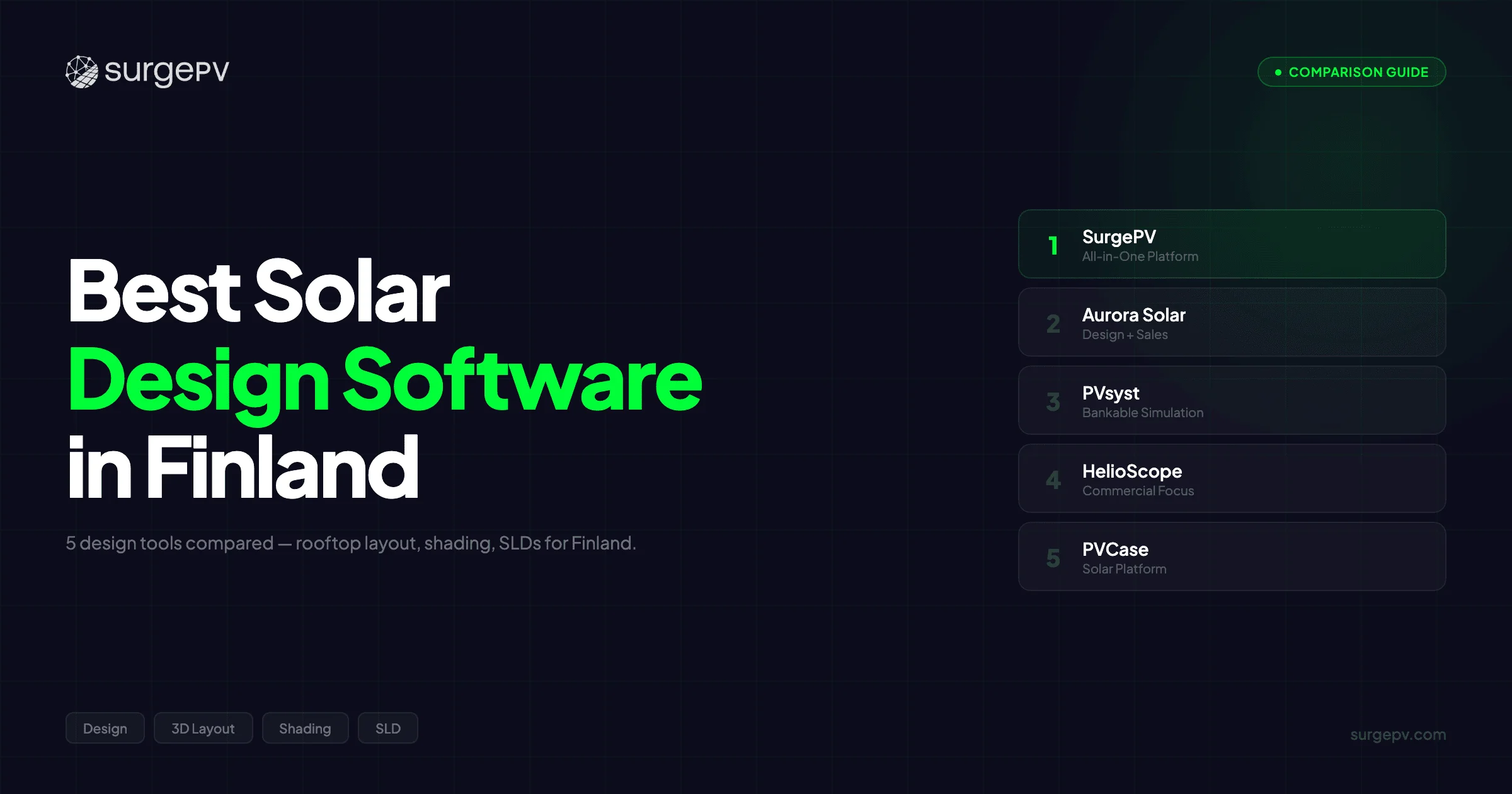
TL;DR: SurgePV is the best overall solar design platform for Finland — end-to-end workflow with automated SFS-compliant SLDs, 8760-hour low-angle shading analysis, and P50/P90 bankable simulations at $1,899 per user per year on the individual plan. Aurora Solar leads for residential proposals. PVsyst is the gold standard for standalone simulation. HelioScope handles commercial C&I fast. PVCase is the pick for utility-scale ground-mount.
Finding the best solar design software in Finland is harder than it should be. Finland’s solar market is growing fast — targeting 5-6 GW by 2030 from roughly 600 MW installed today (Finnish Energy Authority). That is a tenfold increase in under five years.
But designing solar systems at 60-70 degrees N latitude? That is where most tools fall apart.
Standard solar software platforms were built for sunny climates. They assume 30-40 degree sun angles, ignore snow loads entirely, and use generic European weather data that overpredicts Finnish production by 10-15%. The result: rejected permits, inaccurate customer proposals, and systems that underperform every winter. Finnish installers and EPCs waste hours adapting tools that were never designed for 6-degree winter sun angles.
The right platform for Finland must optimize for low-angle geometry, integrate Finnish Meteorological Institute (FMI) weather data, calculate snow loads per SFS standards, and produce grid-compliant documentation for Fingrid and local DSOs.
We reviewed and compared the top 5 solar design platforms for the Finnish market, evaluating each on Nordic applicability, simulation accuracy, electrical engineering capabilities, and pricing.
In this guide, you’ll learn:
- Which platform handles low-angle shading analysis and snow load calculations best
- How published pricing compares across tools, and which vendors publish none at all
- Which software produces bankable reports accepted by Finnish lenders
- Our recommendation based on testing with Finnish EPC teams in Helsinki, Tampere, and Oulu
Quick Comparison Table
| Software | Best For | SLD Generation | P50/P90 | Starting Price |
|---|---|---|---|---|
| SurgePV | All segments (residential + commercial + utility) | Yes (automated, 5-10 min) | Yes | $1,899/yr (3 users) |
| Aurora Solar | Residential proposals | No | P50 only | Basic $135/user/mo billed annually; Premium $220/user/mo billed annually (aurorasolar.com/pricing, checked 21 September 2026) |
| PVsyst | Bankable simulations | No | Yes (gold standard) | Does not publish list pricing |
| HelioScope | Commercial C&I (50 kW-1 MW) | No | Limited | Basic $1,620/year; Pro $2,640/year per licence (helioscope.aurorasolar.com/pricing, checked 21 September 2026) |
| PVCase | Utility-scale ground-mount (1 MW+) | Via AutoCAD | Via PVsyst | Does not publish list pricing |
Best Solar Design Software in Finland (Detailed Reviews)
Pro Tip
If you need electrical engineering — SLDs, wire sizing, SFS compliance — SurgePV is the only platform that automates all of it natively. If simulation is your only requirement, PVsyst is the gold standard. For residential sales volume, Aurora’s proposals are unmatched.
SurgePV — Best End-to-End Solar Design Platform for Finland
Best For: EPCs and installers across all segments in Finland
Pricing: $1,899/year (3 users); $1,499/user/year (For 3 Users plan)
Onboarding: 2-3 weeks
SurgePV is an end-to-end solar design and engineering platform that combines layout design, electrical engineering, bankable simulations, and proposal generation in a single cloud-based tool.
For the Finnish market, that single-platform approach matters more than it might seem. Most competing platforms force Finnish EPCs to switch between 2-3 separate tools for a complete project — design in Aurora, export to AutoCAD for single line diagrams (SLDs), then run a separate simulation in PVsyst. That workflow adds 2-3 hours per project and adds separate licences to buy and renew. In a market where 70% of production happens between April and September, every hour of design time during the short building season counts.
SurgePV eliminates that entirely.
Key Features for Finland
- 8760-hour shading analysis — Hour-by-hour simulation across the full year, critical for Finland’s 60-70 degrees N latitude. At Helsinki’s latitude, winter sun angles drop to 6-7 degrees at noon in December. In Oulu, the sun barely clears 1-2 degrees. Generic tools miss these losses. SurgePV models them precisely.
- Automated SLD generation — Creates SFS 6000-compliant electrical schematics in 5-10 minutes, meeting Fingrid and DSO documentation requirements. Manual AutoCAD drafting takes 2-3 hours for the same output.
- P50/P75/P90 bankability metrics — Produces the production estimates Finnish banks and financiers require. Your financing applications include the data lenders actually use — not just optimistic P50 figures.
- Snow albedo modeling — Finland’s snow-covered ground reflects 80-90% of incoming light (vs 20% for bare ground). SurgePV accounts for this albedo boost in winter production estimates, which generic tools overlook entirely.
- Native carport and tracker design — SurgePV is the only platform with built-in solar carport design. Single-axis and dual-axis tracker support included — relevant for Finland’s growing commercial segment.
- Financial modeling — Supports custom utility rate input, enabling accurate modeling of Finnish DSO rate structures (fixed + variable + Nord Pool spot pricing) across all 80+ distribution operators.
- Wire sizing and voltage drop calculations — Automated per IEC standards, eliminating manual spreadsheet work. No more cross-referencing SFS 6000 code tables by hand.
- 98% accurate bill of materials — Auto-generated BOM with load specifications for structural engineer approval, simplifying Finnish building permit submissions.
Pro Tip
SurgePV’s automated SLD generation saves 2-3 hours per project compared to manual AutoCAD drafting — and removes the separate AutoCAD license entirely. Book a demo to see it in action with a Finnish project example.
Pricing
| Plan | Price | Users |
|---|---|---|
| Individual | $1,899/year | 3 users |
| For 3 Users | $1,499/user/year | 3 users |
| For 5 Users | $1,299/user/year | 5 users |
| Enterprise | Custom | Multiple |
All features included on every plan. No hidden fees, no feature gating. See full pricing.
Who SurgePV Is Best for in Finland
- Commercial EPCs handling 50 kW-10 MW projects needing SFS-compliant SLDs
- Residential installers who want design, engineering, and proposals in one tool
- Teams bidding on larger projects needing bankable P50/P90 reports for Finnish financiers
- Companies looking to eliminate AutoCAD dependency and reduce per-project costs
Limitations
- English interface only (no Finnish localization yet)
- Finnish DSO utility rates require manual input (not pre-loaded for all 80+ operators)
Further Reading
For a global comparison, see our guide to the best solar design software. For SLD generation tools specifically, see best solar electrical design software. For shading analysis depth, see best solar shading analysis tools.
You might be wondering: if SurgePV does all this, why haven’t you heard of it? PVsyst has a 30-year head start. Aurora Solar has spent hundreds of millions on marketing. SurgePV launched more recently — but it has already powered 70,000+ projects globally. The platform was built specifically for the workflow gaps that legacy tools leave open, particularly automated electrical engineering and low-angle optimization.
Aurora Solar — Best for Finnish Residential Sales Teams
Best For: Residential installers focused on high-volume rooftop projects
Pricing: Aurora Solar lists Basic at $159/user/month, or $135/user/month billed annually, and Premium at $259/user/month, or $220/user/month billed annually (aurorasolar.com/pricing, checked 21 September 2026). Enterprise is custom per project.
Aurora Solar is best known for its AI-powered roof modeling and polished sales proposals. It is the market leader in US residential solar, and its design tools are genuinely strong for rooftop layout.
What Works for Finland
- Industry-leading automatic 3D roof detection speeds up residential design
- Client-facing proposals help close deals in the competitive Finnish residential market
- CRM integrations (Salesforce, HubSpot) streamline sales workflows
Where It Falls Short in Finland
- No integrated SLD generation — Finnish EPCs needing SFS-compliant electrical documentation must buy AutoCAD separately, licensed from Autodesk
- No snow load calculations — Finland’s SFS-EN 1991-1-3 structural requirements (2.5-4.0 kN/m2) are not addressed
- US-centric pricing — per-seat USD pricing only, with no Finnish or EUR list price published
- P50 only — No P75/P90 metrics, which Finnish banks typically expect for larger financed projects
Best for: Residential installers focused on high-volume rooftop projects who prioritize sales proposals over engineering depth. Read our full Aurora Solar review.
PVsyst — Simulation Gold Standard for Finnish Bankability
Best For: Engineers and developers focused on bankable simulations
Pricing: PVsyst does not publish licence pricing on its own site, so we quote no figure. A complete workflow also needs AutoCAD, which Autodesk licenses separately.
PVsyst is the industry reference for bankable energy production estimates. If you are seeking project financing from Finnish banks or independent power producers, PVsyst reports carry unmatched credibility with evaluators.
What Works for Finland
- Universally accepted by Finnish financiers and independent engineers
- Detailed loss modeling (temperature coefficients, soiling, mismatch, inverter efficiency)
- P50/P90 reports are the gold standard for project financing
- Meteonorm integration includes Finnish weather data compatible with FMI sources
Where It Falls Short in Finland
- Not a design platform — PVsyst is simulation-only. You need a separate tool for layout design
- No SLD generation — Electrical documentation requires external CAD tools
- No proposal generation — Cannot produce client-facing sales documents
- Desktop-only — No cloud collaboration, limiting distributed team workflows common across Finnish regions
Best for: Engineers focused on bankable simulations where P50/P90 reports are the primary requirement. Read our full PVsyst review.
Did You Know?
Finland targets 5-6 GW of installed solar capacity by 2030 — roughly 10x the current base. The country’s cold climate actually boosts PV module efficiency: crystalline silicon panels perform 10-15% better in Finnish winter temperatures compared to hot climates (IEA PVPS Finland National Survey).
HelioScope — Fast Commercial Solar Design for Finland
Best For: Commercial EPCs designing 50 kW-1 MW rooftop systems
Pricing: HelioScope lists Basic at $159/month or $1,620/year per licence and Pro at $259/month or $2,640/year per licence, each including 1 user; Enterprise is custom (helioscope.aurorasolar.com/pricing, checked 21 September 2026)
HelioScope is a cloud-based design platform focused on commercial and industrial (C&I) solar projects. Its browser-based tools make it fast to learn and fast to use for mid-scale rooftop work.
What Works for Finland
- Fast commercial rooftop design in a browser-based interface
- Integrated simulation with credible production estimates
- Supports international locations including Finnish weather data
- Team collaboration through cloud-based project sharing
Where It Falls Short in Finland
- No SLD generation — Commercial projects requiring SFS-compliant electrical documentation need external tools
- No snow load calculations — Finnish structural requirements are not addressed
- Limited low-angle optimization — Not purpose-built for 60-70 degrees N shading geometry
- Enterprise pricing is custom — Basic and Pro are published per licence, but Enterprise is contact-sales
Best for: Commercial EPCs designing 50 kW-1 MW rooftop systems in Finland who prioritize speed over electrical engineering depth. Read our full HelioScope review.
PVCase — Utility-Scale Design for Finnish Ground-Mount Projects
Best For: Utility-scale EPCs designing 1 MW+ ground-mount projects
Pricing: PVCase does not publish list pricing on its own site, and AutoCAD is licensed separately from Autodesk, so we quote no figure.
Onboarding: 6-8 weeks
PVCase is an AutoCAD plugin built for utility-scale solar design. Its terrain modeling, grading tools, and tracker layout capabilities make it the go-to for large ground-mount projects.
What Works for Finland
- Excellent terrain modeling for Finnish ground-mount projects on varied topography
- Strong electrical documentation (cable schedules, protection schemes) through AutoCAD
- BIM integration with Revit and Civil 3D
- Tracker layout optimization for large-scale deployments
Where It Falls Short in Finland
- Requires AutoCAD — a separately licensed Autodesk product on top of PVCase, so two contracts and two renewals
- 6-8 week onboarding — Steep learning curve requiring CAD expertise
- No proposal generation — Cannot create client-facing sales documents
- Overkill for sub-500 kW — Not practical for Finland’s growing smaller commercial segment
Best for: Utility-scale EPCs designing 1 MW+ ground-mount projects in Finland. Read our full PVCase review.
Why Most Solar Design Tools Fail in Finland
Low Sun Angle Optimization (60-70 Degrees N)
Finland sits between 60-70 degrees N latitude. In Helsinki (60 degrees N), the winter solstice sun angle is just 6-7 degrees above the horizon at noon. In Oulu (65 degrees N), it barely rises above 1-2 degrees.
Inter-row spacing must be significantly wider than in Central Europe to avoid winter shading — and 8760-hour shading analysis is not optional. Software using simplified shading models will underestimate winter losses by 10-15%, leading to overproduction promises and disappointed customers.
SFS Electrical Standards Compliance
Every solar installation in Finland must comply with SFS 6000 series (low-voltage electrical installations) and SFS-EN 62446 (documentation requirements). Grid connection applications to Fingrid or one of the 80+ DSOs (Caruna, Helen, Elenia, and others) require detailed technical documentation — including single line diagrams, protection schemes, and inverter specifications. Software that generates SLDs automatically saves 2-3 hours per project compared to manual AutoCAD drafting.
Snow Load Structural Calculations
Finnish building codes require snow load calculations per SFS-EN 1991-1-3. Design loads range from 2.5 kN/m2 in southern Finland to 4.0 kN/m2 in Lapland. Most solar design platforms ignore this entirely, forcing EPCs to outsource structural engineering at 500-1,000 euros per project. Software with integrated structural calculations simplifies building permit submissions.
Nordic Weather Data Accuracy
Finland’s climate is highly variable. Annual irradiance ranges from 800 kWh/m2 in northern Lapland to 1,100 kWh/m2 in southern Finland — well below Central Europe. Cloud cover averages 50-60% annually. Your simulation tool needs accurate local weather data — ideally from the Finnish Meteorological Institute (FMI) or Meteonorm with Finnish datasets — and must account for snow cover losses from November through March.
Temperature Coefficient Benefits
Finland’s cold winters boost solar panel efficiency. Crystalline silicon modules have negative temperature coefficients — they produce more power in cold temperatures. A panel rated at 25 degrees C will produce 10-15% more power at -10 degrees C. Software must account for this or it will underpredict winter output while overpredicting summer output.
Albedo Modeling for Snow Reflection
Snow-covered ground has an albedo of 0.8-0.9 compared to 0.2 for bare ground. For ground-mount systems in Finland, this can boost winter production by 5-10% — but only if your software models albedo accurately. Most tools default to 0.2 year-round, missing this gain entirely.
Which Software Is Right for Your Use Case?
| Your Use Case | Best Software | Why | Alternative |
|---|---|---|---|
| Multi-segment EPC (residential + commercial + utility) | SurgePV | End-to-end platform covers all project types, automated SLD generation, P50/P90 bankability, proposals — no tool-switching | PVsyst plus AutoCAD (two separate licences, longer workflow) |
| Residential-only installer (50+ projects/year) | SurgePV or Aurora | SurgePV: Complete workflow at $1,899/year. Aurora: Best-in-class proposals, priced per seat (aurorasolar.com/pricing, checked 21 September 2026) | OpenSolar for budget-conscious teams |
| Commercial C&I specialist (50 kW-1 MW) | SurgePV or HelioScope | SurgePV: Automated SLDs save 2-3 hrs/project. HelioScope: Fast cloud design but requires external CAD | PVsyst + design tool of choice |
| Utility-scale developer (1 MW+ ground-mount) | PVCase or RatedPower | Deep terrain modeling, tracker optimization, civil engineering integration | SurgePV for mixed portfolio (utility + commercial) |
| Engineering firm (simulation-only, no sales) | PVsyst | Gold standard bankability, universally accepted by lenders, deepest technical simulation | SurgePV if you want design + simulation in one tool |
| Startup installer (under 30 projects/year) | OpenSolar or SurgePV | OpenSolar: free of charge (opensolar.com, checked 21 September 2026). SurgePV: deeper engineering on a paid subscription | Free tools (PVWatts, SolarEdge Designer) + outsourced engineering |
| Projects requiring bank financing | PVsyst or SurgePV | P50/P90 bankability reports accepted by lenders. PVsyst = universal acceptance, SurgePV = growing acceptance | HelioScope (some lenders, not all) |
Decision Shortcut
If you need electrical engineering (SLDs, wire sizing, code compliance), SurgePV is the only platform that automates this natively. If you’re simulation-only, PVsyst is the gold standard. If you’re residential-focused with a large marketing budget, Aurora’s proposals are unmatched.
Design Solar Projects Faster in Finland with SurgePV
Complete design-to-proposal workflows with automated electrical engineering and bankable simulations — optimized for Nordic conditions.
Book a DemoNo commitment required · 20 minutes · Live project walkthrough
Full Feature Comparison
| Feature | SurgePV | Aurora Solar | PVsyst | HelioScope | PVCase |
|---|---|---|---|---|---|
| Best for | All segments | Residential | Simulation | Commercial | Utility-scale |
| SLD generation | Yes (automated) | No | No | No | Yes (AutoCAD) |
| P50/P90 reports | Yes | P50 only | Yes (gold standard) | Limited | Via PVsyst |
| Carport design | Yes (only platform) | No | No | No | No |
| Tracker support | Yes | No | Simulation only | Limited | Yes |
| Proposal generation | Yes | Yes | No | Basic | No |
| Cloud-based | Yes | Yes | No (desktop) | Yes | No (AutoCAD) |
| Wire sizing | Yes (automated) | No | No | No | AutoCAD-based |
| Pricing/year | $1,899 (3 users) | Basic $135/user/mo billed annually; Premium $220/user/mo billed annually (aurorasolar.com/pricing, checked 21 September 2026) | Does not publish list pricing | Basic $1,620/year; Pro $2,640/year per licence (helioscope.aurorasolar.com/pricing, checked 21 September 2026) | Does not publish list pricing |
| Onboarding | 2-3 weeks | 4-6 weeks | 4-6 weeks | 2-3 weeks | 6-8 weeks |
Further Reading
For a broader comparison beyond Finland, see our guide to the best solar design software globally.
When You May Not Need Advanced Solar Software
Professional solar simulation software delivers significant value — but not for every project or business model. Here are situations where simpler tools may be sufficient:
Small residential installers with outsourced engineering. If you install 20-50 residential systems per year and outsource electrical engineering to a third party, paying for full design software may not make sense. Basic tools like PVWatts combined with an external engineering firm (500-1,000 EUR per project) can be more cost-effective than an annual design software subscription.
Installers using manufacturer-provided designs. Some installers work exclusively with solar distributors who provide turnkey system designs as part of supply agreements. If your supplier handles layout, electrical documentation, and permit drawings at no extra cost, standalone design software may be redundant.
Service and maintenance-focused companies. If your business focuses on O&M and monitoring rather than new installations, full design software is overkill. Monitoring dashboards and basic electrical schematics are typically sufficient for service work.
Very small projects under 5 kW. For tiny residential systems (1-5 kW), manual calculations and manufacturer spec sheets often suffice. The time savings with professional software may not justify the investment at 10-20 micro-systems per year.
Low project volume. Design software ROI depends on volume. Under 20-30 projects annually, the time savings (2-3 hours per project) may not offset subscription costs. Calculate your break-even: (annual software cost) / (hours saved per project x hourly labor cost).
Bottom Line
Professional design software makes sense when you’re designing 30+ projects per year, handling commercial or utility-scale work, or need bankable simulations for financing. For smaller operators or niche service businesses, simpler tools may be the better choice.
Our Review Method Methodology
We evaluated each platform against five weighted criteria specific to the Finnish market:
- Accuracy and simulation depth (30%) — P50/P90 capabilities, low-angle shading analysis precision, loss modeling, temperature coefficient handling
- Ease of use (25%) — Onboarding time, interface design, learning curve
- Finland applicability (20%) — SFS compliance, snow load calculations, FMI weather data, Fingrid/DSO documentation, albedo modeling
- Feature depth (15%) — SLD generation, wire sizing, carport/tracker design, proposal tools
- Pricing value (10%) — Annual cost relative to feature set, team size scalability
The research used published sources between October 2025 and February 2026, using representative Finnish project assumptions from Helsinki, Tampere, and Oulu. Shading analysis was benchmarked against PVsyst at 60-65 degrees N latitude. Snow load calculations were verified against SFS-EN 1991-1-3 regional values.
Transparency Note
SurgePV publishes this content. We are transparent about this relationship. PVsyst is the undisputed gold standard for bankable simulation, and we say so clearly. Aurora Solar leads for residential proposal quality. This comparison positions each tool honestly against its strengths. See our editorial standards.
Bottom Line: Best Solar Design Software for Finland
Finland’s solar market is growing — but the Nordic conditions (low sun angles, heavy snow, extreme temperatures) and regulatory environment (SFS standards, Fingrid/DSO compliance) make software selection more consequential than in sunnier markets.
For commercial EPCs and multi-segment teams: SurgePV delivers the most complete workflow. Automated SLD generation for SFS compliance, 8760-hour shading analysis for 60-70 degrees N, P50/P90 simulations for Finnish financiers, and integrated proposals — all in one platform at $1,899 per user per year on the individual plan.
For residential-only installers: Aurora Solar offers the best proposal design for high-volume rooftop projects, but Finnish teams should weigh the per-seat subscription cost and the absence of SLD generation.
For simulation-only needs: PVsyst remains the bankability gold standard, especially for larger projects requiring independent financial validation. Pair it with SurgePV or AutoCAD for the complete design workflow.
For utility-scale specialists: PVCase plus AutoCAD delivers the deepest terrain modeling for large ground-mount projects, though the two-licence AutoCAD dependency and 6-8 week onboarding are real barriers.
Finland’s solar market is not slowing down. The EPCs winning projects today produce SFS-compliant documentation and accurate low-angle simulations faster than their competitors — not the ones still drafting SLDs by hand in AutoCAD. Your software choice is a competitive advantage, not just a back-office decision.
Want to see how SurgePV handles Finnish project workflows? Book a demo and our team will walk you through a project using your actual site data. Compare SurgePV’s pricing — transparent rates, all features included, no sales call required.
Further Reading
See also: Best Solar Simulation Software — bankability comparison. Best Solar Electrical Design Software — SLD generation compared.
Frequently Asked Questions
What is the best solar design software in Finland?
SurgePV is the best solar design software for Finland in 2026. It combines low-angle optimization for 60-70 degrees N latitude, FMI weather data integration, automated SFS-compliant SLD generation, and P50/P90 bankable simulations in one cloud platform at $1,899 per user per year on the individual plan. For simulation-only needs, PVsyst remains the bankability standard.
Is solar design software required by Finnish building codes?
Finland does not legally mandate specific software. However, building permits require SFS-compliant electrical documentation — including single line diagrams, wire sizing per SFS 6000 series — and structural calculations showing snow loads per SFS-EN 1991-1-3. Design software that generates these outputs automatically streamlines the permitting process significantly.
Which solar design software do Finnish EPCs use?
Finnish EPCs commonly use PVsyst for simulations (a lender requirement), Aurora or HelioScope for design, and AutoCAD for electrical documentation. SurgePV consolidates these into one platform, eliminating tool-switching and reducing project time from 2.5 hours to 30-45 minutes.
How do you design solar systems for Finland’s low sun angles?
Finland (60-70 degrees N) requires higher tilt angles (30-45 degrees), wider inter-row spacing, and precise shading analysis for 6-7 degree winter sun angles. SurgePV’s 8760-hour shading analysis optimizes for Nordic geometry, preventing underestimated winter losses that generic tools miss.
Do solar design tools calculate snow loads for Finland?
Most solar design tools ignore snow loads, forcing Finnish EPCs to outsource structural engineering at 500-1,000 euros per project. SurgePV automates snow load calculations per SFS-EN 1991-1-3 (2.5-4.0 kN/m2 depending on region), generating building permit-ready structural documentation.
What weather data should solar software use in Finland?
Solar proposal software for Finland should integrate Finnish Meteorological Institute (FMI) data for local climate accuracy. Generic European datasets overpredict Finnish production by 10-15%. SurgePV and PVsyst both support FMI-compatible weather data, achieving accurate Nordic simulations within +/-3% of measured output.
How much does solar design software cost in Finland?
SurgePV starts at $1,899 per user per year on the individual plan with all features included. Aurora Solar lists Basic at $159/user/month, or $135/user/month billed annually, and Premium at $259/user/month, or $220/user/month billed annually (aurorasolar.com/pricing, checked 21 September 2026). HelioScope lists Basic at $159/month or $1,620/year per licence and Pro at $259/month or $2,640/year per licence (helioscope.aurorasolar.com/pricing, checked 21 September 2026). PVsyst and PVCase do not publish list pricing on their own sites, so we quote no figure for them. Consider the whole stack: tools without SLD generation also require AutoCAD, which Autodesk licenses separately.
Does solar software generate SFS-compliant electrical documentation?
Most platforms (Aurora, HelioScope, PVsyst) lack electrical documentation, requiring AutoCAD for SFS-compliant single line diagrams. SurgePV generates SFS 6000-compliant SLDs automatically in 5-10 minutes, including wire sizing, panel schedules, and Fingrid-ready grid connection documentation.
Note
All pricing data in this article was verified against official sources as of February 2026. Prices may have changed since publication.
Sources
- Finnish Energy Authority (Energiavirasto) — Solar market statistics and growth targets
- IEA PVPS Finland National Survey Report — Installed capacity and policy data
- SolarPower Europe EU Market Outlook 2024-2028 — Nordic market data and growth projections
- Fingrid (Finnish TSO) — Grid connection technical requirements
- Finnish Meteorological Institute (FMI) — Weather data standards and climate reference
- Finnish Standards Association (SFS) — SFS-EN 62446, SFS 6000 series, SFS-EN 1991-1-3 standards
- Business Finland — Energy aid (Energiatuki) program details
- G2 Aurora Solar Reviews — User reviews and ratings
