Pros
Cons
TL;DR: Pipe Solar is a usage-based solar proposal and CRM platform that charges $15 per proposal with no fixed monthly fee. The 3-click workflow — pricing, financing approval, e-signature — is genuinely fast, and Copilot AI claims 35% efficiency gains on project milestones. For residential installers running under 30 proposals per month, the cost model works. For high-volume operations, costs hit $18,000/year at 100 proposals per month, and the platform has no electrical engineering at all — no SLDs, no wire sizing, no commercial structure support. For teams needing a complete design-to-proposal workflow, SurgePV — the leading solar design software — delivers automated SLDs, commercial structure design, and bankable accuracy from a single platform.
Author: Keyur Rakholiya Title: Contributing Writer, SurgePV | MD & CEO, Heaven Green Energy Limited Expertise: 1+ GW solar projects delivered, 20+ design software platforms tested, 10+ years EPC operations Published: 2026-03-08 Last Updated: 2026-03-08 Review Methodology: Official Pipe Solar documentation (pipe.solar), Scanifly partnership announcement, Capterra reviews, competitive testing against Aurora Solar, OpenSolar, and SurgePV
Who This Review Is For
This review covers Pipe Solar across pricing, features, user feedback, and competitive positioning. It helps you decide whether it fits your workflow — or whether an alternative is the better call.
This review is useful if you are:
- A residential solar installer evaluating usage-based pricing vs fixed subscriptions
- A sales-first team looking for the fastest path from prospect to signed contract
- A solar company with variable seasonal volume wanting to minimize fixed overhead
- An EPC comparing Pipe Solar vs Aurora, OpenSolar, or SurgePV
Skip this review if you are:
- A commercial EPC needing SLD generation or electrical engineering
- An installer designing carports, trackers, or large ground-mount systems
- A team requiring bankable simulation accuracy validated against PVsyst
- A high-volume operation running more than 80 proposals per month (pricing scales fast)
What Is Pipe Solar?
Pipe Solar is a cloud-based solar proposal and operations platform built around three functions: design, proposals, and CRM. It was founded by Do Hyun Jin and Ryan Soni and is headquartered in Washington DC (655 15th St NW Ste 800). The product targets residential and light commercial solar installers who want to move fast from lead to signed contract without managing multiple disconnected tools.
Company Background
| Detail | Info |
|---|---|
| Founded | Washington DC (year not publicly disclosed) |
| Founders | Do Hyun Jin and Ryan Soni |
| Headquarters | 655 15th St NW Ste 800, Washington, DC 20005 |
| Team Size | Small team (not publicly disclosed) |
| Primary Market | United States residential solar |
| Business Model | Usage-based — $15 per proposal, no monthly subscription |
Core Value Proposition
Pipe Solar’s pitch is speed and cost alignment. Unlike Aurora Solar or Enact, which charge flat monthly subscriptions regardless of project volume, Pipe Solar charges per proposal. In slow months, you pay less. The platform also positions its 3-click workflow — pricing, financing approval, document signing — as the fastest path from prospect to close.
The 2025 Scanifly partnership added 3D LiDAR-assisted design to the platform, embedding accurate site surveys directly into the sales workflow rather than treating design and proposals as separate steps.
What Pipe Solar Is Not
Pipe Solar is not an electrical engineering tool. There is no SLD generation, no wire sizing, no voltage drop calculation, no conduit fill analysis. It does not support carport solar design, solar trackers, or large ground-mount systems. It is built for residential sales, not commercial engineering.
Positioning Note
Pipe Solar describes itself as a “next-generation solar proposals and CRM platform.” The word “design” appears in its marketing, but design in this context means satellite-based roof layouts for proposals — not engineering drawings for permits or construction.
Pipe Solar Pricing & License Cost
Pipe Solar pricing uses a pay-per-proposal model. There is no fixed monthly subscription fee. This is the platform’s most distinctive feature and also its most important variable for total cost analysis.
Pipe Solar License Price 2026
| Metric | Detail |
|---|---|
| Base rate | $15 per proposal |
| Monthly fee | None |
| Users included | Unlimited |
| Volume pricing | Not publicly disclosed |
| CAD & permitting | Waived for license holders |
| Concierge option | Available (can be passed to homeowner) |
Cost at Scale
| Monthly proposals | Annual cost |
|---|---|
| 10 | $1,800/year |
| 20 | $3,600/year |
| 30 | $5,400/year |
| 50 | $9,000/year |
| 100 | $18,000/year |
The usage-based model is cost-effective at lower volumes but stops being competitive above roughly 50 proposals per month when compared to flat-rate platforms with broader capabilities.
Is Pipe Solar Free? Free Trial
Pipe Solar does not offer a free plan. There is no published free trial. Because the pricing is usage-based, teams could in principle create a single test proposal at $15 to evaluate the platform. Contact pipe.solar directly to discuss evaluation options before committing.
Total Cost of Ownership Comparison
| Workflow | Annual Cost |
|---|---|
| Pipe Solar (30 proposals/month) | ~$5,400/year |
| Pipe Solar (100 proposals/month) | ~$18,000/year |
| Pipe Solar + AutoCAD for SLDs | +$2,000/year additional |
| SurgePV (3 users, all-inclusive) | $1,499/user/year |
| Aurora Solar (estimated) | ~$4,800–$6,000/year |
Hidden Cost Warning
Pipe Solar’s $15/proposal base rate covers proposals only. Teams needing SLDs, electrical drawings, or permit packages still require separate tools (AutoCAD, SketchUp, or a permit service). SurgePV includes all of this natively with no additional software license required.
Core Features & Capabilities
Design Tools
Pipe Solar offers three design pathways:
- Professional design team — Submit project details; the Pipe Solar team returns a completed design in 5–10 minutes at 97% accuracy.
- AI-generated layout — Automated panel layout in seconds using satellite imagery.
- Self-serve design — Full manual customization using HD satellite imagery and LiDAR data.
The Scanifly integration (announced 2025) adds 3D LiDAR-assisted site surveys directly into the workflow. Before this partnership, Pipe Solar’s design relied entirely on satellite imagery. Now installers can embed accurate 3D roof measurements into the proposal without a separate site survey step.
The 97% design accuracy claim refers to designs produced by the professional team pathway. This means fewer change orders on installation day — a real cost saving for residential contractors. No independent variance methodology (such as ±% vs PVsyst) is published.
Pro Tip
If you use the professional design pathway at $15/proposal, you are essentially outsourcing your design work to Pipe Solar’s team. For installers without in-house designers, this removes a hiring cost. For teams with existing designers, the cost-per-proposal model may be less efficient than a flat monthly tool.
Pipe Solar CRM & Project Management
Pipe Solar includes a built-in operations CRM. This is not a bolt-on module — project management is core to the platform’s value proposition.
CRM capabilities:
- Milestone tracking across the full project lifecycle
- Kanban-style pipeline management
- Real-time status tracker for instant project insights
- Early identification of potential delays
- Customer portal giving homeowners direct access to project progress
- Sub-dealer invites for multi-tier sales organizations
Integrations:
- GHL (GoHighLevel) for advanced CRM workflows
- Zapier for connecting external apps
- Slack and Gmail for automated notifications
- Inventory control built into the platform
The customer portal is a differentiator. Homeowners can log in to track their own project status rather than calling the installer for updates. This reduces inbound support volume for residential operations.
Proposals & Financing
The proposal workflow is Pipe Solar’s strongest feature. The 3-click path from pricing to financing approval to signed document is the fastest sequence in this category.
Proposal features:
- Interactive, branded proposals with real-time visual timeline for homeowners
- Instant financing approvals in 5 seconds via GoodLeap, Mosaic, and TPO
- E-signatures with audit trails
- Mobile-responsive customer portal
- Financing options include cash, loan, lease, and PPA structures
Speed matters here. A financing approval in 5 seconds vs. waiting for a lender callback closes more deals during the in-home consultation. Pipe Solar has clearly engineered the proposal experience for maximum conversion at the point of sale.
Copilot AI Automation
Pipe Solar’s Copilot AI handles project milestone automation. The platform claims a 35% efficiency gain through automated tasks:
- Automatically creates and imports leads
- Auto-requests CAD drawings and files permits
- Sends notifications via Slack and Gmail integrations
- Tracks milestone completion without manual input
The 35% efficiency figure is Pipe Solar’s own claim. No independent audit of this number is published. That said, automating lead creation, permit filing requests, and Slack/email notifications are genuine time savings in residential solar operations.
What Copilot AI Does Not Do
Copilot AI automates project management milestones — it is not a design AI, does not generate SLDs, and does not perform shading or energy simulation. “AI” in this context means workflow automation, not engineering intelligence.
What Pipe Solar Cannot Do
For commercial EPCs evaluating Pipe Solar, these gaps are disqualifying:
| Capability | Pipe Solar | SurgePV |
|---|---|---|
| SLD generation | No | Automated, 5–10 min |
| Wire sizing | No | Yes |
| Voltage drop calculation | No | Yes |
| Conduit fill | No | Yes |
| Carport solar design | No | Yes |
| Solar tracker design | No | Yes |
| East-West racking | No | Yes |
| Bankable simulation accuracy | Not published | ±3% vs PVsyst |
| Commercial structures | No | Yes |
Need More Than Proposals?
SurgePV handles the full workflow — design, SLD generation, shading analysis, and proposals — in a single platform built for commercial EPCs.
Book a DemoNo commitment required · 20 minutes · Live project walkthrough
User Reviews & Feedback
Pipe Solar has limited third-party review data. The platform is not listed on G2 or TrustRadius as of March 2026. A small number of reviews appear on Capterra under the “Solar Pipeline” product listing.
Available Review Data
| Platform | Listings | Status |
|---|---|---|
| G2 | Not listed | No independent reviews |
| TrustRadius | Not listed | No independent reviews |
| Capterra | Listed as “Solar Pipeline” | Small number of reviews |
| Website testimonials | 3 published | Company-selected |
What Users Praise (Capterra / Website)
Based on available Capterra reviews and published testimonials:
| Rank | Feature | Source |
|---|---|---|
| 1 | Usage-based pricing — cost-effective for seasonal businesses | Capterra |
| 2 | 3-click proposal-to-signing workflow speed | Testimonials |
| 3 | 97% design accuracy reducing change orders | Platform claim |
| 4 | AI automation saves significant time | Testimonials |
| 5 | Customer portal for homeowner updates | Testimonials |
Direct user quote (Capterra): “Solar Pipeline works seamlessly and provides features needed to manage solar leads and easily increase sales.”
What Users Criticize
| Rank | Issue | Source |
|---|---|---|
| 1 | Learning curve to master all features | Capterra |
| 2 | Time investment for full proficiency | Capterra |
| 3 | Limited public review data makes independent validation difficult | Industry observation |
Review Data Limitation
Pipe Solar is a newer platform. The absence of G2 and TrustRadius reviews is not necessarily a negative signal — it reflects recency, not poor performance. Evaluate it through a trial proposal rather than relying on third-party scores that don’t yet exist.
Pros & Cons
✅ Pros
1. Usage-Based Pricing Aligns Cost with Revenue ⭐ UNIQUE ADVANTAGE
Most solar software charges $200–$500/month regardless of whether you’re closing deals. Pipe Solar charges $15 per proposal. During a slow January, you pay $15 if you create one proposal. This is genuinely valuable for seasonal businesses and for startups that cannot justify $3,000/year in fixed software overhead before they scale.
2. 3-Click Workflow to Signed Contract
From pricing to financing approval to e-signature in three clicks. The 5-second instant financing approval via GoodLeap, Mosaic, and TPO is the fastest in-home closing experience available in this category. For residential sales reps running same-day appointments, this workflow reduces the time between “yes” and a legally binding signature.
3. Professional Design Team at No Extra Markup
The 5–10 minute professional design turnaround is included in the $15/proposal fee. For small installers without in-house design staff, this removes a hiring cost. The 97% accuracy claim means fewer costly change orders on installation day.
4. Copilot AI Cuts Administrative Overhead
Automated lead imports, permit filing requests, and Slack/Gmail notifications eliminate manual administrative steps. The 35% efficiency gain claim is unverified by a third party, but the underlying automations (lead creation, permit requests, notifications) are genuine time savers in a residential sales workflow.
5. Scanifly LiDAR Integration for Accurate Site Surveys
The 2025 Scanifly partnership brings 3D LiDAR measurements into the proposal workflow. This is a meaningful upgrade — accurate roof geometry means more precise proposals and fewer surprises at installation.
6. Unlimited Users
No per-seat pricing. A 10-person sales team and a 2-person team pay the same per-proposal rate. This is unusual in solar software, where most platforms charge per user.
⚠️ Cons
1. No Electrical Engineering ⚠️ CRITICAL
No SLD generation. No wire sizing. No voltage drop. No conduit fill. If your projects require permit drawings, you need a separate tool. For residential-only installers in states with simple AHJ requirements, this may be manageable. For anyone touching commercial work, this is a hard stop.
2. Costs Scale Aggressively at Volume (N G2 mentions: N/A — internal analysis)
At 100 proposals per month, annual cost is $18,000. That is more expensive than Aurora Solar, more expensive than SurgePV for 3 users, and carries none of the engineering capabilities. The usage-based model is only cost-effective below roughly 40–50 proposals per month depending on what alternative you compare it against.
3. No Commercial Structure Support
No carport solar design. No tracker design. No East-West racking. If your pipeline includes any commercial or ground-mount projects, Pipe Solar cannot handle the design side.
4. Limited Independent Review Data
No G2 or TrustRadius listing means no structured feedback at scale. Buyers cannot compare ease-of-use scores, implementation success rates, or support quality against category benchmarks. This makes third-party validation impossible before purchase.
5. Scanifly Dependency for 3D Design
The 3D LiDAR capability is not native. It runs through a Scanifly partnership. Changes to that partnership — pricing, terms, availability — could affect the design workflow. Platforms with native LiDAR capabilities (or native 3D engines) carry less integration risk.
6. Volume Pricing Not Disclosed
The $15/proposal base rate is clear. What happens at 500 proposals per month is not. For high-volume operations evaluating total annual cost, this makes precise budgeting impossible without a direct sales conversation.
Pipe Solar vs SurgePV
Pipe Solar and SurgePV address different parts of the solar workflow. Pipe Solar is a proposal and CRM tool. SurgePV is a full design, engineering, simulation, and proposal platform. This comparison matters because residential teams sometimes consider one when they need the other.
Feature Comparison
| Feature | Pipe Solar | SurgePV | Winner |
|---|---|---|---|
| Proposal generation | 3-click workflow, fast | Full branded proposals | Pipe Solar (speed) |
| SLD generation | No | Automated, 5–10 min | SurgePV |
| Wire sizing | No | Yes | SurgePV |
| CRM | Built-in operations CRM | Integrates with existing CRM | Pipe Solar (native) |
| Commercial structures | No | Carports, trackers, East-West | SurgePV |
| Shading analysis | Via Scanifly (LiDAR) | Native shadow analysis | SurgePV |
| Pricing model | $15/proposal (usage-based) | $1,499/user/year (flat) | Depends on volume |
| Bankable accuracy | Not published | ±3% vs PVsyst | SurgePV |
| Financing integrations | GoodLeap, Mosaic, TPO | Included in proposals | Pipe Solar (breadth) |
| User limit | Unlimited | Per-user pricing | Pipe Solar |
| G2 reviews | Not listed | Established presence | SurgePV |
Workflow Time Comparison (30 kW Residential Project)
| Step | Pipe Solar | SurgePV |
|---|---|---|
| Roof design | 5–10 min (pro team) | Integrated with proposal |
| Shading simulation | Via Scanifly | Native, included |
| Financing approval | 5 seconds (instant) | Via proposal tool |
| SLD generation | Not available | 5–10 min (automated) |
| Proposal to signature | 3-click workflow | 15–20 min |
| Total (proposal only) | Under 30 min | 45–60 min |
| Total (with SLD for permit) | Not possible | 60–75 min |
For pure residential sales without permit drawings, Pipe Solar’s workflow is faster. For any project requiring electrical documentation, Pipe Solar cannot complete the job.
Annual Cost Comparison
| Scenario | Annual Cost |
|---|---|
| Pipe Solar (30 proposals/month) | ~$5,400/year |
| Pipe Solar (50 proposals/month) | ~$9,000/year |
| SurgePV (3 users, all-inclusive) | ~$4,497/year ($1,499/user) |
| Aurora Solar (estimated, 1 user) | ~$4,800–$6,000/year |
At 30 proposals per month, SurgePV at 3 users is already comparable in cost — and includes SLD generation, shading analysis, and commercial structure support that Pipe Solar does not offer.
Pipe Solar Alternatives
SurgePV
The solar design software built for EPCs that need complete electrical engineering alongside proposals. Automated SLD in 5–10 minutes, native shadow analysis, carport and tracker design, and ±3% accuracy vs PVsyst. Pricing from $1,499/user/year. Best for commercial EPCs and multi-market operations.
Aurora Solar
Aurora is the established residential sales platform with AI-based roof detection, full shading simulation, and a polished proposal builder. It charges a flat monthly subscription and has the broadest third-party review base in the category. Best for residential-focused teams wanting a proven platform with a large user community.
OpenSolar
OpenSolar offers a free base tier, making it the lowest-cost entry point in solar proposal software. It supports design, proposals, and basic financial modeling. The free plan limits some features, but for budget-constrained early-stage installers, it is the most accessible starting point. See the full OpenSolar comparison for details.
Arka360
Arka360 is a strong option for India-focused installers or teams needing a native CRM built into their design platform. Pricing starts at $199/month. It covers residential and commercial design, proposals, and shading — with the limitation that electrical engineering is basic and may require AutoCAD for complex projects.
SolarMonkey
SolarMonkey is a European proposal and CRM platform. It covers residential solar proposals, financing, and customer communication workflows. Best for European installers who need country-specific compliance and local financing integrations.
Scanifly
Scanifly is the site survey and 3D design tool that Pipe Solar now integrates with. If 3D LiDAR-based roof measurement is the primary need, Scanifly as a standalone product gives you direct access to that capability. Pipe Solar’s Scanifly integration is convenient but does add a dependency layer.
Who Should Use Pipe Solar?
Best Fit for Pipe Solar
Residential-only installers with variable monthly volume. If you close 10–30 projects per month and those numbers fluctuate seasonally, the usage-based model aligns software cost with actual revenue. You pay more in summer, less in winter.
Sales-first teams without engineering requirements. If your AHJ accepts manufacturer-generated permit packages and you outsource electrical drawings, Pipe Solar’s proposal speed and financing integration handle everything you actually need at the point of sale.
Small companies with multiple sales reps. Unlimited users at $15/proposal means a 10-person sales team pays the same per-proposal rate as a solo installer. For growing residential teams, this matters.
Installers already using GoHighLevel. The GHL integration means Pipe Solar can slot into an existing CRM stack rather than replacing it.
Who Should Use SurgePV?
Commercial EPCs. If any project in your pipeline requires SLD generation, wire sizing, or commercial structure design, Pipe Solar cannot complete it. SurgePV handles the full engineering-to-proposal workflow.
High-volume residential operations. Above 50 proposals per month, usage-based pricing at $15/proposal becomes expensive compared to a flat-rate platform that includes electrical engineering.
Teams needing bankable simulation. SurgePV’s ±3% accuracy vs PVsyst is documented and suitable for financier review. Pipe Solar publishes no simulation accuracy data.
Multi-market EPCs (India + US). SurgePV supports both markets with equal focus. Pipe Solar is US residential only.
Frequently Asked Questions
What is Pipe Solar?
Pipe Solar (also written as pipesolar) is a cloud-based solar proposal and operations CRM platform founded in Washington DC. It charges $15 per proposal with no monthly subscription, includes unlimited users, and offers a 3-click workflow from pricing to financing approval to signed contract. It is built for residential solar sales teams, not for commercial engineering.
How much does Pipe Solar cost?
Pipe Solar costs $15 per proposal. There is no fixed monthly fee. Unlimited users are included. At 30 proposals per month, that is $5,400/year. At 100 proposals per month, $18,000/year. Volume pricing above the base rate is not publicly disclosed.
What is the Pipe Solar login process?
Access Pipe Solar at pipe.solar. Setup takes 3–7 days. The platform includes a customer portal that gives homeowners their own login to track project status, separate from the installer’s login.
Does Pipe Solar have a CRM?
Yes. Pipe Solar includes a built-in operations CRM with milestone tracking, Kanban pipeline management, and a customer portal. It integrates with GoHighLevel and Zapier for external CRM connections.
What are the best Pipe Solar alternatives?
The main alternatives are:
- SurgePV — best for commercial EPCs needing full electrical engineering and solar proposal software
- Aurora Solar — established residential platform with broad review base
- OpenSolar — free tier available, strong for budget-conscious teams
- Arka360 — built-in CRM, strong India focus, $199/month
Does Pipe Solar generate SLDs?
No. Pipe Solar does not generate single line diagrams, wire sizing calculations, voltage drop analysis, or any electrical engineering documentation. Teams needing SLDs should evaluate SurgePV, which produces permit-ready SLDs automatically in 5–10 minutes.
Is Pipe Solar good for commercial solar?
No. Pipe Solar is designed for residential solar sales. It has no commercial structure support (carports, trackers, ground-mount), no electrical engineering, and no published simulation accuracy for bankable projects. Commercial EPCs should use a platform built for engineering-grade output.
Final Verdict
Pipe Solar Executive Summary
Strengths:
- Usage-based pricing removes fixed monthly overhead for low-volume operations
- 3-click proposal-to-signature workflow is the fastest in the residential category
- 97% design accuracy (professional team pathway) reduces change orders
- Copilot AI handles milestone automation with claimed 35% efficiency gains
- Unlimited users at all tiers
- Scanifly 3D LiDAR integration adds accurate site survey capability
Limitations:
- No electrical engineering — no SLD, wire sizing, or voltage drop
- No commercial structure support — carports, trackers, ground-mount not available
- Costs scale to $18,000/year at 100 proposals/month — expensive at high volume
- No G2 or TrustRadius presence — limited independent validation
- Bankable accuracy not published — no ±% vs PVsyst or equivalent
The Decision Framework
Choose Pipe Solar when:
- Residential-only, fewer than 40–50 proposals/month, no SLD requirement
- Variable seasonal volume where fixed monthly fees feel wasteful
- Multiple sales reps and unlimited-user pricing matters
- Speed of proposal-to-signature is the primary competitive need
Choose SurgePV when:
- Any project requires SLD generation or electrical engineering
- Commercial structures (carports, trackers) are in the pipeline
- Volume exceeds 30–40 proposals/month and a flat annual cost makes more sense
- Bankable project accuracy is required for financier review
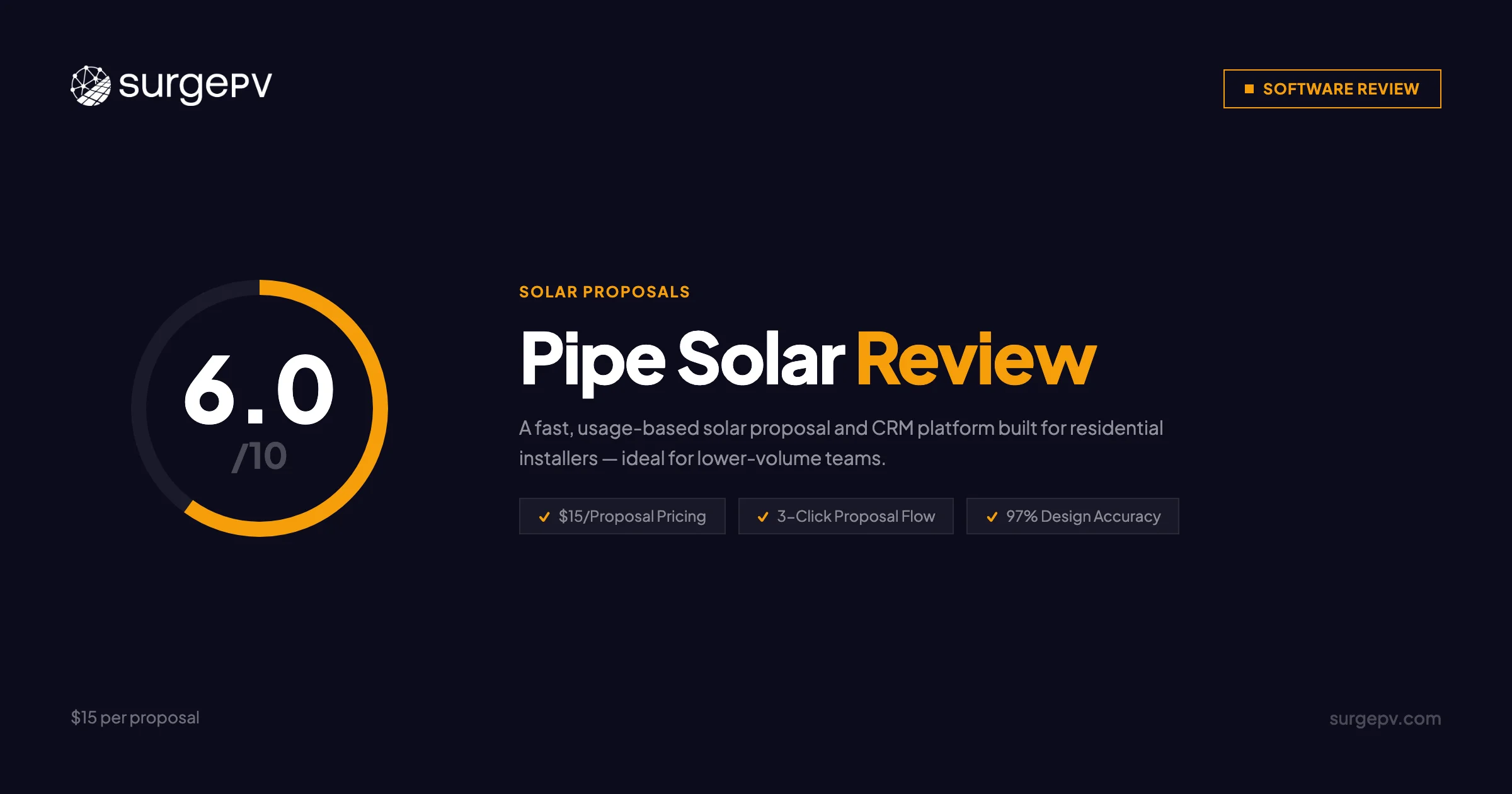
Rating: 6/10
Pipe Solar earns a 6 for what it does well within a narrow scope. The usage-based model is genuinely innovative. The 3-click workflow is the best in residential proposal speed. But the complete absence of electrical engineering, the lack of commercial structure support, and the limited independent review data hold it back. It is a proposal and CRM tool that does its job well. It is not a solar design platform.
Take the Next Step
If Pipe Solar’s proposal speed appeals to you but you need electrical engineering and commercial capabilities, SurgePV covers both without switching tools.
- Book a demo — see SurgePV’s automated SLD generation and proposal workflow live
- Pricing calculator — calculate your annual cost vs Pipe Solar at your proposal volume
- Compare platforms — full comparison of solar proposal and design platforms
- Solar proposal software — how SurgePV handles proposals alongside full engineering
Related Resources
Platform Comparisons:
- Arka360 Review — built-in CRM, India focus, full design and proposals
- Best Solar Design Software — complete platform comparison guide
Feature Deep Dives:
- Solar Proposals — SurgePV’s proposal generation capabilities
- Shadow Analysis — native shading simulation vs Pipe Solar’s Scanifly integration
- Generation & Financial Tool — ROI modeling and financial analysis
This Pipe Solar review was written by Keyur Rakholiya, Contributing Writer at SurgePV and MD & CEO of Heaven Green Energy Limited, with 1+ GW of solar project experience and hands-on testing of 20+ design software platforms. All Pipe Solar information is sourced from official pipe.solar documentation, the Scanifly partnership announcement (2025), and Capterra reviews. We maintain editorial independence and disclose our company affiliation transparently.
Review last updated: March 8, 2026 | Next review: June 2026
About the Contributors

Co-Founder · SurgePV
Akash Hirpara is Co-Founder of SurgePV and at Heaven Green Energy Limited, managing finances for a company with 1+ GW in delivered solar projects. With 12+ years in renewable energy finance and strategic planning, he has structured $100M+ in solar project financing and improved EBITDA margins from 12% to 18%.

Content Head · SurgePV
Rainer Neumann is Content Head at SurgePV and a solar PV engineer with 10+ years of experience designing commercial and utility-scale systems across Europe and MENA. He has delivered 500+ installations, tested 15+ solar design software platforms firsthand, and specialises in shading analysis, string sizing, and international electrical code compliance.
