A solar installation is not finished when the last panel is clipped into place. It is finished when the local authority signs off that the system is safe to energize. That sign-off is often a Certificate of Final Electrical Inspection, or CFEI.
For installers working in regulated markets, the CFEI is the gate between commissioning and grid connection. Without it, the homeowner cannot turn the system on. The utility will not approve net metering. The financing may not release the final payment. Yet many project schedules treat the CFEI as an afterthought, squeezed in after construction when missing documents or code deviations are expensive to fix.
Modern solar design suite helps installers avoid many of these problems before the inspector arrives. Accurate single-line diagrams, correct conductor sizing, and clean bill-of-materials exports reduce the gap between what was designed and what was built.
This guide explains what a CFEI is, what inspectors actually check, and how to prepare so your project passes the first time.
Quick Answer
CFEI stands for Certificate of Final Electrical Inspection. It is an official document issued by a local building or engineering authority after a physical inspection confirms that an electrical installation — including a solar PV system — complies with approved plans and the applicable electrical code. It is required before the system can be energized and, in many markets, before the utility will process a net metering application.
In this guide you will learn:
- What CFEI means and where it fits in a solar project
- Why it matters for installers, homeowners, and financiers
- What inspectors typically check during the final inspection
- The difference between an electrical permit and a CFEI
- How to prepare documentation and site conditions for a first-pass pass
- The most common failure points and how to avoid them
- How CFEI works in the Philippines, where it is a net metering prerequisite
- A practical checklist you can use before calling for inspection
What Is CFEI?
CFEI is the acronym for Certificate of Final Electrical Inspection. It is a document issued by a local authority — usually the Office of the Building Official, city engineering office, or authorized electrical inspector — certifying that a completed electrical installation has been physically inspected and found compliant with the approved plans and the applicable electrical code.
In the solar context, the CFEI covers the entire electrical assembly: the DC wiring from the modules, the inverter, the AC wiring to the main panel, disconnects, overcurrent protection, grounding, labeling, and the provision for a bidirectional meter if net metering is requested.
The certificate is not a design approval. That happens earlier, when the electrical permit is issued. The CFEI is a post-construction verification. It confirms that what was built matches what was approved and that it is safe to energize.
Key Takeaway
The electrical permit says you may build. The CFEI says you built it right. You need both before the system can legally be turned on.
Why CFEI Matters for Solar Installations
The CFEI is easy to underestimate because it is a paperwork step at the end of a project. But it sits at the intersection of safety, finance, and grid access.
Safety. The inspection verifies that the installation will not create fire, shock, or arc-fault hazards. Grounding, conductor sizing, and overcurrent protection are not cosmetic details. They are the difference between a system that operates for 25 years and one that fails catastrophically.
Grid access. In most regulated markets, the distribution utility will not process a net metering or grid-interconnection application without a valid CFEI. The utility needs assurance that the local authority has inspected and approved the installation before it allows export to the grid. This is why the CFEI appears near the end of every serious solar proposal timeline.
Project cash flow. Many solar projects are paid in milestones. The final payment is often tied to commissioning, which requires the CFEI. A failed inspection can delay payment by days or weeks, especially if the installer must correct deficiencies and request a re-inspection.
Warranty and insurance. Some equipment warranties and property insurers require proof that the installation was inspected and approved by the local authority. A missing CFEI can complicate claims if something goes wrong later.
For installers, the CFEI is also a reputational signal. Projects that pass the first time demonstrate professionalism. Projects that fail repeatedly strain relationships with authorities, utilities, and customers.
What Does a CFEI Inspection Cover?
The exact checklist varies by jurisdiction, but the core elements are consistent with the Philippine Electrical Code, the National Electrical Code, and similar standards worldwide. The inspector is looking for three things: the installation matches the approved plans, the work complies with the code, and the site is safe to energize.
A thorough site assessment during the design phase prevents many of the issues that show up at final inspection. Shading, roof access, and service panel location all affect whether the installation can be built as drawn.
Physical installation
The inspector will verify that the installed equipment matches the as-built drawings. This includes module placement, inverter location, conduit runs, junction boxes, and the main service panel connection. Any deviation from the approved plan must be documented and justified.
Wiring and protection
DC wiring must be properly sized, routed, and protected from physical damage. AC wiring must meet the ampacity and derating requirements for the local climate. Overcurrent protection must be present and correctly rated. Grounding and bonding must be continuous and accessible.
Disconnects and labeling
A main DC disconnect, inverter AC disconnect, and utility-accessible AC disconnect are typically required. Each must be clearly labeled with voltage, current, and purpose. Labels must be permanent and weather-resistant.
Inverter and metering
The inverter must be installed according to the manufacturer’s instructions and the approved design. The utility must have physical access to the meter socket and the bidirectional meter provision if net metering is part of the project.
Inverter sizing and placement should be locked during the design stage. Last-minute changes are one of the most common reasons the installed equipment no longer matches the approved plans. A solar yield and financial analysis can help confirm the inverter capacity against the array size and load profile before the permit is submitted.
Fire safety and access
Rapid shutdown systems, where required, must function correctly. Walkways and access paths must be clear. The installation must not block emergency egress or fire department access.
Pro Tip
Do not treat the CFEI inspection as the first time someone checks the work. Walk the site with the inspection checklist the day before. Fix discrepancies before the inspector arrives. A re-inspection often resets the timeline and adds cost.
CFEI vs Electrical Permit: The Difference
New installers sometimes confuse the electrical permit with the CFEI. They are two separate documents with two separate purposes.
| Document | Timing | Purpose | Issued by |
|---|---|---|---|
| Electrical permit | Before construction | Authorizes the planned electrical work | Office of the Building Official |
| CFEI | After construction | Confirms the completed work passed inspection | Office of the Building Official or engineering office |
The electrical permit application includes the design plans, single-line diagram, bill of materials, and professional certifications. The CFEI application includes the as-built documents, photographs, test reports, and proof that the work was done under the original permit.
You cannot get a CFEI without first obtaining the electrical permit. You cannot energize the system without the CFEI. The sequence is permit → install → inspect → certificate → energize.
Where CFEI Fits in the Solar Project Timeline
The CFEI is the last step before commissioning, but it depends on decisions made much earlier. Treating it as a final task is a common scheduling error.
Design phase. The electrical permit application defines what the authority expects to see on site. If the single-line diagram, bill of materials, or structural drawings are inaccurate, the final inspection will fail regardless of how clean the installation looks.
Procurement phase. Substituting equipment without updating the approved documents creates a mismatch. The inspector will compare the inverter nameplate, module datasheets, and breaker ratings to the approved plan.
Construction phase. Photos taken during construction prove that work was done correctly before it was covered. Conduit runs inside walls, grounding connections under concrete, and junction boxes above ceilings cannot be inspected after the fact.
Commissioning phase. The CFEI inspection happens after construction but before the utility installs the bidirectional meter or approves net metering. This is the narrow window where any delay has a direct cost.
Installers who map the CFEI across all four phases rarely get surprised at the end.
How to Prepare for a CFEI Inspection
A first-pass CFEI inspection is the result of preparation that begins before construction starts. The installers who consistently pass quickly are the ones who treat documentation and code compliance as part of the build, not as a final scramble.
Before construction
Submit complete and accurate plans. The single-line diagram must match the intended equipment. Conductor sizes, breaker ratings, grounding details, and inverter specifications must be correct. Changes during construction are normal, but every change must be reflected in the as-built drawings.
Confirm the authority’s specific requirements. Some LGUs require additional forms, barangay clearances, or professional seals. Knowing this in advance prevents last-minute document hunts.
During construction
Take progress photos. Photograph the conduit runs, grounding connections, inverter installation, and labeling before they are covered or enclosed. These photos are often required with the CFEI application and are invaluable if an inspector questions whether something was done correctly.
Keep the site clean and accessible. Inspectors will not climb over debris or move equipment to see connections. Junction boxes, disconnects, and the inverter must be reachable without tools or contortions.
Before the inspection
Prepare the as-built package. This typically includes:
- Approved electrical permit
- As-built single-line diagram
- Bill of materials
- Certificate of Compliance from a licensed electrical engineer
- Progress and completion photos
- Test reports for grounding and insulation resistance
- Completed CFEI application form
Do a pre-inspection walkthrough using the same checklist the authority will use. Check every disconnect, label, grounding point, and conduit support. Correct anything that does not match the approved plans.
Real-World Example
A residential installer in Metro Manila scheduled a CFEI inspection on a Friday afternoon. The inspector found that the AC disconnect label had peeled off and the grounding electrode was not visible behind a newly poured concrete pad. The re-inspection was scheduled for the following week because the LGU office was closed over the weekend. The two-day delay pushed back the net metering application and the final payment. The total cost of the fix was small. The cost of the delay was not.
Common CFEI Failures and How to Avoid Them
Most CFEI failures are not major design flaws. They are small, avoidable oversights that accumulate on site. Here are the failures we see most often across projects.
Missing or incorrect labels
Disconnects, breakers, and junction boxes must be labeled with their function, voltage, and current rating. Handwritten labels that fade, labels in the wrong language, or missing labels are an immediate fail.
Fix: Use permanent, weather-resistant labels. Install them before the inspection. Verify that every disconnect and enclosure has the correct label.
Inadequate grounding
Grounding electrodes, grounding conductors, and equipment grounding must be continuous and properly bonded. Inspectors often find loose connections, corrosion, or grounding conductors that are too small.
Fix: Follow the approved grounding diagram exactly. Torque connections to specification. Expose grounding points so the inspector can see them.
Wiring not protected
Exposed DC cabling, unsupported conduit runs, or cables routed through areas where they can be damaged are common issues.
Fix: Use conduit or cable trays where required. Support cabling at the intervals specified by code. Keep cables away from sharp edges and high-traffic areas.
Inverter installation deviations
The inverter model, location, or mounting method does not match the approved plans. This often happens when the originally specified inverter is unavailable and a substitute is installed without updating the documents.
Fix: If you change equipment, update the as-built drawings and bill of materials before applying for the CFEI. The inspector will compare the nameplate to the plans.
Inaccessible equipment
Junction boxes, disconnects, or inverters are installed behind furniture, vegetation, or locked enclosures that the inspector cannot access.
Fix: Ensure all equipment is accessible without moving obstacles. If a locked enclosure is unavoidable, have the key available during inspection.
Missing documentation
The as-built diagram is incomplete, the Certificate of Compliance is unsigned, or photos do not show the required details.
Fix: Create a document checklist and verify every item before submitting the application. A complete application is processed faster and signals professionalism.
CFEI in the Philippines: A Case Study in Net Metering
The Philippines is one market where the CFEI is a well-known bottleneck for residential and commercial solar. Under the country’s net metering framework, the distribution utility requires a CFEI from the Local Government Unit before it will process the interconnection application.
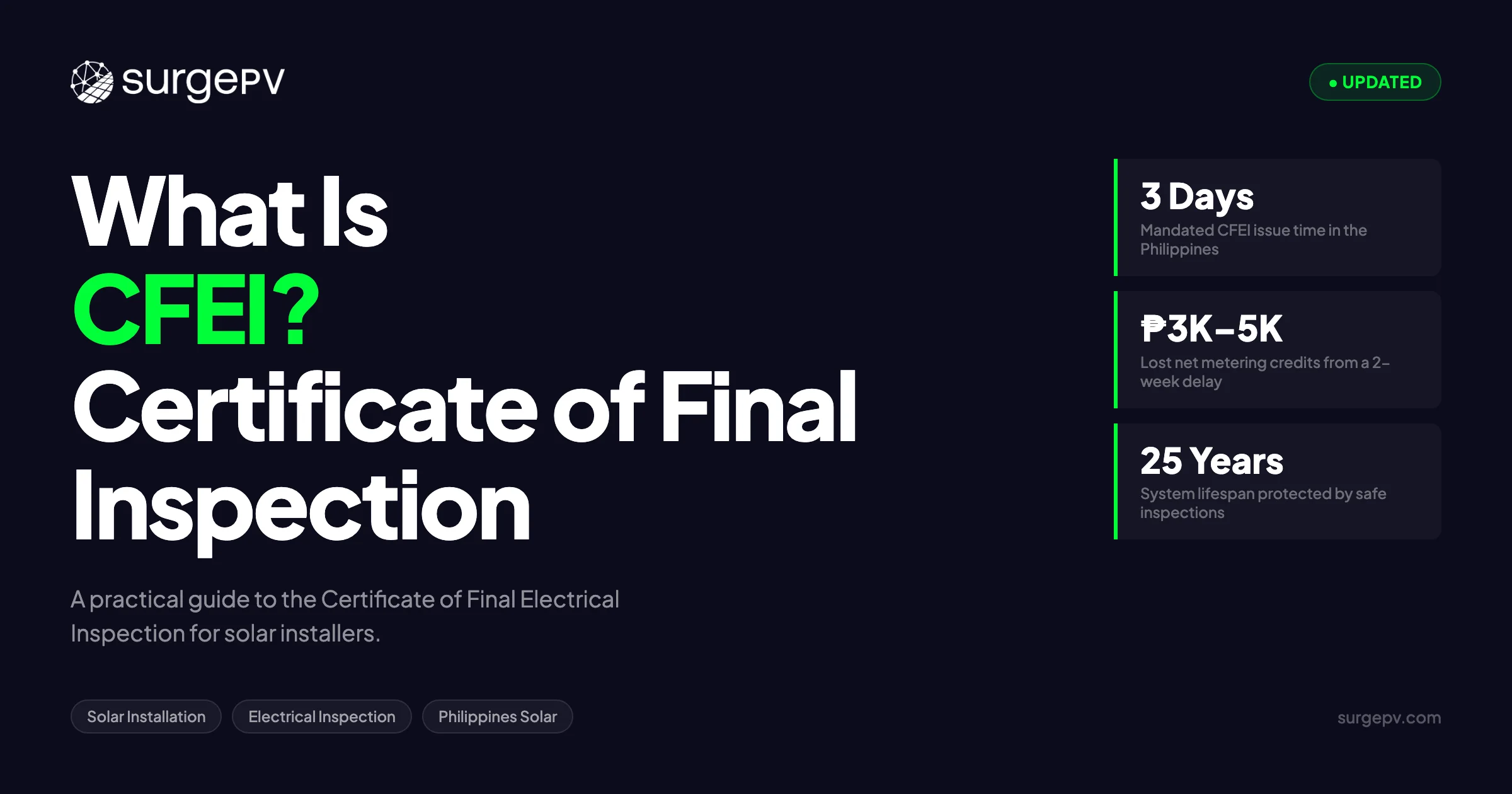
The Department of Energy issued an April 2026 mandate requiring LGUs to issue the CFEI within three working days of the physical inspection. This was a response to long delays that had slowed solar adoption. In practice, the three-day rule helps, but the overall timeline still depends on how quickly the inspection can be scheduled and how complete the application is.
For installers in the Philippines, the CFEI is not just a compliance step. It is the document that unlocks net metering, which is often the financial reason the customer bought solar in the first place. A delayed CFEI means delayed savings, delayed payments, and frustrated customers.
If you are working on a Philippines project, we have a dedicated guide that walks through the city-by-city process, required documents, and escalation steps if an LGU misses the deadline. You can read it here: CFEI Guide Philippines: Certificate of Final Electrical Inspection for Solar.
SurgePV Analysis
The Philippines experience shows why the CFEI should be on the critical path, not the critical path’s afterthought. Projects that treat the LGU inspection as a final formality often lose one to three weeks. Projects that prepare for the inspection during construction usually pass the first time.
The Cost of CFEI Delays
A CFEI delay is rarely just a delay. It triggers downstream costs that are easy to underestimate.
Lost production. Every day the system is not energized is a day of lost savings or revenue. For a 5 kWp residential system in the Philippines, a two-week delay can mean PHP 3,000–5,000 in lost net metering credits, depending on the local retail rate and irradiance.
Re-inspection fees. Some LGUs charge for re-inspections. Even when they do not, the labor cost of returning to site, coordinating with the customer, and waiting for the inspector adds up.
Customer satisfaction. Delays erode trust. Customers who were promised a timeline based on installation completion do not always understand that the authority inspection is outside the installer’s direct control. Clear communication about the CFEI timeline prevents this.
Cash flow. For installers who bill on commissioning, a CFEI delay delays final payment. For projects with financing milestones, it can delay drawdowns.
The cheapest way to handle the CFEI is to pass it the first time.
Practical CFEI Checklist for Installers
Use this checklist before calling for the final inspection. It is not jurisdiction-specific, but it covers the items most authorities will inspect.
Documentation
- Electrical permit issued and on site
- As-built single-line diagram matches the installation
- Bill of materials matches installed equipment
- Certificate of Compliance signed by licensed electrical engineer
- CFEI application form completed
- Progress and completion photos taken
- Grounding and insulation resistance test reports available
Site conditions
- All disconnects installed, labeled, and accessible
- Inverter installed per manufacturer instructions and approved plans
- Grounding and bonding continuous and visible
- Conduit and cabling supported and protected
- Junction boxes accessible and labeled
- Rapid shutdown system functional, where required
- Walkways and access paths clear
- Meter socket and bidirectional meter provision accessible
Final walkthrough
- Compare the installation to the as-built diagram
- Verify every label is present and legible
- Test disconnects and verify open-circuit voltage is safe
- Confirm the customer knows how to operate the disconnects
- Schedule the inspection only after all items are checked
Reduce CFEI Delays with Better Documentation
SurgePV generates as-built single-line diagrams, bill of materials, and project documentation automatically. Book a demo to see how it cuts your inspection prep time.
Book a DemoNo commitment required · 20 minutes · Live project walkthrough
What Most Guides Get Wrong About CFEI
Most CFEI guides treat the certificate as a Philippines-specific net metering requirement. That is only half the story. The CFEI is a universal concept with different names and procedures in different countries.
In the United States, the equivalent is often called the final electrical inspection and is performed by the Authority Having Jurisdiction. In Australia, the Clean Energy Council accredits installers and requires compliance with AS/NZS 5033. In Germany, the electrical installation must comply with VDE standards and is checked by a licensed electrician or the grid operator.
The mistake is thinking that the CFEI is just paperwork. It is a quality gate. Installers who build systems that pass inspection easily are usually the same installers who have fewer warranty claims, fewer callbacks, and stronger customer relationships.
The second mistake is assuming that the inspector will accept verbal explanations. Inspectors work from documents. If the as-built diagram does not match the site, the inspection fails. Documentation discipline is what separates fast approvals from slow ones.
Frequently Asked Questions
What does CFEI stand for?
CFEI stands for Certificate of Final Electrical Inspection. It is an official document issued by a local building or engineering office after a physical inspection confirms that an electrical installation, including solar PV systems, meets the approved plans and applicable electrical code.
Is CFEI required for solar net metering?
Yes. In markets like the Philippines, the CFEI is a mandatory document for net metering applications with distribution utilities such as Meralco. The utility will not process the interconnection request without a valid CFEI.
Who issues the CFEI?
The CFEI is issued by the Local Government Unit’s Office of the Building Official or city/municipal engineering office. The inspection is typically performed by an Electrical Inspector or authorized representative.
How long does it take to get a CFEI?
Timelines vary by LGU. In the Philippines, the DOE April 2026 mandate requires LGUs to issue the CFEI within three working days of the physical inspection. Scheduling the inspection itself can add several days.
What is the difference between an electrical permit and a CFEI?
An electrical permit authorizes the work before construction begins. The CFEI certifies that the completed installation was inspected and complies with the approved plans and electrical code. You need both.
What are the most common CFEI failures?
Common failures include missing disconnect labels, inadequate grounding, exposed or unprotected wiring, inverter installation not matching the as-built diagram, missing overcurrent protection, and inaccessible junction boxes.
Conclusion
The CFEI is the final gate between a completed solar installation and an energized, revenue-producing system. It is not a formality. It is a safety and compliance verification that protects the customer, the utility, and the installer.
To handle the CFEI well:
- Start preparing during the design phase, not after construction
- Keep as-built documentation accurate and complete
- Walk the site with an inspection checklist before calling the authority
- Fix discrepancies before the inspector arrives
- Communicate the CFEI timeline clearly to the customer
Installers who master the CFEI process finish projects faster, get paid sooner, and build a reputation for clean, professional work. That is worth more than any single certificate. The right solar software makes the documentation side of that process far easier to repeat across every project.
Where this fits
This article is part of SurgePV's Solar Installation hub, which works through the topic from first principles to the decisions a project team actually has to make.